| 854929 |
ACC, US Army, nylon, orange white, US, Circa 2001, Early-21st Century |
ACC Patch |
2.5" x 2" |
|
 |
| 650217 |
Aiguilette, Shoulder, Bands & Honor Guards, nylon, medium blue, US, World War II |
Braided medium blue cord which forms a circle |
12 in x 4 in |
.01 oz |
 |
| 428156 |
Antenna (Set), Radio, (with Case), Iraqi Army, Metal, Olive Drab/Black, Iraqi, Circa 1985, Persian Gulf War (Desert Storm) |
2 each 4 section olive drab metal antennae. Each section locks into the other by means of a bayonet type lock. The lower section is covered by a .125" thick black cover 3.56" up from the bottom for 25.62" on one and 3.125" in up from the bottom for 25.93" on the other. Case consists of 2 each 5.25" wide x 45.5" long canvas cases riveted together back to back head to toe with 4 aluminum rivets. Hole in one case. Antennae scratched and chipped. |
12 ft 9 in x .75 in dia |
2 lbs 6 oz |
 |
| 427809 |
Antenna, Radio, Iraqi Army, Metal/Plastic, Sand/Black, UG 21 B/U 82-61, Iraqi, Circa 1985, Persian Gulf War (Desert Storm) |
A flexible metal antenna w/black plastic and metal coupling. Antenna is scuffed and adjustable. One line has been secured by means of a wire. |
42" |
1 lb |
 |
| 243916 |
Ashtray, Souvenir, Force De Stabilisation, Commemorative, Civilian, French Army, Pewter, Gray, French, 1997, Late-20th Century |
Pewter ashtray with a crest in the center. |
4 3/8" dia x 1 1/4" h |
9 oz |
 |
| 838326 |
Ashtray, Souvenir, Nuremburg, Brass, Black, German, World War II |
Ashtray with three slots. Inside painted red. Outside painted black. |
|
|
 |
| 421130 |
Badge (Pair), Marksman's, Collar Target, Blont System, US Army, Sterling Silver, Bright, US, Circa 1895, Late-19th Century |
A pair of marksman collar buttons; design is a target (round concentric circles in black); has a button loop on back. |
.75" x .9" |
.5 oz |
 |
| 421131 |
Badge (Pair), Marksman's, Collar Target, Blont System, US Army, Sterling Silver, Bright, US, Circa 1895, Late-19th Century |
Marksmanship Collar Dogs c1890. A pair of marksman collar buttons; design is a target (round concentric circles in black); has a button loop on back. With issue box. |
.75" x .9" |
.5 oz |
 |
| 428113 |
Badge, Beret, Eagle, Iraqi Army, Metal, Yellow, Iraqi, Circa 1985, Persian Gulf War (Desert Storm) |
A stamped brass Iraqi beret insignia consisting of a standing eagle with drooped wings and head looking over the eagles right shoulder. National shield of Iraq on its breast. Eagle is standing on a .875 in L x .25 in loop with Arabic writing inside. Fastener is wire and loop. Reverse is painted black. |
.03 in x .88 in x 1.19 in |
.5 oz |
 |
| 426000 |
Badge, Beret, Iraqi Army, Metal, Brass, Iraqi, Circa 1990, Persian Gulf War (Desert Storm) |
An Iraqi Army cap badge made of stamped brass in the shape of a standing eagle with drooping wings , having a shield w/3stars on his chest and standing on a ribbon with arabic script thereon. Badge has two flat metal stubs with holes in them soldered to the rear. The stubs are pushed through the fabric and a piece of wire passed between the holes thereby affixing the insignia to the headgear. |
1.38" x .88" |
<1 oz |
 |
| 421108 |
Badge, Breast, Marksman's, Blont System, US Army, Sterling Silver, Bright, US, Circa 1895, Late-19th Century |
Silver colored bar with rounded ends. In the center on the front side is the word Marksman with targets at each end. There is a pin fastener on the rear. |
1.25" x .4" |
.5 oz |
 |
| 421793 |
Badge, Breast, Marksman's, US Army, Sterling Silver, Bright/Black, US, Circa 1940, Mid-20th Century |
Sharpshooter Badge with 3 shingles. Silver. Sword, Pistol-D and Rifle. There is a pin fastener on the rear. |
1.4" x 1" x .15" |
.5 oz |
 |
| 421119 |
Badge, Breast, Sharpshooter's, Blont System, US Army, Sterling Silver, Bright, US, Circa 1900, Early-20th Century |
A bar with rounded edges with the word Sharpshooter in the center and targets on each end. There is a pin fastener on the rear. Suspended from a loop at the lower center of the bar is a pendent in the shape of a Maltese cross with a target in the center (concentric circles). The edges of the cross and the rings of the target are raised and smooth. |
1.75" x 1.75" |
.25 oz |
 |
| 422683 |
Badge, Cap, 5th Cavalry, D Troop, Enlisted, US Army, BRASS, Bright, P1872, US, Circa 1890, Late-19th Century |
Stamped brass cavalry insignia (crossed saber), with the number 5 soldered in the top angle and the letter D soldered in the lower angle. Wire fasteners on the rear. |
2.25" X 1.25" X .25" |
.25 oz |
 |
| 614406 |
Badge, Cap, Airborne, Enlisted, US Army, Cloth, Blue/White/Red, US, Circa 1943, World War II |
Badge |
2.15" diameter |
2 g |
 |
| 428388 |
Badge, Cap, Artillery, Enlisted, US Army, Metal, Yellow, US, Circa 1897, Late-19th Century |
A pair of crossed 2 1/8"L cast yellow metal cannon with a screw-post fastener. There are 2 needle points, one on each cannon(both bent all the way in)to keep the insignia from rotating. This specimen appears to have been gilded . |
1.88 in x 1.13 in |
.5 oz |
 |
| 428389 |
Badge, Cap, Artillery, Enlisted, US Army, Metal, Yellow, US, Circa 1897, Late-19th Century |
A pair of crossed 1 29/32"L cast yellow metal cannon with a screw-post fastener with a bent 1/4" pivot on back of right upper cannon barrel(to keep insignia from turning).Marks on the underside of cannon show that at one time there was a number or numbers soldered to the specimen. |
1.75 in x 1.68 in |
1 oz |
 |
| 421120 |
Badge, Cap, Bandsman's, Enlisted, US Army, Brass, Bright, US, Circa 1890, Late-19th Century |
A stamped brass lyre with the number 10 applied to the front. |
.9" x 1.12" |
.12 oz |
 |
| 421122 |
Badge, Cap, Bandsman's, Enlisted, US Army, German Silver, Bright, P1896, US, Circa 1900, Early-20th Century |
A die stamped German silver bandsman's cap badge (silver lyer) with a screw-post and nut fastener on the rear. |
.9" x 1.5" |
.12 oz |
 |
| 421107 |
Badge, Cap, Bandsman's, US Army, Brass, Bright, US, Circa 1885, Late-19th Century |
A die stamped bright brass bandman's cap insignia (a four string lyer). |
.9" x 1.12" |
.25 oz |
 |
| 426514 |
Badge, Cap, Infantry, Enlisted, US Army, Metal, Gold, US, Circa 1874, Late-19th Century |
Enlisted mans cap insignia, stamped metal, crossed muskets with loops on the reverse to sew into the cap. |
2.41 in |
.01 oz |
 |
| 421863 |
Badge, Cap, Infantry, Officer's, US Army, Wool/BullionThread, Black/Gold, US, Circa 1862, Civil War |
Hunting Horn, Inf Insignia, Bullion. A hand embroidered bullion thread infantry insignia (Hunting Horn) on a black wool backing cloth. |
4" x 2.5" |
.5 oz |
 |
| 421862 |
Badge, Cap, Infantry, Officer's, US Army, Wool/Metallic Thread, Black/Gold, P1875, US, Circa 1878, Late-19th Century |
A bullion embroidered infantry insignia (crossed muskets) on a black wool backing cloth. |
2.25" x 1.75" |
.25 oz |
 |
| 427896 |
Badge, Cap, Officer's, Man's, US Army, Brass, Bright, US, Circa 1944, World War II |
A 1936 pattern officers eagle hat badge of heavy brass with a screw back fastener and a .25 in prong on the tip of each wing to keep it from turning on the cap. |
.02" x 2.5" x 2.75" |
2 oz |
 |
| 421872 |
Badge, Cap, Ordnance, Officer's, US Army, Wool/Metallic Thread, Blue/Bright, US, Circa 1875, Late-19th Century |
Oval hand embroidered bullion thread "OD" script with bullion oakleaves. A black backing cloth. |
3" x 1.75" |
.25 oz |
 |
| 421864 |
Badge, Cap, Staff Wreath, Officer's, US Army, Bullion Embroidered/Wool, Gold/Blue, US, Circa 1839, Mid-19th Century |
An embroidered wreath on dark blue backing cloth. |
2.9" x 1.9" |
.25 oz |
 |
| 421866 |
Badge, Cap, US Army, Wool/Metallic Thread, Black/Gold, US, 1880, Late-19th Century |
axe facine sword in gold embroidery on blk felt |
2.25" x 1.6" |
.12 oz |
 |
| 421215 |
Badge, Cap, Us Coat Of Arms, Officer's, US Army, brass, Bright, US, Circa 1940, World War II |
A bright gilded brass die stamped US Coat of Arms (eagle with wings extended) with a screwpost fastener on the rear. |
2" x 2" |
.5 oz |
 |
| 854934 |
Badge, Civilian Employee, Civilian, US Army, tin, yellow blk, US, Circa 1943, Mid-20th Century |
Button for Civilian worker FTH. pinback |
2.5" |
|
 |
| 844297 |
Badge, Collar, Infantry, Officer's, Metal, Subdued, US, Late-20th Century |
Sealed in original packaging a pair of collar infantry badges for officers. |
|
|
 |
| 844298 |
Badge, Collar, Infantry, Officer's, Metal, Subdued, US, Late-20th Century |
Sealed in orginal packaging of collar badges infantry for officers. |
|
|
 |
| 427148 |
Badge, Collar, Mg Infantry, Officer's, US Army, Brass, Bright, M1918, US, Circa 1918, World War I |
Standard pattern M1918 infantry officers machine gun unit collar insignia. Hinged pin & fastening device. |
1.13 in x.63 in |
1 oz |
 |
| 426836 |
Badge, Commemorative, 21st Reunion, Ist Infantry Division, Civilian, Cloth/Medal, Gold, US, 1940, World War II |
A commemorative badge with button and name tage. In the center is the Big Red One on on a gold colored backing. On the reverse is straight pin locking device; the words printed in blue ink, Universal Badge Co., 3 school St., Boston, Mass. |
4.25 in x 2.38 in |
.2 oz |
 |
| 421726 |
Badge, Commerative, American Expeditionary Force, US Army, Brass/Enamel, Red/Yellow/Blue, US, Circa 1917, World War I |
AEF Badge, Veteran. Circular small badge. pinback. red center. With "AEF" and a srvice chevron. |
.6" x .12" |
.12 oz |
 |
| 422795 |
Badge, Expert Marksman's, (with Bayonet, & Rifle Bars), US Army, STERLING SILVER, Bright, US, Circa 1942, World War II |
A sterling silver expert marksman's badge consisting of a Maltese cross in a laurel wreath; Badge has a pin fastener on the rear. Attached to the bottom of the cross by a pair of loops and rings is a qualification bar with the word Bayonet in silver on a blackened background with a raised silver edge; another with Rifle. |
2.25" x 1.12" |
.5 oz |
 |
| 422794 |
Badge, Expert Marksman's, (with Bayonet, Field Artillery, & Rifle Bars), US Army, Sterling Silver, Bright, US, Circa 1942, World War II |
A sterling silver expert marksman's badge consisting of a Maltese cross in a laurel wreath; Badge has a pin fastener on the rear. Attached to the bottom of the cross by a pair of loops and rings is a qualification bar with the word Bayonet in silver on a blackened background with a raised silver edge; another with Field Artillery, and a third with Rifle. |
2.6" x 1.25" |
.5 oz |
 |
| 422793 |
Badge, Expert Marksman's, Pistol, US Army, Sterling Silver, Bright/Black, US, Circa 1920, Early-20th Century |
A bar with rounded edges with the words Expert Pistol in the center and targets on each end. There is a pin fastener on the rear. Suspended from a loop at the lower center of the bar is a pendent in the shape of two crossed automatic pistols with a wreath around the outside. |
1.5" X 1.25" |
.33 oz |
 |
| 426126 |
Badge, Expert Marksman's, US Army, Metal, Tarnished Silver, US, Circa 1917, World War I |
A World War One era expert rifleman's badge consisting of a 1/4" x 2" bar with the words "Expert Rifleman". Suspended from this by two wire loops (one has been replaced with thread) an olive wreath with a pair of 1 3/4" long crossed '03 Springfield rifles over the wreath. Pin fastener on back of bar. |
2" x 1.63" |
.5 oz |
 |
| 422995 |
Badge, Irvin Parachutes, Civilian, British Royal Air Force, Brass/Enamel, Bright/Blue/White, British, Circa 1948, Mid-20th Century |
Badge, Irvin Parachute Company |
1" X .75" X .25" |
.12 oz |
 |
| 421357 |
Badge, Marksman's, (with Rifle & Pistol Bars), US Army, Sterling Silver, Bright/Gray, US, Circa 1950, Mid-20th Century |
Badge, Marksman. 2 shingles. Sterling silver Maltese cross marksman's badge; smooth raised edge with a blackened center. Badge has a pin fastener on the rear. Attached to the bottom of the cross by a pair of loops and rings is a qualification bar with the word Rifle in silver on a blackened background with a raised silver edge, and a second with the word Pistol. |
2" x 1" |
.25 oz |
 |
| 421118 |
Badge, Marksman's, Collar Target, Blont System, US Army, Sterling Silver, Bright, US, Circa 1895, Late-19th Century |
Marksman collar button, design is a target(round concentric circles in black); has a button loop on back. |
.75" x .9" |
.25 oz |
 |
| 426756 |
Badge, Marksman's, Russian Marksman's Third Class, metal, Multicolor, Soviet, Circa 1990, Late-20th Century |
Russian weapons qualification badge 3rd class. The badge has gold colored trim with gold colored leaves on the top left and right, and the bottom of the badge. The top center of the badge has the Soviet red star with the hammer and sickle in gold color. the center of the badge has a back ground of dark blue with a large white colored number three. The back of the badge is gold colored with a spring-pin locking device. The badge is of an arrowhead configuration. |
1.25 in x 1.75 in |
.5 oz |
 |
| 426110 |
Badge, Musician, Enlisted, US Army, Wool, Blue/White, US, Circa 1900, Early-20th Century |
A musicians patch consisting of a rectangle of dark blue cloth with a white 2 3/4"L x 1 3/8"H hunting horn embroidered into the center of it. Patch has been used as there are remnants of black sewing thread on the edges. |
3.63 in x 2.25 in |
<1 oz |
 |
| 428437 |
Badge, Musician, Enlisted, US Army, Wool, Blue/White, US, Circa 1900, Early-20th Century |
A musicians patch consisting of a rectangle of dark blue cloth with a white 2 3/4"L x 1 3/8"H hunting horn embroidered into the center of it. Patch has been used as there are remnants of black sewing thread on the edges. |
3.75 in x 2.25 in |
<1 oz |
 |
| 422796 |
Badge, Sharpshooter's, (with Rifle, Pistol, Mg, & Auto Rifle Bars), US Army, Sterling Silver, Bright/Gray, US, Circa 1942, World War II |
A sterling silver sharpshooter's badge; A Maltese cross with a target in the center (concentric circles) with a smooth raised edge with a blackened center. Badge has a pin fastener on the rear. Attached to the bottom of the cross by a pair of loops and rings is are qualification bars with the words Rifle, Pistol, Machine Gun, & Auto Rifle in silver on a blackened background with a raised silver edge. |
2.75" X 1" |
.66 oz |
 |
| 422976 |
Badge, Sharpshooter's, US Army, Sterling Silver, Bright/Gray, US, Circa 1895, Early-20th Century |
A bar with rounded edges with the word Sharpshooter in the center and targets on each end. There is a pin fastener on the rear. Suspended from a loop at the lower center of the bar is a pendent in the shape of a Maltese cross with a target in the center (concentric circles). The edges of the cross and the rings of the target are raised and smooth. |
1.9" x 1.75" x .25" |
.5 oz |
 |
| 422792 |
Badge, Sharpshooter's, US Army, Sterling Silver, Bright/Gray, US, Circa 1895, Late-19th Century |
A bar with rounded edges with the word "Sharpshooter" in the center. There is a pin fastener on the rear. Suspended from a loop at the lower center of the bar is a pendent in the shape of a Maltese cross with a target in the center (concentric circles). The edges of the cross and the rings of the target are raised and smooth. |
1.75" X 1.75" |
.5 oz |
 |
| 614376 |
Badge, Sleeve, Armament Specialist, U.S. Army Air Force, Cloth, Blue/Gold, US, Circa 1943, World War II |
Badge |
2.5" per side |
3 g |
 |
| 513618 |
Badge, Sleeve, Chief Boatswains Mate, US Navy, Wool Felt, Blue/Red/White, US, Circa 1940, Mid-20th Century |
Standard pattern navy sleeve badge for a Chief Petty Officer (Boatswain's Mate) winter uniform. Consists of three red chevrons and a rocker on dark blue felt. There is an eagle perched on the rocker and a pair of crossed anchors inside the rocker and the top chevron. Used. |
|
|
 |
| 614378 |
Badge, Sleeve, Communications Specialist, U.S. Army Air Force, Cloth, Blue/Gold, US, Circa 1943, World War II |
Badge |
2.5" per side |
2 g |
 |
| 614379 |
Badge, Sleeve, Engineering Specialist, U.S. Army Air Force, Cloth, Blue/Gold, US, Circa 1943, World War II |
Badge |
2.5" per side |
3 g |
 |
| 614374 |
Badge, Sleeve, Photography Specialist, Enlisted, U.S. Army Air Force, Cloth, Blue/Gold, US, Circa 1943, World War II |
Badge |
1.5" per side |
2 g |
 |
| 421951 |
Badge, Sleeve, Signal Corps, Enlisted, US Army, WOOL, Olive Drab/Brown, US, Circa 1917, World War I |
PFC SigC WW1. Wool Signal Corps insignia woven on OD background. |
2.75" |
.1 oz |
 |
| 421177 |
Badge, Sleeve, Signal Corps, US Army, WOOL, Olive Drab/Brown, US, Circa 1917, World War I |
PFC SigC WW1. Olive drab Signal Corps shoulder patch for winter uniform with brown embroidered Signal Corps embelem. |
2.7" dia |
.12 oz |
 |
| 614375 |
Badge, Sleeve, Weather Specialist, U.S. Army Air Force, Cloth, Blue/Gold, US, Circa 1943, World War II |
Badge |
2.5" per side |
2 g |
 |
| 426757 |
Badge, Sports, 2nd Class, Russian Army, metal, Multicolor, Russian, Circa 1990, Late-20th Century |
A Russian military sportsmanship badge 2nd class. The badge consists of a gold colored star with an inner boarder of white with a small gold colored star on top, three dots on each side with Russian scrip on the bottom. The center of the badge has a green background with a gold colored running figure, on the left is a leaf. The back is gold colored with a screw post and a silver colored round retainer. |
1 in x 1 in |
.25 oz |
 |
| 421870 |
Badge, Turn-back, Infantry Coatee, Officer's, US Army, Wool/BullionThread, Black/Gold, P1832, US, Circa 1845, Mid-19th Century |
A hand embroidered gold bullion infantry officer's coat tail insignia (hunting horn). |
2.75" x 2.12" |
.12 oz |
 |
| 421871 |
Badge, Turn-back, Infantry Coatee, Officer's, US Army, Wool/Matalic Thread, Black/Silver, P1832, US, Circa 1845, Mexican War |
An infantry dress coatee turnback badge consisting opf a silver hunting horn embroidered on wool backing cloth. |
2.75" x 2.12" |
.12 oz |
 |
| 421273 |
Bag (Set), Doctor's, (with Contents), US Army, Leather, Black, US, Circa 1885, Late-19th Century |
Kit, test-tube medical. A black leather medical bag with a center section of leather covered wood and metal brackets to hold 11 glass tubes on each side; front and back sections hold 13 tubes. One tube has small shot, 2 have bicarbonate, the remainder are filled with various unknown substances. |
10.25" x 4" x 4.75" |
2 lbs 14oz |
 |
| 422912 |
Bag, Barracks, US Army, Cotton HBT, BLUE, US, Circa 1943, World War II |
Blue denim duffel bag with brass gromets and white cotton cord. Material has been much laundered, is soft and has some holes. |
15" x 23" |
1 lb |
 |
| 422135 |
Bag, Dispatch, US Army, Leather, brown, US, Circa 1910, Early-20th Century |
Dispatch case, Saddlebag, Haversack. Brn Leather |
13" x 13" |
2 LBS 9 OZ |
 |
| 427670 |
Bag, Ditty, US Army, Cloth, Red, US, Circa 1968, Vietnam Era |
A red cloth bag with green draw string. Slightly soiled lower left corner. |
14.25 in x 13.5 in |
2 oz |
 |
| 427088 |
Bag, Ditty, US Army, COTTON, KHAKI/RED/WHITE, US, Circa 1918, World War I |
A cotton bag with 2 each 4" x 5" pockets sewn to the inside. There is a pink soft cotton cloth for stowing needles sewn to one pocket. Drawstring closure. A 7/8" 1 1/8" patch with a 3/4" x 1" Red Cross sewn to the outside. |
9 in x 9 in |
1 oz |
 |
| 426930 |
Bag, Ditty, US Army, Cotton, OD, US, World War I |
Small OD ditty bag with stains |
|
|
 |
| 426931 |
Bag, Ditty, US Army, Cotton, OD, US, World War I |
4 pocket ditty bag, stained and looks home-made. |
14" x 8.25" |
|
 |
| 426932 |
Bag, Ditty, US Army, Cotton, Tan/Brown, US, World War I |
12-pocket personal roll-up ditty bag, home-made bag. |
32.25" x 19.75" |
|
 |
| 426431 |
Bag, Duffel, Iraqi Army, Nylon, Olive Drab, Iraqi, Circa 1985, Persian Gulf War (Desert Storm) |
Duffle bag with over the shoulder strap and side handle. Bag is dirty, worn and has holes in it. |
|
|
 |
| 837082 |
Bag, Duffel, US Army, Cotton Canvas, Olive Drab, US, Mid-20th Century |
A large, long, canvas bag with a round bottom and an open top with four large metal grommets which stack over a metal loop to close the bag. The bag also has a carrying handle and (a) shoulder strap(s) attached to the side of the bag. |
|
|
 |
| 858181 |
Bag, Duffel, US Army, Cotton Canvas, Olive Green, US, Late-20th Century |
A large, long, canvas bag with a round bottom and an open top with four large metal grommets which stack over a metal loop to close the bag. The bag also has a carrying handle and (a) shoulder strap(s) attached to the side of the bag. |
|
|
 |
| 421886 |
Bag, Field, Officer's, US Army, Canvas/Leather, Olive Drab/Brown, US, Circa 1918, World War I |
Mussette, leather bottomed. Canvas field bag with leather bottom section and leather buckle strap, camvas shoulder strap. |
12.5" x 14" |
16 oz |
 |
| 858174 |
Bag, Laundry, Cotton, OD, US, Late-20th Century |
Standard heavy cotton laundry bag with draw string closure. |
|
|
 |
| 832408 |
Bag, Rice Flour, General Mills Inc., Cotton, Tan, US, Vietnam Era |
Tan rice flour bag. Dirty and hole in the backside of bag. |
|
|
 |
| 446150 |
Bag, US Army, Cotton Canvas, Olive Drab, B-4, US, Mid-20th Century |
Garment bag with leather handle. On both sides marked with name and service number. |
22" X 18" |
9 lbs |
 |
| 858176 |
Bag, Waterproof, Clothing, Rubber/Nylon, OD Green, US, Late-20th Century |
Large waterproof clothing bag with chord tie closure. |
|
|
 |
| 567559 |
Band, Dental, Box, Paper/copper, Brown/copper/black, US, Mid-20th Century |
Cardboard box divided into 20 compartments. Each compartment is numbered on the bottom 1-20. There are 40 band pieces inside. On outside of box is nomenclature, size, and amount of bands when new. Whis was 100. Also on outside of box is a chart showing sizes of bands with corresponding numbers of the compartments inside of box. |
4.625" x 6.625" x 1.125 |
3oz |
 |
| 578624 |
Bandoleer, Cavalry, US Army, Cotton Canvas, Olive Drab, M1912, .30 Caliber, US, 1917, Early-20th Century |
Cavalry Bandolier c1917 webelt with three small (4" x 1.5") pockets arranged horizontally in the center, with flaps secured by snap fasteners. To each side there are six pockets (2.5" x 4") with flaps secured by lift-the-dot fasteners. The bandolier is fastened with an 11.5" woven cotton web strap with a metal tip, that secures to a bronze doubl bar frame buckle. |
43" x 4" |
|
 |
| 650198 |
Banner, 1st Division, Civilian, Fabric, Red, US, 1986, Late-20th Century |
A small tied quilt with the 1st Infantry Division coat of arms at the center. It has a wide red border with a white rectangle on which the green shield and red "1" appear. Reverse is red with white plastic hoops for hanging. |
25 in x 24 in |
|
 |
| 513656 |
Banner, Commemorative, Orenburg Province, Civilian, Fabric, Multicolored, Russian, Circa 1995, Late-20th Century |
A 5 sided window hanging white in color with a grey edging and having 2 red & yellow diagonal bars. In the upper left hand corner are 2 Lenin Badges. Written on a grey bar across the lower half is "Orenburg Province"(In russian). On the reverse is a blue torch with a head of wheat on each side of it. |
|
ounce |
 |
| 513655 |
Banner, Commemorative, Russian Army, Fabric, Red/White/Blue, Russian, Circa 1995, Late-20th Century |
A five sided window hanging with a red border and twined red/white/blue edging. The center is white having there on a Shield with the Russian colors, below that a blue section with the words "Armed Forces Russian Federation"(In Cyrillic) and below that a melange of weapons. Reverse side is blank excepting for 3 lines of Cyrillic print. |
|
ounce |
 |
| 467990 |
Banner, Welcome Home, Operation Desert Storm, Civilian, AMVETS, Nylon, White/Red/Yellow, US, 1991, Persian Gulf War (Desert Storm) |
AMVETS flag with a yellow ribbon and bow running through the middle from the leading edge to the fly edge. Flag has a white field. The top has a red inscription "OPERATION DESERT STORM WE SUPPORT OUR TROOPS". Bottom reads "WELCOME HOME". Leading edge has AMVET crest in the upper corner and two grommets for halliard. Reverse of the flag is blank, but the design on the obverse shows through. |
58"x 34 1/4" |
160 grams |
 |
| 427727 |
Basket, Vietnamese, Winnowing, Civilian, Bamboo, Natural, Vietnamese, Circa 1970, Vietnam Era |
A flat, oval shaped, woven bamboo strip basket with lip. An agricultural implement used for winnowing grain. |
28.5" dia x 1" |
2 lbs 1 oz |
 |
| 428183 |
Baton, Miniature, Iraqi Army, Wood, Brown, Iraqi, Circa 1990, Persian Gulf War (Desert Storm) |
A turned wood swagger-stick(baton) made of 2 pieces of wood glued together and turned on a lathe. In appearance looks more like a chair leg. Dented scratched and chipped. Varnished surface(10% gone). Nail pounded into each end. |
24 in x 1.38 in dia |
9 oz |
 |
| 426257 |
Baton, Miniature, US Army, Wood, Black/Brown, US, Circa 1920, Early-20th Century |
A plain hardwood officer's baton (swaggerstick). Made of a very hard wood, charred at the tip, black in color with brown stripes. No markings. |
25.38 in x .5 in dia |
2 oz |
 |
| 495957 |
Baton, Miniature, US Army, Wood, Black/Silver, US, Circa 1920, Early-20th Century |
A plain hardwood officer's baton(swaggerstick). Made of a very hard wood, 2 in silver tip, black in color with 2.375 in silver head. |
24.25 in x .69 in dia |
2 oz |
 |
| 609675 |
Bayonet, Knife, (with Scabbard), Iraqi Army, Steel/Plastic, Bright/Brown, (AKM), Soviet, Circa 1980, Persian Gulf War (Desert Storm), SN: 5172 |
Bayonet attached to AK-47 (1ID2588). Scabbard is metal with wrap around rubber molding. Clip and leather attachment. |
10.75" oal |
1 lb |
 |
| 428200 |
Bayonet, Knife, Iraqi Army, Steel/Rubber, Black/Gray, (AKM), Iraqi, Circa 1985, Persian Gulf War (Desert Storm), SN: 8884 |
A standard pattern Soviet made AKM bayonet with insulated synthetic handle, 5.75in long x 1.125in wide blade with serrated back edge, wire cutter hole and one sided edge. Strap is missing from handle. |
10.75" x 2.56" x 1.56" |
10 oz |
 |
| 426371 |
Bayonet, Knife, US Army, Steel/Plastic, Black, M1905E1, US, Circa 1942, World War II, SN: 374606 |
A standard pattern M1905E1 bayonet for the M-1 rifle. The M1905E1 was a shortened and refinished M1905. This specimen has black plastic handles and the blade has been ground in a curve to a point at the back of the blade. Plastic handle dented and gouged. |
14.56" x 3.44" x 1" |
1 lb 4 oz |
 |
| 468142 |
Bayonet, Spike, (mounted On Plaque), US Army, Steel, Bright, French, 1992, Late-20th Century |
A 25 1/6" long French bayonet with a brass handle and a 20 3/8" long 4 corner blade. Barrel catch is located at hilt of end of handle. The whole is mounted on 31 1/2" x 8" padded and red cloth covered wooden base. |
25 1/16" x 3 1/16" x 3/4" |
3 lb 14 oz |
 |
| 421274 |
Bell, US Army, Metal, Bronze, US, Circa 1890, Late-19th Century |
Bell, Camel. Tarnished bronze camel bell with cast Army coat-of-arms design; large crack on one side which has a poorly attempted repair; the clapper is missing. |
4" x 4.4" dia |
1lb 10.5oz |
 |
| 422132 |
Belt, Cartridge, Civilian, LEATHER, Brown, US, Circa 1912, Early-20th Century |
A brown leather cartridge belt without buckles or belt tip, holders for 35 cartridges; stitching on upper edge has come apart and bottom outside section has a 10.5" cut or break in the leather. Leather is somewhat supple. |
32" x 2.75" |
6 OZ |
 |
| 423006 |
Belt, Cartridge, Dismounted, US Army, Cotton Canvas, Olive Drab, M1923, .30 Caliber, US, Circa 1942, World War II |
CartridgeBelt M1910. khaki ten pocket LTD. |
35" x 4" x 1.5" |
1 lb 8.5oz |
 |
| 421407 |
Belt, Cartridge, Dismounted, US Army, Cotton Canvas, Olive Drab, M1923, .30 Caliber, US, Circa 1943, World War II |
10 Pkt Cartridgebelt c1944 dk grn |
75 cm x 12 cm x 3 cm |
1 LB 8 OZ |
 |
| 421471 |
Belt, Cartridge, Infantry, US Army, Cotton Web, Olive Drab, P1903, .30 caliber, US, Circa 1910, Early-20th Century |
Cartridgebelt, 8 pkt woven M1902. Cotton canvas belt, with a blackened brass tongue and keeper. The belt has eight cartridge pouches. |
45 x 3.5" |
15.5 oz |
 |
| 421416 |
Belt, Cartridge, Infantry, US Army, Cotton Web, Olive Drab, P1907, .30 Caliber, US, Circa 1942, World War II |
CartridgeBelt, 10 pkt OD c1944 |
|
10oz |
 |
| 422031 |
Belt, Cartridge, Shotgun, Civilian, leather, brown, US, Circa 1930, Mid-20th Century |
CartridgeBelt, Sam Browne modified. 10 loop Brn leather belt (44" X 2.25", Sam Browne pattern) to which has been added ten cartridge loops for shotgun shells. |
|
1 lb 4 oz |
 |
| 822617 |
Belt, Cartridge, Single Loop, US Army, Cotton Web, Dark Blue, P1894, .30 Caliber, US, Circa 1890, Late-19th Century |
Prariebelt, M1884 Whittemore Dk blue with "US" H buckle |
|
|
 |
| 421838 |
Belt, Cartridge, Single Loop, US Army, Cotton Web, Dark Blue, P1894, .30 Caliber, US, Circa 1895, Late-19th Century |
Belt, Mills c1896. 45 Dk blue woven cotton canvas cartridge belt. No buckle |
45 X 3 |
19 OZ |
 |
| 421321 |
Belt, Cartridge, Single Loop, US Army, Cotton Web, Dark Blue, P1894, .45 Caliber, US, Circa 1895, Late-19th Century |
Belt, web c1890 dk blue cotton web cartridge belt with loops for 45 rounds of .45 caliber rifle ammunition. On one side there is a brass keeper, on the other is a stamped brass H-style plate with a recessed oval with raised letters US in the center. |
35" x 3" |
14 OZ |
 |
| 421904 |
Belt, Cartridge, Single Loop, US Army, Cotton Web, Drab, P1898, .45 Caliber, US, Circa 1898, Late-19th Century |
Prariebelt. c1890. A drab cotton web cartridge belt with three horizontal blue lines in the material. The belt has loops for 45 rounds of .45 caliber rifle ammunition. The ends of the belt are reinforced with brass tips and wire keepers. The belt has a heavy brass wire C-style double hook closure in front. |
40" x 2.75" |
12 OZ |
 |
| 421314 |
Belt, Cartridge, US Army, Cotton Web, Khaki, M1915, US, Circa 1915, World War I |
PistolBelt, M1917 w/2 pouches. |
|
10.25 oz |
 |
| 422667 |
Belt, Dress, Enlisted, US Army, Cotton, Blue/Yellow, US, Circa 1980, Late-20th Century |
Belt, Dress EM. Blue cotton belt with yellow cotton edging and brass buckle with an applied US Coat of Arms insignia. |
42" X 1.75" |
8 oz |
 |
| 421660 |
Belt, Dress, Sword, Cavalry, Officer's, US Army, Leather, Gold/Yellow/Blue, P1902, US, Circa 1920, Early-20th Century |
A cavalry officer's dress belt lined in blue wool (on leather) with gold and yellow matalic lace on the front (three rows of gold separated with yellow - the cavalry branch color). The belt has a wire catch stitched to one end. The other end passes through the loop on the belt plate, folds back and is secured by a leather and lace keeper. The belt plate is a cast brass rectangular plate with the Arms of the United States (aneagle with spread wings) and a wreath. The reverse of the plate has a wide L-shaped tongue. On the left side of the belt on the bottom is a brass loop with P-1902 saber straps attached made in the same manner as the belt with gold matalic lace on the outside of the straps. |
. |
12.5 oz |
 |
| 421139 |
Belt, Equipment, Hagner, (with Belt Plate), US Army, Leather, Black, P1874, US, Circa 1880, Late-19th Century |
Belt, c1872, w/US buckle. Blk leather belt with a cast brass catched stitched and rivited to one end. The other end of the belt loops through a brass buckle folds back through a leather keeper and is secured by a brass hook into one of a series of holes in the center of the belt. The belt plate is rectangular cast brass with a raised edge, a raised oval in the center and the letters US in the oval. |
39.5" x 1.75" |
9 oz |
 |
| 422721 |
Belt, Equipment, Individual, US Army, Cotton Web, Olive Green, LC-1, Large, US, Circa 1985, Late-20th Century |
Pistolbelt, c1985 Dk OD nylon web belt with two rows of gromets evenly spaced along the top and bottom. The belt is adjustable on both ends with black metal keepers. The buckle is gray plastic with the two halves snapping together. |
|
13 oz |
 |
| 422709 |
Belt, Equipment, Individual, US Army, Cotton Web, Olive Green, LC-1, US, Circa 1985, Late-20th Century |
Belt, pistol. Dk grn nylon web w/plastic buckle. 2 rows of gromets evenly spaced along the top and bottom. The belt is adjustable on both ends with black metal keepers. The buckle is gray plastic with the two halves snapping together. |
60" x 2.25" |
13.5 oz |
 |
| 858201 |
Belt, Equipment, Individual, US Army, Nylon, Olive Drab, M1967, Medium, US, Late-20th Century |
Typical nylon web equipment belt. |
|
|
 |
| 421648 |
Belt, Garrison, US Army, Leather, Russet, P1902, US, Circa 1940, World War II |
A russet leather belt with tapered at one end with five holes in a row evenly spaced in the center of the belt. There is a brass frame single-prong buckle on the other end. The belt has a leather keeper and the end of the belt has snaps for removing the buckle. |
41" x 1.75" |
5.75 oz |
 |
| 426440 |
Belt, Iraqi Army, Leather, Brown, Iraqi, Persian Gulf War (Desert Storm) |
Worn, brown leather belt with silver buckle. |
|
|
 |
| 854882 |
Belt, Officer's, US Army, Leather, brown, M1921, US, Circa 1940, Mid-20th Century |
Sam Browne, US with brass buckle, sword chain & safe. No shoulderstrap. |
|
|
 |
| 421410 |
Belt, Pistol Or Revolver, US Army, Cotton Web, Olive Drab, M1936, US, Circa 1943, World War II |
PistolBelt. Steel buckle and fittings. Canvas Dbl 45 pouch. |
|
11 OZ |
 |
| 470770 |
Belt, Pistol Or Revolver, US Army, Cotton Web, Olive Drab, M1936, US, Circa 1945, World War II |
PistolBelt. Grn modified parade with shiny brass. |
36" x 2.25" |
10.5 oz |
 |
| 422415 |
Belt, Sam Browne, Officer's, US Army, Leather, Russet, M1921, 40, US, Circa 1935, Mid-20th Century |
Belt, Sam Browne. c1930. Russet leather belt with brass D-rings attached. The belt has an adjustable brown leather shoulder strap attached to the upper d-rings. Attached to the belt is a brown leather safe. |
. |
13.5 oz |
 |
| 421938 |
Belt, Sam Browne, Sam Browne, Officer's, US Army, Leather, Russet, M1921, US, Circa 1922, Early-20th Century |
Sam Browne. Belt, brn leather with brass D-rings attached. The belt has an adjustable brown leather shoulder strap attached to the upper d-rings. The belt has a removable brass double-pronged frame buckle. |
42" x 2.125" |
15 OZ |
 |
| 422668 |
Belt, Sam Browne, Sword Sling, Officer's, US Army, Leather, Black, US, Circa 1980, Late-20th Century |
Clip, Saber. Blk leather belt safe with a slot in the front through which a metal loop fits. Attached to the loop is a chrome plated chain with hook at the end to attached to the scabbard ring. |
12" X .75" |
4.5 oz |
 |
| 421263 |
Belt, Sword, Hagner (with Belt Plate), US Army, Leather, Black, US, Circa 1890, Late-19th Century |
Belt, Garrison c1880. Blk leather with a cast brass catch stitched and rivited to one end. The other end of the belt loops through a brass buckle, folds back through a leather keeper, and is secured by a brass hook into one of a series of holes in the center of the belt. The belt plate is rectangular cast brass "US". Attached to the left side of the belt is a brass keeper (2.4" x 3.12"), with two leather saber straps(.75" x 12" and .75" x 26.5"). |
|
13.5 oz |
 |
| 858235 |
Belt, Trousers, Enlisted, US Army, Cotton Web, Light Khaki, US, World War II |
Cotton web belt, light khaki color with brass tip. Attached to slide buckle (1ID5314). |
|
|
 |
| 427819 |
Belt, Waist, (frame Field Buckle), US Army, Cotton Web, Drab, M1904, US, Circa 1917, World War I |
A 1.125 in wide OD web belt with a dark metal buckle and a frayed tip. |
35" x 1.13" |
4 oz |
 |
| 427731 |
Belt, Waist, (with Service Buckle), US Army, Cotton Web, Black, P1957, US, Circa 1965, Vietnam Era |
A black web service belt faded to dark blue, with a 1.25 in x .5 in metal tip and a brass buckle. |
40.5" x 1.25" |
3 oz |
 |
| 421157 |
Belt, Waist, (with Service Buckle), US Army, Cotton Web, Khaki, M1937, US, Circa 1940, World War II |
A faded khaki cotton web belt with a brass tip on one end 1.5cm wide. On the other end is a square solid brass service buckle with a friction slide bar fastener. The buckle is held to the belt by a hinged jaw with teeth-like serations. |
32.5" x 1.25" |
4 oz |
 |
| 608634 |
Belt, Waist, Civilian, Iraqi Police Forces, Imitation Leather, Black/Tan, Iraqi, 2005, Early-21st Century |
Imitation leather belt black on outside and brown on inside, printed on the silver buckle is “Galvin Klein.” |
45" oal |
|
 |
| 421577 |
Belt, Waist, Summer Service Coat, Officer's, Man's, US Army, COTTON, KHAKI, US, Circa 1945, World War II |
A khaki cotton belt with two lines of stitching on each side except buckle end and two lines of looping stitches. |
91.8 cm x 3 cm |
1 oz |
 |
| 421578 |
Belt, Waist, Summer Service Coat, Officer's, Man's, US Army, COTTON, KHAKI, US, Circa 1945, World War II |
A khaki cotton belt with two lines of stitching on each side except buckle end and two lines of looping stitches. |
95 cm x 3 cm |
2 oz |
 |
| 423113 |
Belt, Waist, US Army, Cotton Web, Black, P1957, US, Circa 1977, Late-20th Century |
Belt, blk nylon web waistbelt with a brass tip on one end 1.5cm wide. |
33.5" x 1.25" |
2 oz |
 |
| 421520 |
Belt, Waist, US Army, Cotton Web, Khaki, M1937, US, Circa 1939, World War II |
A khaki cotton web belt with a brass tip on one end 1.5cm wide. |
39" x 1.25" |
2 OZ |
 |
| 836047 |
Belt, Waist, with buckles, Enlisted, US Army, Cotton, Black, US, Late-20th Century |
Cottonw web service belt with two slide buckles. One buckle shiny and the other one tarnished. |
|
|
 |
| 427522 |
Beret, Service, Man's, Iraqi Army, Wool, Black, 56, Iraqi, Circa 1985, Persian Gulf War (Desert Storm) |
A black wool beret measuring 10 in across and having a black cotton liner. Hardened headband is of imitation leather. Two .25 in vents 1 in apart. Beret is worn and faded. |
10" dia |
3 oz |
 |
| 426160 |
Beret, Service, Man's, Iraqi Army, Wool, Black, Iraqi, Circa 1985, Persian Gulf War (Desert Storm) |
A simple black wool beret with a black stretch cloth liner. Poor condition with 16 holes of varying sizes. One repair. |
9" x 8.5" |
1 oz |
 |
| 427523 |
Beret, Service, Man's, Iraqi Army, Wool, Black, Iraqi, Circa 1985, Persian Gulf War (Desert Storm) |
A black wool beret measuring 9" across & having a black cotton liner. Headband has been replaced by sewing a shiny black cloth in its place. 2 holes in front where insignia was worn, 1 grommet missing from 1 one of the 2 vent holes. 2 holes in top. Worn & faded. |
9" dia |
2 oz |
 |
| 426161 |
Beret, Service, Man's, Iraqi Army, Wool, Black, Iraqi, Circa 1990, Persian Gulf War (Desert Storm) |
A plain black wool beret with a cotton liner and having the Iraqi national emblem fastened to it with rings. The beret is washed out, has several holes, and has been repaired in two places. The eagle is slightly tarnished. |
9.5" x 9" |
2 oz |
 |
| 427524 |
Beret, Service, Man's, Iraqi Army, Wool, Black, Iraqi, Circa 1990, Persian Gulf War (Desert Storm) |
A black wool beret measuring 9.75 across & having a black cotton liner which is torn almost the entire length of the beret. Head band has been replaced by sewing in a shiny black cloth in its place. Both grommets are missing from the vent holes and there are three .25 in holes in the area where the insignia was worn. Beret is faded. |
9.75" dia |
2 oz |
 |
| 427526 |
Beret, Service, Man's, Iraqi Army, Wool, Olive Green, 53, Iraqi, Circa 1985, Persian Gulf War (Desert Storm) |
An olive green wool beret measuring 10 in across and having a black cotton liner. Inside is a stiffening tab for attaching the unit emblem/insignia and two .5 in wide tassels hanging from the rear. The imitation leather band is hardened making the beret unuseable though it appears new. |
10" dia. |
3 oz |
 |
| 427525 |
Beret, Service, Man's, Iraqi Army, Wool, Olive Green, 58, Iraqi, Circa 1985, Persian Gulf War (Desert Storm) |
An olive green beret measuring 9.5 in across and having an olive drab silk liner. There are two .37 in black tassels hanging from the rear. Inside is a tab for attaching the unit insignia. The imitation leather is hardened making the beret unusable and the .31 in vents are rusty. |
9.5" dia |
3 oz |
 |
| 422758 |
Beret, Service, Mechanized Infantry, Officer's, Iraqi Army, Wool, Black, Iraqi, Circa 1990, Persian Gulf War (Desert Storm) |
Beret, Iraqi blk wool with greenish cotton lining that is badly torn, binding around edge of beret badly frayed, has anodized copper eagle emblem with shield and three (3) stars on chest, mounted on front of beret through stiff plastic circle. |
-- |
3 oz |
 |
| 656154 |
Bible, "Holy Bible", US, 1839, Mid-19th Century |
Bible, small Leather bound, 1839 edition of the "Bible" "Stereotyped by Henry Wallis and Luther Roby". Leather is somewhat worn but still in good condition except for the front cover, which had come lose and someone has put scotch tape on leather. |
4.5" x 2.875" x 1.625" |
6.5 oz. |
 |
| 428063 |
Binoculars, Night Vision, Iraqi Army, Metal/Rubber/Synthetics, Olive Drab, PB4DS, Iraqi, Circa 1980, Persian Gulf War (Desert Storm), SN: 912 |
A standard pattern Dutch made passive night vision device PB-4DS consists of a metal carrying case, the binocular and 2 C-cell batteries. Lens cover has been repaired. OD label on the barrel with name "Boven". |
18.63" x 11" x 6.75" |
15lbs 11oz |
 |
| 422128 |
Bit, Civilian, steel, Bright, US, Circa 1930, Mid-20th Century |
Bit, horse, draft/wagon. Steel horse bit. |
8" x 6" |
1 lb 3 oz |
 |
| 842719 |
Blade (Set), Tongue, US Army, Paper, White/Blue, 6", US, Global War on Terrorism |
(13) tongue depressors, individually packaged. |
1.25" x 8.25" x 0.13" |
|
 |
| 427431 |
Blades, Razor, Polisilver, Iraqi Army, Steel/Paper, Brown/Black/White, Iraqi, Circa 1985, Persian Gulf War (Desert Storm) |
A yellowish brown package of ten individually wrapped double edge safety razor blades. Package has a 1/4" wide black stripe across the lower half of the package on which is written in white letters "POLISILVER". Other writing is black in English and Arabic. Reverse side "Exported by Bromax Warsaw Poland". |
1.78 in x 1 in |
1 oz |
 |
| 842760 |
Blanket (Set), Temperature Management, Lower Body, US Army, Plastic, White/Blue, US, Global War on Terrorism |
(4) temperature management blankets, individually packaged. |
7.75" x 15.75" x 0.75" |
|
 |
| 842761 |
Blanket (Set), Temperature Management, Upper Body, US Army, Plastic, White/Blue, US, Global War on Terrorism |
(14) temperature management blankets, individually packaged. |
7.75" x 15.75" x 0.75" |
|
 |
| 426829 |
Blanket, US Army, wool, Olive Drab, US, To Be Determined |
|
|
|
 |
| 811615 |
Block, Berlin Wall, US Army, Concrete, Gray/Green/Red, US, Late-20th Century |
A small concrete section 8" x 6" x 6" of the Berlin Wall |
8" x 6" x 6" |
22.5 lbs |
 |
| 842741 |
Blood Collection Set (Set), Safety-Lok, US Army, Plastic/Paper, White/Black/Blue, 23 Gauge, US, Global War on Terrorism |
(120) blood collection sets, color coded (blue), individually packaged. |
2.38" x 3.75" x 0.5" |
|
 |
| 842771 |
Blood Set (Set), Latex-Free, Nonvented, US Army, Plastic/Paper, White/Blue, US, Global War on Terrorism |
(6) latex-free blood sets, individually packaged. |
6" x 20.5" x 1.25" |
|
 |
| 375369 |
Blouse, Battle Dress, 1st Armored Division, British Army, Wool, Dark Khaki, P1940, 12, British, 1946, Mid-20th Century |
Short jacket w/5-button front; belt and buckle at wiast; 2 breast poskets w/buttoned flaps; buttoned cuffs; SSI of Brit. 1st Armoured Div.; on label. |
|
1 lb |
 |
| 426458 |
Blouse, Battle Dress, British Army, Wool, Dark Khaki, 38/40 Regular, British, Circa 1943, World War II |
A short, waist-length jacket with buttoned front closure, two breast pockets with button-down flaps, shoulder loops, buttoned cuffs, and belted adjustment at the waist band. |
38" |
2.25 lbs |
 |
| 513652 |
Board, Shoulder, Motorized Rifles, Colonel's, Officer's, Russian Army, Fabric, Olive/Red/Gold, Russian, Circa 1990, Late-20th Century |
Russian Army Colonel of Motor Rifles shoulder board consisting of a rectangular shoulder board with 2 clipped corners. On the board are 2 red stripes 5/8in apart with 3 yellow metal stars and a yellow metal motor rifle insignia. On the bottom is a fastener strap. |
|
0.6 oz |
 |
| 427666 |
Board, Shoulder, Officer's, Italian Army, Fabric/Metal/Leather, Black/Pewter, Italian, Circa 1942, World War II |
Italian officers epaulette consisting of a 2.375 in W x 5 in L piece of metal rounded on one end, square on the other, with a silver button 1 in from the rounded end and a 2 in fasces centered on a checkered background. This on a black wool background board of like shape with a leather holding strap with a brass button fastener. The fasces on the top appears to have been silver plated at one time. |
5.13" x 2.38" x .63" |
2 oz |
 |
| 426824 |
Boards (Pair), Shoulder, Wool/Leather, Gold, US, Mid-20th Century |
|
|
|
 |
| 423067 |
Book, "General Orders, US Army", US Army, US, 1 DEC 1918, World War I |
White booklet with black printing. |
6.25" x 4.25" |
.5 oz |
 |
| 427147 |
Book, Instruction, Stove, "Coleman G.I. Pocket Stove", US, Circa 1950, Mid-20th Century |
A 20 page instruction booklet for the Coleman Pocket Stove. Printed in black ink on white paper with much red background and many pictures. Held together with 2 staples. |
5" x 3.13" |
< .5 oz |
 |
| 858141 |
Book, Match, Damp Climates, Civilian, Cardboard, OD, US, Late-20th Century |
Small book of matches for damp climates. 19 matches in book. |
|
|
 |
| 467980 |
Boot Trees (Pair), US Army, Wood, Brown, US, Circa 1917, World War I |
Pair of wooded stiffeners for riding boots. Each stiffener consists of a foot insert and a three part calf insert (front, middle and back). |
20" ht |
4180 grams |
 |
| 427567 |
Boot, Combat, Left, Iraqi Army, Leather/Rubber, Black, 43, Iraqi, Circa 1985, Persian Gulf War (Desert Storm) |
A black split-leather combat boot w/pebble grain finish and a one piece rubber lug sole and heel cemented and sewn to the upper. Solid toe, oil cloth tongue and fabric laces. |
11.88" x 4.25" x 9.5 |
1 lb 14 oz |
 |
| 427571 |
Boot, Combat, Left, Iraqi Army, Leather/Rubber, Black, Iraqi, Circa 1985, Persian Gulf War (Desert Storm) |
A black leather buckle top combat boot with rubber lug sole and heel. 12 nails on sole and heel. 7 pair eyelets. Plain toe. Scuffed, scratched and gouged. Fabric laces. Strap tips unraveled and lining loose. |
12.13" x 4.38" x 10.25" |
2 lbs |
 |
| 427568 |
Boot, Combat, Right, Iraqi Army, Leather/Rubber, Black, 43, Iraqi, Circa 1985, Persian Gulf War (Desert Storm) |
A black split-leather combat boot w/pebble grain finish and a 1 piece rubber lug sole and heel cemented and sewn to the upper. Solid toe, oil cloth tongue and fabric laces. |
11.88" x 4.25" x 9.5 |
1 lb 14 oz |
 |
| 427572 |
Boot, Combat, Right, Iraqi Army, Leather/Rubber, Black, Iraqi, Circa 1985, Persian Gulf War (Desert Storm) |
A black leather buckle top combat boot with rubber lug sole and heel. 12 nails on sole and heel. 7 pair eyelets. Plain toe. Scuffed, scratched and gouged. Fabric laces. Strap tips unraveled and lining loose. |
12.13" x 4.38" x 10.25 |
2 lbs |
 |
| 427153 |
Boot, Service, Combat, Composition Sole, Left, Man's, US Army, Leather, Brown, M1943, 10 1/2B, US, Circa 1944, World War II |
M1943 Buckle top combat boot. Scuffed and scratched. Seam loose on rubber sole on both sides. Laces frayed. |
12.44" x 4.25" x 10.75" |
2 lbs 4 oz |
 |
| 427029 |
Boot, Service, Combat, Composition Sole, Left, Man's, US Army, Leather, Brown, M1943, 10 1/2E, US, Circa 1943, World War II |
A brown leather smooth side out cap toed combat boot with a Good Year "Wing foot" heel and a "Sieberling" oil proof half sole. Boot has seven eyelets to a side, the top being strapped by two 3/4" straps from right to left. Boots are well worn. One of seven nails on half sole is missing. |
|
1 lb 14 oz |
 |
| 427034 |
Boot, Service, Combat, Composition Sole, Left, Man's, US Army, Leather, Brown, M1943, 7C, US, 1945, World War II |
A brown leather, rough side out, plain toed, strap type combat boot with black rubber sole and heel. Heel fastened with 13 nails, sole sewn and nailed with 22 brass nails. Six holes to a side. Top is lined with white duck. Leather laces. |
|
2 lbs 2 oz |
 |
| 427045 |
Boot, Service, Combat, Composition Sole, Modified, Man's, US Army, Leather, Brown, M1943, US, 1945, Mid-20th Century |
A standard issue boot, made with leather upper, 7 eyelets with a two buckle upper wrap-around. Leather on back of heel torn. Right corner of tongue torn. Sole has been replaced, new sole made in Austria. Leather cracking. Upper part of inside boot made of canvas. Second strap worn completely through. |
12.5" x 4.5" x 10" |
1 lb 14 oz |
 |
| 427046 |
Boot, Service, Combat, Composition Sole, Modified, Man's, US Army, Leather, Brown, M1943, US, 1945, Mid-20th Century |
A standard issue boot, made with leather upper, 7 eyelets with a two buckle upper wrap-around. Leather on back of heel torn. Right corner of tongue torn. Sole has been replaced, new sole made in Austria. Leather cracking. Upper part of inside boot made of canvas. Second strap worn completely through. |
12.5" x 4.5" x 10" |
1 lb 14 oz |
 |
| 427154 |
Boot, Service, Combat, Composition Sole, Right, Man's, US Army, Leather, Brown, M1943, 10 1/2B, US, Circa 1944, World War II |
M1943 buckle top combat boot. Scuffed and scratched. 5/16" hole at right side, 3/8" up from sole. Rubber sole stitching loose left and right side. Heel slightly worn. |
12.44" x 4.25" x10.75" |
2 lbs 4 oz |
 |
| 427028 |
Boot, Service, Combat, Composition Sole, Right, Man's, US Army, Leather, Brown, M1943, 10 1/2E, US, Circa 1944, World War II |
A brown leather smooth side out cap toed right combat boot with a Goodyear "Wing Foot" heel and a "Sieberling" oil proof half sole. Boot has seven eyelets to a side, the top being strapped by two leather straps from left to right. The buckle is missing from the top strap. Boots are worn. |
|
1 lb 14 oz |
 |
| 427035 |
Boot, Service, Combat, Composition Sole, Right, Man's, US Army, Leather, Brown, M1943, 7C, US, 1945, World War II |
A brown leather, rough side out, plain toed, strap type combat boot with black rubber sole and heel. Heel fastened with 13 nails, sole sewn and nailed with 22 brass nails. Six holes to a side. Top is lined with white duck. Leather laces. |
|
2 lbs 2 oz |
 |
| 421894 |
Bootjacks (Pair), US Army, Wood/Steel, Tan/Bright, US, Circa 1941, World War II |
Boot Jacks. |
|
4 OZ |
 |
| 422741 |
Boots (Pair), Combat, Desert, US Army, Leather, TAN, 6 B, US, Circa 1990, Persian Gulf War (Desert Storm) |
Boots, Desert suede. Tan rough-out leather ankle length with direct molded rubber sole. Boots lace up the front with tan cotton laces. These boots have been much used. |
|
3 lbs 1 oz |
 |
| 422705 |
Boots (Pair), Combat, Desert, US Army, Leather/Nylon, TAN, 11 1/2 W, US, Circa 1991, Late-20th Century |
Boots, desert. Rough-out leather boots with nylon upper sections, tan metal "speed-lace" eyelets, a padded nylon collar, and tan rubber soles and heels. |
|
3 lbs 14oz |
 |
| 422730 |
Boots (Pair), Combat, Desert, US Army, Leather/Nylon, TAN, 9 1/2 W, US, Circa 1990, Persian Gulf War (Desert Storm) |
Boots, Desert. tan rough-out leather boots with nylon upper sections, tan metal "speed-lace" eyelets, and tan rubber soles and heels. |
|
3 lbs 3 oz |
 |
| 426426 |
Boots (Pair), Combat, Desert, US Army, Leather/Nylon/Rubber, Tan, US, Circa 1990, Persian Gulf War (Desert Storm) |
TAN BOOTS |
12 |
4 lbs |
 |
| 602443 |
Boots (Pair), Combat, Desert, US Army, Leather/Nylon/Rubber, Tan/Brown, 10, US, Circa 1979, Late-20th Century |
A typical pair, left and right foot, of desert combat boots with boot strings and seven eyelets on the side of each boot. |
|
29 oz |
 |
| 603184 |
Boots (Pair), Combat, Desert, US Army, Rubber/Nylon/Leather, Tan, 11W, US, Circa 2000, Early-21st Century |
Lace up Desert Camouflage Uniform boots, tan in color with direct molded sole; suede cowhide and nylon upper. |
|
|
 |
| 422718 |
Boots (Pair), Combat, Tropical, Man's, US Army, Rubber/Cotton Canvas/Leather, Olive Green/Black, 11 R, US, Circa 1985, Late-20th Century |
Boots, jungle. Panama soul. olive green cotton canvas and nylon uppers and tongue, nine black metal eyelets per side, black leather heel and toe, and black rubber "Panama" cleated sole and heel. |
|
3 lbs 9 oz |
 |
| 421972 |
Boots (Pair), Riding, Officer's, US Army, LEATHER, Black, P1902, 6, US, Circa 1895, Late-19th Century |
Boots, Riding blk leather wellingtons. A pair of black leather top boot with brown leather souls and heels. Tops have cloth pull loops inside at the top. |
|
1 LB 12 OZ |
 |
| 421853 |
Boots (Pair), Service, Combat, Composition Sole, US Army, LEATHER, Brown, M1943, 8 B, US, Circa 1944, World War II |
Boots, Buckle roughout M1943. buckle boots, light brown rough out leather with composition soles and rubber heels, lace-up front with a 5" high cuff top with two straps secured by metal buckles. |
|
5 LBS |
 |
| 603141 |
Bottle, Beer, Bitburger Drive, Civilian, US Army, Glass, Brown, 330-Mililiter, German, 2004, Early-21st Century |
Bitburger Drive, Alkoholfrei (alcohol free) brown beer bottle. Bottle is labeled for export and has information in four languages including German and English. Primary labeling is in German. Bottle has been opened but the cap is present. In addition to the paper labeling on the bottle, molded into the glass is the term “Bitte ein Bit,” or “Please a Bit.” |
9" tall |
|
 |
| 836030 |
Bottle, Beer, Budweiser, Glass, Brown, 12 oz., US, Vietnam Era |
Empty Budweiser beer bottle with torn and missing parts of label. (Located in 1ID 5137 cardboard beer case.) |
|
|
 |
| 836031 |
Bottle, Beer, Budweiser, Glass, Brown, 12 oz., US, Vietnam Era |
Empty Budweiser beer bottle with most of labe missing. (Located in 1ID 5137 cardboard beer case.) |
|
|
 |
| 836032 |
Bottle, Beer, Budweiser, Glass, Brown, 12 oz., US, Vietnam Era |
Empty Budweiser beer bottle with part of label torn and missing. (Located in 1ID 5137 cardboard beer case.) |
|
|
 |
| 836033 |
Bottle, Beer, Budweiser, Glass, Brown, 12 oz., US, Vietnam Era |
Empty Budweiser beer bottle with torn label. (Located in 1ID 5137 cardboard beer case.) |
|
|
 |
| 836034 |
Bottle, Beer, Budweiser, Glass, Brown, 12 oz., US, Vietnam Era |
Empty Budweiser beer bottle with torn labels. (Located in 1ID 5137 cardboard beer case.) |
|
|
 |
| 836035 |
Bottle, Beer, Budweiser, Glass, Brown, 12 oz., US, Vietnam Era |
Empty Budweiser beer bottle with minor tears along age of labels. (Located in 1ID 5137 cardboard beer case.) |
|
|
 |
| 836028 |
Bottle, Beer, Falstaff, Glass, Brown, 12 oZ., US, Vietnam Era |
Empty Flalstaff beer bottle with stickers. (Located in 1ID 5137 cardboard beer case) |
|
|
 |
| 836029 |
Bottle, Beer, Falstaff, Glass, Brown, 12 oz., US, Vietnam Era |
Empty Falstaff beer bottle with stickers. (Located in 1ID 5137 cardboard beer case) |
|
|
 |
| 836026 |
Bottle, Beer, Schlitz, Glass, Brown, 12 oz., US, Vietnam Era |
Empty Schlitz beer bottle. (Located in 1ID 5137 cardboard beer case) |
|
|
 |
| 836027 |
Bottle, Beer, Schlitz, Glass, Brown, 12 oz., US, Vietnam Era |
Empty Schlitz beer bottle. Missing neck sticker. (Located in 1ID 5137 cardboard beer case) |
|
|
 |
| 595998 |
Bottle, Commemorative, Wine, Desert Shield, US Army, Glass, Green, US, Circa 1991, Persian Gulf War (Desert Storm) |
One commemorative bottle of wine. The bottle has not been open and is full of wine. A large label is attached to the front of the bottle with the words "Commemorative Bottle, To be opened on a safe return." There is a large yellow bow painted on the center of the label. On the reverse is a label in red letters "Fields of Fair, Vintage One, Proprietors Reserve." In green letters "Kansas Table Wine. Cellared and bottled by Fields of Fair, St. George, Kansas. Contains Sulfites." On the neck of the bottle is red adhesive and attached to that is a small label with a half sunflower and the words "From the land of Kansas." |
11.75" x 3" |
45 oz |
 |
| 428096 |
Bottle, Medicine, Eyedrops (samacetamid), Iraqi Army, Glass, Brown/White/Blue/Yellow, Iraqi, 1988, Persian Gulf War (Desert Storm) |
A brown 10 ml bottle with a white eye-dropper cap and a white and yellow label. Bottle was abut half empty. Contents allegedly a 20% composition of Sulphacetamide Sodium. Batch No.3009, mfg date 7/88 Exp 1/91. (Note: Bottle emptied when cataloged). |
.94 in dia x 3.19 in |
2 oz |
 |
| 567562 |
Bottle, Medicine, w/ Stopper, Synthetic Porcelain, United States, Glass, Clear, US, Mid-20th Century |
GLass bottle with rolled lip and friction fit glass stopper. Front side of bottle has in raised letters "De Trey's/Synthetic Porcelain/MFD (trade mark) By/The L.D. Caulk Co. Opposite side has a square 1.5 in x .75 in Depression. Probably for a printed paper label. Bottom of the bottle has "89" in raised letters. Glass stopper has trademark on one side and "Caulk" on the other all in raised letters. A - Bottle B - Stopper |
2.5" x 1" Dia |
1oz |
 |
| 567563 |
Bottle, Medicine, w/ stopper, Synthetic Porcelain, United States, Glass, Clear, US, Mid-20th Century |
GLass bottle with rolled lip and friction fit glass stopper. Front side of bottle has in raised letters "De Trey's/Synthetic Porcelain/MFD (trade mark) By/The L.D. Caulk Co. Opposite side has a square 1.5 in x .75 in Depression. Probably for a printed paper label. Bottom of the bottle has "89" in raised letters. Glass stopper has trademark on one side and "Caulk" on the other all in raised letters. A - Bottle B - Stopper |
2.5" x 1" Dia |
1oz |
 |
| 567564 |
Bottle, Medicine, w/ stopper, Tincture Metaphen, United States, Glass, Clear/blue, US, Mid-20th Century |
Galss bottle, rolled lip and friction fit glass stoper. Has a blue label painted on on the front with "Abbot/Tincture Metaphen" in White letters. No other markings on bottle A - Bottle B - Stopper |
5.75" x 2.5" Dia |
11oz |
 |
| 428273 |
Bottle, Water, US Army, Plastic, Clear, 1.5-Liter, US, Circa 1990, Persian Gulf War (Desert Storm) |
A clear plastic 1.5 liter water bottle with a 3.3125in wide blue paper label with bilingual titles in Arabic and English. |
3.5" dia x 12.5" |
2 oz |
 |
| 426720 |
Bowl, Commemorative, Presentation, Japanese Army, Gold Plate, Bright, Japanese, Circa 1975, Late-20th Century |
A 24K gold plated bowl. On the front center of the bowl is a scene of a mountain surrounded by clouds. On the upper back of the bowl is inscribed the following " 1975, LTG Kaoru Onizawa, Ground Self Defense Force, Japan." There is a black colored, plastic stand that is included with this object. |
7" dia |
21 oz |
 |
| 608687 |
Bowl, Decorative, Civilian, Enameled Brass, Multicolor, Iraqi, Circa 2005, Early-21st Century |
Brass decorative bowl, bowl is not solid in the sense that it can hold a liquid, but can hold solid objects, such as dates. The base of the bowl is turned and the upper portion appears to be cast. Inside and outside of the bowl above the base is enameled with blue being the primary color. Base of the bowl has been bent, most likely from dropping. |
7" x 3" |
|
 |
| 608688 |
Bowl, Decorative, Civilian, Enameled Brass, Multicolor, Iraqi, Circa 2005, Early-21st Century |
Brass decorative bowl, bowl is not solid in the sense that it can hold a liquid, but can hold solid objects, such as dates. The base of the bowl is turned and the upper portion appears to be cast. Inside and outside of the bowl above the base is enameled with pink being the primary color. |
7" x 3" |
|
 |
| 426710 |
Bowl, Stainless Steel, Bright, 6 7/8, US, Late-20th Century |
Small stainless steel bowl with out turned rim. |
|
10.5 oz |
 |
| 426711 |
Bowl, Stainless Steel, Bright, US, Late-20th Century |
Oval shaped, stainless steel bowl with out ward rim. |
10" x 4.75" x 2.25" |
8.6 oz |
 |
| 427698 |
Bowl, Sugar, 1st Infantry Division, US Army, China, White/Gold, US, Circa 1950, Mid-20th Century |
A plain white porcelain sugar bowl with lid. Consists of a 2.625 dia base which rises .5 in to a 2 in dia and then spreads to a dia of 5.125 at a height of 2.625 in. There are 2 handles each .4375 wide and protruding .625. The 4.625 dia x 1.75 in high lid is also of plain white porcelain with a .125 wide gilded edge. There is a .4375 wide gilded loop handle on top. The bowl has a .125 gilded bottom edge, the handles are gilded and there is a .03125 in wide gilded top outer edge. On one side is a .9375 in high green BRO SSI surrounded by a green and gold wreath. |
6.5" x 5.13" x 3.88" |
12 oz |
 |
| 826240 |
Box, 50th Anniversary D-Day, Aluminium, Silver/shiny, Small, US, Late-20th Century |
Small souvenir metal box with sliding lid. |
2.25" x 3.75" x 1.125" |
1.3 oz |
 |
| 826242 |
Box, 50th Anniversary D-Day, Metal, Multicolored, US, Late-20th Century |
Medium size commemorative metal box souvenir of the 50th Anniversary of the D-Day landings with hinged lid. |
7.75" x 3" x 5.125" |
7.6 oz |
 |
| 602388 |
Box, Ammunition, .30 Caliber, US Army, Wood, OD Green, .30 caliber, US, Circa 1917, Early-20th Century |
An Ammo Box, .30 caliber, made of Oak. There is a leather strap .75 inch wide in worn condition used to carry the box. Metal hinged with six slot screws and a metal finger push locking device. Tongue and groove wood work and nine slot screw in the bottom of the box. In black ink, large letters D O T on each side. The box shows signs of wear with scraped paint |
12.5 inL x 7.75 inH x 4.5 inW |
5 Lbs |
 |
| 602441 |
Box, Ammunition, .30 Caliber, US Army, Wood, OD Green, .30 Caliber, US, Circa 1917, Early-20th Century |
An Ammo Box, .30 caliber, made of oak. There is a leather strap .75 inch wide in worn condition used to carry the box. Metal hinged with six slot screws and a metal finger push locking device. Tongue and groove wood work and nine slot head screws in the bottom of the box. There is a large, red # 1 with a layer of a large, black D letter on one side of the box and on the other side in large, black letters is D O. |
12.5 inL x 7.75 inH x 4.5 inW |
5 Lbs |
 |
| 602442 |
Box, Ammunition, .30 Caliber, US Army, Wood, OD Green, .30 Caliber, US, Circa 1917, Early-20th Century |
An Ammo Box, .30 caliber, made of oak. There is a leather strap .75 inch wide in worn condition used to carry the box. Metal hinged with six slot screws and a metal finger push locking device. Tongue and groove wood work and nine slot head screws in the bottom of the box. There is a large, black # 3 on one side, a little red paint is found on the bottom of one edge. In black ink is stenciled in black ink is "CHEST 49.1.84". |
12.5 inL x 7.75 inH x 4.5 inW |
5 Lbs |
 |
| 427976 |
Box, Ammunition, Artillery, Iraqi Army, Wood, Brown, Iraqi, Circa 1980, Late-20th Century |
A Russian MFG ammunition crate with top & bottom made of .25 in hardboard and wooden sides joined by dove-tailing. Wood handles on each end and wood skids on the bottom and the top. |
19.94" x 13.81" x 6" |
7 lbs 7 oz |
 |
| 428052 |
Box, Ammunition, Machine-gun, Iraqi Army, Metal, Olive Drab, 7.62 x 39mm, Iraqi, Circa 1985, Persian Gulf War (Desert Storm) |
Standard Soviet pattern box for linked 7.62 x 39mm machine gun ammunition(see reference). A ribbed metal box with hinged lid. Lid has turning lock latch. Carrying strap is 1in wide x 9.5 in long with metal ends. Chipped, scratched and rusty. |
10.75" x 3.25" x 10.25" |
4 lbs 9 oz |
 |
| 428053 |
Box, Ammunition, Machine-gun, Iraqi Army, Metal, Olive Drab, 7.62 x 39mm, Iraqi, Circa 1985, Persian Gulf War (Desert Storm) |
Standard Soviet pattern ammunition box for linked 7.62 x 39mm machine gun ammunition(see reference). A ribbed metal box with hinged lid. Lid has turing lock latch. Carrying strap is 1 in wide x 9.5 in long with metal ends. Scratched, bent, dented and rusty. |
10.75 " x 3.25" x 10.25" |
4 lbs 11oz |
 |
| 428054 |
Box, Ammunition, Machine-gun, Iraqi Army, Metal, Olive Drab, 7.62 x 39mm, Iraqi, Circa 1985, Persian Gulf War (Desert Storm) |
Standard Soviet pattern ammunition box for linked 7.62 x 39mm machine-gun ammo (See reference). A ribbed metal box with hinged lid. Lid has a turning lock latch. Carrying strap is 1 in w x 9.5 in long with metal ends. This one has a 1.5 in 5 pointed star centered on both sides. |
10.75" 3.25" x 10.25 |
4 lbs 4 oz |
 |
| 434116 |
Box, Ammunition, Machine-gun, Iraqi Army, Metal, Olive Drab, 7.62 X 39mm, Iraqi, Circa 1985, Persian Gulf War (Desert Storm) |
Standard Soviet pattern Ammunition box for linked 7.62mm x 39 machinegun ammunition(see reference). A ribbed metal box with a hinged lid. Lid has turning lock latch. Carrying strap is 1" wide x 9 1/2" long with metal ends. |
10.75" x 3.25" x 10.25" |
4 lbs 9 oz |
 |
| 427975 |
Box, Ammunition, Machine-gun, Iraqi Army, Metal, Olive green, 7.62 X 39mm, Iraqi, Circa 1980, Persian Gulf War (Desert Storm) |
An aluminum machine-gun ammunition can with opening on the end. Handle is on lid which has the springloaded squeeze type latch common to Soviet mfg ammo boxes. Lid is steel. Box is assembled with rivets instead of being welded. Surface chipped, scratched & gouged. Paint is flaking revealing bare metal beneath. |
15.13" x 8" x 3.63 |
3 lbs |
 |
| 832410 |
Box, Ammunition, RPD, Metal, Black/OD, RPD Light Machine Gun, 7.62mm, Soviet, Vietnam Era |
Ammo drum/cannister with canvas carrier. |
|
|
 |
| 836025 |
Box, Beer (Case), Falstaff, Cardboard, Tan, US, Vietnam Era |
Cardboard box (case) with bottle dividers inside. Box is dirty, stained and with some tears. |
16.5" x 10" x 11" |
|
 |
| 427677 |
Box, Commemorative, Cigarette, Peruvian Army, Metal/Wood, Silver/Red, Peruvian, 1983, Late-20th Century |
A silver cigarette box with a wooden insert. Consists of a box with round sides and a silver lid with a 1.8125 diameter sun disk with a saber amidst the wreath. Centered on the saber blade is a radiating sun with a human face. |
5.19" x 3.88" x 1.31" |
7 oz |
 |
| 143689 |
Box, Ration, C-ration, B-1a Unit, US Army, Cardboard, Brown, US, Circa 1965, Mid-20th Century |
This is an empty brown cardboard box, 6.13" x 3" x 4.88". Printed on the top of the box in black ink: Meal, Combat, Inidividual / Ham and Eggs, Chopped / B-1A Unit. |
6.13" x 3" x 4.88" |
1.5 oz |
 |
| 143696 |
Box, Ration, C-ration, B-2unit, US Army, Cardboard, Brown, US, Circa 1965, Mid-20th Century |
This is an empty brown cardboard box, 6.13" x 3" x 4.88". Printed on the top of the box in black ink: Meal, Combat, Individual / Meat Balls with Beans in Tomato Sauce / B-2 Unit. On the bottom of the box is a 2.5" long glue [?] trail. |
6.13" x 3" x 4.88" |
1.5 oz |
 |
| 143693 |
Box, Ration, C-ration, B-3unit, US Army, Cardboard, Brown, US, Circa 1965, Mid-20th Century |
This is an empty brown cardboard box, 6.13" x 3" x 4.88". Printed on the top of the box in black ink: Meal, Combat, Individual / Prk Steak / B-3 Unit. |
6.13" x 3" x 4.88" |
2 oz |
 |
| 143699 |
Box, Ration, C-ration, B-3unit, US Army, Cardboard, Brown, US, Circa 1965, Mid-20th Century |
This is an empty brown cardboard box, 6.13" x 3" x 4.88". Printed on the top of the box in black ink: Meal, Combat, Individual / Chicken, Boned / B-3 Unit. |
6.13" x 3" x 4.88" |
1.75 oz |
 |
| 427972 |
Box, Ration, Meals, Ready-to-eat, US Army, Cardboard, Tan/Black, US, Circa 1990, Persian Gulf War (Desert Storm) |
A standard pattern 2 piece cardboard rationn box for: Meal Ready to Eat, Ind. FSN 8970-00-149-1094. This box was packed 2/90. Box is scuffed,torn and marked on the bottom "#12 MP Uniform". |
19" x 13.75" x 6" |
4 lbs 8 oz |
 |
| 423015 |
Box, Razor Blades, 20 Package Count, US Army, paper, Black/Tan, US, Circa 1942, World War II |
Razor Blades. Box for twenty (20) packages of 5-blade containers. Box filled with cardboard. |
6" x 2" x 1" |
1.5 oz |
 |
| 427860 |
Box, Storage, Iraqi Army, Wood, Olive Drab/Black, Iraqi, Circa 1985, Persian Gulf War (Desert Storm) |
A metal re-inforced wooden box; hinged top. Metal handles on each side. |
27" x 15" 14" |
20 Lbs |
 |
| 422081 |
Box, Telephone, Field, US Army, Steel, Black, US, Circa 1944, World War II |
Black steel box, with numerous corregated openings. The box also has apatures for the reciever and chords. |
6" x 8.5" x 3.5" |
4 LBS 4 OZ |
 |
| 468230 |
Bracelet, Souvenir, Commemorative, Prisoner Of War, Civilian, Metal, Silver, US, Circa 1999, Late-20th Century |
A silver bracelet w/ apx 4cm opening. Bracelet is 1/2" wide and has engraving. Engraved as follows: POW/MIA logo, then "SPEC. STEVEN M. GONZALES/USA 03-31-99 YUGOSLAVIA", "TX". |
6 1/2 cm dia |
15 grams |
 |
| 468228 |
Bracelet, Souvenir, Commemorative, Prisoner Of War, Civilian, Silver Plate, Bright, US, Circa 1999, Late-20th Century |
A silver bracelet w/ apx 4cm opening. Bracelet is 1/2" wide and has engraving. |
6 1/2 cm dia |
15 grams |
 |
| 468229 |
Bracelet, Souvenir, Commemorative, Prisoner Of War, Civilian, Silver, Bright, US, Circa 1999, Late-20th Century |
A silver bracelet with apx 4cm opening. Bracelet is 1/2" wide and has engraving. Engraved as follows: POW/MIA logo, then "SSGT CHRISTOPHER J. STONE/USA 03-31-99 YUGOSLAVIA", "MI". |
6 1/2 cm dia |
15 grams |
 |
| 427486 |
Breeches, Service, Dismounted, Summer, Enlisted, Man's, US Army, Cotton, Drab, M1910, 39 1/2 x 25, US, Circa 1918, World War I |
Front heavily spotted with white spots and 1 rust colored spot on left thigh. Lower button missing from fly. Eleven eyelets missing from trousers legs and holes frayed. Both leg laces present and in good condition. |
38" x 16" |
1 lb 4 oz |
 |
| 423819 |
Breeches, Service, Dismounted, Summer, Enlisted, Man's, US Army, Cotton, Drab, Medium, US, Circa 1918, World War I |
Brown breeches, button fly, laced calves, reinforcing on inseam of knee. |
tbd |
1.4 lbs |
 |
| 422833 |
Breeches, Service, Dismounted, Winter, Enlisted, Man's, US Army, Wool, Olive Drab, 27 x 27, US, Circa 1917, World War I |
Breeches, drab wool, WW1. Olive drab wool uniform breeches with white cotton twill waistband and pockets, tan plastic buttons on fly and leg buttons. A few small moth holes on leg bottoms. |
|
1 lb 1.5oz |
 |
| 422566 |
Breeches, Service, Dismounted, Winter, Enlisted, Man's, US Army, Wool, Olive Drab, 31 waist, US, 1918, World War I |
Breeches, woolen drab WW1. EM uniform wool breeches with cotton pockets, waistband facing, and leg lacings; button fly; few holes with one of them mended. |
|
1 lb 15oz |
 |
| 426545 |
Breeches, Service, Dismounted, Winter, Enlisted, Man's, US Army, Wool, Olive Drab, M1917, US, Circa 1917, World War I |
Five button front fly, one button has been replaced. There is a 1/4 inch diameter hole on the upper right leg. The bottom of both legs are badly frayed and cut uneven. The bottom of the right leg has five machine made lace up holes and the left leg has 6 machine mad lace up holes. |
33" x 16" |
1 lb 3 oz |
 |
| 426388 |
Breeches, Service, Dismounted, Winter, Enlisted, Man's, US Army, Wool, Olive Drab, M1917, W31/L27, US, Circa 1917, World War I |
Olive drab wool breeches with front button fly, full cut thigh, but tight fitting knee to calf with laces at sides. |
|
|
 |
| 426279 |
Breeches, Service, Dismounted, Winter, Enlisted, Man's, US Army, Wool, Olive Drab, M1917, W32 x L24, US, Circa 1918, World War I |
A pair wool breeches with re-enforced knees, 5-button fly and striped cotton lining on waist band. Well worn, scattered faded spots of paint, rust etc. Knees soiled. Short (5/8in) rip on lower right leg, 1/4 in hole left side below fly, and a repaired hole on right side. Seam on right side knee re-enforcement unraveling. |
36" x 13" x 1.5" |
1.2 lb |
 |
| 427931 |
Breeches, Service, Dismounted, Winter, Enlisted, Man's, US Army, Wool, Olive Drab, M1917, W35 x L24, US, 1917, World War I |
A pair of wool breeches. Repaired 2.25 in rip in right inner thigh. Medium to heavy moth damage on front with holes up to .62 in long. |
|
1 lb 9 oz |
 |
| 467883 |
Breeches, Service, Dismounted, Winter, Enlisted, Man's, US Army, Wool, Olive Drab, P1912, US, Circa 1917, World War I |
Standard pattern M1917 woolen breeches w/ tin "US Army " buttons (4 on fly, 5 on waist w/ 1 missing for suspenders). Has original calf laces. |
|
630 grams |
 |
| 421478 |
Breeches, Service, Mounted, Summer, US Army, Cotton, Khaki, 33 x 25, US, Circa 1908, Early-20th Century |
Breeches, Khaki. Cotton twill breeches with seven (7) brown plastic buttons on the bottom of each leg. |
|
1 LB 6 OZ |
 |
| 426597 |
Breeches, Service, Mounted, Winter, Officer's, Man's, US Army, Wool, Olive Drab, M1917, US, Circa 1917, World War I |
|
|
|
 |
| 427196 |
Breeches, Service, Mounted, Winter, Officer's, Man's, US Army, Wool, Olive Drab, W35 X L22, US, Circa 1913, Early-20th Century |
A pair of breeches with 5-button fly, reinforced knees, 5 button calves and 6 belt loops. There are 2 hip pockets and 1 watch pocket, with pointed button down flap. There are 5 buttons on the inside waist band. 2 front pockets and 1 hideaway pocket in the left front waist band. Light surface moth damage on both leg fronts. Probably tailor made. |
|
1 lb 10 oz |
 |
| 468122 |
Breeches, Service, Mounted, Winter, Officer's, US Army, Wool/Gaberdine, Olive Drab, P1926, US, Circa 1930, Early-20th Century |
Standard pattern M1926 officers OD riding breeches w/ 5 buttons fly, 4 standard pockets and watch pocket on right side. Four gray suspender buttons inside waist band. Very light moth damage on right leg. |
35 x 24" |
1 lb 10 oz |
 |
| 422131 |
Bridle, Civilian, Leather/Steel, Brown/Bright, US, Circa 1930, Early-20th Century |
Bridle and Bit, Leather bridle and steel snaffel bit with molded designs on the sides and a brass ring in the center of the bit; reins are different size straps and one is broken. |
|
1 lb 7 oz |
 |
| 447248 |
Bridle, Steel/Leather, Brown, US, Circa 1905, Early-20th Century |
Bit, Steel "H" |
|
1 lb 10 oz |
 |
| 426880 |
Briefcase, Iraqi Army, Plastic, Black, Iraqi, Persian Gulf War (Desert Storm) |
BLACK |
15.5" x 13" x 3.75" |
2,5 lbs |
 |
| 421202 |
Bucket, Silver Ore, METAL, Gray/Brown, US, Circa 1900, Early-20th Century |
Ore cup with heavy wire handle, extends 4" high. Inside of cup shows that it was extensively used. |
3.25" x 4.5" dia |
1 lb 4 oz |
 |
| 426777 |
Buckle, Belt, Souvenir, 1-34th Armor, Civilian, Metal, Bronze, US, Circa 1990, Late-20th Century |
An oval shaped commerative belt buckle with: The Strong Arm For Victory on the top front, 1st Battalion on the middle left and 34th Armor on the middle right. The word Centurions is located on the bottom of the front buckle. In the center of the buckle is lifted a strong arm holding a shield. The buckle is stored in the original white cardboard storage box. |
3" x 2.38" |
5.2 oz |
 |
| 655973 |
Buckle, brass, Enlisted, Man's, US Army, Steel, Brass/Rusty, US, Circa 1939, Mid-20th Century |
Brass plated buckle for web belt. Most of the brass plating has worn off, buckle is rusted and pitted. |
|
1.5 ounce |
 |
| 858234 |
Buckle, Slide, Brass, Shiny, US, World War II |
Typical slide buckle for cotton web trousers belt. This buckle is attached to belt (1ID5315). |
|
|
 |
| 862644 |
Buckle, waist, Enlisted, US Army, bronze, bronze, US, Circa 1904, Early-20th Century |
Buckle for slim web belt. tarnish bronze. |
|
|
 |
| 656187 |
Buckle, waistbelt, Enlisted, Man's, US Army, Steel, Brass, US, Circa 1939, Mid-20th Century |
Buckle, brass sliding. Brass plated buckle for web waist belt. Some of plating has worn off. |
2.25' x 1.5" |
1.5 ounces |
 |
| 421601 |
Buckle, Waistbelt, Service, US Army, Brass, Bright, US, Circa 1950, Mid-20th Century |
A rectangular, stamped brass buckle with a clamp at one end for attachment to a belt and a sliding friction bar through the center. |
2.4" x 1 .6" x .25" |
1.25 oz |
 |
| 89567 |
Buffalo Head, Civilian, paper, brown, US, Circa 1969, Late-20th Century |
The head and neck of a medium sized buffalo bull; stuffed by not on a plaque. |
|
100 lbs |
|
| 86905 |
Buffalo Head, Civilian, Skin/Bone/Horn, Brown/Black, US, Circa 1985, Late-20th Century |
Full size buffalo head, summer fur, recently mounted. |
|
25 lbs |
|
| 421320 |
Bugle, Field, B Flat, US Army, Brass, Bright, M1894, US, 1918, World War I |
Bright brass double loop bugle with two rings soldered to the inner loop front and rear and with a German silver mouth peice. |
10" x 4.25" x 4.875" |
13.5 oz |
 |
| 90086 |
Bunk, Single, Enlisted, Man's, US Army, iron, white, M1904, US, Circa 1915, Early-20th Century |
An Army bunk: white foot board, metal. Quartermaster symbol at top of center metal rod. There are also two metal pieces that stick out on the outside of the middle metal section. |
91.5CM H x 81CM W |
15 1/2 lbs |
 |
| 421631 |
Button, Coat, Enlisted, US Army, BRASS, Black/Bronze, US, Circa 1918, World War I |
Buttons, WW1 US Eagle. Overcoat buttons, 2 ea dk bronze. |
1.12" dia. |
.5 oz |
 |
| 421795 |
Button, Dress Helmet, Inf, US Army, BRASS, Gilt, US, Circa 1890, Late-19th Century |
Button, helmet Inf crossed rifles. Brass button for dress helmet |
1" x .25" |
.12 oz |
 |
| 854933 |
Button, Enlisted, Woman's, US Army, tin, yellow green, US, Circa 1942, World War II |
WAAC Button pinback |
1.5" |
|
 |
| 194202 |
Button, Lapel, "40 & 8", Civilian, American Legion, Enamelled Brass, Blue/Gilt, US, Circa 1919, World War I |
An oval gold button with a center piece in the form of the American Legion logo with a diamond in the middle. Screw back fastener. Attached to fastener is a rectangular 40/8 tab of brass and blue enamel. Blue velvet covered box with white velvet interior liner. |
.437 in x .63 in |
1 oz |
 |
| 427816 |
Button, Lapel, Artillery School, US Army, Metal, Bronze/red/white/blue, US, Circa 1918, Early-20th Century |
A patriotic shield imposed on crossed cannon insignia with pin type fastener. |
.75" x .75" |
1 oz |
 |
| 194201 |
Button, Lapel, Civilian, American Legion, Metal, Blue/Bronze, US, Circa 1919, World War I |
A bronze button in the form of the American Legion logo with a screw fastener on the reverse. Slightly tarnished. |
.5 in dia x .3 in |
2 oz |
 |
| 427827 |
Button, Lapel, National Defense, Civilian Military Training Camps, Metal/Paper, Red/White/Blue, US, Circa 1925, Early-20th Century |
A round pin-on button colored red on upper half w/word "National", white in the center with letters "CMTC" and blue on the bottom with word "Defense". |
.75 in dia x .19 in |
<1 oz |
 |
| 427695 |
Button, Lapel, Usa Veterans Of World War I, Civilian, Enamelled Brass, Red/White/Blue, US, Circa 1920, Early-20th Century |
A rounded triangle of yellow metal having a 1/16 in wide blue border with the words "U*S*A*Veterans of World War 1*". Inside the border a red poppy on a white background. Screwback fastener. |
.56 in x .03 in |
<1 oz |
 |
| 427696 |
Button, Lapel, World War I Veterens, Civilian, Metal, Red/White/Blue, US, Circa 1920, Early-20th Century |
A rounded triangle of yellow metal having a 1/16 in wide blue border with the words "U*S*A*Veterans of World War I*". Inside the border a red poppy on a white background. Screwback fastener. |
.56 in x .03 in |
<1 oz |
 |
| 421330 |
Buzzer, Field Telegraph, US Army, Leather/Metal, Brown/Black, M1914, US, Circa 1917, World War I |
Telegraph, Buzzer. Service buzzer enclosed in a brown leather case. |
7" X 5" X 4" |
4 LBS 4 OZ |
 |
| 421433 |
Camera, Still Picture, Kodak, US Army, Steel/Glass/Leather, CAMEL/Brown, No. 2A, Model C, Brownie, US, Circa 1905, Early-20th Century |
Camera, Brownie, No. 2A box camera, Model C, camel brown leatherette cover and leather handle on top; with lens centered on front and a viewing glass on top. |
15 X 8.5 X 13 cm |
1 LB 9.5OZ |
 |
| 842708 |
Camouflage Net System (ULCANS), Desert, Radar Scattering, US Army, Metal/Fabric, Multicolor, US, Global War on Terrorism |
(A-L) SUPPORT POLE (12), olive drab, aluminum, sectional, 4' long. (M-R) SHAPE DISRUPTOR (6), olive drab, plastic, a circular plate (for support poles). (S) ANCHOR STAKES (SET), a set of (8) aluminum stakes, olive drab, stacked together and bound with brown adhesive tape. (T) ANCHOR STAKES (SET), a set of (8) aluminum stakes, olive drab, stacked together and bound with brown adhesive tape. (U) ANCHOR STAKES (SET), a set of (8) aluminum stakes, olive drab, stacked together and bound with brown adhesive tape. (V) STAKE BAG (1), olive drab, nylon, rectangular, draw cord closure. (W) CARRYING CASE (1), olive drab, rubberized material, a large elongated cylindrical bag with nylon web carry strap. (X) DESERT CAMOUFLAGE SCREEN (1), a large desert camouflage pattern net. NOTE: An undetermined number of nets have been joined together to form a single large net. (Y-Z) CARRYING CASE (2), tan, rubberized material, four folding flaps with nylon web buckle straps. |
44" x 72" x 20" |
|
 |
| 842709 |
Camouflage Net System (ULCANS), Desert, Radar Scattering, US Army, Metal/Fabric, Multicolor, US, Global War on Terrorism |
(A-L) SUPPORT POLE (12), olive drab, aluminum, sectional, 4' long. (M-R) SHAPE DISRUPTOR (6), olive drab, plastic, a circular plate (for support poles). (S) ANCHOR STAKES (SET), a set of (8) aluminum stakes, olive drab, stacked together and bound with brown adhesive tape. (T) ANCHOR STAKES (SET), a set of (8) aluminum stakes, olive drab, stacked together and bound with brown adhesive tape. (U) ANCHOR STAKES (SET), a set of (8) aluminum stakes, olive drab, stacked together and bound with brown adhesive tape. (V) STAKE BAG (1), olive drab, nylon, rectangular, draw cord closure. (W) CARRYING CASE (1), olive drab, rubberized material, a large elongated cylindrical bag with nylon web carry strap. |
19" x 56" x 14" |
|
 |
| 842710 |
Camouflage Net System (ULCANS), Desert, Radar Scattering, US Army, Metal/Fabric, Multicolor, US, Global War on Terrorism |
(A-L) SUPPORT POLE (12), olive drab, aluminum, sectional, 4' long. (M-R) SHAPE DISRUPTOR (6), olive drab, plastic, a circular plate (for support poles). (S) ANCHOR STAKES (SET), a set of (8) aluminum stakes, olive drab, stacked together and bound with brown adhesive tape. (T) ANCHOR STAKES (SET), a set of (8) aluminum stakes, olive drab, stacked together and bound with brown adhesive tape. (U) ANCHOR STAKES (SET), a set of (8) aluminum stakes, olive drab, stacked together and bound with brown adhesive tape. (V) STAKE BAG (1), olive drab, nylon, rectangular, draw cord closure. (W) CARRYING CASE (1), olive drab, rubberized material, a large elongated cylindrical bag with nylon web carry strap. |
19" x 56" x 14" |
|
 |
| 842711 |
Camouflage Net System (ULCANS), Desert, Radar Scattering, US Army, Metal/Fabric, Multicolor, US, Global War on Terrorism |
(A-L) SUPPORT POLE (12), olive drab, aluminum, sectional, 4' long. (M-R) SHAPE DISRUPTOR (6), olive drab, plastic, a circular plate (for support poles). (S) ANCHOR STAKES (SET), a set of (8) aluminum stakes, olive drab, stacked together and bound with brown adhesive tape. (T) ANCHOR STAKES (SET), a set of (8) aluminum stakes, olive drab, stacked together and bound with brown adhesive tape. (U) ANCHOR STAKES (SET), a set of (8) aluminum stakes, olive drab, stacked together and bound with brown adhesive tape. (V) STAKE BAG (1), olive drab, nylon, rectangular, draw cord closure. (W) CARRYING CASE (1), olive drab, rubberized material, a large elongated cylindrical bag with nylon web carry strap. |
19" x 56" x 14" |
|
 |
| 655971 |
Can, Bacon, Friction Lid, US Army, Tin, Silver-Gray, M1916, US, 1918, World War I |
Silver metal tin box with matching lid. |
6.75" x 2.5" x 275" |
10 ounces |
 |
| 428198 |
Can, Oil, Weapons, Iraqi Army, Steel, White, Iraqi, Circa 1985, Persian Gulf War (Desert Storm) |
A round white metal can 1.3125in thick x 2.5in wide x 2.875in high with a concave bottom and a 1 inch mouth with a screw on cap. Designed for use as an oil can for soviet weapons. |
1.31" x 2.5" x 2.88" |
2 oz |
 |
| 428199 |
Can, Oil, Weapons, Iraqi Army, Steel, White, Iraqi, Circa 1985, Persian Gulf War (Desert Storm) |
A round white metal can 1.3125in thick x 2.5in wide x 2.875 high with a concave bottom and a 1inch mouth with a screw cap. Designed for use as an oil can for soviet weapons. |
1.31" x 2.5" x 2.88" |
2 oz |
 |
| 513659 |
Can, Ration, Meat & Rice, Russian Army, Metal, Green/Gray/Gold, Russian, Circa 1993, Late-20th Century |
A 7.5cm dia x 7cm high grey tin can with a yellow metallic label with green design. The writing is all cyrillic and in black. The number embossed into the lid appears to be "680801". Top of can slightly dented. |
|
10.6 oz |
 |
| 513660 |
Can, Ration, Russian Army, Metal, Gold/Red/Orange/Green, Russian, Circa 1993, Late-20th Century |
A 7.5 cm dia x 7cm high grey metal can with a yellow metallic label portraying a green dish in front of a red bowel over an orange colored triangle design background. Over the bowl the word "Kasha" in red over "Pyerlovaya s Myasom"(transliterated). Stamped on the top in black ink "1210395". |
7.5 cm dia x 7cm |
10.6 oz |
 |
| 426442 |
Can, Soft Drink, Combat Cooler, US Army, Aluminum, Brown, US, Late-20th Century |
Empty aluminum can: COMBAT COOLER Cola |
|
ounce |
 |
| 426441 |
Can, Soft Drink, Combat Cooler, US Army, Aluminum, Green, US, Late-20th Century |
Empty aluminum can: COMBAT COOLER Lemon Lime |
|
ounce |
 |
| 422750 |
Can, Water, US Army, PLASTIC, TAN, 5 Gallon, US, Circa 1990, Persian Gulf War (Desert Storm) |
Jerry Can, tan plastic five (5) gallon water can with handle and spout with screw-on cover on top. |
19" x 14" x 6" |
5 lbs 2 oz |
 |
| 842772 |
Canister, Outer, Medi-Vac CRD, US Army, Plastic, Clear/Red, 1500 ml, US, Global War on Terrorism |
A rigid plastic canister with a red plastic lid. There is an outlet on the side of the canister with a short length of red tubing attached. The side of the canister is graduated in milliliters. There are several ports on the top of the lid. |
6.75" x 6.75" x 11.25" |
|
 |
| 426436 |
Canteen, Water, (with Carrier), Iraqi Army, Aluminum/Canvas, Dull/OD, Iraqi, Circa 1985, Persian Gulf War (Desert Storm) |
Aluminum canteen with black plastic cap attached with chain. OD canvas canteen pouch with 2 snap attachments. |
|
|
 |
| 426435 |
Canteen, Water, (with Carrier), Iraqi Army, Canvas/Plastic, Khaki/Green, Iraqi, Circa 1985, Persian Gulf War (Desert Storm) |
|
|
|
 |
| 422134 |
Canteen, Water, Bullseye Type, US Army, Tin/Cloth, Brown, P1858, US, Circa 1863, Civil War |
Canteen, bullseye. Round tinned-iron canteen with concentretic circles (bullseyes) on the sides, and a spout at the top. The body of the canteen has tin loops on each side towards the top and centered on the bottom (to hold the shoulder strap), and the whole is covered in brown burlap material. |
|
14 OZ |
 |
| 422746 |
Canteen, Water, Collapsible, (with Cover And Carrying Strap), US Army, Plastic, Olive Green, LC-1, 2-Quart, US, 1983, Persian Gulf War (Desert Storm) |
Canteen, bladder. OD plastic 2-quart w/Blk screw-on plastic cap. A tan nylon cover with a snap closure at the top (canteen spout protrudes from the top front corner). Inside, the cover has a synthetic pile insulation. Attached to D-rings on each side is a olive drab adjustable carrying strap (general purpose). There are two black metal sliding belt hooks on the rear. |
8" X 8" X 3" |
1 lb |
 |
| 422748 |
Canteen, Water, Collapsible, US Army, Plastic, Olive Green, LC-1, 2-Quart, US, 1983, Late-20th Century |
Canteen, bladder. OD plastic 2-quart w/Blk screw-on plastic cap. A tan nylon cover with a snap closure at the top (canteen spout protrudes from the top front corner). Inside, the cover has a synthetic pile insulation. Attached to D-rings on each side is a olive drab adjustable carrying strap (general purpose). There are two black metal sliding belt hooks on the rear. |
8" X 8" X 3" |
1 lb |
 |
| 422722 |
Canteen, Water, Collapsible, US Army, Plastic, Olive Green, LC-1, 2-Quart, US, 1983, Persian Gulf War (Desert Storm) |
Canteen, 2 quart OD plastic with black screw-on plastic cap. A tan nylon cover with a snap closure at the top (canteen spout protrudes from the top front corner). Inside, the cover has a synthetic pile insulation. Attached to D-rings on each side is a olive drab adjustable carrying strap (general purpose). There are two black metal sliding belt hooks on the rear. |
8" X 8" X 3" |
1 lb |
 |
| 422743 |
Canteen, Water, Collapsible, US Army, Plastic, Olive Green, LC-1, 2-Quart, US, 1983, Persian Gulf War (Desert Storm) |
Canteen, bladder. OD plastic 2-quart w/Blk screw-on plastic cap. A tan nylon cover with a snap closure at the top (canteen spout protrudes from the top front corner). Inside, the cover has a synthetic pile insulation. Attached to D-rings on each side is a olive drab adjustable carrying strap (general purpose). There are two black metal sliding belt hooks on the rear. |
8" X 8" X 3" |
10 oz |
 |
| 422747 |
Canteen, Water, Collapsible, US Army, Plastic, Olive Green, LC-1, 2-Quart, US, 1983, Persian Gulf War (Desert Storm) |
Canteen, bladder. OD plastic 2-quart w/Blk screw-on plastic cap. A tan nylon cover with a snap closure at the top (canteen spout protrudes from the top front corner). Inside, the cover has a synthetic pile insulation. Attached to D-rings on each side is a olive drab adjustable carrying strap (general purpose). There are two black metal sliding belt hooks on the rear. |
8" X 8" X 3" |
1 lb |
 |
| 422733 |
Canteen, Water, Collapsible, US Army, Plastic, Olive Green, LC-1, 2-Quart, US, 1990, Persian Gulf War (Desert Storm) |
Canteen, bladder. OD plastic 2-quart canteen with black screw-on plastic cap. A tan nylon cover with a snap closure at the top (canteen spout protrudes from the top front corner). Inside, the cover has a synthetic pile insulation. Attached to D-rings on each side is a olive drab adjustable carrying strap (general purpose). There are two black metal sliding belt hooks on the rear. |
9" X 9" X 3" |
11 oz |
 |
| 422744 |
Canteen, Water, Collapsible, US Army, Plastic, Olive Green, LC-1, 2-Quart, US, 1990, Persian Gulf War (Desert Storm) |
Canteen, bladder. OD plastic 2-quart w/Blk screw-on plastic cap. A tan nylon cover with a snap closure at the top (canteen spout protrudes from the top front corner). Inside, the cover has a synthetic pile insulation. Attached to D-rings on each side is a olive drab adjustable carrying strap (general purpose). There are two black metal sliding belt hooks on the rear. |
8" X 8" X 3" |
10 oz |
 |
| 422710 |
Canteen, Water, Collapsible, US Army, Plastic, Olive Green, LC-1, 2-Quart, US, Circa 1983, Persian Gulf War (Desert Storm) |
Canteen, 2 quart OD plastic with black screw-on plastic cap. A tan nylon cover with a snap closure at the top (canteen spout protrudes from the top front corner). Inside, the cover has a synthetic pile insulation. Attached to D-rings on each side is a olive drab adjustable carrying strap (general purpose). There are two black metal sliding belt hooks on the rear. |
8" X 8" X 3" |
1 lb |
 |
| 422745 |
Canteen, Water, Collapsible, US Army, Plastic, Olive Green, LC-1, 2-Quart, US, Circa 1985, Persian Gulf War (Desert Storm) |
Canteen, bladder. OD plastic 2-quart w/Blk screw-on plastic cap. A tan nylon cover with a snap closure at the top (canteen spout protrudes from the top front corner). Inside, the cover has a synthetic pile insulation. Attached to D-rings on each side is a olive drab adjustable carrying strap (general purpose). There are two black metal sliding belt hooks on the rear. |
|
10 oz |
 |
| 858153 |
Canteen, Water, Plastic, OD Green, US, Late-20th Century |
Standard plastic canteen. |
|
|
 |
| 858204 |
Canteen, Water, Plastic, OD, Quart, US, Late-20th Century |
Typical plastic 1-quart canteen with attach cap. |
|
|
 |
| 835481 |
Canteen, with Cup, Iraqi Army, Aluminum, Shiny, Iraqi, Global War on Terrorism |
Iraqi canteen with folding cup. The canteen cover 1ID5103 is part of this set. |
|
|
 |
| 835561 |
Canteen, with cup, Iraqi Army, Aluminum, Shiny, Iraqi, Global War on Terrorism |
Iraqi canteen with folding handle cup. The canteen cover for this set is 1ID5101. |
|
|
 |
| 426162 |
Cap, Baseball, Desert Camouflage, Man's, Iraqi Army, Cotton, Brown/Tan/Olive Drab, Medium, Iraqi, Circa 1990, Persian Gulf War (Desert Storm) |
A Korean made American style baseball cap in desert camouflage pattern. |
11" x 7" x 3" |
2 oz |
 |
| 426790 |
Cap, Camouflage Pattern, Cotton/Nylon, Camo, 7 5/8, US, Late-20th Century |
Camouflage cap with ear flaps and bill. |
|
|
 |
| 858142 |
Cap, Canteen, Replacement, US Army, Plastic, Black, US, Late-20th Century |
A round, threaded, screw-on, black plastic cap with a rivet on top for attaching a metal retaining chain. This cap has a chemical attachment and is sealed in its orignal bag. |
|
|
 |
| 422033 |
Cap, Cold Weather, Private Puchase, Officer's, US Army, Fur, Gray/Brown, US, 1890, Late-19th Century |
Fur hat, lined with a cotton shell. This is a private purchase officer's hat. |
12" x 8" |
8 OZ |
 |
| 836138 |
Cap, Desert, Camo, Cotton/Nylon, Brown/Tan/Taupe, 7, US, Global War on Terrorism |
Typical desert camo cap. Never been worn. Still has tag with barcode on it. |
|
2.7 oz |
 |
| 421280 |
Cap, Dress, B Company, 24th Infantry Regiment (with Box), Enlisted, Man's, US Army, Wool, Blue, 7 3/8, US, Circa 1905, Early-20th Century |
Kepi c1890. Blue wool garrison cap with black composition band and bill, black rivet vents, brass buttons and brass B Company, 24th Infantry Regiment cap badge, leather sweatband. Cap is still in its original box. |
|
6 OZ |
 |
| 421928 |
Cap, Dress, Signal Corps, Enlisted, Man's, US Army, Wool, Blue, M1902, 6 7/8, US, Circa 1907, Early-20th Century |
Hat, dress SigC c1907, Dress blue enlisted cap, with orange, blue and white wool Signal Corps band, black leather bill, brown leather sweatband; black cotton lining. |
|
6.5 oz |
 |
| 602384 |
Cap, Dress, White, Enlisted, US Army, Cotton/Nylon/Leather, White/Gold, 7 3/8, US, Circa 1975, Vietnam Era |
Service, Dress Cap, white in color. Black colored visor with gold embroidered oak leaves with a 1/2 inch wide gold hat band above the visor. There is a 1-3/4 inch wide, brown colored sweat band inside the cap. A clear plastic liner with a pocket containg the following; "Theodore Walter Quelch, Chaplain (Major), United States Army". A decal with the "Flight Ace" trade mark is found on the sweat band and on the inside top of the cap. The cap size 7-3/8, is also found of the sweat band. There is a gold colored "Eagle" cap insignia located above the visor (our number 1ID2484). |
|
10 oz |
 |
| 425939 |
Cap, Fatigue, Man's, US Army, Cotton HBT, Olive drab, 7 1/2, US, Circa 1943, World War II |
Visor beginning to fray. Metal eye missing from right front vent hole. There is a small puncture on top and at both left vent holes. Faded. A 2" x 1" white tag is sewn into neck band, but is faded and illegible. |
12.25" x 7"3" |
3 oz |
 |
| 421654 |
Cap, Fatigue, Man's, US Army, Cotton HBT, Olive Drab, 7, US, Circa 1944, World War II |
Cap, HBT (patrol). An od cotton soft cap with a short visor. |
|
3 OZ |
 |
| 425924 |
Cap, Fatigue, Man's, US Army, Cotton HBT, Olive Drab, Small, US, Circa 1943, World War II |
Faded and slightly discolored. Visor and edges fraying. Appearance generally shabby. Repaired hole in top of cap. |
11.5" x 7" x 3" |
3 oz |
 |
| 425925 |
Cap, Fatigue, Man's, US Army, Cotton HBT, Olive drab, Small, US, Circa 1943, World War II |
Faded and slightly discolored. Visor fraying and small rust stains & spots on top and side. Metal eye missing from left front vent hole. Cap is generally shabby and worn. Faded illegible white tag inside of cap on left side. |
10" x 7" x 3" |
3 oz |
 |
| 427054 |
Cap, Fatigue, Private Purchase, Man's, US Army, Cotton, Olive Green, 6 7/8, US, Circa 1960, Mid-20th Century |
A block type fatigue cap with a metal stiffener in the top. The cap is lined with a cotton fabric on the sides and a treated top. There are four vents, two on each side. The sweatband is 1" wide of brown leather. Inside the front is a white tag. There are sweat stains on the bill and punture holes in the front where the rank or DUI was worn. |
|
2 oz |
 |
| 426998 |
Cap, Fatigue, US Army, Cotton, Olive Green Shade 106, 7 1/4, US, Circa 1964, Mid-20th Century |
An OG 106 cap (1964 issue). This one is in good shape overall. There are slight sweat stains on the bill and front right side about 1/2" up from the edge. |
10.5" x 7.25" x 3.5" |
2 oz |
 |
| 513638 |
Cap, Field, Camouflage, Soviet Army, Cotton, Brown/Green/Olive Drab, 55, Soviet, 1990, Late-20th Century |
A woodland pattern camouflage field cap with 2-button tie down ear flaps, a visor, a faux leather sweatband and 2 vent holes on each side. |
|
3 oz |
 |
| 513629 |
Cap, Field, Camouflage, Soviet Army, Cotton, Brown/Green/Olive Drab, 56, Soviet, Circa 1989, Late-20th Century |
A woodland pattern camouflage field cap with tie down 2-button ear flaps, faux leather sweat band, visor and 2 small vents on each side. This specimen has a Soviet insignia on the front. |
|
|
 |
| 426159 |
Cap, Field, Man's, Iraqi Army, Cotton, Olive Green, Small, Iraqi, Circa 1990, Persian Gulf War (Desert Storm) |
A plain block type cotton field cap of two layers of cotton cloth sewn with single seams. Two copper vent rivets on each side 3/4" down from top edge. Stuffed visor. Seam on visor coming loose and hole in top left rear seam. |
9" x 7" x 3.5" |
2 oz |
 |
| 194219 |
Cap, Field, Pile, US Army, Cotton/Wool, Olive Green, M1951, 7, US, Circa 1953, Mid-20th Century |
An M1951 field pile cap Mil SpecMil-C-1913B in good condition. Used. |
8.5" x 6.5" x 4.5" |
6 oz |
 |
| 426746 |
Cap, Field, Russian Army, Cloth, Camo, Russian, Circa 1995, Late-20th Century |
Russian camo field cap with ear flaps. |
|
4 oz. |
 |
| 426452 |
Cap, Field, US Army, Cotton, Olive Drab, US, Mid-20th Century |
Olive Drab field cap with soft bill. No support inside of cap. Silver colored gromment on left and right side of cap. |
|
3 oz |
 |
| 425922 |
Cap, Field, Wind Resistant, US Army, Cotton Poplin, Olive Green, M1951, 7, US, 1957, Mid-20th Century |
An M1951 Cotton cap with remnants of a white adhesive on left earlap. |
11" x 7" x 4" |
3 oz |
 |
| 425937 |
Cap, Field, Wind Resistant, US Army, Cotton, Olive Green, M1951, 7, US, Circa 1951, Mid-20th Century |
An M1951 Cotton Cap with a dark stain in the front center and small pink stains on visor. Insignia punctures in front center. Faded. |
10" x 7" x 4" |
3 oz |
 |
| 421677 |
Cap, Field, Woman's, US Army, Cotton Poplin, OLIVE DRAB, 7, US, 1944, World War II |
Cap, patrol, WAC. Heavy cotton poplin field cap with visor, ear flaps lined with wool, two (2) steel gromets on each side for air circulation. |
|
3.5 oz |
 |
| 421276 |
Cap, Forage, A Company, 25th Infantry Regiment (colored), Enlisted, Man's, US Army, Wool, Blue, M1895, 7 1/8, US, Circa 1898, War with Spain |
forage cap c1898 Blue wool with black patent leather bill and strap, brass buttons and A Company, 25th Infantry brass cap badge, brown leather sweatband and black cotton lining. |
|
5.25 oz |
 |
| 421375 |
Cap, Forage, Bandsman's, US Army, Wool, Blue, 6 7/8, US, Circa 1900, Early-20th Century |
Kepi c1890. Blue wool cap, with a black leather brim. There is an embroidered "US" in a wreath on the front of the cap, and it has a gold chincord. |
|
4 OZ |
 |
| 421861 |
Cap, Forage, Cavalry, Officer's, US Army, Wool, Blue, P1872, US, Circa 1885, Late-19th Century |
Kepi, Offcr c1870. Dark blue wool cavalry officers forage cap (kepi). Cavalry insignia is embroidered on a separate piece of wool and appliqued to the cap; it has original buttons. |
|
3.5 oz |
 |
| 422811 |
Cap, Forage, Officer's, US Army, Wool, Blue, P1895, 7 1/4, US, Circa 1898, Late-19th Century |
Cap, Forage blu wool w/black cotton braid around bottom, black bill, tarnished gold braid, tarnished gold Eagle and stars emblem sewn-on, tan leather sweatband that is mostly unsewn, black lining. |
|
5 oz |
 |
| 422978 |
Cap, Forage, Officer's, US Army, Wool, Blue, P1895, 7 1/4, US, Circa 1898, Late-19th Century |
Cap, Forage Offcr. Blue wool forage cap with black braid around the crown, black leather bill, two (2) brass buttons, gold cord, gold Eagle insignia, tan leather sweatband, and black rayon lining. Gold is tarnished. Several moth holes in hat; hole in binding at back. |
|
6 oz |
 |
| 421860 |
Cap, Forage, US Army, Wool, Blue, P1872, 6 3/4, US, Circa 1885, Late-19th Century |
Forage cap with black leather visor and chinstrap. Strap secured by bright brass general service buttons. |
|
4 OZ |
 |
| 434083 |
Cap, Garrison, Artillery, Enlisted, Man's, US Army, Cotton, Khaki, US, Mid-20th Century |
Flat, rectangular, envelope style cap with red piping sewn around the edge of the curtain. |
|
|
 |
| 421979 |
Cap, Garrison, Enlisted, Man's, US Army, COTTON, Khaki, P1942, 7, US, Circa 1942, World War II |
Khaki wool garrison cap with leather sweatband. |
|
1.5 oz |
 |
| 434084 |
Cap, Garrison, Enlisted, Man's, US Army, Cotton, Khaki, US, Mid-20th Century |
Flat, rectangular, envelope style cap. |
|
|
 |
| 858240 |
Cap, Garrison, Enlisted, Man's, US Army, Cotton, Tan, US, World War II |
Flat, rectangular, envelope style cap with Signal Corps piping. |
|
|
 |
| 421982 |
Cap, Garrison, Enlisted, Man's, US Army, WOOL, Olive Drab, 6 3/4, US, Circa 1943, World War II |
Enlistedman's Garrison Cap, olive drab wool, no piping. Brown leather sweat band. |
|
2.5 oz |
 |
| 421986 |
Cap, Garrison, Enlisted, US Army, Tropical Worsted Wool, Khaki, 6 3/4, US, Circa 1943, World War II |
O'seas cap, khaki EM Cavalry yellow. light weight wool garrison cap, khaki with yellow rayon braid, brown imitation leather sweatband, yellow rayon lining. |
|
2 OZ |
 |
| 423081 |
Cap, Garrison, Enlisted, Woman's, US Army, Polyester, Army Green, 23 1/2, US, Circa 1984, Late-20th Century |
Cap, O'seas female Green poly/wool Garrison Cap with rayon lining. |
|
2 oz |
 |
| 421980 |
Cap, Garrison, Enlisted, Woman's, US Army, Polyester, Light Green, 21 1/2, US, Circa 1960, Mid-20th Century |
Cap, O'seas female. Poly/wool green gabardine Women's Enlisted Garrison Cap with green rayon lining. |
|
1.75 oz |
 |
| 836044 |
Cap, Garrison, Green, Enlisted, Man's, US Army, Wool Serge, Green, 7 1/8, US, Late-20th Century |
Flat, rectangular, envelope style cap. |
|
|
 |
| 194218 |
Cap, Garrison, Infantry (tw), Enlisted, Man's, US Army, Worsted Wool, Khaki, 6 7/8, US, Circa 1945, World War II |
A slightly faded khaki garrison cap. Made of worsted wool with Infantry blue edging. Cap appears to be unused. Leather sweat band is dried hard and broken in 4 places. |
10.75" x 4.5" x .38 |
2 oz |
 |
| 650129 |
Cap, Garrison, Khaki, US Army, cotton, khaki, US, World War II |
Khaki garrison cap with light blue piping (Infantry). |
10.5 in x 4 in |
.05 oz |
 |
| 426787 |
Cap, Garrison, Man's, US Army, Wool Elastique, Olive Drab, 7, US, Circa 1950, Mid-20th Century |
Flat, rectangular, envelope style cap. |
11.25" x 5" |
2.8 oz |
 |
| 421981 |
Cap, Garrison, Officer's, Man's, US Army, WOOL, green, M1954, 7 1/4, US, Circa 1956, Mid-20th Century |
Cap, Officer Garrison c1956. men's green, brown leather sweat band, black and gold braid, green rayon lining. |
|
4 OZ |
 |
| 421557 |
Cap, Garrison, Officer's, US Army, Tropical Worsted Wool, Khaki, 6 7/8, US, 1943, World War II |
Cap, Offcr Khaki Garrison. Summer worsted garrison cap, black edging from which most of gold has deteriorated or come off, leather sweatband, rayon lining; some moth holes. |
|
2 oz |
 |
| 421564 |
Cap, Garrison, Officer's, US Army, Wool, Olive Drab (Forest Green), 6 7/8, US, Circa 1946, Mid-20th Century |
Cap, Offcr Choc garrison. olive drab wool with black and gold edging, leather sweatband, and rayon lining. |
|
2.5 oz |
 |
| 650126 |
Cap, Garrison, Olive Drab, Enlisted, Man's, US Army, wool, Olive drab, US, World War II |
Olive drab garrison cap with light blue piping. It has a medium brown leather sweatband. |
5 in x 10.5 in |
.5 oz |
 |
| 427919 |
Cap, Garrison, Ordnance Corps, Enlisted, Man's, US Army, Wool, Olive Drab, 7 1/4, US, Circa 1944, World War II |
An olive drab wool garrison cap with ordnance braid (yellow & crimson) on the edge. Sweat band of 1.5 in wide OD cotton. Scattered moth damage with holes up to .125 in diameter (15). |
|
3 oz |
 |
| 434082 |
Cap, Garrison, Signal Corps, Enlisted, Man's, US Army, Cotton, Khaki, US, Mid-20th Century |
Flat, rectangular, envelope style cap with orange/white piping sewn around the edge of the curtain. |
|
|
 |
| 858239 |
Cap, Garrison, Summer, Enlisted, Man's, US Army, Cotton, Tan, 7 1/8, US, World War II |
Flat, rectangular, envelope style cap with Signal Corps piping. |
|
|
 |
| 605683 |
Cap, Garrison, Summer, Officer's, Man's, US Army, Cotton, Khaki, US, Mid-20th Century |
Cap is made of cotton khaki material with two rows of top stitching and khaki satin lining. Cap has gold braid trim and a Maj. General rank on the left front side. |
12 x 6 |
|
|
| 421905 |
Cap, Overseas, Enlisted, Man's, US Army, Wool, Olive Drab, 7, US, Circa 1918, World War I |
O'seas cap drab wool, enlisted, with white cotton sweatband. |
|
2 oz |
 |
| 427921 |
Cap, Overseas, Enlisted, Man's, US Army, Wool, Olive Drab, M1917, US, Circa 1917, World War I |
An overseas cap made of a coarse woven wool with a coarse cotton liner. Liner soiled. |
10.88" x 5.13" |
3 oz |
 |
| 426546 |
Cap, Overseas, Enlisted, Man's, US Army, Wool, Olive Drab, US, Circa 1917, World War I |
There is a 1-1/2 wide cotton lining in the inside of the cap. There is a machine stitched eyelet to hold the insignia on the left-side front. On the right side front is a large red stain and three small holes, the largest being .25 inch in diameter. |
10.75" x 4.5" |
2.8 oz |
 |
| 426985 |
Cap, Overseas, Enlisted, Man's, US Army, Wool, Olive Drab, US, Circa 1917, World War I |
A French pattern overseas cap of olive drab wool. This cap consists of three pieces of wool cloth sewn together and folded up. Top is pleated down the center inward so that the cap can be folded flat. This specimen is in extraordinarily good condition, having no visible damage except the hole on the left front made by the insignia. |
11.5" x 5.5" |
3 oz |
 |
| 426387 |
Cap, Overseas, US Army, Wool, Olive Drab, 7 1/8, US, Circa 1917, World War I |
Olive drab wool, flat, rectangular, envelope style cap. |
|
|
 |
| 425943 |
Cap, Pile, Cold Weather, Man's, US Army, Cotton/Wool, Olive Drab, MQ-1, 7, US, Circa 1948, Mid-20th Century |
A cotton poplin field cap with OD wool kersey lining, a plain stiff visor, and pile ear flaps with string ties. Two pin holes on top of cap. Slight stain on right ear flap. Edge of visor beginning to fray. |
9" x 6.5" x 5" |
6 oz |
 |
| 426461 |
Cap, Pile, Cold Weather, US Army, Cotton/Wool, Olive Green, US, Mid-20th Century |
Olive Green Cap with quilt-like lining inside. Pile applied along perimeter of cap and ear flaps. Flaps attached by button strap and when not in use are folded on top of cap. |
|
5.2 oz |
 |
| 427895 |
Cap, Service, Convertible, Officer's, Man's, US Army, Wool/Leather, Olive Drab/Brown, P1921, 7, US, Circa 1942, World War II |
A dark olive green wool service cap with 1.75 in high headband, a 10.75 in L x 9.75 W top, a 2.12 in leather visor, a .62 in wide leather chin strap and a 1.81 in wide perforated leather sweat band. Made so wool cover can be removed from the frame and replaced by one of another color. There is a .62 in thick x 10 in dia filler inside the cap. Wool cover has slight moth damage (1.12 in round hole on front edge and some surface skimming). There are 2 .31 in long holes on the left side next to the vent holes. |
10.75" x 9.75" x 6" |
8 oz |
 |
| 427199 |
Cap, Service, Officer's, Man's, US Army, Wool/Leather, Olive Drab/Russet, M1912, US, Circa 1912, Early-20th Century |
An officer's service cap. Exterior in good condition, 1 small 3/8" spot on top. 1 pin hole on top. Sweatband torn on right side and about 1/2 of the stitching has come loose. Interior lining is disintegrating. |
10.5" x 10" x 22" |
6 oz |
 |
| 467436 |
Cap, Service, Officer's, US Army, Wool Felt, Olive Drab, 7 1/8, US, Circa 1943, World War II |
A standard pattern P1935 Officers Service Cap. Stained mishap, corrosion on metal. Seams on sweat band coming apart, plastic cover inside is beginning to come apart. |
11 1/4" x 10 1/4" x 4 1/4" |
8 oz |
 |
| 467992 |
Cap, Service, Peaked, Civilian, Baden-Wuerttemburg Police, Wool, Green/Black/Gold, 7, West German, Circa 1980, Late-20th Century |
Standard German police cap of the 1980's with a black plastic bill and gold chinstrap. German metal cockade on band (bullseye of gold around red, with a black center). A brass star with the Bad-Wuert. coat of arms (3 balck lions) on front of cap. |
|
770 grams |
 |
| 421484 |
Cap, Service, Signal Corps, Enlisted, Man's, US Army, Wool, Blue, M1895, 7 3/4, US, Circa 1898, War with Spain |
Cap, forage c1900. Plain SigC cap with brass Sigc Insignia; black leather bill and strap around front with two (2) brass buttons and buckle; brown leather sweatband and black cotton lining. Made under a Q.M.D. contract of 1892. |
|
6.5 oz |
 |
| 421485 |
Cap, Service, Signal Corps, Enlisted, Man's, US Army, Wool, Blue, M1902, 6 7/8, US, Circa 1904, Early-20th Century |
Hat, M1902 SigC (EM) orange side bands and gilt signal falags insignia. Paper sticker on inside of light brown leather sweat band (torn). Leather strap in front with two (2) brass buttons. "C.2 70" stamped on inside of hat top. Brim is black leather. |
|
7 OZ |
 |
| 428217 |
Cap, Service, Winter, Enlisted, Man's, US Army, Wool/Leather, Olive Drab/Russet, M1912, US, Circa 1931, Early-20th Century |
An enlisted men's service cap. One small hole in the top. Edging on brown leather visor is cracked and about 20% missing. White paint on edges. Sweatband unraveling at rear. Brass insignia slightly tarnished. |
10.38" x 10.13" x 3.75" |
6 oz |
 |
| 425940 |
Cap, Utility, US Army, Cotton Sateen, Olive Green Shade 107, 7 1/2, US, 1959, Mid-20th Century |
An OG107 utility cap with white paint flecks on lower side of visor. |
12.25" x 8" x 3" |
3 oz |
 |
| 427258 |
Cap, Winter, US Army, Cotton, Olive Drab, 7 1/4, US, Circa 1940, Mid-20th Century |
Winter field cap with light weight cotton duck outside, olive green wool inside lining, visor, and adjustable chin strap. Earflaps extend downwards to cover the neck. |
|
6 oz |
 |
| 425953 |
Cap, Winter, US Army, Cotton, Olive Drab, Medium, US, Circa 1943, World War II |
A close fitting cotton, windproof helmet with a soft cotton twill lining, coming down low on the back of the neck. Several staple punctures from laundry markers on neck piece. Issued under stock numbers 73-H-64405 -to- 73-H-64425. |
14" x 8.5" x 1.5" |
8 oz |
 |
| 421977 |
Cap, Winter, Winter, US Army, Cotton, Olive Drab, M1907, 7 3/4, US, Circa 1935, Early-20th Century |
Cap, Cold weather olive drab cap with ear flap all the way aroung, "RAU" written on outside right back, has 2 chin straps, cloth brim, inside of cap is black wool. |
|
6.5 oz |
 |
| 422105 |
Carrier, Box Respirator, British Army, Cotton Canvas, Drab, P1917, US, Circa 1917, World War I |
Carrier, Gasmask WW1. Drab cotton canvas carrier with a flap on the top secured by two snap fasteners, and a neck strap of olive drab woven cotton. |
10" x 10 x 3 |
14 OZ |
 |
| 422069 |
Carrier, Box Respirator, US Army, Cotton Canvas, Drab, M1917, US, 1918, World War I |
Carrier, gasmask WW1. LTD. OD cotton canvas gas mask carrier with a flap on the top secured by two LTD fasteners, and a neck strap of olive drab woven cotton. No mask. |
10" x 9.5" x 3" |
2 lbs 14oz |
 |
| 854938 |
Carrier, Carbine, Hanger, US Army, Metal, Bright, US, Circa 1865, Indian Wars |
Saddle Hanger for Trapdoor Carbine |
|
|
 |
| 421651 |
Carrier, Gas Mask, Service (without Gas Mask), US Army, Cotton, Olive Drab, US, Circa 1943, World War II |
Carrier, Gasmask. WW2, Kidney. (No Mask) OD cotton canvas carrier with a flap secured by lift-the-dot fasteners. Attached to the bag are adjustable, olive drab cotton web shoulder and waist straps with springclip fasteners. |
18" x 15" |
15 OZ |
 |
| 421952 |
Carrier, Gas Mask, Service, (with Gas Mask), US Army, Cotton Canvas, Olive Drab, US, Circa 1943, World War II |
Gasmask & Carrier, WW2. An olive drab cotton canvas bag with a roll flap on the front secured by lift-the-dot fasteners. The bag has a cotton web shoulder strap with an adjustment buckle and a waist strap (somewhat narrower). both straps have black metal hook fasteners. Inside is a gas mask of canvas covered rubber material with triangular lenses, black head straps, and a metal valve fitting to which is attached a flexible hose that runs to a filter canister (held in the carrier). |
|
|
 |
| 574889 |
Carrier, Water, Native, Montagnard, Civilian, Gourd/Bamboo, Brown, South Vietnamese, Circa 1965, Vietnam Era |
A gourd canteen with a bamboo shoulder strap. |
9.75" x 4.75" |
.14 lbs |
 |
| 434110 |
Cartridge (Inert), Artillery, High Explosive (HE), Brass, Dull, 105mm, US, Mid-20th Century |
Brass shell casing of 105 mm |
|
|
 |
| 434109 |
Cartridge (Inert), Artillery, High Explosive (HE), US Army, Steel, Dull, M1, 105mm, US, Mid-20th Century |
Projectile of 105 mm shell |
24" X 6" |
|
 |
| 426937 |
Cartridge (inert), Dummy, US Army, Brass, Bright, .50 Caliber, US, Mid-20th Century |
|
|
|
 |
| 421137 |
Cartridge Box, Mckeever, US Army, Leather, Black, P1881, .45 Caliber, US, Circa 1885, Late-19th Century |
McKeever cartridge box |
6.5" x 4.5" x 1.5" |
9 OZ |
 |
| 421138 |
Cartridge Box, Mckeever, US Army, Leather, Black, P1881, .45 Caliber, US, Circa 1885, Late-19th Century |
Cartridgebox, McKeever. Blk leather, hinged at the bottom with a strap and stud closure at the top. All the fittings are brass, and there are two belts loops sewn on back. Inside there is a canvas lining with ten (10) loops on each side for cartridges. |
6.5" x 4.5" x 1.5" |
9 oz |
 |
| 421279 |
Cartridge Box, Mckeever, US Army, Leather, Russet, P1902, .30 Caliber, US, Circa 1904, Early-20th Century |
CartridgeBox, McKeever. Dk brn leather, hinged at the bottom with a strap and stud closure at the top. All the fittings are brass, and there are two belts loops sewn on back. Inside there is a canvas lining with ten (10) loops on each side for cartridges. |
7.5" x 4.5" x 1.5" |
8 OZ |
 |
| 422545 |
Cartridge Box, Pistol, US Army, Leather, Russet, P1902, .38 Caliber, US, 1903, Early-20th Century |
Cartridgebox, pistol M1902 russet. A russet leather cartridge pouch with two, 2" belt loops, sewn and fastened to back with brass rivets. There is a brass stud on bottom to hold the billet of the flap. Inside there is a wooden block drilled to hold 12 cartridges .38 caliber cartridges. |
4" x 1.5" x 1.5" |
13 oz |
 |
| 608693 |
Carving, Bas Relief, (framed), "Chariot", Iraq, Circa 2005, Early-21st Century |
Bas Relief of a chariot with two horses and two riders, one is driving the other is shooting a bow and arrow. |
21" x 19" frame |
|
 |
| 608694 |
Carving, Bas Relief, (framed), "Date Tree", Iraq, Circa 2005, Early-21st Century |
Bas Relief of a bronze date tree on a silver back ground, to the left of the tree is a crest; below the tree to the right is “YBGY.” Color has been painted on. Below the tree is inscribed “Pallas.” The frame is in a matching style, another more standard frame is placed over the entire relief. |
16" x 18" frame |
|
 |
| 608692 |
Carving, Bas Relief, (framed), "Samarra Mosque", Iraq, Circa 2005, Early-21st Century |
Bas relief of the Samarra mosque’s winding minaret. The minaret looks like a tower with a spiral walkway around it as the tower tapers to the top. A roof is on the top of the tower. The bas relief is placed in a frame with a triple matt; the matt has a print of an open weave canvas. The lower two layers of the matt on the right side are lose and falling from the top layer. The frame has a faux metallic finish. |
16" x 18" |
|
 |
| 427810 |
Case, Carrying, Radio, Iraqi Army, Canvas, Sand, PRC439, Iraqi, Circa 1985, Persian Gulf War (Desert Storm) |
A tan carrying case w/strap. There are 3 compartments to the case w/flaps for each. There is a small flap cover on one side for access to the headset cord. |
9.5" x 6" |
1.5 lb |
 |
| 421045 |
Case, Carrying, US Army, LEATHER, Brown, US, Circa 1941, World War II |
Pouch, leather belt c1920. Small brown leather case with flap closing. |
3.5" x 4" x 1.5" |
1 OZ |
 |
| 427981 |
Case, Cartridge, Iraqi Army, Brass, Green, ZPU, 14.5mm, Iraqi, Circa 1990, Persian Gulf War (Desert Storm) |
A steel cartridge casing for a Soviet MFG ZPU Series 14.5mm AA gun. Bottle necked shape with laquer coating giving casing a metallic yellow-green hue. Brass primer with red sealant. |
1.03" dia x 4.5" |
4 oz |
 |
| 427982 |
Case, Cartridge, Machine-gun, Iraqi Army, Steel, Brown, 12.7mm, Iraqi, Circa 1983, Persian Gulf War (Desert Storm) |
Steel cartridge casing for the 12.7mm Dshka-38 or Model 38/46( heavy machine guns using this rimless cartridge).Bottle necked shape with brass primer sealed in dark blue. Bent Lip. |
.81" dia x 4.81" |
2.5 oz |
 |
| 427983 |
Case, Cartridge, Rifle, Iraqi Army, Brass, Bright, 7.62 X 39mm, Iraqi, Circa 1985, Persian Gulf War (Desert Storm) |
A brass 7.62mm x 39 brass cartridge case as used with the AK47, AKM, SKS, RPD & RPK weapons. Bottle neck shape with brass primer sealed in red. Rimless. |
.44" x 1.5" |
.5 oz |
 |
| 590213 |
Case, Cigarette, Constabulary, US Army, Aluminium, Gold/Blue/Yellow, West German, Circa 1947, Mid-20th Century |
A RECTANGULAR METAL CASE WHICH SHOWS MUCH WEAR AND USAGE AS THE ORIGINAL SURFACE HAS STRATCHES. ON THE FRONT IS ENGRAVED "U.S. ZONE GERMANY", THE CONSTABULARY INSIGNIA, 1ST INFANTRY DIVISION, A US ARMY IN EUROPE INSIGNIA/SHAEF, A US AIR FORCE EUROPE INSIGNIA, AND A MAP OF WEST GERMANY ARE ENGRAVED AND PAINTED ON THE FRONT. THERE IS A SNAP HOOK WHICH SECURES THE CASE AT THE BOTTOM. INSIDE THERE ARE TWO ELASTIC BANDS WHICH WOULD HOLD A CIGARETTES PACKAGE IN PLACE. THE INSIDE OF THE CASE IS GOLD IN COLOR, WITH THE MONOGRAM OF GJB. THE BACK OF THE CASE IS TEXTURED TO PREVENT IT FROM SLIDING OFF SOMETHING. |
3 .5" x 4 .75 x 5/8" |
2 oz |
 |
| 608698 |
Case, Flag, Commemorative, 25th Infantry Division, Oif Ii, US Army, Wood/Glass, Brown/Clear, US, Circa 2004, Early-21st Century |
Wooden triangle flag case with American flag. Flag sits in triangle case above rectangular platform. Within the platform are two coins; one on each side. The left coin is inscribed “25th Infantry Division (Light) Warrior Brigade”. The right coin is inscribed, “Multi-National Corps Iraq”. Between the two coins is a gold colored plaque, which reads, ‘ FLOWN OVER KIRKUK, IRAQ, JUNE 28 2004, 2ND BRIGADE COMBAT TEAM, 25TH INFANTRY DIVISION, “WARRIORS”’. |
16" x 4" x 13" |
4lb 7oz |
 |
| 422133 |
Case, Map And Dispatch, US Army, Cotton Canvas, Olive Drab, M1938, US, 1943, World War II |
MapCase, WW2. M1938 Dispatch Case, OD canvas with a single flap which attaches via button snap fasteners. A large red tape Geneva Cross has been applied to the outside of the flap. |
|
|
 |
| 842676 |
Case, Medical Instrument, 8-Drawer, US Army, Plastic, Olive Drab, US, Global War on Terrorism |
A heavy duty shipping case, (8) metal drawers, removable lid, (10) spring-loaded latches, (6) hinged plastic handles, large stacking ribs, pressure relief valve, gray foam padding, (2) edge casters, ID plate, 3 x 5 card holder. There is white label tape affixed at top and sides, a bar code label affixed to the back. |
21" x 33" x 13" |
|
 |
| 842677 |
Case, Medical Instrument, 8-Drawer, US Army, Plastic, Olive Drab, US, Global War on Terrorism |
A heavy duty shipping case, (8) metal drawers, removable lid, (10) spring-loaded latches, (6) hinged plastic handles, large stacking ribs, pressure relief valve, gray foam padding, (2) edge casters, ID plate, 3 x 5 card holder. There is white label tape affixed at top and sides, a bar code label affixed to the back. |
21" x 33" x 13" |
|
 |
| 842668 |
Case, Medical Instrument, US Army, Plastic, Olive Drab, US, Global War on Terrorism |
A heavy duty shipping case, removable lid, (10) spring-loaded latches, (6) hinged plastic handles, large stacking ribs, pressure relief valve, (2) edge casters, ID plate, 3 x 5 card holder. There is a brown paper label affixed to the lid, white label tape affixed at top and sides, a barcode label affixed to the back. |
21" x 33" x 13" |
|
 |
| 842669 |
Case, Medical Instrument, US Army, Plastic, Olive Drab, US, Global War on Terrorism |
A heavy duty shipping case, removable lid, (10) spring-loaded latches, (6) hinged plastic handles, large stacking ribs, pressure relief valve, (2) edge casters, ID plate, 3 x 5 card holder. There is a brown paper label affixed to the lid, white label tape affixed at top and sides, a barcode label affixed to the back. |
21" x 33" x 13" |
|
 |
| 842670 |
Case, Medical Instrument, US Army, Plastic, Olive Drab, US, Global War on Terrorism |
A heavy duty shipping case, removable lid, (10) spring-loaded latches, (6) hinged plastic handles, large stacking ribs, pressure relief valve, (2) edge casters, ID plate, 3 x 5 card holder. There is a brown paper label affixed to the lid, white label tape affixed at top and sides, a barcode label affixed to the front. |
21" x 33" x 13" |
|
 |
| 842671 |
Case, Medical Instrument, US Army, Plastic, Olive Drab, US, Global War on Terrorism |
A heavy duty shipping case, removable lid, (10) spring-loaded latches, (6) hinged plastic handles, large stacking ribs, pressure relief valve, (2) edge casters, ID plate, 3 x 5 card holder. There is a yellow paper label affixed to the lid, white label tape affixed at top and sides, a barcode label affixed to the front. |
21" x 33" x 13" |
|
 |
| 842672 |
Case, Medical Instrument, US Army, Plastic, Olive Drab, US, Global War on Terrorism |
A heavy duty shipping case, removable lid, (10) spring-loaded latches, (6) hinged plastic handles, large stacking ribs, pressure relief valve, (2) edge casters, ID plate, 3 x 5 card holder. There is a brown paper label affixed to the lid, white label tape affixed at top and sides, a barcode label affixed to the front. |
21" x 33" x 13" |
|
 |
| 842673 |
Case, Medical Instrument, US Army, Plastic, Olive Drab, US, Global War on Terrorism |
A heavy duty shipping case, removable lid, (10) spring-loaded latches, (6) hinged plastic handles, large stacking ribs, pressure relief valve, (2) edge casters, ID plate, 3 x 5 card holder. There are two brown paper labels affixed to the lid, white label tape affixed at top and sides, a barcode label affixed to the back. |
21" x 33" x 13" |
|
 |
| 842674 |
Case, Medical Instrument, US Army, Plastic, Olive Drab, US, Global War on Terrorism |
A heavy duty shipping case, removable lid, (10) spring-loaded latches, (6) hinged plastic handles, large stacking ribs, pressure relief valve, (2) edge casters, ID plate, 3 x 5 card holder. There is white label tape affixed at top and sides, a barcode label affixed to the back. |
21" x 33" x 13" |
|
 |
| 842675 |
Case, Medical Instrument, US Army, Plastic, Olive Drab, US, Global War on Terrorism |
A heavy duty shipping case, removable lid, (10) spring-loaded latches, (6) hinged plastic handles, large stacking ribs, pressure relief valve, (2) edge casters, ID plate, 3 x 5 card holder. There is white label tape affixed at top and sides, a barcode label affixed to the back. |
21" x 33" x 13" |
|
 |
| 427877 |
Case, Pillow, Souvenir, "mother", Fort Riley, Kansas, US Army, Fabric, Red/Blue/Green, US, Circa 1942, World War II |
A shiny blue pillow case with a faded red fringe around the entire edge interwoven with a yellow yarn. Pictured is a green stem with five red roses and the word "Mother" in green script. Below this an eight line poem. On the bottom "Fort Riley, Kan" and the insignia of the US Army. Back side is of a thin olive drab cloth sewn with blue thread. Some water spots in center. |
16" x 17" |
2 oz |
 |
| 656080 |
Case, Pillow, Souvenir, Civilian, Rayon/Cotton, Multi-color, US, Circa 1944, World War II |
Purple pillow cover with flocked white figures and Army symbols around edge, "Louisiana Maneuvers" flocked in yellow and a Friendship poem in white, 2" blue and white fringe. |
16.5" sq. |
2 oz. |
 |
| 656081 |
Case, Pillow, Souvenir, Civilian, Rayon/Cotton, Pink/Purple, US, Circa 1944, World War II |
Pink pillow cover with faded blue flocked figures of soldiers, tanks, plane and "Louisiana Maneuvers 1944", 1.5" purple fringe. |
17" sq. |
2 oz. |
 |
| 426619 |
Case, Pillow, Souvenir, D Company, 16th Infantry Regiment, US Army, Felt, Multicolored, US, Mid-20th Century |
Multicolored felt pillow case. Very dirty and stained. |
|
|
 |
| 423070 |
Case, Pillow, Souvenir, Fort Huachuca, US Army, rayon, Red/Yellow, US, Circa 1944, World War II |
A red pillow cover with yellow and white twisted braid edging, yellow designs, with a sweetheart poem and the Words United States Army in a banner at the top, and xxx Ft. Huchuca, Arizona xxx" in a border at the bottom. |
16" x 16" |
3.5 oz |
 |
| 427275 |
Case, Pillow, Souvenir, Patriotic, US Army, Fabric, Pink/Blue/Yellow, US, Circa 1919, World War I |
A faded pink pillow case with faded blue 3" tassel/fringe around the entire edge. Backside is yellow w/scattered small stains.Froont side left is picture of President Woodrow Wilson, right side is picture of Gen. Pershing. Center a war service flag on a staff held by a flag covered miss liberty who is surrounded by four servicemen, 1 flyer, 1soldier,1 sailor and an armed marine on the left. Lower left corner worn, upper right corner unravelled. Stained. |
15.5" x 15.5" |
3 oz |
 |
| 833244 |
Casing, Shell, 1-7 F.A., US Army, Brass, Shiny, 105mm M14, US, Vietnam Era |
105mm artillery shell with 1-7F.A. DUI, Crossed Cannons, and 1ID DUI soldered to shell casing. |
14.5" |
|
 |
| 427977 |
Casing, Shell, Anti-aircraft, Iraqi Army, Brass, Bright, 57mm, Iraqi, Circa 1990, Persian Gulf War (Desert Storm) |
A rimmed brass shell casing from a Soviet mfg 57mm AA gun. Casing is of heavy brass with a steel primer. Casing is tapered from about 3.75 in at the base rim to 3.375 then to 2.375in/57mm at the mouth. |
13.75" x 3.75" dia |
5 1/2 lbs |
 |
| 427978 |
Casing, Shell, Anti-aircraft, Iraqi Army, Brass, Bright, M1937, 37mm, Iraqi, Circa 1985, Persian Gulf War (Desert Storm) |
A rimmed brass shell casing from a M1937 37mm AA gun. Heavy brass tapers from 1.75 in above rim to about 1.25 in at the mouth. |
9.88" x 2" |
1 lb 3 oz |
 |
| 427980 |
Casing, Shell, Anti-aircraft, Iraqi Army, Steel, Gray, ZSU-23, 23mm, Iraqi, Circa 1985, Persian Gulf War (Desert Storm) |
A steel shell casing from a ZSU-23/4 AA Gun. Heavy steel, extra heavy base, bottleneck shape from about 1.25 in to 23mm(or .90625in ) at the mouth. Case bent at the mouth, rusty and scraped. |
5.94" x 1.31" dia |
6 oz |
 |
| 427979 |
Casing, Shell, Anti-aircraft, Iraqi Army, Steel, Gray, ZSU-23, 23mm, Iraqi, Circa 1988, Persian Gulf War (Desert Storm) |
A steel shell casing from a ZSU-23/4 AA Gun. Heavy steel, extra heavy base, bottle neck shape from about 1.25 in to 23mm(or .990625) Case bent at mouth. Rusty and scratched. |
5.94" x 1.31" dia |
6 oz |
 |
| 428161 |
Casing, Shell, US Army, Brass, Bright, 75mm, US, Circa 1918, World War I |
Shell casing for"French 75". Stamped into base "75M/M Lot 1270 120 Scovill". 1inch hole drilled into side 5.5 up from bottom. Primer has been removed. Surface 75% tarnished. Iron weight has been placed inside. Shell was used as andiron. |
14.75" x 3.44" dia |
10lbs 14oz |
 |
| 427823 |
Casing, Shell, US Army, Brass, Dull, 75mm, US, Circa 1918, World War I |
Shell casing, 75mm for French 75. 1 inch hole drilled in the side 5.5 in up from base. 75% tarnished. Primer has been removed. |
14" x 3" dia |
2 lbs 9 oz |
 |
| 842714 |
Catheter (Set), IV, Shielded, US Army, Plastic/Paper, White/Gray/Purple, 16 Gauge, US, Global War on Terrorism |
(7) intravenous catheters, color coded (gray), individually packaged. |
1.25" x 8.25" x 0.5" |
|
 |
| 842715 |
Catheter (Set), IV, Shielded, US Army, Plastic/Paper, White/Green/Purple, 18 Gauge, US, Global War on Terrorism |
(5) intravenous catheters, color coded (green), individually packaged. |
1.25" x 8.25" x 0.5" |
|
 |
| 842713 |
Catheter (Set), IV, Shielded, US Army, Plastic/Paper, White/Orange/Purple, 14 Gauge, US, Global War on Terrorism |
(2) intravenous catheters, color coded (orange), individually packaged. |
1.25" x 9.5" x 0.5" |
|
 |
| 842743 |
Catheter (Set), IV, US Army, Plastic/Paper, White/Green/Black, 18 Gauge, US, Global War on Terrorism |
(103) intravenous catheters, color coded (green), individually packaged. |
1.5" x 5" x 0.5" |
|
 |
| 842767 |
Catheter (Set), Suction, Pediatric, Graduated, US Army, Plastic/Paper, White/Blue, 6 French, US, Global War on Terrorism |
(25) suction catheters, individually packaged. |
2.25" x 18" x 0.75" |
|
 |
| 842781 |
Catheter (Set), Suction, US Army, Plastic/Paper, White/Blue, 14 French, US, Global War on Terrorism |
(4) suction catheters, individually packaged. |
4.5" x 5" x 1" |
|
 |
| 842754 |
Catheter (Set), Suction, US Army, Plastic/Paper, White/Blue, 18 French, US, Global War on Terrorism |
(4) suction catheters, individually packaged. |
2" x 25" x 1" |
|
 |
| 842763 |
Catheter (Set), Thoracic, Straight, US Army, Plastic, White/Red, 32 French, US, Global War on Terrorism |
(4) straight thoracic catheters, individually packaged in white plastic tubes with red tamper-proof seals, red and white adhesive labels affixed to the tubes. |
21.25" x 0.75" DIA |
|
 |
| 842769 |
Catheter (Set), Urological, US Army, Plastic/Paper, White/Blue, 12 French, US, Global War on Terrorism |
(6) urological catheters, individually packaged. |
2.25" x 19.25" x 0.5" |
|
 |
| 842770 |
Catheter (Set), Urological, US Army, Plastic/Paper, White/Green, 16 French, US, Global War on Terrorism |
(6) urological catheters, individually packaged. |
2.5" x 21" x 0.75" |
|
 |
| 842768 |
Catheter (Set), Urological, US Army, Plastic/Paper, White/Green, 8 French, US, Global War on Terrorism |
(6) urological catheters, individually packaged. There is an adhesive bar code label affixed to the package. |
2.5" x 21" x 0.75" |
|
 |
| 842735 |
Catheterization Set, Radial Artery, US Army, Plastic/Paper, White/Blue, US, Global War on Terrorism |
A catheterization set, sealed in a peel-to-open package. |
1.63" x 11.89" x 0.5" |
|
 |
| 842736 |
Catheterization Set, Radial Artery, US Army, Plastic/Paper, White/Blue, US, Global War on Terrorism |
A catheterization set, sealed in a peel-to-open package. |
1.63" x 11.89" x 0.5" |
|
 |
| 842737 |
Catheterization Set, Radial Artery, US Army, Plastic/Paper, White/Blue, US, Global War on Terrorism |
A catheterization set, sealed in a peel-to-open package. |
1.63" x 11.89" x 0.5" |
|
 |
| 842738 |
Catheterization Set, Radial Artery, US Army, Plastic/Paper, White/Blue, US, Global War on Terrorism |
A catheterization set, sealed in a peel-to-open package. |
1.63" x 11.89" x 0.5" |
|
 |
| 842723 |
Catheterization Set, Radial Artery, US Army, Plastic/Paper, White/Blue/Red, US, Global War on Terrorism |
A catheterization set, sealed in a peel-to-open package. |
1.56" x 6.44" x 0.75" |
|
 |
| 842724 |
Catheterization Set, Radial Artery, US Army, Plastic/Paper, White/Blue/Red, US, Global War on Terrorism |
A catheterization set, sealed in a peel-to-open package. |
1.56" x 6.44" x 0.75" |
|
 |
| 244023 |
Certificate, Appreciation, Bosnian Deployment, "Task Force Eagle, 1st Infantry Division", US Army, US, 1997, Late-20th Century |
Multi-colored blank certificate. Titled "Task Force Eagle, Bosnia-Herzegovina". |
8.5" x 11" |
1 oz |
 |
| 468179 |
Certificate, Framed, For Award Of Streamer,federal Republic Of Germany, US Army, Wood/Paper, Multicolor, US, 1991, Late-20th Century |
A matted, framed plaque w/ seal in lower right corner of certificate. This certificate awarded the streamer of the Federal Republic of Germany. |
24 x 38 1/4" |
9 3/4 lb |
 |
| 447250 |
Chest (Set), Repair Kit, Saddler's, US Army, Wood/Steel, Olive Drab, US, Circa 1917, World War I |
An olive drab pine wood Saddler's Chest for Battery Wagon (25" x 11.5" x 12"), with steel furniture, fold up legs ( 12" x 1" x 1" ), brass lock (key tied inside door), and front door fitted for tool storage; a small case (23" x 5.125" x 5.25"), with miscellaneous tools and pieces (see addendum); a Large clamp (22" x 4.5" x 4.5"), with leather strap and iron shoe fits to case outside; and an iron foot lever (16" x 1.5" x .25"), to close clamp tightly. |
|
|
 |
| 842685 |
Chest, Medical Instrument and Supply Set, No. 6, US Army, Aluminum, Olive Drab, US, Global War on Terrorism |
(A) MEDICAL INSTRUMENT AND SUPPLY CHEST, olive drab, aluminum, removable lid with shelf insert unit, (10) spring-loaded latches, (4) spring-loaded handles, large stacking ribs. There are white label tapes affixed to the exterior of the chest. (B) Kendall Kerlix Super Sponges / Medium / 100 / REF 1176 (1 package) in Box 10 (C) Scrub Caps (2) in Box 10 (D) LighTouch Infrared Thermometer / Model LTX-1 Standard / Serial No. 009047 / Exergen Corporation (1) in Box 10 (E) Thermal Angel Blood and IV Fluid Infusion Warmer / Model# TA-200 / LOT# F23E / SERIAL# 645 / Item Number: TRM101013 / Two Rivers Medical (1) in Box 10 (F) Glasgow Coma Score (1) in Box 10 (G) Field Management of Combat-Related Head Trauma / 2005, Brain Trauma Foundation (1) in Box 10 (H) Kendall SAFE-T-VAC Suction Catheter / Reorder 30688 / 6 Fr Pediatric Graduated Catheter / 90524 / 619983564 (1) in Box 10 ( I ) Aplicare Compound Benzoin Tincture Swabsticks / 50 Individual Applications / 50 Sterile Packages / One 4-Inch Saturated Swabstick Each / Reorder No. S-1106 (1 box) in Box 10 (J) BD Safety Glide Injection Needle / 50 / REF 305916 (1 box) in Box 10 (K) Introcan Safety IV Catheter / 50 / REF 4252586 (2 boxes) in Box 10 (L) Skilcraft Dry Erase Marker (Yellow) / Chisel Tip (1) (M) Silicone Infant Mask (1) in Box 10 (N) BD Insyte Autogaurd Shielded IV Catheter / REF 381454 (1) in Box 10 (O) Moyco Union Broach / Mylar Dent Refill / ITEM # 38640 / LOT # 914P 9801 (1) in Box 10 (P) Kendall Curity Disposable Scalpels / 10 / REF 131615 (1 box) in Box 10 (Q) Introcan Safety / Introcan Safety - W / Instructions For Use (1) in Box 10 (R) Carton Contents Label (1) in Box 10 (S) Broselow Pediatric Emergency tape (1) in Box 10 (T) Power Cable / Item Number: TRM101012 / Two Rivers Medical (3) in Box 12 (U) Quality Assurance Checklist / MOD Form 758 V5 26 NOV 04 E/R (2) in Box 10 (V) SonoSite Field Case Loading Instructions / 2003 / P03903-01 (2) in Box 10 (W) SonoSite C1.99 Plus and Elite Ultrasound System Service Manual / 2003 / P02913-02 (2) in Box 12 (X) SonoSite Imaging Accessories - Vol. 3 / 2005 (1) in Box 10 (Y) Medical Ultrasound Safety / 1994 (2) in Box 12 (Z) U.S. Army Board Study Guide / Version 5.0 - 25 June 2006 / ISBN: 0-9776750-0-9 (1) in Box 12 |
19.5" x 31.5" x 21.5" |
|
 |
| 842686 |
Chest, Medical Instrument and Supply Set, No. 6, US Army, Aluminum, Olive Drab, US, Global War on Terrorism |
(A) MEDICAL INSTRUMENT AND SUPPLY CHEST, olive drab, aluminum, removable lid, (10) spring-loaded latches, (4) spring-loaded handles, large stacking ribs. There are white label tapes and a bar code label affixed to the exterior of the chest. (B) LABEL - Ethicon / 12 PROXIMATE / Linear Stapler Reloads / REF TR60 / 60mm (1) in Box 6 (C) INSTRUCTIONS FOR USE - BD SafetyGlide Needle (1) In Box 6 (D) LABEL - Ethicon / J946H / Coated / VICRYL / Braided (Polyglactin 910) Suture / 36" (1) in Box 6 (E) Datex Ohmeda / Oxygen Monitor Sensor / 6515014344231 / REF 0237-2034-700 (1); Box 6 (F) Monoject 250 / Single Use / 0.7mm x 40mm / Sterile (41); Box 6 (G) Weck / RANEY CLIPS / Scalp Ligation Clips / REF 658505 (10) Box 6 (H) Ethicon / 47 / CHROMIC GUT / Sterile, Absorbable Surgical Suture / 27" (12) Box 6 ( I ) Ethicon / 489 / ETHILON / Black Monofilament Nylon / Sterile Nonabsorbable Surgical Suture / 30" (12) Box 6 (J) Ethicon / A305 / SILK / Black Braided / Sterile, Nonabsorbable Surgical Suture / 30" (15) Box 6 (K) Alaris P90 Core-Check Disposable Probe Covers (for use with the Core-Check Thermometer) / Alaris Medical Systems / REF P90 / X500 / CORE-CHECK (5 boxes): Box 6 (L) ConMed INSTATRACE Adult Diaphoretic ECG Electrode / REF 1590-005 (1): Box 6 (M) Ethicon / J417 / Coated / VICRYL / Braided (Polyglactin 910) Suture / 27" (36): Box 6 (N) Ethicon / J912 / Coated / VICRYL / Braided (Polyglactin 910) Suture / 18" (35): Box 6 (O) Ethicon / J946 / Coated / VICRYL / Braided (Polyglactin 910) Suture / 36" (42): Box 6 (P) Ethicon / 1671 / ETHILON / Nylon Suture / Black Monofilament / 30" (28):Box 6 (Q) Ethicon / 1 PROXIMATE Linear Stapler Vascular Reload / REF TRV30 / 30mm (11) Located in Box 1 (R) Ethicon / 1 PROXIMATE Linear Stapler Reload / REF TR60 / 60mm (12) Located in Box 1 (S) Ethicon / 680 / SILK / Black Braided / Sterile / Nonabsorbable / Surgical Suture / 30" (25)box 6 (T) Ethicon / 1 PROXIMATE Linear Cutter Reload (Standard) / REF TCR75 / 75mm Reload (12) Located in Box 1 (U) BD Spinal Needle / Spinal Needle, Quinke Type Point / REF 405181 (13) Located in Box 1 (V) Bard-Parker / SCALPEL / Sterile - Single Use / Cat. No. 371611 / no. 11 / 02025144B (11) Located in Box 1 (W) Tyco / KENDALL / CURITY / Scalpel with No. 15 Blade / REF 131615 (14) Located in Box 1 (X) Lukens Medical Corporation / P-8711 / POLYPROPYLENE 6-0 / Blue Monofilament / Sterile Nonabsorbable / Surgical Suture / 30 Inches (34) Located in Box 1 (Y) Ethicon / 8534 / PROLENE / Blue Monofilament / Polypropylene Suture / Sterile, Nonabsorbable Surgical / Suture / 48" (30) Located in Box 1 (Z) Braun / INTROCAN SAFETY / IV Catheter / 18 G / REF 425 2560 (76) Located in Box 1 (AA) Ethicon / 8698 / PROLENE / Blue Monofilament / Polypropylene Suture / Sterile, Nonabsorbable Surgical Suture / 18" (29) Located in Box 1 (BB) Aspen / STERION / Silicone Vessel Loops / Red Maxi / 2 loops per pouch / REF:011011PBX / Latex Free (10) Located in Box 1 (CC) Aplicare / ONE / COMPOUND / BENZOIN TINCTURE / SWABSTICK / One 4-inch saturated / swabstick / Reorder No. S-1106 (43) Located in Box 1 (DD) UNKNOWN - Wrench, Value, Oxygen, black, marked "WESTERN" (2) Located in Box 1 |
19.5" x 31.5" x 21.5" |
|
 |
| 842683 |
Chest, Medical Instrument and Supply Set, Type I, US Army, Aluminum, Green, US, Global War on Terrorism |
(A) MEDICAL INSTRUMENT AND SUPPLY CHEST, double sided, (6) latches on each side, (2) spring loaded handles, pressure equalizer, (2) fixed shelves. The removable sides form table assemblies. Labeled "OR 8B F-5". NOTE: (1) latch missing. (B) HAND TOWEL (18.5" x 37"), green, cotton. (C) HAND TOWEL (18.5" x 37"), green, cotton. (D) HAND TOWEL (18.5" x 37"), green, cotton. (E) HAND TOWEL (18.5" x 37"), green, cotton. |
19" x 30" x 18" |
|
 |
| 842684 |
Chest, Medical Instrument and Supply Set, Type I, US Army, Aluminum, Green, US, Global War on Terrorism |
(A) MEDICAL INSTRUMENT AND SUPPLY CHEST, double sided, (6) latches on each side, (2) spring loaded handles, pressure equalizer, (2) fixed shelves. The removable sides form table assemblies. Labeled "OR 6A F-2". (B) SURGICAL MASKS, cardboard box, opened at top and resealed with clear tape. (C) THREE QUARTER SHEET, sterile, sealed in clear plastic package. (D) THREE QUARTER SHEET, sterile, sealed in clear plastic package. (E) THREE QUARTER SHEET, sterile, sealed in clear plastic package. (F) STERI-DRAPE, sterile, sealed in clear plastic package. (G) STERI-DRAPE, sterile, sealed in clear plastic package. (H) SURGICAL GOWN, sterile, sealed in clear plastic package. ( I ) SURGICAL GOWN, sterile, sealed in clear plastic package. ( J) SURGICAL GOWN, sterile, sealed in clear plastic package. (K) STANDARD BACK GOWN, sterile, sealed in clear plastic package. (L) CHEST/BREAST DRAPE, sterile, sealed in clear plastic package. (M) SUCTION INSTRUMENT, sterile, sealed in paper/plastic package. (N) SUCTION INSTRUMENT, sterile, sealed in paper/plastic package. (O) SUCTION INSTRUMENT, sterile, sealed in paper/plastic package. (P) HIP PACK, sterile, sealed in clear plastic package. (Q) HIP PACK, sterile, sealed in clear plastic package. (R) HIP PACK, sterile, sealed in clear plastic package. (S) RUBBER STRAP, black, molded rubber strap with S-hooks. |
19" x 30" x 18" |
|
 |
| 842805 |
Chest, Storage, Lockable, US Army, Plastic, Black, US, Global War on Terrorism |
CONTICO PRO TUFFBIN (with key lock), heavy-duty ribbed construction, hinged lid with metal hinge pins, molded-in lockable hasps, recessed side handles. NOTE: There are (2) keys attached to the inside of the chest with a plastic cable tie. The exterior of the chest is somewhat soiled. There is a product label and a bar code label affixed to the front of the chest, a white label tape affixed to the lid, a small green label affixed to the side. The letters "QT" are stenciled on the front of the lid. |
21" x 37" x 20" |
|
 |
| 423000 |
Chest, Tool, Horseshoer's, US Army, wood, Olive Drab, P1920, US, 1923, Early-20th Century |
Box, Farrier. Wooden chest, brass bound with black steel handles. |
39" x 18" x 10" |
45 lbs |
 |
| 427218 |
Chevron, Honorable Discharge, US Army, Wool, Red/Olive Drab, US, Circa 1918, World War I |
A red felt 7/16"Wide chevron on a 5/8" wide OD backing of coarse woolen cloth. Machine sewn. |
2.44 in x 2.82 in |
<.5 oz |
 |
| 495571 |
Chevron, Honorable Discharge, World War I, US Army, Cotton/Wool, Red/Olive Drab, US, Circa 1918, World War I |
A single red machine embroidered chevron on and olive drab wool background. |
3" x .5" |
.12 oz |
 |
| 426414 |
Chevron, Private First Class, US Army, Cloth, Dark Blue/OD, US, Circa 1942, World War II |
PFC chevron |
|
|
 |
| 421700 |
Chevron, Private First Class, US Army, Wool, Olive Drab/Blue, US, Circa 1943, World War II |
A single olive drab wool chevron stitched to dark blue wool backing cloth. |
1.6" x 3 |
.12 oz |
 |
| 656181 |
Chevron, Sergeant First Class, SigC, Enlisted, US Army, Wool, Olive Drab/Gold, US, Circa 1917, Early-20th Century |
SFC WW1 SigC. Olive drab wool Chevron, three (3) sewn on stripes above and one (1) curved stripe below sewn on of lighter olive Drab wool with gold Signal Corps emblem embroidered. |
4.75" x 3.5" |
.0625 oz |
 |
| 426294 |
Chevron, Service, 2, US Army, Wool/Metal, Gold/OD, US, Circa 1917, World War I |
A 1917 pattern overseas service badge of gold colored bullion. Consists of two bullion chevrons .3125in wide and .25in apart. One end of lower chevron has @ .25in square of verdigris and a .0625in puncture on the bullion. Each chevron signifies 6 months of overseas war service. |
1.88" x 2.75" |
<1 oz |
 |
| 656186 |
Chevrons (Pair), Corporal, Enlisted, Man's, US Army, Wool, Black/Brown, US, Circa 1930, Early-20th Century |
Chevrons, CPL WW2. Felt on felt |
3" x 3" |
.0625 oz |
 |
| 421481 |
Chevrons (Pair), Corporal, Signal Corps, Enlisted, US Army, COTTON, White/Orange, Model 1902, US, Circa 1902, Early-20th Century |
Chevrons, Cpl SigC white. c1902. Orange Corporal chevrons on white background with the Signal Corps insignia below the chevrons. |
4.75" x 3.25" |
.5 oz |
 |
| 428411 |
Chevrons (Pair), First Sergeant, Infantry, Enlisted, US Army, Fabric, Blue/Black/White, P1872, US, Circa 1872, Late-19th Century |
Pattern 1872 Infantry First Sergeant's chevrons consisting of a dark blue angle of wool cloth divided into three 1/2" wide stripes/chevrons by 4 lengths of 1/16" twisted white braid. Sewn below and centered is a 4" arc of black wool cloth with a 2 1/2" x 1 7/8" diamond cut out of the center. The cut out is backed with white felt and has a black felt 1 5/8" x 1 1/4" diamond sewn in the center. Remnants of glue used in assembly process on back side. |
10.75 in x 7 in |
1 oz |
 |
| 428412 |
Chevrons (Pair), First Sergeant, Infantry, Enlisted, US Army, Fabric, Blue/Black/White, P1872, US, Circa 1872, Late-19th Century |
Pattern 1872 Infantry First Sergeant's chevrons consisting of an angle of dark blue wool cloth divided into three 1/2" wide stripes/chevrons by four lengths of 1/16" twisted white braid. Sewn below and centered is a 4" arc of black wool cloth with a 2 1/2 x 17/8" diamond cut out of its center. The cutout is backed with white felt and has a black felt 1 5/8" x 1 1/4" diamond sewn in the center. Remnants of glue used in assembly process on back side. |
10 in x 7.13 in |
1 oz |
 |
| 421468 |
Chevrons (Pair), Hospital Steward, Noncommissioned Officer's, US Army, Wool, Green/White/Blue, P1901, US, Circa 1902, Early-20th Century |
Hospital Steward's chevrons made of green wool facing cloth divided into three chevrons with white silk chain stitching. There is a single rocker across the top also of green wool edged with white silk chain stitching. In the center there is dark blue cloth with a green and white Maltese Cross in a cutout section in the middle. These chevrons are in unissued condition. |
10" x 7.25" |
1.25 oz |
 |
| 421686 |
Chevrons (Pair), Master Sergeant, Enlisted, US Army, Rayon/Wool, Olive Drab/Blue, US, Circa 1942, World War II |
MSG stripes. Pair. Three olive drab machine embroidered rayon chevrons with three rockers below, on a dark blue wool backing cloth. |
5.25" X 3" |
.5 oz |
 |
| 421685 |
Chevrons (Pair), Master Sergeant, Enlisted, US Army, Wool, Olive Drab/Blue, US, Circa 1942, World War II |
MSG Chevron c1942. Three olive drab wool chevrons with three rockers below, stitched onto a dark blue wool backing cloth. |
5.6" x 3.25" |
.12 oz |
 |
| 421174 |
Chevrons (Pair), Signal Corps, Enlisted, US Army, Wool/Cotton, Red/White/Blue, US, Late-19th Century |
Two Signal chevrons arm patches. No rank, just branch, dark blue squares with Signal Corps emblem, staffs are light orange, torch is red and white, flags are red and white. |
3.9" x 3.9" |
.5 oz |
 |
| 656185 |
Chevrons (Pair), Staff Sergeant, Enlisted, Man's, US Army, Cotton, Black/Gold, US, Circa 1939, World War II |
Chevrons, SSG, WW2. a-b) Pair of black cotton chevrons with woven gold Staff Sergeant stripes. NOTE: This item re-cataloged from 0614 |
4.75" X 3" |
.0625 oz |
 |
| 656183 |
Chevrons (Pair), Staff Sergeant, Enlisted, Man's, US Army, Wool/Cotton, Black/Gold, US, Circa 1939, World War II |
Chevrons, SSG, WW2. a-b) Pair of black felt chevrons with gold cotton machine stitched embroidered Staff Sergeant Stripes. NOTE: This item re-cataloged from 0614. |
3.25" X 3" |
.25 ounce |
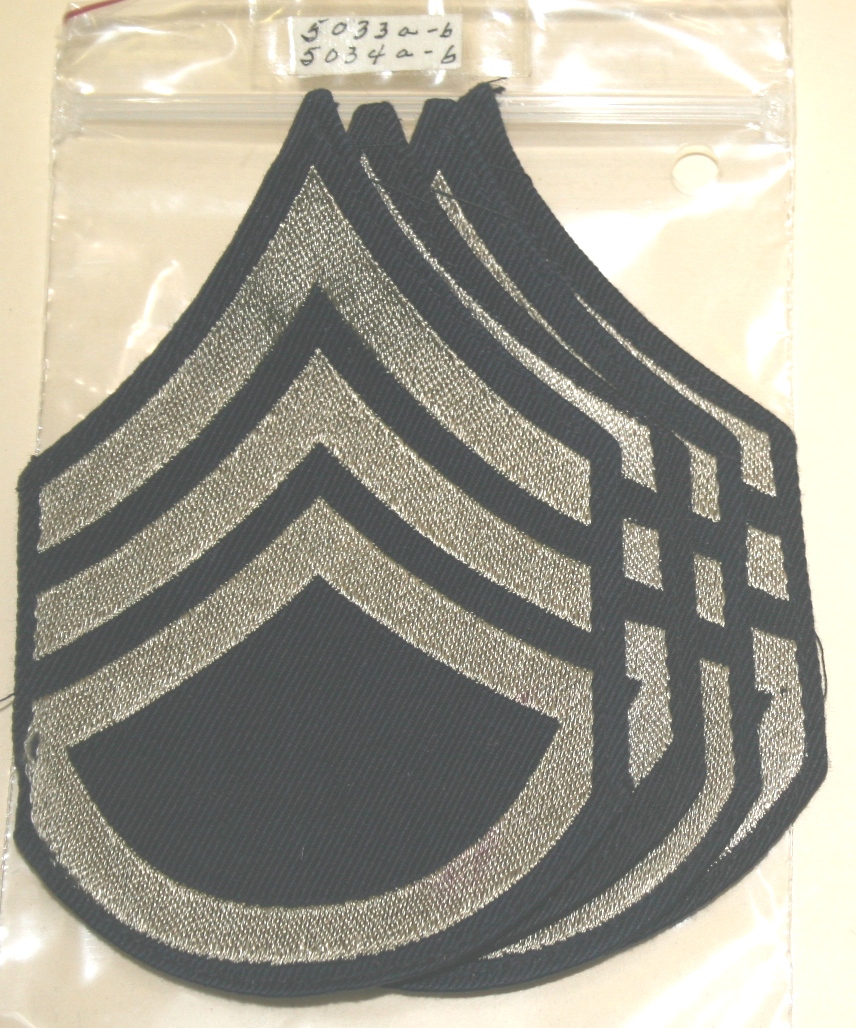 |
| 656203 |
Chevrons (Pair), Staff Sergeant, Enlisted, Man's, US Army, Wool/Cotton, Black/Gold, US, Circa 1939, World War II |
Chevrons, SSG, WW2. a-b) Pair of black felt chevrons with gold cotton machine stitched embroidered stripes of Staff Sergeant. NOTE: This is re-cataloged from 0614. |
3.25" X 3" |
.25 ounce |
 |
| 656182 |
Chevrons (Pair), Staff Sergeant, Enlisted, Man's, US Army, Wooll/Cotton, Black/Gold, US, Circa 1939, World War II |
Chevrons, SSG, WW2. a-b) Pair of black felt chevrons with gold cotton machine stitched embrooidery of Staff Sergeant stripes. NOTE: This item re-cataloged from 0614 |
3.25 " X 3" |
.25 ounce |
 |
| 421156 |
Chevrons (Pair), Staff Sergeant, Enlisted, US Army, Rayon/Wool, Olive Drab/Blue, US, Circa 1942, World War II |
SSG Chevrons, WW2 dk woolen. Three olive drab woven chevrons with a rocker below machine embroidered onto a dark blue wool backing cloth. |
|
.25 oz |
 |
| 656202 |
Chevrons (Pair), Staff Sergeant, US Army, Wool/Cotton, Black/Gold, US, Circa 1939, World War II |
Chevrons, SSG, WW2. a-b) Pair of black felt chev rons with gold cotton machine stitched embroidery of Staff Sergeant Stripes. NOTE: This item is re-cataloged from 0614. |
4.5" x 3" |
.0625 oz |
 |
| 656192 |
Chevrons, Corporal, Enlisted, Man's, US Army, Cotton, Black/Gold, US, Circa 1930, Early-20th Century |
Chevrons, Cpl, WW2. Black cotton chevron with two (2) Gold machine stitched stripes of a Corporal. |
3" x 3" |
|
 |
| 656191 |
Chevrons, Corporal, Enlisted, Man's, US Army, Wool/Cotton, Black/Green, US, Circa 1930, Early-20th Century |
Chevrons, CPL, WW2. Black felt chevron with two (2) green cotton machine stitched stripes. NOTE: This item recataloged from 0614. |
3" X 3" |
.0312 oz |
 |
| 421698 |
Chevrons, Corporal, Enlisted, US Army, Cotton/Wool, Khaki/Olive Drab, US, Circa 1940, World War II |
Chevrons, CPL. One OD wool chevrons stitched to khaki cotton twill backing cloth. |
3" X 3" |
.12 oz |
 |
| 426996 |
Chevrons, Corporal, Enlisted, US Army, Felt/Cotton, Black/Olive Green, US, Circa 1936, Mid-20th Century |
A pattern 1921 corporal rank insignia of olive green thread sewn on black felt background. These are unused, but appear to have slight moth damage on right edge. |
3.13 in x 3.13 in |
1 oz |
 |
| 426997 |
Chevrons, Corporal, Enlisted, US Army, Felt/Cotton, Black/Olive Green, US, Circa 1936, Mid-20th Century |
A pattern 1921 corporal rank insignia of olive green thread sewn on black felt background. These are unused, but appear to have slight moth damage on right edge. |
3.13 in x 3.13 in |
1 oz |
 |
| 421699 |
Chevrons, Corporal, Enlisted, US Army, Rayon/Wool, Olive Drab/Blue, US, Circa 1943, World War II |
Chevrons, CPL. One machine embroidered OD chevrons on blue wool backing cloth. |
3.25" x 3.12" |
.12 oz |
 |
| 426377 |
Chevrons, Corporal, Infantry, US Army, Cloth, Light Blue, US, Late-19th Century |
|
|
|
 |
| 656198 |
Chevrons, Corporal, Signal Corps, Enlisted, Man's, US Army, Cotton, Khaki/Orange/Red/White/Yellow, US, Circa 1910, Early-20th Century |
CPL SigC c1910. Khaki Corporal Signal Corps Chevron with two (2) orange stripes with white stitched edges and red, white and yellow machine embroidery Signal Corps emblem for summer uniform. |
4.75" x 3.5" |
.0625 oz |
 |
| 656199 |
Chevrons, Corporal, Signal Corps, Enlisted, Man's, US Army, Wool, Olive Drab/Orange/Red/Wht/Yelw, US, Circa 1910, Early-20th Century |
CPL SigC c1910. Olive drab wool with two (2) orange Signal Corps Chevron with red, white and yellow emblem embroidered below stripes. |
4.75" x 3.25" |
.0625 oz |
 |
| 426406 |
Chevrons, Corporal, US Army, Cloth, Multicolored, US, World War II |
Various examples of CPL chevrons from World War II |
|
|
 |
| 421684 |
Chevrons, First Sergeant, Enlisted, US Army, Wool, Olive Drab/Blue, US, Circa 1944, Mid-20th Century |
1SGT Chevron c1944. Three olive drab wool chevrons, and three olive drab wool rockers, with a lozenge (diamond) in the center, stitched to dark blue wool backing cloth. |
5.5" x 3.12" |
.25 oz |
 |
| 426404 |
Chevrons, Master Sergeant, US Army, Cloth, Multicolored, US, World War II |
Examples of MSG chevrons form WWII time frame. |
|
|
 |
| 421688 |
Chevrons, Sergeant First Class, Enlisted, US Army, Wool, Olive Drab/Blue, US, Circa 1921, Early-20th Century |
SFC Chevron c1921. Three olive drab wool felt chevrons with two rockers below, stitched to dark blue wool backing cloth. |
4.5" X 3" |
.12 oz |
 |
| 426411 |
Chevrons, Sergeant First Class, US Army, Cloth, Multicolored, US, Mid-20th Century |
Various SFC chevrons from the 1950s |
|
|
 |
| 656190 |
Chevrons, Sergeant, Enlisted, Man's, US Army, Cotton, Gold, US, Circa 1939, World War II |
Chevrons, SGT, WW2. Black cotton chevron with machine stitched embroidery of Sergeant stripes. NOTE: This item is re-cataloged from 0614. |
3.75" x 3" |
|
 |
| 656189 |
Chevrons, Sergeant, Enlisted, Man's, US Army, Wool/Cotton, Black/Green, US, Circa 1930, Early-20th Century |
Chevrons, Sgt WW2. Black felt chevron with green cotton machine stiched embroidery of Sergeant stripes. NOTE: This item re-cataloged from 0614 |
3.5" x 3" |
.0312 |
 |
| 421694 |
Chevrons, Sergeant, Enlisted, US Army, Cotton/Wool, KHAKI, US, Circa 1921, Early-20th Century |
Sgt Chevron c1921, khaki. Three khaki wool felt chevrons stitched to khaki cotton twill backing cloth.Chevrons slightly torn at top of the inverse V at bottom of chevrons. |
4.2" x 3.2" |
.12 oz |
 |
| 421950 |
Chevrons, Sergeant, Enlisted, US Army, WOOL, Olive Drab, US, Circa 1917, World War I |
Sgt SigC WW1. Three olive drab wool felt chevrons stitched to olive drab wool backing cloth. |
3.25" x 4.5" |
.12 oz |
 |
| 421695 |
Chevrons, Sergeant, Enlisted, US Army, Wool, Olive Drab/Blue, US, Circa 1942, World War II |
Sgt chevron c1945. Three olive drab wool felt chevrons stitched to dark blue wool backing cloth. |
3.7" x 3" |
.12 oz |
 |
| 656200 |
Chevrons, Sergeant, Signal Corps, Enlisted, Man's, US Army, Cotton, White/Orange/Red/Yellow, US, Circa 1904, Early-20th Century |
Sgt Sigc Chevron c1905. White duck chevron with three sewn on orange stripes with red, white and yellow embroidered Signal Corps emblem. |
4.75" x 3.25" |
.0625 oz |
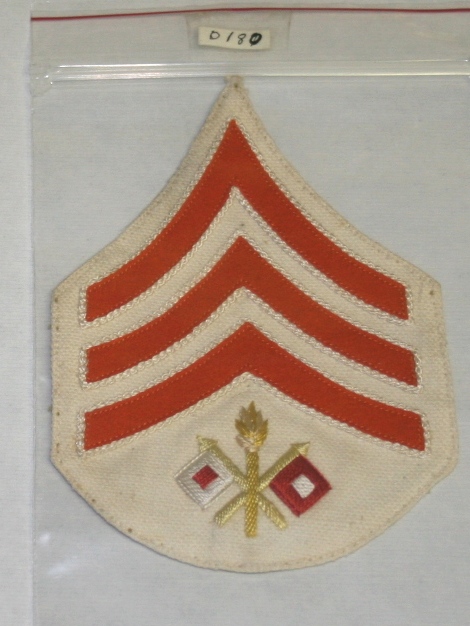 |
| 426413 |
Chevrons, Sergeant, US Army, Cloth, Multicolored, US, Mid-20th Century |
Various examples of SGT chevrons |
|
|
 |
| 656188 |
Chevrons, Staff Sergeant, Enlisted, Man's, US Army, Wool/Cotton, Black/Gold, US, Circa 1939, World War II |
Chevrons, SSG, WW2. Black felt chevron with gold cotton machine stitched embroidery Staff Sergeant stripesl NOTE: This item re-cataloged from 0614. |
4" X 3" |
.0312 |
 |
| 426405 |
Chevrons, Staff Sergeant, Enlisted, US Army, Cloth, Drab, US, World War II |
Various examples of SSG chevrons from WWII time frame |
|
|
 |
| 421689 |
Chevrons, Staff Sergeant, Enlisted, US Army, WOOL, Olive Drab/Blue, US, Circa 1942, World War II |
SSG chevron c1943. Dk woolen. Three olive drab wool chevrons with a rocker below, stitched to a dark blue wool backing. |
4.6" x 3" |
.12 oz |
 |
| 421687 |
Chevrons, Technical Sergeant, Enlisted, US Army, Wool, Olive Drab/Blue, US, Circa 1942, World War II |
Technical Sergeant Chevron c1943. Three olive drab wool felt chevrons with two rockers below, stitched to dark blue wool backing cloth. |
5" x 3.1" |
.25 oz |
 |
| 421697 |
Chevrons, Technician Fifth Grade, Enlisted, US Army, Cotton/Wool, Olive Drab/Blue, US, Circa 1943, World War II |
Chevrons, TechCpl. One OD machine embroidered chevrons with a T below, on a dark blue wool backing. |
3.5" X 2.125" |
.12 oz |
 |
| 421692 |
Chevrons, Technician Forth Grade, Enlisted, US Army, Cotton/Wool, Khaki/Olive Drab, US, Circa 1943, World War II |
T-Sgt Stipe. Khaki. Three olive drab wool felt chevrons with a T below, stitched to a khaki cotton twill backing cloth. |
4.5" x 2.9" |
.12 oz |
 |
| 421693 |
Chevrons, Technician Forth Grade, Enlisted, US Army, Cotton/Wool, Khaki/Olive Drab, US, Circa 1943, World War II |
T-Sgt stripes. khaki. Three olive drab wool felt chevrons with a T below, stitched to a khaki cotton twill backing cloth. |
4.75" x 2.9" |
.12 oz |
 |
| 421691 |
Chevrons, Technician Forth Grade, Enlisted, US Army, Wool, Olive Drab/Blue, US, Circa 1943, World War II |
T-Sgt stripe. Dk woolen. Three olive drab wool felt chevrons with a T below, stitched to a dark blue wool backing cloth. |
4" X 3" |
.12 oz |
 |
| 421690 |
Chevrons, Technician Third Grade, Enlisted, US Army, Wool, Olive Drab/Blue, US, Circa 1943, World War II |
T-SSG stripe. Dk wollen. Three olive drab wool felt chevrons with a T below, stitched to a dark blue wool backing cloth. Tip of chevron has been pulled off. |
4.1" x 3" |
.12 oz |
 |
| 854877 |
Cinch, Saddle, US Army, wool/leather, blue, M1859, US, Circa 1862, Civil War |
Cinch, ACW |
18" |
|
 |
| 421178 |
Cinch, US Army, Hair, Brown, M1904, US, Circa 1905, Early-20th Century |
Cinch, Mule, 2ea. a-b) Twenty-Four braided horsehair strands, 12" long x 7" wide, with metal rings, 4.5" diameter, at each end. c) Leather strap, 22" x 1" w/buckle to fasten to other two pieces together. |
See Description |
1 lb 11 oz |
 |
| 447247 |
Cinch, US Army, Leather/Rope, Brown, M1904, US, Circa 1905, Early-20th Century |
Cinch. Leather ends of cinch, 6.5" diameter, fastened together with many strands of braided rope which is 25" long; strap at one end of strap h as metal circle, 4.5" diameter fastened to it. |
|
2 lbs |
 |
| 428068 |
Circle, Aiming (theodolite), (with Tripod And Case), Iraqi Army, Wood/Metal/Glass, Olive Drab/Silver, Iraqi, Circa 1985, Persian Gulf War (Desert Storm), SN: SR 0170-85 |
A Soviet made theodolite/Aiming circle ser # SR 0170-85 with an adjustable tripod and canvas cover. Instrument has no markings except serial number and is identified solely by the picture in the reference. Instrument appears to be in good condition. |
5.13" x 5" |
12lbs 11oz |
 |
| 426709 |
Clip Board, Medical, Aluminum, Silver/Shiny, US, Late-20th Century |
Hinged aluminum clipboard with 3 clips inside the top cover. Government Forms 4107, 3365, and 519-B also attached within clipboard. |
9" x 12" |
1.85 lbs |
 |
| 421219 |
Clip, Necktie, Signal Corps, US Army, brass, Bright, US, Circa 1950, Mid-20th Century |
A bright brass Signal Corps tie clip in the shape of a button with the crossed flags insignia stamped in the center. |
|
.5 oz |
 |
| 427735 |
Clip, Rifle Ammunition, 8-Round, US Army, Steel, Dark gray, M1, Garand, .30 Caliber, US, Circa 1942, World War II |
A standard M-1 clip holding 8 rounds of de-milled blank ammunition. |
2.63" x 2.13" |
3 oz |
 |
| 427736 |
Clip, Rifle Ammunition, 8-Round, US Army, Steel, Dark Gray, M1, Garand, .30 Caliber, US, Circa 1942, World War II |
Standard clip, Ammunition with 8 orange tipped inert rounds for Garand M-1 rifle. |
3.5" x 2.13" |
3 oz |
 |
| 434098 |
Coat, Battle Dress Uniform, Woodland Camouflage, US Army, Cotton Ripstop, Green/Brown/Black, Large-Long, US, Circa 1995, Late-20th Century |
A long sleeve, woodland pattern camouflage Battle Dress Uniform coat, with two skirt and two breast patch pockets with concealed buttons. On upper left sleeve, is unit patch: 24th Infantry Division |
|
1.82 lbs |
 |
| 835553 |
Coat, Battle Dress Uniform, Woodland Camouflage, US Army, Cotton/Nylon, Green/Brown/Black, Medium-Long, US, Late-20th Century |
A long sleeve, woodland pattern camouflage Battle Dress Uniform coat, with two skirt and two breast patch pockets with concealed buttons. Sewn on: SGM chevrons, 1st Armored Patch, 101st Airborne Patch, American Flag, U.S. ARMY, WALLACE, Parachutist, Air Assault, Master Parachutist. |
|
|
 |
| 426750 |
Coat, Camouflage, Russian Army, Cloth, Multicolor, Russian, Circa 1998, Late-20th Century |
Russian camo coat with four pockets. |
|
|
 |
| 422728 |
Coat, Combat, Desert Camouflage, 24th Infantry Division, US Army, Cotton/Nylon, Brown/Tan/Black, Small, US, 1990, Persian Gulf War (Desert Storm) |
Shirt, Desert chips. 4 pkt desert camouflage coat with Flag insignia on right sleeve, black and olive drab 24th Division patch on left. |
|
1 LB 6 OZ |
 |
| 422676 |
Coat, Combat, Desert Camouflage, First Sergeant's, US Army, Cotton Ripstop, Brown/Tan/Taupe, Large/X-Long, US, Circa 1985, Persian Gulf War (Desert Storm) |
Shirt, BDU Desert camo. Sandy. Metal 1Sgt collar insignia, brown on tan "US Army" and "McGinnis" sewn on tapes above pockets, 63rd Div/ARCOM patch on the left sleeve, and a US flag patch on the right sleeve. |
|
1 LB 10 OZ |
 |
| 657275 |
Coat, Combat, Desert Camouflage, Lieutenant Colonel's, Iraqi Civil Defense Corps, Cotton/Nylon, Brown/Tan/Black, Large, Iraqi, Circa 2002, Early-21st Century |
A four pocket uniform coat with falling collar cut like a BDU in four shade chocolate chip pattern desert camouflage. Fabric weave gives impression of white horizontal lines covering garment. All closer by plastic buttons. 22 buttons in all. Two brown Iraqi Lieutenant colonels shoulder bourds. (Gold eagle over star.) on shoulder tabs. Round ICDC patch on each shoulder. (imbroudered). Unit patch on shoulder. Red white and black map of Iraq on yellow field in red border. Green lettering on map, 36 BNI140-BDE- Chocolate chip pattern. |
|
|
 |
| 422716 |
Coat, Combat, Desert Camouflage, US Army, Cotton/Nylon, Brown/Tan/Black, Large Short, US, Circa 1985, Late-20th Century |
Shirt, Desert chip camouflage combat coat with four (4) front flap-pockets. |
|
1 LB 7 OZ |
 |
| 422703 |
Coat, Combat, Desert Camouflage, US Army, Cotton/Nylon, Brown/Tan/Black, Medium Short, US, Circa 1985, Late-20th Century |
Shirt, Desert chip camouflage combat coat with four (4) front flap pockets. |
|
1 LB 5 OZ |
 |
| 468063 |
Coat, Combat, Desert Camouflage, US Army, Cotton/Nylon, Brown/Tan/Black, Small-Regular, US, 1984, Late-20th Century |
A desert camouflage pattern coat with 4 pockets, 2 on each side, each with 2 button flap. The shirt has a 5-button front and a 2-button tab closure on the sleeves. Size and ID tags on back of neck and bottom at front. |
|
1 lb 8 oz |
 |
| 838162 |
Coat, Combat, Desert Camouflage, US Army, Cotton/Nylon, Brown/Tan/Taupe, Large Regular, US, Global War on Terrorism |
A long sleeve, desert pattern camouflage Battle Dress Uniform coat, with two skirt and two breast patch pockets with concealed buttons. Patches: SGM chevrons, 101st Airborne, 1st Armored Division, American Flag, Air Assault, Army Aviation, Parachutist. |
|
|
 |
| 836136 |
Coat, Desert, Camo, US Army, Cotton/Nylon, Brown/Tan/Taupe, Medium Regular, US, Global War on Terrorism |
Typical desert camo coat with the following patches sewen on: American Flag, Rank SSGT, Cavalry, Name: GILBERT and US ARMY. |
|
2 lbs |
 |
| 650157 |
Coat, Dress, Acu, Enlisted, Man's, Cotton, green-woodland/grey/sand brown, M-R, US, 2007, Early-21st Century |
Dress coat - new Army Combat Uniform |
|
2.0 lbs. |
 |
| 422059 |
Coat, Dress, Cavalry, Man's, US Army, WOOL, Dark Blue, M1885, Medium, US, Circa 1889, Late-19th Century |
Tunic, dress Cav EM M1885. Single breasted blue coat with yellow collar, epaulettes, back vent cuff flaps and cord border; nine button front, heavily lined inside. |
|
2 LBS |
 |
| 421643 |
Coat, Dress, Cavalry, Technical Sergeant's (with Trousers), Enlisted, Man's, US Army, Wool, Blue, P1902, 46, US, Circa 1920, Early-20th Century |
Tunic, Dress NCO c1920. Dk Blue wool, 6 button coat, stand-up collar with faded yellow piping, Technical Sergeant chevrons and five (5) .5" wide hash marks on each sleeve. Four bullion WW1 overseas chevrons. Cav/Inf ? |
|
3 LBS |
 |
| 650131 |
Coat, Dress, DCU, Enlisted, Man's, US Army, Cotton, tan/green/brown, M-L, Afghan, 2001, Early-21st Century |
Dress coat for the 3-color Desert Army uniform - DCU. |
. |
2.0 lbs. |
 |
| 427178 |
Coat, Dress, Officer's, Man's, US Army, Cotton, White, M1907, Small, US, Circa 1907, Early-20th Century |
An M1907 officers white dress coat. Epaulets punctured from insignia use. Yellow magic marker stains on upper right collar and down the front, with an additional stain on the right back. There is a repair on the left front about 6 1/4"up from the bottom edge. |
|
1 lb 1 oz |
 |
| 421930 |
Coat, Dress, Signal Corps, Corporal's, Enlisted, Man's, US Army, Wool, Dark Blue, M1902, 35 S, US, Circa 1915, Early-20th Century |
Tunic, Dress blue. c1915. SigC Cpl rank on sleeves; orange and white stand-up collar, epaulettes and cuffs; brass buttons. Coat has several moth holes. |
. |
2 lbs 4 oz |
 |
| 602439 |
Coat, Dress, White, Officer's, Man's, US Army, Cotton/Nylon, White, Large, US, Circa 1970, Vietnam Era |
An Army officers dress white coat. On the inside right breast pocket is the following label "Tailored by Foree of San Antonio". Four front pockets with gold colored buttons. Four front gold colored buttons, and shoulder loops with gold buttons.No other markings noted. |
|
2 Lbs-4 Oz |
 |
| 595980 |
Coat, Field, 63d Infantry Division, Man's, US Army, Cotton Sateen, Olive Drab, M1951, Large, US, 1956, Mid-20th Century |
A M1951 olive green wind-resistant cotton sateen field coat. Made primarily of 9-ounce wind resistant, water-repellent treated cotton sateen cloth in olive green shade 107, and fully lined with similarly treated 5.5 ounce cotton oxford. The coat contains four large pockets with snap fastened flaps (two upper patch-type and two lower inside-hanging type), a plain collar, shoulder loops, a slide fastened front closure, and an elastic draw cord at the hem. Above the right top pocket on a black background in yellow is U.S. ARMY. On the right and left shoulder loops is sewn Warrent Officer insignia. On the upper right sleeve is the 63d Infantry Division insignia, a red flame with a centered yellow sword. Above the upper left pocket is the name tag on a white background with black lettering is the name CURTIS. |
34.5" x 24" |
45 oz |
 |
| 425918 |
Coat, Mackinaw, Man's, US Army, Cotton/Wool, Olive Drab, Small, US, 1938, Mid-20th Century |
Generally somewhat soiled, slleves show fading, 2 top buttons have been replaced with darker ones. Some light moth damage on collar and back of lining. Several fornt button holes beginning to unravel. |
37" x 18" x 3" |
4lb2oz |
 |
| 421078 |
Coat, Sack, Cavalry, Enlisted, Man's, US Army, WOOL, Dark Blue, Small, US, Circa 1899, Late-19th Century |
Sack Coat, EM's, five (5) brass buttons, black rayon lining and unbleached muslin sleeve lining. Signal Corps Patches added to coat are separately catalogued CCN 421174 |
. |
2 LBS |
 |
| 421275 |
Coat, Sack, Infantry Private's (with Trousers And Belt), Enlisted, Man's, US Army, Wool, Dark Blue, P1890, 34S, US, Circa 1902, Early-20th Century |
Sack Coat, 5 button. PFC! Dk blue wool with black cotton twill lining, a stand and fall collar, and white felt private chevrons on each sleeve. The coat has many moth holes, some of which have been mended. Also includes a pair of medium blue trousers with .5" white felt stripe on each leg, marked "Inspected 1902", 29 x 30, 26.5 oz, and a leather waist belt with "Rock Island Arsenal TTG" stamped on back, brass "US" buckle and brass rivets, 1.75" x 39", 8 oz. |
|
28 oz |
 |
| 421903 |
Coat, Sack, Infantry, Enlisted, Man's, US Army, WOOL, Blue, Small, US, Circa 1882, Indian Wars |
Sack Coat, 5 button. Infantry. Blue sack coat with a stand and fall collar, and two campaign stripes on the sleeves. |
|
1 LB 9 OZ |
 |
| 426907 |
Coat, Service, 1st Infantry Division, Enlisted, Man's, US Army, Wool, Olive Drab, M1912, US, Circa 1914, World War I |
A wool, M-1912, olive drab, coat. This coat has four pockets and the coat is not lined. The coat has a stand up collar and on the right collar is a infantry collar disk with the letter "C". On the right collar is the "US" enlisted mans collar disk. Both disk are attached to the collar with a screw post locking device. On the upper right sleeve is a dark green 2-1/2" diamater patch of two crossed rifles disignating the infantry rank of Private First Class sewed onto the sleeve. On the middle of the left sleeve is a tan colored Honorable Discharge chevron. On the upper part of the left sleeve is the First Division insignia (a red colored number one). On the lower left sleeve is four brown colored overseas service chevrons. The jacket has five buttons in front and a metal locking device around the collar. Above the right brest pocket is a faded WWI Victory ribbon pinned to the jacket with a straight pin locking device. On the inside of the jacket, on the left side is a stain which may be composed of dried glue that is still holding a non-readable printed label. On the inside of the color is green colored hand written "BALNVM." The jacket is faded to a lighter green than normal with small stains and small holes in the fabric. |
24" x 18" |
1 lb 13 oz |
 |
| 657162 |
Coat, Service, Enlisted, Man's, East German Army, Cloth, Gray Green, M44, East German, Circa 1980, Late-20th Century |
A four pocket (two on uper sleeve) heasvy duty blouse with rank insignia epaulets on each shoulder. There is a whit swet band that buttons into the collar. |
|
|
 |
| 427257 |
Coat, Service, Four Pocket, 1st Division, Enlisted, Man's, US Army, Cotton, Khaki, US, 1932, Early-20th Century |
A khaki service coat with khaki 1st Div SSI on left shoulder. Shadow of Sgt stripes on both sleeves. Left lapel stained. Insignia punctures on both lapels. All exterior buttons missing. Brass belt hooks buttoned on w/metal buttons. |
22" x 29" x 2.5" |
1 lb 8 oz |
 |
| 421968 |
Coat, Service, Four Pocket, Enlisted, Man's, US Army, Wool Serge, Olive Drab, 35 R, US, Circa 1942, World War II |
Coat, EM 4 pkt c1941. Service drab wool. has 93rd Div patch tacked on. |
|
2 lbs 11oz |
 |
| 426303 |
Coat, Service, Four Pocket, Enlisted, Man's, US Army, Wool/Polyester, Army Green Shade 344, 40 Regular, US, Circa 1970, Late-20th Century |
A AG344 lightweight green uniform. Light green inner lining. Shading where prior ensiginas were located on each upper sleeve. |
34" x 22" |
1 lb 15 oz |
 |
| 426539 |
Coat, Service, Four Pocket, First Sergeant's, 40th Infantry Div., Enlisted, Man's, US Army, Wool Serge, Olive Drab, M1939, US, Circa 1940, World War II |
A service coat, M1939 with the the 19 Dec, 1940 style change. The rank of First Sergeant (style before 1942) is found on the upper left and right sleeves. The 40th Infantry Division insignia, gold star on a dark blue background, is found on the upper left sleeve. On the left sleeve below the rank insignia is found a green patch with 4 chevrons reflecting 4 oversea tours. On the bottom of the left sleeve is found, on a dark blue background, five gold stripes, one for each three years of service. Located on the lower right sleeve is on a green background, two gold chevrons reflecting 2 wounds received in service. The coat has four front pockets with gold buttons. There are four gold colored buttons to fasten the coat. On the left and right at the waist are brass belt hooks. There is no belt with this coat. The inside of the coat is fully lined. There are two shoulder loops with buttons on both sides of the coat. There is a small hole located on the lower left breast pocket. |
32.75" x 20" |
2 lbs 9 oz |
 |
| 425919 |
Coat, Service, Four Pocket, Officer's, Man's, US Army, Cotton, Olive Drab, M1926, 42, US, Circa 1930, Early-20th Century |
An officers cotton service coat with 2 World War One Metallic overseas stripes on the left sleeve. 2 Buttons loose are in a pocket. Sweat stains in armpits & neck is soiled. Right sleeve stained. |
35" x 18" x 3" |
2 lbs 6 oz |
 |
| 427217 |
Coat, Service, Four Pocket, Officer's, Man's, US Army, Wool, Olive Drab, 40, US, Circa 1926, Early-20th Century |
A wool gabardine service coat with one wound stripe. Area around right armpit has 10 small holes (possible moth damage). On the left sleeve are two overseas service chevrons. Epaulets and collar are punctured from insignia. Coat has brown twill lining. Sleeves are lined with white black & orange lined cotton. |
27" x 33" |
2 lbs 13oz |
 |
| 427216 |
Coat, Service, Four Pocket, Officer's, Man's, US Army, Wool, Olive Drab, Large, US, 1933, Early-20th Century |
Worn and showing signs of wear, scattered moth damage, insignia holes in collar, lapels and epaulets. Right armpit stained and repaired (hand sewn) for 2 1/4". Faint 1"+ paint stain on right elbow. Back seam slightly unraveled at bottom. Left lower front pocket lining rotten and torn. Left arm pit stained and moth damaged. Generallly scattered small holes and spot stains. |
24" x 32" |
2 lbs 13oz |
 |
| 422883 |
Coat, Service, Four Pocket, Officer's, US Army, Wool/Rayon/Brass, Green/Gold, 39, US, Circa 1960, Mid-20th Century |
Tunic, Offcr Grn 4pkt. Grn 6th Army and 41st Div patches, brass buttons, and ribbons over each pocket, seven service stripes. |
|
3 lbs |
 |
| 426802 |
Coat, Service, Officer's, Man's, US Army, Wool, Olive Drab, US, Mid-20th Century |
With fouraguerre. 1ID patch on upper right shoulder. Cloth and metal ribbons: Silver Star, Bronze Star, European-African-Middle Eastern Campaign w/5 bronze stars, World War II Victory Medical Badge above ribbions |
|
|
 |
| 423021 |
Coat, Service, Private's, Enlisted, Woman's, US Army, Wool, Army Green, 12 R Plus, US, Circa 1985, Late-20th Century |
Tunic, Grn. Female poly/wool gabardine jacket with brass buttons, rayon lining, and Private's chevrons on each sleeve. |
|
|
 |
| 423023 |
Coat, Service, Sergeant's, Enlisted, Woman's, US Army, Wool, Army Green, 12 S, US, Circa 1985, Late-20th Century |
Tunic, Grn. female poly/wool gabardine jacket with brass buttons, rayon lining and Sergeant chevrons on each sleeve. |
|
1 lb 8 oz |
 |
| 421615 |
Coat, Service, Spec 7 (with Skirt), Enlisted, Woman's, US Army, Wool, Army Green, 10, US, Circa 1978, Late-20th Century |
Uniform, WAC c1980. Grn Serv Coat with brass buttons, green Sp7 insignia on both sleeves, and four (4) hash marks on left sleeve, and rayon lining. Includes Army Green wool service skirt. |
|
2lbs 3.5oz |
 |
| 467446 |
Coat, Service, Summer, 1st Division, Enlisted, Man's, US Army, Cotton, Khaki, P1912, US, Circa 1917, World War I |
A standard pattern M1912 mens cotton uniform coat with plastic buttons, and a 1st Division patch on the left shoulder. On the right sleeve is the shadow of a SGT stripe and on the left, that of a PFC or red discharge stripe. Several small white stains (paint?) and soiled spots on tail of coat. There is a patch with four overseas chevrons in the lower left sleeve and one wound down on the lower right sleeve. |
|
1lb, 12 oz |
 |
| 470736 |
Coat, Service, Summer, 4th Army, Officer's, Man's, US Army, Wool, Khaki, 36, US, Circa 1957, Late-20th Century |
Tunic, khaki Officer c1980. Custom made khaki wool gabardine with khaki rayon half lining, brass buttons and red and white 4th Army patch on left sleeve. |
|
|
 |
| 858244 |
Coat, Service, Summer, Enlisted, Man's, US Army, Worsted Wool, Khaki, US, World War II |
A single breasted, khaki, tropical worsted wool, four-pocket service coat with brass buttons, button down shoulder loops, and a roll collar with notched lapels. Slight staining on coat. No back belt. Wearing along back seams. |
|
|
 |
| 423034 |
Coat, Service, Summer, Half Sleeve, Enlisted, Woman's, US Army, polyester, Light Green, 12 R, US, Circa 1985, Late-20th Century |
Tunic, Lime Grn. Woman's short sleeved jacket with brass buttons. |
|
8 oz |
 |
| 427705 |
Coat, Service, Summer, Modified, Enlisted, Man's, US Army, Cotton, Drab, M1910, 38, US, Circa 1918, Early-20th Century |
A cotton uniform coat which has been altered by giving it a rounded open lay-down type collar, removing the two top pockets and replacing the military buttons with tan wooden buttons. Coat is in unused condition. |
|
1 lb 5 oz |
 |
| 421899 |
Coat, Service, Summer, Signal Corps, Corporal's, Enlisted, Man's, US Marine Corps, cotton, Khaki, P1912, 15 1/2 x 30, US, Circa 1915, Early-20th Century |
Tunic, khaki - Cpl SigC. single breasted coat with two flapped, pleated chest pockets, pointed cuffs, eagle buttons, high collar, corporal's stripes and signal insignia on sleeves. Highly starched. |
|
5 oz |
 |
| 468091 |
Coat, Service, Summer, US Army, Cotton, Khaki, P1921, 7 1/2 back, US, Circa 1922, Early-20th Century |
A standard pattern M1921 cotton service coat with small smudges of black paint under right armpit, a 3/8" long rust spot on right side of collar and a 1/8" hole on upper right breast 2" below collar seam. Buttons are of brown "IVORENE" plastic and are removable. |
31 1/2 sleeve |
1 lb 12 oz |
 |
| 426305 |
Coat, Service, US Army, Wool, Olive Drab, US, Mid-20th Century |
Enlisted green service coat. All patches removed. |
|
|
 |
| 421100 |
Coat, Service, Winter (with Breeches), Officer's, US Army, Wool, Olive Drab, 36, US, Circa 1918, Early-20th Century |
Tunic, offcr WW1. A single breasted, four pocket officer's coat with standing collar, cotton lining, bright brass buttons, and overseas stripe on left cuff Also includes a pair of size 29 x 24 breeches with button closure on leg bottoms. |
|
3 LBS 3 OZ |
 |
| 468090 |
Coat, Service, Winter, 1st Division, Enlisted, Man's, US Army, Wool, Olive Drab, P1917, US, Circa 1917, World War I |
Standard pattern P1917 EM service coat w/ 1st Division Patch on left shoulder, red discharge stripe and 2 metallic overseas chevrons on left sleeve. Scattered moth damage on entire surface. Standard collar is slightly darker green than rest of coat. Olive drab cotton liner in coat, green liner in sleeves. |
|
2 lb 2 oz |
 |
| 426544 |
Coat, Service, Winter, Corporal's, 1st Division, Enlisted, Man's, US Army, Wool, Olive Drab, M1912, US, Circa 1915, World War I |
A fully lined coat made in olive drab wool, it has four front pockets and stand up collar. There is an inside pocket on the left chest between the lining and the outer shell. The jacket has 5 buttons in the front, on the left collar is an enginner collar disk and on the right is the US enlisted mans disk collar. On the lower right sleeve are two wound chevrons. On the upper right sleeve is the rank of Corporal. On the lower left sleeve are three overseas service chevrons. On the middle of the left sleeve is a red honorable discharge chevron. On the upper left sleeve is a red 1st Division SSI. Above the right breast pocket is the World War I Victory ribbon with 4 bronze colored campaign stars attached to the ribbon. On the lower right part of the jacket is found three small holes and one small yellowish stain. The button on the left shoulder loop is missing. |
30" x 18" |
2 lbs 1 oz |
 |
| 426278 |
Coat, Service, Winter, Corporal's, 1st Division, Enlisted, Man's, US Army, Wool, Olive Drab, M1917, 37, US, Circa 1917, World War I |
A wool coat with 1st Division SSI on left shoulder, sewn cross stitch with red thread, red discharge stripe, and 4 overseas service chevrons on left sleeve. On the right sleeve are corporal stripes and 2 wound chevrons. Small hole on left sleeve by service chevrons, some skimming. Thin OD cotton liner stained and faded. Grey & blue striped white cloth sleeve liners. Bronze US disc on left collar and bronze K Infantry disc on left. Tags on and in left inner breast pocket. |
25" x 30" x 2" |
2 lbs |
 |
| 194231 |
Coat, Service, Winter, Enlisted, Man's, US Army, Wool, Olive drab, M1917, 28 L, US, 1918, World War I |
A wool service coat. Apparently has seen little use. Scattered moth damage (Several holes up to 3/8 " diameter). Top collar hook missing. 2 overseas chevrons, SSI & discharge stripe removed by previous owner. |
31.5" x 7.5" |
3 lbs 2 oz |
 |
| 427916 |
Coat, Service, Winter, Enlisted, Man's, US Army, Wool, Olive Drab, M1917, Medium, US, Circa 1918, World War I |
Service coat with a brown cotton gabardine liner. Upper right collar catch missing, L shaped tear at right side seam 5 in above hem. .5 in tear 7 in above hem on left side. Minimal moth damage. Two yellow metallic overseas stripes on left sleeve. .5 in hole in back of lining. |
7.75" x 32" x 28.5" |
2 lbs 8 oz |
 |
| 426389 |
Coat, Service, Winter, Enlisted, Man's, US Army, Wool, Olive Drab, M1917, US, Circa 1917, World War I |
Heavy wool enlisted service coat. On upper left shoulder sewn on is 1ID patch and below that is faded red discharge chevron and below that is 4 overseas chevrons. Coat is missing all front buttons. On the collar are disc: US and Crossed Rifles with F. Above left front breast pocket is Victory Ribbon with 5 bronze stars. Small moth hole along inner left sleeve. |
|
|
 |
| 428280 |
Coat, Service, Winter, Farrier's, Enlisted, Man's, US Army, Wool Serge, Olive Drab, M1912, 37 Regular, US, 1916, World War I |
A service coat with tan cotton twill lining. Has 3 bronze wire O/S chevrons on left lower sleeve, red silk discharge chevron sewn to middle of both sleeves. Farrier patch on right sleeve. Staining at cuffs and bottom of lining; small stitched repairs in various places. Missing metal collar hooks. |
|
2 lbs 3 oz |
 |
| 426596 |
Coat, Service, Winter, Officer's, Man's, US Army, Wool, Olive Drab, M1917, US, Circa 1918, World War I |
Officer's WWI Coat. On left upper shoulder is 1ID patch and on lower left sleeve service chevron. |
|
|
 |
| 426717 |
Coat, Service, Winter, Sergeant's, Enlisted, Man's, US Army, Wool, Olive Drab, M1917, US, Circa 1918, World War I |
Enlisted Service Coat from WWI. On upper left shoulder is wool 1ID patch. Below unit patch is sergeant chevrons, but these are not from WWI era. Chevrons are OD on dark blue background. Below chevrons are 6 overseas chevrons. On right lower sleeve by cuff is 1 overseas chevron. On the stand up collar are 2 Discs: US and crossed rifles. |
|
2.25 lbs |
 |
| 427268 |
Coat, Service, Winter, Signal Corps Private First Class', Enlisted, Man's, US Army, Wool, Olive Drab, M1917, 42, US, Circa 1917, World War I |
A wool service coat with a Signal Corps Pfc insignia sewn to the right arm and a red discharge stripe on the left. Coat is clean but has 11 scattered small moth holes 1/2" dia or smaller. There is a 5/16" long rip at the left shoulder seam. Lower collar hook is missing and there is a 1" tear inside the left sleeve lining. |
|
3 lbs 2 oz |
 |
| 421616 |
Coat, Service, Winter, Women's Army Corps, Army Service Forces, Enlisted, Woman's, US Army, Wool, Taupe, 18 L, US, Circa 1958, Late-20th Century |
Tunic, WAC taupe with peter-pan collar, sergeant's stripes, bronze buttons, and an Army Service Forces patch on left sleeve, rayon lining. |
|
1 LB 12 OZ |
 |
| 427915 |
Coat, Three-quarter Length, Officer's, US Army, Wool, Olive Drab, 42 Regular, US, Circa 1943, World War II |
Officers short overcoat. 1" long "L" shaped tear in lining at right front shoulder. 1 in separation in seam at split in rear. |
42 REG |
5 lbs |
 |
| 422807 |
Coat, Undress, Officer's, US Army, Wool, Dark Blue, P1894, 37, US, Circa 1894, Late-19th Century |
Tunic, LtCol dk blue wool with black cotton braid around stand-up collar and down front, six (6) buttons, black rayon lining with striped sleeve lining. |
|
2 lbs 15oz |
 |
| 422975 |
Coat, Undress, United States Volunteers, Officer's, US Army, Wool, Dark Blue, 38, US, 1898, Late-19th Century |
Tailored blue wool officer coat with button flap, black rayon braid on stand-up collar, each side of front, and around bottom. Captain's bars with white background. Gold braid tarnished. |
|
2 lbs 4 oz |
 |
| 620769 |
Coin, Commemorative, 100th Medical Detachment 30th medical bridgade, US Army, Metal, Burgundy/Brass/Yellow/Green, US, Early-21st Century |
Obverse: top rim of coin says" 100th Medical Detachment (VS HQ) 30th Medical Brigade" In the center of the coin is the Distinctive Unit Insignia for the U.S. Army Veterinary Command. Beneath insignia is the motto "Knowledge Integrity". Reverse: top rim of coin says "Presented for Excellence" The top center of the coin has a Colonel insignia. The bottom center of the coin has a CSM shoulder insignia. To the right of the coin is the 30th medical brigade shoulder insignia. To the left is the AMEDD insignia. IN the center is a bar engraved with 690. The 100th Medical Detachment (VS HQ) is Veterinary Services Europe in Heidelburg, Germany. U.S. ARMY VETERINARY COMMAND Distinctive Unit Insignia Distinctive Unit Insignia. Description: A silver color metal and enamel device 1 1/4 inches (3.18cm) in height overall consisting of a shield and crest blazoned: Shield: Sanguine, a torch Argent inflamed Proper entwined by two serpents of the second langued Or. Crest: From a wreath Argent and Sanguine a demi-unicorn rampant Argent armed Or. Attached below the shield a gold color scroll inscribed "KNOWLEDGE-INTEGRITY" in black. Symbolism: Maroon and white are the colors traditionally associated with the Medical department. The torch, symbolic of learning, is entwined by serpents which represent health-giving virtues. The unicorn, a fabulous creature whose horn possessed the power of purification, denotes the hygienic function of the organization. Background: The distinctive unit insignia was originally approved for the Meat and Dairy Hygiene School on 15 Jul 1953. It was redesignated for the U.S. Army Medical Service Veterinary School on 20 Jul 1962. On 24 Jun 1968 the insignia was amended to add the crest and motto. The distinctive unit insignia was redesignated for the U.S. Army Medical Department Veterinary School on 21 Mar 1969. On 31 Jan 1975 it was cancelled. As an exception to policy the insignia was reinstated for wear by personnel assigned to non-color bearing units of the U.S. Army Medical Department Veterinary Services on 9 Feb 1983. As a result of the organization of the U.S. Army Veterinary Command, the insignia was redesignated for the U.S. Army Veterinary Command and all non-color bearing veterinary units on 2 Oct 1994. 30TH MEDICAL BRIGADE SHOULDER SLEEVE INSIGNIA DISTINCTIVE UNIT INSIGNIA SHOULDER SLEEVE INSIGNIA. Description: On a maroon rectangle arched at the top and bottom with a 1/8 inch (.32cm) white border, 2 inches (5.08cm) in width and 3 inches (7.62cm) in height overall, a white sword entwined by a gold serpent grasping a gold star in its jaws. Symbolism: Maroon and white are the colors traditionally associated with the Medical Corps. The upright sword symbolizes military preparedness and is entwined by a serpent recalling the Staff of Aesculapius and a heritage of medical service. The star represents the state of Texas, where the 30th Medical Regiment was first activated. Background: The insignia was authorized on 10 Dec 1993. DISTINCTIVE UNIT INSIGNIA. Description: A silver color metal and enamel device 1 1/8 inches (2.86cm) in height overall, consisting of a shield blazoned: Sanguine a sword in pale Argent, point upward entwined by a serpent Vert, holding in its mouth a mullet Or, between two daggers fesswise in cross, points to center of the second, hilts and pommels of the fourth. Attached below the shield a silver scroll doubled and inscribed "IN CRUCE MEA FIDES" in black letters. Symbolism: Maroon and white are the colors traditionally associated with the Medical Corps, the original allocation of the organization. The sword and daggers characterize the former unit as a military unit, while their position in the form of a cross entwined by a serpent, indicated that the organization was a medical unit. The star in the mouth of the serpent is representative of the state of activation, Texas. The motto "In Cruce Mea Fides" (In the cross is my faith), is expressive of the confidence placed in the medical functioning of the original organization. Background: The insignia was originally approved on 10 Feb 1943 for the 30th Medical Regiment. It was amended to correct the blazon of the shield on 26 Jun 1943. On 3 Feb 1959 the insignia was rescinded. The insignia was reinstated and redesignated for the 30th Medical Group on 16 Jun 1966. On 10 Dec 1993 it was redesignated for the 30th Medical Brigade. |
2" dia x .13" thick |
1.75oz |
 |
| 620898 |
Coin, Commemorative, 104th division institutional training, US Army, Metal, Brass/Black, US, Early-21st Century |
Obverse: top rim of coin says "104th Division (Institutional Training) We Succeed". IN the center of the coin is a wolf's head howling to the left. Reverse: the inner rim of the coin says "Presented By The Command Sergeant Major For Excellence". IN the center of the coin is a CSM shoulder insignia in black. |
1.31" dia x .13" thick |
1.50oz |
 |
| 620744 |
Coin, Commemorative, 10th Mountain Division Light Infantry, US Army, Metal, Brass/Blue/Red/White, US, Early-21st Century |
Obverse: Outer rim of coin says " 10th Mountain Division Light Infantry" The inside circle of the coin has the shoulder patch that is trimmed in white with a dark blue background. There are two red swords crossed in the center. Above the patch is the word mountain in white on a blue background. Reverse: Outer rim of the coin says "Climb To Glory North Apennines PO Valley Somalia Hati" Each word or phrase is separated by a star. In the center of the coin there are soldiers climbin g over a mountainous wall. Underneath the figures is a horizontal blank bar. The shoulder patch for the 10th was approved on January 7, 1944. The blue background of the patch and the crossed bayonets suggest the infantry, the bayonets also form a Roman number "X" (10) representing the unit’s number. The overall shape of the patch is of a powder-keg suggesting the Division’s explosive power. Red, white, and blue suggest the national colors. The word "MOUNTAIN" is white on a blue tab affixed directly above the patch. |
1.75" dia x .06" thick |
|
 |
| 620745 |
Coin, Commemorative, 10th Mountain Division Light Infantry, US Army, Metal, Multicolored, US, Early-21st Century |
Obverse: Outer rim of coin says "10th Mountain Division Light Infantry" The inside circle has the 10th Mountain Division shoulder patch of a pair of red swords crossed in the center of a blue background that is trimmed in white. Above this is the words Mountain in white on a blue background. Reverse: Outer rim of coin says " Presented By The Division Command Sergeant Major" The inside circle of the coin has a a CSM shoulder patch which has yellow chevrons trimmed in green. Inside the chevrons is a wreath with a star. The shoulder patch for the 10th was approved on January 7, 1944. The blue background of the patch and the crossed bayonets suggest the infantry, the bayonets also form a Roman number "X" (10) representing the unit’s number. The overall shape of the patch is of a powder-keg suggesting the Division’s explosive power. Red, white, and blue suggest the national colors. The word "MOUNTAIN" is white on a blue tab affixed directly above the patch. |
2" dia x .06" thick |
2oz |
 |
| 620994 |
Coin, Commemorative, 115th Field Hospital, US Army, Metal, Brass/Burgundy/Yellow/Green, US, Early-21st Century |
Obverse: outer rim of coin has brass letters on a burgundy background. It says "Commander Command Sergeant Major". The top center of the coin has Colonel rank insignia. The bottom center of the coin has CSM rank insignia. In the center of the coin is a burgundy scroll with brass letters that says "Coin of Excellence". Reverse: outer rim of coin has brass letters on a burgundy background. It says "Warrior Medic 115th Field Hospital". IN the center of the coin is a large burgundy cross. In the center of the cross is a tent. The top end of the cross says "HHC". The right end of the cross says "565th". The bottom end of the cross says "485th". The left end of the cross says "6143rd". In the upper left outside corner of the cross is a group of animals (Horse, dog and goat). In the upper right outside corner of the cross is a Combat Medic. In the lower left outside corner of the cross is a giant mosquito. In the lower right outside corner of the cross is a Humvee ambulance. |
2" dia x .13" thick |
2oz |
 |
| 620757 |
Coin, Commemorative, 115th SIG BN, US Army, Metal, Brass/Red/Blue/White, US, Early-21st Century |
Obverse: Outer rim of coin says "Soldiers Supporting Soldiers and Families of America's Corps United States Army Garrison Fort Lewis, Washington" inner circle says "HHC USAG VB YTC 115th SIG BN. Inside that circle is an emplem of a blue volcano peak errupting with red lava and grey smoke. A golden I is supperimposed over the volcano. The background is white. A scroll underneath the emblem says "America's Corps". Reverse: top rim of coin says "Garrison Commander" bottom rim of coin says "Coin for Excellence". In the center of the coin is an engraved picture of Fort Lewis. Towers, a forest and a mountain peak in the background. |
1.56" dia x .13" thick |
.75oz |
 |
| 620760 |
Coin, Commemorative, 115th SIG BN, US Army, Metal, Brass/Red/Blue/White, US, Early-21st Century |
Obverse: Outer rim of coin says "Soldiers Supporting Soldiers and Families of America's Corps United States Army Garrison Fort Lewis, Washington" inner circle says "HHC USAG VB YTC 115th SIG BN. Inside that circle is an emplem of a blue volcano peak errupting with red lava and grey smoke. A golden I is supperimposed over the volcano. The background is white. A scroll underneath the emblem says "America's Corps". Reverse: top rim of coin says "Garrison Commander" bottom rim of coin says "Coin for Excellence". In the center of the coin is an engraved picture of Fort Lewis. Towers, a forest and a mountain peak in the background. |
1.5" dia x .13" thick |
.75oz |
 |
| 621034 |
Coin, Commemorative, 121st General Hospital Korea, US Army, Metal, Multicolored, US, Early-21st Century |
Obverse: inside rim of coin says "121st GEN HOSP KOREA ONE TEAM". In the center of the coin is the distincitve unit insignia for 121st General Hospital Korea. It is a white cross with a red and blue yin/yang symbol in the center. There is a Ying/Yang symbol to the left and right sides of the cross. At the bottom of the cross there are rays eminiating from the left and right sides. The motto is "Our Mission Your Health". There are three green dots over a green mountain peak on the left and right sides of the cross. Reverse: outer rim of coin has brass letters on a burgundy background. It says "Presented by the Command Sergeant Major for Outstanding Service". In the center of the coin is CSM shoulder insignia. |
2" dia x .13" thick |
1.85oz |
 |
| 864845 |
Coin, Commemorative, 121st General Hospital, US Army, Metal, Gold/White/Black/Red/Green, US, Late-20th Century |
circular, gold with color; obverse has "121st General Hospital/One Team" w/ smaller inner border w/ "Your Health/Our Mission" with white cross with red/blue Ying/Yang in center; reverse "on dark blue/black rim "Presented by the Commander for Outstanding Service" w/ COL Insignia and flags of US and Korea; |
2" diam |
|
 |
| 621008 |
Coin, Commemorative, 12st General Hospital Korea, US Army, Metal, Multicolored, US, Early-21st Century |
Obverse: outer rim of coin says "121st General Hospital Korea One Team!". In the center of the coin is the distinctive unit insignia for 121st General Hospital. It is a white cross with a red/blue Yin/Yang symbol in the center. At the top outside corners of the cross are Yin/Yang symbols in red and blue. The motto forms a circle around the cross in black with gold letters. It says "Our Mission Your Health". To the left and right sides are green mountain with three circles over it figures. Reverse: brass letters on a black background. It says "Presented by the Commander For Outstanding Service". In the center of the coin is Colonel Rank insignia. To the left top of the coin is an American flag. To the right top of the coin is a South Korean flag. |
2" dia x .13" thick |
1.75oz |
 |
| 864851 |
Coin, Commemorative, 130th Station Hospital, US Army, Metal, Silver/Maroon/Green, US, Late-20th Century |
circular, silver with obverse design of maroon cross with green scroll w/ "We Will Serve" & lion rampant; above and below "130th Station Hospital/Heidelberg, FRG" reverse "For Excellence with map of Germany with Heidelberg marked & emblem of 7th Medical COM |
1 1/2" diam |
|
 |
| 620761 |
Coin, Commemorative, 142d Medical Battalion FSB 41st ASG, US Army, Metal, Brass, US, Early-21st Century |
Obverse: Outer rim of coin says "Jungle Fighter Support U.S. Army South" The center of the coin has a symbol of a cross with two hands clasped together. The scroll below this has writing "Duty Honor Care". Reverse: Outer rim of coin says "142d Medical Battalion (FSB) 41st ASG" The inside circle of the coin has an engraved picture of a soldier holding a weapon. Surrounding him are symbols for various corps. At the top is the Quartermaster corps, (going clockwise) is Ordinance Corps, Transportation Corps, Adjutant General Corps, Christian Chaplain Corps, Medical Corps and Army Band. |
1.5" dia x .13" thick |
1.25oz |
 |
| 864838 |
Coin, Commemorative, 163rd Medical BN, US Army, Metal, Gold/Maroon/Red/Orange, US, Late-20th Century |
gold with maroon obverse with 163D Medical Battalion (DS) Republic of Korea with DUI in center with gold shield with 3 black arrows & "Preserve to Maintain" reverse w/ maroon rim with "Commander's Coin/Outstanding Duty Performance" with COL insignia, map of Asia with North/South Korea & US & Korean flags; |
1 1/2" diam |
|
 |
| 620755 |
Coin, Commemorative, 168th Medical Battalion, US Army, Metal, Multicolored, US, Early-21st Century |
Obverse: Outer rim of coin says " 168th Medical Battalion Area Support" There is a star on the lower left and lower right sides. There is an inner circle to the coin. At the top of the inner circle is a caduceus with single serpent. Around the Distinctive Unit Insignia there are trapezoid shapes (7 of them) Burgundy background with gold letters: (clockwise from right of caduceus) 154 PM (trimmed in purple), 38 PM (trimmed in dark indigo), 5 PM (trimmed in blue), C CO (trimmed in green), B CO (trimmed in yellow), A CO (trimmed in orange) and HsC (trimmed in red). The insignia says "Medical Aid and Support" Reverse: top rim of coin says "Command Sergeant Major" bottom rim of coin says "coin of Excellence". To the left and the right of the coin there is a serpent figure curled around a red staff on a field of blue. These shapes are dogtag shaped. There is an inner circle to the coin. Scrolls form a circle within the inner circle. The scrolls at the top say "Normandy" and "Northern France" then there is a South Korean flag in color. The bottom scrolls say "Central Europe" and "Ardenne Alsace" Between the central Europe and Normandy is an American flag in color (on the left side of the coin across from the South Korean flag). In the center of the coin is a CSM shoulder patch in green and gold. Distinctive Unit Insignia. Description: A silver color metal and enamel device 1 1/4 inches (3.18 cm) in width overall, consisting of a maroon octagon charged with a serpent entwined pillar between six stars, all silver. Attached below, a silver scroll inscribed "MEDICAL AID AND SUPPORT" in black letters. Symbolism: Maroon and white are colors traditionally associated with the Medical Corps. The column with the serpent entwined represents the strong medical support supplied by the unit. The stars allude to provision of command administrative duties. The octagon refers to the many phases of medical control and planning. The one column, six stars, and eight sides of the device allude to the numerical designation of the 168th Medical Battalion. Background: The distinctive unit insignia was approved on 30 January 1968. It was amended to revise the description and symbolism on 14 September 1993. Coat of Arms. Blazon: Shield: Argent, on an octagon Sanguine three mullets to dexter and three sinister of the field overall and throughout a column palewise of the first entwined by a serpent Sable. Crest: From a wreath Argent and Sanguine (Maroon) in front of a serpent Vert entwining a ragged staff of the second within a wreath of laurel Proper, a lion passant guardant Or holding in its front claws a fleur-de-lis Azure. Motto: MEDICAL AID AND SUPPORT. Symbolism: Shield: Maroon and white are colors traditionally associated with the Medical Corps. The column with the serpent entwined represents the strong medical support supplied by the unit. The stars allude to provision of command administrative duties. The octagon refers to the many phases of medical control and planning. The one column, six stars, and eight sides of the device allude to the numerical designation of the 168th Medical Battalion. Crest: World War II campaign participation in Northern France and Normandy is recalled respectively by the fleur-de-lis and lion, the last being derived from the arms of that region. Campaigns in Central Europe and the Rhineland are represented by the ragged staff; the serpent refers to the mission of medical care and support to American troops in combat. The wreath of laurel signifies honor and achievement. Green denotes hygiene and growth, gold indicates excellence. Background: The coat of arms was approved on 14 September 1993. It was amended to include a crest on 3 October 2002. |
1.75" dia x .13" thick |
1.50oz |
 |
| 620766 |
Coin, Commemorative, 16th Medical Logistics Battalion, US Army, Metal, Brass/Burgundy/Green/Blue, US, Early-21st Century |
Obverse: Outer rim of coin says "16th Medical Logistics Battalion Waegwan Pyongtake Seoul" The inside of the coin has the words "Support to Health Care" Surrounding two red crosses and a Korean symbol (for water maybe?) that has a green dot in the center. Reverse: Outer rim of coin says "Command Sergeant Major Coin of Excellence" The inside circle of coin has a blank bar in the center. To the right is a CSM shoulder patch. At the bottom is the Combat Medic Badge. At the Top is a Presidential Seal. To the right is the 18th Medical Command shoulder sleeve insignia. To the left is a CSM shoulder patch. 18TH MEDICAL COMMAND SHOULDER SLEEVE INSIGNIA DISTINCTIVE UNIT INSIGNIA SHOULDER SLEEVE INSIGNIA. Description: On a shield, oblong in shape and arched at both sides, 3 inches (7.62cm) in height and 2 inches (5.08cm) in width, within a 1/8 inch (.32cm) white border a field of blue having a white-edged maroon sword throughout the center with point down and entwined about the blade two white zig-zag bands in the form of a figure eight. Symbolism: The sword is in the color maroon, suggestive of human blood, and symbolic of the medical needs of an army. The zig-zag bands are in pure white to suggest bandaging and the antiseptic requirements of medical practice; by entwining the sword they signify the support provided by the organization. Background: The shoulder sleeve insignia was originally approved for the 18th Medical Brigade on 25 Oct 1967. It was redesignated for the 18thMedical Command on 16 Feb 1984. DISTINCTIVE UNIT INSIGNIA. Description: A device of gold color metal and enamel 1 1/8 inches (2.86cm) in height consisting of a gold sun of eighteen rays bearing in center a maroon Maltese Cross all centered on a gold disc scored with concentric rays and enclosed by a maroon motto scroll bearing the words "Trust, Labor, Courage" in gold letters; over the lower half of the scroll a wreath of gold oak leaves entwined by two white serpents their tails crossed in center, their heads raised at either side and facing outward. Symbolism: The gold sun and maroon cross are symbolic of the support provided by the organization. The Maltese Cross is the symbol of the Knights of Malta, also called Knights Hospitaler, Knights of St. John and Order of the Hospital of St. John, which grew out of a hospital established in the 11th Century to care for pilgrims in the Holy Land. The eighteen rays of the sun allude to the unit’s numerical designation. The serpents are a reference to the Staff of Aesculapius of the Medical Corps insignia and the oak is a symbol of strength. Background: The distinctive unit insignia was originally approved for the 18th Medical Brigade on 29 Feb 1968. It was redesignated on 16 Feb 1984 for the 18th Medical Command. |
1 1.31" dia x .13" thick |
1.75oz |
 |
| 864858 |
Coin, Commemorative, 16th MEDLOG BN, US Army, Metal, Silver/Red/Blue/WHite, US, Late-20th Century |
circular; obverse, with "16ht MEDLOB BN/Republic of Korea around rim & full color crossed US and Korean flags in center superimposed over a map of South Korea w/ Waegman" on map; back has "Support to Health Care/1st Always" with maroon design in center; |
1 1/2" diam |
|
 |
| 620772 |
Coin, Commemorative, 173d Airborne Brigade Separate, US Army, Metal, Brass/Blue/Green, US, Late-20th Century |
Obverse: Top of coin says Alfred V. Rascon. Bottom of coin says "173d Airborne Brigade Separate. In the center of the coin is an engraved image of the Medal of Honor. to the left of the image it says "March 16, 1966" to the right of the image it says "South Vietnam". Reverse: Top of coin says "HHC 1- 503d Airborne Infantry Reconnaissance Platoon. There are three raised stars to the left and the right of the coin. In the center of the coin is a blank bar. The top center of the coin to the left is the shoulder insignia for 173d Airborne. To the right is the Distinctive Unit Insignia of the 503d Infantry Regiment. |
1.75" dia x .13" thick |
1.50oz |
 |
| 620770 |
Coin, Commemorative, 177th Military Police Brigade, Metal, Brass/Gold/Green, US, Early-21st Century |
Obverse: top rim of coin says "177th Military Police Brigade" bottom rim of coin says"Eye of the Tiger". In the center of the coin is the shoulder sleeve insignia with the gear and four keys. Reverse: outer rim of coin says "Presented by Brigade Command Sergeant Major". In the center of the coin is a CSM shoulder insignia patch. 177TH MILITARY POLICE BRIGADE SHOULDER SLEEVE INSIGNIA DISTINCTIVE UNIT INSIGNIA Shoulder Sleeve Insignia. Description: A yellow circular insignia with a 1/8 inch (.32cm) green border, 3 inches (7.62cm) in diameter overall consisting of a twelve spoke green gear wheel bearing two yellow keys in bend addorsed, the sinister inverted, and interlaced with two yellow keys in bend sinister addorsed the sinister inverted. Symbolism: Green and yellow are the colors associated with Military Police. The gear wheel suggests the heraldic term "embattled" representing a fortress and reflects the unit's involvement in defense. The keys allude to the organization's mission of protection and law enforcement. The gear wheel also represents Detroit, the "Motor City," present location of the unit. Background: The shoulder sleeve insignia was approved on 29 Jun 1988. Distinctive Unit Insignia. Description: A gold color metal and enamel device 1 1/4 inches (3.18cm) in height overall consisting of a green background bearing at each side a gold snow-capped mountain peak and at base a blue background bearing two white wavy bars, overall a vertical double-warded gold key bearing a black gear wheel charged with a white five-pointed star, all enclosed by a continuous four-folded gold scroll inscribed at side, top and side "PROTECT DEFEND PRESERVE" all in green letters. Symbolism: The snow-capped mountain peaks symbolize the organization's war service in the Aleutian Islands during World War II. The upright key alludes to the unit's mission of protection and apprehension. The five-pointed star, a symbol of achievement and authority, was suggested by the state flag of Alaska and the city flag of Detroit. The gear wheel also represents Detroit, the "Motor City" and present location of the unit. The wavy blue and white bars represent Lake Superior, Lake Huron, Lake Michigan and other waters around the upper and lower peninsulas that make up the State of Michigan. Green and yellow (gold) are the colors used for Military Police units. Background: The distinctive unit insignia was originally approved for the 177th Military Police Group 5 Jan 1977. It was redesignated and the description updated on 19 Nov 1986 for the 177th Military Police Brigade. |
1.75" dia x .13" thick |
1.50oz |
 |
| 864911 |
Coin, Commemorative, 18th MEDCOM, US Army, Metal, Gold/Maroon/White, US, Late-20th Century |
circular; gold coin w/ maroon & white; obverse "18th Medical Command around rim with DUI with maroon Maltese Cross & "Trust, Labor, Courage" in center; reverse has "Trust, Labor, Courage" around rim with Combat Medic Statue & "142" |
2" diam |
|
 |
| 864874 |
Coin, Commemorative, 18th MEDCOM, US Army, Metal, Silver/YellowRed/Blue/WHite, US, Late-20th Century |
circular; silver coin w/ gold rim obverse, with color SSI of the 18th Medical Command in the center, rectangular with blue background & maroon sword pointed down surrounded by white ribbon; around center design is the Medical Department corps insignias; reverse has "18th Medical Command" around rim with bright yellow CSM insignia in center & 6 DUI ; |
2" diam |
|
 |
| 620848 |
Coin, Commemorative, 18th Medical Command, CSM, Metal, Brass/White/Black/Burgundy, US, Early-21st Century |
Obverse: the outer ring is brass. The next ring is black. In the center of the coin is a white circle. In the center of that is a pentagon shaped brass piece. This piece says "18th Medical Command Soldier" In the center of that there is the shoulder sleeve insignia for the 18th Medical command. There are six dui insignias. The top left insignia is from the 121st General Hospital. The middle left insignia is from the 168th Medical Battalion. The bottom left is from the 106th Medical Detachment. The top right is from the 618th Dental Company. The middle right is from the 16th MEDLOG BN. The bottom right is from the 52nd Medical Evacuation Battalion. Reverse: the outer rim of coin says "Command Sergeant Major" In the center of the coin is a CSM shoulder insignia. 18TH MEDICAL COMMAND |
1 1.31" dia x .13" thick |
1.50oz |
 |
| 620743 |
Coin, Commemorative, 1st Calvary Division, Metal, Brass/Yellow/Black, US, Early-21st Century |
Obverse: Outer rim of coin says " The First Team Tradition With A Future" on each side of coin there is a pair of crossed sabers. In the center of the coin is the 1st calvary shoulder patch. Reverse: Outer top rim of the coin says"Presented For Military Excellence" There is an engraved picture of a man on horseback carrying a guidon with crossed sabers behind him. Underneath the figure is a horizonal bar. History of "The Patch" The patch of the 1st Cavalry Division has a history as colorful as its design, reflecting the proud heritage of the United States Cavalry in a timeless manner. The insignia selected for the First team patch was designed by Colonel and Mrs. Ben Dorsey. The colonel was then commander of the 7th Cavalry Regiment at Fort Bliss, Texas. Mrs. Dorsey related that the combination of the golden sunset at Fort Bliss and the traditional colors of the Cavalry; blue and yellow, were a great influence on the background color and the insignia. The choice of the horse's head for the insignia was made by the family after they observed a mounted trooper ride by their home on a beautiful blue-black thoroughbred. Later, to improve visibility, the color scheme was modified replacing the blue for black, the symbolic color of iron and armor. On a "sunset" yellow triangular Norman Shield with rounded corners 5 1/4 inches in height, a black diagonal stripe extends over the shield from upper left to the lower right. In the upper right, a black horse's head cut off diagonally at the neck, appears within 1/8 inches of an Army Green border. The traditional Cavalry color of yellow and the horse's head is symbolic of the original organizational structure of the Cavalry. The color black is symbolic of iron, alluding to the organizational transition from mounted horses to tanks and heavy armor. The black stripe, in heraldry termed a "Sable Bend", represents a "baldric" (a standard Army issue belt worn over the right shoulder to the opposite hip - sometimes referred to as a "Sam Browne belt") which retains either a scabbard which sheaths the trooper's saber or revolver holster. During the Vietnam engagements, the yellow background of the patch for Battle Dress Uniform (BDU) was changed to a subdued Olive Drab (OD) green in order to minimize targeting of personnel. The yellow/black patch is retained for Class "A" uniform dress. Otherwise the patch has not changed from the original design and shape. |
1.5" dia x .13" thick |
|
 |
| 428220 |
Coin, Commemorative, 1st Infantry Division (with Display Case), US Army, Silver, Bright, US, Circa 1991, Late-20th Century |
A 2.5in Dia .999 silver coin w/1st Div emblem and actions pictured. Coin is sealed in plastic and encased in a wood box with a blue velvet background. Box has a brass latch and brass hinges. |
6.13" x 6.31" x 1" |
1 lb 2 oz |
 |
| 425996 |
Coin, Commemorative, 1st Infantry Division (with Display Case), US Army, Silver, Bright, US, Circa 1995, Late-20th Century |
A Big Red One Silver Coin in a Brown Wood Box with blue lining and brass hinges. The coin is encased in plastic. |
3.5" dia |
1 lb 3 oz |
 |
| 620742 |
Coin, Commemorative, 1st Infantry Division Big Red One, Metal, Brass/Green/Red/Black, US, Early-21st Century |
Obverse: Outer Rim of coin "1st Infantry Division Big Red One" there is a star on the left and the right sides of coin. The center circle is sunken in. In the center is a upsidedown pentagon in green with a red number 1 in the center. Reverse: Outer Rim of coin has a black background with brass letters "No Mission Too Difficult No Sacrifice Too Great" there is a star on the left and right sides of the coin. In the center of the coin in black letters it says "BRO PRO". |
1 1.19" dia x .13" thick |
1.5oz |
 |
| 620962 |
Coin, Commemorative, 1st Infantry Division DISCOM, Metal, Brass/Red/Blue, US, Early-21st Century |
The coin is in the shape of an inverted pentagon. Obverse: the top side of the coin says "Kitzingen". The left side of coin says "Schweinfurt". The right side of the coin says "Katterbach". The bottom side of the coin says "Vilseck". In the center of the coin is a horizontal band that has two large red stripes on each side and a medium sized blue stripe in the center. IN the center of the blue stripe is the shoulder insignia for the 1st infantry division. At the top of the coin is the regimental insignia for Quartermaster Corps, Ordinance Corps and Transportation Corps. At the bottom of the coin is a caduceus for Medical Service Corps and the regimental insignia for Aviation Corps. Reverse: top side of coin says "1st Infantry Division DISCOM. Left side of coin says "Commander's Award" Right side of coin says "For Excellence". Bottom of coin says "Support to Victory". In the center of the coin is a large red 1. The scroll to the left of the 1 says "No Mission Too Difficult". The scroll to the right of the 1 says "No Sacrifice Too Great". 1ST INFANTRY DIVISION SHOULDER SLEEVE INSIGNIA DISTINCTIVE UNIT INSIGNIA SHOULDER SLEEVE INSIGNIA. Description: On an olive drab shield, 2 1/2 inches in width and 3 3/4 inches in height overall (the parallel sides 2 1/2 inches in length with a 90 degree angle pointed base) a red Arabic numeral "1" (1 3/4 inches in height overall). Symbolism: The numeral identifies the division's designation. Background: Originally approved on 31 Oct 1918 as a red number "1" for the 1st Division and amended on 31 Mar 1927 to include the background of the insignia in the design. It was redesignated for the 1st Infantry Division on August 19, 1942. DISTINCTIVE UNIT INSIGNIA. Description: An oval-shaped gold color metal and enamel device 1 1/8 inches in height overall consisting of a gold color metal background encircled by an elliptical band divided horizontally of red enamel to the top and blue enamel to base, inscribed on the blue the motto "VICTORY" in gold color metal letters; centered on the device is the figure from the 1st Division Monument, modelled, in gold color metal, with wings and upraised arms extending over the red enamel portion of the band. Symbolism: The colors red and blue are from the distinguishing flags of Infantry Divisions. The figure portion is that of the 1st Infantry Division Monument, located in Washington, D. C. Background: The Distinctive Unit Insignia was originally approved on December 9, 1930 for elements of the 1st Division. It was redesignated for wear by all non-color-bearing elements of the 1st Infantry Division on September 2, 1965. The distinguished unit insignia was amended on 14 Jan 1974 to include the symbolism in the design. |
2.38" x 1.56" x .13" |
2oz |
 |
| 621012 |
Coin, Commemorative, 1st Medical Group Fort Hood, Texas, Metal, Brass/Maroon, US, Early-21st Century |
Obverse: inside rim of coin says "1st Medical Group Fort Hood Texas:. In the center of the coin is the distinctive unit insignia for the 1st Medical Brigade. Reverse: outer rim of coin says "Soldier Medic First In Combat Zone Medical Care". In the top center of the coin is the Combat Medic Statue. In the bottom center of the coin is the Combat Medic Badge. 1ST MEDICAL BRIGADE Shoulder Sleeve Insignia Distinctive Unit Insignia Shoulder Sleeve Insignia. Description: On a white rectangle arced at top and bottom with a 1/8 inch (.32cm) yellow border, 2 inches (5.08cm) in width and 3 inches (7.62cm) in height overall, a maroon cross throughout bearing a yellow rod entwined by a green snake with a red eye. Symbolism: Maroon and white are the colors used by Army Medical Department units; gold is for excellence. The staff of Aesculapius and the maroon cross symbolize the medical arts and allude to the mission of the brigade. Background: The shoulder sleeve insignia was approved 6 Jun May 2000. Distinctive Unit Insignia. Description: A maroon shield bearing within a wreath of silver oak leaves the helmet of an esquire charged with the shoulder sleeve insignia of the First Division, a shield with the figure "1." All above a silver scroll bearing the inscription "FORTITUDE AND COMPASSION" in black letters. Symbolism: Maroon and white (silver) are the colors used by the Army Medical Service. The red numeral "1" on an olive drab shield is the shoulder sleeve insignia of the 1st Division as authorized 31 October 1918, and with which the unit served in World War I. The helmet indicates the military character of the organization. Background: The distinctive unit insignia was originally approved for the 1st Medical Regiment on 19 Dec 1923. It was redesignated and amended to include the motto for the 1st Medical Group on 20 Mar 1968. On 26 Apr 1968 it was amended to correct the symbolism. The insignia was redesignated on 6 Jun 2000 for the 1st Medical Brigade. |
1.5" dia x .13" thick |
1.25oz |
 |
| 864855 |
Coin, Commemorative, 1st Medical Group, US Army, Metal, Reddish Gold/Maroon, US, Late-20th Century |
obverse "1st Medical Group/Fort Hood, Texas" w/ shield with knight w/ helmet & scroll "Fortitude & Compassion" reverse on maroon rim "Soldier Medic/First in Combat Zone Medical Care" w/ Combat Medic Statue & FMB; |
1 1/2" |
|
 |
| 621047 |
Coin, Commemorative, 212th Mobile Army Surgical Hospital, Metal, Pewter/Red/Burgundy/White, US, Early-21st Century |
Obverse: inside rim of coin says "212th Mobile Army Surgical Hospital The Last Mash Standing". In the center of the coin is the distinctive unit insignia for 212th MASH. There is a burgundy cross that has a star at the top and two fluer-di-lis on it. Around this is a red circle that has two stars on the left and right sides. The motto is "Skilled and Resolute". Reverse: the top rim says "Presented by the First Sergeant" bottom rim of coin says "For Excellence". In the center of the coin is the First Sergeant shoulder insignia. |
1.63" dia x .13" thick |
1.25oz |
 |
| 621048 |
Coin, Commemorative, 21st Combat Support Hospital, US Army, Metal, Brass/Yellow/Burgundy, US, Early-21st Century |
Obverse: the top rim of the coin says "21st Combat Support Hospital". In the top left corner is the Expert Combat Medic Badge. In the lower left corner is the Combat Medic Badge. In the center right is the distinctive unit insignia for the 21st Combat Support Hospital. Reverse: top center of coin says "For Superior Service and Achievement in Support of the Mission". In the center of the coin is a Colonel rank insignia. At the bottom center of the coin is CSM shoulder insignia. At the bottom rim it says "Commander's Coin for Excellence".21ST COMBAT SUPPORT HOSPITAL DISTINCTIVE UNIT INSIGNIA Distinctive Unit Insignia. Description: A gold color metal and enamel device 1 1/8 inches (2.86 cm) in height overall, consisting of a gold wing bearing a maroon cross charged with a gold bear's head caboshed. Attached below, a maroon scroll inscribed "FEAR NOT" in gold letters. Symbolism: Maroon is the color traditionally associated with the Medical Corps. The cross, a symbol of the Medical Corps, is charged with a bear's head, representative of the place of activation of the unit, Camp White in Oregon, in the Crater Lake region, where black bears are seen. The gold eagle's wing denotes association with the air forces. The motto, "Fear Not," is expressive of the characteristics of the personnel in performance of their duties. Background: The distinctive unit insignia was originally approved for the 11th Field Hospital on 8 December 1942. It was rescinded on 19 July 1961. The insignia was reinstated and authorized for the 21st Evacuation Hospital on 29 January 1968. The distinctive unit insignia was redesignated effective 16 December 1992, for the 21st Combat Support Hospital, with description and symbolism revised. |
2" dia x .13" thick |
1.75oz |
 |
| 621017 |
Coin, Commemorative, 2290th Army Hospital, US Army, Metal, Brass, US, Early-21st Century |
Obverse: inside rim of coin says "2290th US Army Hospital Conserve the Fighting Strength". In the center of the coin is the distinctive unit insignia for the 2290th Army Hospital. Reverse: inside rim of coin says "Readiness and Healthcare First Outstanding Performance". In the center of the coin is the Combat Medic Statue with a blank brass bar underneath on the right hand side. 2290TH U.S. ARMY HOSPITAL Distinctive Unit Insignia Distinctive Unit Insignia. Description: A gold color metal and enamel device 1 1/8 inches (2.86cm) in height overall consisting of a cross divided quarterly gold and black bearing throughout a cross botonny divided quarterly red and white all in front of two upright gold serpents one on each side of the vertical arm of the cross with heads looking outward at the top and tails coiled in base, and encircling the sides and base a maroon scroll inscribed "CONSOLE IN ADVERSITY" in gold letters. Symbolism: Maroon and white are colors used for the Army Medical Department. The color gold is indicative of the sun and dispelling the darkness; black connotes despair and adversity. The cross emblematic of support in distress in the colors gold and black alludes to the motto of the organization. The serpent, a symbol associated with physicians, refers to the effective medical treatment provided by the Hospital. The red and white (silver) cross botonny combined with the colors gold and black from the Great Seal and Flag of Maryland denotes the Hospital's location in that state. Background: The distinctive unit insignia was approved on 26 Mar 1969. |
1.75" dia x .13" thick |
1.25oz |
 |
| 620986 |
Coin, Commemorative, 2290th Army Hospital, US Army, Metal, Brass/Burgundy/White, US, Early-21st Century |
Obverse: inner rim of coin "2290th US Army Hospital Conserve The Fighting Strength" In the center of the coin is distinctive unit insignia for the 2290th U.S. Army Hospital. Reverse: inside rim of coin says "Readiness and Healthcare First Outstanding Performance". In the center of the coin is the Combat Medic Statue. 2290TH U.S. ARMY HOSPITAL Distinctive Unit Insignia Distinctive Unit Insignia. Description: A gold color metal and enamel device 1 1/8 inches (2.86cm) in height overall consisting of a cross divided quarterly gold and black bearing throughout a cross botonny divided quarterly red and white all in front of two upright gold serpents one on each side of the vertical arm of the cross with heads looking outward at the top and tails coiled in base, and encircling the sides and base a maroon scroll inscribed "CONSOLE IN ADVERSITY" in gold letters. Symbolism: Maroon and white are colors used for the Army Medical Department. The color gold is indicative of the sun and dispelling the darkness; black connotes despair and adversity. The cross emblematic of support in distress in the colors gold and black alludes to the motto of the organization. The serpent, a symbol associated with physicians, refers to the effective medical treatment provided by the Hospital. The red and white (silver) cross botonny combined with the colors gold and black from the Great Seal and Flag of Maryland denotes the Hospital's location in that state. Background: The distinctive unit insignia was approved on 26 Mar 1969. |
1.75" dia x .13" thick |
1.25oz |
 |
| 620752 |
Coin, Commemorative, 232d Medical Battalion, Metal, Brass/Burgundy/Green/Yellow, US, Early-21st Century |
Obverse: Outer rim of coin has brass letters on a burgundy background. The letters say "Presented by the CDR and CSM For Outstanding Performance of Duty" There is a star on the right and left side of coin. In the bottom center of the coin is the Distinctive Unit Insignia. Above to the left is an oak leaf Lt. Col and the right side is a CSM rank in yellow. Reverse: Top rim is 232d Medical Battalion the bottom says Soldier Medic. In the center of the coin is the Combat Medic image of a medic distributing IV to a wounded solider. On the left side are caduceus: Medical Service Corps, Nurse Corps and Specialist Corps. On the right side is a U.S. shield, a Coast Guard shield and a Civilian Caduceus. Top left is the red instructors badge from AMEDD School. On the right is an Army Drill Sergeant instructors badge in green and yellow. Distinctive Unit Insignia. Description: A Gold color metal and enamel device 1 1/8 inches (2.86 cm) in height overall consisting of a shield blazoned: Argent, a cross Sanguine charged with a sprig of oak fructed Proper, on a chief Vert two swords in saltire of the first hilted Or. Attached at bottom, a Maroon scroll inscribed "SOLDIER MEDIC." Symbolism: Maroon and white are the colors associated with the Medical Corps. Green expresses hope and regeneration. The cross is a symbol of healing and caring. The acorn and oak leaves are symbols of potentiality, strength and endurance. Army combat medics receive their start or initial medical training in this unit. The crossed swords stand for combat readiness and commemorate the two wars (World War II and Korean War) in which this unit received battle honors. Background: The distinctive unit insignia was authorized on 29 February 1988. Drill Sergeant Identification Badge: DESCRIPTION: Metal: A gold plated metal and enamel insignia, 2 inches (5.08 cm) in width and 1 51/64 inches (4.56 cm) in height, consisting of a flaming torch above a breast plate and jupon in front of a rattlesnake on a green background, grasping in its mouth at upper right and with its tail at upper left, the ends of an encircling scroll inscribed "THIS WE'LL DEFEND" in black letters, between 13 black stars, 7 on the left and 6 on the right. EMBROIDERED: An embroidered insignia, as described above in subdued colors, except the size is 2 3/4 inches (6.99 cm) in width and 2 1/2 inches (6.35 cm) in height. The insignia is on an olive drab square background measuring 3 1/2 inches (8.89 cm) in width and height. II. SYMBOLISM: Some elements of the design are adapted from the United States Army Flag and the Seal of the Department of the Army (a snake, the motto and scroll and the armor). Also contained in the design is the torch of liberty and 13 stars. III. AWARD ELIGIBILITY: a. The Commandant of the Drill Sergeant course may award the badge upon successful completion of the Drill Sergeant course and assignment as a drill sergeant to a training command. The Commandant of the Drill Sergeant School will authorize the permanent wear of the badge to eligible personnel by memorandum. Officers are authorized to wear this badge if it was permanently awarded to them while in an enlisted status. b. The badge may be revoked if the recipient is removed from the position of a drill sergeant for cause, regardless of the amount of time the individual has served in the position in a satisfactory manner. Authority to revoke the badge is delegated to commanders of U.S. Army training centers and commandants of drill sergeant schools. Commanders of U.S. Army training centers may further delegate the revocation authority to commanders in the grade of colonel or higher who have the authority to remove soldiers from drill sergeant duties and withdraw skill qualification identifier (SQI) "X." IV. WEAR: This badge is authorized as a nonsubdued metal badge and as a subdued embroidered cloth badge. The nonsubdued metal badge will be worn on the right side as prescribed in AR 670-1. The subdued embroidered badge may only be worn on utility uniforms and field jackets with the badge centered on the right breast pocket between the bottom of the pocket flap and the bottom of the pocket or in a similar location on uniforms without pockets. When wearing both the subdued Drill Sergeant and Career Counselor Badges on utility uniforms, the Drill Sergeant Badge will be worn to the right of the Career Counselor Badge. V. BACKGROUND: The metal badge was first approved as the distinctive insignia for wear by trainer personnel assigned to U.S. Army Training Activities on 15 January 1958. The insignia for Trainer Personnel was authorized for wear by drill sergeants assigned to training commands in 1964. At this time, the insignia was authorized for wear in metal and embroidered form. The embroidered version was manufactured in full color (yellow, green and black) and subdued. In 1969, policy was changed and it was mandatory to wear subdued insignia on field clothing. At this time, the Drill Sergeant Identification Badge, embroidered, was no longer authorized for wear in full color. |
1 1.31" dia x .13" thick |
2oz |
 |
| 620767 |
Coin, Commemorative, 249th General Hospital 44th Medical Brigade, Metal, Brass/Burgundy/White, US, Early-21st Century |
Obverse: the top rim of coin says "249th General Hospital" The bottom rim of coin says "44th Medical Brigade". In the center of the coin is the shoulder sleeve insignia for the 44th Medical Command. At the top of the insignia are white letters "Airborne" on a blue background. Reverse: the top rim of coin says "Commanders Coin of Excellence" The bottom rim of coin says "leadership starts here" The center of the coin has the Distinctive Unit Insignia for the 249th General Hospital. Around the insignia in a circle is "Strength When Needed". Around this are corps insignia, starting from top clockwise: Medical Corps, Dental Corps, Veterinary Corps, Specialist Corps, Signalman Corps, Adjutant General Corps, Ordinance Corps,(possible glider badge), Chemical Corps, Medical Corps, Quartermaster Corps, Warrant Officer Obsolete,Medical Service Corps and Nurse Corps. |
2" dia x .13" thick |
1.6oz |
 |
| 620741 |
Coin, Commemorative, 255th Medical Detachment, US Army, Metal, Pewter, US, Early-21st Century |
Obverse: Outer rim of coin says "255th Medical Detachment Vector Borne" The inside circle of the coin is an engraved picture of a skeleton with a scythe riding a locust. Reverse: Outer rim of coin says "255th Medical Detachment For Excellence". Inside the coin there is a shoulder patch that is dogtag shaped. The background is red. In the center is a yellow snake curled around a sword. |
1 1.19" x .13" |
1oz |
 |
| 620758 |
Coin, Commemorative, 27th Main support Battalion, Metal, Brass, US, Early-21st Century |
Obverse: Outer rim of coin says " World War II Korea Vietnam Persian Gulf" In the center of the coin is the cavalry shield that says wagonmaster. To the right of the shield is a horse and wagon picture. To the left of the shield are two crossed sabers. Above the shield it says "America's" below the shield it says "First Team". Reverse: The outer rim says "27th Main Support Battalion "With Pride"". In the center of the coin is the Distinguishing Unit Insignia for the 27th Main support. The scroll at the bottom of the insignia says "Ex Animo". The top of the coin is the Calvary insignia and going clockwise are: The quarter master insignia, a medical corps insignia, a transportation insignia and an ordinance insignia. 27th Main Support Battalion The 27th Main Support Battalion receives its lineage from the 27th Maintenance Battalion. It was constituted on 1 September 1921 in the regular Army as the 27th Ordnance Company and as an element of the newly formed 1st Cavalry Division. Activated 20 days later at Fort Bliss, Texas, the 27th Ordnance Company's mission was to provide farrier and blacksmith support for the horses and equipment of the division. On 2 March 1943, the 27th Ordnance Company was reorganized and redesignated the 27th Ordnance Medium Maintenance Company. Thereafter, the unit proceeded to the Southwest Pacific Theater with the 1st Cavalry Division where it established a reputation for professionalism in its duty performance. On 25 March 1949, the company was again reorganized and redesignated as the Headquarters and Headquarters Detachment, 27th Ordnance Battalion, with the remainder of the battalion reorganized concurrently. During the Korean War, the battalion deployed to Korea with the Presidential Unit Citation Streamer and the Chryssoun Aristion Andrias (Bravery gold Medal of Greece). On 1 September 1963, the battalion was redesignated as the 27th Maintenance Battalion. It was reorganized with the division in 1965 as part of the first airmobile division. Shortly thereafter, it was deployed to Vietnam and served six years with the division in the Vietnam Conflict. There it earned the Vietnamese Valorous Unit Award, the Vietnamese Cross of Gallantry, the Vietnamese Civil Action Honor Medal, and the Meritorious Unit Commendation and Streamer, among many others. The 27th Maintenance Battalion had maintained its dedicated and professional support to the First Team willingly for almost 64 years before being deactivated and reorganized into the 4th Main Support Battalion on 20 June 1985. Elements of the 15th Medical Battalion and the 15th Supply and Transport Battalion were concurrently reorganized into this new battalion. Although shortly lived, the 4th Main Support Battalion quickly established itself as a dedicated and successful support unit in its superior support of the 1st Cavalry Division at numerous field exercises and several National Training Center Rotations at Fort Irwin, California. On 1 May 1987, the battalion was reinstated as the 27th Main Support Battalion, assuming its colors and carrying on its proud tradition of the past. The mission of the 27th Main Support Battalion is to provide logistical support to units in the division rear area and to provide backup direct support to the Forward Support Battalions and the Aviation Support Battalion. The 27th Main Support Battalion is organized with five companies and a headquarters detachment. The Headquarters and Headquarters Detachment (HHD) consists of all battalion-level command and staff personnel, all battalion food service personnel, and a support operations section. The Alpha Company is a supply and services company that provides bulk petroleum supply, water purification support, ration support, and general supply support. The Bravo Company is the division's main transportation asset. Consisting of 4 truck platoons, the company's primary mission is to ensure distribution of supplies to forward units and to transport main battle tanks and other heavy armored vehicles. The Charlie Company is the heavy maintenance company in the Main Support Battalion and it repairs track and wheeled equipment, engineer equipment, fire control equipment, and tank turrets. Additionally, the service and recovery section provides metal working support and vehicle recovery support. The Delta Company is the electronic/light maintenance company in the Main Support Battalion and it repairs fuel and electric components, radios, special electronic devices and ground missile systems. The company also maintains the repair parts warehouse for the Main Support Battalion. The Echo Company is a medical company that has the mission of treating, holding and evacuating patients of the units within and passing through the Division Support Area. Branch Insignia: A ship's steering wheel, superimposed thereon a shield charged with a winged car wheel on a rail, all of gold color metal, 1 inch in height. In 1919, "a winged car wheel, flanged, on a rail, surrounded by a rim one inch in diameter" was approved as the insignia of the Transportation Corps. The Army Reorganization Act, 4 June 1920, placed all transportation except military railways under the Quartermaster General. The Transportation Corps essentially in its present form was organized on 31 July 1942 as a result of the Army reorganization of 1942 and has functioned since then as one of the services. The present Transportation Corps insignia is based on that of the World War I Corps, with shield and ship's wheel added. The winged car wheel is for rail transportation and the Mariner's helm for transport by water. The U.S. highway marker shield is for land transportation. Branch Plaque: The plaque design has the branch insignia, letters, and rim in gold. The background is brick red. Regimental Insignia: A gold color metal and enamel device 1 1/4 inches in height overall consisting of a ship's steering wheel bearing a shield charged with a winged car wheel on a rail, all gold centered upon a brick red spearhead point up, all standing upon a curving gold scroll spanning the lower tips of the spearhead and inscribed "SPEARHEAD OF LOGISTICS" in blue letters. The insignia was approved on 7 March 1986. Regimental Coat of Arms: There is no coat of arms approved for the Transportation Corps Regiment. The regimental insignia in proper colors is displayed above a designation scroll "TRANSPORTATION CORPS". The background of the flag is brick red and the fringe is yellow. Symbolism of Regimental insignia: Brick red and golden yellow are the colors associated with the Transportation Corps. The traditional insignia of the branch superimposed on the spearhead denotes the spirit of the motto. The branch insignia consists of the car wheel symbolizing rail transportation, the wing symbolizing air transportation, a mariner’s helm for water transportation, and a U.S. highway marker shield for land transportation. Branch Colors: Brick red piped with golden yellow. Brick red - 65020 cloth; 67113 yarn; PMS 202. Golden yellow - 65001 cloth; 67104 yarn; PMS 116. During World War I, the personnel of the Motor Transport Corps wore purple piping on overseas caps. In 1919, the Transportation Corps was assigned the colors scarlet piped with green. Under the requirement of an Act of Congress of 1920, these services were combined under the Quartermaster Corps. When the Transportation Corps was established in 1942, the brick red piped with golden yellow was assigned as the branch color. Birthday: 31 July 1942. The historical background of the Transportation Corps starts with World War I. Prior to that time, transportation operations were chiefly the responsibility of the Quartermaster General. The Transportation Corps, essentially in its present form, was organized on 31 July 1942. Branch Insignia: A gold color eagle with wings spread perched on a wheel with a blue felloe set with thirteen gold stars, having thirteen gold spokes and the hub white with a red center; superimposed on the wheel a gold sword and key crossed diagonally hilt and bow up. The insignia is 3/4 inches in height. The insignia of the Quartermaster Department was approved in 1895. The design was retained when the Corps was established in 1912. After World War I, the earlier design, with the eagle's head superimposed on one wing, was changed to depict the head above the wings. The wagon wheel is symbolic of transportation and symbolize the original colonies and the origin of the Corps during the Revolutionary War. The sword, indicative of the military forces, and the key, alluding to storekeeping functions, symbolize the control of military supplies by the Quartermaster Corps. The eagle symbolizes our nation; red, white, and blue are the national colors. Branch Plaque: The plaque design has the branch insignia (gold with ring of wheel in blue, stars and inner hub white, and hub pin in red) with gold letters. The designation band is blue, the letters and borders are gold, and the background is buff. Regimental Insignia: A gold color metal and enamel device 1 inch in height consisting of a gold eagle with wings spread and head lowered looking to his right and standing upon a wheel with a blue felloe set with thirteen gold stars, having thirteen gold spokes and the hub white with a red center; superimposed on the wheel a gold sword and key crossed diagonally hilt and bow up, all on a black background and resting upon a wreath of green laurel terminating at either side below the eagle's wings at the upper end of the sword and key. Attached below the device is a gold scroll inscribed "SUPPORTING VICTORY" in black. The original regimental insignia was all gold and approved on 31 March 1986. The design was changed on 7 June 1994 to add color to the insignia. Regimental Coat of Arms: The coat of arms appears on the breast of a displayed eagle on the regimental flag. The coat of arms is: Buff, a chevron Azure between a short sword point down bendwise sinister surmounted by a helmet contourne Argent, a bundle of arrows Sable surmounted by a garb Or, and a quill bendwise of the third surmounted by a key wards to base bendwise sinister of the fifth. Displayed above the eagle's head is the crest (on a wreath of the colors Or and buff, the device from the Quartermaster Corps Regimental Insignia Proper). The Coat of Arms was approved on 16 June 1994. Prior to approval of the Coat of Arms, the Quartermaster regimental flag consisted of the branch insignia centered above a designation scroll on a buff background with blue fringe. Symbolism of Regimental Insignia: The device utilizes the traditional Quartermaster Corps branch insignia with the eagle in a slightly different configuration known historically as the "Regimental Eagle". The eagle symbolizes our nation; the wagon wheel is symbolic of transportation and delivery of supplies. The stars and spokes of the wheel symbolize the original colonies. The sword, indicative of the military forces, and the key, alluding to the storekeeping functions, symbolize the control of military supplies by the Quartermaster Corps. The wreath signifies honor and achievement. Symbolism of the Regimental Coat of Arms: Buff is the primary color traditionally associated with the Quartermaster Corps. The dark blue chevron represents valor and alludes to the fact that the Quartermaster Corps is the foundation of logistics. The Spartan helmet and short sword symbolize the Corps' warrior spirit -- warriors supporting warriors. The shock of wheat superimposed over the spray of arrows represents the diversity of vital supplies the Quartermaster Corps provides. The arrows symbolize the defensive mission of the Corps. The wheat symbolizes the life-giving sustenance the Corps provides all soldiers. The key and quill represents the Quartermaster's control of military supplies and attests to the sound business practices and professionalism of the Corps. Branch Colors: Buff - 65015 cloth; 67135 yarn; PMS 465 The plumes for the Quartermasters in 1835 were prescribed to be light blue. In 1851, the pompon on the caps of all members of the staff corps consisted of the lower two-thirds in buff and the upper third of the color of the corps. Light or saxony blue was used for the Quartermaster Department. In 1884, the color buff was adopted which is presently used. Light blue is still used as the secondary color on flags for Quartermaster units. Birthday: 16 June 1775. The Quartermaster Corps, originally designated the Quartermaster Department, was established on 16 June 1775. While numerous additions, deletions and changes of functions have occurred, its basic supply and service support functions have continued in existence. Branch Insignia: A gold color metal shell and flame 1 inch in height. The use of the "shell and flame" by the Ordnance Corps dates back to 1832; it is considered to be the oldest branch insignia of the Army. Similar insignia had been used by the British Army. After its adoption by the American Army, the design was used by the Artillery as well as the Ordnance until 1834 when the crossed cannon was adopted by the Artillery. In 1835, the shell and flame was used on a button for members of the Ordnance Corps and the design had been used in various items worn on the uniform since it was first adopted. The simplicity of the shell and flame harmonizes with the armament of days gone by, while the action it connotes is applicable with equal force to the weapons of today. Branch Plaque: The plaque design has the branch insignia, letters, and rim in gold. The background is crimson. Regimental Insignia: A gold color metal and enamel device 1 1/8 inches in height overall consisting of two gray antique cannons in saltire on a white disc behind an encircling scroll in the form of a buckle red belt with, between the intersecting cannons and the belt, a black antique bomb, its scarlet flames issuing at the top of the device from behind the belt, which bears the inscription "ORDNANCE CORPS U.S.A." in gold letters. The regimental insignia for the Ordnance Corps was approved on 25 March 1986. Regimental Coat of Arms: There is no coat of arms approved for Ordnance Corps Regiment. The regimental insignia (all in yellow except the letters on the insignia are crimson) is displayed above a yellow scroll inscribed "ARMAMENT FOR PEACE" in crimson. The background of the flag is crimson and the fringe is yellow. Symbolism of Regimental Insignia: The crossed cannons are representative of the Ordnance Corps' early relationship to the Artillery. The flaming bomb, also known as the shell and flame, represents the armament of days gone by, while the energy it connotes is applicable to the weapons of our own day. The cannoneer's belt, which encircles the flaming bomb and crossed cannons, is embossed with the words "ORDNANCE CORPS U.S.A." and represents the traditional association between munitions and armament. The white background symbolizes the Ordnance Corps' motto, "ARMAMENT FOR PEACE." Branch Colors: Crimson piped with yellow. Crimson - 65013 cloth; 67112 yarn; PMS 220. Yellow - 65002 cloth; 67108 yarn; PMS 123. In 1835, the Ordnance Corps had a red plume - the same as Artillery. Crimson was prescribed as the Ordnance color in 1851. In 1902, it was changed to black and scarlet. Crimson and yellow were established as the branch colors on 14 October 1921. Birthday: 14 May 1812. The Ordnance Department was established by the act of 14 May 1812. During the Revolutionary War, ordnance material was under supervision of the Board of War and Ordnance. Numerous shifts in duties and responsibilities have occurred in the Ordnance Corps since colonial times. It acquired its present designation in 1950. |
1.5" dia x .13" thick |
1oz |
 |
| 864907 |
Coin, Commemorative, 27th Medical Group Cannon AFB, US Army, Bronze, Gold, US, Late-20th Century |
obverse "27th Medical Group/Cannon AFB New Mexico" with male silhouettes; reverse has New Mexico cross in center & sun rays; around rim "Aerospace Medicine Medical Support Medical Operations DENTAC" |
1/2" x 1/8" |
|
 |
| 621036 |
Coin, Commemorative, 28th Combat Support Hospital, Metal, Pewter/Red/Blue/White, US, Early-21st Century |
Obverse: top rim of coin says "China Dragons". Left side of coin says "Bosnia". Right side of coin says "China Burma". Bottom rim of coin says "Desert Shield/Storm". In the top center is an American flag with an eagle's head on it. To the left of the flag is the Master Parachutist Badge. To the right is the Expert Combat Medic Badge. In the center of the coin is the 44th Medical Command shoulder insignia. To the left is the Parachutist Badge and to the right is the Combat Medic Badge. Reverse: top rim of coin says "Commander' sCoin 28th Combat Support Hospital". Bottom rim of coin says "Airborne! Outstanding Performance". In the center of the coin is the distinctive unit insignia for the 28th Combat Support Hospital. 28TH COMBAT SUPPORT HOSPITAL DISTINCTIVE UNIT INSIGNIA Distinctive Unit Insignia. Description: A silver color metal and enamel device 1 3/16 inches (3.02 cm) in width overall consisting of a maroon Greek cross surmounted overall by a silver Chinese dragon, all above and between a blue scroll bearing the inscription “SERVICE THROUGH MOBILITY” in silver letters, the ends of the scroll terminating at the upper ends of the cross. Symbolism: Maroon and white are the colors used for the Army Medical Department. The cross refers to the Hospital and its mission. The Chinese dragon symbolizes the organization’s service in the China Defensive Campaign, World War II. Background: The distinctive unit insignia was originally approved for the 28th Surgical Hospital on 5 March 1970. It was redesignated for the 28th Combat Support Hospital on 2 January 1973. |
2" dia x .13" thick |
2oz |
 |
| 864904 |
Coin, Commemorative, 2D Recruiting Brigade Medical Recruiting Detachment, US Army, Bronze, Gold/Red, US, Late-20th Century |
circular; obverse has gold background with raised letters around rim "U S Army 2D Recruiting Brigade Medical Recruiting Detachment" w/ 5 raised stars & a raised Caduceus & "AMEDD" in red; reverse "Providing the Providers Presented by the Command In Grateful Recognition of Your Outstanding Support of the Army's Medical Recruiting Effort" |
1 1/2" x 1/8" |
|
 |
| 620753 |
Coin, Commemorative, 2nd Battalion 8th U.S. Cavalry Regiment, Metal, Brass/White, US, Early-21st Century |
Obverse: Outer rim says "Second Battalion Eighth U.S. Cavalry Regiment Mustangs. The Distinctive Unit Insignia is in the center of the coin. A white horse on it's hind legs with a brass bar under it. The bar has eight stars and a scroll underneath that says Honor And Courage. Under the insignia is 1866. Reverse: Outer rim of coin says " Indian Wars WWII Korean War Vietnam War Gulf War. In the center of the coin is a pair of crossed sabers that have an 8 at the top of them and a 2 at the bottom of them. There is a brass bar underneath them. At the top of the 8 is the word "Bosnia". The story of the 8th Cavalry Mustangs begins with the activation of troop B on 23 October 1866 at Angel Island, CA. After being activated, the 8th Cavalry spent the first years in Arizona fighting the Apache and Commache Indians. The Mustangs were moved to Ft. Davis, Texas in 1875. They served along the Mexican border protecting settlers and ranchers from hostile Indians for the next several years. They were again sent to fight Indians in 1890, this time to Montana to fight the Sioux. Mustang troopers were sent to foreign shores for the first time at the turn of the century. They served in Cuba from 1898 to 1902. Their next overseas duty took them to the Philippines in 1910. In 1915, the 8th Cavalry was moved again. This time they were moved to Fort Bliss, Texas. Their assignment was to patrol the Mexican - American border to protect ranchers from bandit raids. It was during this assignment that two of the more famous personnel were assigned to 8th Cavalry: Lieutenant George S. Patton and General Pershing. The 8th Cavalry became part of the 1st Cavalry Division in September 1921. It served as a horse cavalry regiment until 1942, when the Mustangs took part in amphibious training. They served in the pacific theater during World War II. Again in 1945, they found themselves in the Philippines. Receiving orders directly from General MacArthur, they drove 100 miles from Luzon to Manila driving a wedge in the enemy lines. They were the "FIRST IN MANILA" and received a Presidential Unit Citation for this action. At the end of WWII, they were ordered to accompany General MacArthur to Japan. They spent the next five years in Japan. Eighteen days after North Korea moved across the 18th parallel the Mustangs made an amphibious landing behind enemy lines. The Mustangs remained in Korea until December 1951, when they returned to Japan for another five years. In September 1963, the 8th Cavalry was reorganized into 2/8 Cavalry, an airborne unit. The Mustangs were sent to Vietnam in September 1965. The Mustangs saw some of the fiercest battles. B Company was the first unit in the 1st Cavalry Division to receive the Valorous Unit Citation in 1966. The 2/8 very actively patrolled the jungles of Vietnam it stood down in June of 1972, mostly patrolling north and south of Hwy 1 east of Bien Hoa. On May 10th 1972 a Chinook helicopter carrying a platoon from D Co. 2/8 (Angry Skipper) crashed and all aboard were killed. The battalion left Vietnam in 1971 and was inactivated in June of 1972. Reactivated in April 1974, the Mustangs found their current home: Fort Hood. This time, they were mechanized. 2/8 Cavalry deployed in August 1990 to Saudi Arabia in support of Operation Desert Shield and Dessert Storm. The Mustangs helped the coalition forces overwhelm the Iraqi forces and secure the freedom of Kuwait, the redeployed back to Fort Hood in April 1991. In August of 1998, the Mustangs were called upon to deploy to Bosnia in support of Operation Joint Forge as a part of the peace keeping stabilization force. The 2nd Battalion, 8th Cavalry occupied Camp Bedrock in September of 1998 and patrolled the Tuzla Corridor. The 2nd Battalion, 8th Cavalry redeployed back to Fort Hood in March of 1999. As of early 2001, the 2nd Battalion, 8th Cavalry Regiment, following the transition of the 1st Battalion, 12th Calvary Regiment to the M1A2 SEP tank, was itself scheduled to that M1A2 tank. |
1.5" dia x .13" thick |
1.25oz |
 |
| 614104 |
Coin, Commemorative, 302d Military Intelligence Battalion (trac), US Army, Metal, Gold, US, Circa 1990, Persian Gulf War (Desert Storm) |
Coin |
1.65" dia x .4" |
2 oz. |
 |
| 620949 |
Coin, Commemorative, 30th Medical Brigade, Metal, Multicolored, US, Early-21st Century |
Obverse: outer rim of coin has gold letters on a white background. It says "30th Medical Brigade U.S. Army V Corps". There are three stars to the left and right sides of the coin. IN the center of the coin is the shoulder sleeve insignia for the 30th Medical brigade. It is surrounded by seven distinctive unit insignias. Starting from the top and going clockwise: Distinctive Unit Insignia for the 30th Medical Brigade. Distinctive Unit Insignia for 93rd Medical Battalion. Distinctive Unit insignia for 212th MASH (possibly). Distinctive Unit Insignia for 421st Medical Battalion. Distinctive Unit Insignia for 226th MEDLOG Battalion. Distinctive Unit Insignia for the Veterinary Command. Distinctive unit insignia for 67th Combat Support Hospital. At the bottom of the coin it says "Coin of Excellence". Reverse: outer rim of coin has gold letters on a white background. It says "Victory Medics One Team". There are three stars on the left and right sides of the coin. In the center of the coin in gold and on a burgundy background is the Combat Medic Statue. At the top left is Colonel Insignia. At the top right is CSM insignia. At the bottom of the coin is a horizontal brass bar that is blank. SHOULDER SLEEVE INSIGNIA DISTINCTIVE UNIT INSIGNIA SHOULDER SLEEVE INSIGNIA. Description: On a maroon rectangle arched at the top and bottom with a 1/8 inch (.32cm) white border, 2 inches (5.08cm) in width and 3 inches (7.62cm) in height overall, a white sword entwined by a gold serpent grasping a gold star in its jaws. Symbolism: Maroon and white are the colors traditionally associated with the Medical Corps. The upright sword symbolizes military preparedness and is entwined by a serpent recalling the Staff of Aesculapius and a heritage of medical service. The star represents the state of Texas, where the 30th Medical Regiment was first activated. Background: The insignia was authorized on 10 Dec 1993. DISTINCTIVE UNIT INSIGNIA. Description: A silver color metal and enamel device 1 1/8 inches (2.86cm) in height overall, consisting of a shield blazoned: Sanguine a sword in pale Argent, point upward entwined by a serpent Vert, holding in its mouth a mullet Or, between two daggers fesswise in cross, points to center of the second, hilts and pommels of the fourth. Attached below the shield a silver scroll doubled and inscribed "IN CRUCE MEA FIDES" in black letters. Symbolism: Maroon and white are the colors traditionally associated with the Medical Corps, the original allocation of the organization. The sword and daggers characterize the former unit as a military unit, while their position in the form of a cross entwined by a serpent, indicated that the organization was a medical unit. The star in the mouth of the serpent is representative of the state of activation, Texas. The motto "In Cruce Mea Fides" (In the cross is my faith), is expressive of the confidence placed in the medical functioning of the original organization. Background: The insignia was originally approved on 10 Feb 1943 for the 30th Medical Regiment. It was amended to correct the blazon of the shield on 26 Jun 1943. On 3 Feb 1959 the insignia was rescinded. The insignia was reinstated and redesignated for the 30th Medical Group on 16 Jun 1966. On 10 Dec 1993 it was redesignated for the 30th Medical Brigade. U.S. ARMY VETERINARY COMMAND Distinctive Unit Insignia Distinctive Unit Insignia. Description: A silver color metal and enamel device 1 1/4 inches (3.18cm) in height overall consisting of a shield and crest blazoned: Shield: Sanguine, a torch Argent inflamed Proper entwined by two serpents of the second langued Or. Crest: From a wreath Argent and Sanguine a demi-unicorn rampant Argent armed Or. Attached below the shield a gold color scroll inscribed "KNOWLEDGE-INTEGRITY" in black. Symbolism: Maroon and white are the colors traditionally associated with the Medical department. The torch, symbolic of learning, is entwined by serpents which represent health-giving virtues. The unicorn, a fabulous creature whose horn possessed the power of purification, denotes the hygienic function of the organization. Background: The distinctive unit insignia was originally approved for the Meat and Dairy Hygiene School on 15 Jul 1953. It was redesignated for the U.S. Army Medical Service Veterinary School on 20 Jul 1962. On 24 Jun 1968 the insignia was amended to add the crest and motto. The distinctive unit insignia was redesignated for the U.S. Army Medical Department Veterinary School on 21 Mar 1969. On 31 Jan 1975 it was cancelled. As an exception to policy the insignia was reinstated for wear by personnel assigned to non-color bearing units of the U.S. Army Medical Department Veterinary Services on 9 Feb 1983. As a result of the organization of the U.S. Army Veterinary Command, the insignia was redesignated for the U.S. Army Veterinary Command and all non-color bearing veterinary units on 2 Oct 1994. 421ST MEDICAL BATTALION DISTINCTIVE UNIT INSIGNIA COAT OF ARMS Distinctive Unit Insignia. Description: A silver color metal and enamel device 1 1/8 inches (2.86 cm) in height overall, consisting of a maroon cross bearing a horizontal silver stretcher superimposed by a silver staff entwined by a green serpent and terminating with a stylized silver castle bearing a taeguk, all enclosed on either side and at bottom by a maroon tripartite scroll inscribed "ANYONE ANYWHERE ANYTIME" in silver letters. Symbolism: The colors maroon and white (silver) are those traditionally associated with the Army Medical Department. Green denotes hope and good health. The maroon cross reflects medicine, courage and zeal. The staff and serpent are adapted from the staff of Aesculapius, the mythological God of Medicine, and represent life-giving powers. The stylized castle and taeguk refer to the unit's decorations and campaign credits received in the European Theater and Republic of Korea. Background: The distinctive unit insignia was authorized on 21 October 1988. Coat of Arms. Blazon: Shield: Argent, a cross Sanguine (Maroon) surmounted in chief by a stylized castle Argent (Silver Gray), above a stretcher fesswise of the first, overall a staff of the third, bearing a taeguk entwined by a serpent Vert. Crest: From a wreath Argent and Sanguine, four helicopter blades saltirewise Argent (Silver Gray) surmounted by an annulet Or charged with a cross Gules between a wreath of oak Proper. Motto: ANYONE, ANYWHERE, ANYTIME. Symbolism: Shield: The colors maroon and white (silver) are those traditionally associated with the Army Medical Department. Green denotes hope and good health. The maroon cross reflects medicine, courage and zeal. The staff and serpent are adapted from the staff of Aesculapius, the mythological God of Medicine, and represent life-giving powers. The stylized castle and taeguk refer to the unit's decoration and campaign credits received for service in the European Theater and Republic of Korea. Crest: The helicopter blades reflect the unit's mission of airmobile evacuation. The cross is the traditional symbol for medical assistance. Red denotes bravery and valor. The gold ring refers to the continuous medical support provided by the battalion. The ring and cross symbolize a wheel; this combination alludes to movement and the unit's ground ambulance support. It also highlights the Meritorious Unit Commendation awarded for service in the European Theater. The wreath of oak signifies regeneration, health and the unit's campaign decoration for service in Korea. Background: The coat of arms was authorized on 2 October 2001. 226 UNIT INSIGNIA DESCRIPTION A silver color metal and enamel device 1 1/4 inches in width overall consisting of a red Greek cross surmounted by a maroon arrowhead indented on the sides and superimposed upon a silver arrowhead pointing throughout all supported in base by a curved silver scroll inscribed "SUPPORT THE HEALERS" in maroon letters. 67TH COMBAT SUPPORT HOSPITAL DISTINCTIVE UNIT INSIGNIA Distinctive Unit Insignia. Description: A silver color metal and enamel device 1 1/8 inches (2.86 cm) in width overall, consisting of a maroon cross with a silver demi-fleur-de-lis issuing from each arm and a single silver fleur-de-lis placed in the center, and in saltire behind the cross two silver swords with points overlapping a down-curving scarlet scroll above the pommels below resting on an upward curving silver scroll inscribed “MIHI PORTATE VULNERATOS” in maroon. Symbolism: Maroon and white (silver) are colors traditionally associated with the Medical Department. The cross represents the Hospital and the service it provides. The five fleurs-de-lis signify the unit’s campaign honors for service in France and Central Europe in World War II. The scarlet scroll at the top refers to the Hospital’s Meritorious Unit Commendation. The crossed swords, signify the mission of the unit to provide care to all patients within the combat zone. The translation of the motto is “Bring Ye To Me (Your) Wounded.” Background: The distinctive unit insignia was originally approved for the 67th Evacuation Hospital on 30 December 1968. It was redesignated for the 67th Combat Support Hospital, effective 16 July 1993, with description and symbolism revised. |
2" dia x .13" thick |
1.75oz |
 |
| 864865 |
Coin, Commemorative, 30th Medical Brigade, US Army, Metal, Gold/SilverMaroon, US, Late-20th Century |
circular; silver coin with enamel & gold rim obverse, with "30th Medical Brigade/US Army Europe/with maroon shield with green snake in center; reverse "Presented by the Commanding General For Excellence/543" w/ 1 star flag in maroon; |
1 1/2" diam |
|
 |
| 864869 |
Coin, Commemorative, 31st Combat Support Hospital, US Army, Metal, Gold, US, Late-20th Century |
circular; obverse, with "31st Combat Support Hospital/Ft. Bliss" around rim w/ enamel insignia with "Rightfully Proud" in center; reverse has Combat Medic Statue on back "046" & "Presented by the Commander for Excellence/Rightfully Proud" |
1 1/2" diam |
|
 |
| 620762 |
Coin, Commemorative, 32nd Medical Brigade, Metal, Pewter/Burgundy, US, Early-21st Century |
Coin is square in shape but diamond shaped in orientation. Obverse: Outer rim of coin says "32nd Medical Brigade Combat Medics Fort Sam Houston" On the bar along the rim is engraved CSM Clark. The center of the coin has a burgundy cross with a torch and a silver star on the inside of it. This is the 32nd Medical Brigade's Distinctive Unit Insignia. The DUI on the right is the 232d Medical Battalion. The DUI on the left is the 187th Medical Battalion. The DUI in the center is U.S. Medical Department and School. Reverse: Outer rim of the coin says "Presented by The CDR & CSM Award of Excellence" Inside the coin at the top is Colonel rank. At the bottom is CSM rank. There are three medical unit crests in the center of the coin. DISTINCTIVE UNIT INSIGNIA COAT OF ARMS U.S. Medical Department Center and School Shoulder Sleeve Insignia Distinctive Unit Insignia Shoulder Sleeve Insignia. Description: On a maroon lozenge with rounded corners, 2 inches (5.08cm) in width and 3 inches (7.62cm) in height, a torch entwined with a serpent, all white. Symbolism: Maroon and white are the colors traditionally associated with the Medical Corps. The serpent is adapted from the Army Medical Service insignia. The torch is representative of knowledge. Background: The shoulder sleeve insignia was originally approved for the U.S. Army Medical Training Center on 11 February 1959. It was cancelled on 20 July 1973. The insignia was reinstated and redesignated, with description and symbolism revised, for wear by personnel of the U.S. Army Medical Department Center and School on 5 January 1993. Distinctive Unit Insignia. Description: A gold color metal and enamel device 1 1/4 inches (3.18cm) in height overall, consisting of a sanguine (maroon) rococo-shaped shield with an unsheathed sword, point down, and staff of Aesculapius crossed in saltire all gold, below a field hospital tent between on the left an open book and on the right a wheel of a horse drawn field ambulance all white with gold outlines and details, all above a white motto scroll inscribed "TO CONSERVE FIGHTING STRENGTH" in gold letters. Symbolism: The open book alludes to the study of, and schooling in the techniques, practices, improvements and policies of the former Army Medical Field Service indicated by the field hospital tent and the wheel of a field ambulance (horse drawn). The staff of Aesculapius, an ancient sword (point down to signify the noncombatant role of medical units in active fighting) refers to all aspects of military medical and health sciences. Maroon (sanguine) and argent (silver or white) are the colors used by all Army medical organizations. Background: The distinctive unit insignia was originally approved for U.S. Army Medical Field Service School on 17 June 1965. It was redesignated for the Academy of Health Sciences and amended to revise the symbolism on 20 February 1973. The description of the insignia was amended to include metric measurements and to extend authorization of wear to personnel of the U.S. Army Medical Department Center and School on 5 January 1993. The insignia was redesignated for the U.S. Army Medical Department Center and School on 2 June 2005. Distinctive Unit Insignia. Description: A Gold color metal and enamel device 1 1/8 inches (2.86 cm) in height overall consisting of a shield blazoned: Argent, a cross Sanguine charged with a sprig of oak fructed Proper, on a chief Vert two swords in saltire of the first hilted Or. Attached at bottom, a Maroon scroll inscribed "SOLDIER MEDIC." Symbolism: Maroon and white are the colors associated with the Medical Corps. Green expresses hope and regeneration. The cross is a symbol of healing and caring. The acorn and oak leaves are symbols of potentiality, strength and endurance. Army combat medics receive their start or initial medical training in this unit. The crossed swords stand for combat readiness and commemorate the two wars (World War II and Korean War) in which this unit received battle honors. Background: The distinctive unit insignia was authorized on 29 February 1988. Coat of Arms. Blazon: Shield: Argent, a cross Sanguine charged with a sprig of oak fructed Proper, on a chief Vert two swords in saltire of the first hilted Or. Crest: On a wreath of the colors Argent and Sanguine two laurel branches Or each entwined with three ribands Gules, Argent and Vert, enclosing a Korean taeguk Proper; overall an oriental dragon erect of the third, fumant of the fourth. Motto: SOLDIER MEDIC. Symbolism: Shield: Maroon and white are the colors associated with the Medical Corps. Green expresses hope and regeneration. The cross is a symbol of healing and caring. The acorn and oak leaves are symbols of potentiality, strength and endurance. Army combat medics receive their start or initial medical training in this unit. The crossed swords stand for combat readiness and commemorate the two wars (World War II and Korean War) in which this unit received battle honors. Crest: The wreath of laurel stands for honor and accomplishment; gold is symbolic of excellence. The ribands around the wreath represent the flag of Italy and denote the unit's participation in the World War II Rome-Arno Campaign and the Meritorious Unit Commendation (Italy). The aggressive, oriental dragon and the taeguk refer to the unit's service in Korea. The battalion earned four campaign participation credits and received the Republic of Korea Presidential Unit Citation. Background: The coat of arms was authorized on 29 February 1988. The coat of arms was amended to correct the description of the crest on 19 September 2001. 187TH MEDICAL BATTALION DISTINCTIVE UNIT INSIGNIA COAT OF ARMS Distinctive Unit Insignia. Description: A Gold color metal and enamel device 1 1/8 inches (2.86 cm) in height consisting of a shield blazoned: Per chevron Argent and Sanguine, in chief a cross couped of the last and in base between a castle tower and fleur-de-lis Or, the rod of Aesculapius of the first. Attached below the shield a Maroon scroll doubled and inscribed "TRAIN TO SAVE" in Gold. Symbolism: Maroon and white are the branch colors of the Medical Corps. The cross and the rod of Aesculapius are recognized as symbols of healing and medicine. The chevron division alludes to support--medical support and training. The castle tower and fleur-de-lis refer to the location of the unit's World War II campaigns in Central Europe. Background: The distinctive unit insignia was approved on 1 February 1988. Coat of Arms. Blazon: Shield: Per chevron Argent and Sanguine, in chief a cross couped of the last and in base between a tower and a fleur-de-lis Or the rod of Aesculapius of the first. Crest: On a wreath of colors, Argent and Sanguine, a demilion Or armed and langued Gules gorged with a collar of the like edged of the first and grasping in the dexter paw three spears Proper. Motto: TRAIN TO SAVE. Symbolism: Shield: Maroon and white are the colors associated with the Medical Corps. Gold is symbolic of excellence. The cross and rod of Aesculapius are symbols of healing and medicine. The chevron alludes to support and reflects the unit's training and support mission. The castle tower and fleur-de-lis refer to the locations of the unit's World War II campaigns in Central Europe. Crest: The lion, a symbol of courage and power, stands for the unit's service in World II. The three spears represent the unit's campaign credits for Rhineland, Ardennes-Alsace and Central Europe. The red collar symbolizes the Battalion's Meritorious Unit Commendation. Background: The coat of arms was approved on 1 February 1988. |
1.75" x 1.75" x .13" |
2oz |
 |
| 620859 |
Coin, Commemorative, 3d Medical Command, Metal, Brass/Burgundy/Yellow, US, Early-21st Century |
Obverse: outer rim of coin says "3d Medical Command "Front Line Surgeons" ". In the center of the coin there is the shoulder sleeve insignia. To the left of the insignia it says WWII. To the right of the insignia it says SWA. Reverse: outer rim of coin says "Echelon Above Corps Medical Coin of Excellence" in the center of the coin is a General's flag with two stars.3D MEDICAL COMMAND SHOULDER SLEEVE INSIGNIA DISTINCTIVE UNIT INSIGNIA SHOULDER SLEEVE INSIGNIA. Description: On a maroon triangle, one point down, with a 1/8 inch (.32cm) yellow border, 3 inches (7.62cm) in height and 2 ¾ inches (6.99cm) in width overall, two yellow serpents with maroon eyes entwined upon a yellow staff with a white Maltese cross at top. Symbolism: Maroon and white are colors traditionally associated with the Medical Corps. The designation of the Command is denoted by the triangular shape of the insignia. The staff and serpents refer to medical service and the Maltese cross recalls the unit’s heritage of support in combat. Yellow/gold stands for excellence. Background: The shoulder sleeve insignia was authorized on 12 Jun 1992. DISTINCTIVE UNIT INSIGNIA. Description: A gold color metal and enamel device 1 1/8 inches (2.86cm) in height overall, consisting of a maroon cross surmounted by a white Maltese cross; on either side a gold spring of laurel conjoined at top and surmounted at top by two brown scimitars crossed diagonally points down with red tassels; at bottom an arced red scroll inscribed "FRONT LINE SURGEONS" in gold letters. Symbolism: Maroon and white are colors traditionally associated with the Medical Corps. The maroon cross stands for Army medicine while the Maltese cross recalls the 3d Medical Command’s heritage of service and sacrifice in the field. The laurel sprigs, signifying honor and achievement, recall the unit’s World War II campaigns and service. They simulate an arrowhead recalling the unit’s assault landing in Sicily, while forming a triangle highlighting the unit’s numerical designation. The scimitars represent the unit’s participation in the two Southwest Asia Campaigns. Gold stands for excellence, red for courage and sacrifice. Background: The distinctive unit insignia was authorized on 27 Jul 1992. |
1.75" dia x .13" thick |
1.50oz |
 |
| 864856 |
Coin, Commemorative, 3rd Annual Pacific Regional Medical Command NCO Conference, US Army, Metal, Gold/Yellow/White/Red/Blue, US, Late-20th Century |
circular; gold; obverse around rim " 3rd Annual Pacific Regional Medical Command NCO Conference" w/ emblem with 2 yellow palm trees/white cross/Diamond Head & red hibicus in center; reverse has NCO chevrons around rim & in center "NCO Education Leading our way into tomorrow" |
1 1/2" diam |
|
 |
| 620746 |
Coin, Commemorative, 3rd Armonred Division, Metal, Brass/Green, US, Late-20th Century |
Obverse:Outer rim of coin at top says Germany. At the bottom says 3d Armored Division. In the center is their emblem of a triangle that has spearhead at the bottom of it. The number 3 is at the top of the triangle. The date on the coin is 1981. Reverse: the top rim of coin says Spearhead. The bottom rim of coin says Stay Battle Ready. In the center of the coin there is a spear head inside a triangle surrounded by a wreath of feathers. |
1.38" dia x .06" thick |
.75oz |
 |
| 620763 |
Coin, Commemorative, 44th Medical Brigade XVIII Airborne Corps, Metal, Brass/Burgundy/Green/Yellow, US, Early-21st Century |
Obverse: top part of coin says "44th Medical Brigade" Bottom part of coin says "XVIII Airborne Corps". There is a red beret with a white diamond patch on the front of it in the top center of the coin. At the bottom center of the coin is a Master Parachutist Badge. Reverse: Top rim of coin says "Command Sergeant Major" Bottom rim of coin says "Coin of Excellence" In the center of the coin is a CSM shoulder patch in green and yellow. |
1.56" dia x .13" |
1oz |
 |
| 620776 |
Coin, Commemorative, 44th Medical Brigade XVIII Airborne Corps, Metal, Multicolored, US, Early-21st Century |
Obverse: top rim of coin says "44th Medical Brigade" bottom rim says "XVIII Airborne Corps" In the center of the coin is the 44th Medical Command Shoulder Sleeve Insignia. A tap above it says "Airborne". To the right of that is the shoulder sleeve insignia for the 82nd Airborne Division. Underneath that is the shoulder sleeve insignia for the 10th light infantry brigade. To the left of that is the shoulder sleeve insignia for the XVIII Airborne Corps. To the left of that is a black and white diagonal striped shoulder sleeve insignia (unknown). Above that is the shoulder sleeve insignia for the 101st Airborne. Reverse: outside rim of the coin says " Pride Competence Character Commanding General's Team" In the center of the coin is a blank horizontal brass bar. Above it is a burgundy flag with one star (general's flag). To the left of the bar is the AMEDD distinguishing unit insignia. To the right of the bar is the 44th Medical Command distinguishing unit insignia. At the bottom is the combat medic badge. |
1 1.31" dia x 1'4" thick |
1.75oz |
 |
| 620950 |
Coin, Commemorative, 44th Medical Command, Metal, Brass/Burgundy/White, US, Early-21st Century |
Obverse: outer rim of coin has white letters on a burgundy background. It says "44th Medical Command XVIII Airborne Corps". In the center of the coin is a burgundy beret with flashing. Above the beret is the Combat Medic Badge. To the left is the Master Parachutist Badge. To the right is the Air assault badge. At the bottom is the Expert Medic Badge. Reverse: outer rim of coin has white letters on a burgundy background. It says "Command Sergeant Major Coin of Excellence". IN the center of the coin is CSM rank insignia. |
1.89" dia x .13" thick |
1.75oz |
 |
| 426666 |
Coin, Commemorative, 45th Anniverssary, End Of Resistance, US Army, Metal, Bronze, US, Circa 1984, Late-20th Century |
A bronze colord commerative coin, on a raised surface is engraved "Association DU Memorial, A Travers Le Monde, 45e Anniversaire De La Resistance Du Finistere, 1939-1946." Found on the reverse of the coin is sun compass with a center anchor. On the bottom is enscribed FIA Edit, P.Peron. The coin is stored in a blue colored collector box which came with the coin. |
2.75 Dia. |
5.8 oz |
 |
| 621024 |
Coin, Commemorative, 47th Combat Support Hospital, Metal, Brass/Green/Burgundy/White, US, Early-21st Century |
Obverse: outer rim of coin says "Presented by the Commanding Officer Dedicated to Life". There is a star on the lower left and right sides of the coin. In the center of the coin is the Regimental insignia for the Army Medical Department. Reverse: outer rim of coin says "47th Combat Support Hospital For Excellence". There are six stars on the right and left sides of the coin. In the center of the coin is the distinctive unit insignia for the 47th Combat Support Hospital. 47TH COMBAT SUPPORT HOSPITAL DISTINCTIVE UNIT INSIGNIA Distinctive Unit Insignia. Description: A gold color metal and enamel device 1 1/8 inches (2.86 cm) in height consisting of a white point rising above and between two evergreen trees and at lower center in front of the trees a gold sun having at its center the grip and crossguard of a maroon sword with blade extending above the sun onto the white point; around the base a maroon scroll inscribed with the words “DEDICATED TO LIFE” in gold letters. Symbolism: The colors of the Medical Department are maroon and white. The evergreens are reminiscent of Fort Lewis, Washington, where the post is located within sight of Mt. Rainier, represented by the white peak at center. The gold sun is symbolic of life and the sword is for surgery in defense of life, suggesting the Hospital’s motto “Dedicated To Life.” Background: The distinctive unit insignia was originally approved for the 47th Surgical Hospital on 2 April 1969. It was redesignated for the 47th Combat Support Hospital on 13 September 1973. |
1.63" dia x .13" thick |
1.25oz |
 |
| 620985 |
Coin, Commemorative, 47th Combat Support Hospital, Metal, Brass/Green/Red/Yellow, US, Early-21st Century |
Obverse: outer rim of coin has brass letters on a green background. "47th Combat Support Hospital Camp Wolf, Kuwait". In the center of the coin is a distinctive unit insignia for the 47th Combat Suppot Hospital. Reverse: outer rim of coin is brass letters on a green background. It says "For Excellence In Performance of Duty". There are three stars on the left and right sides of the coin. Top rim of coin says "Enduring Freedom". Bottom rim of coin says "Iraqi Freedom". In the top center of the coin is the Colonel insignia. Bottom center of coin is a CSM shoulder insignia. 47TH COMBAT SUPPORT HOSPITAL DISTINCTIVE UNIT INSIGNIA Distinctive Unit Insignia. Description: A gold color metal and enamel device 1 1/8 inches (2.86 cm) in height consisting of a white point rising above and between two evergreen trees and at lower center in front of the trees a gold sun having at its center the grip and crossguard of a maroon sword with blade extending above the sun onto the white point; around the base a maroon scroll inscribed with the words “DEDICATED TO LIFE” in gold letters. Symbolism: The colors of the Medical Department are maroon and white. The evergreens are reminiscent of Fort Lewis, Washington, where the post is located within sight of Mt. Rainier, represented by the white peak at center. The gold sun is symbolic of life and the sword is for surgery in defense of life, suggesting the Hospital’s motto “Dedicated To Life.” Background: The distinctive unit insignia was originally approved for the 47th Surgical Hospital on 2 April 1969. It was redesignated for the 47th Combat Support Hospital on 13 September 1973. |
2" dia x .13" thick |
2oz |
 |
| 620979 |
Coin, Commemorative, 47th Combat Support Hospital, Metal, Multicolored, US, Early-21st Century |
Obverse: outer rim of coin has brass letters on a green background. It says "47th Combat Support Hospital Camp Wolf, Kuwait". There are three stars to the right and left sides of the coin. In the center of the coin is the distinctive unit insignia for the 47th combat support hospital. Underneath that it says "2003". Reverse: outside rim of coin says "Enduring Freedom Iraqi Freedom". In the center of the coin is a map of Kuwait and Iraq. To the right of the map is a United Kingdom flag. To the left of the map is an United States flag. At the bottom left is a Kuwait flag. In the center of the map is an eagle that has a blue circle trimmed in red with a white A in the center. 47TH COMBAT SUPPORT HOSPITAL DISTINCTIVE UNIT INSIGNIA Distinctive Unit Insignia. Description: A gold color metal and enamel device 1 1/8 inches (2.86 cm) in height consisting of a white point rising above and between two evergreen trees and at lower center in front of the trees a gold sun having at its center the grip and crossguard of a maroon sword with blade extending above the sun onto the white point; around the base a maroon scroll inscribed with the words “DEDICATED TO LIFE” in gold letters. Symbolism: The colors of the Medical Department are maroon and white. The evergreens are reminiscent of Fort Lewis, Washington, where the post is located within sight of Mt. Rainier, represented by the white peak at center. The gold sun is symbolic of life and the sword is for surgery in defense of life, suggesting the Hospital’s motto “Dedicated To Life.” Background: The distinctive unit insignia was originally approved for the 47th Surgical Hospital on 2 April 1969. It was redesignated for the 47th Combat Support Hospital on 13 September 1973. |
1 1.31" dia x .13" thick |
2oz |
 |
| 620764 |
Coin, Commemorative, 4th Battalion, 11th field artillery 172d Infantry, Metal, Multicolored, US, Early-21st Century |
Obverse: top rim of coin says "4th Battalion 11th Field Artillery" In the center is the coat of arms for the 11th field artillery. The scroll beneath says "On Time". Reverse: top rim of coin says "172d Infantry Brigade (Separate)" The bottom rim of coin says "Artic Thunder". In the center of the coin is a map of Alaska in blue with an eagle superimposed over it and a Howlitzer over the bottom part of the map. The shoulder patch for the 172d Infantry Brigade is in the upper right corner of the coin. The 11th Field Artillery Coat of Arms. Blazon: Shield: Or, on a bend Gules, three alerions of the field, in dexter base a six-pointed mullet of the second. On a sinister canton of the like a winged centaur courant with bow and arrow Argent (for the 6th Field Artillery). Crest: On a wreath of the colors Or and Gules, a lion rampant Sable, langued Gules, grasping in his dexter paw a six-pointed mullet as on shield. Motto: ON TIME. Symbolism: Shield: The 11th Field Artillery was formed by the transfer of personnel from the 6th Field Artillery and served in France in the 6th Division, its battle service being in the province of Lorraine. The arms of Lorraine have three alerions on the red band, the field being gold. To this is added the insignia of the 6th Division and, on a canton, the crest of the 6th Field Artillery. |
1.75" dia x .13" thick |
1.25oz |
 |
| 426874 |
Coin, Commemorative, 4th Cavalry Regiment, US Army, Bronze, Dull, US, Circa 1980, Late-20th Century |
4th Cavalry Regiment unit coin. A round coin with heraldric designs on both faces. Coin is worn. |
|
|
 |
| 620765 |
Coin, Commemorative, 52nd Medical Battalion, Metal, Burgundy/Brass, US, Early-21st Century |
Obverse: Outer rim of circle says "52nd Medical Battalion "First to Care"". Inside circle of coin has the Distinctive Unit Insignia with the broken battle axe held together by a snake. There is a raised diamond to the left and to the right of the coin. Reverse: Outer rim of coin says "Medical Evacuation Battalion" Inside center of the coin says "From the "Z" to the sea. Pyongyang Camp Page 542nd Seoul HHD CP. Humphereys 377th 560th 568th" There is a helicopter to the left of the coin and an ambulance to the right of the coin. The bottom of the coin has a blank scroll with a bar. The background is a map of Korea with the words superimposed over the top of it. Distinctive Unit Insignia. Description: A Silver color metal and enamel device 1 1/8 inches (2.86 cm) in height overall, blazoned: Sanguine, a battle-axe with fracted handle bendwise, the pieces overlapping and bound together by a snake Argent. Symbolism: The shield is maroon, the first named color of the Medical Department. The battle-axe with broken handle represents the fighting strength of the military forces impaired by sickness or injury. The snake, symbolizing the Medical Department in its function of mending and healing, is shown as binding together the pieces of the broken handle and restoring the weapon to combat efficiency. Background: The distinctive unit insignia was originally approved on 9 August 1941. It was rescinded on 27 February 1951. It was reinstated on 23 October 1952. The insignia was amended to correct the description and add a symbolism on 16 January 1987. Coat of Arms. Blazon: Shield: Sanguine, a battle-axe with fracted handle bendwise the pieces overlapping and bound together by a snake Argent. Crest: From a wreath Argent and Sanguine, six arrows saltirewise of the first surmounted by a cross per quarterly of the like and of the second fimbriated Or bearing a Taeguk fimbriated and radiating four demi-fleurs-de-lis crosswise of the like. Motto: MAINTAIN THE FIGHTING STRENGTH. Symbolism: Shield: The shield is maroon, the first named color of the Medical Department. The battle-axe with broken handle represents the fighting strength of the military forces impaired by sickness or injury. The snake, symbolizing the Medical Department in its function of mending and healing, is shown as binding together the pieces of the broken handle and restoring the weapon to combat efficiency. Crest: Maroon and white are the colors traditionally associated with the Medical Corps. The cross refers to the medical mission and its two colors represent the campaign participation credits earned by the unit in World War II and the Korean War. The fleurs-de-lis highlight the World War II campaigns in Europe. The six arrows commemorate the Republic of Korea Presidential Unit Citation and the five Meritorious Unit Commendations awarded to the organization. The Taeguk underscores the numerous awards and decorations earned for Korean War service. Background: The coat of arms was originally approved on 9 August 1941. It was rescinded on 14 December 1951. The coat of arms was reinstated and amended to include a crest on 7 August 2003. |
1.56" dia x .13" thick |
1oz |
 |
| 620754 |
Coin, Commemorative, 52nd Medical Battalion, Metal, Pewter/Green/Black/Yellow, US, Early-21st Century |
Obverse: the coin is in a shield shape. With a grey battle axe on a field of black. The axe has a snake intertwined around it. Reverse: The top rim of the coin says "52nd Medical Battalion "First to Care"" Around the bottom edge of the shield from left side to right side it says "Command Sergeant Major Coin of Excellence". In the center of the coin is a Command Sergeant Major shoulder patch. Distinctive Unit Insignia. Description: A Silver color metal and enamel device 1 1/8 inches (2.86 cm) in height overall, blazoned: Sanguine, a battle-axe with fracted handle bendwise, the pieces overlapping and bound together by a snake Argent. Symbolism: The shield is maroon, the first named color of the Medical Department. The battle-axe with broken handle represents the fighting strength of the military forces impaired by sickness or injury. The snake, symbolizing the Medical Department in its function of mending and healing, is shown as binding together the pieces of the broken handle and restoring the weapon to combat efficiency. Background: The distinctive unit insignia was originally approved on 9 August 1941. It was rescinded on 27 February 1951. It was reinstated on 23 October 1952. The insignia was amended to correct the description and add a symbolism on 16 January 1987. Coat of Arms. Blazon: Shield: Sanguine, a battle-axe with fracted handle bendwise the pieces overlapping and bound together by a snake Argent. Crest: From a wreath Argent and Sanguine, six arrows saltirewise of the first surmounted by a cross per quarterly of the like and of the second fimbriated Or bearing a Taeguk fimbriated and radiating four demi-fleurs-de-lis crosswise of the like. Motto: MAINTAIN THE FIGHTING STRENGTH. Symbolism: Shield: The shield is maroon, the first named color of the Medical Department. The battle-axe with broken handle represents the fighting strength of the military forces impaired by sickness or injury. The snake, symbolizing the Medical Department in its function of mending and healing, is shown as binding together the pieces of the broken handle and restoring the weapon to combat efficiency. Crest: Maroon and white are the colors traditionally associated with the Medical Corps. The cross refers to the medical mission and its two colors represent the campaign participation credits earned by the unit in World War II and the Korean War. The fleurs-de-lis highlight the World War II campaigns in Europe. The six arrows commemorate the Republic of Korea Presidential Unit Citation and the five Meritorious Unit Commendations awarded to the organization. The Taeguk underscores the numerous awards and decorations earned for Korean War service. Background: The coat of arms was originally approved on 9 August 1941. It was rescinded on 14 December 1951. The coat of arms was reinstated and amended to include a crest on 7 August 2003. |
2" x 1.63" x .13" |
1.75oz |
 |
| 864853 |
Coin, Commemorative, 5502D Army Hospital, Aurora CO, US Army, Metal, Gold, US, Late-20th Century |
circular, gold; obverse "5502D US Army Hospital Aurora, CO" with hospital emblem of a winged staff in front of a rising sun with mountains & scroll "Value Life Above All" reverse "In recognition of Excellence" with AMEDD Center & School crest; |
1 1/2" diam |
|
 |
| 864882 |
Coin, Commemorative, 5502nd Army Hospital, US Army, Metal, Gold, US, Late-20th Century |
circular; obverse, with "5502D Army Hospital/Aurora, Colorado" around rim with insignia in center with "Value Life" on back |
1 1/2" diam |
|
 |
| 864883 |
Coin, Commemorative, 5502nd Army Hospital, US Army, Metal, Gold, US, Late-20th Century |
circular; obverse, with "5502D Army Hospital/Aurora, Colorado" around rim with insignia in center with "Value Life" on back |
1 1/2" diam |
|
 |
| 864859 |
Coin, Commemorative, 55th Medical Group, US Army, Metal, Gold/Maroon/White, US, Late-20th Century |
circular; gold coin with "55th Medical Group/Spearhead Medics" with DUI of 55th, of a maroon & white checkerboard shield with a white star in the center; reverse World War II/Vietnam" on rim with Combat Medic Badge & Master Parachuist Badge in cneter; |
1 1/2" diam |
|
 |
| 620756 |
Coin, Commemorative, 56th Medical Evacuation Battalion, Metal, Brass/Red/White, US, Early-21st Century |
Obverse: Outer rim of coin says "56th Medical Evacuation Battalion You Call-We Haul" Inner circle has the Distinctive Unit Insignia of a red cross on a white background with the Peak of Mount Rainier in the center. At the bottom of the crest is "Medicine Warriors" with an ambulance at the bottom of the coin. Reverse: Outer rim says "HHD 57th 690th 498th with stars separating each unit. In the center circle at the top it says Award. At the bottom it says For Excellence. In the center is the Airborne Distinctive Unit Insignia (Medical) with badges around it. The badge at the top is Master Aviator. The badge at the right is the Combat Medic Badge. The badge at the bottom is a Master (unknown badge. There is shield within a shield. The shield has wings) . The badge at the left is a Master Parachutist. |
1.5" dia x .13" thick |
1oz |
 |
| 621014 |
Coin, Commemorative, 57th Med Co Air Ambulance, Metal, Burgundy/White/Red/Green, US, Early-21st Century |
Obverse: outer rim of coin says "Southwest Aisa Dong Xoai Vietnam 1964-1965 Vietnam 1968 Vietnam 1969-1970 Vietnam 1970-1971 Vietnam 1972-1973". IN the center of the coin is the distinctive unit insignia for the 57th Med Co Air AMB. Reverse: In the center of the coin is a bust engraving of Major Charles Kelly. To the right is a Purple Heart Medal. To the Left is a Distinguished Service Cross Medal. At the bottom is a scroll that says ""When I have Your Wounded" July 1, 1964.". DISTINGUISHED SERVICE CROSS OBVERSE REVERSE INITIAL DESIGN CURRENT DESIGN 1. Description: A cross of bronze, 2 inches in height and 1 13/16 inches in width with an eagle on the center and a scroll below the eagle bearing the inscription "FOR VALOR". On the reverse side, the center of the cross is circled by a wreath with a space for engraving the name of the recipient. 2. Ribbon: The ribbon is 1 3/8 inches wide and consists of the following stripes: 1/8 inch Old Glory Red 67156; 1/16 inch White 67101; 1 inch Imperial Blue 67175; 1 1/16 inch White; and 1/8 inch Old Glory Red. 3. CRITERIA: The Distinguished Service Cross is awarded to a person who, while serving in any capacity with the Army, distinguishes himself or herself by extraordinary heroism not justifying the award of a Medal of Honor; while engaged in an action against an enemy of the Unites States; while engaged in military operations involving conflict with an opposing/foreign force; or while serving with friendly foreign forces engaged in an armed conflict against an opposing Armed Force in which the United States is not a belligerent party. The act or acts of heroism must have been so notable and have involved risk of life so extraordinary as to set the individual apart from his or her comrades. 4. Components: The following are authorized components of the Distinguished Service Cross: a. Decoration (regular size): MIL-D-3943/4. NSN 8455-00-269-5745 for decoration set. NSN 8455-00-246-3827 for individual replacement medal. b. Decoration (miniature size): MIL-D-3943/4. NSN 8455-00-996-50007. c. Ribbon: MIL-R-11589/50. NSN 8455-00-252-9919. d. Lapel Button (metal replica of ribbon bar): MIL-L-11484/1. NSN 8455-00-253-0808. 5. BACKGROUND: a. The Distinguished Service Cross was established by President Woodrow Wilson on January 2, 1918. General Pershing, Commander-in-Chief of the Expeditionary Forces in France, had recommended that recognition other than the Medal of Honor, be authorized for the Armed Forces of the United States for service rendered, in like manner, to that awarded by the European Armies. The request for establishment of the medal was forwarded from the Secretary of War to the President in a letter dated December 28, 1917. The Act of Congress establishing this award (193-65th Congress) dated July 9, 1918 is contained in Title 10 United States Code (USC) 3742. The establishment of the Distinguished Service Cross was promulgated in War Department General Order No. 6, dated January 12, 1918. b. The first design of the Distinguished Service Cross was cast and manufactured by the United States Mint at Philadelphia. The die was cast from the approved design prepared by Lieutenant Aymar E. Embry, Engineers Officer Reserve Corps. Upon examination of the first medals struck at the Mint, it was considered advisable to make certain minor changes to add to the beauty and the attractiveness of the medal. Due to the importance of the time element involved in furnishing the decorations to General Pershing, one hundred of the medals were struck from the original design and numbered 1 to 100. These medals were furnished with the provision that these crosses be replaced when the supply of the second design was accomplished which would also be numbered 1 to 100. c. Title 10, USC 3991, provides for a 10% increase in retired pay for enlisted personnel who have retired with more than 20 years of service if they have been awarded the Distinguished Service Cross. d. Order of precedence and wear of decorations is contained in Army Regulation (AR) 670-1. Policy for awards, approving authority, supply, and issue of decorations is contained in AR 600-8-22. |
1.63" dia x .13" thick |
1.25oz |
 |
| 620971 |
Coin, Commemorative, 5th Army Fort Sam Houston, Metal, Brass/Red/Blue/White, US, Early-21st Century |
Obverse: outer rim of coin says "Fifth United States Army Fort Sam Houston, Texas". There are three seals in the center of the coin. The top seal is the United States Army Seal. The left seal is the United States Reserve. The right Seal is the Army National Guard. Reverse: the inside rim of coin says "Presented by the Deputy Commanding General For Excellence". There are two stars on the lower right and left sides. The top center of the coin has the shoulder insignia for Fifth Army. Below that is a map of the United States with a two star General's flag superimposed over the Eastern half with the staff pointing to a star in Texas. FIFTH ARMY SHOULDER SLEEVE INSIGNIA DISTINCTIVE UNIT INSIGNIA SHOULDER SLEEVE INSIGNIA. Description: On a red rectangular background with top corners chamfered at 45° having a 2 1/2 inch base, 2 3/4 inches in height and top 1 3/8 inches, a silhouette of a mosque in blue charged with a white letter "A" 1 9/16 inches in height, members 3/16 inch in width above a white number "5", 11/16 inch in height, members 1/8 inch in width. Symbolism: The flag colors of red, white and blue are self-explanatory. The outlined figure of the mosque is symbolic of the country in which this Army was originally activated. The letter "A" indicates "Army", and conforms, in general, to designs used by the First and Third United States Armies. Background: The original shoulder sleeve insignia, approved January 26, 1927, was pentagon shaped with a white background and five red stars formed in a pentagon shape. The current design was originally approved on April 7, 1943. DISTINCTIVE UNIT INSIGNIA. Description: A device of silver color metal and enamel 1 1/4 inches in height overall consisting of a silver Florentine fleur-de-lis garnished with red buds and placed over the center of it a blue mosque tower with two silver stars on its base, two blue stars flanking its dome and a single blue star centered below it making a total of five stars positioned in the form of a "V". Symbolism: The blue mosque is adapted from the Fifth Army shoulder sleeve insignia and refers to the initial activation of the Headquarters, Fifth Army, in Morocco, North Africa, January 5, 1943. The Florentine style fleur-de-lis denotes service in Italy and the five stars the number of campaigns to the Fifth Army’s credit. The "V" form alludes to the Army’s numerical designation. Background: The distinctive unit insignia was approved on October 31, 1968. |
1.89" dia x .13" thick |
1.75oz |
 |
| 620992 |
Coin, Commemorative, 6250th United States Army Hospital Fort Lewis, Metal, Multicolored, US, Early-21st Century |
Obverse: outer rim of coin has brass letters on a burgundy background. It says "6250th United States Army Hospital For Lewis". In the center of the coin is the distinctive unit insignia for 6250th Army Hospital. It is a round white disc. In the center is a stylized Maltese cross that is burgundy. The ends of the cross are in cross shapes. The snake is gold and coils around the cross and the staff in the center of the cross. The snake is in an oval blue area. Between the ends of the cross are points from a four star shape. At the bottom of the insignia is the motto "Beyond Excellence" which is brass letters on a red background. Reverse: outer rim of coin has brass letters on a burgundy background. It says "Leading & Caring Training & Retaining". In the center of the coin is a CSM shoulder rank insignia. |
1.56" dia x .13" thick |
1.25oz |
 |
| 620737 |
Coin, Commemorative, 62d Medical Group McChord AFB, Metal, Brass, US, Early-21st Century |
Obverse: Outer rim of coin "62d Medical Group McChord AFB WA" there is a laurel leaf on the left and the right sides of coin. In the center of the coin there is the Medical Group building in front of Mount Saint Helens. Reverse: Outer rim of coin "MED Group Rocks A Healthy Force ... Is A Fighting Force" The inside circle of coin has eight stars and a cross with a snake wrapped around a staff hurling by in a ball of flame like a comet. |
1.75" dia x .12 thick |
1.5oz |
 |
| 620771 |
Coin, Commemorative, 62nd Medical Brigade, Metal, Brass/Red, US, Early-21st Century |
Coin is in the shape of a combat medic. Obverse: at the bottom of the coin it says "62nd Medical Brigade". Reverse: in the center of the combat medic figure is the Distinctive Unit Insignia for the 62d medical brigade. At the bottom it says "Awarded for Excellence A Team of Teams". Shoulder Sleeve Insignia Distinctive Unit Insignia Shoulder Sleeve Insignia. Description: On a rectangle rounded on each corner divided per bend sinister maroon and white with a 1/8 inch (.32cm) yellow border, 2 inches (5.08cm) in width and 3 inches (7.62cm) in height overall, a red cross edged white bearing a white stylized fleur-de-lis. Symbolism: Maroon and white are the colors of the Army Medical Department, split diagonally in reference to the unit’s transition from a Medical Group to a Medical Brigade. A gold border is emblematic of excellence and valor. The red cross is a symbol of aid and comfort. The fleur-de-lis further alludes to the unit’s heritage of descent from a collecting company and service during World War II. Background: The shoulder sleeve insignia was authorized 16 Oct 2001. Distinctive Unit Insignia. Description: A silver color metal and enamel insignia 1 1/8 inches (2.86cm) in height overall consisting of a red cross bearing a silver fleur-de-lis issuing from the base of the stem four silver rays, all above a maroon scroll arched from the lower point of the horizontal arms of the cross inscribed "PROUD AND STEADFAST" in silver letters. Symbolism: Maroon and white (silver) are the colors used for the Army Medical Department. The red cross, symbol of aid and comfort, and used to mark Army ambulances, refers to the descent of the organization from a collecting company. The fleur-de-lis alludes to France and the area in Europe during World War II where the unit served, the four rays specifically referring to Normandy, Northern France, Rhineland and Central Europe campaigns. Background: The distinctive unit insignia was originally approved for the 62d Medical Group on 12 Nov 1969. It was redesignated for the 62d Medical Battalion on 16 Oct 2001. |
2.25" x 1.63" x .13" |
|
 |
| 620777 |
Coin, Commemorative, 62nd Medical Brigade, Metal, Burgundy/Pewter/Red/Green, US, Early-21st Century |
Obverse: outer rim of coin says "62nd Medical Brigade Outstanding Performance". Pewter letters on a burgundy background. Inside the coin at the top center is an engraved combat medic statue. Below that is the distinctive unit insignia for the 62nd medical brigade to the left and the shoulder sleeve insignia to the right. Reverse: Outer rim of coin says "Presented by Command Sergeant Major" There is a star to the left and a star to the right of the coin. In the center of the coin on a pewter background is the CSM shoulder insignia. |
2" dia x .13" thick |
2oz |
 |
| 621005 |
Coin, Commemorative, 62nd Medical Group, Metal, Pewter/Red/Burgundy, US, Early-21st Century |
Obverse: outside rim of coin says "62nd Medical Group Fort Lewis Washington". There is a star on the left and right sides of the coin. In the center of the coin is the distinctive unit insignia for the 62nd Medical Group. Reverse: outer rim of coin says "Operation Desert Storm Somalia WWII Commander's Recognition for Excellence". There is a star on the left and right sides of the coin. At the top of the coin is the Expert Combat Medic Badge. In the center of the coin it says "Combat Health Support". At the bottom of the coin there is a blank horizontal pewter bar. 62D MEDICAL BRIGADE Shoulder Sleeve Insignia Distinctive Unit Insignia Shoulder Sleeve Insignia. Description: On a rectangle rounded on each corner divided per bend sinister maroon and white with a 1/8 inch (.32cm) yellow border, 2 inches (5.08cm) in width and 3 inches (7.62cm) in height overall, a red cross edged white bearing a white stylized fleur-de-lis. Symbolism: Maroon and white are the colors of the Army Medical Department, split diagonally in reference to the unit’s transition from a Medical Group to a Medical Brigade. A gold border is emblematic of excellence and valor. The red cross is a symbol of aid and comfort. The fleur-de-lis further alludes to the unit’s heritage of descent from a collecting company and service during World War II. Background: The shoulder sleeve insignia was authorized 16 Oct 2001. Distinctive Unit Insignia. Description: A silver color metal and enamel insignia 1 1/8 inches (2.86cm) in height overall consisting of a red cross bearing a silver fleur-de-lis issuing from the base of the stem four silver rays, all above a maroon scroll arched from the lower point of the horizontal arms of the cross inscribed "PROUD AND STEADFAST" in silver letters. Symbolism: Maroon and white (silver) are the colors used for the Army Medical Department. The red cross, symbol of aid and comfort, and used to mark Army ambulances, refers to the descent of the organization from a collecting company. The fleur-de-lis alludes to France and the area in Europe during World War II where the unit served, the four rays specifically referring to Normandy, Northern France, Rhineland and Central Europe campaigns. Background: The distinctive unit insignia was originally approved for the 62d Medical Group on 12 Nov 1969. It was redesignated for the 62d Medical Battalion on 16 Oct 2001. |
2" dia x .13" thick |
1.75oz |
 |
| 864875 |
Coin, Commemorative, 62nd Medical Group, US Army, Metal, Silver, US, Late-20th Century |
circular; silver coin with "62nd Medical Group" with DUI of 62nd, of a Fleur de lis on a cross w/ "Proud & Steadfast" reverse "In Recognition of Excellence" around rim & Stretcher & Caduceus; |
1 1/2" diam |
|
 |
| 621006 |
Coin, Commemorative, 67th Combat Support Hospital, Metal, Red/Gray/Yellow, US, Early-21st Century |
The coin is in the shape of a cross. Obverse: A red cross trimmed in silver. The top of the cross says "Victory Medics 67th CSH". The bottom of the cross says "67th FST One Team!". The Expert Combat Medic Badge is to the left of the center. The Combat Medic Badge is to the right of the center. In the center of the coin is the distinctive unit insignia for the 67th Combat Support Hospital. Reverse: The top of the coin says "Vietnam". The bottom of the coin says "WWII" The left of the coin says "Bosnia". The right of the coin says "Kosovo". In the top center of the coin it says "Command Team". In the bottom center of the coin it says "For Excellence". To the left center of the coin is Colonel rank insignia. To the right center of the coin is the CSM rank insignia. 67TH COMBAT SUPPORT HOSPITAL DISTINCTIVE UNIT INSIGNIA Distinctive Unit Insignia. Description: A silver color metal and enamel device 1 1/8 inches (2.86 cm) in width overall, consisting of a maroon cross with a silver demi-fleur-de-lis issuing from each arm and a single silver fleur-de-lis placed in the center, and in saltire behind the cross two silver swords with points overlapping a down-curving scarlet scroll above the pommels below resting on an upward curving silver scroll inscribed “MIHI PORTATE VULNERATOS” in maroon. Symbolism: Maroon and white (silver) are colors traditionally associated with the Medical Department. The cross represents the Hospital and the service it provides. The five fleurs-de-lis signify the unit’s campaign honors for service in France and Central Europe in World War II. The scarlet scroll at the top refers to the Hospital’s Meritorious Unit Commendation. The crossed swords, signify the mission of the unit to provide care to all patients within the combat zone. The translation of the motto is “Bring Ye To Me (Your) Wounded.” Background: The distinctive unit insignia was originally approved for the 67th Evacuation Hospital on 30 December 1968. It was redesignated for the 67th Combat Support Hospital, effective 16 July 1993, with description and symbolism revised. |
1 1.06" dia x .094" thick |
.80oz |
 |
| 864888 |
Coin, Commemorative, 6th AMEDD Detachment, US Army, Metal, Gold/Maroon, US, Late-20th Century |
circular gold coin obverse in maroon"6th AMEDD Detachment/Proud to Serve" w/ maroon caduceus & underneath outline of western U S states; reverse "Commanders Coin of Excellence/Mission First People Always" w/ Combat Medic Statue & 2 DUI; |
1 3/4" diam |
|
 |
| 864878 |
Coin, Commemorative, 6th AMEDD Recruiting Detachment, US Army, Bronze, Gold/Silver/Red/Green, US, Late-20th Century |
circular; gold rim with silver sides; obverse "6th AMEDD Recruiting Detachment/Ft. Baker, California" with Combat Medic Statue & 2 pair red wings & US Army Recruiting emblem on front; reverse "Commander/Proud to Serve Coin of Excellence" with oak leaf and bridge on back; |
2" diam |
|
 |
| 620876 |
Coin, Commemorative, 70th Regional Support Command, Metal, Brass/Red/Green/White, US, Early-21st Century |
Obverse: outer rim of coin says "70th Regional Support Command Trailblazers" There are two stars on the lower left and lower right sides. In the center of the coin is the shoulder insignia for the 70th Regional Support Command. Reverse:The coin has brass letters on a red background. outer rim of coin says "Leading & Caring Training & Retaining". In the center of the coin is a CSM rank insignia. 70TH REGIONAL READINESS COMMAND SHOULDER SLEEVE INSIGNIA DISTINCTIVE UNIT INSIGNIA SHOULDER SLEEVE INSIGNIA. Description. On a scarlet pole axe head 3 1/4 inches (8.26cm) in length, edge 2 7/16 inches (6.19cm) in width and hammer 1 3/4 inches (4.45cm) in width, worn with blade up, charged in base with a representation of Mount Hood and a green fir tree proper below a white axe with handle couped. Symbolism: The Division is known as “The Trailblazer Division” represented by the axe head which was used in the early days to blaze the trail through the wilderness represented by the mountain and tree and is representative of the aim of the organization to overcome all obstacles in the path to its military objective. Background: The shoulder sleeve insignia was originally authorized on 15 Jun 1943 for the 70th Division (Training). On 16 Nov 1996 the insignia was redesignated for the 70th Regional Support Command. The insignia was redesignated for the 70th Regional Readiness Command effective 16 July 2003. DISTINCTIVE UNIT INSIGNIA. Description: A device of silver color metal and enamel 1 3/16 inches (3.02cm) in height overall consisting of two black fleurs-de-lis issuant at either side of a scarlet battle-axhead itself charged with a silver fleur-de-lis, the cutting edge of the axhead in base and of silver inscribed with the word “Trailblazers” in black letters. Symbolism: The axhead, suggested by the Division‘s shoulder sleeve insignia is represented in the form of a battle-ax in honor of the Unit’s first combat participation. The three fleurs-de-lis denote service in the Rhineland, Ardennes-Alsace and Central Europe Campaigns of the war. The word “Trailblazers” is the Division’s nickname. Background: The distinctive unit insignia was originally authorized for the noncolor bearing units of the 70th Division on 9 Apr 1968. The insignia was redesignated for the 70th Regional Support Command on 16 Nov 1996. The insignia was redesignated for the 70th Regional Readiness Command on 16 July 2003. |
1.5" dia x .13" thick |
.75oz |
 |
| 864872 |
Coin, Commemorative, 7th MEDCOM, US Army, Metal, Gold/Silver, US, Late-20th Century |
circular; obverse, with "The 7th Serves/Proud and Professional" with insignia in center reverse "7th MEDCOM Outstanding Performance" w/ 2 star flag |
1 1/2" diam |
|
 |
| 620773 |
Coin, Commemorative, 7th Signal Brigade, Metal, Red/White/Blue/Pewter, US, Early-21st Century |
Obverse: top ridge of coin says "7th Signal Brigade" Bottom rim of coin says "Duty Honor Country". In the center of the coin there are two signal flags (the Branch Insignia) one white with a red square and one red with a white square. Over the flags and the torch is the shoulder sleeve insignia for the 7th signal brigade. Reverse: Outer rim of coin says "Presented By the Commander in Recognition for Superior Performance". In the center of the coin is the Distinctive Unit Insignia for the 7th Signal Brigade. This insignia is after 1998 due to the motto change to "Get The Word To The Man". 7TH SIGNAL BRIGADE Shoulder Sleeve Insignia Distinctive Unit Insignia Shoulder Sleeve Insignia. Description: A shield arced at top and base 2 inches (5.08cm) in width overall divided chevronwise blue (ultramarine) and white, a seven stepped orange area (one step in center and three on either side) issuing from base onto the white area, in chief two orange diagonal electric flashes with both ends pointed emitting from the top step of the orange stepped area, all within a 1/8 inch (.32cm) white border. Symbolism: Orange and white are the colors used for the Signal Corps. The blue area alludes to the troposphere, the lower portion of the atmosphere which extends, more or less, seven miles above the surface of the earth, the stratosphere forming the atmosphere’s upper portion. The seven steps of the orange area refer to antenna, wave length, frequency, modulation, selectivity, volume and control and also allude to the numerical designation (7) of the Brigade. The two electric flashes or impulses symbolize the transmitting and the receiving of radio and radar signals and communication, the white pointed area simulating the "bending" or breaking of electric waves (beams) in the troposphere and the scattering of a portion of them back to earth. Background: The shoulder sleeve insignia was approved on 16 Mar 1970. Distinctive Unit Insignia. Description: A silver color metal and enamel device 1 3/16 inches (3.02cm) in height overall consisting of a silver knight’s helmet facing front and bearing a crest of three ostrich plumes one orange between two white all upon a field of four lightning flashes pilewise and contained on the two sides and bottom by a blue serpentine scroll inscribed with silver letters with the motto "VOICE OF FREEDOM," the scroll ending at either side next to the white plumes. Symbolism: Orange and white are the colors of the Signal Corps. The function of signal communications is represented by the background of flashes. The knight’s orange and white plumed helmet between on the wavy blue band, simulating a winding river, is a reference to the Brigade’s unofficial "Order of the Orange and White Knights of the Rhine." Background: The distinctive unit insignia was approved on 18 Mar 1970. It was amended on 24 Apr 1998, to change the motto. |
1.14" dia x .13" thick |
1.25oz |
 |
| 620974 |
Coin, Commemorative, 82D Airborne Division, Metal, Pewter, US, Early-21st Century |
Obverse: top rim of coin says "82D Airborne Division". Bottom rim of coin says "America's Guard of Honor". IN the center of the coin is an American Flag blowing in the breeze with a soldier standing in front of it. Reverse: top rim of coin says "All The Way" bottom rim of coin says "Airborne". IN the center of the coin is a wreathe that has Master Parachutist Badge at the bottom. In the center of the wreath is the shoulder sleeve insignia for 82D Airborne Division. 82D AIRBORNE DIVISION SHOULDER SLEEVE INSIGNIA DISTINCTIVE UNIT INSIGNIA SHOULDER SLEEVE INSIGNIA. Description: Upon a red square 2 3/8 inches on a side a blue disc 1 3/4 inches in diameter with the letters AA in white. The inner elements of the two A’s vertical lines and the outer elements arcs of a circle 1 3/8 inches in diameter, elements of the letters 1/8 inch in width. Attached immediately above the square is a blue tab with the word "AIRBORNE" in white. Symbolism: The double "A" refers to the nickname "All American Division" adopted by the organization in France during World War I. Background: The insignia was approved for the 82d Division by the Adjutant General, American Expeditionary Forces on October 21, 1918 and was confirmed by the Adjutant general, War Department on July 8, 1922. The insignia was redesignated for the 82d Airborne Division and an "Airborne" tab authorized on August 31, 1942. Authorization for the tab was rescinded on October 16, 1946 and subsequently restored on December 23, 1948 and announced in later March 1, 1949. DISTINCTIVE UNIT INSIGNIA. Description: A silver color metal and enamel device, 1 1/8 inches in height overall consisting of pair of blue enamel stylized wings, tips down surmounted by a white enamel fleur-de-lis supported by a blue enamel scroll inscribed, "IN AIR, ON LAND" in silver color metal letters. Symbolism: The fleur-de-lis is representative of the battle honors earned in France during World War I. The wings are symbolic of the Division’s mission. The motto is expressive of the personnel of the organization either on land or in the air. Background: The distinctive unit insignia was approved on October 23, 1942. It was cancelled and a Distinctive Unit Insignia of the same design as the shoulder sleeve was authorized July 31, 1990. The original distinctive unit insignia was reinstated on May 21, 1998. |
1.56" dia x .13" thick |
1oz |
 |
| 864844 |
Coin, Commemorative, 86th Combat Support Hospital No. 51, US Army, Metal, Gold, US, Late-20th Century |
circular; obverse, with "86th Combat Support Hospital/ WWII Pacific Saudi Somalia" around rim; in center is cross superimposed over oriental building; "Achievement is our Goal" reverse is "666 MED 83rd MED 61st MED Achievers" with Air Assault Badge with a caduceus & 44th MED Brigade SSI & "#51" |
1 1/2" diam |
|
 |
| 621030 |
Coin, Commemorative, 86th Combat Support Hospital, Metal, Brass/Burgundy/White/Red, US, Early-21st Century |
Obverse: inside rim of coin says "666 MED 83rd 61st MED Achievers". In the center of the coin is a blank horizontal brass bar. At the bottom of the coin is the shoulder sleeve insignia for 44th Medical Command. At the top of the coin is a combat medic badge with a wreath around it. Reverse: inside rim of coin says "86th Combat Support Hospital WWII Pacific Saudi Somalia Hati". In the center of the coin is the distincitve unit insignia for the 86th Evacuation Hospital. 86TH EVACUATION HOSPITAL DISTINCTIVE UNIT INSIGNIA Distinctive Unit Insignia. Description: A gold color metal and enamel device 1 1/8 inches (2.86 cm) in height overall consisting of a maroon stylized Japanese shelter, gold gable with incised lines, white openings, and bearing a red Greek cross surmounted by a maroon Greek cross, all in front of a gold circular background with radiating lines, all enclosed by a red circular scroll inscribed "ACHIEVEMENT IS OUR GOAL" in gold letters. Symbolism: The stylized Japanese shelter with the openings of light and bearing a red Greek cross symbolizes the care, hope and knowledge offered by the Hospital while stationed overseas at Osaka, Japan. The red annulet circling the gold rays alludes to the collecting and evacuating capabilities of the Hospital. Maroon and white are colors used by the Medical Department. Background: The distinctive unit insignia was originally approved for the 86th Evacuation Hospital on 2 July 1970. It was redesignated on 20 April 1973, for the 86th Combat Support Hospital. Effective 16 March 1984, the insignia was redesignated for the 86th Evacuation Hospital. |
1.5" dia x .13" thick |
1.25oz |
 |
| 621032 |
Coin, Commemorative, 86th Combat Support Hospital, Metal, Multicolored, US, Early-21st Century |
Coin is in the shape of a dog tag with a hole in the side of it. Obverse: outer rim of coin has pewter letters on a burgundy background. It says "WWII Pacific Saudi Somalia Hati Centam Kosovo Afghanistan 86th Combat Support Hospital". In the center of the coin is the distinctive unit insignia for the 86th Combat Support Hospital (Evacuation Hospital). It splits the center of a globe by hemispheres. Underneath the DUI it says "Fort Campbell, Kentucky". Reverse: outer rim of coin has pewter letters on a burgundy background. It says "Commander's Coin of Excellence". Top left of coin has the glider badge. Top center of coin has the 44th Medical Command shoulder insignia. Top right of coin has the combat medic badge. Lower left of coin has the combat medic statue. lower right of coin says "HSC MEDCO 61st PM". 86TH EVACUATION HOSPITAL DISTINCTIVE UNIT INSIGNIA Distinctive Unit Insignia. Description: A gold color metal and enamel device 1 1/8 inches (2.86 cm) in height overall consisting of a maroon stylized Japanese shelter, gold gable with incised lines, white openings, and bearing a red Greek cross surmounted by a maroon Greek cross, all in front of a gold circular background with radiating lines, all enclosed by a red circular scroll inscribed "ACHIEVEMENT IS OUR GOAL" in gold letters. Symbolism: The stylized Japanese shelter with the openings of light and bearing a red Greek cross symbolizes the care, hope and knowledge offered by the Hospital while stationed overseas at Osaka, Japan. The red annulet circling the gold rays alludes to the collecting and evacuating capabilities of the Hospital. Maroon and white are colors used by the Medical Department. Background: The distinctive unit insignia was originally approved for the 86th Evacuation Hospital on 2 July 1970. It was redesignated on 20 April 1973, for the 86th Combat Support Hospital. Effective 16 March 1984, the insignia was redesignated for the 86th Evacuation Hospital. 44TH MEDICAL COMMAND SHOULDER SLEEVE INSIGNIA DISTINCTIVE UNIT INSIGNIA SHOULDER SLEEVE INSIGNIA. Description: On a white shield within a 1/8 inch (.32 cm) white border 2 inches (5.08 cm) in width overall a four-pointed gold star (with longer vertical points) superimposed on a maroon four-pointed star (points saltirewise and all of equal length) between two maroon flanks. Symbolism: Maroon and white are the colors used for the Army Medical Service. The gold star superimposed over the maroon star is symbolic of the unit’s mission of command and control over medical units. The four points of each taken together allude to the organization’s numerical designation. Background: This insignia was originally approved for the 44th Medical Brigade on 5 Oct 1966. The shoulder sleeve insignia was redesignated for the 44th Medical Command on 6 August 2001. DISTINCTIVE UNIT INSIGNIA. Description: A silver color metal and enamel device 1 1/8 inches (2.86 cm) in diameter consisting of a silver saltire (cross), the four arms equal and with straight ends, surmounted by a maroon cross, the four arms equal and with arched ends. Symbolism: Maroon and white (silver) are the colors used for the Army Medical Service and the two crosses refer to the medical and surgical mission of the organization while the four arms of each cross taken together allude to the organization’s numerical designation. Background: This insignia was originally approved for the 44th Medical Brigade on 12 Aug 1966. The distinctive unit insignia was redesignated for the 44th Medical Command on 6 August 2001. |
2.38" dia x .13" thick |
1.75oz |
 |
| 864885 |
Coin, Commemorative, 8th Army, 18th Medical Command & Korea, US Army, Metal, Gold/Maroon/White, US, Late-20th Century |
gold with maroon & white; obverse around rim "18th Medical Command Award of Excellence"; with Maltese cross in maroon in center with "Trust,Labor, Courage" reverse A Team of Teams" with Combat Medic Statue & "Fit Ready Reliable" |
2" diam |
|
 |
| 620815 |
Coin, Commemorative, 91W Combat Medicine Fort Indiantown Gap, Metal, Multicolored, US, Early-21st Century |
Obverse: outer rim of coin says "Army National Guard Medical Team We Own the Golden Hour". In the center of the coin is an hour glass with a burgundy caduceus of the Medical Department superimposed on it. Reverse: outer rim of coin says "Medical Company Training Site Fort Indiantown Gap". In the center of the coin is a distinctive unit insignia for the 91W Combat medicine. The upper arch says "MCTS-FTIG, PA" the bottom arch says "91W Combat Medicine" Around the circle is "Advanced Military Provider NREMT-PHTLS BTLS Trauma AIMS" In the center of the circle is a yellow snake over a sword. Behind the snake is a blue star symbol. |
1.75" dia x .13" thick |
1.50oz |
 |
| 620775 |
Coin, Commemorative, 93rd Medical Battalion 30 Medical Brigade, Metal, Multicolored, US, Early-21st Century |
Obverse: top rim of coin says "93rd Medical Battalion" bottom rim of coin says "30th Medical Brigade". At the center of the coin is a Dental Corps Caduceus. To the left of the coin is a United States Flag. To the right of the coin is a Germany Flag. Reverse: at the top left corner it says "Trained Ready Dedicated". At the bottom of the coin it says "Selfless Service". To the left of the coin is a Colonel rank insignia. To the right of the coin is a CSM shoulder insignia. In the center of the coin is an eagle with wings spread holding a plaque that says DS/PM. |
1 1.31" dia x .13" thick |
1.75oz |
 |
| 864887 |
Coin, Commemorative, 98th General Hospital, #152, US Army, Metal, Gold/, US, Late-20th Century |
circular gold coin obverse "98th General Hospital/Outstanding Performance" reverse has eagle's head in center over a Geneva cross & "Dedicated MEDDAC Nursing Service" / |
1 5/8" diam |
|
 |
| 620886 |
Coin, Commemorative, 99th Regional Support Command USAR, Metal, Multicolored, US, Early-21st Century |
Obverse: outer rim of coin says "99th Regional Support Command USAR". There is a star on the bottom left and bottom right sides. In the center of the coin is the distinctive unit insignia for the 99th Regional Readiness Command. Reverse: outer rim of coin says "Presented by the Command Sergeant Major For Excellence". In the center of the coin is the shoulder rank insignia for CSM. 99th REGIONAL READINESS COMMAND SHOULDER SLEEVE INSIGNIA DISTINCTIVE UNIT INSIGNIA SHOULDER SLEEVE INSIGNIA. Description: A shield 2 1/2 inches (6.35cm) in height, Sable a fess chequy Argent and Azure, all within a 1/8 inch (.32cm) green border. Background: The shoulder sleeve insignia was originally authorized for the 99th Division on 21 May 1923. It was redesignated on 22 Apr 1968 for the 99th U. S. Army Reserve Command. On 16 Apr 1996 it was reassigned and authorized for the 99th Regional Support Command. It was amended to revise the description and add a symbolism on 6 December 1998. The insignia was redesignated for the U.S. Army 96th Regional Readiness Command effective 16 July 2003. DISTINCTIVE UNIT INSIGNIA. Description: A gold color metal and enamel device 1 1/8 inches (2.86cm) in height overall consisting of a king chess piece of white enamel on a black enamel area enclosed laterally by two blue and white checky squares of nine pieces each, five blue and four white, and arched to base passing behind the lower portion of the chess piece two bars, the inner green and the other red, both terminating at the checky squares, and arched across the top a gold scroll bearing “CHECKMATE” in black letters. Symbolism: The king chess piece denotes authority and leadership and relates to the command aspects of the unit’s mission. The blue and white checks on the black area refer to the arms of the city of Pittsburgh, Pennsylvania, the original home of the previous organization, and to the shoulder sleeve insignia of the 99th Infantry Division. The dual nine number of checks relates to the former and present numerical designation of the organization. Green and red are references to the colors of the Belgium Fourragére awarded the original unit for the Ardennes-Alsace and Central Europe Campaigns during World War II. The Rhineland Campaign is referred to by the colors from the Provencal Arms: green, white (silver), and black. Background: The distinctive unit insignia was originally authorized for the 99th U. S. Army Reserve Command on 13 May 1970. It was reassigned and authorized for the 99th Regional Support Command on 16 Apr 1996. The Insignia was redesignated for the U.S. Army 99th Regional Readiness Command effective 16 July 2003. |
1.5" dia x .13" thick |
1oz |
 |
| 620787 |
Coin, Commemorative, 9th Theater Support Command U.S. Army Japan, Metal, Multicolored, US, Early-21st Century |
Obverse: outer rim of coin says "United States Army Japan 9th Theater Support Command" In the center of the coin is a picture of Mount Fugi with an orange sun over it. To the left is a bundle of cherry blossoms. To the right is a map of Japan. In the bottom center is a Japanese Torii gate (Definition: The gate to a Shinto shrine (Jinja), the Torii designates holy ground. As Shinto is a religion of worship of nature spirits, or Kami, most Shinto shrines are located outdoors. The Gate marks the gateway between the physical and spiritual worlds, and is often the only ondication that one is entering a shrine. The Torii is traditionally made in three pieces, three being a sacred number of the Kami. When entering a shrine, a visitor will clap their hands three times, and bow three times to summon the spirits.) with the letters TLK underneath it. Reverse: outer rim of coin says "Presented By the Command Sergeant Major For Leadership Excellence" At the top right is a shoulder sleeve patch for the US Army Japan (picture of Mount Fugi on a round patch). At the top left is a shoulder patch for 9th Theater Support Command (white star on a field of blue trimmed in white trimmed in red). In the center of the coin are crossed flags. The U.S. flag is on the left and the Japanese flag is on the right. Over the flags is the shoulder insignia for CSM. |
2" dia x .13" thick |
2oz |
 |
| 621035 |
Coin, Commemorative, Aberdeen MEDDAC, Metal, Brass/Burgundy/Yellow/White, US, Early-21st Century |
Obverse: inside rim of coin says "Kirk U.S. Army Health Clinic Aberdeen Proving Ground". There is a Colonel rank insignia to the left and right sides of the coin. In the center of the coin is the Combat Medic Statue. Underneath this is a brass bar with the number 0708 engraved on it. Reverse: outer rim of coin says "Presented by the Commander For Outstanding Performance of Duty". There is Colonel insignia to the left and right sides of the coin. In the center of the coin is the distincitve unit insignia for Aberdeen MEDDAC. The insignia is a maltese cross half burgundy and half white. Behind the cross is a sun with rays eminating upwards and out. Over the cross is a fortress that has an upside down two on it. Underneath the sun and cross is the motto "Your Health is our goal". U.S. ARMY MEDICAL DEPARTMENT ACTIVITY (MEDDAC) ABERDEEN PROVING GROUND DISTINCTIVE UNIT INSIGNIA Distinctive Unit Insignia. Description: A silver color metal and enamel insignia 1 3/16 inches (3.02cm) in height consisting of a yellow demi-sun emitting yellow rays behind a cross botonny divided crosswise white and maroon and surmounted by a silver castle bearing a blue fleam, the sun and the cross issuing from a maroon scroll inscribed "YOUR HEALTH IS OUR GOAL" in silver letters. Symbolism: The castle is a symbol of strength and safety; it stands for the U.S. Army Medical Activity and its major subordinate element, Kirk General Hospital. In addition, the castle, which is taken from the arms of Aberdeen, Scotland alludes to the unit's location at Aberdeen Proving Ground. The fleam is the prototype of the surgeon's lancet; it refers to Major General Norman Thomas Kirk for whom the Hospital was named. General Kirk, Surgeon General of the Army during and after World War II, was noted particularly for his distinguished achievements in the field of surgery. Background: The distinctive unit insignia was originally approved for the Kirk Army Hospital on 5 Dec 1969. It was redesignated on 21 Aug 1973 for the U.S. Medical Department Activity, Aberdeen Proving Grounds. |
1.75" dia x .13" thick |
1.50oz |
 |
| 620897 |
Coin, Commemorative, Academy Battalion, Metal, Brass/Burgundy/White/Red, US, Early-21st Century |
Obverse: outer rim of coin is brass letters on a burgundy background. It says "Academy Battalion Excellence in Action". IN the center of the coin is the distincitive unit insignia for the AMEDD Center and School. Surrounding the insignia are burgundy guidon's. At the top the guidon says "HHD". To the right the guidon says "A" to the left the guidon says "E" and the two guidon's at the bottom say "C" "B". Reverse: outer rim of coin is brass letters on a burgundy background. It says "Presented by the CDR and CSM For Outstanding Performance of Duty". There is a star on the left and right sides of the coin. In the center of the coin is an American flag. To the left is a LT. COL rank insignia. To the right is a CSM shoulder insigina. |
1.75" dia x .13" thick |
1.75oz |
 |
| 620910 |
Coin, Commemorative, Academy of Health Sciences, Metal, Burgundy/Brass, US, Early-21st Century |
Obverse: outer rim of coin says "AMEDD Readiness Starts Here Academy of Health Sciences". Brass letters on a burgundy background. In the center o fthe coin there is an engraved picture of a building with a large Snake coiled around a torch in yellow superimposed over it. Reverse: outer rim of coin says "Presented By the Dean/Commandant For Excellence". There is a star on the lower left and lower right sides of the coin. At the top center of the coin is the Combat Medic Statue. At the bottom center of the coin is a distinctive unit insignia for the Medical Department Center and School. U.S. Medical Department Center and School Shoulder Sleeve Insignia Distinctive Unit Insignia Shoulder Sleeve Insignia. Description: On a maroon lozenge with rounded corners, 2 inches (5.08cm) in width and 3 inches (7.62cm) in height, a torch entwined with a serpent, all white. Symbolism: Maroon and white are the colors traditionally associated with the Medical Corps. The serpent is adapted from the Army Medical Service insignia. The torch is representative of knowledge. Background: The shoulder sleeve insignia was originally approved for the U.S. Army Medical Training Center on 11 February 1959. It was cancelled on 20 July 1973. The insignia was reinstated and redesignated, with description and symbolism revised, for wear by personnel of the U.S. Army Medical Department Center and School on 5 January 1993. Distinctive Unit Insignia. Description: A gold color metal and enamel device 1 1/4 inches (3.18cm) in height overall, consisting of a sanguine (maroon) rococo-shaped shield with an unsheathed sword, point down, and staff of Aesculapius crossed in saltire all gold, below a field hospital tent between on the left an open book and on the right a wheel of a horse drawn field ambulance all white with gold outlines and details, all above a white motto scroll inscribed "TO CONSERVE FIGHTING STRENGTH" in gold letters. Symbolism: The open book alludes to the study of, and schooling in the techniques, practices, improvements and policies of the former Army Medical Field Service indicated by the field hospital tent and the wheel of a field ambulance (horse drawn). The staff of Aesculapius, an ancient sword (point down to signify the noncombatant role of medical units in active fighting) refers to all aspects of military medical and health sciences. Maroon (sanguine) and argent (silver or white) are the colors used by all Army medical organizations. Background: The distinctive unit insignia was originally approved for U.S. Army Medical Field Service School on 17 June 1965. It was redesignated for the Academy of Health Sciences and amended to revise the symbolism on 20 February 1973. The description of the insignia was amended to include metric measurements and to extend authorization of wear to personnel of the U.S. Army Medical Department Center and School on 5 January 1993. The insignia was redesignated for the U.S. Army Medical Department Center and School on 2 June 2005. |
1.75" dia x .13" thick |
1.50oz |
 |
| 620725 |
Coin, Commemorative, Adjutant General's Corps Regiment, US Army, Metal, Blue/Gold/Red, US, Early-21st Century |
Reverse: Outer rim of coin says The Adjutant General's Corps Regiment 17 June 1987. The date and regiment are separated by two sets of six stars. The inside of the coin is gold in color. The top center has a scroll that says 1775. The bottom center has a scroll that says Defend and Serve. In the center is a shield of red, gold and blue. U.S. shield with laurel leaves underneath it. Outside the shield is a shield shape filled with blue with a shield shape filled with red surrounding it. Obverse: outer rim of coin says Department of The Army United States of America. The inner circle is colored baby blue. In side there is an american flag, a motto "This We'll Defend" encircled by a snake. In the center there is a Roman cuirass below a veritcal unsheathed sword, point up, the pommel resting on the neck opening of the cuirass and a Phrygian cap supported on the sword, all between on the right (left to the observer) of the cuirass and esponton is a flag of unidentified design with cords and tassels, on a flagstaff with spearhead, above a cannon barrel, the muzzle and slanting upward behind the cuirass, in front of the drum, with two drumsticks and the fly end of the flag draped over the drumhead; below, but partly in front of the cannon barrel is a pile of three cannon balls, one and two. To the left (right to the observer) of the cuirass and musket is a national color of the Revolutionary War period, with cords and tassels on a flagstaff with spearhead, similarly arranged above a mortar on a carriage, the mortar facing inward and in front of the lower portion of the color and obscuring the lower part of it; below the mortar are two bomb shells placed side by side. Centered above the Phrygian cap is a rattlesnake holidng in it's mouth a scroll inscribed "This We'll Defend". Centered below the cuirass is 1775. Symbolism: The central element of the Department of the Army seal is a Roman cuirass, a symbol of strength and defense. The sword, esponton (a type of half-pike formerly used by subordinate officers), musket, bayonet, cannon, cannon balls, mortar boms are representative of traditional Army implements. The drum and drumsticks are symbols of public notification of the Army's Purpose and intent to serve the Nation and it's people. The Phrygian cap (often called the Cap of Liberty) supported on the point of the unsheathed sword and the motto "This We'll Defend" on a scroll held by a rattlesnake is a symbol depicted on some American colonial flags and signifies the Army's constant readiness to defend and preserve the United States. |
1.5" dia x .13" thick |
|
 |
| 864871 |
Coin, Commemorative, AMEDD Center & School, US Army, Metal, Gold/Maroon, US, Late-20th Century |
circular; gold coin with "US Army Medical Dept. Center & School around rim; maroon/white DUI of Center & School in center reverse "Commanding General's Award in Recognition of Outstanding Duty Performance" |
1 1/2" diam |
|
 |
| 864860 |
Coin, Commemorative, AMEDD Center & School, US Army, Metal, Gold/Maroon/White, US, Late-20th Century |
circular; gold coin with "US Army Medical Dept. Center & School" around rim; maroon/white DUI of Center & School in center reverse has 3 dimensional relief of Combat Medic Statue #12 and around rim "Soldier Medic" |
2" diam |
|
 |
| 620916 |
Coin, Commemorative, AMEDD NCO Academy, Metal, Brass/Burgundy/Blue/Green, US, Early-21st Century |
Obverse: outer rim of coin has brass letters on a burgundy background. It says "AMEDD NCO Academy Commandant's Coin". In the center of the coin is Van Autreve Hall. There is a blue sky. In the center of the sky is the shoulder insignia for the AMEDD Center and School. The scroll at the bottom of the coin on the green grass says "Van Autreve Hall". Reverse: outer rim of coin has brass letters on a burgundy background. It says "ANCOC BNCOC "Train to Lead" "Lead the Way"". There is a star separating each phrase. IN the center of the coin is CSM insignia. To the right are Corporal, Sergeant and Staff Sergeant insignia. Underneath is Sergeant First Class insignia. To the left are Master Sergeant, 1st Sergeant and Sergeant Major insignia. At the top it says "Presented by the Commandant" At the bottom of the CSM insignia it says "Awarded for Excellence". |
1 1.31" dia x .13" thick |
2oz |
 |
| 620807 |
Coin, Commemorative, Andrew Rader Health Clinic, Metal, Brass, US, Early-21st Century |
Obverse: outer rim of coin says "Where Quality is A Way of Life". In the center of the coin there is a Medical Department Caduceus. To the right is the U.S. Capitol Building. To the left is the Washington Monument. Underneath everything is a scroll that says "Andrew Rader Health Clinic". Reverse: top rim of coin says "Readiness and Health Care First" Bottom rim of coin says "Compassion Competence". In the center of the coin is the Combat Medic Statue. There is a blank horizontal bar underneath the image. |
1.5" dia x .13" thick |
1oz |
 |
| 620810 |
Coin, Commemorative, Armed Forces Institute of Pathology DNA Registry, Metal, Brass, US, Early-21st Century |
Obverse: outer rim of coin says "Armed Forces Institute of Pathology Department of Defense DNA Registry". In the center of the coin is the distinctive unit insignia for the DNA Registry. It is a shield with five stars in the center of it. In the upper lefthand corner of the shield is a cross with a diamond in the center. At the top of the shield are what looks to be DNA chains. Reverse: outer rim of the coin says "Department of Defense DNA Registry AFRSSIR AFDIL" in the center of the coin is the seal for the Department of Defense Institute of Pathology. It is a DOD eagle crest in the middle of a DNA/RNA double helix chain. Across the coin in the center are the words "EST. 1990". |
1.5" dia x .13" thick |
1oz |
 |
| 620928 |
Coin, Commemorative, Armed Forces Institute of Pathology, Metal, Brass, US, Early-21st Century |
Obverse: inner rim of coin says "Armed Forces Institute of Pathology". In the center of the coin is the distincitve unit insignia for the Armed Forces Institute of Pathology. It is a shield that has a diamond over a cross in the upper left hand corner. There are five stars in the center of the shield. The motto is "Consultatio Eruditio Investigatio". A snake is entwined around three laurel leaves at the top of the shield. Reverse: a wreath surrounds 3/4 of the shield. At the top center is a microscope surrounded by words "Armed Forces Institute of Pathology" and "1949". Under this it says "Honors". To the left of the microscope it says "Founded as Army Medical Museum 1862" |
3" dia x .22" thick |
7.50oz |
 |
| 620918 |
Coin, Commemorative, Army Medical Department Center and School, Metal, Brass/Burgundy, US, Early-21st Century |
Obverse: outer rim of coin has brass letters on a burgundy background. It says "United States Army Medical Department Center and School". In the center of the coin is the distinctive unit insignia for the U.S. Medical Department Center and School. Reverse: top of coin says "Command Sergeant Major". Bottom of coin says "Coin of Excellence". At the top center of the coin is the regimental insignia for the AMEDD center and school. It is on the U.S. eagle that has arrows in it's right talon and laurel leaves in it's left talon. To the left center is CSM insignia. To the right center is Hospital Corps shoulder insignia from 1887. At the bottom center is the Combat Medic Badge. U.S. Medical Department Center and School Shoulder Sleeve Insignia Distinctive Unit Insignia Shoulder Sleeve Insignia. Description: On a maroon lozenge with rounded corners, 2 inches (5.08cm) in width and 3 inches (7.62cm) in height, a torch entwined with a serpent, all white. Symbolism: Maroon and white are the colors traditionally associated with the Medical Corps. The serpent is adapted from the Army Medical Service insignia. The torch is representative of knowledge. Background: The shoulder sleeve insignia was originally approved for the U.S. Army Medical Training Center on 11 February 1959. It was cancelled on 20 July 1973. The insignia was reinstated and redesignated, with description and symbolism revised, for wear by personnel of the U.S. Army Medical Department Center and School on 5 January 1993. Distinctive Unit Insignia. Description: A gold color metal and enamel device 1 1/4 inches (3.18cm) in height overall, consisting of a sanguine (maroon) rococo-shaped shield with an unsheathed sword, point down, and staff of Aesculapius crossed in saltire all gold, below a field hospital tent between on the left an open book and on the right a wheel of a horse drawn field ambulance all white with gold outlines and details, all above a white motto scroll inscribed "TO CONSERVE FIGHTING STRENGTH" in gold letters. Symbolism: The open book alludes to the study of, and schooling in the techniques, practices, improvements and policies of the former Army Medical Field Service indicated by the field hospital tent and the wheel of a field ambulance (horse drawn). The staff of Aesculapius, an ancient sword (point down to signify the noncombatant role of medical units in active fighting) refers to all aspects of military medical and health sciences. Maroon (sanguine) and argent (silver or white) are the colors used by all Army medical organizations. Background: The distinctive unit insignia was originally approved for U.S. Army Medical Field Service School on 17 June 1965. It was redesignated for the Academy of Health Sciences and amended to revise the symbolism on 20 February 1973. The description of the insignia was amended to include metric measurements and to extend authorization of wear to personnel of the U.S. Army Medical Department Center and School on 5 January 1993. The insignia was redesignated for the U.S. Army Medical Department Center and School on 2 June 2005. |
1 1.31" dia x .13" thick |
2oz |
 |
| 620778 |
Coin, Commemorative, Army National Guard, Metal, Brass/Green/Yellow, US, Early-21st Century |
Obverse: outer rim of coin says "Army National Guard Americans At Thier Best". In the center of the coin is an Army National Guard seal. Centered on a light blue disc edged red, a representation of the Minute Man Statute by Daniel French in bronze detailed black facing to the right, all enclosed by a blue border bearing the words ARMY NATIONAL GUARD at the top and five stars below all in white. Background: The device was authorized by NGR 750-58 for use in marking material. It was authorized as the seal for the Army National Guard on 28 August 1989. Reverse: outer rim of coin says "Leading Training and Caring for Soldiers Presented by" In the center of the coin is a CSM shoulder insignia with CSM underneath it engraved in bronze. |
1.5" dia x .13" thick |
1oz |
 |
| 620800 |
Coin, Commemorative, Army Spouse Coin, US Army, Metal, Brass, US, Early-21st Century |
Obverse: outer rim of coin says Department of the Army United States of America" in the center of the coin is the U.S. Army Emblem. Reverse: the top and the bottom of the coin have a wreath. There is a blank horizontal bar across the middle of the coin dividing the coin into three equal segments. The top segment says "We Serve Together". The bottom segment says "Army Spouse". DEPARTMENT OF THE ARMY EMBLEM Display Plaque Background: Prior to the establishment of the Department of the Army Emblem, there was no official display item to identify the Army. The Army seal had traditionally been used to authenticate documents only and was not authorized for display. In recognizing the need to provide a display item, The Secretary of the Army approved the emblem design as the official emblem to represent the Army on 29 January 1974. Description: The Army emblem is derived from the Army seal and differs from the seal in several respects: a. The emblem is displayed in color while the seal is not. b. The emblem includes the inscription "Department of the Army" instead of the seal inscription "War Office". c. On the emblem, the American flag is on its own right (observers left) to reflect the current custom for display of flags. The Army flag pattern has been added to the other flag. d. The Roman numerals "MDCCLXXVIII" which indicate the date the Army seal was adopted, were replaced with the date "1775" to reflect the date the Army was established. Symbolism: The symbolism for the elements of the Army emblem is the same as for the Army seal with the above deviations and additions: The colors of the design elements are those traditionally associated with the ideals of the United States and of the Army. The flags are in proper colors. Blue is symbolic of loyalty, vigilance, perseverance, and truth. Red denotes courage, zeal, and fortitude. White alludes to deeds worthy of remembrance. Black is indicative of determination and constancy. Gold represents achievement, dignity, and honor. Current Usage: The reproduction of the Army emblem is authorized in publications and other printed matter of an official or quasi-official nature in Army approved films and in official Army motion pictures or television programs. The design may not be modified in any manner. It may be reproduced in its proper colors, through the use of a one-color line process, or as a line drawing. The use of the Army emblem for any other purposes, including its incorporation in other items for commercial sale, will be only as authorized by The Institute of Heraldry. |
1.56" dia x .13" thick |
1oz |
 |
| 620721 |
Coin, Commemorative, Assistant Secretary of Defense for Reserve Affairs, US Army, Metal, Blue/Gilt, US, Early-21st Century |
Obverse: Outer rim of coin says Department of Defense United States of America in bronze letters on a Navy Blue background. The center of the coin has a periwinkle blue background with an eagle in the center. The eagle has thriteen stars above it's head and wingspan. It is holding three arrows in it's talons. A red white and blue crest is on it's chest. a long wreath of laurel leaves ring around the bottom of the coin up to the wing tips. Reverse: On outer rim it says Assistant Secretary of Defense for Reserve Affairs and there are four stars. On the inside there are six crests in bronze. From bottom left going counterclockwise: Airforce Reserve crest that has an eagle over a star. Air National Guard that has two planes and a rifleman. United States Marine Corps Reserve with the globe, anchor and eagle. Department of the Navy Naval Reserve that has the eagle with an anchor. United States Army Reserve that has a man with the laurel wreath. United States Coast Guard Reserve that has a shield and anachor. |
1.75" dia x .13" thick |
1.5oz |
 |
| 620724 |
Coin, Commemorative, Assistant Secretary of Defense Health Affairs, US Army, Metal, Bronze/White/Red, US, Early-21st Century |
Obverse: outer rim of bronze coin says The Assistant Secretary of Defense Health Affairs. The inside of the coin at the botton is Presented by the Honorable Dr. Sue Bailey. There is a white flag on a staff. The flag has an eagle with a shield holding arrows in it's talons. There are four red stars at the corners of the flag. The flag has fringe. Reverse: bronze coin has a medical heliocopter at the top, a medical airplane (looks like an airforce C-9) in the middle and a medical ship at the bottom The ship is the USS Comfort a hospital ship of the U.S. Navy. This would be a universal service coin because three military branches are represented. |
1.75" dia x .13" thick |
2oz |
 |
| 620791 |
Coin, Commemorative, Association of the United States Army, US Army, Metal, Brass, US, Early-21st Century |
Obverse: outer rim of coin says "Association of the United States Army" In the center of the coin there is an eagle holding a laurel leaf and a shield with a torch on it. Reverse: top rim of coin says "Objective Force--This Decade" there is a star on the lower right and lower left of the coin. In the center of the coin are the words "2001 Annual Meeting Washington D.C." below this is a torch. |
1.75" dia x .13" thick |
1.50oz |
 |
| 620748 |
Coin, Commemorative, Association of the United States Army, US Army, Metal, Brass/Yellow/White/Red, US, Early-21st Century |
Obverse: Outer rim of coin is divided into segments. Around the inner circle of coin are the words "Association of The United States Army". Inside the coin is a yellow eagle and a white pentagon shaped shield that has a red flamed torch in the center. Reverse: Outer rim of coin is divided into segments. Inside the rim are three scrolls along the top that says "Presidents Award For Excellence" underneath that centered is "General Gordon R. Sullivan President, AUSA 'Voice for the Army Support for the Soldier'". |
1.63" dia x .13" thick |
1.25oz |
 |
| 620749 |
Coin, Commemorative, Association of U.S Army September 11, 2001, US Army, Metal, Brass/Red/White/Blue, US, Early-21st Century |
Obverse: Coin is in the shape of a pentagon In a circle there is an eagle holding a shield with a torch on it and a laurel leaf. Around the circle are the words "Association of the United States Army". Reverse: Inside the pentagon are the words "2002 Annual Meeting Washington, DC "Realizing the Army Vision" September 11, 2001. In the center is a red white and blue remembrance ribbon. |
2" x 2.13" x .13" |
2oz |
 |
| 620984 |
Coin, Commemorative, BAMC, Metal, Brass/Yellow/Green/Red, US, Early-21st Century |
Coin is in the shape of a pentagon. Obverse: the coin is a CSM rank insignia. Reverse: In the middle of the coin is the distinctive unit insignia for Brooke Army Medical Center. BROOKE ARMY MEDICAL CENTER DISTINCTIVE UNIT INSIGNIA Distinctive Unit Insignia. Description: A gold color metal and enamel device 1 1/8 inches (2.86cm) in height overall consisting of a red enamel cross with a small semi-circle at the end of each arm surmounted overall by four gold rays emanating saltirewise from behind a white enamel five-pointed star, all with a maroon enamel oval scroll passing under the horizontal arms and points of the rays, bearing the inscription between the rays, at top, "DEDICATION" and in base, "DUTY SERVICE" all in gold letters. Symbolism: Maroon and white are the colors of the Army Medical Department. The red cross, symbol of military aid and assistance, represents the Center and its mission, and the semi-circles are used to allude to the Spanish-type architecture of the Fort. The rays, forming an "X," symbolize the first routine military use of the x-ray by Doctor Brooke for whom the Center is named. The star, symbol of leadership, refers to the State of Texas, General Sam Houston and the Fort named in his honor, and Brigadier General Roger Brooke. Background: The distinctive unit insignia was originally approved for the Brooke General Hospital on 5 Dec 1969. The insignia was redesignated for the Brooke Army Medical Center on 15 Aug 1973. |
2.63" x 1.63" x .13" |
2oz |
 |
| 864873 |
Coin, Commemorative, Blanchfield Army Hospital, US Army, Metal, Gold, US, Late-20th Century |
circular; obverse, with "COL Florence A. Blanchfield Army Community Hospital" around rim with insignia in center with "Preservation of Strength; reverse "Pulse of the Eagle/Ft. Campbell, KY/for Excellence" with CMS & COL insignias & drawing of the hospital; |
1 1/2" diam |
|
 |
| 621000 |
Coin, Commemorative, Bremerton Fleet Hospital Five, Metal, Brass/Blue/Red, US, Early-21st Century |
Obverse: outer rim of coin has brass letters on a blue background. It says "Fleet Hospital Five Bremerton". In the center is the crest for Fleet Hospital Five. It is a blue shield with a golden helm in the center. In the helm is a red cross. At the top of the shield is a helmet for a suit of armor. To the left the scroll says "Healing Hands". To the right the scroll says "Warrior Hearts". There is a wreath made out of wheat that the scrolls are entwined around. Reverse: outer rim of coin says "Keyport PSNS Bangor Port Hadlock Everett. There is a twisted rope circle in the center. In the rop circle are the words "Naval Hospital Bremerton, WA. There is a totem to the left and right of the circle. In the center of the circle is a circle. The state of Washington has an anchor through it. |
2" dia x .13" thick |
1.75oz |
 |
| 621015 |
Coin, Commemorative, Brooke Army Medical Center, Metal, Burgundy/Yellow/Red, US, Early-21st Century |
Obverse: outer rim of coin says "Troop Commander's Coin". In the center of the coin is the distinctive unit insignia for Brooke Army Medical Center. There are four stars to the left and right sides of the coin. Reverse: outer rim of coin says "Brook Army Medical Center for Excellence". In the center of the coin is Brooke Army Medical Center. At the bottom center of the coin is the Combat Medic Statue. At the top left is the Texas state flag. At the top right is the Regimental insignia for the Army Medical Department. BROOKE ARMY MEDICAL CENTER DISTINCTIVE UNIT INSIGNIA Distinctive Unit Insignia. Description: A gold color metal and enamel device 1 1/8 inches (2.86cm) in height overall consisting of a red enamel cross with a small semi-circle at the end of each arm surmounted overall by four gold rays emanating saltirewise from behind a white enamel five-pointed star, all with a maroon enamel oval scroll passing under the horizontal arms and points of the rays, bearing the inscription between the rays, at top, "DEDICATION" and in base, "DUTY SERVICE" all in gold letters. Symbolism: Maroon and white are the colors of the Army Medical Department. The red cross, symbol of military aid and assistance, represents the Center and its mission, and the semi-circles are used to allude to the Spanish-type architecture of the Fort. The rays, forming an "X," symbolize the first routine military use of the x-ray by Doctor Brooke for whom the Center is named. The star, symbol of leadership, refers to the State of Texas, General Sam Houston and the Fort named in his honor, and Brigadier General Roger Brooke. Background: The distinctive unit insignia was originally approved for the Brooke General Hospital on 5 Dec 1969. The insignia was redesignated for the Brooke Army Medical Center on 15 Aug 1973. |
2" dia x .13" thick |
2oz |
 |
| 621010 |
Coin, Commemorative, Brooke Army Medical Center, Metal, Pewter, US, Early-21st Century |
Obverse: outside rim of coin says "Respect Selfless Service Honor Integrity Personal Courage The Army Values Loyalty Duty". IN the top center of the coin is the distinctive unit insignia for Brooke Army Medical Center. Underneath that is a pewter tab with the letters CSM on it. Below that is a smaller pewter tab with the numbers 035 engraved on it. Reverse: outside rim of coin says "Brooke Army Medical Center Troop Command". The top inside rim of coin says "Award of". The bottom inside rim of coin says "Excellence". In the center of the coin is an engraving of the Combat Medic Statue. BROOKE ARMY MEDICAL CENTER DISTINCTIVE UNIT INSIGNIA Distinctive Unit Insignia. Description: A gold color metal and enamel device 1 1/8 inches (2.86cm) in height overall consisting of a red enamel cross with a small semi-circle at the end of each arm surmounted overall by four gold rays emanating saltirewise from behind a white enamel five-pointed star, all with a maroon enamel oval scroll passing under the horizontal arms and points of the rays, bearing the inscription between the rays, at top, "DEDICATION" and in base, "DUTY SERVICE" all in gold letters. Symbolism: Maroon and white are the colors of the Army Medical Department. The red cross, symbol of military aid and assistance, represents the Center and its mission, and the semi-circles are used to allude to the Spanish-type architecture of the Fort. The rays, forming an "X," symbolize the first routine military use of the x-ray by Doctor Brooke for whom the Center is named. The star, symbol of leadership, refers to the State of Texas, General Sam Houston and the Fort named in his honor, and Brigadier General Roger Brooke. Background: The distinctive unit insignia was originally approved for the Brooke General Hospital on 5 Dec 1969. The insignia was redesignated for the Brooke Army Medical Center on 15 Aug 1973. |
2" dia x .13" thick |
1.75oz |
 |
| 620997 |
Coin, Commemorative, Brooke Army Medical Center, Metal, Pewter/Burgundy/Red/Yellow, US, Early-21st Century |
Obverse: outer rim of coin has pewter letters on a burgundy background. It says "Brooke Army Medical Center Commanding General". There is a star on the left and right sides of the coin. In the center of the coin is a five pointed star cut out of the center. In the center of the star is the distinctive unit insignia for Brooke Army Medical Center. Reverse: outer rim of coin has pewter letters on a burgundy background. It says "For Excellence In Caring Learning Readiness". There is a single silver star cut out in the center of the coin. BROOKE ARMY MEDICAL CENTER DISTINCTIVE UNIT INSIGNIA Distinctive Unit Insignia. Description: A gold color metal and enamel device 1 1/8 inches (2.86cm) in height overall consisting of a red enamel cross with a small semi-circle at the end of each arm surmounted overall by four gold rays emanating saltirewise from behind a white enamel five-pointed star, all with a maroon enamel oval scroll passing under the horizontal arms and points of the rays, bearing the inscription between the rays, at top, "DEDICATION" and in base, "DUTY SERVICE" all in gold letters. Symbolism: Maroon and white are the colors of the Army Medical Department. The red cross, symbol of military aid and assistance, represents the Center and its mission, and the semi-circles are used to allude to the Spanish-type architecture of the Fort. The rays, forming an "X," symbolize the first routine military use of the x-ray by Doctor Brooke for whom the Center is named. The star, symbol of leadership, refers to the State of Texas, General Sam Houston and the Fort named in his honor, and Brigadier General Roger Brooke. Background: The distinctive unit insignia was originally approved for the Brooke General Hospital on 5 Dec 1969. The insignia was redesignated for the Brooke Army Medical Center on 15 Aug 1973. |
2" dia x .13" thick |
1.75oz |
 |
| 620796 |
Coin, Commemorative, Brown's Military Coins, Metal, Brass/Red/White/Blue, US, Early-21st Century |
Obverse: outer rim of coin says "United We Stand An American Tradition" There is a star on the right and left sides of the coin. In the center of the coin there is an engraved picture of an eagle's head. His profile is facing to the right. Behind him is the U.S. Flag flowing in the breeze. Reverse: top rim of coin says "Brown's Military Coins" In the center of the coin it says "$50.00 Discount on your first order with this coin limit one discount per customer 1-813-837-9418 |
1.63" dia x .13" thick |
1.25oz |
 |
| 608700 |
Coin, Commemorative, C Company, 1-77th Armor, 1st Infantry Div. (mech), US Army, Bronze, Dull, US, Circa 2004, Early-21st Century |
C Company 1-77 AR coin; face has on top Captain Rank. The upper left the 1st Infantry Division patch; the upper right the Distinguished Unit Insignia for 2nd Brigade, 1st ID each in color. The center has in color the Distinguished Unit Insignia for 1-77 AR, to the left is written “Blood on” to the right “the axe.” Below the 1-77 DUI is written C Co 1-77 AR. Center bottom is the rank of the First Sergeant. Written along the rim along the bottom of the coin is “Awarded for excellence and dedication to duty.” The rear of the coin has a skull wearing a Combat Vehicle Crewman’s helmet above an M-1 tank. Written along the top rim of the coin is “Charlie Company 1st BN 77th Armor.” Below the M-1 is written “-House of Pain- Steel Tigers.” |
1.5" dia |
|
 |
| 608701 |
Coin, Commemorative, C Company, 1-77th Armor, 1st Infantry Div. (mech), US Army, Bronze, Dull, US, Circa 2004, Early-21st Century |
C Company 1-77 AR coin; face has on top Captain Rank. The upper left the 1st Infantry Division patch; the upper right the Distinguished Unit Insignia for 2nd Brigade, 1st ID each in color. The center has in color the Distinguished Unit Insignia for 1-77 AR, to the left is written “Blood on” to the right “the axe.” Below the 1-77 DUI is written C Co 1-77 AR. Center bottom is the rank of the First Sergeant. Written along the rim along the bottom of the coin is “Awarded for excellence and dedication to duty.” The rear of the coin has a skull wearing a Combat Vehicle Crewman’s helmet above an M-1 tank. Written along the top rim of the coin is “Charlie Company 1st BN 77th Armor.” Below the M-1 is written “-House of Pain- Steel Tigers.” |
1.5" dia |
|
 |
| 620988 |
Coin, Commemorative, Carlisle Barracks MEDDAC, Metal, Multicolored, US, Early-21st Century |
Obverse: outer rim of coin has brass letters on a burgundy background. It says "Dunham Army Health Clinic Carlisle Barracks, PA". In the center of the coin is the distinctive unit insignia for Carlisle Barracks MEDDAC. Reverse: top rim of coin says "Commander's Coin". Bottom rim of coin says "Of Excellence". In the center of the coin is the shoulder insignia for the Army Medical Department. There is a Medical Department Caduceus above the insignia. There is a Nurse Corps Caduceus to the left of the insignia. There is a Medical Service Corps Caduceus to the right of the insignia. Underneath the insignia is Colonel's rank insignia. U.S. ARMY MEDICAL DEPARTMENT ACTIVITY (MEDDAC) CARLISLE BARRACKS DISTINCTIVE UNIT INSIGNIA Distinctive Unit Insignia. Description: A gold color metal and enamel device 1 1/4 inches (3.18cm) in height consisting of two gold swords in saltire surmounted at center by a white dragon's wing charged with a red cross throughout and issuant above the wing between the sword points a blue fleur-de-lis and below the wing between the swords hilts a gold seven-pointed star, all on a background of gold concentric rays and enclosed by a continuous maroon scroll inscribed in gold with the worlds "SERVICE" at left, "TO THE" above the fleur-de-lis and "FINEST" on the right and charged at bottom center with two white five-pointed stars. Symbolism: The design symbolizes some of the highlights of the military medical career of Major General George C. Dunham, for whom the Hospital, the major subordinate organization of the Medical Activity, was named. The swords denote service during both World Wars and the fleur-de-lis is for France where he was wounded while in command of a World War I evacuation hospital. The dragon's wing is from the coat of arms of London, England where the then Major Dunham distinguished himself as a student of tropical medicine and hygiene. The red cross, further symbolic of the medical profession and the white of the wing allude to his "wide knowledge of hygiene, practical sanitation and public health, and his skill at organizing courses of instruction in sanitation." The seven-pointed star in base refers to the seven decorations he received from nations of Latin-America where he served on special mission during World War II. During this time the General earned his own country's Distinguished Service Medal (indicated by the colors, red, white, blue) and was promoted to the rank of Major General, signified by the two stars on the scrolls below. The rays of the background contained by the maroon scroll symbolize the General's dedication to the medical profession and to the service of his country. Background: The distinctive unit insignia was originally approved for the Dunham Army Hospital on 21 Nov 1969. It is redesignated for the U.S. Army Medical Department Activity, Carlisle Barracks on 22 Aug 1973. |
1.75" dia x .13" thick |
1.50oz |
 |
| 620880 |
Coin, Commemorative, Center for Health Promotion and Preventative Med, Metal, Brass/Red/Burgundy, US, Early-21st Century |
Obverse: outer rim of coin says "United States Army Center for Health Promotion and Preventive Medicine Pacific". At the top center of the coin is Mount Fuji. At the bottom center of the coin is the distinctive unit insignia for the U.S. Army Center for Health Promotion and Preventive Medicine. Above this symbol is a Torii in red. Reverse: top rim of coin says "Readiness Thru Health" bottom center of coin has two Japanese characters. In the center of the coin at the bottom is Colonel rank insignia. At the top is a pair of crossed flags. An American flag to the left and a Japanese flag to the right. description of insignia: Torii One or more torii gates mark the approach and entrance to a shrine. They come in various colors and are made of various materials. Most torii, however are made of wood, and many are painted orange and black. U.S. ARMY CENTER FOR HEALTH PROMOTION AND PREVENTIVE MEDICINE Distinctive Unit Insignia Distinctive Unit Insignia. Description: A silver color metal and enamel device 1 1/8 inches (2.86cm) in height overall consisting of a maroon triangle bearing at center a silver X-ray tube charged with a silver serpent entwined on a staff, and overall a maroon lamp of learning all issuing out of a silver gear wheel bearing in maroon letters the words "CONSERVARE SALUTEM" at bottom. Symbolism: The colors maroon and white (silver) are the traditional colors associated with the Army Medical Department. The gear wheel represents hygiene services provided by the unit to the Army's industrial operations. The triangle suggests three areas of environmental health engineering: investigation, evaluation and control. The staff and serpent is a traditional medical symbol. The lamp symbolizes the quest for knowledge and excellence as portrayed in the unit's motto and mission. Background: The distinctive unit insignia was originally approved for the U.S. Army Environmental Hygiene Agency on 1 Aug 1984. It was redesignated for the U.S. Army Center for Health Promotion and Preventive Medicine on 2 Nov 1995. |
1.44" dia x .13" thick |
2oz |
 |
| 620935 |
Coin, Commemorative, Chief Army Nurse Corps, Metal, Brass/Burgundy, US, Early-21st Century |
Obverse: top of coin says "Ready Caring" bottom of coin says "Proud". In the center of the coin is a Nurse Corps Caduceus. To the left is a General one star insignia. To the right is the Regimental insignia for the Army Medical Corps. Reverse: inside rim of the coin it says "Chief Army Nurse Corps Coin of Excellence". In the center of the coin is the Combat Medic Statue. |
1.75" dia x .13" thick |
1.50oz |
 |
| 426718 |
Coin, Commemorative, Civilian, Romanian Army, Metal, Bronze, US, Circa 1995, Late-20th Century |
A round commemorative coin from the country of Romania. On one side is the word in large letters "Romania" below is an engraved statue and lower is the words "Monumentul Ostasilor Romani Care. On the reverse of the coin is a large Eagle hold a cross in the beak with lightning bolts being held by the talons. On a scroll below is the following " Ministerul Apararii Nationale. The coin is contained in a black coin box with a dark blue felt liner. |
2.75" dia |
4.2 oz |
 |
| 620954 |
Coin, Commemorative, Command and General Staff College Combined Arms, Metal, Multicolored, US, Early-21st Century |
Please re-enter the physical description, the field length is 47523 characters for CCN 620954. |
1 1.31" dia x .13" thick |
1.50oz |
 |
| 620734 |
Coin, Commemorative, Command Masterchief CMC Award, US Navy, Metal, Brass, US, Early-21st Century |
Obverse: Outer rim of coin is coiled rope. Top of coin says flagship. Bottom of coin says Command Master Chief. In the center of the coin are hollow arrows (three) going clockwise. In the top arrow there is the word Commitment. On the right side arrow is the word Leadership. On the left side arrow is the word Unity. In the center of the circle of arrows is a buildiing that has a anchor chain wreath with two stars and an anchor within and USN Command inside the circle. Reverse: Outside rim of coin says Recognized for Excellence (enclosed by two stars) and CMC Award. The inside circle has a hollow triangle center. Outside the triangle on each side is: Courage. Honor. Commitment. Inside the triangle is Nation Navy Unit Shipmate Self. |
1.75" dia x .13" |
1oz |
 |
| 864839 |
Coin, Commemorative, CPPM-PAC, US Army, Metal, Gold, US, Late-20th Century |
circular, gold; obverse "CPPM-AC/December 15, 1995/Pacific Theater/Readiness Through Health" with map of North America & Asia; reverse "US Army Center for Health Promotion & Preventive Medicine Pacific" with wheel in center with Staff of Aesculepius; |
1 1/2" diam |
|
 |
| 620718 |
Coin, Commemorative, CSM Jack Clark JR., Metal, Burgundy/Yellow/Bronze, US, Early-21st Century |
Command Sergent Major Jack Clark JR. Coin. Obverse: Circular photographic color portrait of CSM Jack Clark Jr. around the edges the brass letters read CSM Jack Clark JR 1973-2003. The portrait is a bust photograph. In the background is an American Flag and an Army Medical Flag. He is wearing discs on his collar. Reverse: circular center with color AMEDD crest brass letters around edge in maroon enamel background reading Army Medical Command Command Sergeant Major. The AMEDD shield is superimposed on the eagle with laurel leaves in it's right talon and arrows in it's left talon. Above the eagle is a wreath surrounding a cross and seven stars. The motto held in the eagle's beak is "To Conserve Fighting Strength". The background color for the eagle is yellow (in the inner circle). |
1 1.31" dia .19" thick |
2oz |
 |
| 864884 |
Coin, Commemorative, CSM MEDCOM, US Army, Metal, Gold/Maroon/Green/Blue, US, Late-20th Century |
circular; obverse, with "Army Medical Command" on maroon border with crest in color in center; reverse "MEDCOM Command Sergeant Major/Warrior Spirit" on maroon border with Indian War chevron & CSM insignia in center; |
2" diam |
|
 |
| 864848 |
Coin, Commemorative, Darnall Army Hospital, US Army, Metal, Gold/Black, US, Late-20th Century |
circular; gold coin with black highlights; obverse around rim "Darnall Army Community Hospital" with 2 serpents rising from waves; scroll underneath with "Care and Concern" reverse has map of state of Texas and "Thank you for your Care and Concern" |
1 1/2" diam |
|
 |
| 620915 |
Coin, Commemorative, Defense Language Institute Foreign Language Center, Metal, Multicolored, US, Early-21st Century |
Obverse: outer rim of coin says "Defense Language Institute Foreign Language Center". The letters are brass on a kelly green background. In the center of the coin is the U.S. Army Element Defense Language Institute Foreign Language Center distinctive unit insignia. To the top left of the insignia it says "USA" to the bottom left of the insignia it says "USN". To the top right of the insignia it says "USMC". To the bottom right of the insignia it says "USAF". The bottom rim of the coin says "DOD". There is a star on the left and right sides of the coin. Reverse: brass letters on a kelly green background. It says "Command Sergeant Major For Excellence". There is a star on the lower right and left sides of the coin. In the center of the coin is a CSM insignia trimmed in black. U.S. ARMY ELEMENT DEFENSE LANGUAGE INSTITUTE FOREIGN LANGUAGE CENTER SHOULDER SLEEVE INSIGNIA DISTINCTIVE UNIT INSIGNIA Shoulder Sleeve Insignia. Description: On a shield divided bendwise white and scarlet separated by a blue bar with a black griffin's head at top and a silver gray depiction of the Rosetta Stone at bottom all within a 1/8 inch (.32cm) yellow border 2 1/2 inches (6.35cm) in width and 3 inches (7.62cm) in height overall. Symbolism: Red, white and blue are our National Colors. The Rosetta Stone symbolizes the Defense Language Foreign Language Center's mission and is combined with the griffin's head to underscore the vital role of language and intelligence in total military preparedness. Background: The shoulder sleeve insignia was approved on 30 Apr 1999. Distinctive Unit Insignia. Description: A gold color metal and enamel device 1 1/8 inches (2.86cm) in height overall consisting of a shield blazoned: Per bend Azure and Gules on a bend Or between a fragment of the Rosetta Stone (depicting the name "Ptolemy" in Egyptian hieroglyphics, in Hieratic or script, and in Greek) and a Spanish trooper's hat both of the last, an olive branch Proper. Below the shield, a Gold scroll inscribed "DEFENSE LANGUAGE INSTITUTE" in black letters. Symbolism: The hat, worn by the first soldiers of the Presidio of Monterey, where the Army Language School was founded, alludes to the military aspect of the school. The Rosetta Stone, key to our knowledge of the language of ancient times, symbolizes the study of language as the key of understanding. It is inscribed with the word "Ptolemy" in Egyptian hieroglyphics, in Hieratic or script, and in Greek. The olive branch stands for the peace attained through understanding. Background: The distinctive unit insignia was originally approved for the Army Language School, Presidio of Monterey, California on 24 Oct 1956. It was reassigned on 1 Jul 1963 for wear by only the Army elements of Defense Language Institute. On 30 Apr 1999 the insignia was redesignated for wear by only the Army elements of the Defense Language Institute Foreign Language Center. |
1.13" dia x .13" thick |
1oz |
 |
| 620913 |
Coin, Commemorative, Defense Language Institute, Metal, Brass/Yellow/Red/Blue, US, Early-21st Century |
Obverse: outer rim of coin says "Defense Language Institute Foreign Language Center". In the center of the coin is the distincitve unit insignia for the U.S. Army Element Defensde Language Institute Foreign Language Center. Reverse: outer rim of coin says "Commandant's Coin For Excellence". In the center of the coin is an eagle with arrows in its talons. The U.S. shield is on its breast. To the top of the left wing it says "USA". To the top of the right wing it says "USMC". To the bottom of the right wing it says "USAF". To the bottom of the left wing it says "USN". At the bottom of the coin it says "DOD". U.S. ARMY ELEMENT DEFENSE LANGUAGE INSTITUTE FOREIGN LANGUAGE CENTER SHOULDER SLEEVE INSIGNIA DISTINCTIVE UNIT INSIGNIA Shoulder Sleeve Insignia. Description: On a shield divided bendwise white and scarlet separated by a blue bar with a black griffin's head at top and a silver gray depiction of the Rosetta Stone at bottom all within a 1/8 inch (.32cm) yellow border 2 1/2 inches (6.35cm) in width and 3 inches (7.62cm) in height overall. Symbolism: Red, white and blue are our National Colors. The Rosetta Stone symbolizes the Defense Language Foreign Language Center's mission and is combined with the griffin's head to underscore the vital role of language and intelligence in total military preparedness. Background: The shoulder sleeve insignia was approved on 30 Apr 1999. Distinctive Unit Insignia. Description: A gold color metal and enamel device 1 1/8 inches (2.86cm) in height overall consisting of a shield blazoned: Per bend Azure and Gules on a bend Or between a fragment of the Rosetta Stone (depicting the name "Ptolemy" in Egyptian hieroglyphics, in Hieratic or script, and in Greek) and a Spanish trooper's hat both of the last, an olive branch Proper. Below the shield, a Gold scroll inscribed "DEFENSE LANGUAGE INSTITUTE" in black letters. Symbolism: The hat, worn by the first soldiers of the Presidio of Monterey, where the Army Language School was founded, alludes to the military aspect of the school. The Rosetta Stone, key to our knowledge of the language of ancient times, symbolizes the study of language as the key of understanding. It is inscribed with the word "Ptolemy" in Egyptian hieroglyphics, in Hieratic or script, and in Greek. The olive branch stands for the peace attained through understanding. Background: The distinctive unit insignia was originally approved for the Army Language School, Presidio of Monterey, California on 24 Oct 1956. It was reassigned on 1 Jul 1963 for wear by only the Army elements of Defense Language Institute. On 30 Apr 1999 the insignia was redesignated for wear by only the Army elements of the Defense Language Institute Foreign Language Center. |
1 1.31" dia x .13" thick |
1.75oz |
 |
| 426664 |
Coin, Commemorative, Defense Ministry, Ukrainian Army, Aluminum, Gold, US, Late-20th Century |
Ukrainian Coin with insription: MiHiCTEPCTBO OBOPOHK YKPAYHK |
3.875" |
3.4 oz. |
 |
| 620833 |
Coin, Commemorative, DENTAC Alaska, Metal, Multicolored, US, Early-21st Century |
Obverse: top rim of coin says "U.S. Army Dental Activity" Bottom of coin says "Alaska" in the center of the coin is the distinctive unit insignia for DENTAC ALASKA. Reverse: Outer rim of coin says "FT Wainwright FT Richardson Commander's Excellence Award" In the center of the coin there is a polar bear head on a blue background.(shoulder sleeve insignia) Above the bear head is a horizontal bar with the numbers 401 engraved on it. U.S. ARMY DENTAL ACTIVITY, ALASKA Distinctive Unit Insignia Distinctive Unit Insignia. Description: A gold color metal and enamel device 1 1/8 inches (2.86cm) in height overall, consisting of a maroon cross centered on a white background below four indented concentric arcs of yellow, orange, red and blue from base to top; between the red and blue arcs a maroon motto scroll arched from base and inscribed "CHALLENGES OPPORTUNITIES" in gold letters. Symbolism: Maroon and white are the colors traditionally associated with the Army Medical Corps. The maroon cross is a traditional symbol of mercy. The white field surrounding the cross alludes to the climate, and sometimes harsh environment of Alaska, the state in which the unit serves. The colored arcs refer to the aurora borealis, a natural phenomenon of the Arctic region, and connote the spirit of the unit's motto. Background: The distinctive unit insignia was originally approved for the U.S. Army Dental Activity, Fort Richardson on 26 Jan 1981. Due to unit re-designation the insignia was assigned to U.S. Army Dental Activity, Alaska, with description revised, on 24 May 1990. |
1.75" dia x .13" |
|
 |
| 620825 |
Coin, Commemorative, DENTAC Fort Carson, CO, US Army, Metal, Brass/Burgundy/Blue/White, US, Early-21st Century |
Obverse: outer rim of coin says "DENTAC Fort Carson, Colorado" In the center of the coin is the distinctive unit insignia for DENTAC Fort Carson, CO. A blue mountain with a white diamond in the center that has a burgundy cross in the center. The motto is "Dedication Pride Service". Reverse: the top rim of the coin says "In Recognition of Excellence" In the center of the coin is a mountain that has the words "The Mountain Post Team" underneath it. The top of the coin has three DUI's and the bottom of the coi has three DUI's. In the bottom center is the 3rd Armored Calvary Regiment Distinctive Unit Insignia. On the bottom right is the 4th Infantry Division's Distinctive Unit Insignia. In the upper left side is the distinctive unit insigina for the Medical Department Activity at Fort Carson, CO. At the top center is the distinctive unit insignia for the 7th infantry division the motto is "In War Invincible In Peace Prepared" There is an hourglass shape in the center with red diamond shapes filling in the background. A sword is stuck in the middle of the DUI. The DUI to the right says "Provide with Pride" which is the 43D area support group's DUI. The DUI at the bottom left says "De Opresso Liber" it is the DUI for the 5th Special Forces Group. There is a sword with two crossed arrows through the blade.U.S. ARMY DENTAL ACTIVITY, FORT CARSON ‚€ÃƒÆ’‚‚žÃƒÂƒÃ†Â’‚ÂÂÂÂÂcolor of the shield and by the crest. The unitâÃÃÃÃÆ|
1.75" dia x .13" thick |
1.50oz |
 |
| 620830 |
Coin, Commemorative, DENTAC Fort Riley, KS, Metal, Pewter/Burgundy/Yellow, US, Early-21st Century |
Obverse:Pewter letters on a burgundy background. outer rim coin says "US Army DENTAC Fort Riley, KS" There is a star on the left and the right side of coin. In the center of the coin is the distinctive unit insignia for DENTAC Fort Riley, KS. The insignia is pewter and burgundy in color. Reverse: Burgundy background with Pewter letters. outer rim of coin says "Commander's Coin in Recognition of Excellence" Center of coin is pewter. In the top center of the coin there is a calvry person on horseback engraved. To the bottom left of the coin is the rank insignia for Colonel. To the bottom right of coin is the rank insignia for CSM. U.S. ARMY DENTAL ACTIVITY,FORT RILEY Distinctive Unit Insignia Distinctive Unit Insignia. Description: A gold color metal and enamel device 1 3/16 inches (3.02cm) in height overall consisting of the ancient Greek letter delta all gold enclosing a maroon area with an upright sword, hilt to base, entwined by two serpents also gold, all on a white enamel area bordered by a continuous tri-arc gold scroll that passes under the tips of the delta and bears a demi-sun behind the delta at the top inscribed "PREVENT" on the left, "MAINTAIN" on the right and "RESTORE" in base all in black. Symbolism: Maroon and white (silver) are the colors used for the Army Medical Department. The sword (a symbol for soldiers) and serpents simulate a caduceus (sans wings) and refer to the study and science of healing. Gold and silver (white) are the two precious metals used by the unit. Delta is equivalent to the English "D", the first letter of the word DENTISTRY, and together with all of the above represents the unit's overall mission and capabilities. The sun is emblematic of leadership and alludes to the sunflower of the State of Kansas, the home of DENTAC, Fort Riley. Background: The distinctive unit insignia was approved on 15 May 1980. |
1 1.31" dia x .13" thick |
2oz |
 |
| 620828 |
Coin, Commemorative, DENTAC Fort Sill, Metal, Brass/Burgundy/White, US, Early-21st Century |
Coin is in the shape of a tooth (molar). Obverse: at top of the crown of the tooth it says "United States Army" In the center of the tooth is the Dental Corps Caduceus. On the left root of the tooth it says "Dental" on the right root of the tooth it says "Corps". Reverse: In the center of the crown of the tooth there is the distinctive unit insignia for DENTAC Fort Sill. At the base of the tooth it says "Commander's Award for Excellence". On the left root it says "Fort Sill" on the right root it says "DENTAC". U.S. ARMY DENTAL ACTIVITY,FORT SILL Distinctive Unit Insignia Distinctive Unit Insignia. Description: A gold color metal and enamel device 1 3/16 inches (3.02cm) in height overall consisting of a white enamel disc surmounted throughout by a maroon patée cross quadrant at the center bearing an arrow with point up interlaced by two serpents, all gold and all above a gold scroll edging the disc inscribed "SERVING THE SOLDIER" between at either side three gunstones one above the other in black enamel. Symbolism: Maroon and white are the colors used for the Army Medical Department. The cross is emblematic of aid and assistance. Gold and silver (white) are the metals closely associated with dentistry. The gunstones and the arrow refer to artillery and missiles and, with the entwined serpents, symbolize service to Fort Sill personnel. The white areas allude to the four facets of complete dental care. Together the above refer to the overall mission and capabilities of DENTAC, Ft. Sill. Background: The distinctive unit insignia was approved on 23 Jun 1980. |
7.13" x 1.63" x .13" |
.50oz |
 |
| 864890 |
Coin, Commemorative, DENTAC Ft. Drum #307, US Army, Bronze, Red/Gold/Silver, US, Late-20th Century |
circular; gold with enamel design; obverse red center w/ US Army Dental Activity/Ft. Drum, New York"; w/ outline of state of New York, 10th Mountain Division SSI & DUI w/ staff of ___ and red cross & "Service with Pride" reverse "Serve with Pride/Commander's Award for Excellence" with Dental Corps insignia & "307" |
1 1/2" diam |
|
 |
| 864886 |
Coin, Commemorative, DENTAC Japan, US Army, Metal, Gold/Maroon/White, US, Late-20th Century |
circular, gold w/ red/white/black;obverse around rim" U S army Dental Activity/Japan with insignia in center with "Prevent Restore/Prepare" reverse around rim "Coin of Excellence Camp Zama Japan Torii Station Okinawa" with central design of cental corps insignia, map of Japan & US and Japanese flags; |
1 3/4" diam |
|
 |
| 620905 |
Coin, Commemorative, DENTAC West Point, Metal, Pewter/Blue/Burgundy, US, Early-21st Century |
Obverse: outer rim of coin says "Commander's Award For Excellence". In the center is the West Point symbol of a Trojan helmet with a sword through it. Reverse: outer rim of coin says "U.S. Army Dental Activity West Point". In the center of the coin is the distinctive unit insignia for DENTAC West Point. Underneath the insignia is a horizontal pewter bar with the numbers 114 on it. U.S. ARMY DENTAL ACTIVITY,WEST POINT Distinctive Unit Insignia Distinctive Unit Insignia. Description: A silver color metal and enamel device 1 1/4 inches (2.86cm) in height overall consisting of a Greek cross divided in half horizontally with dark blue above and grey below, charged at center with a small maroon cross interlaced with a white annulet and a white vertical bar on the vertical arm of the cross; and issuing saltirewise between the upper angles of the cross two silver demi-caducei their lower ends issuing in the lower angles of the cross and terminating above a maroon scroll with the silver reverse and the inscription "SERVICE TO THE CORPS" in silver letters. Symbolism: Maroon and white (silver) are the colors used for the Dental Corps. The cross divided with the colors of the Military Academy over two caducei in saltire, symbolic of healing, exemplify the unit's dental service to the Corps of Cadets. The maroon cross entwined by a white annulet connotes the Dental Corps' continual struggle against disease and decay. The white vertical bar alludes to the long and close association of the Army Medical Department with the Academy which dates from 1802. Background: The distinctive unit insignia was approved on 26 Sep 1980. |
1.75" dia x .13" thick |
1.25oz |
 |
| 620823 |
Coin, Commemorative, Dental Activity Fort Gordon, GA, Metal, Brass/Burgundy/White, US, Early-21st Century |
Obverse: outer rim of coin says "United States Army Dental Activity Fort Gordon, GA". In the center of the coin is the Distinctive Unit Insignia for DENTAC Fort Gordon, GA. Reverse: outer rim of coin says " Outstanding Performance Concerned Patient Care Ecellence in Dentistry" At the top left of coin is the Regimental Insignia for AMEDD (a shield shape with an American flag on the left side and a snake on a staff on the right side). At the bottom right is the Dental Corps Caduceus. Distinctive Unit Insignia:Maroon and white are the colors traditionally associated with the United States Army Medical Department. The red cross is an internationally recognized symbol for aid and assistance. The serpent historically represents those who provide care to the sick and injured, to include those suffering from dental disease. The lightning flashes signify the use of modern dental techniques in combating disease and alludes to the Signal Corps Center at Fort Gordon where the Dental Activity is located. The arch and pillars are adopted from the Seal of the State of Georgia and symbolize the unit’s home area. |
1.66" dia x .13" thick |
1.1oz |
 |
| 620816 |
Coin, Commemorative, Dental Activity Fort Hood Texas, Metal, Brass/Red/Blue/Black, US, Early-21st Century |
Obverse: outer rim of coin says "Dental Activity Fort Hood Texas" There are two stars to the right and the left side of the coin. In the center of the coin is the distinctive unit insignia for Dental Activity Fort Hood Texas. The motto is "Quality Care Concern" There is a snake wrapped around an arrow in the center of a triangle. Reverse: outer rim of coin says "Service and Achievement Commanders Award". There is a star to the left and right side of the coin. In the center is the Dental Corps Caduceus. U.S. ARMY DENTAL ACTIVITY, FORT HOOD Distinctive Unit Insignia Distinctive Unit Insignia. Description: A gold color metal and enamel device 1 1/8 inches (2.86cm) in height overall consisting of a vertical gold arrow entwined by a black serpent in front of a red open triangle and all surmounting a continuous blue scroll inscribed "QUALITY CARE CONCERN" in gold letters between the angles of the triangle. Symbolism: The single serpent entwined around a golden arrow symbolizes the DENTAC's high goals, exemplified by diligent striving to further knowledge and to improve dental care. The triangle is symbolic of cohesiveness and dedication of the three groups in the triad: "Officer," "Enlisted" and "Civilian" members of the organization. Red is the color of strength and firmness, and blue represents courage. Background: The distinctive unit insignia was approved on 28 May 1981. |
1.75" dia x .13" thick |
1.50oz |
 |
| 620821 |
Coin, Commemorative, Dental Clinic Command Fort Leavenworth, KS, Metal, Multicolored, US, Early-21st Century |
Obverse: Outside rim of coin says "Commander's Award for Excellence" There are two stars on the lower right and lower left sides. At the bottom of the coin is a half wreath. In the center of the coin is a Dental Corps Caduceus. Reverse: top rim of coin says "USA Dental Clinic Command" bottom rim of coin says "Fort Leavenworth, Kansas". In the center of the coin is the Fort Leavenworth Crest. The Fort Leavenworth crest is based on the Leavenworth family coat of arms. It was designed in 1907 by Captain Henry E. Eames, 10th Infantry, an instructor in the Department of Engineering of the General Service School. In 1925, the Secretary of War approved the following description. BLAZONRY Shield: Argent, a chevron azure between three lamps of the like, flamed proper. Crest: On a wreath of the colors (argent and azure), an eagle displayed proper in his beak a scroll bearing the word "Leavenworth" gules. Motto: Ad bellum pace parati (prepared in peace for war). The chevron indicates the martial character of the College while the three lamps symbolize study and learning and the three-part Army--Active, Army National Guard, and U.S. Army Reserve. The eagle crest is the national emblem perched with extended wings to indicate alertness. The helmet indicates a gentleman or knight while the red mantling with the colors of the shield completes the national colors. The colors used indicate: Argent (silver-white)--purity Azure (blue)--justice Or (golden, yellow)--nobility Gules (red)--valor |
1.31" dia x .13" thick |
1oz |
 |
| 620817 |
Coin, Commemorative, Dental Clinic Command Fort Lee, VA, Metal, Brass/Burgundy/Red/Blue, US, Early-21st Century |
Obverse: outer rim of coin says "The Dental Clinic Command Taking Care of Soldiers". In the center of the coin there is a burgundy bull with white horns. Under the bull it says "Bull Team". There is a star on the right and a star on the left side of the coin. Reverse: the outer rim of the coin says "Fort Lee Virginia Awarded For Excellence" in the center of the coin is the Medical Department shoulder insignia in the left corner. The Quartermaster Corps emblem in the bottom center of the coin (supporting victory is the motto with an eagle carrying a circle with two keys crossed in front of it". The last insignia says "support starts here" It is a blue five pointed star that is pieced together like an angular jig saw puzzle. The motto scroll is in bright red with gold lettters (this distinctive unit insignia is from HEADQUARTERS COMPANY GARRISON &COMBINED ARMS SUPPORT COMMAND) |
1.75" dia x .13" thick |
1.50oz |
 |
| 864867 |
Coin, Commemorative, Dental Command, US Army, Metal, Gold/Green/Maroon/White, US, Late-20th Century |
circular; gold coin with "US Army Dental Command on front with Dental Command crest in center with 2 green olive branches on either side of a maroon & white triangle with a Staff of Asclepius in center; reverse has a 3 dimensional map of world & "242" with "Commander's Coin Awarded for Excellence" |
2" diam |
|
 |
| 620941 |
Coin, Commemorative, Dental Corps 90th Anniversary, Metal, Brass, US, Early-21st Century |
Obverse: top rim of coin says "The Dental Corps" bottom rim of coin says "United States Army". Five stars are at the top of coin. To the right center is the Dental Corps Caduceus. IN the center is a hand holding a torch. Reverse: The outer rim of the coin is a wreath of laurel leaves. In the center of the coin it says "Army Dental Corps 90th Anniversary March 3, 1911-March 3, 2001" There are two stars separating the bottom of the word Anniversary and the top of the date. |
1.5" dia x .13" thick |
1oz |
 |
| 864864 |
Coin, Commemorative, Dental Corps Outstanding Performance, US Army, Metal, Gold, US, Late-20th Century |
circular; gold coin with "US Army Dental Corps on front with Dental Corps Insignia; reverse has eagle w/ Medical shield & "Total Health Care/Outstanding Performance & Service" |
1 1/2" diam |
|
 |
| 864889 |
Coin, Commemorative, Dental Service Support Pacific, US Army, Metal, Gold/Black, US, Late-20th Century |
circular, gold with "Service & Achievement/Commander's Award with Dental Insignia; reverse "Dental Service Support Area Pacific; with rainbow in center "Spirit and Concern" |
1 3/4" diam |
|
 |
| 620939 |
Coin, Commemorative, Department of Healthcare Operations, Metal, Multicolored, US, Early-21st Century |
Obverse: outer rim of coin says "Department of Healthcare Operations AMEDDC&S". IN the center of the coin is an American Flag. Over the flag is the Combat Medic Statue. Reverse: outer rim of coin says "LDB CAB MLB PAB HSMB DMSET LMB SOB MOB". In the center of the coin is the Regimental Insignia for the AMEDD center and school. ON the right side are: Medical Service Corps Caduceus, Nurse Corps Caduceus, Civilian Caduceus, Medical Corps Caduceus. On the left side are: Medical Corps Caduceus, Dental Corps Caduceus, Specialist Corps Caduceus and Veterinary Corps Caduceus. |
2" dia x .13" thick |
2oz |
 |
| 864901 |
Coin, Commemorative, Department of Nursing Excellence, US Army, Bronze, Gold/Pink/Blue, US, Late-20th Century |
circular gold in color; obverse has raised rim with "Department of Nursing/Excellence" w/ ___insignia in pink/blue in center; reverse around rim "Committed to those we serve with raised insignia in center-COL eagle; Nurse Corps Insignia & Command Sergeant Major; |
1 5/8" x 1/8" |
|
 |
| 620723 |
Coin, Commemorative, Department of the Army, US Army, Metal, Bronze/Blue/Green, US, Early-21st Century |
Reverse: The side is bronze with no color. There is an Army Medical Heliocopter on top, a medical airplane (C-9 ?) in the center and a Medical ship at the bottom. Obverse: outer rim of coin says Department of The Army United States of America. The inner circle is colored baby blue. In side there is an american flag, a motto "This We'll Defend" encircled by a snake. In the center there is a Roman cuirass below a veritcal unsheathed sword, point up, the pommel resting on the neck opening of the cuirass and a Phrygian cap supported on the sword, all between on the right (left to the observer) of the cuirass and esponton is a flag of unidentified design with cords and tassels, on a flagstaff with spearhead, above a cannon barrel, the muzzle and slanting upward behind the cuirass, in front of the drum, with two drumsticks and the fly end of the flag draped over the drumhead; below, but partly in front of the cannon barrel is a pile of three cannon balls, one and two. To the left (right to the observer) of the cuirass and musket is a national color of the Revolutionary War period, with cords and tassels on a flagstaff with spearhead, similarly arranged above a mortar on a carriage, the mortar facing inward and in front of the lower portion of the color and obscuring the lower part of it; below the mortar are two bomb shells placed side by side. Centered above the Phrygian cap is a rattlesnake holidng in it's mouth a scroll inscribed "This We'll Defend". Centered below the cuirass is 1775. Symbolism: The central element of the Department of the Army seal is a Roman cuirass, a symbol of strength and defense. The sword, esponton (a type of half-pike formerly used by subordinate officers), musket, bayonet, cannon, cannon balls, mortar boms are representative of traditional Army implements. The drum and drumsticks are symbols of public notification of the Army's Purpose and intent to serve the Nation and it's people. The Phrygian cap (often called the Cap of Liberty) supported on the point of the unsheathed sword and the motto "This We'll Defend" on a scroll held by a rattlesnake is a symbol depicted on some American colonial flags and signifies the Army's constant readiness to defend and preserve the United States. |
1.5" dia x .13" thick |
1.5oz |
 |
| 620920 |
Coin, Commemorative, Department of Training Support, US Army, Brass, Bright/Burgundy/Yellow/Blue, US, Early-21st Century |
Obverse: outer rim of coin has white letters on a burgundy background. It says "Army Training and Evaluation Program New Organization Training. Force Modernization Training Expert Field Medical Badge." There are stars separating these phrases. In the center of the coin is the distinctive unit insignia for the Medical Center and School. Reverse: outer rim of coin has pewter letters on a burgundy background. It says "Department of Training Support Coin of Excellence". IN the center of the coin is a globe with the land in yellow. Superimposed over Africa is a Combat Medic Statue. U.S. Medical Department Center and School Shoulder Sleeve Insignia Distinctive Unit Insignia Shoulder Sleeve Insignia. Description: On a maroon lozenge with rounded corners, 2 inches (5.08cm) in width and 3 inches (7.62cm) in height, a torch entwined with a serpent, all white. Symbolism: Maroon and white are the colors traditionally associated with the Medical Corps. The serpent is adapted from the Army Medical Service insignia. The torch is representative of knowledge. Background: The shoulder sleeve insignia was originally approved for the U.S. Army Medical Training Center on 11 February 1959. It was cancelled on 20 July 1973. The insignia was reinstated and redesignated, with description and symbolism revised, for wear by personnel of the U.S. Army Medical Department Center and School on 5 January 1993. Distinctive Unit Insignia. Description: A gold color metal and enamel device 1 1/4 inches (3.18cm) in height overall, consisting of a sanguine (maroon) rococo-shaped shield with an unsheathed sword, point down, and staff of Aesculapius crossed in saltire all gold, below a field hospital tent between on the left an open book and on the right a wheel of a horse drawn field ambulance all white with gold outlines and details, all above a white motto scroll inscribed "TO CONSERVE FIGHTING STRENGTH" in gold letters. Symbolism: The open book alludes to the study of, and schooling in the techniques, practices, improvements and policies of the former Army Medical Field Service indicated by the field hospital tent and the wheel of a field ambulance (horse drawn). The staff of Aesculapius, an ancient sword (point down to signify the noncombatant role of medical units in active fighting) refers to all aspects of military medical and health sciences. Maroon (sanguine) and argent (silver or white) are the colors used by all Army medical organizations. Background: The distinctive unit insignia was originally approved for U.S. Army Medical Field Service School on 17 June 1965. It was redesignated for the Academy of Health Sciences and amended to revise the symbolism on 20 February 1973. The description of the insignia was amended to include metric measurements and to extend authorization of wear to personnel of the U.S. Army Medical Department Center and School on 5 January 1993. The insignia was redesignated for the U.S. Army Medical Department Center and School on 2 June 2005. |
1 1.31" dia x .13" thick |
2 oz |
 |
| 620722 |
Coin, Commemorative, Deputy Commanding General, Metal, Green/Red/Pewter, US, Early-21st Century |
Obverse: Deputy Commanding General is on the outside rim. There are two circular logos on the bottom one is Army National Guard ( this is a picture of a Colonial rifleman) and the other is United States Army Reserves (this is a picture of a minuteman's head with a wreath around it). At the top of the coin there is the 5th Army insignia which is an A with a 5 underneath it in white. The A is surrounded by an Arabic byzantene turret in blue on a red six sided shield. Reverse: Says Proud Professionals. there is a map of the United States from California to Louisiana. Texas and Washington State have a star on them. There is a red flag superimposed on the US with two white stars. |
1.5" dia x .13" thick |
1oz |
 |
| 620759 |
Coin, Commemorative, DUSTOFF Europe, Metal, Brass/Burgundy/White/Green, US, Early-21st Century |
Reverse: Outer rim of coin says "Duty Honor Country When I have your Wounded" In the center of the coin is the 421st Medical Brigade Distinctive Unit Insignia (for Dust Off Europe). To the right of the coin is the 45th Medical Comany Distinctive Unit Insignia. To the right is the 159th Medical Company Distinctive Unit Insignia. At the top is the 236th Medical Company Distinctive Unit Insignia. At the bottom of the coin is the 557th Medical Company Distinctive Unit Insignia. Obverse: Outer rim of coin is white background with gold letters. It says "421st Evacuation Battalion Anyone, Anywhere, Anytime". In the center of the coin on a burgundy background in gold letters it says "Dustoff Europe". There is a LT. Col oakleaf to the left of the coin and a CSM shoulder patch to the right of the coin. At the bottom of the coin is the coat of arms. At the top of the coin is the Distinctive Unit Insignia. 421ST MEDICAL BATTALION DISTINCTIVE UNIT INSIGNIA COAT OF ARMS Distinctive Unit Insignia. Description: A silver color metal and enamel device 1 1/8 inches (2.86 cm) in height overall, consisting of a maroon cross bearing a horizontal silver stretcher superimposed by a silver staff entwined by a green serpent and terminating with a stylized silver castle bearing a taeguk, all enclosed on either side and at bottom by a maroon tripartite scroll inscribed "ANYONE ANYWHERE ANYTIME" in silver letters. Symbolism: The colors maroon and white (silver) are those traditionally associated with the Army Medical Department. Green denotes hope and good health. The maroon cross reflects medicine, courage and zeal. The staff and serpent are adapted from the staff of Aesculapius, the mythological God of Medicine, and represent life-giving powers. The stylized castle and taeguk refer to the unit's decorations and campaign credits received in the European Theater and Republic of Korea. Background: The distinctive unit insignia was authorized on 21 October 1988. Coat of Arms. Blazon: Shield: Argent, a cross Sanguine (Maroon) surmounted in chief by a stylized castle Argent (Silver Gray), above a stretcher fesswise of the first, overall a staff of the third, bearing a taeguk entwined by a serpent Vert. Crest: From a wreath Argent and Sanguine, four helicopter blades saltirewise Argent (Silver Gray) surmounted by an annulet Or charged with a cross Gules between a wreath of oak Proper. Motto: ANYONE, ANYWHERE, ANYTIME. Symbolism: Shield: The colors maroon and white (silver) are those traditionally associated with the Army Medical Department. Green denotes hope and good health. The maroon cross reflects medicine, courage and zeal. The staff and serpent are adapted from the staff of Aesculapius, the mythological God of Medicine, and represent life-giving powers. The stylized castle and taeguk refer to the unit's decoration and campaign credits received for service in the European Theater and Republic of Korea. Crest: The helicopter blades reflect the unit's mission of airmobile evacuation. The cross is the traditional symbol for medical assistance. Red denotes bravery and valor. The gold ring refers to the continuous medical support provided by the battalion. The ring and cross symbolize a wheel; this combination alludes to movement and the unit's ground ambulance support. It also highlights the Meritorious Unit Commendation awarded for service in the European Theater. The wreath of oak signifies regeneration, health and the unit's campaign decoration for service in Korea. Background: The coat of arms was authorized on 2 October 2001. |
1 1.31" dia x .13" thick |
1.50oz |
 |
| 621027 |
Coin, Commemorative, Eisenhower Army Medical Center, Metal, Brass/Burgundy/Red/Green, US, Early-21st Century |
Obverse: outer rim of coin says "Eisenhower Army Medical Center Fort Gordon". In the center of the coin is a distinctive unit insignia for Eisenhower Army Medical Center. At the top of the insignia it says "Caring from the Heart". At the bottom of the insignia it says "One Team". Reverse: outer rim of coin says "For Outstanding Performance From the Commander and Command Sergeant Major". In the center of the coin is an American flag blowing in the breeze. Top center is LT Colonel insignia. Bottom center is CSM insignia. DWIGHT D. EISENHOWER ARMY MEDICAL CENTER DISTINCTIVE UNIT INSIGNIA Distinctive Unit Insignia. Description: A gold color metal and enamel device 1 3/16 inches (3.02cm) in height overall consisting of an arch supported by three pillars all white each of the outer pillars entwined with a gold serpent and all three surmounted by a scarlet Greek cross all above a maroon scroll, the ends terminating behind the horizontal arms of the cross and inscribed "DIGNITY DEDICATION HONOR" in gold letters. Symbolism: Maroon and white are the colors used for units of the Army Medical Department. The cross, a symbol for aid and assistance together with the serpents associated with Aesculapius, the God of healing and medicine, refers to the Center and to its basic mission. The arch and pillars are taken from the Georgia State Seal. They refer to the organization's home area. Background: The distinctive unit insignia was originally approved for the U.S. Army Hospital, Fort Gordon on 19 Nov 1970. It was redesignated for the U.S. Army Medical Center, Fort Gordon on 22 Aug 1973. On 3 Jun 1975 the insignia was redesignated for the Dwight David Eisenhower Army Medical Center. |
2" dia x .13" thick |
1.75oz |
 |
| 621057 |
Coin, Commemorative, Eisenhower Army Medical Center, Metal, Pewter/Brass/Burgundy, US, Early-21st Century |
Obverse: top rim of coin says "Eisenhower Army". Bottom rim of coin says "Medical Center". On the left center side is a one star General flag. On the right center side of coin is the CSM rank insignia. In the center of the coin is an engraved picture of the Eisenhower Army Medical Center that has an American Flag flying on the flag pole in front of the building. Reverse: in the center of the coin is the shoulder insignia for the U.S. Army Medical Department. Around this is the Caduceus going clockwise from top: Civlian, Medical Service Corps, Nurse Corps, Medical Corps, a DUI( Chaplin's Corps Regimental insignia crest/motto. The shield has a dove on it flying over a book. At the bottom is the motto "Pro Deo Et Patria (for God and Country) at the top of this is the nu ber 1775), Specialist Corps, Veterinary Corps, Dental Corps and a disc of the Medical Corps Caduceus. CHAPLAINS CORPS |
2" dia x .13" thick |
1.75oz |
 |
| 621062 |
Coin, Commemorative, Eisenhower Army Medical Center, Metal, Pewter/Burgundy/Brass, US, Early-21st Century |
Obverse: top rim of coin says "Eisenhower Army" bottom rim of coin says "Medical Center". To the left center is a one star General's flag. To the right center is CSM shoulder insignia. In the middle is the Eisenhower Army Medical Center. There is an American flag flying on the flagpole outside of the building. Reverse:In the center of the coin is the shoulder insignia for the Army Medical Department. Around it are Caducei going clockwise from top: Civilian Corps, Medical Service Corps, Nurse Corps, Medical Corps, Chaplain Corps Regimental Insignia, Specialist Corps, Veterinary Corps, Dental Corps and a Disc of Medical Corps. |
2" dia x .13" thick |
1.75oz |
 |
| 620983 |
Coin, Commemorative, Eisenhower Army Medical Center, Metal, Pewter/Burgundy/Yellow/Green, US, Early-21st Century |
Obverse: outer rim of coin has pewter letters on a burgundy background. It says "Eisenhower Army Medical Center "Caring from the Heart". In the center of a cut out cross there are two snakes entertwined forming a heart. In the heart shape is an American Flag. Reverse: outer rim of coin has pewter letters on a burgundy background. It says "Coin of Excellence "One Team"". In the center of a cut out cross is the distinctive unit insignia for Eisenhower Army Medical Center. To the left is a one star General flag. To the right is a CSM shoulder insignia. DWIGHT D. EISENHOWER ARMY MEDICAL CENTERDISTINCTIVE UNIT INSIGNIA Distinctive Unit Insignia. Description: A gold color metal and enamel device 1 3/16 inches (3.02cm) in height overall consisting of an arch supported by three pillars all white each of the outer pillars entwined with a gold serpent and all three surmounted by a scarlet Greek cross all above a maroon scroll, the ends terminating behind the horizontal arms of the cross and inscribed "DIGNITY DEDICATION HONOR" in gold letters. Symbolism: Maroon and white are the colors used for units of the Army Medical Department. The cross, a symbol for aid and assistance together with the serpents associated with Aesculapius, the God of healing and medicine, refers to the Center and to its basic mission. The arch and pillars are taken from the Georgia State Seal. They refer to the organization's home area. Background: The distinctive unit insignia was originally approved for the U.S. Army Hospital, Fort Gordon on 19 Nov 1970. It was redesignated for the U.S. Army Medical Center, Fort Gordon on 22 Aug 1973. On 3 Jun 1975 the insignia was redesignated for the Dwight David Eisenhower Army Medical Center. |
2" dia x .13" thick |
1.75oz |
 |
| 864877 |
Coin, Commemorative, Eisenhower Army Medical Center, US Army, Metal, Gold/Red, US, Late-20th Century |
circular; gold with enamel; obverse "Eisenhower Army Medical Center/Troop Command" w/ insignia in center & CSM insignia & hibicus; reverse has Combat Medic Statue in center & For Outstanding Performance/Mission First People Always" |
1 1/2" diam |
|
 |
| 620883 |
Coin, Commemorative, Europe Regional Dental Command, Metal, Multicolored, US, Early-21st Century |
Obverse: top rim of coin says "Europe Regional Dental Command Commander's Award" in the center of the coin is the distinctive unit insignia for Europe Regional Dental Command. This is a black shield with a blue stripe on the top. In the stripe there are three gold stars. In the center of the shield is a white lion holding a red cross in it's right paw. Reverse: the outer rim of the coin says "Heidelberg Landstuhl Wuerzburg U.S. Army DENCOM. To the left of the coin is a Colonel insignia. To the right of the coin is a Sergeant Major insignia. In the top center is the Dental Corps caduceus. |
2.38" dia x .13" thick |
2.50oz |
 |
| 620720 |
Coin, Commemorative, Excellence Coin, Metal, Bronze/Red/Green, US, Early-21st Century |
Obverse: Outer circle says United States Army Inspector General Agency First Right, Then Forward. The two phrases are separated by stars. In the center of the coin is a mace and a sword crossed. In the center of this is a wreathe that says Droit ET AVANT and a sheath is over the mace. Reverse: Above Center is a Lieutenant General Flag and Below Center is a Sergeant Major shoulder patch. The words Presented for Excellence are at the bottom. |
1 1.06" dia x .13" thick |
1.5oz |
 |
| 620888 |
Coin, Commemorative, Expert Field Medical Badge, Metal, Pewter, US, Early-21st Century |
Obverse: outer rim of coin says "Expert Field Medical Badge A Portrait of Excellence". There are two leaf clusters on the left and right sides of the coin. In the center of the coin is the Expert Field Medical Badge. Reverse: outer rim of coin says "Established 18 June 1965 EFMB". There are two leaf clusters on the left and right sides of the coin. In the center of the coin is the Regimental insignia. Below that is a scroll/horizontal bar that is blank. Search U.S. Military Army Badges EXPERT FIELD MEDICAL BADGE More of this Feature • Army Badges Menu Join the Discussion Visit Our Message Forum Related Resources • Army Awards & Decorations • Enlisted Job Descriptions • Officer Job Descriptions • Warrant Job Descriptions DESCRIPTION: An oxidized silver badge 15/16 inch in height and 1 7/16 inches in width consisting of a stretcher crossed by a caduceus surmounted at top by a Greek cross. SYMBOLISM: The Medical Corps insignia of branch, modified by the addition of a Greek cross suggesting the Geneva Convention between the wings and the entwined serpents, signifies the recipient’s skills and expertise. It is superimposed upon a stretcher alluding to medical field service. AWARD ELIGIBILITY: This badge recognizes Army medical personnel for attaining a high state of technical skill in field medical functions. It is awarded on the basis of proven skill and performance. Prior to being awarded the badge, personnel must successfully pass all test parts prescribed by Army Regulations. DATE APPROVED: The Expert Medical Badge was approved on 18 June 1965. SUBDUED BADGES: Subdued badges are authorized in metal and cloth. The metal badge is black. The cloth badge has an olive green base cloth with the stretcher, caduceus and cross embroidered in black. MINIATURE BADGES: A dress miniature badge 9/16-inch in height is authorized. |
1.56" dia x .13" thick |
1.25oz |
 |
| 621039 |
Coin, Commemorative, Fort Belvior MEDDAC, Metal, Brass/Green/Yellow/Burgundy, US, Early-21st Century |
Obverse: inside rim of coin says "DeWitt Health Care Network A Proud Partner in the Walter Reed Health Care System". In the center of the coin is the distinctive unit insignia for Fort Belvior MEDDAC. Reverse: top rim of the coin says "Commander". Bottom rim of the coin says "Command Sergeant Major". In the center of the coin is an eagle. To the left is Colonel insignia. To the right is CSM insignia. Underneath the eagle it says "Coin of Excellence". U.S. ARMY MEDICAL DEPARTMENT ACTIVITY, FORT BELVOIR Distinctive Unit Insignia Distinctive Unit Insignia. Description: A gold color metal and enamel device 1 1/8 inches (2.86cm) in height overall consisting of a Greek cross quartered with dark red (maroon) and white enamel, surmounted overall by a gold Greek cross charged with three sets of two red (scarlet) enamel horizontal bars issuing from each of the four corners of the outer cross a green enamel oak leaf bearing a gold acorn, all above a gold scroll inscribed, 'DEDICATED TO SERVICE" in black letters. Symbolism: The red and white cross represents the U.S. Army Medical Activity and its major subordinate activity, DeWitt General Hospital, located at the Army Engineer Center. The oak leaves represent the oak forest that surrounded the original Belvoir Manor after which Fort Belvoir was named. The oak leaves and acorns also allude to the new life, strength and many years of service given by Brigadier General Wallace DeWitt, MC, USA to the medical service after whom the Hospital was named. The three sets of narrow scarlet bars on a gold field were suggested by the coat of arms (or three bars gemel Gules) of Thomas Lord Fairfax, Fort Belvoir being a part of the original Fairfax grant. Background: The distinctive unit insignia was originally approved for DeWitt Army Hospital on 1 Aug 1969. It was redesignated for the U.S. Army Medical Department Activity, Fort Belvoir on 22 Aug 1973. |
1.63" dia x .13" thick |
1.25oz |
 |
| 621016 |
Coin, Commemorative, Fort Belvior MEDDAC, Metal, Pewter, US, Early-21st Century |
Obverse: top rim of coin says "Fort Belvior VA". Bottom rim of coin says "Military District of Washington". In the center of the coin is an eagle flying. Behind the eagle center is the Capitol Building, a fortress from the Engineer Corps device, the Washington Monument and a sword over that. Reverse: top rim of coin says "Dewitt Army Community Hospital". bottom rim of coin says "MEDDAC". In the center of the coin is the Regimental insignia for the Medical Department. Over that is a Caduceus. Over that is the distinctive unit insignia for Fort Belvoir MEDDAC. U.S. ARMY MEDICAL DEPARTMENT ACTIVITY, FORT BELVOIR Distinctive Unit Insignia Distinctive Unit Insignia. Description: A gold color metal and enamel device 1 1/8 inches (2.86cm) in height overall consisting of a Greek cross quartered with dark red (maroon) and white enamel, surmounted overall by a gold Greek cross charged with three sets of two red (scarlet) enamel horizontal bars issuing from each of the four corners of the outer cross a green enamel oak leaf bearing a gold acorn, all above a gold scroll inscribed, 'DEDICATED TO SERVICE" in black letters. Symbolism: The red and white cross represents the U.S. Army Medical Activity and its major subordinate activity, DeWitt General Hospital, located at the Army Engineer Center. The oak leaves represent the oak forest that surrounded the original Belvoir Manor after which Fort Belvoir was named. The oak leaves and acorns also allude to the new life, strength and many years of service given by Brigadier General Wallace DeWitt, MC, USA to the medical service after whom the Hospital was named. The three sets of narrow scarlet bars on a gold field were suggested by the coat of arms (or three bars gemel Gules) of Thomas Lord Fairfax, Fort Belvoir being a part of the original Fairfax grant. Background: The distinctive unit insignia was originally approved for DeWitt Army Hospital on 1 Aug 1969. It was redesignated for the U.S. Army Medical Department Activity, Fort Belvoir on 22 Aug 1973. |
1.75" dia x .13" thick |
1oz |
 |
| 620964 |
Coin, Commemorative, Fort Benning GA Infantry, Metal, Pewter/Blue/Red, US, Early-21st Century |
The coin is a seven sided coin almost like an inverted arrowhead in appearance. Obverse: The outer rim of coin is blue with pewter letters. It says "Fort Benning GA Home of the infantry". To the left of the coin are two pewter stars on a red background. To the right of the coin there is a pewter star on a red background and a CSM shoulder insignia on a red background. In the top center of the coin it says "Follow me". There is a sword over two crossed rifles. To the left center is an engraved picture of a helicopter dropping troops. To the right center is a picture with five stars around a tank. Top right is a picture of an open paracute a ranger scroll and a soldier. Top right of coin has an airplane and a Master Parachutist badge. Reverse: top of coin says "Awarded for Excellence". In the center of the coin is a soldier waving his right hand above his head. Behind him is a rifle on a background of blue. At his feet there is a peak that has CSM Clark engraved on it. In the background there a rays eminating in a radial pattern. Behind his is a wreath with two stars on it. U.S. ARMY INFANTRY SCHOOL AND U.S. ARMY INFANTRY CENTER SHOULDER SLEEVE INSIGNIA DISTINCTIVE UNIT INSIGNIA DEVICE Shoulder Sleeve Insignia. Description: On a blue Norman shield 3 13/16 inches (8.10cm) in height and 2 1/4 inches (5.72cm) in width, a white bayonet paleways point up below the motto "FOLLOW ME" in white letters on an arc of a circle. Symbolism: Light blue and white are the current and former Infantry Branch colors. The bayonet is point up with the cutting edge to the left signifying victory and honor. Background: The shoulder sleeve insignia was originally approved for the Infantry School on 23 Apr 1951. It was redesignated for the U.S. Army Infantry School on 7 Aug 1964. The insignia was amended to change the size and provide a border space for overedge stitching on 10 Jun 1969. On 30 Oct 1974 the authorization for wear was amended to personnel assigned to the U.S. Army Infantry Center and its assigned units. Distinctive Unit Insignia. Description: A silver color metal and enamel device 1 1/16 inches (2.70cm) in height overall on a Norman shield Azure a bayonet paleways silver with red grip in chief on the arc of a circle the motto "FOLLOW ME" Argent. Symbolism: The shield is blue and of the old long narrow shape known as the Norman. The colors used are those always identified with the Infantry. The motto is the old familiar order. Background: The distinctive unit insignia was originally approved for the Infantry School on 30 Apr 1935. It was redesignated for the U.S. Army Infantry School on 7 Aug 1964. On 30 Oct 1974 the authorization for wear was amended to personnel assigned to the U.S. Army Infantry Center and its assigned units. Device. Description: On a Norman shield Azure a bayonet paleways Proper in chief on the arc of a circle the motto "FOLLOW ME" Argent. Symbolism: The shield is blue and of the old narrow shape known as the Norman. The bayonet is point up, a token of victory. The colors used are those always identified with the Infantry. The motto is the old familiar order. Background: The device was originally approved for the Infantry School on 8 Jun 1922. It was redesignated for the U.S. Army Infantry School on 7 Aug 1964. Flag, Infantry School Flag, Infantry Center Flag: The U.S. Army Infantry School flag is light blue with white fringe. The Infantry School's shoulder sleeve insignia is centered on the flag (TIOH drawing 5-1-193). The U.S. Army Infantry Center flag is national flag blue with yellow fringe. The Infantry Branch insignia is centered on the flag (TIOH drawing 5-1-76). |
2" x 1.31" x .13" |
1.25oz |
 |
| 621022 |
Coin, Commemorative, Fort Benning, Georgia MEDDAC, Metal, Brass/Burgundy/Red/Yellow, US, Early-21st Century |
Obverse: In the center of the coin is the distinctive unit insignia for Fort Benning MEDDAC. The motto is in burgundy and the background is in black. Reverse: inside rim of coin says "Martin Army Community Hospital Fort Benning, Georgia". In the center of the coin is an engraved picture of the hospital.U.S. ARMY MEDICAL DEPARTMENT ACTIVITY, FORT BENNING Distinctive Unit Insignia Distinctive Unit Insignia. Description: A silver color metal and enamel device 1 3/16 inches (3.02cm) in height overall consisting of a blue enamel mosque silhouette charged with a red enamel cross centered upon a silver torch with a red flame and silver bayonet in saltire above two silver five pointed stars within silver annulets, the bottom and sides of the lower half of the mosque enclosed by two silver branches of laurel separated by a crimson enamel bar with a vertical yellow enamel center stripe and around the dome of the mosque a background of silver rays enclosed by the dome-shaped maroon scroll inscribed with the motto "DEDICATION TO OTHERS" in silver letters, the scroll terminating upon the ends of the laurel branches at either side. Symbolism: The design symbolizes some of the contributions made by Major General Joseph I. Martin during his 37 years with Army Medical Service. The bayonet, alluding to the Infantry School at Fort Benning where the General (the Captain) trained in 1928, also (together with the scarlet cross) refers to his accomplishments in the area of field medicine, which are reflected in today's modern system of training of medical personnel, symbolized by the flaming torch. The mosque was suggested by the shoulder sleeve insignia of the 5th Army, which General Martin served as Chief Surgeon in Africa and Italy during World War II. Two subsequent post war tours as Chief Surgeon for the Western Pacific with headquarters in Manila and Chief Surgeon for the Pacific with headquarters in Tokyo are represented by the annulet enclosed stars in the lower blue area. The laurel branches represent awards of the Legion of Merit for stateside service in 1940 and the Distinguished Service Medal for the General's outstanding work with the 5th Army in Northern Italy during the winter of 1944-45. The simulated ribbon at bottom center alludes to the American Typhus Commission Medal awarded to General Martin for outstanding and meritorious service during typhus outbreaks in Naples, Italy in 1943-44 and in Japan in 1946. Background: The distinctive unit insignia was originally approved for Martin Army Hospital on 30 Jan 1970. It was redesignated for the U.S. Army Medical Department Activity, Fort Benning on 22 Aug 1973. |
1.75" dia x .13" thick |
1.50oz |
 |
| 620999 |
Coin, Commemorative, Fort Bliss DENTAC, Metal, Brass/Blue/Yellow/Burgundy, US, Early-21st Century |
Obverse: outer rim of coin says "Fort Bliss Dental Activity". In the center of the coin is the distinctive unit insignia for Fort Bliss DENTAC. Reverse: outer rim of coin says "Hospital Dental Clinic Dental Clinic 3 White Sands Missile Range Troop Dental Clinic". IN the top center of the coin is a burnt orange mountain with two peaks. In front of the mountain is a sun with nine points. Underneath this is Colonel rank insignia. U.S. ARMY DENTAL ACTIVITY, FORT BLISS Distinctive Unit Insignia Distinctive Unit Insignia. Description: A gold color metal and enamel device 1 3/16 inches (3.02cm) in height overall consisting of a blue disc with a maroon Maltese cross centered thereon, the cross bearing on its center a gold disc charged with a white five-pointed star and around its arms a gold annulet inscribed "PREVENT PRESERVE PROTECT" in black letters, the words separated by the points of a white delta symbol placed overall. Symbolism: Maroon and white are colors used for the Army Dental Corps. Gold and silver (white) denote the two precious metals used by the dental profession. The Greek letter delta is equivalent to the English D, the first letter of the word dentistry; the maroon Maltese cross alludes to the "Hospitalers" (Knights of St. John) and presents military and civilian aid and assistance. An annulet connotes unity and a star connotes leadership and together all of the above represent the overall mission and capabilities of the organization. The white star also refers to Texas, the disc and delta to the sunny climate and Rocky Mountains area of Fort Bliss, the unit's home. Background: The distinctive unit insignia was approved on 19 Feb 1981. |
2" dia x .13" thick |
1.75oz |
 |
| 620837 |
Coin, Commemorative, Fort Bragg Dental Activity, Metal, Brass/Red/Green, US, Early-21st Century |
Obverse: to the left of the coin it says "USA" to the right of the coin it says "DENTAC". In the center of the coin is the distinctive unit insignia in red and green. Reverse: outer rim of coin says "Fort Bragg, North Carolina USA Dental Activity" In the center of the coin is an engraved picture of an Airborne soldier standing on a rock. To the left of the soldier is a Master Parachutist badge. To the right of the soldier is a parachute open and falling. U.S. ARMY DENTAL ACTIVITY, FORT BRAGG Distinctive Unit Insignia Distinctive Unit Insignia. Description: A silver color metal and enamel device 1 1/8 inches (2.86cm) in height overall consisting of a group of three green pine trees charged with a silver cross enclosed at the top and bottom by a silver scroll inscribed "DEDICATION" at the top and "EXCELLENCE" at the bottom in maroon letters. Symbolism: Maroon and white (silver) are the colors traditionally associated with the Medical Corps. The pine trees allude to the unit's home area at Ft. Bragg in North Carolina, the "Tar Heel State." Their color, green, is symbolic of rejuvenation, life and health, and refers to the unit's mission. The cross is a traditional symbol of care and assistance and further denotes the DENTAC's mission and close accord with the field of medicine. Background: The distinctive unit insignia was approved on 15 May 1980. |
1.63" dia x .13" thick |
1.25oz |
 |
| 620831 |
Coin, Commemorative, Fort Campbell DENTAC, Metal, Brass/Red/Blue, US, Early-21st Century |
Coin is in the shape of a tooth. Obverse: at the top of the crown it says "United States Army". In the center of the tooth is the Dental Corps Caduceus. On the left root it says "Dental" on the right root it says "Corps". Reverse: in the center of the crown there is the distinctive unit insignia for Fort Campbell Dentac in color" At the lower base part of crown it says "Commander's Award for Excellence" On the left root it says "Fort Campbell" on the right root it says "DENTAC". U.S. ARMY DENTAL ACTIVITY, FORT CAMPBELL Distinctive Unit Insignia Distinctive Unit Insignia. Description: A silver color metal and enamel device 1 1/4 inches (3.18cm) in width consisting of a silver eagle's head detailed black in front of a crenelated wall divided vertically blue and red on a black background all encircled by a silver scroll inscribed "PROFESSIONAL" at the top and "PRIDE" on the bottom in maroon letters. Symbolism: Maroon and white (silver) are the colors associated with the Dental Corps. The black background and eagle's head have been adapted from the shoulder sleeve insignia of the 101st Airborne which this unit supports. The crenelated wall is a symbol of strong defense and refers to the nature of most dental work. The wall also alludes to Ft. Campbell, the unit's location; the blue alludes to the flag of Kentucky and the red to the Tennessee state flag. Background: The distinctive unit insignia was approved on 1 Oct 1980. |
1.75" x .44" x .094" |
.6oz |
 |
| 621033 |
Coin, Commemorative, Fort Campbell MEDDAC, Metal, Multicolored, US, Early-21st Century |
Obverse: outer rim of coin says "Blanchfield Community Hospital Fort Campbell, Kentucky". In the center of the coin is the distinctive unit insignia for Fort Campbell MEDDAC. Reverse: outer rim of coin says "Accountability Responsiveness Excellence Pulse of the Eagle Compassion". In the center of the coin is an engraving of the Combat Medic. Underneath this it says "Command Sergeant's Major Award for Excellence". To the right of this going clockwise are enlisted rank insignia. Private, Private, Specialist, Corporal, Sergeant, Staff Sergeant, Sergeant First Class, Master Sergeant, First Sergeant, Sergeant Major and Command Sergeant Major. U.S. ARMY MEDICAL DEPARTMENT ACTIVITY, FORT CAMPBELL Distinctive Unit Insignia Distinctive Unit Insignia. Description: A gold color metal and enamel device 1 1/8 inches (2.86cm) in height overall consisting of an oval field divided crosswise and diagonally into eight segments alternately of gold and black starting from top left, and centered thereon issuant from base a gold ship's mast with gold rigging and a white square sail bearing on center a maroon cross and attached at the left side of the upper mast a green pennant which circumscribes the oval field and ends with a swallow-tail at the right side of the upper mast, the pennant having two folds both at upper left and at upper right and bearing on its lower section the inscription "PRESERVATION OF STRENGTH" in gold letters. Symbolism: White and maroon are the colors used by the Medical Department. The gold and black of the background are reminiscent of the arms of the Campbell Clan, alluding to the namesake of the Fort. The sail is a symbol of renewed hope and revived health and the cross refers to the mission of the Medical Activity. The green of the encircling pennant is symbolic of wisdom and of health and endurance. Background: The distinctive unit insignia was originally approved for the U.S. Army Hospital, Fort Campbell on 28 Aug 1970. It was redesignated for the U.S. Army Medical Department Activity, Fort Campbell on 23 Aug 1973. |
1.75" dia x .13" thick |
1.25oz |
 |
| 620908 |
Coin, Commemorative, Fort Carson MEDDAC, Metal, Brass/Burgundy/Blue, US, Early-21st Century |
Obverse: outer rim of coin says "U.S. Army Medical Activity FT. Carson, Colorado" the center of the coin has the distinctive unit insignia for Fort Carson MEDDAC. Reverse: outer rim of coin says "Commander's Coin In Recognition of Excellence" in the top center of the coin is the Fort Carson distinctive unit insignia. To the left center is Colonel insignia. To the right center is CSM insignia.U.S. ARMY MEDICAL DEPARTMENT ACTIVITY, FORT CARSONDistinctive Unit Insignia Distinctive Unit Insignia. Description: A silver color metal and enamel device 1 3/16 inches (3.02cm) in height consisting of a range of three white mountain peaks surmounted by a maroon cross with pointed base, all within and in front of an encircling maroon scroll, the upper part inscribed "PRO DEO" and the lower part "ET HUMANITATE" in silver letters. Symbolism: The range of mountain peaks symbolizes wisdom and strength; it represents the Rocky Mountains at the foot of which the U.S. Army Medical Activity at Fort Carson is located. In addition, the mountain peaks simulate Indian tepees and allude to the historical background of the area around Fort Carson which was named for the famed Indian scout, "Kit" Carson. The maroon cross, emblem of mercy, service and physical care, stands for the Medical Activity. The base of the cross is pointed or "fitche," a heraldic term which had its origin in the spike attached to the foot of the cross carried by pilgrims during the Middle Ages. The spike was stuck into the ground, fixing the cross in an upright position to mark the location selected for encampment. Maroon and white are the colors used for organizations of the Army Medical Department. Background: The distinctive unit insignia was originally approved for the U.S. Army Hospital, Fort Carson on 6 Aug 1969. It was redesignated for the U.S. Army Medical Department Activity, Fort Carson on 22 Aug 1973. |
1.75" dia x .13" thick |
1.50oz |
 |
| 621037 |
Coin, Commemorative, Fort Detrick Barquist U.S. Army Health Clinic, Metal, Brass/Burgundy/Gold, US, Early-21st Century |
Obverse: outer rim of coin says "Barquist U.S. Army Health Clinic Fort Detrick, Maryland". In the center of the coin there is an eagle with the Regimental insignia for the Medical Department on its breast. Underneath the motto says "To conserve the Fighting Strength". Reverse: outer rim of coin has brass letters on a burgundy background. It says "1st in Readiness 1st Choice in Healthcare". In the center of the coin is the distinctive unit insignia for Barquist U.S. Army Health Clinic. It is a burgundy cross with the staff of Aesculapius (snake around a staff) in the center. At each corner of the cross there is a maltese cross half burgundy/half white (a total of 4). |
1.75" dia x .13" thick |
1.50oz |
 |
| 620827 |
Coin, Commemorative, Fort Drum, NY Dental Activity, Metal, Multicolored, US, Late-20th Century |
Obverse: outer rim of coin is trimmed in brass and pewter in color. It says "Serve With Pride Commander's Award for Excellence" In the center of the coin is a Dental Corps caduceus in pewter with a red background. At the top of the coin is a horizontal bar with the numbers 389 engraved on it. Reverse: outer rim of coin says "United States Army Dental Activity Fort Drum, New York". In the right hand side of the coin is a map of New York State with a star at the location of Fort Drum. On the left side is the shoulder insignia for the 10th Mountain Infantry Division. At the bottom center is the distinctive unit insignia for the Dental Activity Fort Drum, New York. At the bottom of the coin it says "30 September 1986" DENTAL COMMAND Distinctive Unit Insignia Distinctive Unit Insignia. Description: A gold color metal and enamel device 1 1/8 inches (2.86cm) in height consisting of a maroon hexagon bearing a white crenelated triangle charged with a gold rod of Aesculapius, all enclosed in base by a green laurel wreath superimposed by a gold scroll inscribed "GLOBAL CARE" in maroon. Symbolism: Maroon and white are the colors traditionally used by the Dental Corps. Gold represents the precious metals used by dentists. The hexagon represents the six Army imperatives: quality people, training, leader development, force mix, doctrine and modernization. The triangle suggests the Greek letter "delta," a symbol of dentistry. Its white color alludes to the absence of disease and the dental profession's focus on prevention and infectious disease control. The triangle is embattled to symbolize the U.S. Army Dental Command's mission to ensure a ready force. The rod of Aesculapius is a symbol of healing and medicine; the laurel wreath underscores the command's quality of care, dental readiness and education programs. Background: The distinctive unit insignia was approved on 6 Sep 1996. |
1.56" dia x .19" thick |
1.2oz |
 |
| 620989 |
Coin, Commemorative, Fort Eustis MEDDAC, Metal, Brass, US, Early-21st Century |
Obverse: inside rim of coin says "USA MEDDAC Fort Eustis, VA". In the center of the coin is the distinctive unit insignia for Fort Eustis MEDDAC. Reverse: outer rim of coin says "To Conserve the Fighting Strength". There is a blank scroll at the top center. At the bottom center it says "McDonald Army Community Hospital". IN the center of the coin is the Combat Medic Statue. U.S. ARMY MEDICAL DEPARTMENT ACTIVITY, FORT EUSTIS Distinctive Unit Insignia Distinctive Unit Insignia. Description: A gold color metal and enamel device 1 3/16 inches (3.02cm) in height overall consisting of a gold anchor on a maroon enamel base enclosed by a pair of gold wings, elevated with tips touching, issuing from a white enamel wheel with eight spokes bearing a scarlet enamel Greek cross all above a circumscribed maroon enamel scroll, the ends terminating at the lower part of the wings, inscribed with "MEDICINE IN MOTION" in gold letters. Symbolism: Maroon and white are the colors used for the Army Medical Department. The red cross, symbolic of sustained aid, represents the Medical Department Activity. The wheel, anchor and wings, suggested by the arms of the Army Transportation School at Fort Eustis, refer to the unit's location. Background: The distinctive unit insignia was originally approved for the McDonald Army Hospital on 13 Jan 1970. It was redesignated for the U.S. Army Medical Department Activity, Fort Eustis on 30 Aug 1973. |
1.5" dia x .13" thick |
1oz |
 |
| 620824 |
Coin, Commemorative, Fort Gordon Georgia Dental Laboratory, Metal, Brass/Burgundy/Blue/White, US, Early-21st Century |
Obverse: outer rim of coin says "Quality Service Beyond Expectations Your Partner For Success". In the center of the coin is a cross that has a blue cross going diagonally and a white cross superimposed over the blue cross in the center. Below the cross is a stretched out version of the world. It is almost a long oval in shape. Reverse: outer rim of coin says "United States Army Dental Laboratory Fort Gordon, Georgia" In the center of the coin there is a Caduceus that has the letters ADL superimposed over the middle of the snakes (Army Dental Laboratory?). Above the caduceus is the words "Commander's Award". |
1.56 dia x .19 thick |
1oz |
 |
| 621023 |
Coin, Commemorative, Fort Hood MEDDAC, Metal, Brass/Burgundy/Yellow/Green, US, Early-21st Century |
Obverse: outer rim of the coin says "Darnall Army Community Hospital Number One". In the center of the coin is a cut out petagon shape. In the center of this is the distinctive unit insignia for Fort Hood MEDDAC. Reverse: outer rim of coin says "Command Sergeant Major Coin of Excellence". In the center of the coin cut out is a CSM insignia. U.S. ARMY MEDICAL DEPARTMENT ACTIVITY, FORT HOOD Distinctive Unit Insignia Distinctive Unit Insignia. Description: A gold color metal and enamel device 1 1/4 inches (3.18cm) in height overall consisting of a white enameled star surmounted by a heraldic water bouget, the upper part light green enamel and the lower part with three wavy bands of alternating blue and white enamel above and between the two points of the base of the star a segment of an arc divided into three sections, the upper section an acute angle with equal sides gold and the lower section divided from right to left blue and red enamel (simulating the Armor shoulder sleeve insignia), issuing from opposite corners of the horizontal points of the star two gold demi-serpents, their heads curving inwards to rounded top of rod at apex of the star. Encircling the device in base and terminating at opposite sides of the horizontal points of the star, a maroon scroll bearing the inscription "CARE AND CONCERN" in gold letters. Symbolism: Maroon and white are the colors used for Medical organizations. The star refers to Texas where the organization and Darnall General Hospital are located. The heraldic water bouget was used by armies in the Middle Ages to carry water. It symbolizes the historical significance of Carl Roger Darnall's contribution to medical science - the value of liquid chlorine in the purification of water. The light green area represents chlorine; the blue wavy bands are symbolic of water; the two together represent the universal use of chlorinated water. The serpents refer to the healing arts and the triangular segment, simulating the Armored Force insignia, denotes the medical support rendered at the largest permanent Armored Post in the United States. Background: The distinctive unit insignia was originally approved for the U.S. Darnell Army Hospital on 9 Sep 1969. It was redesignated for the U.S. Army Medical Department Activity, Fort Hood on 30 Aug 1973. |
2" dia x .13" thick |
1.50oz |
 |
| 620914 |
Coin, Commemorative, Fort Huachuca Dental Activity, Metal, Brass/Burgundy/Yellow/Red, US, Early-21st Century |
Obverse: outer rim of coin says "Fort Huachuca Dental Activity "Simply the Best" ". In the center of the coin is the distinctive unit insignia for Fort Huachuca DENTAC. Reverse: outer rim of coin is red with brass letters it says "Fort Huachuca, Arizona Home of the Buffalo Soldier". There is a star on the left and right sides of the coin. In the center of the coin is a mountain that has a red and yellow sun rays eminating from behind it. There is a soldier being led by a Native American both have rifles. U.S. ARMY DENTAL ACTIVITY, FORT HUACHUCA Distinctive Unit Insignia Distinctive Unit Insignia. Description: A silver color metal and enamel device 1 1/8 inches (2.86cm) in height overall consisting of two green chevrons interlaced on a circular disc of silver above and blue below; above and resting on the chevrons, and extending past the disc at top center a white cross, couped, pointed and voided throughout on a maroon cross, also pointed; surrounding the disc and touching the cross at either side a maroon motto scroll bearing in silver letters the inscription "DENTISTRY SCIENCE ART." Symbolism: Maroon and white are the colors traditionally used for the Medical Corps. The green chevrons represent mountains and the blue alludes to the watershed of the mountains, thus referring to the Apache - Chiricahua Indian word "huachuca" meaning "mountains with water" and also to the unit's location, Fort Huachuca, Arizona. The white cross resembles an Indian sun design and also refers to the unit's location in Arizona. Background: The distinctive unit insignia was approved on 2 Jun 1980. |
1.75" dia x .13" thick |
1.25oz |
 |
| 621013 |
Coin, Commemorative, Fort Huachuca MEDDAC, Metal, Brass/Burgundy/Blue/Green, US, Early-21st Century |
Obverse: outer rim of coin has brass letters on a burgundy background. It says "U.S. Army MEDDAC Fort Huachuca, Arizona". In the center of the coin is the distinctive unit insignia for Fort Huachuca MEDDAC. Reverse: outer rim of coin has brass letters on a burgundy background. It says "Commander and Sergeant Major Coin In Recognition of Excellence". The top center of the coin has the Regimental Insignia for the Army Medical Department. At the bottom is a blank horizontal brass bar. U.S. ARMY MEDICAL DEPARTMENT ACTIVITY, FORT HUACHUCA Distinctive Unit Insignia Distinctive Unit Insignia. Description: A silver color metal and enamel device 1 1/8 inch (2.86cm) in width overall consisting of a chevron with alternating horizontal silver and blue wavy bands surmounted overall by a maroon Greek cross charged with a silver winged green lozenge all above and encircled in base by a maroon scroll bearing the inscription "SERVICE FOR HEALTH" in silver letters. Symbolism: Maroon and white are the colors used for Medical organizations. Two of the outstanding pioneering achievements in the career of Major General Raymond Whitcomb Bliss, MC (for whom the Hospital, a major subordinate activity of the U.S. Army Medical Department Activity, Fort Huachuca was named) "Aerial Evacuation of Casualties" and "Preventive Medicine" are symbolized by the wings and the green lozenge simulating the emerald from the ring customarily worn by medieval physicians to ward off disease. The chevron pictorially represents a mountain and the white and blue wavy bands represent water referring to "Huachuca," an Apache-Chiricahua Indian word meaning "mountains with water" and refers to Fort Huachuca, Arizona, home station of the Activity. Background: The distinctive insignia unit was originally approved for Raymond Bliss Army Hospital on 19 Mar 1970. It was redesignated for the U.S. Army Medical Department Activity, Fort Huachuca on 30 Aug 1973. |
1.75" dia x .13" thick |
1.25oz |
 |
| 620977 |
Coin, Commemorative, Fort Huachuca MEDDAC, Metal, Brass/Burgundy/Green/Yellow, US, Early-21st Century |
Obverse: outer rim of coin says "U.S. Army MEDDAC Fort Huachuca, Arizona". In the center of the coin is the distinctive unit insignia for U.S. Army Medical Department Activity Fort Huachuca. Reverse: outer rim of coin says "Commander and Sergeant Major Coin In Recognition of Excellence". In the top center of the coin is the Regimental insignia for the Medical Department. To the left is Sergeant Major shoulder insignia. To the right is Colonel insignia. At the bottom center is a horizontal brass bar that says "CSM Clark". U.S. ARMY MEDICAL DEPARTMENT ACTIVITY,FORT HUACHUCA Distinctive Unit Insignia Distinctive Unit Insignia. Description: A silver color metal and enamel device 1 1/8 inch (2.86cm) in width overall consisting of a chevron with alternating horizontal silver and blue wavy bands surmounted overall by a maroon Greek cross charged with a silver winged green lozenge all above and encircled in base by a maroon scroll bearing the inscription "SERVICE FOR HEALTH" in silver letters. Symbolism: Maroon and white are the colors used for Medical organizations. Two of the outstanding pioneering achievements in the career of Major General Raymond Whitcomb Bliss, MC (for whom the Hospital, a major subordinate activity of the U.S. Army Medical Department Activity, Fort Huachuca was named) "Aerial Evacuation of Casualties" and "Preventive Medicine" are symbolized by the wings and the green lozenge simulating the emerald from the ring customarily worn by medieval physicians to ward off disease. The chevron pictorially represents a mountain and the white and blue wavy bands represent water referring to "Huachuca," an Apache-Chiricahua Indian word meaning "mountains with water" and refers to Fort Huachuca, Arizona, home station of the Activity. Background: The distinctive insignia unit was originally approved for Raymond Bliss Army Hospital on 19 Mar 1970. It was redesignated for the U.S. Army Medical Department Activity, Fort Huachuca on 30 Aug 1973. |
1.75" dia x .13" thick |
1.25oz |
 |
| 620991 |
Coin, Commemorative, Fort Irwin MEDDAC, Metal, Brass/Burgundy/White/Blue, US, Early-21st Century |
Obverse: outer rim of coin says "Weed Army Community Hospital Fort Irwin, GA". In the center of the coin is the shoulder insignia for the Medical Department. Reverse: outer rim of coin says "Presented by the Command Team For Excellence". There is a diamond on the lower left and right sides of the coin. At the top left of the coin is Colonel rank insignia. At the top right is Sergeant Major insignia. At the bottom center is the distinctive unit insignia for Fort Irwin MEDDAC. UNITED STATES ARMY MEDICAL DEPARTMENT ACTIVITY (MEDDAC), FORT IRWIN DISTINCTIVE UNIT INSIGNIA Distinctive Unit Insignia. Description: A gold color metal and enamel device 1 3/16 inches (3.02 cm) in height consisting of a blue oval, its upper half surrounded by the upper portion of an opened book with white pages, maroon edges and gold binding, the lower half of the oval surrounded by a branch of laurel on the left and oak on the right all in gold separated by a bar of crimson with white ends concave on top and convex on the bottom; upon the blue oval three gold five-pointed stars enarched above a sun symbol with ten rays composed of the upper half of a Philippine sun in gold conjoined with the lower half of a Chinese sun in white and charged in center with a maroon fleur-de-lis. Symbolism: Some highlights of the military-medical career of General Frank W. Weed are symbolized in the design. The colors white and maroon are traditional to the Army Medical Department. The background of the central oval is blue to denote overseas service, represented by the symbols thereon as follows: the three stars above the Philippine sun indicate three tours of duty as surgeon and medical officer in the Philippines; the lower half of the sun symbol relates to the sun on the flag of the Republic of China, representing the General's service in Tientsin, China in 1914; the fleur-de-lis at center represents World War I service in France with the Office of the Chief Surgeon, AEF. The Distinguished Service Medal (symbolized by the branch of laurel) was awarded to General Weed in 1923 in recognition of his World War I service in the U.S. and France, and the oak branch refers to the oak leaf cluster, DSM awarded him in World War II. The crimson and white bar at bottom center refers to the Legion of Merit he received for his work as Commanding General of Letterman General Hospital during World War II. The opened book at top commemorates the General's efforts as assistant editor and editor-in-chief of the medical history titled "Medical Department of the U.S. Army in the World War" in fifteen volumes regarded by many as a monumental work. Background: The distinctive unit insignia was originally approved for Weed Army Hospital on 29 January 1970. It was redesignated for the US Army Medical Department Activity, Fort Irwin, on 4 August 1980. |
2" dia x .13" thick |
1.75oz |
 |
| 620822 |
Coin, Commemorative, Fort Irwin, GA DENTAC, Metal, Brass/Burgundy/Green/Black, US, Early-21st Century |
Obverse: top rim of coin says "U.S.A. DENTAC" bottom rim of coin says "Fort Irwin, CA" To the left side of coin is Colonel Insignia. To the right side of coin is CSM shoulder insignia. At the top center are the words "Presented By the DENTAC Commander for a job well done!!" In the center of the coin is the U.S. Army Dental Activity Fort Irwin Distinctive Unit Insignia. Reverse: the top rim of the coin says "National Training Center" the top center of the coin has a horizontal bar with the number 203 engraved on it. In the center of the coin is a desert scene engraved picture. To the right is a brown coyote howling at the sky. To the left is a turtle headed towards a shrub oak. Above the turtle is a tree. Behind the tree and above the coyote is a mountain range. U.S. ARMY DENTAL ACTIVITY, FORT IRWIN Distinctive Unit Insignia Distinctive Unit Insignia. Description: A device of gold color metal and enamel device 1 3/16 inches (3.02cm) in width consisting of a maroon cross centered upon a gold Western Indian mountain symbol and above it a maroon mountain symbol, the two separated by a gold recessed Indian rising sun all above a recessed gold semicircular base inclosed by a semicircular maroon scroll bearing in gold letters the words "DAUNTLESS DENTAL SERVICE." Symbolism: The cross is a traditional symbol of medical aid and the color maroon refers to the Dental Corps. The textured gold background represents the Mojave Desert and the Indian sun and mountain symbols represent the climate and terrain of the area of Fort Irwin. Background: The distinctive unit insignia was approved on 25 Sep 1981. |
1 1.31" dia x .13" thick |
1.75oz |
 |
| 620832 |
Coin, Commemorative, Fort Jackson DENTAC, Metal, Brass/Red/Green, US, Early-21st Century |
Obverse: the outer rim of coin says "U.S. Army Dental Activity Fort Jackson, South Carolina" In the left Center of the coin is a statue of Andrew Jackson who Fort Jackson was named after. To the right center of the coin is the distincitve unit insignia for DENTAC Fort Jackson in red and green. Reverse: outer rim of coin says "Respect Selfless Service Honor Integrity Personal Courage Loyalty Duty" In the center of the coin is the Dental Corps Caduceus. To the left center is the rank insignia for Colonel. To the right center is the rank insignia for CSM. At the bottom it says "Award for Excellence".U.S. ARMY DENTAL ACTIVITY, FORT JACKSON Distinctive Unit Insignia Distinctive Unit Insignia. Description: A silver color metal and enamel device 1 1/8 inches (2.86cm) in height overall consisting of a red Greek cross between two palmetto trees, trunks silver and foliage green and hanging over the top of the cross, all enclosed at the bottom by a silver color scroll inscribed "PREVENT AND RESTORE" in maroon letters. Symbolism: Maroon and white (silver) are the colors traditionally associated with the Medical Corps. The red Greek cross is a symbol of health and healing and typifies the unit's mission and motto. The palmetto trees denote the unit's location in South Carolina, "The Palmetto State." Background: The distinctive unit insignia was approved on 2 Jun 1980. |
2" dia x .13" thick |
2.25oz |
 |
| 621063 |
Coin, Commemorative, Fort Jackson MEDDAC, Metal, Brass/Burgundy/Green/Blue, US, Early-21st Century |
Obverse: top rim of coin says "Moncrief Army Community Hospital FT. Jackson, South Carolina". In the center of the coin is the distinctive unit insignia for Fort Jackson MEDDAC. Reverse: inside rim of coin says "Soldier Medic Conserve the Fighting Strength". In the center of the coin is the Combat Medic Statue. MEDICAL DEPARTMENT ACTIVITY, FORT JACKSON Distinctive Unit Insignia Distinctive Unit Insignia. Description: A gold color metal and enamel device 1 1/8 inches (2.86cm) in height overall, consisting of a maroon Greek cross with a white border in front of a palmetto tree with green fronds and gold trunk, and in front of a maroon scroll across the tree trunk in base a gold flaming torch inclined to the left with base end saltirewise over a gold hickory branch inclined to the right, the top of each terminating at the sides below the horizontal arms of the cross and upon a blue background enclosed by the maroon scroll, which terminates on each side of the cross below the fronds of the tree, inscribed "ACCENTUATE" on the left and "THE POSITIVE" on the right. Symbolism: Maroon and white are the colors used for the Army Medical Department. The Greek cross, a symbol signifying aid and assistance, is also the mathematical plus sign which denotes the positive; with the border around the cross it alludes to the motto "Accentuate the Positive." The Activity's location at Fort Jackson, South Carolina, is indicated by the palmetto tree for the "Palmetto State" and the hickory branch for Andrew Jackson, nicknamed "Old Hickory," for whom the Fort was named. The flaming torch, indicative of learning, represents the basic training activities identified with the installation. Background: The distinctive unit insignia was originally approved for the U.S. Army Hospital, Fort Jackson on 27 Jul 1970. It was redesignated for the Moncrief Army Hospital on 28 Jun 1972. On 30 Aug 1973 the distinctive unit insignia was redesignated for U.S. Army Medical Department Activity (MEDDAC), Fort Jackson. |
2" dia x .13" thick |
2oz |
 |
| 620860 |
Coin, Commemorative, Fort Knox MEDDAC, Metal, Brass/Burgundy/Blue, US, Early-21st Century |
Obverse: top rim of coin says "United States Army MEDDAC" lower rim of coin says "Fort Knox, Kentucky". In the center of the coin there is the distinctive unit insignia for the Fort Knox MEDDAC. Beneath that is a brass horizontal bar. Reverse: top rim of coin says "Presented By MEDDAC Command" bottom rim of coin says "For Excellence". In the center of the coin there is a red cross. It is surrounded by four symbols. The top symbol is a Medical Corps Caduceus. The bottom symbol is a Civilian Caduceus. The left symbol is a Colonel's rank insignia. The right symbol is a CSM rank insignia. MEDICAL DEPARTMENT ACTIVITY (MEDDAC), FORT KNOX DISTINCTIVE UNIT INSIGNIA Distinctive Unit Insignia. Description: A gold color metal and enamel insignia 1 3/16 inches (3.02cm) in height consisting of a representation of the Philippine sun, gold with white rays, the disc bearing a maroon cross moline voided gold; surmounting the upper rays an arched band divided horizontally scarlet, white and blue, and surmounting the lower rays a maroon scroll inscribed "BECAUSE WE CARE" in gold letters. Symbolism: The cross and the sun stand for the U.S. Army Medical Department Activity at Fort Knox. The cross in general symbolizes service and care; the particular type of heraldic cross used in the design simulates four hearts and alludes to the motto. The sun, source of our light and heat, has long been associated with the healing arts. The disc of the sun also represents a gold coin in reference to the gold reserve at Fort Knox where the Activity is located. In addition, the use of the Philippine sun stands for the distinguished Philippine service of General Ireland for whom the Ireland General Hospital is named. The scarlet, white and blue band simulates the American Expeditionary Force arm band which General Ireland wore as a member of General Pershing's staff during World War I. The colors maroon and white are used for organizations of the Army Medical Department. Background: The distinctive unit insignia was originally approved for the Ireland Army Hospital on 31 Dec 1969. It was redesignated for the U.S. Army Medical Department Activity, Fort Knox on 4 Sep 1973. |
1.75" dia x .13" thick |
1.25oz |
 |
| 621050 |
Coin, Commemorative, Fort Knox MEDDAC, Metal, Brass/Burgundy/Blue/Green, US, Early-21st Century |
Obverse: outer rim of coin is brass letters on a burgundy background. It says "Ireland Army Community Hospital". In the center of the coin is white buildings, green trees and green grass. Reverse: outer rim of coin has brass letters on a burgundy background. It says "MEDDAC Coin of Excellence Fort Knox, Kentucky". The top left of the coin has Colonel insignia. The top right of the coin has CSM insignia. In the center of the coin is a map of Kentucky in burgundy. In the center of this is a distinctive unit insignia for Fort Knox MEDDAC. At the bottom of the coin is a brass bar that has the number 258 engraved on it. MEDICAL DEPARTMENT ACTIVITY (MEDDAC), FORT KNOX DISTINCTIVE UNIT INSIGNIA Distinctive Unit Insignia. Description: A gold color metal and enamel insignia 1 3/16 inches (3.02cm) in height consisting of a representation of the Philippine sun, gold with white rays, the disc bearing a maroon cross moline voided gold; surmounting the upper rays an arched band divided horizontally scarlet, white and blue, and surmounting the lower rays a maroon scroll inscribed "BECAUSE WE CARE" in gold letters. Symbolism: The cross and the sun stand for the U.S. Army Medical Department Activity at Fort Knox. The cross in general symbolizes service and care; the particular type of heraldic cross used in the design simulates four hearts and alludes to the motto. The sun, source of our light and heat, has long been associated with the healing arts. The disc of the sun also represents a gold coin in reference to the gold reserve at Fort Knox where the Activity is located. In addition, the use of the Philippine sun stands for the distinguished Philippine service of General Ireland for whom the Ireland General Hospital is named. The scarlet, white and blue band simulates the American Expeditionary Force arm band which General Ireland wore as a member of General Pershing's staff during World War I. The colors maroon and white are used for organizations of the Army Medical Department. Background: The distinctive unit insignia was originally approved for the Ireland Army Hospital on 31 Dec 1969. It was redesignated for the U.S. Army Medical Department Activity, Fort Knox on 4 Sep 1973. |
2" dia x .13" thick |
2oz |
 |
| 620839 |
Coin, Commemorative, Fort Knox MEDDAC, Metal, Brass/Burgundy/White, US, Early-21st Century |
Obverse: top rim of coin says "United States Army MEDDAC" Bottom rim of coin says "Fort Knox, Kentucky" In the center of the coin is the Fort Knox MEDDAC distinctive unit insignia. Below the insignia is a horizontal brass plate that is blank. Reverse: top rim of coin says "Presented By MEDDAC COMMAND" bottom rim of coin says "For Excellence". In the center of the coin is a burgundy cross that has four circled symbols surrounding it. The top symbol is the Medical Corps Caduceus. The bottom symbol is the Civilian Caduceus. The symbol to the left is Colonel rank insignia. The symbol to the right is CSM rank insignia. MEDICAL DEPARTMENT ACTIVITY (MEDDAC),FORT KNOX DISTINCTIVE UNIT INSIGNIA Distinctive Unit Insignia. Description: A gold color metal and enamel insignia 1 3/16 inches (3.02cm) in height consisting of a representation of the Philippine sun, gold with white rays, the disc bearing a maroon cross moline voided gold; surmounting the upper rays an arched band divided horizontally scarlet, white and blue, and surmounting the lower rays a maroon scroll inscribed "BECAUSE WE CARE" in gold letters. Symbolism: The cross and the sun stand for the U.S. Army Medical Department Activity at Fort Knox. The cross in general symbolizes service and care; the particular type of heraldic cross used in the design simulates four hearts and alludes to the motto. The sun, source of our light and heat, has long been associated with the healing arts. The disc of the sun also represents a gold coin in reference to the gold reserve at Fort Knox where the Activity is located. In addition, the use of the Philippine sun stands for the distinguished Philippine service of General Ireland for whom the Ireland General Hospital is named. The scarlet, white and blue band simulates the American Expeditionary Force arm band which General Ireland wore as a member of General Pershing's staff during World War I. The colors maroon and white are used for organizations of the Army Medical Department. Background: The distinctive unit insignia was originally approved for the Ireland Army Hospital on 31 Dec 1969. It was redesignated for the U.S. Army Medical Department Activity, Fort Knox on 4 Sep 1973. |
1.75" dia x .13" thick |
1oz |
 |
| 620843 |
Coin, Commemorative, Fort Knox MEDDAC, Metal, Brass/White/Burgundy, US, Early-21st Century |
Obverse: top rim of coin says "United States Army MEDDAC" the bottom rim of coin says "Fort Knox, Kentucky". In the center of the coin there is the distinctive unit insignia for Fort Knox MEDDAC. Reverse: top rim of the coin says "Presented by MEDDAC Command" bottom rim of coin says "For Excellence" in the center of the coin is a burgundy cross. Around the cross are symbols in circles. At the top is the Medical Corps Caduceus. At the bottom is the Civilian Caduceus. To the left is Colonel Insignia. To the right is the CSM rank insignia. MEDICAL DEPARTMENT ACTIVITY (MEDDAC), FORT KNOX DISTINCTIVE UNIT INSIGNIA Distinctive Unit Insignia. Description: A gold color metal and enamel insignia 1 3/16 inches (3.02cm) in height consisting of a representation of the Philippine sun, gold with white rays, the disc bearing a maroon cross moline voided gold; surmounting the upper rays an arched band divided horizontally scarlet, white and blue, and surmounting the lower rays a maroon scroll inscribed "BECAUSE WE CARE" in gold letters. Symbolism: The cross and the sun stand for the U.S. Army Medical Department Activity at Fort Knox. The cross in general symbolizes service and care; the particular type of heraldic cross used in the design simulates four hearts and alludes to the motto. The sun, source of our light and heat, has long been associated with the healing arts. The disc of the sun also represents a gold coin in reference to the gold reserve at Fort Knox where the Activity is located. In addition, the use of the Philippine sun stands for the distinguished Philippine service of General Ireland for whom the Ireland General Hospital is named. The scarlet, white and blue band simulates the American Expeditionary Force arm band which General Ireland wore as a member of General Pershing's staff during World War I. The colors maroon and white are used for organizations of the Army Medical Department. Background: The distinctive unit insignia was originally approved for the Ireland Army Hospital on 31 Dec 1969. It was redesignated for the U.S. Army Medical Department Activity, Fort Knox on 4 Sep 1973. |
1.75" dia x .13" thick |
1.25oz |
 |
| 621055 |
Coin, Commemorative, Fort Knox MEDDAC, Metal, Copper, US, Early-21st Century |
Obverse: top rim of coin says "USA MEDDAC FT. Knox Kentucky To Conserve The Fighting Strength". In the center of the coin is a Medical Corps Caduceus. The background is porous like a pumus stone. Reverse: In the center of the coin is the distinctive unit insignia for Fort Knox MEDDAC. The background of the coin is porous like a pumus stone. MEDICAL DEPARTMENT ACTIVITY (MEDDAC), FORT KNOX DISTINCTIVE UNIT INSIGNIA Distinctive Unit Insignia. Description: A gold color metal and enamel insignia 1 3/16 inches (3.02cm) in height consisting of a representation of the Philippine sun, gold with white rays, the disc bearing a maroon cross moline voided gold; surmounting the upper rays an arched band divided horizontally scarlet, white and blue, and surmounting the lower rays a maroon scroll inscribed "BECAUSE WE CARE" in gold letters. Symbolism: The cross and the sun stand for the U.S. Army Medical Department Activity at Fort Knox. The cross in general symbolizes service and care; the particular type of heraldic cross used in the design simulates four hearts and alludes to the motto. The sun, source of our light and heat, has long been associated with the healing arts. The disc of the sun also represents a gold coin in reference to the gold reserve at Fort Knox where the Activity is located. In addition, the use of the Philippine sun stands for the distinguished Philippine service of General Ireland for whom the Ireland General Hospital is named. The scarlet, white and blue band simulates the American Expeditionary Force arm band which General Ireland wore as a member of General Pershing's staff during World War I. The colors maroon and white are used for organizations of the Army Medical Department. Background: The distinctive unit insignia was originally approved for the Ireland Army Hospital on 31 Dec 1969. It was redesignated for the U.S. Army Medical Department Activity, Fort Knox on 4 Sep 1973. |
1.5" dia x .13" thick |
1oz |
 |
| 621064 |
Coin, Commemorative, Fort Knox MEDDAC, Metal, Copper, US, Early-21st Century |
Obverse: top rim of coin says "USA MEDDAC FT Knox Kentucky To Conserve The Fighting Strength". In the center of the coin is the medical corps caduceus. The background is porous like a pumice stone. Reverse: in the center of the coin is the distinctive unit insignia for Fort Knox MEDDAC. The background is porous like a pumice stone. MEDICAL DEPARTMENT ACTIVITY (MEDDAC), FORT KNOX DISTINCTIVE UNIT INSIGNIA Distinctive Unit Insignia. Description: A gold color metal and enamel insignia 1 3/16 inches (3.02cm) in height consisting of a representation of the Philippine sun, gold with white rays, the disc bearing a maroon cross moline voided gold; surmounting the upper rays an arched band divided horizontally scarlet, white and blue, and surmounting the lower rays a maroon scroll inscribed "BECAUSE WE CARE" in gold letters. Symbolism: The cross and the sun stand for the U.S. Army Medical Department Activity at Fort Knox. The cross in general symbolizes service and care; the particular type of heraldic cross used in the design simulates four hearts and alludes to the motto. The sun, source of our light and heat, has long been associated with the healing arts. The disc of the sun also represents a gold coin in reference to the gold reserve at Fort Knox where the Activity is located. In addition, the use of the Philippine sun stands for the distinguished Philippine service of General Ireland for whom the Ireland General Hospital is named. The scarlet, white and blue band simulates the American Expeditionary Force arm band which General Ireland wore as a member of General Pershing's staff during World War I. The colors maroon and white are used for organizations of the Army Medical Department. Background: The distinctive unit insignia was originally approved for the Ireland Army Hospital on 31 Dec 1969. It was redesignated for the U.S. Army Medical Department Activity, Fort Knox on 4 Sep 1973. |
1.5" dia x .13" thick |
1oz |
 |
| 620861 |
Coin, Commemorative, Fort Knox, Metal, Pewter/Yellow/Red/White, US, Early-21st Century |
Obverse: outer rim of coin says "Presented by the NCO Academy Commandant For Excellence" In the center of the coin in color is the distinctive unit insignia for Fort Knox. It is a shield that has gold and green chevrons pointed up on the left and right sides. In the center of the shield on a field of black is a sword pointed down. At the top of the shield is a golden wreath with a torch in the center of it. The scroll at the bottom of the shield says "Leadership Through Knowledge" Reverse: inside the rim it says "Home of Mounted Warfare Forge the Thunderbolt" in the center of the coin is CSM rank insignia. |
1.75" dia x .13" thick |
1.25oz |
 |
| 620995 |
Coin, Commemorative, Fort Leavenworth MEDDAC, Metal, Brass/Burgundy/Green/White, US, Early-21st Century |
Obverse: outer rim of coin has brass letters on a burgundy background. It says "Munson Army Health Center Fort Leavenworth". In the center of the coin is the distinctive unit insignia for Fort Leavenworth MEDDAC. Reverse: outer rim of coin has brass letters on a burgundy background. It says "For Excellence of Service From the Commander and Sergeant Major". In the top center is Colonel insignia. At the bottom center is Sergeant Major insignia. In the center of the coin is an American Flag blowing in the breeze. MEDICAL DEPARTMENT ACTIVITY (MEDDAC),FORT LEAVENWORTH DISTINCTIVE UNIT INSIGNIA Distinctive Unit Insignia. Description: A gold color metal and enamel device 1 3/16 inches (3.02cm) in height overall consisting of a gold sunburst behind a green enamel Greek cross surmounted with a stylized maroon field tent (front view) fimbriated gold and charged with a white enamel Greek cross all above a gold scroll inscribed "CONSTANT DEDICATED CARE" in black enamel letters. Symbolism: The green cross symbolizes the location of the U.S. Army Medical Department Activity at Fort Leavenworth, Kansas a pioneer Army post and a cross road of the early West. The stylized tropical medical tent on the green field symbolizes Brigadier General Edward L. Munson, for whom Munson General Hospital was named. Munson Medical Tent and developed the scheme of field training for officers and enlisted men of the Medical Department. The rising sunburst alludes to General Munson's Medico-Military service in the Philippine Islands, Japan and other assignments in the Far East; the sunburst also alludes to Kansas the "Sunflower State." Background: The distinctive unit insignia was originally approved for the U.S. Munson Army Hospital on 25 Nov 1969. The insignia was redesignated on Sep 4 1973 for the U.S. Army Medical Department Activity, Fort Leavenworth. |
2" dia x .13" thick |
1.75oz |
 |
| 621042 |
Coin, Commemorative, Fort Lee MEDDAC, Metal, Brass/Burgundy/White/Blue, US, Early-21st Century |
Obverse: outer rim of coin is brass letters on a burgundy background. It says "Presented by CDR and SMNCO For Setting the Highest Standards of Excellence". In the center of the coin is the combat medic statue. There is a star on the right and left sides of the coin. Reverse: outer rim of coin is brass letters on a burgundy background. It says "Kenner Army Health Clinic Fort Lee, Virginia". In the center of the coin is the distinctive unit insignia for Fort Lee MEDDAC. Underneath that it says "For Excellence".MEDICAL DEPARTMENT ACTIVITY (MEDDAC), FORT LEE DISTINCTIVE UNIT INSIGNIA Distinctive Unit Insignia. Description: A device of gold color metal and enamel 1 3/16 inches (3.02cm) height overall consisting of a white background on which are two maroon five-pointed stars above three maroon horizontal bars divided in two by a vertical red bar topped by a blue demi-fleur-de-lis and just below it on the red bar a gold interlaced five-pointed star above the central point of a gold trident issuant out of base; enclosing the device at sides and bottom a maroon scroll in three folds with gold ends flanking the fleur-de-lis at top and inscribed in gold letters with the words "MEDICINE" on the left, "SERVICE" at bottom and "HEALTH" on the right. Symbolism: The device symbolizes some of the highlights of the career of General Albert W. Kenner, after whom Kenner General Hospital, an element of the U.S. Army Medical Department Activity, Fort Lee is named. General Kenner received degrees in philosophy and medicine from George Washington University (represented by the three stars and three bars adapted from the coat of arms of George Washington). The red bar in center refers to the "Big Red One" of the 1st Division for which the General served as medical officer in France (symbolized by the blue fleur-de-lis at top) during World War I, participating in every engagement of the division and receiving wounds and a decoration for gallantry. The interlaced star in center refers to the flag of Morocco where General Kenner served as chief surgeon for the task force landing at Casablanca in 1942. Later on as the chief medical officer for the allies during the invasion of Europe (symbolized by the gold trident), General Kenner was responsible for coordinating the medical services of air, sea and ground forces. The colors white and maroon are traditionally associated with the Army Medical Department. Background: The distinctive unit insignia was originally approved for the Kenner Army Hospital on 5 Dec 1969. It was redesignated for the U.S. Army Medical Department Activity, Fort Lee on 4 Sep 1973. |
1.5" dia x .13" thick |
1oz |
 |
| 621043 |
Coin, Commemorative, Fort Lee MEDDAC/NARMC, Metal, Multicolored, US, Early-21st Century |
Obverse: outside rim of coin is white letters on a burgundy background. It says "Kenner Army Health Clinic Fort Lee, Virginia". In the center of the coin is the distinctive unit insignia for Fort Lee MEDDAC. Underneath the DUI it says "For Excellence". Reverse: outside rim of coin has white letters on a burgundy background. It says "Noncommissioned Officer of the Year Soldier of the Year". In the center of the coin is the distinctive unit insignia for North Atlantic Regional Command. It is a shield that has the staff of Aesculapius (snake entertwined around a staff) in the center with a red/white/blue rainbow over the top. To the left of the staff is an olive branch to the right of the staff is a quiver of arrows. Underneath the staff in the ocean it says "NARMC". The scroll beneath says "North Atlantic Regional Medical Command". To the left of the DUI it says "25 FEB" to the right of the DUI it says "1 MAR". Underneath DUI it says "2001". MEDICAL DEPARTMENT ACTIVITY (MEDDAC), FORT LEE DISTINCTIVE UNIT INSIGNIA Distinctive Unit Insignia. Description: A device of gold color metal and enamel 1 3/16 inches (3.02cm) height overall consisting of a white background on which are two maroon five-pointed stars above three maroon horizontal bars divided in two by a vertical red bar topped by a blue demi-fleur-de-lis and just below it on the red bar a gold interlaced five-pointed star above the central point of a gold trident issuant out of base; enclosing the device at sides and bottom a maroon scroll in three folds with gold ends flanking the fleur-de-lis at top and inscribed in gold letters with the words "MEDICINE" on the left, "SERVICE" at bottom and "HEALTH" on the right. Symbolism: The device symbolizes some of the highlights of the career of General Albert W. Kenner, after whom Kenner General Hospital, an element of the U.S. Army Medical Department Activity, Fort Lee is named. General Kenner received degrees in philosophy and medicine from George Washington University (represented by the three stars and three bars adapted from the coat of arms of George Washington). The red bar in center refers to the "Big Red One" of the 1st Division for which the General served as medical officer in France (symbolized by the blue fleur-de-lis at top) during World War I, participating in every engagement of the division and receiving wounds and a decoration for gallantry. The interlaced star in center refers to the flag of Morocco where General Kenner served as chief surgeon for the task force landing at Casablanca in 1942. Later on as the chief medical officer for the allies during the invasion of Europe (symbolized by the gold trident), General Kenner was responsible for coordinating the medical services of air, sea and ground forces. The colors white and maroon are traditionally associated with the Army Medical Department. Background: The distinctive unit insignia was originally approved for the Kenner Army Hospital on 5 Dec 1969. It was redesignated for the U.S. Army Medical Department Activity, Fort Lee on 4 Sep 1973. |
1.75" dia x .13" thick |
1.50oz |
 |
| 620829 |
Coin, Commemorative, Fort Leonard Wood DENTAC, Metal, Multicolored, US, Early-21st Century |
Obverse: top rim of coin says "USA Dental Activity" bottom rim of coin says "FT Leonard Wood, MO" In the top center of the coin is a double arrow pointed right. The inner arrow is blue and says Maneuver Support Center. The outer arrow is red. To the left of the coin in green is a map of Missouri. To the right of the coin are three circles that are looped together. The bottom right circle has the chemical corps regimental insignia. The bottom left circle has the Engineer Corps regimental insignia. The top circle has the Infantry regimental insignia. Where the circles loop there is the letter F and the letter L. Reverse: top rim of coin says "Commander's Coin" bottom rim of coin says "For Outstanding Performance" In the center of the coin is the distinctive unit insignia for DENTAC Fort Leonard Wood. Top center is the insignia for Colonel. Bottom center is the rank insignia for CSM. Left side center is the Dental Corps Caduceus. Right side center is the Combat Medic Badge. U.S. ARMY DENTAL ACTIVITY, FORT LEONARD WOOD Distinctive Unit Insignia Distinctive Unit Insignia. Description: A silver color metal and enamel device 1 3/16 inches (3.02cm) in height overall consisting of a silver lozenge with scalloped upper edges bearing on a silver-edged maroon cross throughout a silver cross flory its vertical bar entwined by two silver serpents, all above a tri-parted maroon scroll bearing in silver letters the words "CARE WITH PRIDE." Symbolism: White (silver) and maroon are the colors associated with the Army Dental Corps. The maroon Greek cross and entwined serpents are traditional symbols of medical aid and refer to General Leonard Wood, who was also a physician. The scalloped edges suggest the terrain of the Ozark Mountain area and further simulate the outline of an Indian arrowhead in allusion to the unit's home area. The cross flory alludes to the French influence in the area, the name Ozark itself being of French derivation. Background: The distinctive unit insignia was approved on 23 Oct 1981. |
2" dia x .13" thick |
1.75oz |
 |
| 621038 |
Coin, Commemorative, Fort Leonard Wood MEDDAC, Metal, Multicolored, US, Early-21st Century |
Obverse: top rim of coin says "General Leonard Wood" bottom rim of coin says "Army Community Hospital". In the center of the coin is an engraved picture of the hospital. Beneath that is a blank horizontal bar. Reverse: outside rim of coin says "In Recognition of Excellence". There is a red cross to the left and right sides of the coin. In the center of the coin is the distinctive unit insignia for Fort Leonard Wood MEDDAC. MEDICAL DEPARTMENT ACTIVITY (MEDDAC), FORT LEONARD WOOD DISTINCTIVE UNIT INSIGNIA Distinctive Unit Insignia. Description: A silver color metal and enamel device 1 1/8 inches (2.86cm) in height overall consisting of a circle surmounted throughout by a silver five-pointed star bearing a red enamel Greek cross, the two areas above the horizontal arms of the star light blue enamel and the three lower areas of maroon enamel, all enclosed around base by a white enamel crescent and around the top by a maroon enamel scroll bearing the inscription "COMPASSION AND COURAGE" in silver letters. Symbolism: Maroon and white are the colors for the Army Medical Department. The silver star, suggested by the General Staff Corps Insignia of Branch, and the red cross are used to allude to General Leonard Wood, the only medical officer ever to become Chief of Staff of the Army, and for whom Fort Leonard Wood and General Leonard Wood General Hospital were named. The blue is taken from the color of the ribbon of the Medal of Honor and refers to the award of the Medal of Honor to General Wood during the Apache Indian Campaign. The crescent, borne in dexter chief in the coat of arms of the state of Missouri refers to the location of the U.S. Army Medical Department Activity at Fort Leonard Wood. Background: The distinctive unit insignia was originally approved for the General Leonard Wood Army Hospital on 30 Jan 1970. It was redesignated for the U.S. Army Medical Department Activity, Fort Leonard Wood on 4 Sep 1973. |
1.63" dia x .13" thick |
1.25oz |
 |
| 620820 |
Coin, Commemorative, Fort Meade Dental Activity, Metal, Brass/Burgundy/White, US, Early-21st Century |
Obverse: outside rim of coin says "Fort Meade Dental Activity". There are four stars to the right and the left side of the coin. In the center of the coin there is the distinctive unit insignia for Fort Meade Dental Activity. The insignia is in burgundy and white with brass letters. Underneath the insignia on the left side is the AMEDD Regimental Insignia(shield with red white and blue American flag on the left side. On the right side is a snake on a staff). On the right side is the Dental Corps Caduceus. Reverse: outer rim of coin has twelve stars. In the center of the coin are three images. ON the left is an ordinance corps regimental insignia. Two crossed cannons surounded by a circle that says Ordinance Corps USA. To the right is a U.S.A. shield with an eagle in the center with a scroll and torch on top. At the bottom center is a armored tank. At the bottom of the coin is a horizontal plate with the number 132 engraved on it. U.S. ARMY DENTAL ACTIVITY,FORT MEADE Distinctive Unit Insignia Distinctive Unit Insignia. Description: A gold color metal and enamel device 1 3/16 inches (3.02cm) in height overall consisting of a gold star pierced maroon, conjoined between the points with five maroon crosses on a white background; arching from base a maroon motto scroll bearing in gold letters the words "SERVICE CARE STRENGTH." Symbolism: Maroon and white are the traditional colors of the Army Medical Corps. The five-pointed star pierced maroon suggests achievement in dental health care service for five major commands. The crosses, symbolic of mercy, allude to the five posts which the unit services. Background: The distinctive unit insignia was approved on 24 Jan 1983. Ordinance Corps:Regimental Insignia: A gold color metal and enamel device 1 1/8 inches in height overall consisting of two gray antique cannons in saltire on a white disc behind an encircling scroll in the form of a buckle red belt with, between the intersecting cannons and the belt, a black antique bomb, its scarlet flames issuing at the top of the device from behind the belt, which bears the inscription "ORDNANCE CORPS U.S.A." in gold letters. The regimental insignia for the Ordnance Corps was approved on 25 March 1986. |
1.75" dia x .13" thick |
1.50oz |
 |
| 621040 |
Coin, Commemorative, Fort Meade MEDDAC, Metal, Brass/Burgundy/White, US, Early-21st Century |
Obverse: outer rim of coin says 1st in Readiness 1st choice in health care". In the center of the coin is an Eagle with the Regimental insignia for the Medical Department on its breast. Underneath the eagle is a scroll that says "Army Medical Department Regiment". Above the eagle's head is a cross surrounded by a wreath. There is a star on the left and right sides of the coin. Reverse: outer rim of the coin says " Fort Meade MEDDAC Coin of Excellence". In the center of the coin is the distinctive unit insignia for Fort Meade MEDDAC. There is a star to the right and left sides of the coin. U.S. ARMY MEDICAL DEPARTMENT ACTIVITY,FORT MEADE Distinctive Unit Insignia Distinctive Unit Insignia. Description: A silver color metal and enamel insignia 1 inch (2.54cm) in height overall consisting of a cross botonné from the Maryland state flag saltirewise surmounted by a maroon enamel Greek cross bearing the Staff of Aesculapius in silver. Symbolism: Maroon and white are the colors used for the Army Medical Department. The Greek cross, symbol of aid and comfort, reflects the personnel and mission of the U.S. Army Medical Department Activity and the botonné cross refers to Maryland, the organization's location. The Staff of Aesculapius, symbol of the God of Healing, represents the spirit of the Activity. Background: The distinctive unit insignia was originally approved for the Kimbrough Army Hospital on 14 Nov 1969. It was redesignated for the U.S. Army Medical Department Activity, Fort George G. Meade on 13 Sep 1973. |
2" dia x .13" thick |
2oz |
 |
| 621028 |
Coin, Commemorative, Fort Meade MEDDAC, Metal, Brass/White/Red/Brown, US, Early-21st Century |
Obverse: outer rim of coin says "Fort Meade MEDDAC". In the center of the coin is a white circle. At the top center of that is the distinctive unit insignia for Fort Meade MEDDAC. Below that is an American Flag that has the Statue of Liberty in front of it. Reverse: outer rim of coin says "1st in Readiness 1st Choice in Healthcare". In the center of the coin is a white circle. At the top of that circle it says "God Bless America Land That I Love". In the center is an eagle holding a red/white/blue crest and arrows in its talon. U.S. ARMY MEDICAL DEPARTMENT ACTIVITY, FORT MEADE Distinctive Unit Insignia Distinctive Unit Insignia. Description: A silver color metal and enamel insignia 1 inch (2.54cm) in height overall consisting of a cross botonné from the Maryland state flag saltirewise surmounted by a maroon enamel Greek cross bearing the Staff of Aesculapius in silver. Symbolism: Maroon and white are the colors used for the Army Medical Department. The Greek cross, symbol of aid and comfort, reflects the personnel and mission of the U.S. Army Medical Department Activity and the botonné cross refers to Maryland, the organization's location. The Staff of Aesculapius, symbol of the God of Healing, represents the spirit of the Activity. Background: The distinctive unit insignia was originally approved for the Kimbrough Army Hospital on 14 Nov 1969. It was redesignated for the U.S. Army Medical Department Activity, Fort George G. Meade on 13 Sep 1973. |
2" dia x .13" thick |
1.50oz |
 |
| 620980 |
Coin, Commemorative, Fort Monmouth MEDDAC, Metal, Brass, US, Early-21st Century |
Obverse: inside rim of coin says "USA MEDDAC Fort Monmouth,NJ". In the center of the coin is the distinctive unit insignia for Fort Monmouth MEDDAC. Reverse: inside rim of coin says "Pursuit for Excellence". In the center of the coin is the Combat Medic statue. At the bottom of the coin it says "Patterson Army Health Clinic". MEDICAL DEPARTMENT ACTIVITY (MEDDAC), FORT MONMOUTH DISTINCTIVE UNIT INSIGNIA Distinctive Unit Insignia. Description: A gold color metal and enamel device 1 1/8 inches (2.86cm) in height overall consisting of a red enamel cross bearing a vertical gold lightning flash, below supporting and conjoined with a white enamel heraldic water bouget, all above and enclosed by a wavy maroon enamel scroll touching the outer corners of the lateral and lower arms of the cross and terminating at the water bouget, bearing the inscription "NO LESS THAN THE BEST" in gold letters, with all open areas within the design of blue enamel. Symbolism: Maroon and white are colors of the Army Medical Department. The water bouget alludes to the necessity of water in sustaining life, and also alludes to Molly Pitcher and her devotion in the Battle of Monmouth for which Fort Monmouth was named. The red cross represents the U.S. Army Medical Department Activity and is symbolic of aid and assistance. The flash refers to the Army Electronic Command at Fort Monmouth and symbolizes quick, efficient service. The water bouget also simulates an "M" and refers to both medical and Monmouth. Background: The distinctive unit insignia was originally approved for the Patterson Army Hospital on 16 Dec 1969. It was redesignated for the U.S. Army Medical Activity, Fort Monmouth on 13 Sep 1973. |
1.5" dia x .13" thick |
.80oz |
 |
| 621007 |
Coin, Commemorative, Fort Monmouth MEDDAC, Metal, Brass, US, Early-21st Century |
Obverse: the inside rim of coin says "USA MEDDAC Fort Monmouth NJ". In the center of the coin is the distinctive unit insignia for Fort Monmouth MEDDAC. Reverse: inside rim of coin says "Striving for Excellence". At the bottom of the coin it says "Patterson Army Health Clinic". At the top center of the coin is an engraved brass bar with the number 172 on it. In the center of the coin is the combat medic statue. MEDICAL DEPARTMENT ACTIVITY (MEDDAC), FORT MONMOUTH DISTINCTIVE UNIT INSIGNIA Distinctive Unit Insignia. Description: A gold color metal and enamel device 1 1/8 inches (2.86cm) in height overall consisting of a red enamel cross bearing a vertical gold lightning flash, below supporting and conjoined with a white enamel heraldic water bouget, all above and enclosed by a wavy maroon enamel scroll touching the outer corners of the lateral and lower arms of the cross and terminating at the water bouget, bearing the inscription "NO LESS THAN THE BEST" in gold letters, with all open areas within the design of blue enamel. Symbolism: Maroon and white are colors of the Army Medical Department. The water bouget alludes to the necessity of water in sustaining life, and also alludes to Molly Pitcher and her devotion in the Battle of Monmouth for which Fort Monmouth was named. The red cross represents the U.S. Army Medical Department Activity and is symbolic of aid and assistance. The flash refers to the Army Electronic Command at Fort Monmouth and symbolizes quick, efficient service. The water bouget also simulates an "M" and refers to both medical and Monmouth. Background: The distinctive unit insignia was originally approved for the Patterson Army Hospital on 16 Dec 1969. It was redesignated for the U.S. Army Medical Activity, Fort Monmouth on 13 Sep 1973. |
1.5" dia x .094" thick |
.60oz |
 |
| 621059 |
Coin, Commemorative, Fort Monmouth MEDDAC, Metal, Multicolored, US, Early-21st Century |
Obverse: outer rim of coin says "Patterson Army Health Clinic Fort Monmouth,NJ". The left center of the coin has Colonel insignia. The right center of the coin has Sergeant insignia. In the center of the coin is the distictive unit insignia for Fort Monmouth MEDDAC. Underneath that is a blank horizontal brass bar. Reverse: outer rim of coin says "No Less Than the Best Coin for Excellence". IN the center of the coin is the Combat Medic statue. MEDICAL DEPARTMENT ACTIVITY (MEDDAC),FORT MONMOUTH DISTINCTIVE UNIT INSIGNIA Distinctive Unit Insignia. Description: A gold color metal and enamel device 1 1/8 inches (2.86cm) in height overall consisting of a red enamel cross bearing a vertical gold lightning flash, below supporting and conjoined with a white enamel heraldic water bouget, all above and enclosed by a wavy maroon enamel scroll touching the outer corners of the lateral and lower arms of the cross and terminating at the water bouget, bearing the inscription "NO LESS THAN THE BEST" in gold letters, with all open areas within the design of blue enamel. Symbolism: Maroon and white are colors of the Army Medical Department. The water bouget alludes to the necessity of water in sustaining life, and also alludes to Molly Pitcher and her devotion in the Battle of Monmouth for which Fort Monmouth was named. The red cross represents the U.S. Army Medical Department Activity and is symbolic of aid and assistance. The flash refers to the Army Electronic Command at Fort Monmouth and symbolizes quick, efficient service. The water bouget also simulates an "M" and refers to both medical and Monmouth. Background: The distinctive unit insignia was originally approved for the Patterson Army Hospital on 16 Dec 1969. It was redesignated for the U.S. Army Medical Activity, Fort Monmouth on 13 Sep 1973. |
1.5" dia x .13" thick |
1oz |
 |
| 621060 |
Coin, Commemorative, Fort Monmouth MEDDAC, Metal, Multicolored, US, Early-21st Century |
Obverse: outer rim of coin says "Patterson Army Health Clinic Fort Monmouth, NJ". To the left is Colonel insignia. To the right is Sergeant insignia. In the center is the distinctive unit insignia for Fort Monmouth MEDDAC. Reverse: outer rim of coin says "No Less Than the Best Coin for Excellence". In the center of the coin is the Combat Medic Statue. MEDICAL DEPARTMENT ACTIVITY (MEDDAC), FORT MONMOUTH DISTINCTIVE UNIT INSIGNIA Distinctive Unit Insignia. Description: A gold color metal and enamel device 1 1/8 inches (2.86cm) in height overall consisting of a red enamel cross bearing a vertical gold lightning flash, below supporting and conjoined with a white enamel heraldic water bouget, all above and enclosed by a wavy maroon enamel scroll touching the outer corners of the lateral and lower arms of the cross and terminating at the water bouget, bearing the inscription "NO LESS THAN THE BEST" in gold letters, with all open areas within the design of blue enamel. Symbolism: Maroon and white are colors of the Army Medical Department. The water bouget alludes to the necessity of water in sustaining life, and also alludes to Molly Pitcher and her devotion in the Battle of Monmouth for which Fort Monmouth was named. The red cross represents the U.S. Army Medical Department Activity and is symbolic of aid and assistance. The flash refers to the Army Electronic Command at Fort Monmouth and symbolizes quick, efficient service. The water bouget also simulates an "M" and refers to both medical and Monmouth. Background: The distinctive unit insignia was originally approved for the Patterson Army Hospital on 16 Dec 1969. It was redesignated for the U.S. Army Medical Activity, Fort Monmouth on 13 Sep 1973. |
1.5" dia x .13" thick |
1oz |
 |
| 620834 |
Coin, Commemorative, Fort Polk, Louisiana DENTAC, Metal, Pewter/Burgundy/Red/Green, US, Early-21st Century |
Obverse: outer rim of coin says "US Army DENTAC Fort Polk, Louisiana". In the center of the coin in red/white/burgundy is the distincitve unit insignia for DENTAC Fort Polk. There are two stars to the left and the right sides of the coin. Reverse: outer rim of coin says "Presented By the DENTAC Command For Excellence" There are three stars to the bottom right and left sides of coin. In the center of the coin is a green map of Louisiana. Top center is a Colonel's rank insignia. Top right is CSM rank insignia. Superimposed over the state of Louisiana is a seal "Joint Readiness Training Center and Fort Polk" A map of the United States colored like a U.S. Flag is in the center of the seal. U.S. ARMY DENTAL ACTIVITY, FORT POLK Distinctive Unit Insignia Distinctive Unit Insignia. Description: A circular device of silver color metal and enamel 1 1/8 inches (2.86cm) in width overall consisting of a silver disc surmounted by a continuous maroon motto scroll bearing at the top in silver letters the word "MILITARY" and at the bottom the word "PROFESSIONALS" overall and extending past the motto scroll a white stole bearing a red cross throughout turned at either end revealing the maroon reverse side above and below and parallel to the white side. Symbolism: Maroon and white are the traditional colors of the Army Medical Department. The stole, a garment worn by Episcopal priests, and the cross of St. George from the Episcopal Church flag, represent the Right Reverend Leonidas Polk, the Episcopal bishop of Louisiana known as the "Fighting Bishop" after whom Fort Polk was named. The red cross also alludes to the historical mission of mercy that medical units have always performed. Background: The distinctive unit insignia was approved on 3 Apr 1980. |
2" dia x .13" thick |
2oz |
 |
| 621018 |
Coin, Commemorative, Fort Riley MEDDAC, Metal, Multicolored, US, Early-21st Century |
Obverse: outside rim of coin says "Irwin Army Community Hospital Fort Riley, KS". The top center of the coin has the combat medic statue. The bottom center of the coin has the Medical Department Caduceus. Reverse: outside rim of coin says "Presented for Exceptional Performance We Care". The top center of the coin has the distinctive unit insignia for Fort Riley MEDDAC. To the bottom left is Colonel insignia. To the bottom right is CSM insignia. MEDICAL DEPARTMENT ACTIVITY (MEDDAC),FORT RILEY DISTINCTIVE UNIT INSIGNIA Distinctive Unit Insignia. Description: A gold color metal and enamel insignia 1 3/16 inches (3.02cm) in height consisting of a maroon disc within an encircling band divided horizontally at the center, the upper half blue and the lower half composed of thirteen evenly spaced vertical segments of red and white, issuing from the upper edge of the band a gold demi-sunflower; overall an upright sword interlaced with two arrows saltirewise points downs, all gold, the sword entwined with a green serpent and the pommel extending slightly beyond the lower edge of the band, surmounting the sword and arrows at the center a representation of the front view of a white tent. Symbolism: The blue, red and white design of the encircling band is taken from the first ribbon of the Medal of Honor; it indicates that Irwin General Hospital, a major subordinate element of the U.S. Army Medical Department Activity. Fort Riley is named for General Irwin, known as the "Fighting Doctor" whose gallantry in action in February 1861 was the first deed for which the Medal was awarded. The sword interlaced with the crossed arrows commemorates that action during which General Irwin took command of a unit to rescue a detail surrounded by an Apache war party. The serpent and the sword stand for the Medical Activity; they simulate the Staff of Aesculapius, father of Medicine. The sunflower refers to the sun source of light and healing. In addition, as the state flower of Kansas, it alludes to the Activity's location at Fort Riley. The tent stands for the first Tent Field Hospital which was designed by General Irwin at the battle of Shiloh, Tennessee during the Civil War. The design of that Hospital has since served as a model for modern armies. The colors maroon and white are used for organizations of the Army Medical Department. Green, which was formerly combined with yellow for the guidons of Army Medical units, is a symbol of life, growth and health. Background: The distinctive unit insignia was originally approved for the Irwin Army Hospital on 16 Jun 1970. It was redesignated for the U.S. Army Medical Department Activity, Fort Riley on 25 Sep 1973. |
1 1.31" dia x .13" thick |
1.75oz |
 |
| 620996 |
Coin, Commemorative, Fort Rucker Aeromedical Center, Metal, Copper, US, Early-21st Century |
Obverse: outer rim of coin says "U.S. Army Aeromedical Center Fort Rucker Alabama". There is a star on the lower left and right sides of the coin. In the center of the coin is the distinctive unit insignia for U.S. Army Aeromedical Center. It is a caduceus over a torch with a pair of wings on either side of the torch. Behind this is a cross. The scroll at the bottom says "Concerned Care". Reverse: outer rim of coin says "Loyalty Duty Respect Selfless Service Personal Courage Integrity Honor". In the center of the coin are two badges (one above the other) for the Master Flight Surgeon (top) and Master Aviator. Master Flight Surgeon I. DESCRIPTION: An oxidized silver badge 23/32 inch in height and 2 1/2 inches in width, consisting of a shield, its field scored with horizontal lines and bearing the Staff of Aesculapius on and over a pair of displayed wings. A star is added above the shield to indicate the degree of Senior Flight Surgeon and the star is surrounded with a laurel wreath to indicate the degree of Master Flight Surgeon. II. SYMBOLISM: The wings suggest flight and reflect the skills associated with aerial flight. The Staff of Aesculapius is traditionally and historically associated with healing and medical skills. III. AWARD ELIGIBIITY: Awarded to any medically qualified Army Medical Corps Officer who satisfactorily completes training and other requirements prescribed in AR 600-105. IV. DATE APPROVED: The Flight Surgeon Badge (originally approved as the Aviation Medical Officer Badge) was approved on 28 December 1956. The Senior Flight Surgeon (formerly the Flight Surgeon) and Master Flight Surgeon (formerly the Senior Flight Surgeon) Badges were approved on 12 August 1963. The changes in designations were by message from the Commander, U.S. Army Military Personnel Center, 22 November 1973. V. SUBDUED BADGES: Subdued badges are authorized in metal and cloth. The metal badge is black. The cloth badge is of olive green base cloth with design elements embroidered in black. VI. MINIATURE BADGES: Dress miniature badges are authorized in the following sizes: Flight Surgeon – 21/64 inch in height and 1 1/4 inches in width; Senior Flight Surgeon – 13/32 inch in height and 1 1/4 inches in width; Master Fight Surgeon – 15/32 inch in height and 1 1/4 inches in width. Miniature badges are 19/32 inch in height and 2 inches in width; 11/16 inch in height and 2 inches in width; and 23/32 inch in height and 2 inches in width, respectively. Master Aviator I. DESCRIPTION: An oxidized silver badge 3/4 inch in height and 2 1/2 inches in width, consisting of the shield of the coat of arms of the United States on and over a pair of displayed wings. A star is added above the shield to indicate qualification as a Senior Army Aviator. The star is surrounded with a laurel wreath to indicate qualification as a Master Army Aviator. II. SYMBOLISM: The wings suggest flight and reflect the skills associated with aerial flight. The shield of the coat of arms of the United States signifies loyalty and devotion to duty. III. AWARD ELIGIBILITY: Army Aviator: An individual must have satisfactorily completed the prescribed training and proficiency tests, and must have been designated as an aviator in orders issued by the appropriate headquarters as outlined in AR 600-105. Senior Aviator: An aviator, who is medically qualified and instrument qualified may apply for the Senior Aviator Badge as long as the aviator has served seven years of rated aviation service, served 84 months in operational flying duty assignments and accumulated 1,000 hours of flight time. Master Aviator: A Senior Aviator, who is medically qualified and instrument qualified may apply for the Master Aviator Badge as long as the aviator has served fifteen years of rated aviation service, served 120 months in operational flying duty assignments and accumulated 2,000 hours of flight time. IV. DATE APPROVED: The Aviator and Senior Aviator Badges were approved on 27 July 1950 and the Master Aviator Badge was approved on 12 February 1957. V. SUBDUED BADGES: Subdued badges are authorized in metal and cloth. The metal badge is black; the cloth badge is of olive green base cloth with design elements embroidered in black. VI. MINIATURE BADGES: Dress miniature badges are authorized in the following sizes: Aviator – 21/64 inch in height and 1 1/4 inches in width; Senior Aviator – 13/32 inch in height and 1 1/4 inches in width; Master Aviator – 15/32 inch in height and 1 1/4 inches in width. Miniature badges are 19/32 inch in height and 2 inches in width; 11/16 inch in height and 2 inches in width; and 23/32 inch in height and 2 inches in width, respectively. |
1.5" dia x .13" thick |
1.50oz |
 |
| 621031 |
Coin, Commemorative, Fort Sill MEDDAC, Metal, Brass/Burgundy, US, Early-21st Century |
Obverse: outer rim of coin has brass letters on a burgundy background. It says "Reynolds Army Community Hospital Fort Sill, Oklahoma". The distinctive unit insignia for Fort Sill MEDDAC is in the center of the coin. Reverse: top rim of coin says "Coin of Excellence". The top right center of the coin is CSM insignia. The top left center of the coin is Colonel rank insignia. In the center of the coin is a picture of Reyonlds hospital. At the bottom center of the coin is the branch insignia for Field Artillery. MEDICAL DEPARTMENT ACTIVITY (MEDDAC), FORT SILL DISTINCTIVE UNIT INSIGNIA Distinctive Unit Insignia. Description: A silver color metal and enamel device 1 1/8 inches (2.86cm) in height overall consisting of a voided silver five pointed star with a smaller silver star at its center and all on a maroon Greek cross with yellow enamel radiating rays beneath an arc of six conjoined red crosses and encircled in base by a red scroll, the ends terminating at either end of the arc of red crosses inscribed "LIFE AND HEALTH" in silver letters. Symbolism: Maroon and white are the colors used for the Army Medical Department. The cross, a traditional symbol for aid and assistance, alludes to the basic mission of the Medical Department Activity at Fort Sill. The two stars refer to Major General Charles Ransona Reynolds, the Surgeon General during the period June 1935 - June 1939 and for whom Reynolds General Hospital, a major element of the Medical Activity, was named. The rays of the background symbolize the General's inspired leadership, contributions and dedication to the Medical profession and service to his Country. The colors red and yellow are used for Artillery and together with the six crosses taken from the Indian shield on the Oklahoma State Flag refer to the Artillery School at Ft. Sill, Oklahoma, where the activity is located. In numerology the number six is also symbolic of Life (physical and mental health) and alludes to the motto. Background: The distinctive unit insignia was originally approved for the U.S. Reynolds Army Hospital on 8 Sep 1971. It was redesignated for the U.S. Army Medical Department Activity, Fort Sill on 21 Sep 1973. |
1.75" dia x .13" thick |
1.30oz |
 |
| 621025 |
Coin, Commemorative, Fort Sill MEDDAC, Metal, Pewter/Red/Yellow/Burgundy, US, Early-21st Century |
Obverse: outer rim of coin says "Reynolds Army Community Hospital Fort Sill, Oklahoma". In the center of the coin is the distinctive unit insignia for Fort Sill MEDDAC. Reverse: top rim of coin says "Coin of Excellence". Bottom rim of coin says "Fort Sill, OK". The top left center of the coin has Colonel insignia. The top right center of the coin has CSM insignia. There is an engraved picture of the Reynolds Army Community Hospital in the center of the coin. MEDICAL DEPARTMENT ACTIVITY (MEDDAC), FORT SILL DISTINCTIVE UNIT INSIGNIA Distinctive Unit Insignia. Description: A silver color metal and enamel device 1 1/8 inches (2.86cm) in height overall consisting of a voided silver five pointed star with a smaller silver star at its center and all on a maroon Greek cross with yellow enamel radiating rays beneath an arc of six conjoined red crosses and encircled in base by a red scroll, the ends terminating at either end of the arc of red crosses inscribed "LIFE AND HEALTH" in silver letters. Symbolism: Maroon and white are the colors used for the Army Medical Department. The cross, a traditional symbol for aid and assistance, alludes to the basic mission of the Medical Department Activity at Fort Sill. The two stars refer to Major General Charles Ransona Reynolds, the Surgeon General during the period June 1935 - June 1939 and for whom Reynolds General Hospital, a major element of the Medical Activity, was named. The rays of the background symbolize the General's inspired leadership, contributions and dedication to the Medical profession and service to his Country. The colors red and yellow are used for Artillery and together with the six crosses taken from the Indian shield on the Oklahoma State Flag refer to the Artillery School at Ft. Sill, Oklahoma, where the activity is located. In numerology the number six is also symbolic of Life (physical and mental health) and alludes to the motto. Background: The distinctive unit insignia was originally approved for the U.S. Reynolds Army Hospital on 8 Sep 1971. It was redesignated for the U.S. Army Medical Department Activity, Fort Sill on 21 Sep 1973. |
1.75" dia x .13" thick |
1.50oz |
 |
| 620835 |
Coin, Commemorative, Fort Steward Dental Activity, Metal, Brass/Blue/Yellow/Red, US, Early-21st Century |
Obverse: outer rim of coin says "Fort Stewart Dental Activity Vision of Excellence" In the center of the coin is the distincitve unit insignia in color. Reverse: There is a diamond shape within the circle of the coin. At the base of each arc there is a word "Quality Caring Fun Growth" In the center of the coin is a U.S. Flag that has in the center of it the word "Success" in a box. At the top of the diamond is a diagonal striped box.(3rd Infantry division shoulder insignia) At the bottom of the diamond is an Airborne arrow in a circle. U.S. ARMY DENTAL ACTIVITY,FORT STEWART Distinctive Unit Insignia Distinctive Unit Insignia. Description: A silver color metal and enamel device 1 1/8 inches (2.86cm) in height overall consisting of a red Greek cross, its lateral arms coincident with a horizontal bar checkered silver and blue; above the cross a yellow castle tower masoned silver and enclosing three silver swords with points conjoined in base and the central sword blade passing front center of the cross all on a field of maroon enclosed in base by a silver scroll inscribed in black with the words "READINESS THROUGH HEALTH," the scroll reversed in blue at either side of the castle tower and passing above the tower and behind the sword hilts. Symbolism: Maroon and white are the colors used for the U.S. Army Dental Corps. Gold and silver are the two precious metals closely associated with dentistry and the red cross is emblematic of aid and assistance. The three swords enclosed by the embattled tower, are symbolic of military protection, strength and preparedness. The crenellations of the tower refer to the various fields comprising the dental profession and the checkered bar refers to the processes and technology involved; it further alludes to the coats of arms of the Stewart Clan of Scotland, ancestors of General Daniel Stewart, Revolutionary War hero and namesake of Fort Stewart. Background: The distinctive unit insignia was approved on 14 Nov 1980. |
1.31" dia x .13" |
1.25oz |
 |
| 621051 |
Coin, Commemorative, Fort Stewart MEDDAC, Metal, Multicolored, US, Early-21st Century |
Obverse: outer rim of coin is brass letters on a burgundy background. It says "Proudly Caring For the Rock of the Marne". Top rim of coin has Colonel insignia. Bottom rim of coin has CSM insignia. In the center of the coin is the Combat Medic statue in gold. Behind it is a large square that has white and blue diagonal lines. The square is trimmed in green. Reverse: outer rim of coin says "Winn Army Community Hospital Fort Stewart, Georgia". There is a star on the left and right sides of the coin. In the center of the coin is the distinctive unit insignia for Fort Stewart MEDDAC. U.S. ARMY MEDICAL DEPARTMENT ACTIVITY, FORT HUNTER-STEWART Distinctive Unit Insignia Distinctive Unit Insignia. Description: A gold metal and enamel device 1 3/16 inches (3.02cm) in height overall consisting of a maroon enamel elliptical background behind a bar containing twenty-seven squares alternating blue (ultramarine) and white enamel, surmounted by a scarlet enamel Greek cross (upper and lower arms extended above and below the bar) all bordered above and below with a band of gold (stippled and recessed) all below a gold scroll inscribed "HEALTH AND SERVICE" in scarlet letters, and in base on either side three gold oak leaves. Symbolism: The scarlet cross, a symbol of aid and assistance, represents the U. S. Army Medical Department Activity located at Fort Hunter-Stewart, Georgia. The blue and white checkered squares on the gold background were suggested by the coat of arms of the Stewart clan of Scotland, the ancestral clan of General Daniel Stewart, Revolutionary War hero after whom Camp Stewart was named. The checks also allude to the Activity's accurate and efficient supervision and the ability to test, to examine and to control sickness and disease. The oak leaves, and the number twenty-seven in numerology mean life impulse, strength and good health; the oak tree also is the state tree of Georgia. Maroon and white are colors used by the Medical Department. Background: The distinctive unit insignia was originally approved for the U.S. Army Hospital, Fort Stewart on 2 Jun 1970. It was redesignated for the U.S. Army Medical Department Activity, Fort Hunter-Stewart on 27 Aug 1973. |
1.75" dia x .13" thick |
1.25oz |
 |
| 621066 |
Coin, Commemorative, Fort Stewart MEDDAC, Metal, Multicolored, US, Early-21st Century |
Obverse: outside rim of coin says "Winn Army Community Hospital Fort Stewart, Georgia". In the center of the coin is the distinctive unit insignia for Fort Stewart MEDDAC. Reverse: outer rim of coin has brass letters on a burgundy background. It says "Proudly Caring for the Rock of the Marne". The top center of the coin has Colonel insignia. The bottom center of the coin has CSM insignia. In the center of the coin is a square that has white and blue diagonal lines. The square is trimmed in green. In the center of the square is a gold combat medic statue. U.S. ARMY MEDICAL DEPARTMENT ACTIVITY, FORT HUNTER-STEWART Distinctive Unit Insignia Distinctive Unit Insignia. Description: A gold metal and enamel device 1 3/16 inches (3.02cm) in height overall consisting of a maroon enamel elliptical background behind a bar containing twenty-seven squares alternating blue (ultramarine) and white enamel, surmounted by a scarlet enamel Greek cross (upper and lower arms extended above and below the bar) all bordered above and below with a band of gold (stippled and recessed) all below a gold scroll inscribed "HEALTH AND SERVICE" in scarlet letters, and in base on either side three gold oak leaves. Symbolism: The scarlet cross, a symbol of aid and assistance, represents the U. S. Army Medical Department Activity located at Fort Hunter-Stewart, Georgia. The blue and white checkered squares on the gold background were suggested by the coat of arms of the Stewart clan of Scotland, the ancestral clan of General Daniel Stewart, Revolutionary War hero after whom Camp Stewart was named. The checks also allude to the Activity's accurate and efficient supervision and the ability to test, to examine and to control sickness and disease. The oak leaves, and the number twenty-seven in numerology mean life impulse, strength and good health; the oak tree also is the state tree of Georgia. Maroon and white are colors used by the Medical Department. Background: The distinctive unit insignia was originally approved for the U.S. Army Hospital, Fort Stewart on 2 Jun 1970. It was redesignated for the U.S. Army Medical Department Activity, Fort Hunter-Stewart on 27 Aug 1973. |
1.75" dia x .13" thick |
1.25oz |
 |
| 620975 |
Coin, Commemorative, Fort Story Virginia, Metal, Brass/Red/Blue/Green, US, Early-21st Century |
Obverse: in the center of the coin it says "Fort Story Virginia". There is the Cape Henry lighthouse in the right center of the coin. The top center of the coin has The Transportation Branch Insignia and the Transportation Center and School shoulder insignia. To the left center is the Department of the Army Emblem. To the bottom left center is a Virginia Beach City seal that has Cape Henry lighthouse in the center of it in red. Reverse: outer rim of coin says "Presented by the Post Command "Not Just Another Installation"". In the left center of the coin is LTCOL insignia. To the right center of the coin is Sergeant Major shoulder insignia. Underneath the LTCOL insignia it says "For Excellence". At the bottom of the coin is a blank brass scroll. U.S. ARMY TRANSPORTATION CENTER AND U.S. ARMY TRANSPORTATION SCHOOL |
1.75" dia x .13" thick |
1.50oz |
 |
| 620948 |
Coin, Commemorative, FT. Eustis Dental Activity, Metal, Pewter/Green/Black, US, Early-21st Century |
Obverse: top rim of coin says "Ft. Eustis Dental Activity" bottom rim of coin says "Commander's Excellence Award". In the center of the coin is the distinctive unit insignia for Ft. Eustis DENTAC. The cross is black on this coin. Reverse: inside rim of coin says "Ft. Eustis Ft. Lee Ft. Monroe Ft. Story The Virginia DENTAC" and in the center of the coin is the Dental Corps Caduceus. U.S. ARMY DENTAL ACTIVITY, FORT EUSTIS Distinctive Unit Insignia Distinctive Unit Insignia. Description: A silver color metal and enamel device 1 3/16 inches (3.02cm) in height overall consisting of a maroon cross with an embattlement a top its vertical arm and nine silver squares across its lateral arm, divided alternately four above and five below with corners conjoined, the cross interlaced by a silver annulet passing in front of the vertical arms and inscribed "GUARDIANS OF" on the upper portion and "ORAL HEALTH" on the lower in maroon; all open areas within the annulet green. Symbolism: Maroon and white are the colors used for the Army Medical Department and a cross is emblematic of aid. The conjoined squares, symbolic of advanced technology, allude to the unit's capabilities of mission accomplishment. The annulet simulates a wheel and refers to the Transportation Center at Fort Eustis. The interlacing and embattlements denote strength and refer to DENTAC Fort Eustis, VA. Background: The distinctive unit insignia was approved on 2 Jun 1980. |
1.75" dia x .13" thick |
1.50oz |
 |
| 621056 |
Coin, Commemorative, FT. Jackson MEDDAC, Metal, Brass/Burgundy/Green/Blue, US, Early-21st Century |
Obverse: inside rim of coin says "Moncrief Army Community Hospital FT. Jackson, South Carolina". In the center of the coin is the distinctive unit insignia for Fort Jackson MEDDAC. Reverse: top rim of coin says "Soldier Medic". Bottom rim of coin says "Conserve the Fighting Strength". In the center of the coin is the Combat Medic Statue.MEDICAL DEPARTMENT ACTIVITY, FORT JACKSON Distinctive Unit Insignia Distinctive Unit Insignia. Description: A gold color metal and enamel device 1 1/8 inches (2.86cm) in height overall, consisting of a maroon Greek cross with a white border in front of a palmetto tree with green fronds and gold trunk, and in front of a maroon scroll across the tree trunk in base a gold flaming torch inclined to the left with base end saltirewise over a gold hickory branch inclined to the right, the top of each terminating at the sides below the horizontal arms of the cross and upon a blue background enclosed by the maroon scroll, which terminates on each side of the cross below the fronds of the tree, inscribed "ACCENTUATE" on the left and "THE POSITIVE" on the right. Symbolism: Maroon and white are the colors used for the Army Medical Department. The Greek cross, a symbol signifying aid and assistance, is also the mathematical plus sign which denotes the positive; with the border around the cross it alludes to the motto "Accentuate the Positive." The Activity's location at Fort Jackson, South Carolina, is indicated by the palmetto tree for the "Palmetto State" and the hickory branch for Andrew Jackson, nicknamed "Old Hickory," for whom the Fort was named. The flaming torch, indicative of learning, represents the basic training activities identified with the installation. Background: The distinctive unit insignia was originally approved for the U.S. Army Hospital, Fort Jackson on 27 Jul 1970. It was redesignated for the Moncrief Army Hospital on 28 Jun 1972. On 30 Aug 1973 the distinctive unit insignia was redesignated for U.S. Army Medical Department Activity (MEDDAC), Fort Jackson. |
2" dia x .13" thick |
2oz |
 |
| 864870 |
Coin, Commemorative, Great Plains Dental Command, US Army, Metal, Gold/Green, US, Late-20th Century |
circular; gold with enamel; obverse "Global Care" with maroon & green insignia & around rim list of all Dental locations; reverse has green map of Great Plains Regional Dental Command with stars for locations & Dental Corps Insignia; "Supporting America's Army into the 21st Century & Great Plains Dental Command" |
1 3/4" diam |
|
 |
| 864866 |
Coin, Commemorative, Great Plains Medical Command, US Army, Metal, Gold/Black, US, Late-20th Century |
circular gold coin obverse gold on a black rim "Great Plains Medical Command" with horse/mule drawn ambulance and AMEDD crest in the background; reverse "Commander's Coin" on rim with mroon single star flag in center with "BG Timboe" |
2" diam |
|
 |
| 620889 |
Coin, Commemorative, Great Plains Regional Dental Command, Metal, Brass/Burgundy/Green, US, Early-21st Century |
Obverse: outside rim of coin says "Bliss Huachuca Hood Carson Sill Polk Sam Houston Riley Leavenworth Leonard Wood" Inside the rim it says "Soldier readiness through prevention and care Commander's Award of Excellence" In the center of the coin is the distinctive unit insignia for the Dental Command. Reverse: outside rim of coin says "Supporting America's Army into the 21st Century Great Plains Regional Dental Command". At top center is the Dental Corps Caduceus. At the center of the coin are the states in the Great Plains Regional Dental Command in green. (Arizona, New Mexico, Texas, Colorado, Oklahoma, Kansas, Louisiana, Arkansas, Missouri). The coin is trimmed in bright shiny brass. The rest of the coin has a petina on it. DENTAL COMMAND . |
1.75" dia x .13" thick |
1.75oz |
 |
| 620863 |
Coin, Commemorative, Great Plains Regional Medical Center, Metal, Brass/Burgundy/Green/Yellow, US, Early-21st Century |
Obverse: outer rim of coin is brass letters on a burgundy background. It says "For Superior Performance One Team" There are three stars on the lower left and lower right sides. The coin has the center cut out into a pentagon shape. In the center of the pentagon going vertically is a covered horse and wagon with four horses. There is a burgundy cross on the wagon. In the center of this is a Regimental insignia for the AMEDD. Reverse: the outer rim of the coin says "Presented by the Command Sergeant Major GPRMC". There is a star on the lower right and lower left sides. In the center of the coin is a CSM rank carved out. |
2" dia x .13" thick |
1.50oz |
 |
| 620893 |
Coin, Commemorative, Great Plains Regional Medical Command, Metal, Brass/Black/Burgundy/Red, US, Early-21st Century |
Obverse: Outer rim of coin has brass letters on a black background. It says "Great Plains Regional Medical Command". At the bottom of the rim there are vertical lines forming ridges on the edge of the coin. In the center of the coin is a covered wagon with a team of four horses. On the wagon is a red cross. The mountains are in the background. Rays of light are eminating from behind the mountains. In the center of the mountains in the sky is the Regimental insignia for the Medical Corps. Reverse: outer rim of coin has brass letters on a black background. The top has vertical lines forming ridges. There are four dots to the left and four dots to the right sides of the coin. In the center of the coin is a one star General flag in burgundy that has a brass bar in the foreground. The bar has scrolled edges and is blank. |
1 1.31" dia x .13" thick |
1.75oz |
 |
| 620844 |
Coin, Commemorative, Headquarters Company U.S. Army Garrison, Metal, Burgundy/Brass/Red/Green, US, Early-21st Century |
Coin is in the shape of a dog tag. Obverse: top of coin says "Headquarters Company" bottom rim of coin says "U.S. Army Garrison". In the center of the coin is the distinctive unit insignia for the Headquarters Company U.S. Army Garrison Command. It is on a red background. There are two crossed swords in the center going horizontally. Forming an x with a loop in the center is a green chain. The motto is on a black scroll it says "Sustain Support Defend". There is a long horizontal bar below that and a shorter on below that. Reverse: top rim of coin says "Headquarters Company" bottom rim of coin says "Commander's Coin of Excellence". In the center of the coin is the shoulder insignia for U.S. Army Medical Command. To the right of that is the distinctive unit insignia for the U.S. Army Medical Research And Materiel Command. Below that is words saying "Medical Research and Materiel Command". U.S. ARMY MEDICAL RESEARCH AND MATERIEL COMMAND Distinctive Unit Insignia Distinctive Unit Insignia. Description: A gold color metal and enamel device 1 1/8 inches (2.86cm) in height overall consisting of a maroon hexagon, one point up, bearing on the two vertical sides a white curved segment on each side of a gold vertical flaming torch entwined with two gold serpents facing the flame, all in front of gold rays radiant from the hexagon and enclosed by a maroon scroll arched and touching the hexagon at the top inscribed "PROTECT," folded in back of the hexagon at the sides, and on a curve touching the base point inscribed "PROJECT-SUSTAIN," all letters gold. Symbolism: Maroon and white are the colors used for the Army Medical Department. The entwined serpents are suggested by the Army Medical Corps branch insignia and are associated with the art of medical healing. The flaming torch serving as the support refers to the guiding light of research and knowledge developed by the Command. The hexagon represents the symbols used in chemical formulas for structure of matter. The white spherical segments together with the emanating rays represent the worldwide mission to provide facilities and materials for medical activities. Background: The distinctive unit insignia was originally approved for the U.S. Army Medical Research and Development Command on 4 Feb 1972. The insignia was redesignated for the U.S. Army Medical Research and Materiel Command on 17 Nov 1994. On 21 Mar 1996 the insignia was amended to change the motto. |
2" x 1.13" x .13" |
1.25oz |
 |
| 620973 |
Coin, Commemorative, Headquarters U.S. Army Garrison, Metal, Pewter/Red/Blue/Yellow/Green, US, Early-21st Century |
Obverse: inside rim of coin says "Headquarters United States Army Garrison Fort Sam Houston Texas". In the center of the coin is a flag post with an American flag flying from the top (in color). The post has a cannon on its left and right sides. There are trees and rocks forming a wreath around the flag pole and cannons. There are clouds in the sky. Reverse: top rim of coin says "Coin of Excellence". Bottom rim of coin says "Team of Winners". In the center of the coin is a CSM shoulder insignia (in color). |
2" dia x .13" thick |
1.50oz |
 |
| 620803 |
Coin, Commemorative, Health Facility Project Office, Metal, Pewter/White/Red/Blue, US, Early-21st Century |
Obverse: outer rim of coin has "Health Facility Project Office" In the Center of the coin there are three emblems. In the upper right corner of the circle is the distinctive unit insignia for MEDDAC Alaska. In the lower right corner is a polar bear head on a blue background with a gold star over his head(this is the shoulder sleeve insignia for U.S. Army Alaska). In the background there is a white circle with a red cross, a T-Square and a drawing compass (this is the Health Facility Planning Agency's Distinctive Unit Insignia) Reverse: outer rim of coin says "New Bassett ACH" in the center of the coin there is an engraved picture of a building in the woods. MEDICAL DEPARTMENT ACTIVITY (MEDDAC), ALASKA DISTINCTIVE UNIT INSIGNIA Distinctive Unit Insignia. Description: A gold color metal and enamel device 1 3/16 inches (3.02cm) in height overall consisting of a blue enamel cloud of three lobes charged with seven gold stars in the form of the constellation Big Dipper, in base a row of six stylized white enamel mountain peaks bearing in lower base center a scarlet enamel Greek cross, all above a maroon enamel scroll bearing the inscription, "ABOVE ALL WE CARE" in gold letters Symbolism: The Big Dipper is a symbol of the State of Alaska where the U.S. Army Medical Department Activity - Alaska is located. The seven stars also refer to Captain John W, Bassett's medico-military service with the 7th Medical Battalion of the 7th Infantry Division after whom an element of the U.S. Army Medical Department Activity - Alaska was named. The stylized mountain peaks allude to the Aleutian Islands of the Alaskan Range and especially Attu Island where Captain Bassett was killed in action during World War II. The six mountain peaks symbolize the Pythagorean number for life and good fortune and also the number of divisions of the body, two arms, two legs, the head and the torso. The scarlet cross is a symbol used by medical units. Background: The distinctive unit insignia was originally approved for the Bassett Army Hospital on 29 Oct 1969. It was redesignated for the U.S. Army Medical Department Activity - Alaska on 7 Jan 1976. UNITED STATES ARMY, ALASKA SHOULDER SLEEVE INSIGNIA SHOULDER SLEEVE INSIGNIA. Description: On a blue disc 2 ½ (6.35cm) inches in diameter, a Great Bear’s face affronte in white with markings in black, black nose with lips and tongue highlighted in red below a five pointed star, 5/8 inch (1.59cm) in diameter in golden yellow. Symbolism: The insignia represents the constellation Ursa Major (the Great Bear), which, according to ancient myth, is the guardian of the North Star (Polaris), depicted by the golden yellow star. Background: The shoulder sleeve insignia was originally authorized for the Alaskan Defense Command on 24 Mar 1943. It was redesignated for the Alaskan Department on 31 Dec 1943. On 1 Mar 1949 the insignia was redesignated for Headquarters, U. S. Army Alaska. On 2 Dec 1968 the insignia was amended to delete the word "Headquarters". |
2" dia x .13" thick |
1.75oz |
 |
| 864893 |
Coin, Commemorative, Health Services Command, US Army, Bronze, Gold, US, Late-20th Century |
circular; obverse bronze gold colored raised rim; raised letters around edge "U S Army Health Services Command" w/ 2 intertwined snakes, the lamp of learning & Responsive & Dedicated" with a large Geneva Cross; reverse Raised letters "Department of the Army/U S of A/ with the Department of the Army emblem in center w/ cannon, drum, 2 flags, cannon balls, etc; |
1 5/8" d x 1/8" |
|
 |
| 864902 |
Coin, Commemorative, Health Services Region IV, US Army, Bronze, Gold/Blue, US, Late-20th Century |
obverse, "Office of the Lead Agent" in gold w/ blue background/ gold center with white enamel of the states of TN/MS/AL& parts of LA and FL; "Tricare Gulf South" reverse side "The Premiere Region for Interservice Cooperation and COmmunity Partnership/Gulf South" |
1 1/2" x 1/8" |
|
 |
| 620836 |
Coin, Commemorative, Heidelberg DENTAC, Metal, Brass/Burgundy/White, US, Early-21st Century |
Obverse: outer rim of coin says "Heidelberg Dental Activity" In the center of the coin is the Distinctive Unit Insignia for Heidelberg Dental Activity. Reverse: outer rim of coin says "Buedingen Friedberg Giessen Stutgart Heidelberg Mannheim Darmstadt Babenhausen Hanau". The top center has the Dental Corps caduceus. The bottom center has the Colonel Rank insignia. U.S. ARMY DENTAL ACTIVITY, HEIDELBERG Distinctive Unit Insignia Distinctive Unit Insignia. Description: A gold color metal and enamel device 1 1/8 inches (2.86cm) in height overall consisting of a black disc bearing a gold cross embattled surmounted by a maroon cross voided white; centered overall a lion rampant crowned gold, all surmounted by a triparted maroon motto scroll bearing the words "STEADFAST AND DEDICATED" in gold letters. Symbolism: Maroon and white are the colors associated with the U.S. Army Dental Corps. The maroon and white crosses symbolize the traditional service provided by the Army Dental Activity. The embattled cross alludes to the Heidelberg castle, a prominent landmark in the unit's home area. The black background and crowned rampant lion are taken from the coat of arms of the city of Heidelberg. Background: The distinctive unit insignia was approved on 18 Dec 1980. |
1.63" dia x .13" thick |
1oz |
 |
| 620849 |
Coin, Commemorative, Honorary Career Soldier Career Counselor, US Army, Metal, Brass/Black, US, Early-21st Century |
Obverse: outer rim of coin says "United States Army Medical" in the center of the coin is a Medical Corps Caduceus. Reverse: outer rim of coin says "Honorary Career Soldier Congrats!" In the center of the coin there is a Career Counselor Badge (eagle within a wreath holding a diadem and the lightning bolt). |
1.56" dia x .13" thick |
1oz |
 |
| 620933 |
Coin, Commemorative, I Corps America's Corps, Metal, Brass/Red/Blue/White, US, Early-21st Century |
Obverse: inside rim of coin says "Command Sergeant Major Coin of Excellence". In the center of the coin is the distincitve unit insignia for the I corps. Reverse: in the center of the coin is a CSM insignia. In the background is the shoulder insignia for the I corps. I CORPS SHOULDER SLEEVE INSIGNIA DISTINCTIVE UNIT INSIGNIA SHOULDER SLEEVE INSIGNIA. Description: On a black disc, 2 1/4 inches in diameter, a white circle 2 inches in diameter and 1/4 inch in width. Symbolism: A white circle was used as a corps badge by an organization designated I Corps during the Civil War. The white circle was selected as the identifying device for the current I Corps. Background: The shoulder sleeve insignia was approved by the Adjutant General, American Expeditionary Forces on December 3, 1918 and approved by the War Department on June 17, 1922. DISTINCTIVE UNIT INSIGNIA. Description: A gold color metal and enamel device 1 1/8 inches in height overall consisting of an ultramarine blue volcano discharging a silver gray and red cloud of smoke and lava, superimposed by a gold "I", all upon a black annulet enclosing a white annulet with a central black disc. Crossing the base is a gold scroll inscribed "AMERICA'S CORPS" in black letters. Symbolism: The black disc with white ring is a direct representation of the I Corps shoulder sleeve insignia. The volcanic mountain symbolizes the unit's World War II history in Australia, New Guinea, the Philippines, Japan and later service in Korea and at Fort Lewis - all within the Pacific geological "Ring of Fire." The blue on the mountain symbolizes the I Corps infantry composition and its relation with the Pacific Ocean. The flame and smoke refer to the I Corps' hardening in the fire of combat in WWI, WWII, and Korea. The numeral "I" refers to the unit designation and that I Corps was the first Army Corps into combat in two wars. The gold signifies the high worth of the unit. The motto "America's Corps" is in reference to I Corps' large Reserve Component base, with units located throughout the United States. Background: The current insignia was approved on October 31, 1988. The original distinctive unit insignia for I Corps was approved on June 8, 1942. It was a blue disc with white star, a white Ionic column rising from a white pediment and a motto scroll with "Aspire." A new insignia was authorized on May 21, 1970 which was a hexagon elongated vertically and divided by a wavy black diagonal band with ten silver stars, between dark blue at the top with a yellow fleur-de-lis and a white star and a light blue area in base bearing a Korean Taeguk. A third design was approved on September 14, 1982 and cancelled on October 31, 1988 was a duplicate of the shoulder sleeve insignia. |
1.75" dia x .13" thick |
1.25oz |
 |
| 620944 |
Coin, Commemorative, I Corps America's Corps, Metal, Multicolored, US, Early-21st Century |
Obverse: in the center of the coin is the distinctive unit insignia for the I corps. Underneath this at the bottom of the coin are three stars. Reverse: This side of the coin is the shoulder insignia for the I corps. Superimposed over the insignia is a three star General's flag. I CORPS SHOULDER SLEEVE INSIGNIA DISTINCTIVE UNIT INSIGNIA SHOULDER SLEEVE INSIGNIA. Description: On a black disc, 2 1/4 inches in diameter, a white circle 2 inches in diameter and 1/4 inch in width. Symbolism: A white circle was used as a corps badge by an organization designated I Corps during the Civil War. The white circle was selected as the identifying device for the current I Corps. Background: The shoulder sleeve insignia was approved by the Adjutant General, American Expeditionary Forces on December 3, 1918 and approved by the War Department on June 17, 1922. DISTINCTIVE UNIT INSIGNIA. Description: A gold color metal and enamel device 1 1/8 inches in height overall consisting of an ultramarine blue volcano discharging a silver gray and red cloud of smoke and lava, superimposed by a gold "I", all upon a black annulet enclosing a white annulet with a central black disc. Crossing the base is a gold scroll inscribed "AMERICA'S CORPS" in black letters. Symbolism: The black disc with white ring is a direct representation of the I Corps shoulder sleeve insignia. The volcanic mountain symbolizes the unit's World War II history in Australia, New Guinea, the Philippines, Japan and later service in Korea and at Fort Lewis - all within the Pacific geological "Ring of Fire." The blue on the mountain symbolizes the I Corps infantry composition and its relation with the Pacific Ocean. The flame and smoke refer to the I Corps' hardening in the fire of combat in WWI, WWII, and Korea. The numeral "I" refers to the unit designation and that I Corps was the first Army Corps into combat in two wars. The gold signifies the high worth of the unit. The motto "America's Corps" is in reference to I Corps' large Reserve Component base, with units located throughout the United States. Background: The current insignia was approved on October 31, 1988. The original distinctive unit insignia for I Corps was approved on June 8, 1942. It was a blue disc with white star, a white Ionic column rising from a white pediment and a motto scroll with "Aspire." A new insignia was authorized on May 21, 1970 which was a hexagon elongated vertically and divided by a wavy black diagonal band with ten silver stars, between dark blue at the top with a yellow fleur-de-lis and a white star and a light blue area in base bearing a Korean Taeguk. A third design was approved on September 14, 1982 and cancelled on October 31, 1988 was a duplicate of the shoulder sleeve insignia. |
1.75" dia x .13" thick |
1.25oz |
 |
| 620951 |
Coin, Commemorative, I corps and Fort Lewis, Metal, Brass/Red/Black/Gray, US, Early-21st Century |
Obverse: outer rim of coin says "Command Sergeant Major I Corps & Fort Lewis". In the center of the coin is the distinctive unit insignia for the I Corps. Reverse: outer rim of coin says "Presented by the Command Sergeant Major For Excellence". In the center of the coin is the CSM insignia. It has radial lines eminating from it to the inner edge of the coin. There is a star on the lower left and lower right sides of the coin. I CORPS SHOULDER SLEEVE INSIGNIA DISTINCTIVE UNIT INSIGNIA SHOULDER SLEEVE INSIGNIA. Description: On a black disc, 2 1/4 inches in diameter, a white circle 2 inches in diameter and 1/4 inch in width. Symbolism: A white circle was used as a corps badge by an organization designated I Corps during the Civil War. The white circle was selected as the identifying device for the current I Corps. Background: The shoulder sleeve insignia was approved by the Adjutant General, American Expeditionary Forces on December 3, 1918 and approved by the War Department on June 17, 1922. DISTINCTIVE UNIT INSIGNIA. Description: A gold color metal and enamel device 1 1/8 inches in height overall consisting of an ultramarine blue volcano discharging a silver gray and red cloud of smoke and lava, superimposed by a gold "I", all upon a black annulet enclosing a white annulet with a central black disc. Crossing the base is a gold scroll inscribed "AMERICA'S CORPS" in black letters. Symbolism: The black disc with white ring is a direct representation of the I Corps shoulder sleeve insignia. The volcanic mountain symbolizes the unit's World War II history in Australia, New Guinea, the Philippines, Japan and later service in Korea and at Fort Lewis - all within the Pacific geological "Ring of Fire." The blue on the mountain symbolizes the I Corps infantry composition and its relation with the Pacific Ocean. The flame and smoke refer to the I Corps' hardening in the fire of combat in WWI, WWII, and Korea. The numeral "I" refers to the unit designation and that I Corps was the first Army Corps into combat in two wars. The gold signifies the high worth of the unit. The motto "America's Corps" is in reference to I Corps' large Reserve Component base, with units located throughout the United States. Background: The current insignia was approved on October 31, 1988. The original distinctive unit insignia for I Corps was approved on June 8, 1942. It was a blue disc with white star, a white Ionic column rising from a white pediment and a motto scroll with "Aspire." A new insignia was authorized on May 21, 1970 which was a hexagon elongated vertically and divided by a wavy black diagonal band with ten silver stars, between dark blue at the top with a yellow fleur-de-lis and a white star and a light blue area in base bearing a Korean Taeguk. A third design was approved on September 14, 1982 and cancelled on October 31, 1988 was a duplicate of the shoulder sleeve insignia. |
1.75" dia x .13" thick |
1.50oz |
 |
| 620943 |
Coin, Commemorative, I Corps, Metal, Pewter/Red/White/Blue, US, Early-21st Century |
Obverse: outer rim of coin has brass letters on a blue background. It says "Retaining America's Finest I Corps". The inner ring is red with brass letters. It says "Selfless Service Honor Integrity Personal Courage Loyalty Duty Respect". IN the center of the coin on a field of white is an American flag blowing in a breeze. Reverse: at the top of the coin is the seal for the U.S. underneath that it says "United States Army I, " Then there is a blank horizontal bar. Then it says "do solemnly swear (or affirm) that I will support and defend the constitution of the United States against all enemies, foreign and domestic, that I will bear ture faith and allegiance to the same, and that I will obey the orders of the President of the United States and the orders of the Officers appointed over me, according to regulations and the uniform code of military justice, So help me God." |
1 1.31" dia x .13" thick |
1.75oz |
 |
| 425997 |
Coin, Commemorative, Ivory Coast Armed Forces, Brass, Bright, Ivory Coast, Circa 1980, Late-20th Century |
A 3 3/16" dia metal coin with a shield thereon. Upon the shield a hand holding a sword vertically and upon the sword an anchor with a eagle standing on the flukes, and a pair of wings above. Above the whole on a ribbon"REPUBLIQUE DE COTE D'IVOIRE". The reverse is blank.Medal in blue paper box w/foam rubber lining. |
3.5" x 3.5" x .5" |
9 oz |
 |
| 620719 |
Coin, Commemorative, Jack L. Tilley, US Army, Metal, Brass/Red/White, US, Late-20th Century |
This coin is in the shape of a shield. Reverse: The center of the shield has Sergeant Major shoulder patch with US flag in the background. Around the edge reads awarded by SMA Jack Tilley 12th Sergeant Major of the Army. The top edge of shield has four stars in bronze on it. Obverse: There is a large white star in the center with the eagle superimposed on it. The eagle has a set of arrows in its left talon and a laurel leaf in its right talon. In the eagle's beak is United States. Above the eagle's head is a wreath with thirteen stars in it. The top half of the shield is red going diagonal from right to left. There is a white star in each corner centered. The bottom half of the shield is white going diagonal from right to left. There is a red star in each corner centered. |
1.89" x 1.44" x .13" |
|
 |
| 620902 |
Coin, Commemorative, Keller Army Community Hospital West Point, Metal, Brass/Burgundy, US, Early-21st Century |
Obverse: outer rim of coin has brass letters on a burgundy background. It says "Keller Army Community Hospital West Point". There is a small eagle with shield on the lower left and right sides of the coin. In the center of the coin is the West Poin distinctive unit insignia. Reverse: outer rim of coin has brass letters on a burgundy background. It says "Commander Command Sergeant Major". There is a star on the left and right sides. On the left side is a Colonel insignia. On the right side is a CSM insignia. In the center is an engraving of Keller U.S. Army Hospital. That has trees and a sign in front of it. At the bottom is a blank brass horizontal bar. U.S. ARMY MEDICAL DEPARTMENT ACTIVITY (MEDDAC) WEST POINT DISTINCTIVE UNIT INSIGNIA Distinctive Unit Insignia. Description: A gold color metal and enamel device 1 3/16 inches (3.02cm) in height overall consisting of a maroon Greek cross with four gold demi-caducei issuing between the angles and bearing a white enamel helmet of Pallas on a diagonal Greek sword in scabbard. Symbolism: Maroon and white are the colors used for the Army Medical Department. The cross, a symbol for aid and assistance together with the caducei, symbols of healing and medicine, allude to the basic mission of the Department. The Greek helmet and sword adapted from the arms of the U.S. Military Academy refer to the long and close association of the two organizations from 1802. Background: The distinctive unit insignia was originally approved on 11 Oct 1973 for the Medical Department Activity, West Point. It was amended on 18 Mar 1980 to correct the symbolism. |
2" dia x .13" thick |
1.75oz |
 |
| 620858 |
Coin, Commemorative, Laboratory Service MED LAB TECH, Metal, Brass/Red/Black, US, Early-21st Century |
Obverse: on a black background with brass letters it says "Laboratory Service Quality Care Through Quality Testing" The inside circle of the coin is red with a Medical Hazmat symbol on it (three surgical suture needles crescent shaped). In the center of the Medical Hazmat symbol is a Medical Corps Caduceus. At the end of each surture needle is a word "MED" "LAB" "TECH". Reverse: outer rim of coin is red with brass letters, it says "Presented for Excellence By the 91K Sergeant Major". In the center of the coin is an engraved picture of the Combat Medic. |
1.75"dia x .13"thick |
1.25oz |
 |
| 620867 |
Coin, Commemorative, Landstuhl Regional Medical Center, CSM, Metal, Brass/Burgundy/Blue/White, US, Early-21st Century |
Obverse: outer rim of coin says "Landstuhl Regional Medical Center Landstuhl Germany". In the center of the coin is the distinctive unit insignia for Landstuhl Regional Medical Center. Reverse: outer rim of the coin says "Presented by the Command Sergeant Major For Excellence" On the lower left and lower right sides there is a tiny combat medic badge. In the center of the coin is a CSM rank insignia with flags peaking out of the top of the Pentagon shape. On the left side:The U.S. Flag is superimposed over the Belgium flag. On the right side:The German flag is superimposed over the Italian flag. At the bottom of the coin it says "Landstahl, 86th MED SQD. Kaiserslautern NATO SHAPE Dexhelm Livorno Vicenza Wiesbaden Baumholder" Outer rim of coin has rank insignia (top and clockwise): Colonel, Private, Private First Class, Specialist, Corporal, Sergeant, Staff Sergeant, Sergeant First Class, Master Sergeant, First Sergeant, Sergeant Major, Command Sergeant Major, Sergeant Major of the Army, Warrant Officer I, Chief Warrant Officer 2, Chief Warrant Officer 3, Chief Warrant Officer 4, Chief Warrant Officer 5, 2nd Lieutenant, 1st Lieutenant, Captain, Major and LT Colonel. LANDSTUHL REGIONAL MEDICAL CENTER DISTINCTIVE UNIT INSIGNIA Distinctive Unit Insignia. Description: A silver color metal and enamel device 1 1/8 inches (2.86cm) in width consisting of a six-armed medium blue cross bearing a silver castle with a green dome and black windows, all enclosed at top by a maroon scroll inscribed 'SELFLESS SERVICE" in silver. Symbolism: Maroon and white (silver) are the colors traditionally used by the Medical Corps; medium blue and white are the colors of the coat of arms of Landstuhl, the unit's location. The castle is also adapted from the coat of arms of Landstuhl. The cross, a traditional symbol of medical care, has six arms creating a hub or central location, thus highlighting the Landstuhl Regional Medical Center's mission and objectives. Background: The distinctive unit insignia was approved on 20 Sep 1995. |
1 1.31" dia x .13" thick |
1.50oz |
 |
| 620869 |
Coin, Commemorative, Landstuhl Regional Medical Center, Metal, Brass/Burgundy/Green/Black/Red, US, Early-21st Century |
Obverse: outer rim of coin says "Landstuhl Regional Medical Center Command Coin of Excellence" there is an Expert Combat Medic Badge to the left and a Combat Medic Badge to the right of the coin (tiny). In the center is the distinctive unit insignia for the Landstuhl Regional Medical Center. Reverse: outside rim of coin says "Landstuhl 88th MDS Dexheim Wiesbaden SHAPE Livorno Vicenza NATO Kaiserslautern Baumholder". In the center of the coin is a map of Europe in black. Four flags are going across the map. Belgium has Italy that has Germany that has United States flag over it. Part of Europe is in red (Sweden maybe?). LANDSTUHL REGIONAL MEDICAL CENTER DISTINCTIVE UNIT INSIGNIA Distinctive Unit Insignia. Description: A silver color metal and enamel device 1 1/8 inches (2.86cm) in width consisting of a six-armed medium blue cross bearing a silver castle with a green dome and black windows, all enclosed at top by a maroon scroll inscribed 'SELFLESS SERVICE" in silver. Symbolism: Maroon and white (silver) are the colors traditionally used by the Medical Corps; medium blue and white are the colors of the coat of arms of Landstuhl, the unit's location. The castle is also adapted from the coat of arms of Landstuhl. The cross, a traditional symbol of medical care, has six arms creating a hub or central location, thus highlighting the Landstuhl Regional Medical Center's mission and objectives. Background: The distinctive unit insignia was approved on 20 Sep 1995. |
1 1.31" dia x .13" thick |
1.75oz |
 |
| 864850 |
Coin, Commemorative, Landstuhl Regional Medical Center, US Army, Metal, Silver, US, Late-20th Century |
silver "Landstuhl Regional Medical Center Commander's Award" around rim; drawing of building in center; reverse has 2nd Medical Brigade Insignia w/ maroon scroll "Not For Self but Others" w/ red Geneva Cross; |
2" diam |
|
 |
| 620922 |
Coin, Commemorative, Leader Training Center AMEDDC&S, Metal, Brass/Burgundy/Blue/Red/White, US, Early-21st Century |
Obverse: outer rim of coin is brass letters on a burgundy background. It says "Leader Training Center AMEDDC&S". There is a star on the left and right sides of the coin. In the center of the coin is an American Flag that has the Combat Medic Statue superimposed over it. Reverse: outer rim of coin has brass letters on a blue background. It says "LDB CAB MLB EXEC SKILLS CBRNE SOB MOB". IN the center of the coin is the Regimental Insignia for AMEDD center and school. The caduceus surrounding the insignia are: (right side) Medical Service Corps, Nurse Corps, Civilian, Medical Corps(enclosed in a circle). (left side). Medical Corps, Dental Corps, Specialist Corps and Veterinary Corps. |
1 1.31" dia x .13" thick |
2oz |
 |
| 426665 |
Coin, Commemorative, Liberation Of Brest, US Army, Bronze, Dull, US, Circa 1984, Late-20th Century |
A bronze colored commerative coin on a raised surface is engraved "Liberation De Brest, 1944, Septembre 1984" in the center of the coin is a flower symbol. On the left side of the front is engraved "FIA Edit", on the right side is engraved P.PERON. On the reverse side of the coin is a large wreath.The coin is stored in a blue colored collector box which came with the coin. |
2.75 In Dia. |
5.8 Oz |
 |
| 620907 |
Coin, Commemorative, Madigan Army Medical Center, Metal, Brass, US, Early-21st Century |
Obverse: top scroll says "Madigan Army". Bottom scroll says "Medical Center". In the center is the distincitve unit insignia for Madigan Army Medical Center. To the left of the insignia is the Medical Corps Caduceus, The Medical Service Corps Caduceus and the Nurse Corps Caduceus. To the right of the insignia is the Specialist Caduceus, The Veterinary Corps Caduceus and the Dental Corps Caduceus. At the top in a circle is the Medical Corps caduceus. Reverse: the inner rim of the coin says "Excellence in Service and Education Through Continuous Improvement". There is a star to the left and right sides of the coin. In the center jof the coin is the Madigan Army Medical Center with a mountain in the background. A brass bar is at the bottom center of the coin it says "LT Adams". Madigan Army Medical Center Distinctive Unit Insignia Distinctive Unit Insignia. Description: A gold color metal and enamel insignia 1 3/16 inches (3.02 cm) in height consisting of a white escallop shell bearing four fir trees conjoined crosswise throughout, green with maroon trunks, all above a maroon scroll inscribed "CARE WITH COMPASSION" in gold letters. Symbolism: The colors maroon and white are used for organizations of the Medical Department. The shell, an emblem signifying life protection, and the fir trees, symbols of life and health, stand for the Center. The conjoining of the trees refers to the close cooperation of the organization’s highly trained specialists who function as a team rather than as individuals to achieve the Center’s mission. The cross formed by the tree trunks stands for service, care and mercy. The shell combined with the trees also refers to the unit’s location near Puget Sound in Washington, known as the "Evergreen State." In addition, the fir as a symbol of life, particularly of the spirit and mind, alludes to the neuropsychiatric field of medicine in which Colonel Patrick Sarsfield Madigan served so prominently and for whom the Center is named. Background: The distinctive badge originally approved for the Madigan General Hospital, 30 January 1970, is redesignated for the Madigan Army Medical Center on 15 August 1973. |
1.75" dia x .13" thick |
1.25oz |
 |
| 620998 |
Coin, Commemorative, Madigan Army Medical Center, Metal, Brass/Burgundy/Green/Gold, US, Early-21st Century |
Obverse: In the center of the coin is the distinctive unit insignia for Madigan Army Medical Center. The inner circle of the coin says "Madigan Army Medical Center". Outside the circle are the enlisted rank insignias. Starting from top going clockwise: Sergeant Major of the Army, Command Sergeant Major, First Sergeant, Sergeant First Class, Sergeant, Specialist, Private, Private, Corporal, Staff Sergeant, Master Sergeant and Sergeant Major. Reverse: inner rim of coin says "Command Sergeant Major Coin of Excellence". In the center of the coin is CSM rank insignia. Madigan Army Medical Center Distinctive Unit Insignia Distinctive Unit Insignia. Description: A gold color metal and enamel insignia 1 3/16 inches (3.02 cm) in height consisting of a white escallop shell bearing four fir trees conjoined crosswise throughout, green with maroon trunks, all above a maroon scroll inscribed "CARE WITH COMPASSION" in gold letters. Symbolism: The colors maroon and white are used for organizations of the Medical Department. The shell, an emblem signifying life protection, and the fir trees, symbols of life and health, stand for the Center. The conjoining of the trees refers to the close cooperation of the organization’s highly trained specialists who function as a team rather than as individuals to achieve the Center’s mission. The cross formed by the tree trunks stands for service, care and mercy. The shell combined with the trees also refers to the unit’s location near Puget Sound in Washington, known as the "Evergreen State." In addition, the fir as a symbol of life, particularly of the spirit and mind, alludes to the neuropsychiatric field of medicine in which Colonel Patrick Sarsfield Madigan served so prominently and for whom the Center is named. Background: The distinctive badge originally approved for the Madigan General Hospital, 30 January 1970, is redesignated for the Madigan Army Medical Center on 15 August 1973. |
1.63" dia x .13" thick |
1oz |
 |
| 621002 |
Coin, Commemorative, Madigan Army Medical Center, Metal, Brass/Burgundy/Green/White, US, Early-21st Century |
Obverse: Madigan Army Medical Center Fort Lewis, Washington". There is a star on the left and right sides of the coin. In the center of the coin is the distincitve unit insignia for Madigan Army Medical Center. Around the insignia are enlisted rank insignia. At the top (going clockwise) is CSM insignia, Sergeant Major, Sergeant First Class, Staff Sergeant, Corporal, Private, Private, Sergeant, Sergeant First Class and First Sergeant. Reverse: outer rim of coin says "Presented By the Command Sergeant Major For Excellence". In the top center of the coin it says "NCO Creed" then there is a blank horizontal brass bar. Then in the center of the coin it says "No one is more professional than I, I am a Noncommissioned Officer, a leader of soldiers. As a Noncommissioned Officer, I realize that I am a member of a time honored corps, which is known as "The Backbone of the Army". Madigan Army Medical Center Distinctive Unit Insignia Distinctive Unit Insignia. Description: A gold color metal and enamel insignia 1 3/16 inches (3.02 cm) in height consisting of a white escallop shell bearing four fir trees conjoined crosswise throughout, green with maroon trunks, all above a maroon scroll inscribed "CARE WITH COMPASSION" in gold letters. Symbolism: The colors maroon and white are used for organizations of the Medical Department. The shell, an emblem signifying life protection, and the fir trees, symbols of life and health, stand for the Center. The conjoining of the trees refers to the close cooperation of the organization’s highly trained specialists who function as a team rather than as individuals to achieve the Center’s mission. The cross formed by the tree trunks stands for service, care and mercy. The shell combined with the trees also refers to the unit’s location near Puget Sound in Washington, known as the "Evergreen State." In addition, the fir as a symbol of life, particularly of the spirit and mind, alludes to the neuropsychiatric field of medicine in which Colonel Patrick Sarsfield Madigan served so prominently and for whom the Center is named. Background: The distinctive badge originally approved for the Madigan General Hospital, 30 January 1970, is redesignated for the Madigan Army Medical Center on 15 August 1973. |
2" dia x .13" thick |
2oz |
 |
| 620854 |
Coin, Commemorative, Madigan Army Medical Center, Metal, Brass/Burgundy/White, US, Early-21st Century |
Obverse: outer rim of coin says "Troop Command, Madigan Army Medical Center Coin of Excellence" in the center of the coin is the distinctive unit insignia for Madigan Army Medical Center. Below that is a brass bar. At the bottom left and bottom right there is a star. Reverse: outer rim of coin says "Care Knowledge Support Fort Lewis, WA" In the center of the coin there is an engraved mountain with a blue sky. To the left of the coin is the Regimental Insignia for the Medical Corps (shield with an American flag on the left side and a snake on a staff on the right side). To the right on the coin is the shoulder insignia for Medical Corps. Below the mountain is a combat medic adminsitering to a patient on a stretcher. Madigan Army Medical Center Distinctive Unit Insignia Distinctive Unit Insignia. Description: A gold color metal and enamel insignia 1 3/16 inches (3.02 cm) in height consisting of a white escallop shell bearing four fir trees conjoined crosswise throughout, green with maroon trunks, all above a maroon scroll inscribed "CARE WITH COMPASSION" in gold letters. Symbolism: The colors maroon and white are used for organizations of the Medical Department. The shell, an emblem signifying life protection, and the fir trees, symbols of life and health, stand for the Center. The conjoining of the trees refers to the close cooperation of the organization’s highly trained specialists who function as a team rather than as individuals to achieve the Center’s mission. The cross formed by the tree trunks stands for service, care and mercy. The shell combined with the trees also refers to the unit’s location near Puget Sound in Washington, known as the "Evergreen State." In addition, the fir as a symbol of life, particularly of the spirit and mind, alludes to the neuropsychiatric field of medicine in which Colonel Patrick Sarsfield Madigan served so prominently and for whom the Center is named. Background: The distinctive badge originally approved for the Madigan General Hospital, 30 January 1970, is redesignated for the Madigan Army Medical Center on 15 August 1973. |
1 1.31" dia x .13" thick |
1.75oz |
 |
| 620857 |
Coin, Commemorative, Madigan Army Medical Center, Metal, Brass/Green/Burgundy, US, Early-21st Century |
Obverse: outer rim of coin says "Commander's Coin" there are eight stars on the right and left sides of coin. In the center of the coin is the distincitve unit insignia for Madigan Army Medical Center. Reverse: outer rim of coin says "Madigan Army Medical Center For Excellence" In the center of the coin is an engraved picture of the Madigan Army Medical Center with the mountains behind it. Below the image is a brass bar with the numbers engraved on it 40/40. The coin is trimmed in green with brass letters. The center of the coin is brass. Madigan Army Medical Center Distinctive Unit Insignia Distinctive Unit Insignia. Description: A gold color metal and enamel insignia 1 3/16 inches (3.02 cm) in height consisting of a white escallop shell bearing four fir trees conjoined crosswise throughout, green with maroon trunks, all above a maroon scroll inscribed "CARE WITH COMPASSION" in gold letters. Symbolism: The colors maroon and white are used for organizations of the Medical Department. The shell, an emblem signifying life protection, and the fir trees, symbols of life and health, stand for the Center. The conjoining of the trees refers to the close cooperation of the organization’s highly trained specialists who function as a team rather than as individuals to achieve the Center’s mission. The cross formed by the tree trunks stands for service, care and mercy. The shell combined with the trees also refers to the unit’s location near Puget Sound in Washington, known as the "Evergreen State." In addition, the fir as a symbol of life, particularly of the spirit and mind, alludes to the neuropsychiatric field of medicine in which Colonel Patrick Sarsfield Madigan served so prominently and for whom the Center is named. Background: The distinctive badge originally approved for the Madigan General Hospital, 30 January 1970, is redesignated for the Madigan Army Medical Center on 15 August 1973. |
2"dia x .13" thick |
2oz |
 |
| 620987 |
Coin, Commemorative, Martin Army Community Hospital, Metal, Brass/Red/Black, US, Early-21st Century |
Obverse: inner rim of coin "Martin Army Community Hospital Fort Benning, Georgia". In the center of the coin is an engraved photo of the hospital. Reverse: in the center of coin is the distinctive unit insignia for MEDDAC Fort Benning, GA (Martin Army Commuity Hospital). At the bottom of the coin is a horizontal brass bar that is blank. U.S. ARMY MEDICAL DEPARTMENT ACTIVITY, FORT BENNING Distinctive Unit Insignia Distinctive Unit Insignia. Description: A silver color metal and enamel device 1 3/16 inches (3.02cm) in height overall consisting of a blue enamel mosque silhouette charged with a red enamel cross centered upon a silver torch with a red flame and silver bayonet in saltire above two silver five pointed stars within silver annulets, the bottom and sides of the lower half of the mosque enclosed by two silver branches of laurel separated by a crimson enamel bar with a vertical yellow enamel center stripe and around the dome of the mosque a background of silver rays enclosed by the dome-shaped maroon scroll inscribed with the motto "DEDICATION TO OTHERS" in silver letters, the scroll terminating upon the ends of the laurel branches at either side. Symbolism: The design symbolizes some of the contributions made by Major General Joseph I. Martin during his 37 years with Army Medical Service. The bayonet, alluding to the Infantry School at Fort Benning where the General (the Captain) trained in 1928, also (together with the scarlet cross) refers to his accomplishments in the area of field medicine, which are reflected in today's modern system of training of medical personnel, symbolized by the flaming torch. The mosque was suggested by the shoulder sleeve insignia of the 5th Army, which General Martin served as Chief Surgeon in Africa and Italy during World War II. Two subsequent post war tours as Chief Surgeon for the Western Pacific with headquarters in Manila and Chief Surgeon for the Pacific with headquarters in Tokyo are represented by the annulet enclosed stars in the lower blue area. The laurel branches represent awards of the Legion of Merit for stateside service in 1940 and the Distinguished Service Medal for the General's outstanding work with the 5th Army in Northern Italy during the winter of 1944-45. The simulated ribbon at bottom center alludes to the American Typhus Commission Medal awarded to General Martin for outstanding and meritorious service during typhus outbreaks in Naples, Italy in 1943-44 and in Japan in 1946. Background: The distinctive unit insignia was originally approved for Martin Army Hospital on 30 Jan 1970. It was redesignated for the U.S. Army Medical Department Activity, Fort Benning on 22 Aug 1973. |
1.75" dia x .13" thick |
1.50oz |
 |
| 620736 |
Coin, Commemorative, Master Chief Petty Officer of the Navy, US Navy, Metal, Brass, US, Early-21st Century |
Obverse: Outer rim of coin is corded rope. There are letters: "Department of the Navy United States of America" There is a star on the left side and a star on the right side of coin. In the center of the coin is an eagle with an anchor in it's talon. Behind the eagle is a schooner at full mast. Reverse: Outer rim of coin says "Master Chief Petty Officer Of The Navy" There is a star on the left and a star on the right side of the coin. In the center of the coin there is an anchor with chain that has USN superimposed on the middle of it. At the top of the anchor are three stars denoting Master Chief Petty Officer. |
1.5" x .13" |
.75oz |
 |
| 864863 |
Coin, Commemorative, McAfee Health Clinic, US Army, Metal, Dark Bronze, US, Late-20th Century |
circular dark bronze/black in color; obverse has "McAfee Health Clinic" with a design in the center with a cross; reverse has outline of building with a Staff of Aes___ in the sky overhead & a missile circling; |
1 1/2" diam |
|
 |
| 620871 |
Coin, Commemorative, McDonald Army Community Hospital Fort Eustis, VA, Metal, Brass/Burgundy, US, Early-21st Century |
Coin has brass letters on a burgundy background. Obverse: Outer rim of coin says "McDonald Army Community Hospital Fort Eustis, Virginia. In the center of the coin is the Fort Eustis MEDDAC distinctive unit insignia. Reverse: outer rim of coin says "Fort Eustis-Fort Monroe-Fort Story In Recognition of Excellence" in the center of the coin is the Combat Medic Statue with a blank scroll above it. U.S. ARMY MEDICAL DEPARTMENT ACTIVITY, FORT EUSTIS Distinctive Unit Insignia Distinctive Unit Insignia. Description: A gold color metal and enamel device 1 3/16 inches (3.02cm) in height overall consisting of a gold anchor on a maroon enamel base enclosed by a pair of gold wings, elevated with tips touching, issuing from a white enamel wheel with eight spokes bearing a scarlet enamel Greek cross all above a circumscribed maroon enamel scroll, the ends terminating at the lower part of the wings, inscribed with "MEDICINE IN MOTION" in gold letters. Symbolism: Maroon and white are the colors used for the Army Medical Department. The red cross, symbolic of sustained aid, represents the Medical Department Activity. The wheel, anchor and wings, suggested by the arms of the Army Transportation School at Fort Eustis, refer to the unit's location. Background: The distinctive unit insignia was originally approved for the McDonald Army Hospital on 13 Jan 1970. It was redesignated for the U.S. Army Medical Department Activity, Fort Eustis on 30 Aug 1973. |
1.13" dia x .13" thick |
1.25oz |
 |
| 620738 |
Coin, Commemorative, MCSF Company Bangor, US Marine Corps, Metal, Brass, US, Early-21st Century |
Obverse: Outer rim of coin "United States Marine Corps" There is a star on the left and the right sides of coin. the center of the coin has the eagle standing on top of the world with an anchor through the world. Reverse: A scroll at the top of coin says "MCSF Company" A scroll at the bottom of the coin says " Bangor" In the center of the coin is an eagle standing on top of a world with an anchor through it. The eagle has a scroll in it's beak that says Semper Fidelis. Under this image are the words MORS DE CONTACTUS. The MCSF is Marine Corps Security Force (Battalion). MORS DE CONTACTUS means Death on Contact. Semper Fidelis means Always Faithful. |
1.5" dia x .13" thick |
1.5oz |
 |
| 620900 |
Coin, Commemorative, MEDDAC Fort Belvior, Metal, Brass/Burgundy/White, US, Early-21st Century |
Obverse: outer rim of coin has brass letters on a burgundy background. It says "USA MEDDAC Fort Belvior Coin of Excellence" there is a star on the left and right sides of the coin. In the center of the coin is the distinctive unit insignia for the MEDDAC Fort Belvior. Its shape is cut out of the center of the coin. It is attached to the rest of the coin in four places. Reverse: outer rim of coin has brass letters on a burgundy background. It says "One Team CDR CSM Team Dewitt". In the center is a DUI cut out. At the top left is Colonel Insignia. At the top right is CSM shoulder insignia. At the bottom center is US Army Medical Department shoulder insignia. U.S. ARMY MEDICAL DEPARTMENT ACTIVITY, FORT BELVOIR Distinctive Unit Insignia Distinctive Unit Insignia. Description: A gold color metal and enamel device 1 1/8 inches (2.86cm) in height overall consisting of a Greek cross quartered with dark red (maroon) and white enamel, surmounted overall by a gold Greek cross charged with three sets of two red (scarlet) enamel horizontal bars issuing from each of the four corners of the outer cross a green enamel oak leaf bearing a gold acorn, all above a gold scroll inscribed, 'DEDICATED TO SERVICE" in black letters. Symbolism: The red and white cross represents the U.S. Army Medical Activity and its major subordinate activity, DeWitt General Hospital, located at the Army Engineer Center. The oak leaves represent the oak forest that surrounded the original Belvoir Manor after which Fort Belvoir was named. The oak leaves and acorns also allude to the new life, strength and many years of service given by Brigadier General Wallace DeWitt, MC, USA to the medical service after whom the Hospital was named. The three sets of narrow scarlet bars on a gold field were suggested by the coat of arms (or three bars gemel Gules) of Thomas Lord Fairfax, Fort Belvoir being a part of the original Fairfax grant. Background: The distinctive unit insignia was originally approved for DeWitt Army Hospital on 1 Aug 1969. It was redesignated for the U.S. Army Medical Department Activity, Fort Belvoir on 22 Aug 1973. |
2" dia x .13" thick |
1.75oz |
 |
| 620969 |
Coin, Commemorative, MEDDAC Fort Drum New York, Metal, Pewter/Green/Red, US, Early-21st Century |
Obverse: outer rim of coin says "U.S. Army Medical Department Activity Fort Drum, New York". In the center of the coin is the distinctive unit insignia for MEDDAC Fort Drum. Reverse: outer rim of coin says "Caring Beyond the Call of Duty". The circle around the inner rim of the coin are scroll shapes. In the center of the coin is the Regimental Insignia for the Medical Department. U.S. ARMY MEDICAL DEPARTMENT ACTIVITY, FORT DRUM Distinctive Unit Insignia Distinctive Unit Insignia. Description: A silver color metal and enamel device 1 1/8 inches (2.86cm) in height overall consisting of a maroon cross bearing a silver staff entwined by a light green serpent between and interlaced by two green pine trees and all in front of a silver mountain peak with white snow cap. Symbolism: The colors maroon and white/silver are traditionally associated with the Army Medical Corps. Green denotes hope, good health and growth. A cross denotes medical care and healing. The staff and serpent are adapted from the Staff of Aesculapius, the mythological god of medicine. Background: The distinctive unit insignia was approved on 4 Nov 1987. |
1.5" dia x .094" thick |
1oz |
 |
| 620965 |
Coin, Commemorative, MEDDAC Heidelberg, Metal, Multicolored, US, Early-21st Century |
Obverse: inside rim of coin says "Medical Department Activity Heidelberg, Germany. Inside this circle it says (clockwise from top): "Friedberg Hanau Babenhausen, Coleman Darmstadt Mannheim Stuttgart Buedingen Butzbach". In the center of the coin is the distinctive unit insignia for MEDDAC Heidelberg that cross is a deep purple with a lion on a shield superimposed on it. Reverse: top of coin says "Presented by" bottom of coin says "The command team". In the top center of the coin is a Colonel rank insignia. At the bottom center of the coin is CSM rank insignina. U.S. ARMY MEDICAL DEPARTMENT ACTIVITY, HEIDELBERG Distinctive Unit Insignia Distinctive Unit Insignia. Description: A silver color metal and enamel device, 1 1/8 inches (2.86cm) in height consisting of a silver octagon bearing a maroon cross surmounted by a black escutcheon charged with a gold rampant lion, all enclosed at bottom by a black scroll inscribed "LIFE BLOOD" in silver. Symbolism: Maroon and white (silver) are the colors traditionally used by the Medical Corps. The cross alludes to healing and is symbolic of the organization's mission. The escutcheon is adapted from the City Arms of Heidelberg, Germany. Background: The distinctive unit insignia was approved on 28 Dec 1998. |
1.63" dia x .13" thick |
1.25oz |
 |
| 864868 |
Coin, Commemorative, Medical Activity Ft. Carson, CO, US Army, Metal, Gold/Maroon/Silver/White, US, Late-20th Century |
circular silver coin with gold rim & enamel design in center; obverse around rim "U S Army Medical Activity/Ft. Carson, CO" in center maroon ribbons with "Pro Deo/Et Humanitate" with mountains & red cross; reverse around rim "Commander's Coin In Recognition of Excellence" with COL Eagle and CSM Insignia & emblem with "Ft. Carson/The Mountain Post" |
1 3/4" diam |
|
 |
| 620774 |
Coin, Commemorative, Medical Center Brigade Alpha Gators, Metal, Brass/Green/Red/Yellow, US, Early-21st Century |
Obverse: top rim of coin says "A Company WRAMC" bottom rim of coin says "Medical Center Brigade". To the left of the coin is Army Captain Bars. To the right of the coin is CMS shoulder insignia. In the center of the coin there is a green aligator with a red cross on it's left shoulder. Superimposed over the figure is "Alpha Gators". The coin has a ridged outer rim with an inner rim of green and a rim inside of yellow. Reverse: top rim of coin says "Soldiers First-One Team" bottom rim of coin says "Coin of Excellence". To the left of the coin are Captain bars. To the right of the coin is CSM shoulder insignia. In the top center is a blank brass bar. In the bottom center is a bar with 047 engraved on it. In the center of the coin is the combat medic figure. The coin has a ridged outer rim with an inner rim of green and a rim inside of yellow. Mission: Alpha Company provides command and control, administrative personnel support, conducts soldier training and medical readiness to assigned personnel at WRAMC to facilitate patient care. On order provide MCB with medical and administrative support as required. METL: • Provide Human Resource Support • Establish Command and Control • Alert, Organize, deploy, and re-deploy individuals • Ensure soldier readiness |
1.75" dia x .13" thick |
1.75oz |
 |
| 864897 |
Coin, Commemorative, Medical Corps Chief, US Army, Bronze, Gold, US, Late-20th Century |
circular gold in color; ridged rim; obverse has raised letters at edge "United States Army Medical Corps" with inner circle of raised stars and in center Medical Corps Caduceus with "27 July 1775" reverse "Presented By Chief Medical Corps" with AMEDD Regiment Shield in center with enamel maroon flag with 2 white stars; |
1 5/8" x 1/8" |
|
 |
| 864898 |
Coin, Commemorative, Medical Corps, US Army, Bronze, Gold, US, Late-20th Century |
circular; obverse gold with raised letters around rim "United States Army Medical Corps" with corps insignia in center; reverse, "A Proud Heritage Established 27 July 1775" around rim with officer's insignia and blank space for engraving |
1 1/2" d x 1/8" |
|
 |
| 620813 |
Coin, Commemorative, Medical Department Activity Fort Drum New York, Metal, Brass/Burgunyd/Green/Silver, US, Early-21st Century |
Obverse: outer rim of coin says "Care Enough To Make A Difference" Inside the center of the coin is the Medical Department Activity of Fort Drum, New York's distinctive unit insignia. A snake around a staff in front of a burgundy cross in front of pine trees in front of a snow capped mountain. Reverse: outer rim of coin says "U.S. Army Medical Department Activity Fort Drum, New York" The center of the coin is an engraved picture of a medic climing a mountain wall receiving assistance from another soldier. U.S. ARMY MEDICAL DEPARTMENT ACTIVITY, FORT DRUM Distinctive Unit Insignia Distinctive Unit Insignia. Description: A silver color metal and enamel device 1 1/8 inches (2.86cm) in height overall consisting of a maroon cross bearing a silver staff entwined by a light green serpent between and interlaced by two green pine trees and all in front of a silver mountain peak with white snow cap. Symbolism: The colors maroon and white/silver are traditionally associated with the Army Medical Corps. Green denotes hope, good health and growth. A cross denotes medical care and healing. The staff and serpent are adapted from the Staff of Aesculapius, the mythological god of medicine. Background: The distinctive unit insignia was approved on 4 Nov 1987. |
2" dia x .13" thick |
1.75oz |
 |
| 620804 |
Coin, Commemorative, Medical Department Activity Fort Meade, Metal, Brass/Burgundy/White, US, Early-21st Century |
Obverse: top rim of coin says "Medical Department Activity" bottom part of coin says "Fort George G. Meade". In a circle around the coin (clockwise from top) it says "Kimbrough Detrick Dunham New Cumberland TobyHannah Letter Kenny FIG Kirk Ritchie" In the center of the coin is the distincitve unit insignia for Fort George G. Meade. U.S. ARMY MEDICAL DEPARTMENT ACTIVITY, FORT MEADE Distinctive Unit Insignia Distinctive Unit Insignia. Description: A silver color metal and enamel insignia 1 inch (2.54cm) in height overall consisting of a cross botonné from the Maryland state flag saltirewise surmounted by a maroon enamel Greek cross bearing the Staff of Aesculapius in silver. Symbolism: Maroon and white are the colors used for the Army Medical Department. The Greek cross, symbol of aid and comfort, reflects the personnel and mission of the U.S. Army Medical Department Activity and the botonné cross refers to Maryland, the organization's location. The Staff of Aesculapius, symbol of the God of Healing, represents the spirit of the Activity. Background: The distinctive unit insignia was originally approved for the Kimbrough Army Hospital on 14 Nov 1969. It was redesignated for the U.S. Army Medical Department Activity, Fort George G. Meade on 13 Sep 1973. |
1.75" dia x .13" thick |
1oz |
 |
| 620797 |
Coin, Commemorative, Medical Department Activity Heidelberg, FRG, Metal, Multicolored, US, Early-21st Century |
Obverse: top rim of coin says "Medical Department Activity" bottom rim of coin says "Heidelberg, FRG" In the center of the coin is the Medical Department Regimental Insignia. A shield that has an American flag on the left side and a green snake on a staff on the right side. Reverse: top of coin says "For Excellence". To the left of the coin is the medical department shoulder insignia of the caduceus on a burgundy background. In the center of the coin is a CSM shoulder insignia superimposed over a map of Germany with a cross marking where Heidelberg is and the word "Heidelberg" |
1.06" dia x .13" thick |
1oz |
 |
| 620790 |
Coin, Commemorative, Medical Department Activity Heidelberg, Germany, Metal, Burgundy/Black/Gold/Dull, US, Early-21st Century |
Obverse: top rim of coin says "Medical Department Activity" bottom rim of coin says "Heidelberg, Germany" Inside ring of coin (top clockwise) says "Friedberg, Hanau, Babenhausen, Coleman, Darmstadt, Mannhem, Stuttgart, Buedingen, Butzbach" In the center of the coin is the Distinctive Unit Insignia for the U.S. Army Medical Department Activity, Heidelberg. Reverse: top rim of coin says "Presented By" bottom rim of coin says "The Command Team". In the top center of the coin is a Colonel insignia. At the bottom center of the coin is a CSM insignia. U.S. ARMYMEDICAL DEPARTMENT ACTIVITY, HEIDELBERG Distinctive Unit Insignia Distinctive Unit Insignia. Description: A silver color metal and enamel device, 1 1/8 inches (2.86cm) in height consisting of a silver octagon bearing a maroon cross surmounted by a black escutcheon charged with a gold rampant lion, all enclosed at bottom by a black scroll inscribed "LIFE BLOOD" in silver. Symbolism: Maroon and white (silver) are the colors traditionally used by the Medical Corps. The cross alludes to healing and is symbolic of the organization's mission. The escutcheon is adapted from the City Arms of Heidelberg, Germany. Background: The distinctive unit insignia was approved on 28 Dec 1998. |
2.5" dia x .25" thick |
4.75oz |
 |
| 864876 |
Coin, Commemorative, Medical Dept. Activity Heidelberg, Germany, US Army, Metal, Gold/Silver, US, Late-20th Century |
circular; obverse, with "Medical Dept. Activity, Heidelberg, Germany" on front w/ insignia with lion rampant in center; reverse "Presented by the Command Team" w/ COL and CSM insignia; silver coin with gold rim |
1 5/8" diam |
|
 |
| 620740 |
Coin, Commemorative, Medical Detachment Fort Richardson, AK, Metal, Brass, US, Early-21st Century |
Obverse: Outer rim of coin says "Medical Detachment Fort Richardson, Alaska" Inside the center of the coin there is a caduceus superimposed above a glacier mountain. To the left of the caduceus is a bear and to the right of the caduceus is a moose. Reverse: In the center of the coin is an engraved picture of the state of Alaska. There are 8 stars inside the state. Above the center of the coin is "Quality Health Care" below the center of the coin is "In The Last Frontier". |
1.56" dia x .13" thick |
1oz |
 |
| 620957 |
Coin, Commemorative, Medical Service Corps, Metal, Pewter, US, Early-21st Century |
Obverse: outer rim of coin says "1917 79 Years of Service 1996 To the Sodier" In the center of the coin is the combat medic statue. Reverse: outer rim of coin says "Soldier Medic Medical Service Corps". In the center of coin is the Medical Service Corps caduceus. "30 June 1917" is scrolled behind the MSC. |
1.75" dia x .13" thick |
1.50oz |
 |
| 620956 |
Coin, Commemorative, Medical Service Corps, Metal, Pewter/Burgundy, US, Early-21st Century |
Obverse: Outer rim of coin says "Medical Service Corps". In the center of the coin is the combat medic statue. At the bottom of this is a scroll that says "1917-1999". Reverse: it says "Quality Service Through Professionalism". In the center of the coin is a globe with longitude and latitude lines on it. Over this globe is the Medical Service Corps caduceus. |
1.75" dia x .13" thick |
1.50oz |
 |
| 620959 |
Coin, Commemorative, Medical Service Corps, Metal, Pewter/Burgundy, US, Early-21st Century |
Obverse: outer rim of coin says "Quality Service Through Professionalism". In the center of the coin is a globe with longitude and latitude lines going through it. Over the globe is a Medical Service Corps Caduceus. Below this is a scroll that says "U.S. Army". Reverse: outer rim of coin says "Medical Service Corps". In the center of the coin is a one star General flag. Below that it says "Presented by BG Mack C. Hill" on a scroll. |
1.75" dia x .13" thick |
1.50oz |
 |
| 864896 |
Coin, Commemorative, Medical Specialists Corps, 50th Anniversary, US Army, Bronze, Gold, US, Late-20th Century |
circular, gold in color; obverse raised rim with "50th Anniversary/Army Medical Specialist Corps" with Corps insignia in center with "16 April 1947" reverse has central scroll with "Caring Beyond the Call of Duty/ 1947-1997" and around scroll "Occupational Therapy, Physical Therapy, Physician Assistants, Dietetics" |
1 5/8" x 1/8" |
|
 |
| 864900 |
Coin, Commemorative, Medical Specialists Corps, 50th Anniversary, US Army, Bronze, Gold, US, Late-20th Century |
circular, gold in color; obverse has raised rim with "United States Army Medical Specialist Corps" with Corps insignia in center with "April 1947" reverse has central scroll with "Caring Beyond the Call of Duty" and around scroll "Occupational Therapy, Physical Therapy, Physician Assistants, Dietetics" |
1 5/8" x 1/8" |
|
 |
| 864909 |
Coin, Commemorative, Medical Specialists Corps, 50th Anniversary, US Army, Bronze, Gold, US, Late-20th Century |
circular gold in color; obverse raised rim with "50th Anniversary/Army Medical Specialist Corps" with Corps insignia in center with "16 April 1947" reverse has central scroll with "Caring Beyond the Call of Duty/ 1947-1997" and around scroll "Occupational Therapy, Physical Therapy, Physician Assistants, Dietetics" |
1 5/8" x 1/8" |
|
 |
| 864895 |
Coin, Commemorative, Medical Specialists Corps, US Army, Bronze, Gold, US, Late-20th Century |
circular gold in color; obverse raised rim with "United States Army/Medical Specialist Corps" with Corps insignia in center with banner with "April 1947" reverse has central scroll (blank) and at top & base of scroll "Special Skills/Special Service" |
1 5/8" x 1/8" |
|
 |
| 620805 |
Coin, Commemorative, Metal, Brass, US, Early-21st Century |
Obverse: outer rim of coin says "USA MEDDAC Fort George G. Meade". There is a laurel half wreath on the left and right sides of the coin. In the center of the coin it says "KACH 184" In the center there is the distinctive unit insignia for Fort George G. Meade MEDDAC. A blank horizontal bar is underneath the DUI. Reverse: the top of coin says "Medic Memorial" the bottom of the coin says "Soldier Medic". In the center of the coin is an engraved picture of the Combat Medic Statue. At the bottom of the coin is an engraved eagle symbol. U.S. ARMY MEDICAL DEPARTMENT ACTIVITY, FORT MEADE Distinctive Unit Insignia Distinctive Unit Insignia. Description: A silver color metal and enamel insignia 1 inch (2.54cm) in height overall consisting of a cross botonné from the Maryland state flag saltirewise surmounted by a maroon enamel Greek cross bearing the Staff of Aesculapius in silver. Symbolism: Maroon and white are the colors used for the Army Medical Department. The Greek cross, symbol of aid and comfort, reflects the personnel and mission of the U.S. Army Medical Department Activity and the botonné cross refers to Maryland, the organization's location. The Staff of Aesculapius, symbol of the God of Healing, represents the spirit of the Activity. Background: The distinctive unit insignia was originally approved for the Kimbrough Army Hospital on 14 Nov 1969. It was redesignated for the U.S. Army Medical Department Activity, Fort George G. Meade on 13 Sep 1973. |
1.5" dia x .13" thick |
1oz |
 |
| 620808 |
Coin, Commemorative, Metal, Pewter, US, Early-21st Century |
Obverse: in the center of the coin is a dagger pointing straight up. There is a triangle symbol superimposed over the top of it. This symbol has the end of the triangle broken and turned towards the center of the triangle. The broken part looks like a lightning bolt. Reverse: top part of coin says "America's Finest" bottom part of coin says "Opressors Beware". In the center of the coin there is an eagle with a shield on it's chest. Underneath the eagle is a blank horizontal bar. |
1.5" dia x .13" thick |
1oz |
 |
| 864899 |
Coin, Commemorative, MSC Conference Volksmarch, US Army, Bronze, Gold/Maroon/White, US, 1993, Late-20th Century |
circular; obverse, gold border with silver background with white heptagon in center with white and maroon Medical Service Corps insignia; reverse "MSC Conference Volksmarch 1993" |
1 5/8" d x 1/8" |
|
 |
| 620809 |
Coin, Commemorative, National Guard Readiness Group DIX, Metal, Yellow/Blue/Red/Brass, US, Early-21st Century |
Obverse: outside rim of coin says "Readiness Group DIX United States Army". In side the coin is a white circle that has words at each arc point formed by a triangle in the center. The word on the left side is "Professionals" word on the right side is "Dedicated" word at the bottom is "To Service". In the triangle there is an Army National Guard (minuteman) with the top angle of the triangle being yellow. The left angle being blue and the right angle being red. Across the blue and red angles is a grey lighting bolt going horizontal across the triangle. Reverse: outer rim of coin says "Outstanding Service to America's First Army". In the center of the coin there is the state of New Jersey etched with the (minuteman) soldier superimposed over the state. This coin appears to be from Fort Dix in New Jersey. |
1.75" dia x .13" thick |
1.50oz |
 |
| 620968 |
Coin, Commemorative, National Training Center, Metal, Brass/Yellow/Blue/Red, US, Early-21st Century |
Obverse: outer rim of coin says "Lead Train Win Fort Irwin California". IN the center of the coin there is an American flag flowing in the wind. Superimposed over that figure is the National Training Center's distinctive unit insignia. A triangle with a yellow top, a blue left side and a red right side. In the center of the triangle is an oval with the letters NTC on it. In the yellow area is a tank. In the blue area there is a tank. In the red area there is a tank. There are two people in the blue section and two people in the red section. There is a helicopter in the upper right corner of the coin that has a plane flying over it. Reverse: outer rim of coin says "National Training Center Command Sergeant Major". NATIONAL TRAINING CENTER SHOULDER SLEEVE INSIGNIA DISTINCTIVE UNIT INSIGNIA SHOULDER SLEEVE INSIGNIA. Description: A nine-sided green device with one point down in base, 2 7/16 inches in height overall, bearing three arrowheads with points converging at center, a yellow arrow at the top, blue at left and red at the right, all within a 1/8 inch yellow border. Symbolism. The colors are adapted from the coat of arms of the National Training Center and refer to Armor, Infantry and Artillery, the combat arms branches brought together to train as combined arms teams and task forces at the National Training Center. The arrowheads signify a concentration of training and education. Though they converge from various angles, they form a cohesive unit signifying the mission and capabilities of the National Training Center. Background. The insignia was approved on 23 Apr 1982. DISTINCTIVE UNIT INSIGNIA. Description: A gold color metal and enamel device 1 1/8 inches in height overall consisting of the shield and motto of the coat of arms. Symbolism: The colors yellow, blue and red are adapted from the Armor shoulder sleeves insignia, and refer to the Armor, Infantry and Artillery branches, recalling the Armor training conducted at Fort Irwin prior to World War II and during the Vietnam build-up. The colors are further symbolic of the Combined Arms Training Mission of the US Army’s National Training Center. Background: The insignia was approved on 19 Mar 1981. |
1.56" dia x .13" thick |
1.25oz |
 |
| 620919 |
Coin, Commemorative, Noncommissioned Officer Academy Ft. Lewis WA, Metal, Brass/Red/White/Blue, US, Early-21st Century |
Obverse: outer rim of coin says "Noncommissioned Officer Academy FT. Lewis, WA". in the center of the coin is the Distinctive Unit Insignia for FT. Lewis I corps. Reverse: top rim of coin says "Presented by the Commandant" bottom rim of coin says "For Excellence". In the center of the coin is CSM insignia. I Corps Insignia SYMBOLISM: The insignia is a replica of the I Corps shoulder sleeve insignia established in 1922. The “Bull’s Eye” signifies one continuous edge, hence a circle, for example, III Corps’ insignia has three points. SHOULDER SLEEVE INSIGINA: On a black disk 2 ¼ inches in diameter, a white circle, 2 inches in diameter and ¼ inch in width. DISTINCTIVE INSIGNIA DESCRIPTION: A silver colored metal and black enamel disc 7/8 inches in diameter upon which is centered an 1/8 inch wide white annulet 1/8 inch inside the circumference. On 31 October 1988, the U.S. Army Institute of Heraldry authorized I Corps a new distinctive unit insignia. DESCRIPTION: A gold metal and enamel device 1-1/8 inches in height overall consisting of an ultramarine blue volcano discharging a silver gray and red cloud of smoke and lava, superimposed by a gold “I”, all upon a black annulet enclosing a white annulet with a central black disc with crossing the base, a gold scroll inscribed “AMERICA’S CORPS” in black letters. SYMBOLISM: The black disc with white ring is a direct representation of the I Corps shoulder sleeve insignia, which was approved in World War I. The volcanic mountain symbolizes the unit’s World War II history in Australia, New Guinea, the Philippines, Japan, and later in Korea and at Fort Lewis, all within the Pacific geological “Ring of Fire.” The blue on the mountain symbolizes the I Corps’ infantry composition and its relation with the Pacific Occean. The flame and smoke refer to I Corps’ hardening in the fire of combat in WWI, WWII, and Korea. The numeral “I” refers to the unit designation and the fact I Corps has been the first Army Corps into combat in two wars. The color gold signifies the high worth of the unit. The motto “America’s Corps” is in reference to I Corps’ large Reserve Component base, with units located throughout the U.S. Last edited 27 April 2000 |
1.5" dia x .13" thick |
1oz |
 |
| 620911 |
Coin, Commemorative, Noncommissioned Officers Academy, Metal, Multicolored, US, Early-21st Century |
Obverse: outer rim of coin says "U.S. Army Medical Department Noncommissioned Officers Academy". In the top center of the coin is an etched building. In the bottom center of the coin is the Regimental insignia for the AMEDD center and school. It is in color and is surrounded by a wreath of laurel leaves. There is a star on the left and right sides of the coin. Reverse: outer rim of the coin says "Commandant's Coin Training the Trainer to Lead". There is a star on the left and right sides of the coin. In the center of the coin is CSM insignia. To the left center of the coin it says BNCOC and there is a Sergeant and Staff Sergeant insignia. To the right center of the coin it says ANCOC. There is a Staff Sergeant and Sergeant First Class insignia. |
2" dia x .13" thick |
2.50oz |
 |
| 620874 |
Coin, Commemorative, North Atlantic Regional Dental Command, Metal, Brass, US, Early-21st Century |
Obverse: outer rim of coin says "Office of the Commander Patients First Teamwork Always Soldiers Forever". In the center of the coin there is a Triangle. In the center of the triangle there is the Regimental Insignia for the AMEDD Center. On the left side of the triangle there is the Dental Corps Caduceus. On the right side of the triangle there is the Medical Corps Caduceus. At the bottom of the triangle there is the Civilian Caduceus. Reverse: outer rim of coin says "West Point Aberdeen Proving Ground FT. Belvoir Fort Bragg Carlisle Barracks FT Drum FT Eustis FT Knox FT Lee FT Meade FT Monmouth Walter Reed". The inside circle says "North Atlantic Regional Dental Command America's RDC" In the center of the coin there is a map of the North Atlantic Region (Minnesota, Wisconsin, Michigan, Illinois, Indiana, Ohio, Kentucky, North Carolina, Virginia, West Virginia, Maryland, Pennsylvania, New York, Maine, Vermont, Connecticut, New Hampshire, Massachussetts, Rhode Island, New Jersey). At the bottom of the map there is a horizontal bar with the numbers 1047 engraved on it. |
1.31" dia x .13" thick |
1.25oz |
 |
| 620841 |
Coin, Commemorative, North Atlantic Regional Medical Command, Metal, Blue/Green/Gilt, US, Early-21st Century |
Obverse: This side of coin has a blue background with brass letters. outer rim of coin says "Respect Selfless Service Honor Integrity Personal Courage Loyalty Duty". In the center of the coin is the distinctive unit insignia for the North Atlantic Regional Medical Command. At the bottom of the coin is a brass bar with number 127 on it. Reverse: This side of coin has a green background with brass letters. outer rim of coin says "Assistant Chief of Staff for Logistics & Acquisition North Atlantic Regional Medical Command" In the center of the coin it says "Recognition of Excellence in the field of Logistics, Acquisition & Engineering". |
2" dia x .13" thick |
1.75oz |
 |
| 620872 |
Coin, Commemorative, North Atlantic Regional Medical Command, Metal, Brass/Blue/Green, US, Early-21st Century |
Obverse: top rim of coin says "Doing Whatever It Takes" In the center of the coin is the Distinctive Unit Insignia for the North Atlantic Regional Medical Command. Reverse: outer rim of coin says "Presented by the Command Sergeant Major For Outstanding Performance" In the top center is the Shoulder insignia for CSM. On the left center is a map of the North Atlantic States (Maine, Vermont, New Hampshire, Massachussetts, New Jersey, New York, Pennsylvania, Rhode Island, Ohio, Indiana, Illinois, Michigan, Wisconsin, Minnesota, West Virginia, Virginia, Maryland, Kentucky and North Carolina). |
1.31" dia x .13" thick |
1.25oz |
 |
| 620838 |
Coin, Commemorative, North Atlantic Regional Medical Command, Metal, Brass/Blue/Green/Yellow, US, Early-21st Century |
Obverse: top rim of coin says "Presented by the NARMC CSM". In the center there is a map of the North Atlantic Region in blue. Above the map is the distincitve unit insignia for NARMC. A rainbow and caduceus in the center of the shield. Words circle the map and DUI. Starting top and going clockwise the words are "Selfless Service Honor Integrity Personal Courage Loyalty Duty Respect" At the bottom of the coin it says "For Excellence". Reverse: arching over the top of the coin it says "Building Trust, Earning Respect" In the center of the coin is a CSM shoulder insignia. At the bottom of the coin there is a horizontal bar with the numbers 225 engraved on them. NARMC stands for North Atlantic Regional Medical Command. |
2" dia x .13" thick |
1.75oz |
 |
| 620855 |
Coin, Commemorative, North Atlantic Regional Medical Command, Metal, Multicolored, US, Early-21st Century |
Obverse: outer rim of coin says "Builidng Trust, Earning Respect Serving with Pride, Competence and Character" in the center of the coin is the distincitve unit insignia for the North Atlantic Regional Command. It is a shield with a rainbow on the ocean. A snake on a staff is in the center. There are olive leaves on the left (for peace) and arrows on the right (for war). NARMC is in gold on the water. The scroll at the bottom says "North Atlantic Regional Medical Command" Reverse: outer rim of coin says "Presented by the commanding General for Outstanding Performance" in the center of the coin there is a red General's flag with two stars. Beneath that to the left is a map of the North Atlantic Region. To the right is a combat medic. Beneath these it says "HOOAH!!!" -------------------------------------------------------------------------------- Serving the Area of our Colonial Beginnings and the Nation’s Capitol with Pride, Competence, and Character -------------------------------------------------------------------------------- Vision Statement America’s leading Regional health system focused on readiness and academic excellence while providing well-coordinated care for the world’s best Army. Building health care teams and medical leaders of competence and character for a lifetime of service to the nation Our Operating Principles Patients First! Customer focus Committed leaders Organized teamwork Strong learning Ethic Open, honest communication Dignity and respect in all relations Caring and concern for all our staff Excellence in resource stewardship Data-driven, information smart, involved clinical decision makers |
1 1.06" dia x .13" thick |
1.25oz |
 |
| 620879 |
Coin, Commemorative, North Atlantic Regional Medical Command, Metal, Multicolored, US, Early-21st Century |
Obverse: outer rim of coin says "Quality, Empowerment, Discipline, Service North Atlantic Regional Medical Command" In the center of the coin is a distinctive unit insignia for the North Atlantic Regional Medical Command. It is a shield with blue/white/red rainbow. A snake on a staff is rising out of the ocean. There is an olive branch on it's left and a bundle of arrows on it's right. In the blue water are the letters NARMC. The scroll motto at the bottom says "North Atlanic Regional Medical Command". Reverse: inside rim of coin says "Presented by the Commanding General Awarded For Excellence". In the center of the coin is a blue map of the North Atlantic Region. Minnesota, Wisconsin, Illinois, Michigan, Indiana, Ohio, Kentucky, North Carolina, Virginia, West Virginia, Pennsylvania, New Jersey, Delaware, Rhode Island, Massachussetts, New Hampshire, Connecticut, Vermont, New York, Maine. With the staff starting in the DC area a flag is superimposed over the area of Canada. It's a two star General's flag. |
1.75" dia x .13" thick |
1.50oz |
 |
| 620890 |
Coin, Commemorative, North Atlantic Regional Veterinary Command, Metal, Pewter/Gilt/Blue/Yellow, US, Early-21st Century |
Obverse: top rim of coin says "North Atlantic Regional Veterinary Command". The bottom rim of coin has 11 yellow stars. The top center of the coin has the Veterinary Corps Caduceus. The center of the coin has the North Atlantic Region states in blue. The commands are marked with triangles and names on each state (Fort Drum, Carlisle Barracks, Fort Knox West Point Azores Fort Monmouth Fort Meade Walter Reed Fort Belvoir Fort Lee Fort Eustis Fort Bragg). Reverse: top rim of coin says "Presented for" Eight stars are to the right, to the left and to the bottom sides of the coin. On the left center side is the U.S. Army Veterinary Command distinctive unit insignia. On the right center side is the U.S. Army Veterinary Command distinctive unit insignia. In the center is CSM shoulder insignia. At the top center is Colonel rank insignia. U.S. ARMY VETERINARY COMMAND Distinctive Unit Insignia Distinctive Unit Insignia. Description: A silver color metal and enamel device 1 1/4 inches (3.18cm) in height overall consisting of a shield and crest blazoned: Shield: Sanguine, a torch Argent inflamed Proper entwined by two serpents of the second langued Or. Crest: From a wreath Argent and Sanguine a demi-unicorn rampant Argent armed Or. Attached below the shield a gold color scroll inscribed "KNOWLEDGE-INTEGRITY" in black. Symbolism: Maroon and white are the colors traditionally associated with the Medical department. The torch, symbolic of learning, is entwined by serpents which represent health-giving virtues. The unicorn, a fabulous creature whose horn possessed the power of purification, denotes the hygienic function of the organization. Background: The distinctive unit insignia was originally approved for the Meat and Dairy Hygiene School on 15 Jul 1953. It was redesignated for the U.S. Army Medical Service Veterinary School on 20 Jul 1962. On 24 Jun 1968 the insignia was amended to add the crest and motto. The distinctive unit insignia was redesignated for the U.S. Army Medical Department Veterinary School on 21 Mar 1969. On 31 Jan 1975 it was cancelled. As an exception to policy the insignia was reinstated for wear by personnel assigned to non-color bearing units of the U.S. Army Medical Department Veterinary Services on 9 Feb 1983. As a result of the organization of the U.S. Army Veterinary Command, the insignia was redesignated for the U.S. Army Veterinary Command and all non-color bearing veterinary units on 2 Oct 1994. |
1.75" dia x .13" thick |
1.50oz |
 |
| 620946 |
Coin, Commemorative, Nurse Corps, Metal, Brass/Black, US, Early-21st Century |
Obverse: top of coin says "Ready". Bottom of coin says "Army Nurse Corps". Left side of coin says "Caring". Right side of coin says "Proud". In the center of the coin is an Army Nurse Corps Caduceus with a black N. Reverse: in the center of the coin is the regimental insignia for the Medical Department. At the bottom of the coin it says "EST. 2 FEB 1901". |
1.56" dia x .13" thick |
1oz |
 |
| 620840 |
Coin, Commemorative, Oath of Reenlistment, US Army, Metal, Burgundy/Brass, US, Early-21st Century |
Obverse: Brass letters on a burgundy background. The coin says "Oath of Reenlistment" at the top of coin. There is a large I and a comma. There is a long brass bar across the coin. The rest of coin says "do solemnly swear (or affirm) that I will support and defend the constitution of the United States against all enemies, foreign and domestic; that I will bear true faith and allegiance to the same; and that I will obey the orders of the President of the United States and the orders of the Officers appoiinted over me, according to regulations and the uniform code of military justice. So help me God!". Reverse: outer rim of coin says "Presented by the U.S. Army Medical Command Career Counselor" To the left top center of the coin there is the Medical Corps shoulder insignia. To the left there is the CSM shoulder insignia. At the bottom center there is the seal for Career Counselor (eagle on a bolt of lightning and holding a diadem. Surrounding the eagle is a wreath). |
2" dia x .13" thick |
1.75oz |
 |
| 620923 |
Coin, Commemorative, Officer Candidate School Fort Benning GA, Metal, Pewter/Red/Blue, US, Early-21st Century |
Obverse: top rim of coin says "Officer Candidate School Duty, Honor, Country". Bottom rim of coin says "Leader of The Millennium" "Fort Benning, Georgia". There is a scroll at the top of the coin that says 1-01. There is a scroll at the bottom of the coin that says "2LT Thomas". In the center of the coin is an Eagle that is holding arrows in its left talon and laurel leaves in its right talon. A scroll in the eagle's beak says "Semper Fidelis". A shield on the eagle is a blue field in the shape of a fortified wall. a yellow document is in the center. Under that is an arrow facing to the left. Under that is crossed sabers. At the top of the shield is a sky of red. Reverse: In the center is a scroll document that says "Commissioned the 25th Day of January 2001". Underneath this it says "Follow Me". Above the scroll is a symbol for OCS (letters entwined). There are service insignia surrounding the scroll (from top clockwise): Infantry, Medical Service Corps, Adjutant General, Armor, Aviation, Corps of Engineers, Field artillery, Chemical, Transportation, Air Defense, Military Intellegence, Police Corps, Signal Corps, Finance, Quartermaster, Ordinance. |
1 1.31" dia x .13" thick |
1.75oz |
 |
| 819399 |
Coin, Commemorative, OIF II, 101st MI BN, US Army, Brass, Multicolor, US, Global War on Terrorism |
Front side of commemorative coin: OPERATION IRAQI FREEDOM II, 101st MI BN, ACE, with 1ID emblem in background along with images of UAV, HUMVEES, and 101st Unit emblem. On the reverse side: SIGIN FUSION HUMINT IMINT TARGETING CMD&D, CGS, a red color relief of Iraq, and blank bar ready for inscription. Encased in clear plastic protective coin container. |
1 3/4" dia |
1.8 oz |
 |
| 620751 |
Coin, Commemorative, Operation Desert Shield 6th MEDSOM BN, US Army, Metal, Brass, US, Late-20th Century |
Obverse: Top ridge of coin says "6th MEDSOM BN" center top of coin says "From the Soldiers, NCO's and Officers" Bottom ridge of coin says "Support to Health Care" There are stars on the right and left sides of the coins. In the center is a x shaped symbol with a cross on the left and right sides. Reverse: Outer rim of coin says " 32d MEDSOM BN 47th MEDSOM BN Operation Desert Shield" with a star on the left and right sides. In the center it says " To the Soldiers NCO's and Officers Our Prayers ARe With YOu! Godspeed and Safe Return Home 1990-1991" |
1 1.31" dia x .13" thick |
1.75oz |
 |
| 620779 |
Coin, Commemorative, Operation Desert Storm, Metal, Brass, US, Late-20th Century |
Obverse: top rim of coin says "Operation Desert Storm". The picture engraved on the coin is a Middle Eastern village(byzantene turrets) with a lightning bolt crashing from the sky. Reverse: outer rim of coin has scrolls that say "America's Best Duty Honor Country" The center of the coin is blank. Lower right edge of coin has phone number (601) 833-6891. |
1.5" dia x .13" thick |
1oz |
 |
| 620731 |
Coin, Commemorative, Operation Enduring Freedom Task Force 44 MED, US Army, Metal, Multicolored, US, Early-21st Century |
Obverse: Outer rim of coin has brass letters on a burgundy background. Operation Enduring Freedom Task Force 44 MED. The inside of coin is brass with a picture of Afghanistan in white. The letters Afghanistan are superimposed over the country. In the center of the country is a United States Flag, A Korean flag, and an Afghanistan flag. Above the country on the brass is an Uzbekistan flag. Below the country and to the right is a Pakistan flag. Reverse: the outer rim has brass letters on a burgundy background. The letters say Dragon Medics 2002-2003. The inner circle has a combat medic image in the bottom center of the coin. There are four distinguishing unit insignias superimposed over a light blue Airborne Sky Dragon symbol. The first airbone DUI at the top is from the Sky Dragons Airborne Coprs XVIII. The DUI on the left side is from the 82 DIV (All American Division). The DUI on the right side is from the Special Forces Airborne. The center shield DUI is burgundy/white/burgundy with a gold and burgundy compass in the center from the 44th Medical command. |
2" dia x .13" thick |
2oz |
 |
| 620730 |
Coin, Commemorative, Operation Joint Guardian, Metal, Multicolored, US, Early-21st Century |
Obverse: brass coin. Outer rim says Task Force Medical Falcon Operation Joint Guardian. At the top center of the coin is a combat medic distributing IV fluids to a patient. The cross on his arm is red the rest of the image is brass. To the left center is an American Flag in red/white/blue colors. To the right center is an Australian Flag in red/blue colors. At the bottom center is Kosovo Force shield /Eagle Emblem. Reverse: Brass coin. Outer rim of coin says Camp Bondsteel Kosovo Command Coin of Excellence. At the top of coin is a silver eagle with an U.S. shield holding arrows in it's talons. At the left center side is the KFOR (Kosovo Force) shield half blue/half white with the white side having letters in Greek. The bottom center of the coin is a CSM shoulder patch ingreen and brass. The right center side is a Multinational Brigade East symbol with five flags on the background of Kosovo. The top of the country has a United States Flag. The bottom right is a Ukraine Flag. The upper left side is a Greece Flag. In the upper right side is the Poland Flag. In the lower left side is a flag that looks like it's Ecuador Flag with yellow blue and red horizontal stripes. |
2" dia x .13" thick |
2oz |
 |
| 620732 |
Coin, Commemorative, Operation Joint Guardian, Metal, Multicolored, US, Early-21st Century |
Obverse: coin is pewter in color. Task Force Medical Falcon Operation Joint Guardian form an arch over the top of the coin. In the center of the coin is the American Flag with a falcon superimposed over it. On the right is the AMEDD crest To Conserve Fighting Strength. On the left is a dog tag shaped insignia of a snake around a sword. At the bottom forming an arch is April-September 2000 Command Coin of Excellence. Reverse: pewter coin. Outside rim says Camp Bondsteel Kosovo Camp Able Sentry Macedonia. On the inside of the circle there is a silver eagle with a U.S. Shield holding arrows in his talons. Below him is a CSM shoulder patch. These are surronded by 7 DUI (Distinctive Unit Insignias). To the left of the eagle's wing tip is the DUI for the 30th medical brigade. The top DUI has a fortress in white on a red background with a Fleur-de-Lis in the center. The DUI at the right wing tip is a Veterinary DUI. It is a yellow circle with a red Vet Corps Caduceus superimposed over a blue world. The DUI below that one has a silver fortress with a snake aournd a staff over a cross. The DUI below that has a burgundy cross with two Fleur-de-Lis circled in yellow. The DUI to the left of the CSM shoulder patch is a red cross with a burgundy arrow pointing upwards superimposed on it. The DUI above that is a trifoil shap with a red cross that has a fleur-de-lis in the center superimposed over crossed swords. |
2" dia x .13" thick |
2oz |
 |
| 620793 |
Coin, Commemorative, Operational Support Airlift Agency, Metal, Brass/Yellow/Blue/Green, US, Early-21st Century |
Obverse: outer rim of coin says "Operational Support Airlift Agency". In the center of the coin is a shield and a distinguishing unit insignia. The shield is blue with a five pointed star in the center. The star has a circle of blue and white trapezoids. In the center of the star is a red spot. Over the shield is the DUI. This DUI says Wartime Readiness and is a wreath of feathers with the Pentagon/Star symbol in the middle. Reverse: outer rim of coin says "For the Right Reason The Right Thing The Right Way." each phrase is separated by a star. In the center of the coin is a CSM rank insignia. Under the insignia is a blank horizontal bar. |
2" dia x .13" thick |
2oz |
 |
| 620938 |
Coin, Commemorative, Ordnance, Metal, Brass/Orange/Yellow, US, Early-21st Century |
Obverse: outer rim of coin says "Presented by the Chief of Ordnance". There are two stars at the bottom. In the center of the coin is the Regimental Insignia. Reverse: In the center of the coin is the Branch insignia for the Ordnance Corps. A tiny branch insignia for Ordnance Corps is at the top, bottom and sides of the coin. There are three stars between each insignia. ORDNANCE CORPS Branch Insignia Branch Plaque Regimental Insignia Branch Insignia: A gold color metal shell and flame 1 inch in height. The use of the "shell and flame" by the Ordnance Corps dates back to 1832; it is considered to be the oldest branch insignia of the Army. Similar insignia had been used by the British Army. After its adoption by the American Army, the design was used by the Artillery as well as the Ordnance until 1834 when the crossed cannon was adopted by the Artillery. In 1835, the shell and flame was used on a button for members of the Ordnance Corps and the design had been used in various items worn on the uniform since it was first adopted. The simplicity of the shell and flame harmonizes with the armament of days gone by, while the action it connotes is applicable with equal force to the weapons of today. Branch Plaque: The plaque design has the branch insignia, letters, and rim in gold. The background is crimson. Regimental Insignia: A gold color metal and enamel device 1 1/8 inches in height overall consisting of two gray antique cannons in saltire on a white disc behind an encircling scroll in the form of a buckle red belt with, between the intersecting cannons and the belt, a black antique bomb, its scarlet flames issuing at the top of the device from behind the belt, which bears the inscription "ORDNANCE CORPS U.S.A." in gold letters. The regimental insignia for the Ordnance Corps was approved on 25 March 1986. Regimental Coat of Arms: There is no coat of arms approved for Ordnance Corps Regiment. The regimental insignia (all in yellow except the letters on the insignia are crimson) is displayed above a yellow scroll inscribed "ARMAMENT FOR PEACE" in crimson. The background of the flag is crimson and the fringe is yellow. Symbolism of Regimental Insignia: The crossed cannons are representative of the Ordnance Corps' early relationship to the Artillery. The flaming bomb, also known as the shell and flame, represents the armament of days gone by, while the energy it connotes is applicable to the weapons of our own day. The cannoneer's belt, which encircles the flaming bomb and crossed cannons, is embossed with the words "ORDNANCE CORPS U.S.A." and represents the traditional association between munitions and armament. The white background symbolizes the Ordnance Corps' motto, "ARMAMENT FOR PEACE." Branch Colors: Crimson piped with yellow. Crimson - 65013 cloth; 67112 yarn; PMS 220. Yellow - 65002 cloth; 67108 yarn; PMS 123. In 1835, the Ordnance Corps had a red plume - the same as Artillery. Crimson was prescribed as the Ordnance color in 1851. In 1902, it was changed to black and scarlet. Crimson and yellow were established as the branch colors on 14 October 1921. Birthday: 14 May 1812. The Ordnance Department was established by the act of 14 May 1812. During the Revolutionary War, ordnance material was under supervision of the Board of War and Ordnance. Numerous shifts in duties and responsibilities have occurred in the Ordnance Corps since colonial times. It acquired its present designation in 1950. |
1.53" dia x .13" thick |
1.25oz |
 |
| 837775 |
Coin, Commemorative, Outstanding Performance, Bronze, Bronze, US, Late-20th Century |
Bronze award coin for "Outstanding Duty Performance" from CG, 1ID, Goeppingen, Germany. |
1.5 dia. |
|
 |
| 620864 |
Coin, Commemorative, Pacific Regional Dental Command, Metal, Brass/Burgundy/Blue/Red/Yellow, US, Early-21st Century |
Obverse: outside rim of coin says "Service and Achievement Command Award" there is a star on the lower left and the lower righ of coin. In the center of the coin is a Dental Corps caduceus in the middle of the Pacific Ocean. A Map of Hawaii is on the left side of coin and a Map of Japan is on the right side of coin. Reverse: outer rim of coin says "Pacific Regional Dental Command Hawaii Japan". There is a star on the lower right and lower left sides of the coin. IN the top center of the coin is the distinctive unit insignia for the DENTAC Hawaii. To the bottom left is Colonel's rank insignia. To the bottom right is CSM rank insignia. U.S. ARMY DENTAL ACTIVITY, HAWAII Distinctive Unit Insignia Distinctive Unit Insignia. Description: A silver color metal enamel device 1 3/16 inches (3.02cm) in width overall consisting of an arch divided red, yellow and blue, rising from a curved silver scroll inscribed "SPIRIT AND CONCERN" in maroon letters and inclosing within the arch a maroon cross. Symbolism: Maroon and white (silver), the colors of the motto scroll and cross, are the colors associated with the Dental Corps. The cross is a symbol of care and healing. The rainbow arch, a traditional symbol of Hawaii, refers to the unit's location. Background: The distinctive unit insignia was approved on 21 May 1981. |
1.75" dia x .13" thick |
1.25oz |
 |
| 620851 |
Coin, Commemorative, Patient Administration 91G, Metal, Brass, US, Early-21st Century |
Obverse: outer rim of coin says "Patient Administration Professional Excellence". IN the center of the coin there is a tiered corner stone. The top says "91G" The next tier down says "Patient Administration", the next tier down says "CornerStone of Concerned Health Care" Reverse: outer rim of coin says "Cornerstone of Concerned Health Care 1964" In the center of the coin is a large "91 G" above this it says "Patient" below this says "Administration". |
1.72" dia x .13" thick |
1.25oz |
 |
| 426731 |
Coin, Commemorative, Peacekeeper 94, (2 EA.), US Army, Bronze, Dull, US, 1994, Late-20th Century |
N/A |
1 1/2" DIA |
|
 |
| 620960 |
Coin, Commemorative, Pharmacy, Metal, Brass/Red/Pewter, US, Early-21st Century |
Obverse: outer rim of coin has pewter letters on a red background. It says "United States Army Pharmacy 1777 1943". There is a star on the lower left and lower right sides of the coin. IN the center of the coin is the Caduceus with a P on it for Pharmacy. To the right of that is the Civilian caduceus. To the left is the Medical Service Corps Caduceus. To the bottom is the Medical Corps caduceus. To the bottom right is the pharmacy pin. It has a white cross in the center with a P at the top left and an X at the bottom right. Over the P and X is a Caduceus. The cross is on a circle of blue which is surrounded by an outer circle of white with silver letters that say "pharmacy technician". Reverse: Outer rim of coin say "Excellence in Pharmaceutical Care and Service. There is a star at the bottom of the coin. In the center of the coin is a globe that has longitude and latitude lines. Over the glove in the center is a mortar and pestle that has RX superimposed over it. At the bottom part of Africa there is a horizontal pewter bar that is blank. |
2" dia x .13" thick |
1.80oz |
 |
| 620895 |
Coin, Commemorative, Practical Nurse Course Madigan, Metal, Multicolored, US, Early-21st Century |
Obverse: outer rim of coin is brass letters on a burgundy background. It says "Madigan Army Medical Center Practical Nurse Course". In the center is the combat medic statue in front of a mountain. Underneath the statue is a brass vertical bar. The bar is blank. Reverse: outer rim of coin is brass letters on a burgundy background. It says "Touch Gair Achievable For Excellence". In the center of the coin is a staff with two snakes entertwined. A wreath lines the outer rim of the coin. To the left center side is the Regimental insignia for the Medical Corps. To the right center is the distincitve unit insignia for the Madigan Army Medical Center. Madigan Army Medical Center Distinctive Unit Insignia Distinctive Unit Insignia. Description: A gold color metal and enamel insignia 1 3/16 inches (3.02 cm) in height consisting of a white escallop shell bearing four fir trees conjoined crosswise throughout, green with maroon trunks, all above a maroon scroll inscribed "CARE WITH COMPASSION" in gold letters. Symbolism: The colors maroon and white are used for organizations of the Medical Department. The shell, an emblem signifying life protection, and the fir trees, symbols of life and health, stand for the Center. The conjoining of the trees refers to the close cooperation of the organization’s highly trained specialists who function as a team rather than as individuals to achieve the Center’s mission. The cross formed by the tree trunks stands for service, care and mercy. The shell combined with the trees also refers to the unit’s location near Puget Sound in Washington, known as the "Evergreen State." In addition, the fir as a symbol of life, particularly of the spirit and mind, alludes to the neuropsychiatric field of medicine in which Colonel Patrick Sarsfield Madigan served so prominently and for whom the Center is named. Background: The distinctive badge originally approved for the Madigan General Hospital, 30 January 1970, is redesignated for the Madigan Army Medical Center on 15 August 1973. |
1 1.31" dia x .13" thick |
2.25oz |
 |
| 620812 |
Coin, Commemorative, Quartermaster's Corps, Metal, Multicolored, US, Early-21st Century |
Obverse: top half of coin says "Logistics Warriors of America's Army" In the center of the coin is the Quartermaster Corps Insignia. An eagle has a round shield with two crossed keys over it. The motto under the eagle says "Supporting Victory". Reverse: outer rim of coin says "Presented by the Command Sergeant Major Sustaining Soldiers". In the center of the coin is a CSM shoulder insignia. Quartermaster Corps Branch Insignia -------------------------------------------------------------------------------- Original Design 1896 War Department General Order #40 of 3 September 1896 authorized the sword, key, wheel and eagle as the insignia of the Quartermaster Corps. The insignia was designed by Captain Oscar F. Long at the direction of the Quartermaster General, Brigadier General Richard Batchelder. This insignia is different from the current issue in that the eagle had its head down in front of the wing just ready to take off in flight. This design is now called the "Regimental Eagle" and was incorporated in 1986 into the Quartermaster Regimental Crest and in 1994 into the Coat of Arms of the Quartermaster Regiment that are displayed on the Quartermaster Regimental flag. -------------------------------------------------------------------------------- Symbolism The sword is characteristic of military forces and symbolized the Quartermaster Corps control of military supplies. The key is representative of the Corps traditional storekeeping function. The wheel is styled after a six-mule-wagon wheel and represents transportation and delivery of supplies. The wheel has thirteen spokes, a red and white hub and a blue felloe (the outer edge of the wheel) embedded with thirteen gilt (gold) stars. The thirteen stars and spokes of the wheel represent the original colonies and the origin of the Corps which occurred during the Revolutionary War. The gilt (gold) eagle is the national bird and is symbolic of our nation. The colors red, white and blue are the national colors. -------------------------------------------------------------------------------- Current Design In September 1921 a modified Quartermaster branch insignia was approved. It was redesigned with the eagle’s head shown erect which is called the "upright displayed eagle". This change was in response to a 1918 letter by the Secretary of War which directed the review of all Army insignia by the National Commission of Fine Arts. The eagle was redesigned by Charles Livingston Bull of the Commission, one of the foremost animal painters in the country. Flora F. Sherwood of the Office of the Quartermaster General drew the new insignia. The new design did not see widespread use until the mid 1930s. This is probably due to the large stocks of the old insignia, tradition and the cost of acquiring the new insignia. |
1.56" dia x .13" thick |
1oz |
 |
| 621001 |
Coin, Commemorative, Redstone Arsenal MEDDAC, Metal, Brass, US, Early-21st Century |
Obverse: outer rim of coin says "Fox Army Community Hospital Redstone Arsenal, Alabama". In the center of the coin is an engraved picture of the hospital. At the top center of the coin is a scroll that says "55th Anniversary". At the bottom of the coin it says "Competence Compassion". Reverse: outer rim of coin says "Commander's Award Team Redstone". In the center of the coin is the Combat Medic Statue. To the left center above the statue is the Regimental insignia for the Medical Department. To the right center above the statue is the distinctive unit insignia for Redstone Arsenal MEDDAC. To the left is the shoulder insignia for the Medical Department. To the right is the Caduceus for Civilians. Beneath is the Combat Medic Badge. Underneath that it says "Soldier Medic". U.S. ARMY MEDICAL DEPARTMENT ACTIVITY (MEDDAC) REDSTONE ARSENAL DISTINCTIVE UNIT INSIGNIA Distinctive Unit Insignia. Description: A gold color metal and enamel device 1 3/16 inches (3.02cm) in height overall consisting of a white enamel stylized cloud formation behind two gold missiles saltirewise, with points upward, charged with a maroon enamel Greek cross bordered gold, all between at the top a maroon enamel scroll inscribed "COMPETENCE" and in base a maroon enamel scroll inscribed "COMPASSION" all in gold letters. Symbolism: the cross, symbolic of aid and assistance on the scarlet disc simulating a "redstone", symbolizes the U.S. Army Medical Department Activity at Redstone Arsenal, Alabama. The cloud formation with the stylized rockets also represents Redstone as the home of the Army missile program. The saltire positioning of the missiles was suggested by the saltire on the Alabama State Flag. Maroon and white are colors used by the Medical Department. Background: The distinctive unit insignia was originally approved for the U.S. Army Hospital, Redstone Arsenal, Alabama on 17 Jun 1970. It was redesignated for the U.S. Army Medical Department Activity, Redstone Arsenal on 26 Sep 1973. |
2" dia x .13" thick |
1.75oz |
 |
| 621003 |
Coin, Commemorative, Redstone Arsenal MEDDAC, Metal, Brass/Burgundy/White/Red, US, Early-21st Century |
Obverse: top rim of coin says "Fox Army" bottom rim of coin says "Health Center". In the center of the coin there is an engraved picture of the Combat Medic Statue. It is surrounded by a wreath. Reverse: top rim of coin says "U.S. Army Medical Dept." bottom rim of coin says "Redstone Arsenal". There are three stars on the left and right sides of the coin. In the center of the coin is the distinctive unit insignia for Redstone Arsenal MEDDAC. U.S. ARMY MEDICAL DEPARTMENT ACTIVITY (MEDDAC) REDSTONE ARSENAL DISTINCTIVE UNIT INSIGNIA Distinctive Unit Insignia. Description: A gold color metal and enamel device 1 3/16 inches (3.02cm) in height overall consisting of a white enamel stylized cloud formation behind two gold missiles saltirewise, with points upward, charged with a maroon enamel Greek cross bordered gold, all between at the top a maroon enamel scroll inscribed "COMPETENCE" and in base a maroon enamel scroll inscribed "COMPASSION" all in gold letters. Symbolism: the cross, symbolic of aid and assistance on the scarlet disc simulating a "redstone", symbolizes the U.S. Army Medical Department Activity at Redstone Arsenal, Alabama. The cloud formation with the stylized rockets also represents Redstone as the home of the Army missile program. The saltire positioning of the missiles was suggested by the saltire on the Alabama State Flag. Maroon and white are colors used by the Medical Department. Background: The distinctive unit insignia was originally approved for the U.S. Army Hospital, Redstone Arsenal, Alabama on 17 Jun 1970. It was redesignated for the U.S. Army Medical Department Activity, Redstone Arsenal on 26 Sep 1973. |
1.5" dia x .094" thick |
.75oz |
 |
| 620934 |
Coin, Commemorative, Reenlistment Fort Lee Virginia, Metal, Multicolored, US, Early-21st Century |
Coin is in the shape of a dog tag. There is a hole on the right side of the tag. Obverse: top of tag says "An Army of One" underneath that is "Fort Lee Virginia". Underneath that are three stars. The bottom of the tag says "Stay Army Indefinite Reenlistment". IN the center of the tag is the Eagle. It has arrows in its left talon and laurel leaves in its right talon. A U.S. shield of Blue/Red/White is on its chest. To the left of the eagle is the Quartermaster Corps insignia. To the right of the eagle is the Career Counselor badge. Reverse: top of tag says "Oath of Reenlistment". underneath this is "I," and underneath that is a blank horizontal pewter bar. Underneath that it says "Do solemnly swear (or affirm) that I will support and defend the constitution of the United States against all enemies, foreign and domestic, that I will bear true faith and allegiance to the same, and that I will obey the orders of the President of the United States and the orders of the Officers appointed over me according to regulations and the uniform code of military justice. So help me God." |
2.17" x 1.25" x .13" |
1.75oz |
 |
| 620903 |
Coin, Commemorative, Research Institute of Environmental Medicine, US Army, Metal, Brass/Maroon, US, Early-21st Century |
Obverse: outer rim is brass letters on a maroon background. It says "Protect Project Sustain Strength in Research". In the left center of the coin is the shoulder insignia for the Medical Center. In the right center of the coin is the distinctive unit insignia for U.S. Army Medical Research and Materiel Command. Reverse: outer rim of coin has brass letters on a maroon background. It says "United States Army Research Institute of Environmental Medicine". In the center of the coin it says "For Excellence" There is an engraving of a soldier near tents and a microscope on the right side. It says "USARIEM Research for the soldier". There is a blank horizontal brass bar at the bottom of the coin. U.S. ARMY MEDICAL RESEARCH AND MATERIEL COMMAND Distinctive Unit Insignia Distinctive Unit Insignia. Description: A gold color metal and enamel device 1 1/8 inches (2.86cm) in height overall consisting of a maroon hexagon, one point up, bearing on the two vertical sides a white curved segment on each side of a gold vertical flaming torch entwined with two gold serpents facing the flame, all in front of gold rays radiant from the hexagon and enclosed by a maroon scroll arched and touching the hexagon at the top inscribed "PROTECT," folded in back of the hexagon at the sides, and on a curve touching the base point inscribed "PROJECT-SUSTAIN," all letters gold. Symbolism: Maroon and white are the colors used for the Army Medical Department. The entwined serpents are suggested by the Army Medical Corps branch insignia and are associated with the art of medical healing. The flaming torch serving as the support refers to the guiding light of research and knowledge developed by the Command. The hexagon represents the symbols used in chemical formulas for structure of matter. The white spherical segments together with the emanating rays represent the worldwide mission to provide facilities and materials for medical activities. Background: The distinctive unit insignia was originally approved for the U.S. Army Medical Research and Development Command on 4 Feb 1972. The insignia was redesignated for the U.S. Army Medical Research and Materiel Command on 17 Nov 1994. On 21 Mar 1996 the insignia was amended to change the motto. |
1.5" dia x .13" thick |
1oz |
 |
| 621045 |
Coin, Commemorative, Rodriguez Army Health Clinic FT Buchanan Puerto RI, Metal, Pewter/Red/Burgundy/White, US, Early-21st Century |
Coin is in the shape of a dog tag. Obverse: top rim of coin says "Rodriguez Army Health Clinic". Bottom rim of coin says "FT. Buchanan, Puerto Rico". In the center of the coin is the shoulder insignia for the Army Medical Department. To the left is an American flag blowing in the breeze. To the right is a Puerto Rican flag blowing in the breeze. There is a star on the left and right sides of the coin. Reverse: top rim of the coin says "Pulse of the South". To the left is the combat medic badge. In the center is a map of Puerto Rico. To the right is the Regimental insignia for the Medical Department. At the bottom left and right sides is a palm tree. There is a pewter horizontal bar between the two palm trees. U.S. ARMY MEDICAL COMMAND Fort Sam Houston, Texas SHOULDER SLEEVE INSIGNIA DISTINCTIVE UNIT INSIGNIA SHOULDER SLEEVE INSIGNIA. Description: On a maroon oval 2 1/4 inches in width and 3 inches in height overall, a sword with hilt at the top and hand guard in the form of a pair of stylized wings, and below two serpents with heads facing center and bodies entwined about the blade all in white and all within an 1/8 inch white border. Symbolism: Maroon and white are the colors used for the Army Medical Department. The wings and serpents allude to the caduceus symbol representing all medical services, and the sword in place of the staff relates to the United States Army. The sword with point to base is symbolic of sacrifice and mercy, and alludes to the noncombatant role of the medical services. Background: The shoulder sleeve insignia was originally approved for the US Army Health Services Command on 31 Jan 73 and redesignated for US Army Medical Command on 30 Jun 94 to be effective 2 Oct 94.. DISTINCTIVE UNIT INSIGNIA. Description: A gold color metal and enamel device 1 1/4 inches in height overall consisting of a green enamel pear-shaped scroll bearing in gold letters on the lower half the words "RESPONSIVE AND DEDICATED" and containing a maroon enamel Greek cross surmounted by a gold lamp enflamed with red enamel, and issuant out of each of the four angles a white enamel pointed ray enclosed at either side by a gold serpent with heads at top facing inward and tails entwined behind the center of the cross and curving down at either side. Symbolism: Maroon and white are the colors used for the Army Medical Department. Green was the color first used in the medieval age for academic gowns for medicine and is currently the academic color for medicine. In 1847, green was prescribed as the first Army Medical Department color. The cross is a traditional symbol for medical aid and assistance, and the lamp represents dedication and service. The white rays together with the arms of the cross relate to the points of the compass alluding to the broad scope of the Medical Command. The serpents, suggested by the branch insignia of the Army Medical Department, are symbolic of wisdom, prudence, renewal, and convalescence. Background: The distinctive unit insignia was originally approved for the US Army Health Services Command on 26 Jan 73 and redesignated for the US Army Medical Command on 30 Jun 94 to be effective 2 Oct 94. |
2.38" x 1.38" x .13" |
1.63oz |
 |
| 620904 |
Coin, Commemorative, ROTC Advanced Camp Cadet Corps, Metal, Brass/Black, US, Early-21st Century |
Obverse: outer rim of coin says "U.S. Army Cadet Command". In the center of the coin in black and brass is the shoulder sleeve insignia for the U.S. Army ROTC Cadet Command. Reverse: outer rim of coin says "For Excellence ROTC Advanced Camp". In the center of the coin there is a mountain in the background. A wooden fort is in the forground that has two towers connected by a bridge. There is an American flag flying from the middle of the fort. U.S. ARMY ROTC CADET COMMAND SHOULDER SLEEVE INSIGNIA DISTINCTIVE UNIT INSIGNIA Shoulder Sleeve Insignia. Description: A shield arced at top and bottom 3 1/2 inches (8.89cm) in height and 2 1/2 inches (6.35cm) in width, consisting of a field divided quarterly yellow and black and thereon at upper right, a yellow Lamp of Knowledge enflamed; at lower left, a yellow Trojan helmet; and diagonally across the yellow quarters, a black sword point up, all between two yellow panels outlined black and inscribed in black letters 5/16 inch (.79cm) in height, "LEADERSHIP" at top and "EXCELLENCE" below, all within a 1/8 inch (.32cm) black border. Symbolism: The shield symbolizes the Army mission of national defense and is divided into quarters representing the four traditional military science courses comprising Senior ROTC curriculum. The sword signifies courage, gallantry, and self-sacrifice intrinsic to the profession of arms. The lamp denotes the pursuit of knowledge, higher learning, and the partnership of Army ROTC with American colleges and universities. The Greek helmet is symbolic of the ancient civilization concept of the warrior scholar. The motto "LEADERSHIP EXCELLENCE" expresses the ultimate responsibility to the nation. Background: The shoulder sleeve insignia was originally approved 28 Apr 1986 for the U.S. Army ROTC Cadet Command and U.S. Army SROTC Cadets. On 28 Jan 1993 the insignia was amended to add metric measurements and subdued colors. Distinctive Unit Insignia. Description: A gold color metal and enamel device 1 1/8 inches (2.86cm) in height consisting of a shield blazoned as follows: Quarterly Or and Sable, in the second and third quarter respectively a lamp of knowledge and a Greek warrior's helmet of the first; overall in bend a sword of the second. Attached at bottom and sides of the shield a black scroll with three folds inscribed "LEADERSHIP" at left and "EXCELLENCE" at right in gold letters, the central fold gold. Symbolism: The shield symbolizes the Army mission of national defense and is divided into quarters representing the four traditional military science courses comprising Senior ROTC curriculum. The sword signifies courage, gallantry, and self-sacrifice intrinsic to the profession of arms. The lamp denotes the pursuit of knowledge, higher learning, and the partnership of Army ROTC with American colleges and universities. The Greek helmet is symbolic of the ancient civilization concept of the warrior scholar. The motto "LEADERSHIP EXCELLENCE" expresses the ultimate responsibility of Army ROTC in the discharge of its moral responsibility to the nation. Background: The Distinctive Unit Insignia was approved on 22 Aug 1986. |
1.5" dia x .13" thick |
1.25oz |
 |
| 620906 |
Coin, Commemorative, School of Aviation Medicine, Metal, Pewter/Maroon, US, Early-21st Century |
Obverse: outer rim of coin has pewter letters on a maroon background. It says "United States Army School of Aviation Medicine". There are six stars on the right and left sides of coin. In the center of the coin is an Army Helicopter with a red cross o nthe front of it. It is flying at an angle with the blades going diagonal up from left to right. Above this is a wing with a shield on it. The shield has a snake on a staff. Above the wings is a wreath with a star in the center. Below at the bottom is a pair of wings with a shield on it. On the shield is an eagle U.S. seal. Above the wings is a wreath with a star in the center. Reverse: outer rim of coin has pewter letters on a maroon background. It says "Presented by the Dean For Excellence". There are six stars on the left and right sides of the coin. In the center of the coin is a combat medic statue. At the top of the coin is a combat medic badge. A wreath surrounds the inner side of the coin. |
1.75" dia x .13" thick |
1.75oz |
 |
| 620785 |
Coin, Commemorative, September 11, 2001, Metal, Brass/Red/White/Blue, US, Early-21st Century |
Obverse: outer rim of coin says "We Will Not Forget September 11, 2001". To the left of the coin is a small airplane shape. To the right of the coin is a small airplane shape. In the center of the coin is New York City's Twin Towers. Reverse: outer rim of coin says "United Together In the Fight Against Terrorism" In the center of the coin with a blue sky with clouds background is the American flag flowing in the breeze. Red/White/Blue with white stars. The outer edge of the coin is ridged with notches. |
1.56" dia x .13" thick |
1.25oz |
 |
| 620786 |
Coin, Commemorative, September 11, 2001, Metal, Bright/Red/White/Blue, US, Early-21st Century |
Obverse: Outer rim of coin is red with silver letters. There are ten stars on the left and right sides of coin. At the top of coin it says "We Remember" at the bottom of coin it says "September 11, 2001". In the center of the coin is the New York City Skyline with the Twin Towers. Reverse: Outer rim of coin is blue with silver letters. There are eight stars on the right and left sides of coin. At the top of the coin it says "Land of the Free" at the bottom of the coin it says "Home of the Brave". In the center of the coin there is the Pentagon building in silver which has an American Flag background behind it. |
1.75" dia x .13" thick |
1.75oz |
 |
| 621049 |
Coin, Commemorative, Sesquicentennial Walter Reed, Metal, Brass, US, Early-21st Century |
Obverse: top rim of coin says "Sesquicentennial". Bottom rim of coin says "1851 September 13, 2001". In the center of the coin is a engraved bust photo of Walter Reed. Reverse: top rim of coin says "1851 Major Waltr Reed 1902". Bottom rim of coin says "Soldier Physician Teacher Researcher". IN the center of the coin there is a maltese cross that has a microscope in the center of it. |
1.75" dia x .13" thick |
1.50oz |
 |
| 620955 |
Coin, Commemorative, SGM Everette, Metal, Multicolored, US, Early-21st Century |
Obverse: inner rim of coin says "Awarded for Excellence in Personnel Service". In the center of the coin is the Regimental Insignia for the Adjutant General's Corps. Reverse: top of coin says "Presented by" bottom of coin says "SGM Everette". in the center of the coin is a SGM insignia. Going vertically on the left center it says "Everette Soldier". Going vertically on the right center it says "Superb Personnelist". ADJUTANT GENERAL'S CORPS Branch Insignia Branch Plaque Regimental Insignia Regimental Coat of Arms Branch Insignia: A silver metal and enamel shield 1 inch in height on which are thirteen vertical stripes, 7 silver and 6 red; on a blue chief 1 large and 12 small silver stars. The basic design--the shield from the Coat of Arms of the United States-- was adopted in 1872 as a solid shield of silver, bearing thirteen stars. In 1924, this design was authorized to be made in gold metal with the colors red, white, and blue in enamel. In December 1964, the insignia was changed to silver base metal with silver stars and silver and red enamel stripes. Branch Plaque: The plaque design has the branch insignia in proper colors on a white background and the branch designation in silver letters. The rim is gold. Regimental Insignia: A silver color metal and enamel device 1 1/8 inches in height consisting of a shield blazoned: Azure (dark blue) within a border Gules, an inescutcheon paly of thirteen Argent and Gules, on a chief Azure a mullet Argent between a pattern of twelve of the like (as on The Adjutant General's insignia of branch), and enclosed in base by two laurel branches Or. Attached above the shield a silver scroll inscribed with the numerals "1775" in red and attached below the shield a silver triparted scroll inscribed "DEFEND AND SERVE" in dark blue. The Regimental Insignia was approved on 23 December 1986. Regimental Coat of Arms: The coat of arms appears on the breast of a displayed eagle on the regimental flag. The coat of arms is: Azure (dark blue) within a bordure per bordure Argent and Gules, an inescutcheon paly of thirteen Argent and Gules; on a chief Azure a mullet Argent between a pattern of twelve of the like (as on The Adjutant General's Corps insignia of branch), all within a bordure Argent and enclosed in base by two laurel leaves Or. Displayed above the eagle's head is the crest (On a wreath of the colors Argent and Azure the numerals "1775" Gules.) Symbolism of Regimental Insignia: Dark blue and scarlet are branch colors of The Adjutant General's Corps. The inner white border signifies unity and the good conscience of those who have done their duty. The inner red, white and blue shield is the insignia of The Adjutant General's Corps and the gold laurel wreath around its base stands for excellence in accomplishing the mission. The "1775" in the crest is the year The Adjutant General's Corps was created. The color red symbolizes valor and the blood shed in our war for independence. Branch Colors: Dark blue piped with Scarlet. Dark Blue - 65012 cloth; 67126 yarn; PMS 539. Scarlet - 65006 cloth; 67111 yarn; PMS 200. The pompons on the Adjutant Generals' caps were topped with white in 1851. The facings were listed in the specification for the Adjutant General's uniform in September 1915 as dark blue. In Circular number 70 dated 28 October 1936, the Adjutant General's Corps and the National Guard Bureau exchanged colors and the present colors were established for the Adjutant General's Corps. The blue used in the branch insignia is ultramarine blue rather than the branch color. Birthday: 16 June 1775. The post of Adjutant General was established 16 June 1775, and has been continuously in operation since that time. The Adjutant General's Department, by that name, was established by the act of 3 March 1813 and was redesignated The Adjutant General's Corps in 1950. |
1.75" dia x .13" thick |
1.25oz |
 |
| 620788 |
Coin, Commemorative, Soldier Medic, Metal, Brass/Red, US, Early-21st Century |
Obverse: in the center of the coin is a caduceus of the Medical Corps surrounded by a circle. This circle is surrounded by enlisted rank insignia. From Private to CSM. In between CSM and Private there are laurel leaves and a red cross. Reverse: the outer rim of the coin is surrounded by a wreath of laurel leaves. At the top of the coin are the words "Soldier Medic". In the center of the coin is a picture of the combat medic statue. Below this is a large scroll that is blank. |
1.5" dia x .13" thick |
1.25oz |
 |
| 620945 |
Coin, Commemorative, Southeast Regional Dental Command, Metal, Multicolored, US, Early-21st Century |
Obverse: outer rim of coin says "Ensuring Readiness Taking Care of Soldiers Training the Team". Inner rim of coin says "Southeast Regional Dental Command Coin of Excellence". In the center of the coin is a Dental Corps Caduceus. Reverse: outer rim of the coin says "Jackson McPherson Rucker Stewart Benning Campbell Gordon". In the center of the coin is a green map of the Southeastern Region. Kentucky, Tennesee, Georgia, South Carolina, Florida, Alabama and Mississippi are there. At the top center is the distinctive unit insignia for Ft. Jackson. Going clockwise are the distinctive unit insignias for Ft. Rucker, Ft. Stewart, Ft. Benning, Ft. Campbell and Ft. Gordon. U.S. ARMY DENTAL ACTIVITY, FORT CAMPBELL Distinctive Unit Insignia Distinctive Unit Insignia. Description: A silver color metal and enamel device 1 1/4 inches (3.18cm) in width consisting of a silver eagle's head detailed black in front of a crenelated wall divided vertically blue and red on a black background all encircled by a silver scroll inscribed "PROFESSIONAL" at the top and "PRIDE" on the bottom in maroon letters. Symbolism: Maroon and white (silver) are the colors associated with the Dental Corps. The black background and eagle's head have been adapted from the shoulder sleeve insignia of the 101st Airborne which this unit supports. The crenelated wall is a symbol of strong defense and refers to the nature of most dental work. The wall also alludes to Ft. Campbell, the unit's location; the blue alludes to the flag of Kentucky and the red to the Tennessee state flag. Background: The distinctive unit insignia was approved on 1 Oct 1980. U.S. ARMY DENTAL ACTIVITY, FORT JACKSON Distinctive Unit Insignia Distinctive Unit Insignia. Description: A silver color metal and enamel device 1 1/8 inches (2.86cm) in height overall consisting of a red Greek cross between two palmetto trees, trunks silver and foliage green and hanging over the top of the cross, all enclosed at the bottom by a silver color scroll inscribed "PREVENT AND RESTORE" in maroon letters. Symbolism: Maroon and white (silver) are the colors traditionally associated with the Medical Corps. The red Greek cross is a symbol of health and healing and typifies the unit's mission and motto. The palmetto trees denote the unit's location in South Carolina, "The Palmetto State." Background: The distinctive unit insignia was approved on 2 Jun 1980. U.S. ARMY DENTAL ACTIVITY, FORT BENNING Distinctive Unit Insignia Distinctive Unit Insignia. Description: A silver color metal and enamel device 1 3/16 inches (3.02cm) in height overall consisting of a silver torch with a red flame in saltire with a silver bayonet over a maroon Greek cross on a silver disc above silver laurel branches with silver rays issuing from the upper half of the disc; encircling the rays a maroon motto scroll inscribed with the words "DEDICATED TO DENTISTRY" in silver letters; the scroll terminating upon the ends of the laurel branches at either side. Symbolism: Maroon and white (Silver) are the colors associated with the Medical Corps. The bayonet and torch refer to the Infantry School at Fort Benning and rest over a maroon Greek cross, a traditional symbol for medical service, alluding to the support mission of the DENTAC to the fort and the school. The circular shape and rays emanating from it refer to the Kasihta Indians, a lower Creek tribe whose town site was eventually to become Fort Benning. The sun references the Kasihtas' belief they descended from it. The laurel branch, an award for dedication, refers to the unit's motto. Background: The distinctive unit insignia was approved 21 Oct 1980. U.S. ARMY DENTAL ACTIVITY, FORT STEWART Distinctive Unit Insignia Distinctive Unit Insignia. Description: A silver color metal and enamel device 1 1/8 inches (2.86cm) in height overall consisting of a red Greek cross, its lateral arms coincident with a horizontal bar checkered silver and blue; above the cross a yellow castle tower masoned silver and enclosing three silver swords with points conjoined in base and the central sword blade passing front center of the cross all on a field of maroon enclosed in base by a silver scroll inscribed in black with the words "READINESS THROUGH HEALTH," the scroll reversed in blue at either side of the castle tower and passing above the tower and behind the sword hilts. Symbolism: Maroon and white are the colors used for the U.S. Army Dental Corps. Gold and silver are the two precious metals closely associated with dentistry and the red cross is emblematic of aid and assistance. The three swords enclosed by the embattled tower, are symbolic of military protection, strength and preparedness. The crenellations of the tower refer to the various fields comprising the dental profession and the checkered bar refers to the processes and technology involved; it further alludes to the coats of arms of the Stewart Clan of Scotland, ancestors of General Daniel Stewart, Revolutionary War hero and namesake of Fort Stewart. Background: The distinctive unit insignia was approved on 14 Nov 1980. DENTAL CLINIC COMMAND, FORT RUCKER Distinctive Unit Insignia Distinctive Unit Insignia. Description: A silver color metal and enamel device 1 1/8 inches (2.86cm) in height overall consisting of a white enamel open book above a pair of silver wings; centered in front of the book, with point down, a silver sword entwined by a serpent and surmounted below center by a maroon cross. Symbolism: Maroon and white are the colors of the Medical Corps, and the cross is a symbol of aid and assistance. The open book represents dental knowledge which readily available for the support of the Army family. The sword is symbolic of the Army while the serpent refers to the healing arts. The wings suggest the aviation activities at Fort Rucker. Background: The distinctive unit insignia was originally approved for the U.S. Army Dental Activity, Fort Rucker on 2 Mar 1982. It was redesignated for the Dental Clinic Command, Fort Rucker on 4 Apr 1996. Maroon and white are the colors traditionally associated with the United States Army Medical Department. The red cross is an internationally recognized symbol for aid and assistance. The serpent historically represents those who provide care to the sick and injured, to include those suffering from dental disease. The lightning flashes signify the use of modern dental techniques in combating disease and alludes to the Signal Corps Center at Fort Gordon where the Dental Activity is located. The arch and pillars are adopted from the Seal of the State of Georgia and symbolize the unit’s home area. |
1 1.31" dia x .13" thick |
1.75oz |
 |
| 620877 |
Coin, Commemorative, Southeast Regional Medical Command, Metal, Brass/Burgundy, US, Early-21st Century |
Obverse: outer rim of coin is brass letters on a burgundy background. The words say "Southeast Regional Medical Command". In the center circle there is a map of the Southeast Region. Kentucky,Tennessee, Mississippi, Alabama, Georgia, South Carolina and Florida. Around the circle it says "FT Campbell, FT Gordon , FT Jackson, Redstone ARN, FT Rucker, FT Stewart, FT Benning." To the left in the circle is a one star General's flag. To the right in the circle is a CSM shoulder insignia. Reverse: there are seven distinctive unit insignia's. Top center insignia is Fort Benning MEDDAC. Top left insignia is Fort Hunter/Stewart MEDDAC. Top right insignia is U.S. Army Aeromedical Center FT. Rucker. Bottom left insignia is FT Jackson MEDDAC. Bottom right insignia is Redstone Arsenal MEDDAC. Bottom center insignia is Fort Campbell MEDDAC. In the center of the coin is Dwight D. Eisenhower Army Medical Center (Fort Gordon). DUI descriptions: For Fort Rucker there is a white cross with a red diamond in the center. In the center of the diamond is a gold snake wrapped around a black torch that it lit. The white cross has a pair of wings on the left and right sides. Behind the white cross is a thin marron cross on the diagonal. The motto forms an arc at the bottom and says "Concerned Care". U.S. ARMY MEDICAL DEPARTMENT ACTIVITY, FORT CAMPBELL |
1.44" dia x .13" thick |
1.75oz |
 |
| 620891 |
Coin, Commemorative, Southeast Regional Medical Command, Metal, Brass/Burgundy, US, Early-21st Century |
Obverse: outer rim of coin says "Southeast Regional Medical Command". In the center of the coin is a map of the states in the Southeast Regional Medical Command. To the left of the states is a General flag (one star). To the right of the states is a CSM shoulder insignia. Bottom left it says "For Excellence". Inside rim of coin says "FT Campbell FT Gordon FT Jackson FT McClellan Redstone ARS FT Rucker FT Stewart FT Benning". Reverse: there are eight distinctive unit insignia's. In the center is Dwight D. Eisenhower Army Medical Insignia. To the center left is Fort Jackson MEDDAC. To the center right is Redstone Arsenal MEDDAC. To the top center is Fort Benning MEDDAC. To the top left is Fort Hunter-Stewart MEDDAC. To the top right is Fort Rucker insignia. To bottom left is FT Campbell MEDDAC. To the bottom right is Fort McClellan. Descripition: Fort McClellan has a arrow/club shaped crest. There is a blue cat at the bottom edge ready to spring. Above the cat is a white square with a diagonal red cross with a burgundy cross over it. Radiating out from the left, right and top sides are gold crowns. For Fort Rucker there is a white cross with a red diamond in the center. In the center of the diamond is a gold snake wrapped around a black torch that it lit. The white cross has a pair of wings on the left and right sides. Behind the white cross is a thin marron cross on the diagonal. The motto forms an arc at the bottom and says "Concerned Care". U.S. ARMY MEDICAL DEPARTMENT ACTIVITY, FORT CAMPBELL |
1.89" dia x .13" thick |
1.75oz |
 |
| 620865 |
Coin, Commemorative, Southeast Regional Veterinary Command, Metal, Brass/Burgundy, US, Early-21st Century |
Obverse: inside rim of coin says "Southeast Regional Veterinary Command Awarded for Excellence". There are three stars on the lower right and left sides of the coin. In the center of the coin there is a map in burgundy of the Southeast Region. This includes:Florida,Georgia,South Carolina,Mississippi, Alabama, Tennesee, Kentucky, Arkansas, Louisiana and Indiana and what looks like Puerto Rico and the Virgin Islands. there is a large star on Georgia and a small star on both South Carolina and Alabama. Reverse: In the center of the coin is the Regimental insignia for the AMEDD. To the left is the Distinctive Unit Insignia for the Veterinary Command. To the right is the Caduceus for the Veterinary Corps. There is a Colonel rank insignia at the top and a CSM insignia at the bottom. Words around the outer edge are: at the top "Conserve" At the bottom left "Defend" at the bottom right "Support. There are four stars separating each word (total of twelve stars). U.S. ARMY VETERINARY COMMAND Distinctive Unit Insignia Distinctive Unit Insignia. Description: A silver color metal and enamel device 1 1/4 inches (3.18cm) in height overall consisting of a shield and crest blazoned: Shield: Sanguine, a torch Argent inflamed Proper entwined by two serpents of the second langued Or. Crest: From a wreath Argent and Sanguine a demi-unicorn rampant Argent armed Or. Attached below the shield a gold color scroll inscribed "KNOWLEDGE-INTEGRITY" in black. Symbolism: Maroon and white are the colors traditionally associated with the Medical department. The torch, symbolic of learning, is entwined by serpents which represent health-giving virtues. The unicorn, a fabulous creature whose horn possessed the power of purification, denotes the hygienic function of the organization. Background: The distinctive unit insignia was originally approved for the Meat and Dairy Hygiene School on 15 Jul 1953. It was redesignated for the U.S. Army Medical Service Veterinary School on 20 Jul 1962. On 24 Jun 1968 the insignia was amended to add the crest and motto. The distinctive unit insignia was redesignated for the U.S. Army Medical Department Veterinary School on 21 Mar 1969. On 31 Jan 1975 it was cancelled. As an exception to policy the insignia was reinstated for wear by personnel assigned to non-color bearing units of the U.S. Army Medical Department Veterinary Services on 9 Feb 1983. As a result of the organization of the U.S. Army Veterinary Command, the insignia was redesignated for the U.S. Army Veterinary Command and all non-color bearing veterinary units on 2 Oct 1994. |
2" dia x .13" thick |
1.50oz |
 |
| 620873 |
Coin, Commemorative, Southeast Regional Veterinary Command, Metal, Brass/Burgundy, US, Early-21st Century |
Obverse: outside rim of coin says "Southeast Regional Veterinary Command Awarded For Excellence". There are three stars on the lower right and lower left sides of the coin. In the center of the coin in burgundy there is a map of the Southeast Region of the United States (Arkansas, Indiana, Mississippi, Alabama, Kentucky, Tennessee, Georgia, South Carolina, Florida, Virgin Islands and Puerto Rico). A large star is on Georgia. A small star is on Alabama and South Carolina. Reverse: Top of coin says "Conserve" bottom left of coin says "Defend". Bottom right of coin says "Support" there are four yellow stars on the left, right and bottom of the coin. The top center of the coin has Colonel insignia. The bottom center of the coin has CSM insignia. The right center of the coin has the Dental Corps Caduceus. The left center of the coin has the distinctive unit insignia for the U.S. Army Veterinary Command. U.S. ARMY VETERINARY COMMAND Distinctive Unit Insignia Distinctive Unit Insignia. Description: A silver color metal and enamel device 1 1/4 inches (3.18cm) in height overall consisting of a shield and crest blazoned: Shield: Sanguine, a torch Argent inflamed Proper entwined by two serpents of the second langued Or. Crest: From a wreath Argent and Sanguine a demi-unicorn rampant Argent armed Or. Attached below the shield a gold color scroll inscribed "KNOWLEDGE-INTEGRITY" in black. Symbolism: Maroon and white are the colors traditionally associated with the Medical department. The torch, symbolic of learning, is entwined by serpents which represent health-giving virtues. The unicorn, a fabulous creature whose horn possessed the power of purification, denotes the hygienic function of the organization. Background: The distinctive unit insignia was originally approved for the Meat and Dairy Hygiene School on 15 Jul 1953. It was redesignated for the U.S. Army Medical Service Veterinary School on 20 Jul 1962. On 24 Jun 1968 the insignia was amended to add the crest and motto. The distinctive unit insignia was redesignated for the U.S. Army Medical Department Veterinary School on 21 Mar 1969. On 31 Jan 1975 it was cancelled. As an exception to policy the insignia was reinstated for wear by personnel assigned to non-color bearing units of the U.S. Army Medical Department Veterinary Services on 9 Feb 1983. As a result of the organization of the U.S. Army Veterinary Command, the insignia was redesignated for the U.S. Army Veterinary Command and all non-color bearing veterinary units on 2 Oct 1994. |
1.44" dia x .13" thick |
1.50oz |
 |
| 864852 |
Coin, Commemorative, Southwest Regional Medical Command, US Army, Metal, Gold/Red/Blue/White, US, Late-20th Century |
gold with red/white/yellow design in center on front; design is of 2 red Indian blankets laid in a cross fashion; at intersection is white star; 1 blanket has blue diamonds; connecting the arms of the red cross is a yellow circle; reverse "Southwest Regional Medical Command Commanding General's Coin of Excellence" with angular design on back; |
2" diam |
|
 |
| 819398 |
Coin, Commemorative, Task Force Falcon, US Army, Brass, Multicolor, US, Late-20th Century |
Brass Commemorative Coin for Task Force Falcon. On the front side are flags: USA and NATO, Eagle, and KOSOVO. On the reverse side of coin is 1st INFANTRY DIVISION COMUSKFOR, 1ID Emblem, and outline of the country Kosovo. Coin is housed in clear plastic proctective coin container. |
1 15/16" dia |
2 oz |
 |
| 620733 |
Coin, Commemorative, Task Force Medical Falcon Shield of Excellence, Metal, Burgundy/Pewter, US, Early-21st Century |
Obverse: Coin is in the shape of a upside down pentagon. At the top edge is a U.S. Flag (red/white/blue) joined together by the Nator KFOR symbol (Kosovo Force) touching an Australian Flag. Below that and center is a falcon in pewter with wings outstretched. Below the falcon are the letters Task Force Medical Falcon. At the bottom of the pentagon point there is a caduceus on a staff over two crossed sabers. Reverse: A the top of the coin in pewter are letters and numbers: 2002-2003 with Camp Bondsteel angled downward from left to right. Camp Able Sentry angled upward from left to right. Below the inverted triangle of pewter is Kosovo on the left side and Macadonia on the right side written in pewter letters on a burgundy background. On the left side is an eagle with the U.S. shield holding arrows in it's talons. In the center is spelled out Command Team. On the right is a CSM shoulder patch. In the center there is a combat medic statue in pewter with a red cross on his arm. Underneath the statue are the letters "Shield of Excellence". |
2.25" x 1.38" x .13" |
2oz |
 |
| 603158 |
Coin, Commemorative, Task Force Victory, US Army, Enameled Metal, Brass/Yellow/Green, US, 2004, Early-21st Century |
Task Force Victory coin, raised script on the coin read around the edge on the face, “1st Infantry Division, Task Force Victory.” The center has in color the 1ID patch with the oak leave of a Lt. Col. on the left with the stripes of a Sergeant Major on the right. Above the patch in raised text reads “Command Team Award,” below “For Excellence.” The reverse has in the center a yellow ribbon with the DUI from the Division HHC over the ribbon. On the left is the silhouette in green of the country of Germany, on the right Iraq. Around the edge of the coin reads on top, “Victory for our Soldiers” and below “Victory for our Families.” |
2" dia |
|
 |
| 864849 |
Coin, Commemorative, Tendon Mondial 2000, US Army, Metal, Gold, US, Late-20th Century |
gold with "Australia Mongolia United States of America" around rim with 3 flags & outline of Mongolia; reverse ""Compassion Care & Commitment Through Friendship" w/ Pacific Command DUI, Caduceus & 3rd emblem above outline of Mongolia "Tendon Mondial 2000" |
1 1/2" diam |
|
 |
| 620799 |
Coin, Commemorative, Tenth Infantry, Metal, Brass, US, Early-21st Century |
Obverse: outer rim of coin says "Civil War Indian Wars War With Spain Philippine Insurrection WWI WWII" In the center of the coin there is the distinctive unit insignia for the tenth infantry regiment. Reverse: In the center of the coin is a large blank scroll. Above the scroll is crossed rifles with a 10 above that. To the right and the left of the cross rifles there are twelve raised stars. Underneath the scroll is a U.S. Army Drill Sergeant Hat. At the bottom rim of the coin it says "Courage and Fidelity". 10TH INFANTRY REGIMENT DISTINCTIVE UNIT INSIGNIA Distinctive Unit Insignia. Description: A gold color metal and enamel device 1 inch (2.54cm) in height overall a Roman numeral "X" blue, superimposed on a Roman Sword in scabbard paleways point down gold, over all a circular band silver fimbriated gold bearing the motto "COURAGE AND FIDELITY" in chief and the date in Roman numerals "MDCCCLV" in base both blue. Symbolism: The Roman numeral "X" signifies the numerical designation of the regiment; the sword is representative of the dress sabers carried by the officers of the regiment when it was organized. The circular band is indicative of the knapsack straps and waist belts, like those if the French chasseurs-a-pied, worn by the 10th Regiment in the late 1850's. The motto is taken from an address made by Colonel Edmund B. Alexander, first colonel of the regiment, upon the occasion of the presentation of the regimental colors at Carlisle Barracks, Pennsylvania, in September 1855. The Roman numerals "MDCCCLV" signify the year the regiment was constituted and organized. |
1.5" dia x .13" thick |
1oz |
 |
| 620912 |
Coin, Commemorative, The AMEDD Center and School, Metal, Brass/Burgundy/Green/Yellow, US, Early-21st Century |
Obverse: outer rim of coin has brass letters on a burgundy background. It says "The AMEDD Center and School One Team, One Fight". at the top center of the coin it says "Academy of Health Sciences". There is an engraved picture of the AMEDD building in the center of the coin. Reverse: outer rim of coin has brass letters on a burgundy background. It says "Presented by the Sergeant Major of the Department of Dental Science". The inner rim of the coin says "Selfless Service, Honor, Integrity, Personal Courage, Loyalty, Duty, Respect". IN the center of the coin is a CSM insignia. |
1.75" dia x .13" thick |
1.50oz |
 |
| 620958 |
Coin, Commemorative, Total Army Personnel Command, Metal, Pewter/Blue/Red, US, Early-21st Century |
Obverse: outer rim of coin says "United States Total Army Personnel Command". There is a two star General flag (in miniture) to the left. There is a CSM insignia to the right (in miniture). In the center of the coin is the distinctive unit insignia for Total Army Personnel Command. The shape is cut out of the coin. Reverse: Outer rim of coin says "Commanding General's & Command Sergeant Major's Coin of Excellence". To the bottom left (in miniture) is a two star General flag. To the bottom right (in miniture) is a CSM rank insignia. IN the center of the coin is the cut out shape of the DUI. The top left center of the coin is a two star General flag. The bottom right center of the coin is a CSM rank insignia. UNITED STATES TOTAL ARMY PERSONNEL COMMAND (PERSCOM) SHOULDER SLEEVE INSIGNIA DISTINCTIVE UNIT INSIGNIA SHOULDER SLEEVE INSIGNIA. Description: On a blue disc with 1/8 inch white border 2 1/2 inches in diameter overall, a blue sphere gridlined white issuing four red arrows crosswise all fimbriated white and overall a vertical white sword. Symbolism: Red, white and blue are the National colors. The globe symbolizes the worldwide mission of the Total Army Personnel Command. The sword symbolizes the military nature of the organization. The arrows indicate the worldwide personnel management policies and programs developed and maintained by the Command in support of the Regular Army, the U.S. Army Reserve, the Army National Guard, and Department of the Army civilians. Background: The shoulder sleeve insignia was originally authorized for the U.S. Total Army Personnel Agency effective October 1, 1987. Upon redesignation of the organization, the shoulder sleeve insignia was authorized for the U.S. Total Army Personnel Command (PERSCOM) effective December 8, 1988. DISTINCTIVE UNIT INSIGNIA. Description: A silver color metal and enamel device 1 1/8 inches in width overall consisting of a blue disc bearing a blue sphere outlined and gridlined silver issuing from four red arrows crosswise all fimbriated white and overall a vertical white sword palewise, all upon and enclosed by a blue scroll with silver reverse in the configuration of a stylized angular figure "8" inscribed "TOTAL ARMY" at the top and "TOTAL VICTORY" at the bottom, all in silver letters. Symbolism: Red, white, and blue are the national colors. The globe symbolizes the worldwide mission of the Total Army Personnel Command. The sword symbolizes the military nature of the organization. The arrows indicate the worldwide personnel management policies and programs developed and maintained by the command in support of the Regular Army, the U.S. Army Reserve, the Army National Guard, and Department of the Army civilians. Background. The distinctive unit insignia was originally authorized for the U.S. Total Army Personnel Agency effective October 1, 1987. Upon redesignation of the organization, the distinctive unit insignia was authorized for the U.S. Total Army Personnel Command (PERSCOM) effective December 8, 1988. Effective 2 October 2003, the distinctive unit insignia was redesignated for the US Army Human Resources Command and the shoulder sleeve insignia was cancelled. |
1 1.31" dia x .13" thick |
1.50oz |
 |
| 620921 |
Coin, Commemorative, Trailblazer 70th Regional Readiness Command, Metal, Brass/Red/Green, US, Early-21st Century |
Obverse: outer rim has brass letters on a red background. It says "Trailblazer 700 Program Graduate". There is a star on the lower left and right sides. In the center of the coin is the shoulder sleeve insignia for the 70th Regional Readiness Command. Surrounding the coin from the top going clockwise is: CSM insignia, Sergeant Major insignia, Master Sergeant insignia, Staff Sergeant insignia, Corporal insignia, Sergeant insignia, Sergeant First Class insignia and First Sergeant insignia. Reverse: outer rim of coin says "Presented by the Command Sergeant Major For Excellence". In the center of the coin is the NCO Creed. "NCO Creed" is at the top of coin. Below that is a blank horizontal bar. Underneath that it says "No one is more professional than I. I am a Noncommissioned Officer, a leader of soldiers. As a Noncommissioned Officer, I realize that I am a member of a time honored corps, which is known as "The Backbone of the Army". " 70TH REGIONAL READINESS COMMAND SHOULDER SLEEVE INSIGNIA DISTINCTIVE UNIT INSIGNIA SHOULDER SLEEVE INSIGNIA. Description. On a scarlet pole axe head 3 1/4 inches (8.26cm) in length, edge 2 7/16 inches (6.19cm) in width and hammer 1 3/4 inches (4.45cm) in width, worn with blade up, charged in base with a representation of Mount Hood and a green fir tree proper below a white axe with handle couped. Symbolism: The Division is known as “The Trailblazer Division” represented by the axe head which was used in the early days to blaze the trail through the wilderness represented by the mountain and tree and is representative of the aim of the organization to overcome all obstacles in the path to its military objective. Background: The shoulder sleeve insignia was originally authorized on 15 Jun 1943 for the 70th Division (Training). On 16 Nov 1996 the insignia was redesignated for the 70th Regional Support Command. The insignia was redesignated for the 70th Regional Readiness Command effective 16 July 2003. DISTINCTIVE UNIT INSIGNIA. Description: A device of silver color metal and enamel 1 3/16 inches (3.02cm) in height overall consisting of two black fleurs-de-lis issuant at either side of a scarlet battle-axhead itself charged with a silver fleur-de-lis, the cutting edge of the axhead in base and of silver inscribed with the word “Trailblazers” in black letters. Symbolism: The axhead, suggested by the Division‘s shoulder sleeve insignia is represented in the form of a battle-ax in honor of the Unit’s first combat participation. The three fleurs-de-lis denote service in the Rhineland, Ardennes-Alsace and Central Europe Campaigns of the war. The word “Trailblazers” is the Division’s nickname. Background: The distinctive unit insignia was originally authorized for the noncolor bearing units of the 70th Division on 9 Apr 1968. The insignia was redesignated for the 70th Regional Support Command on 16 Nov 1996. The insignia was redesignated for the 70th Regional Readiness Command on 16 July 2003. |
2.5" dia x .13" thick |
3oz |
 |
| 864905 |
Coin, Commemorative, Transportation Command, US Army, Bronze, Gold/Blue, US, Late-20th Century |
circular-raised letters "Commander In Chief/U S Transportation Command" w/ raised enamel blue flag w/ 4 white stars; reverse emblem of U S Transportation Command with points of a compass, lines of lattitude and longitude and in the center a combination horse with wings & seahorse type creature; |
1 5/8" d x 3/8" |
|
 |
| 620792 |
Coin, Commemorative, Transportation Corps, Metal, Pewter/Burgundy, US, Early-21st Century |
Coin is in the shape of a triangle. Obverse: in the center of the coin is the Distinguishing Unit Insignia for the Transportation Corps. (a wheel with a maroon arrow behind it and a winged wheel in the center of a shield). Reverse: outer rim of coin says "Loyalty Duty Respect Selfless Service Honor Integrity Personal Courage" In the center of the coin is CSM rank insignia (in yellow and green). |
2.44" x 2.47" x .19" |
2.25oz |
 |
| 621052 |
Coin, Commemorative, Tricare Northeast, Metal, Brass, US, Early-21st Century |
Obverse: the top center of the coin says "Tricare Northeast". There are three wavy lines and three half stars going across the top of the coin. The bottom center of the coin has a minute man next to a map of the United States only showing the Northeast area (Maine, Vermont, New Hampshire, Connecticut, New York, Massachussets, Rhode Island, Pennsylvania, New Jersey, Delaware, Maryland and Virginia). Reverse: the coin has a diagonal line cutting the coin into half. The top half of the coin has a diagonal line cutting it into half. The top half section has an Army Medical Helicopter. The middle half section has an Airforce Medical Airplane (C-9 possibly). The larger bottom half section has the USS Comfort Hospital Ship. |
1.75" dia x .13" thick |
1.50oz |
 |
| 621065 |
Coin, Commemorative, Tricare Northeast, Metal, Brass, US, Early-21st Century |
Obverse: top center of the coin says "Tricare Northeast". There are three wavy lines and three half stars at the top. In the center is a minuteman standing by a map of the Northeast United States. (Maine, New Hampshire, Vermont, Connecticut, New York, Massachussets, Rhode Island, New Jersey, Pennsylvania, Maryland, Deleware and Virginia). Reverse: the bottom half of the coin is the USS Comfort Hospital ship. The top fourth of the coin is an Army Medical helicopter. The middle fourth of the coin is a hospital plane (C-9 perhaps) for the Air Force. |
1.75" dia x .13" thick |
1.50oz |
 |
| 864861 |
Coin, Commemorative, Tripler Army Medical Center 75th Anniversary, US Army, Metal, Gold, US, Late-20th Century |
circular; obverse, with "Tripler Army Medical Center 75th Anniversary 1920-1995" around rim with w/ animal drawn ambulance in center w/ "Civil War Ambulance Wagon designed by Brevet BG Charles Stuart Tripler" reverse "Tripler Army Medical Center/Honolulu, Hawaii" w/ drawing of facility |
1 1/2" diam |
|
 |
| 864837 |
Coin, Commemorative, Tripler Army Medical Center Commander's Coin, US Army, Metal, Gold, US, Late-20th Century |
circular; gold; obverse around rim " Tripler Army Medical Center/Honolulu, Hawaii" w/ etching of Tripler & the mountains behind it; Reverse has "Presented by the Commanding General in Recognition of our extraordinary care to those who serve our country" w/ eagle & DUI with the palm trees, & hibicus, Diamond Head |
1 1/2" diam |
|
 |
| 864862 |
Coin, Commemorative, Tripler Army Medical Center Commander's Coin, US Army, Metal, Gold, US, Late-20th Century |
circular; gold; obverse around rim " Tripler Army Medical Center/Commander's Coin of Excellence"; in center is silhouette of the building w/ US flag; reverse around rim Concern Care and Service" with olive branches; in center, "Presented by the Commanding General . . ." with emblem of palm trees, Diamond head, etc; |
1 1/2" diam |
|
 |
| 620882 |
Coin, Commemorative, Tripler Army Medical Center Pacific Regional, CSM, Metal, Brass/Burgundy/Red/Green, US, Early-21st Century |
Obverse: outer rim of coin says "Tripler Army Medical Center Pacific Regional Medical Command". In the center of the coin is an engraved picture of Tripler Hospital. There is an American flag (in color) in the foreground. Reverse: outer rim of coin says "Presented by the Command Sergeant Major For Excellence" In the center of the coin is a CSM shoulder insignia. There are laurel leaves to the left and the right of the insignia. |
1.5" dia x .13" thick |
1.25oz |
 |
| 621054 |
Coin, Commemorative, Tripler Army Medical Center, Metal, Brass/Burgundy/Red/Yellow, US, Early-21st Century |
Obverse: outer rim of coin has brass letters on a burgundy background. It says "Tripler Army Medical Center Pacific Regional Medical Command". There is a red cross on the left and right sides of the coin. In the center of the coin is an engraving of Tripler Hospital with an American flag in the foreground. Reverse: outer rim of coin says " Commanding General Command Sergeant Major For Achievement". In the left center of the coin is a two star General flag in gold and red. In the right center of the coin is a CSM shoulder insignia. |
1.63" dia x .13" thick |
1.25oz |
 |
| 621067 |
Coin, Commemorative, Tripler Army Medical Center, Metal, Brass/Burgundy/Red/Yellow, US, Early-21st Century |
Obverse: outer rim of coin has brass letters on a burgundy background. It says "Tripler Army Medical Center Pacific Regional Medical Command". On the right and left sides of the coin are red crosses. In the center of the coin is an engraving of Tripler Hospital. An American flag is on a flagpole blowing in the breeze. Reverse: outer rim of coin says "Commanding General Command Sergeant Major For Achievement". In the left center side is a two star General flag with gold stars. On the right center side is CSM shoulder insignia. |
1.63" dia x .13" thick |
1.25oz |
 |
| 864846 |
Coin, Commemorative, Tripler Army Medical Center, US Army, Metal, Gold/Maroon, US, Late-20th Century |
circular; obverse, with "Tripler Army Medical Center Pacific Regional Medical Command" w/ drawing of the hospital w/ US flag in color in froeground; reverse "Presented by the Command Sergeant Major For Excellence" w/ CSM insignia in center; |
1 1/2" diam |
|
 |
| 864879 |
Coin, Commemorative, Tripler Army Medical Center, US Army, Metal, Gold/Yellow/Red/Blue, US, Late-20th Century |
circular; obverse, with "Troop Command/Tripler Army Medical Center w/ palm trees & Diamond Head in center; reverse "Presented by the Commander & the COmmand Sergeant Major" |
1 5/8" diam |
|
 |
| 864880 |
Coin, Commemorative, Tripler Army Medical Center, US Army, Metal, Gold/Yellow/Red/Blue, US, Late-20th Century |
circular; obverse, with "Troop Command/Tripler Army Medical Center w/ palm trees & Diamond Head in center; reverse "Presented by the Commander & the COmmand Sergeant Major" |
1 5/8" diam |
|
 |
| 864857 |
Coin, Commemorative, U S A Medical Department Alaska, US Army, Metal, Gold/Blue/Red/White, US, Late-20th Century |
circular; obverse, with "U S Army Medical Department Alaska around rim with DUI in color in center, DUI has red cross against white mountains with dark blue sky with Big Dipper in gold stars on it; reverse has 3 dimensional polar bear superimposed over Alaska state map; |
1 1/2" diam |
|
 |
| 864892 |
Coin, Commemorative, U S Army Medical Command, US Army, Bronze, Gold, US, Late-20th Century |
octagonal coin with raised rim; obverse has Combat Medic Statue in Relief & "10"; reverse raised rim with DUI of MEDCOM "U S Army Medical Command" with intertwined snakes, lamp and Geneva Cross |
1/2" x 1/16" |
|
 |
| 864891 |
Coin, Commemorative, U S Army Medical Command, US Army, Bronze, Gold/Maroon/White, US, Late-20th Century |
circular; obverse "Silver background with gold edge; U S Army MEDCOM Distinctive Device with 2 snakes & a lamp "Responsive and Dedicated" "U S Army Medical Command" in gold; reverse, "Gold ribbon on banner with the 8 MEDCOM corps insignia around/near rim; in center maroon enamel flag with 3 gold stars; |
2" d x 3/8" |
|
 |
| 864894 |
Coin, Commemorative, U S Army Medical Command, US Army, Bronze, Gold/Maroon/White, US, Late-20th Century |
circular; obverse "Silver background with gold edge; U S Army MEDCOM Distinctive Device with 2 snakes & a Geneva cross w/ Responsive and Dedicated" "U S Army Medical Command" in gold; reverse, "Gold ribbon on banner with the 8 MEDCOM corps insignia around/near rim; |
2" d x 3/8" |
|
 |
| 864908 |
Coin, Commemorative, U S Army Medical Command, US Army, Bronze, Gold/Maroon/White, US, Late-20th Century |
circular; obverse "Silver background with gold edge; Distinctive Device with 2 snakes & a lamp "Responsive and Dedicated" "U S Army Medical Command" in gold; reverse, "Gold ribbon on banner with the 8 MEDCOM corps insignia around/near rim; in center maroon enamel flag with 3 white stars; |
2" d x 1/8" |
|
 |
| 864910 |
Coin, Commemorative, U S Army Medical Dept. Activity, Japan, US Army, Metal, Gold, US, Late-20th Century |
circular; obverse "U S Army Medical Department Activity Japan Camp Zama" with DUI in center with Geneva Cross & scroll w/ "Restore the Strength" reverse "U S Army Medical Department & Regiment" around rim w/ DUI of shield w/ Staff of Asclepius in center |
1 1/2" diam |
|
 |
| 620798 |
Coin, Commemorative, U.S. Army Association, US Army, Metal, Brass/Yellow/Green, US, Early-21st Century |
Obverse: outer rim of coin says "Association of the United States Army". Inside the coin there is an eagle clutching laurel leaves and a shield which has a torch on the front of it. Reverse: outer rim of coin says "AUSA NCO & Soldier Programs Directorate Still Serving". In the center of the coin there is a Master Sergeant Insignia (rounded stylized). Yellow stripes trimmed in green. |
1.75" dia x .13" thick |
1.50oz |
 |
| 620978 |
Coin, Commemorative, U.S. Army Center For Health Promotion Preventive, Metal, Brass/Blue/White/Green, US, Early-21st Century |
Obverse: outer rim of coin says "U.S. Army Center for Health Promotion and Preventive Medicine West". In the center of the coin is the state of Washington. In the center of that is the distinctive unit insignia for U.S. Army Center for Health Promotion and Preventive Medicine. Reverse: outer rim of coin says "Professional Excellence Fort Lewis Washington". There are four stars on the right and left sides of the coin. At the bottom of the coin is a brass bar that has the number 076 engraved on it. In the center of the coin (in color) is a snowy mountain peak with trees at the bottom of it near a blue lake. U.S. ARMY CENTER FOR HEALTH PROMOTION AND PREVENTIVE MEDICINE Distinctive Unit Insignia Distinctive Unit Insignia. Description: A silver color metal and enamel device 1 1/8 inches (2.86cm) in height overall consisting of a maroon triangle bearing at center a silver X-ray tube charged with a silver serpent entwined on a staff, and overall a maroon lamp of learning all issuing out of a silver gear wheel bearing in maroon letters the words "CONSERVARE SALUTEM" at bottom. Symbolism: The colors maroon and white (silver) are the traditional colors associated with the Army Medical Department. The gear wheel represents hygiene services provided by the unit to the Army's industrial operations. The triangle suggests three areas of environmental health engineering: investigation, evaluation and control. The staff and serpent is a traditional medical symbol. The lamp symbolizes the quest for knowledge and excellence as portrayed in the unit's motto and mission. Background: The distinctive unit insignia was originally approved for the U.S. Army Environmental Hygiene Agency on 1 Aug 1984. It was redesignated for the U.S. Army Center for Health Promotion and Preventive Medicine on 2 Nov 1995. |
2" dia x .13" thick |
2oz |
 |
| 620856 |
Coin, Commemorative, U.S. Army Center For Health Promotion, US Army, Metal, Burgundy/Pewter, US, Early-21st Century |
Obverse: outer rim "U.S. Army Center for Health Promotion and Preventive Medicine". In the center of the coin is the distinctive unit insignia for the U.S. Army Center for Health Promotion and Preventive Medicine. Reverse: top rim of coin says "Commander's" bottom rim of coin says "Coin of Excellence". To the left is a general star. To the right is CSM shoulder insignia. In the center is a Regimental insignia for the Medical Corps. Underneath the shield is a bar that has 069 engraved on it. Around this are the Caducei from top clockwise: Civilian, Medical Service Corps, Nurse's Corps, Medical Corps, Specialist Corps, Veterinary Corps, Dental Corps and Medical Corps on a brass circle. U.S. ARMY CENTER FOR HEALTH PROMOTION AND PREVENTIVE MEDICINE Distinctive Unit Insignia Distinctive Unit Insignia. Description: A silver color metal and enamel device 1 1/8 inches (2.86cm) in height overall consisting of a maroon triangle bearing at center a silver X-ray tube charged with a silver serpent entwined on a staff, and overall a maroon lamp of learning all issuing out of a silver gear wheel bearing in maroon letters the words "CONSERVARE SALUTEM" at bottom. Symbolism: The colors maroon and white (silver) are the traditional colors associated with the Army Medical Department. The gear wheel represents hygiene services provided by the unit to the Army's industrial operations. The triangle suggests three areas of environmental health engineering: investigation, evaluation and control. The staff and serpent is a traditional medical symbol. The lamp symbolizes the quest for knowledge and excellence as portrayed in the unit's motto and mission. Background: The distinctive unit insignia was originally approved for the U.S. Army Environmental Hygiene Agency on 1 Aug 1984. It was redesignated for the U.S. Army Center for Health Promotion and Preventive Medicine on 2 Nov 1995. |
1 1.31" dia x .13" thick |
1.75oz |
 |
| 620794 |
Coin, Commemorative, U.S. Army Center for Health Promotion, US Army, Metal, Burgundy/Pewter/Silver, US, Early-21st Century |
Obverse:outer rim of coin says "U.S. Army Center For Health Promotion and Preventive Medicine North" In the center of the coin (in burgundy and silver) is the crest for the U.S. Army Center for Health Promotion and Preventive Medicine. It is a cog wheel in silver that says "Conservare Salutem". Inside the cog wheel is a burgundy triangle that has a lamp in the center with a staff that has a snake on it. Reverse: Outer rim of coin says "For Outstanding Support to America's Army Fort George G. Meade, Maryland". There are three raised stars on the right and left sides of the coin. In the center of the coin is an engraved photo of a building that has a widows walk along the top of it. The building is Federal Style. At the bottom of the coin is a horizontal pewter bar that has the number 252 engraved on it. |
2" dia x .13" thick |
1.75oz |
 |
| 620784 |
Coin, Commemorative, U.S. Army Center for Health Promotion, US Army, Metal, Multicolored, US, Early-21st Century |
Coin is in the shape of a dog tag. Obverse: The outer edge of the coin says "US Army Center for Health Promotion and Preventive Medicine Europe. In the center of the coin is the Distinguishing Unit Insignia for USACHPPMEUR (red triangle, gold lamp and green snake) underneath the crest are the words "Readiness Thru Health Landstuhl, Germany". There is a round hole in the right side of the coin. Reverse: at the top center of the coin is an engraved bar with 102 on it. In the center of the coin is a Colonel's insignia. To the right of the eagle is the Regimental Unit Insignia for AMEDD. To the left of the eagle is the caduceus for Medical Service Corps. Underneath the eagle are the words "Presented by: Commander USACHPPMEUR" About USACHPPMEUR The U.S. Army Center for Health Promotion and Preventive Medicine - Europe (USACHPPMEUR) lineage can be traced back over 60 years. Initially activated during World War II at Fort Sam Houston, Texas, as the 10th Medical Laboratory, the unit landed in Europe on Omaha Beach 11 days after the Normandy invasion in June 1944. It served the Nation proudly and was awarded the Presidential Unit Commendation and the European Streamer. Following a period of deactivation immediately after the war, the 10th Medical Laboratory supported America's Army in Europe for more than 50 consecutive years. In 1994, the 10th Medical Laboratory, located at Landstuhl, Germany, came under the operational control of USACHPPM, located at Aberdeen Proving Grounds, Maryland. In 1995, the 10th Medical Laboratory was inactivated and USACHPPMEUR was activated. As the European component of the larger USACHPPM, the USACHPPMEUR is a flexible, forward deployed preventive medicine platform. It currently has the capability to respond to contingency missions for threat assessments involving radiological, biological, endemic disease, industrial terrorism, and medical entomology. The global USACHPPM team is a linchpin of medical support to combat forces and of the military managed-care system. It provides worldwide scientific expertise and services in clinical and field preventive medicine, environmental and occupational health, health promotion and wellness, epidemiology and disease surveillance, toxicology, and related laboratory sciences. It supports readiness by keeping soldiers fit to fight, while also promoting wellness among their families and the Federal civilian workforce. Professional disciplines represented include chemists, physicists, engineers, physicians, optometrists, epidemiologists, audiologists, nurses, industrial hygienists, toxicologists, entomologists, and many others as well as sub-specialties within these professions. The organization's quest has always been one of excellence and continuous quality improvement; and today, its vision to be the world-class Center for Health Promotion and Preventive Medicine is clearer than ever. To achieve that end, it holds ever fast to its values which are steeped in its rich heritage: Customer satisfaction is its focus. Its people are its most valued resource. Continuous improvement is its pathway. It is an organization fiercely proud of its history, yet equally excited about the future. It is destined to continue its development as a world-class organization with expanded services to the Army, DOD, other Federal agencies, the nation and the world community. |
2.19" x 1.25" x .13" |
1.25oz |
 |
| 620885 |
Coin, Commemorative, U.S. Army Center For Health Promotion, US Army, Metal, Multicolored, US, Early-21st Century |
Obverse: outer rim of coin has white letters on a burgundy background. Outer rim of coin is trimmed in brass. It says "U.S. Army Center For Health Promotion and Preventive Medicine South". At the bottom of the rim is a Colonel Insignia. In the center of the coin is the distinctive unit insignia for the U.S. Army Center for Health Promotion and Preventive Medicine. Underneath it is a horizontal pewter bar with the numbers 011 engraved on it. Surrounding the DUI are symbols for the various departments of USACHPPM. Starting at top and going clockwise: There is a globe (in blue and green) that stands for the Environmental Health Engineering. There is a Combat Medic Statue that stands for Field Preventitive Medicine. There is a book with a red Q on it. This stands for Quality Management Support. There are three hexagons a blue, a red and a yellow one linked horizontally. This stands for Industrial Hygiene. There is a big mosquito. This stands for Entomological. Reverse: outer rim of coin is pewter letters on a pewter background. Outer rim of coin is trimmed in brass. It says "Commander's Coin of Excellence USACHPPM South FT Mcpherson, GA". At the top center is a MSC (Medical Service Corps) Caduceus. At the bottom center is a Specialist Corps with a 91 on it Caduceus. IN the center of the coin is an American Flag in Red/White/Blue. The flag has the Southern states in green superimposed over it. There is Texas, Oklahoma, Louisiana, Arkansas, Mississippi, Alabama, Tennesee, Georgia, South Carolina and Florida. There is a red star in Georgia. U.S. ARMY CENTER FOR HEALTH PROMOTION AND PREVENTIVE MEDICINE Distinctive Unit Insignia Distinctive Unit Insignia. Description: A silver color metal and enamel device 1 1/8 inches (2.86cm) in height overall consisting of a maroon triangle bearing at center a silver X-ray tube charged with a silver serpent entwined on a staff, and overall a maroon lamp of learning all issuing out of a silver gear wheel bearing in maroon letters the words "CONSERVARE SALUTEM" at bottom. Symbolism: The colors maroon and white (silver) are the traditional colors associated with the Army Medical Department. The gear wheel represents hygiene services provided by the unit to the Army's industrial operations. The triangle suggests three areas of environmental health engineering: investigation, evaluation and control. The staff and serpent is a traditional medical symbol. The lamp symbolizes the quest for knowledge and excellence as portrayed in the unit's motto and mission. Background: The distinctive unit insignia was originally approved for the U.S. Army Environmental Hygiene Agency on 1 Aug 1984. It was redesignated for the U.S. Army Center for Health Promotion and Preventive Medicine on 2 Nov 1995. |
2" dia x .13" thick |
2oz |
 |
| 620783 |
Coin, Commemorative, U.S. Army Center for Health Promotion, US Army, Metal, Pewter/Burgundy/Gray, US, Early-21st Century |
Obverse:outer rim of coin says "U.S. Army Center For Health Promotion and Preventive Medicine Europe. The center of the coin has the Distinctive Unit Insignia for UACHPPM. Reverse: top rim of coin says "Landstuhl, Germany. In the center of the coin is an engraved picture of a monument superimposed over a map of Germany. To the left is a crest (possibly from the 10th medical laboratory) thatsays Societus Communicatia ordinata Imperus. In the center of the crest at the bottom it says medical laboratory. to the right of the monument is an eagle with shield holding a single arrow. At the bottom of the coin is a bar with 788 engraved on it. U.S. ARMY CENTER FOR HEALTH PROMOTION AND PREVENTIVE MEDICINE Distinctive Unit Insignia Distinctive Unit Insignia. Description: A silver color metal and enamel device 1 1/8 inches (2.86cm) in height overall consisting of a maroon triangle bearing at center a silver X-ray tube charged with a silver serpent entwined on a staff, and overall a maroon lamp of learning all issuing out of a silver gear wheel bearing in maroon letters the words "CONSERVARE SALUTEM" at bottom. Symbolism: The colors maroon and white (silver) are the traditional colors associated with the Army Medical Department. The gear wheel represents hygiene services provided by the unit to the Army's industrial operations. The triangle suggests three areas of environmental health engineering: investigation, evaluation and control. The staff and serpent is a traditional medical symbol. The lamp symbolizes the quest for knowledge and excellence as portrayed in the unit's motto and mission. Background: The distinctive unit insignia was originally approved for the U.S. Army Environmental Hygiene Agency on 1 Aug 1984. It was redesignated for the U.S. Army Center for Health Promotion and Preventive Medicine on 2 Nov 1995. |
1.89" dia x .19" thick |
1oz |
 |
| 621058 |
Coin, Commemorative, U.S. Army Communications Electronics Command, Metal, Multicolored, US, Early-21st Century |
Obverse: outer rim of coin says "US Army Communications-Electronics Command Fort Monmouth, New Jersey". In the center of the coin is a soldier who is communicating via radio. To the right is the distinctive unit insignia for U.S. Army Communications-Electronic Command. U.S. ARMY COMMUNICATIONS-ELECTRONIC COMMANDDISTINCTIVE UNIT INSIGNIA Distinctive Unit Insignia. Description: A gold color metal and enamel insignia 1 1/8 inches (2.86cm) in height overall, consisting of a black compass rose charged with a gold sword; the primary compass points connected by four arcing blue electrical flashes, all on a gold sphere and encircled at top by a scroll inscribed "COMBAT POWER FOR LEADERS" in gold letters, and enclosed at bottom by a wreath of laurel in shades of light brown. Symbolism: The black compass rose alludes to strategy, stability, worldwide scope and day/night capabilities. The gold sword represents military strength and military preparedness. The blue electrical flashes encircling the compass rose suggest the organization's mission. The gold laurel wreath symbolizes excellence and high ideals. The red scroll signifies leadership, devotion to duty and a commitment to total readiness. Background: The distinctive unit insignia was originally approved on 7 Nov 1988. It was amended on 20 Jul 1989 to revise the description and symbolism. |
1.5" dia x .13" thick |
1oz |
 |
| 621061 |
Coin, Commemorative, U.S. Army Communications-Electronics Command, Metal, Brass/Blue/Red/Yellow, US, Early-21st Century |
Obverse: outer rim of coin says "US Army Communications-Electronics Command Fort Monmouth, New Jersey". In the center of the coin is an engraving of an Army soldier using a radio to communicate. To the right is the distinctive unit insignia for the U.S. Army Communications-Electronics Command. Reverse: outer rim of coin says "Presented by the Command Sergeant Major For Excellence". In the center of the coin is a CSM shoulder insignia. U.S. ARMY COMMUNICATIONS-ELECTRONIC COMMAND DISTINCTIVE UNIT INSIGNIA Distinctive Unit Insignia. Description: A gold color metal and enamel insignia 1 1/8 inches (2.86cm) in height overall, consisting of a black compass rose charged with a gold sword; the primary compass points connected by four arcing blue electrical flashes, all on a gold sphere and encircled at top by a scroll inscribed "COMBAT POWER FOR LEADERS" in gold letters, and enclosed at bottom by a wreath of laurel in shades of light brown. Symbolism: The black compass rose alludes to strategy, stability, worldwide scope and day/night capabilities. The gold sword represents military strength and military preparedness. The blue electrical flashes encircling the compass rose suggest the organization's mission. The gold laurel wreath symbolizes excellence and high ideals. The red scroll signifies leadership, devotion to duty and a commitment to total readiness. Background: The distinctive unit insignia was originally approved on 7 Nov 1988. It was amended on 20 Jul 1989 to revise the description and symbolism. |
1.5" dia x .13" thick |
1oz |
 |
| 620936 |
Coin, Commemorative, U.S. Army Dental Activity Fort Benning GA, Metal, Brass/Burgundy, US, Early-21st Century |
Obverse: outer rim of the coin says "U.S. Army Dental Activity Fort Benning, GA". In the center of the coin is the distinctive unit insignia for DENTAC Fort Benning, GA. Reverse: outer rim of coin it says "United States Army Dental Corps". In the center of the coin is the Dental Corps Caduceus. U.S. ARMY DENTAL ACTIVITY, FORT BENNING Distinctive Unit Insignia Distinctive Unit Insignia. Description: A silver color metal and enamel device 1 3/16 inches (3.02cm) in height overall consisting of a silver torch with a red flame in saltire with a silver bayonet over a maroon Greek cross on a silver disc above silver laurel branches with silver rays issuing from the upper half of the disc; encircling the rays a maroon motto scroll inscribed with the words "DEDICATED TO DENTISTRY" in silver letters; the scroll terminating upon the ends of the laurel branches at either side. Symbolism: Maroon and white (Silver) are the colors associated with the Medical Corps. The bayonet and torch refer to the Infantry School at Fort Benning and rest over a maroon Greek cross, a traditional symbol for medical service, alluding to the support mission of the DENTAC to the fort and the school. The circular shape and rays emanating from it refer to the Kasihta Indians, a lower Creek tribe whose town site was eventually to become Fort Benning. The sun references the Kasihtas' belief they descended from it. The laurel branch, an award for dedication, refers to the unit's motto. Background: The distinctive unit insignia was approved 21 Oct 1980. |
2" dia x .12 thick |
2oz |
 |
| 620818 |
Coin, Commemorative, U.S. Army Dental Activity Fort Sam Houston, Metal, Burgundy/Brass, US, Early-21st Century |
Obverse: outside rim of coin says "US Army Dental Activity Fort Sam Houston, TX" In the center of the coin is the distinctive unit insignia for U.S. Army Dental Activity Fort Sam Houston. A burgundy cross with a white cross inside with a burgundy cross inside. The outer cross has white stripes in the center of each arm of the cross. In the very center is a white five pointed star trimmed in gold. Reverse: outside rim of coin says "Commander's Coin Awarded for Excellence" At the bottom of the coin there is a horizontal bar that has 033 engraved on it. Above that centered to the right is a map of Texas that is colored with the state flag colors and orientation. There is a gold star where Fort Sam Houson is and a white star where it would be on the state flag. Above that and to the right is a Sergeant Major shoulder insignia. To the left of that is a Colonel's rank insignia. At the top center is the Caduceus for the Army Dental Corps. U.S. ARMY DENTAL ACTIVITY, FORT SAM HOUSTON Distinctive Unit Insignia Distinctive Unit Insignia. Description: A silver color metal and enamel device 1 1/8 inches (2.86cm) in height consisting of a maroon cross voided throughout silver, charged at the center with a silver cross couped and voided maroon bearing a silver five-pointed star. Symbolism: Maroon and white (silver) are the colors for the U.S. Army Dental Corps. The large maroon cross, a symbol of aid and mercy, represents the U.S. Army Health Services Command, headquartered at Fort Sam Houston. The silver cross throughout this large cross is symbolic of a "crossroads" and to Sam Houston. When Mexican General Santa Anna surrendered to General Sam Houston at the battle of San Jacinto, Texas became independent from Mexico and was enabled eventually to become a state. Sam Houston was clearly instrumental in the "crossroads" of Texas history, from Mexican Territory to Republic to State. The inner crosses connote the support provided by the Dental Activity. The star is a further reference to Texas, the "Lone Star" State. Background: The distinctive unit insignia was approved on 10 Feb 1981 |
1 1.19" dia x .13" thick |
1.25oz |
 |
| 620826 |
Coin, Commemorative, U.S. Army Dental Command, US Army, Metal, Brass/Burgundy/Green, US, Early-21st Century |
Obverse: outer rim of coin says "U.S. Army Dental Command" There is a star on the left and the right side of the coin. In the center of the coin is the U.S. Army Dental Command Distinctive Unit Insignia in color. Reverse: outer rim of coin says "Commander's Coin Awarded for Excellence". In the center of the coin is a globe with the latatude and longitude lines. Below Africa is a horizontal bar with the number 591 engraved on it. DENTAL COMMAND Distinctive Unit Insignia Distinctive Unit Insignia. Description: A gold color metal and enamel device 1 1/8 inches (2.86cm) in height consisting of a maroon hexagon bearing a white crenelated triangle charged with a gold rod of Aesculapius, all enclosed in base by a green laurel wreath superimposed by a gold scroll inscribed "GLOBAL CARE" in maroon. Symbolism: Maroon and white are the colors traditionally used by the Dental Corps. Gold represents the precious metals used by dentists. The hexagon represents the six Army imperatives: quality people, training, leader development, force mix, doctrine and modernization. The triangle suggests the Greek letter "delta," a symbol of dentistry. Its white color alludes to the absence of disease and the dental profession's focus on prevention and infectious disease control. The triangle is embattled to symbolize the U.S. Army Dental Command's mission to ensure a ready force. The rod of Aesculapius is a symbol of healing and medicine; the laurel wreath underscores the command's quality of care, dental readiness and education programs. Background: The distinctive unit insignia was approved on 6 Sep 1996. |
1 1.31" dia x .13" thick |
2oz |
 |
| 620868 |
Coin, Commemorative, U.S. Army Europe Regional Medical Command, Metal, Pewter/Burgundy/Yellow/Green, US, Early-21st Century |
Obverse: outer rim of coin says "U.S. Army Europe Regional Medical Command For Outstanding Performance". There is a star on the left and the right sides of the coin. In the center of the coin is a map of Europe. To the right center is a shoulder insignia for Army Medical Command. It is surrounded by twelve stars. At the bottom of the coin is a horizontal bar with the numbers 070 engraved on it. Reverse: outer rim of coin says "Presented By Command Sergeant Major" There is a star on the left and right side of the coin. In the center of the coin there is a CSM shoulder insignia patch. |
2" dia x .13" thick |
1.75oz |
 |
| 620847 |
Coin, Commemorative, U.S. Army Europe Regional Medical Command, US Army, Metal, Pewter, US, Early-21st Century |
Obverse: outer rim of coin says "U.S. Army Europe Regional Medical Command Caring for our Nations Best" In the center of the coin there is a Combat Medic engraved. Behind him in color is an American Flag. Reverse: outer rim of coin says "Presented By The Commanding General For Excellence" In the center of the coin is a General Flag (Burgundy with one star). |
1.63" dia.13" |
1oz |
 |
| 620845 |
Coin, Commemorative, U.S. Army Europe Regional Medical Command, US Army, Metal, Pewter/Blue/Burgundy, US, Early-21st Century |
Obverse: outer rim of coin says "U.S. Army Europe Regional Medical Command USAREUR" In the center of the coin is the seal of the U.S. with the Regimental insignia from the AMEDD. The eagle is facing left. A scroll in it's beak says "To Conserve Fighting Strength". Reverse: outer rim says "Commander's Award For Outstanding Performance" In the center of the coin in blue is a map of Europe. On the right side there is a shoulder insignia for the Medical Corps. At the bottom of the coin is a horizontal pewter bar that has the number 464 engraved on it. ERMC Mission The US Army Europe Regional Medical Command (ERMC), headquartered at Nachrichten Kaserne in Heidelberg, Germany, is responsible for providing accessible and effective world class health care to the European theater in a joint effort that ensures readiness, quality and participation by the entire health care community. To meet the European challenge of the ever changing medical environment and the military force, the US Army Europe Regional Medical Command oversees and maintains the successful operation of the Army's three hospitals and 28 medical clinics currently located throughout Germany, Italy and Belgium. Dedicated to a team approach to health care, not just in theory but in practice, the ERMC focus is to ensure that the highest quality peace time health care system is available for all US forces operating within the European theater. Although the US Army's health care system and its mission in Europe date back to the end of WWI, the ERMC's history is young. The command was formed following the military drawdown when 7th MEDCOM closed its doors in Europe on Oct. 15, 1994. To continue its mission, the European Health Services Support Area (E-HSSA), later renamed the ERMC, was activated and co-located at the site of the Landstuhl Regional Medical Center in the Rhineland Pfalz region of Germany. ERMC History The US Army Regional Medical Command was activated on Oct. 16, 1994, under the command and control of the U.S. Army Medical Command, headquartered at Fort Sam, Houston, Texas. The command was originally designated the European Health Service Support Area, one of seven Army health service support regions throughout the world. To clarify beneficiary recognition of their mission, all health service support areas were re-designated regional medical commands in July 1996. The mission of the medical command is to ensure readiness of active-duty soldiers and to provide peacetime community healthcare services for their families and other eligible beneficiaries. To support this mission, the command operates the Landstuhl Regional Medical Center, the only United States military referral center offering subspecialty care in Europe; hospitals in Heidelberg and Wuerzburg, Germany; and 28 outpatient medical clinics in less populous Army communities in Germany, Belgium and Italy. The regional command is the successor of the Army's 7th Medical Command, which was headquartered in Heidelberg and was a major separate command under US Army Europe and 7th Army. The 7th Medical Command had both a peacetime community healthcare mission and the mission to deploy its members in response to contingency operations. The contingency mission of 7th Medical Command went to 30th Medical Brigade, a separate brigade under V Corps, a major subordinate command of US Army-Europe and 7th Army. The Europe Regional Medical Command assumed responsibility for peacetime care. The Army Medical Department does not have the personnel resources, though, to maintain a fully-staffed contingency force and to perform its peacetime mission. Hence, while the medical command is organized to provide community healthcare and is not deployable, its personnel support the deployable medical missions of US Army-Europe. Staffing the Wuerzburg hospital is the 67th Combat Support Hospital, a unit subordinate to V Corps' 30th Medical Brigade. Similarly, personnel in the 212th Mobile Army Surgical hospital, also a 30th brigade unit, are imbedded in the Heidelberg hospital. These personnel support the Europe Regional Medical Command peacetime mission when they have no deployable contingency mission. When they do have a deployable mission, Europe Regional Medical Command replaces them with personnel from the US Army Medical Command Activities and Army Reserve personnel to ensure continuity of peacetime community healthcare. The Commander of the Europe Regional Medical Command also serves as the command surgeon for the US Army, Europe, and 7th Army. Because of this, the command headquarters relocated to Heidelberg. Selected command staff positions also transferred and were integrated with the command surgeon staff in Heidelberg. |
1 1.31" dia x .13" thick |
1.75oz |
 |
| 620942 |
Coin, Commemorative, U.S. Army Forces Command, Metal, Brass/Red/White/Blue, US, Early-21st Century |
Obverse: outer rim of coin says "Freedom's Guardian U.S. Army Forces Command". In the center of the coin filling the circle is a blue/white/red stripe. Superimposed over this is an Eagle's head. Reverse: top rim of coin says "For Excellence" bottom rim of coin says "Presented by Command Sergeant Major FORSCOM". To the right center is a CSM rank insignia. To the left center is the distinctive unit insignia for U.S. Army Forces Command. Below that is the Army National Guard and United States Army Reserve buttons. U.S ARMY FORCES COMMANDFort McPherson, Georgia SHOULDER SLEEVE INSIGNIA DISTINCTIVE UNIT INSIGNIA SHOULDER SLEEVE INSIGNIA. Description: A disc 2 1/2 inches diameter consisting of three horizontal stripes of equal width of blue, white and red, the blue uppermost. The insignia has a 1/8 Army green border. Symbolism: The design was selected during World War I by General Pershing for wear by all personnel assigned to General Headquarters, American Expedition Forces (AEF). The source of the design is a red, white, and blue horizontally striped distinguishing mark worn as a brassard by staff officers when moving about on duty in congested areas in the front of World War I. Background: The shoulder sleeve insignia was originally approved by General Headquarters, AEF, on 7 February 1919; approved by the War Department for GHQ on 17 June 1922; amended to wear the blue uppermost on 19 July 1941; redesignated for Army Ground Forces on 27 March 1942; redesignated for Army Field Forces on 11 May 48; redesignated for Continental Army Command on 9 September 1955; and redesignated for US Army Forces Command effective 1 July 1973. DISTINCTIVE UNIT INSIGNIA. Description: A gold color metal and enamel device 1 3/16 inches in height overall consisting of a disc composed of three equal horizontal stripes blue, white, and red bearing in the center a superimposed gold eagle's head above a vertical gold sword in base, point up, the blade extending below the disc in front of and between two gold swords saltirewise, points up, outside and below the disc entwined with a blue double curved scroll inscribed "FREEDOM'S" on the top and "GUARDIAN" below in gold letters, the ends of the looped scroll terminating in back of the sword points on each side of the disc. Symbolism: The disc horizontally divided blue, white, and red is suggested by the shoulder sleeve insignia. The eagle, which is a symbol of freedom, refers to part of the Command's motto and is also the National emblem. The sword, a symbol of protection and guardianship, alludes to the motto, and depicted unsheathed with point up denotes readiness for combat. The three swords signify the three components of the Army: Active Army, Army Reserve and Army National Guard. Background: The insignia was approved effective 1 July 1973. |
2" dia x .13" thick |
1.75oz |
 |
| 620894 |
Coin, Commemorative, U.S. Army Forces Command, US Army, Metal, Brass/Red/White/Blue, US, Early-21st Century |
Obverse: outer rim of coin says "Freedom's Guardian U.S. Army Forces Command". There is a star on the left and right sides of the coin. In the center of the coin is an eagle with a field of Blue/White/Red horizontal stripes in the background. Reverse: top rim of coin says "For Excellence Presented by Commanding General FORSCOM". To the right center is a four star general flag. To the left is the distincitve unit insignia for U.S. Army Forces Command. Underneath that is the Army National Guard and United States Army Reserve disc pins. The National Guard disc has an outer rim of dark blue with gold letters and five stars. An inner circle of baby blue with the minute man figure on it. The Reserve disk has gold letters on a dark blue background. There is a minute man face with laurel leaves on the left and right sides of it. U.S ARMY FORCES COMMAND Fort McPherson, Georgia SHOULDER SLEEVE INSIGNIA DISTINCTIVE UNIT INSIGNIA SHOULDER SLEEVE INSIGNIA. Description: A disc 2 1/2 inches diameter consisting of three horizontal stripes of equal width of blue, white and red, the blue uppermost. The insignia has a 1/8 Army green border. Symbolism: The design was selected during World War I by General Pershing for wear by all personnel assigned to General Headquarters, American Expedition Forces (AEF). The source of the design is a red, white, and blue horizontally striped distinguishing mark worn as a brassard by staff officers when moving about on duty in congested areas in the front of World War I. Background: The shoulder sleeve insignia was originally approved by General Headquarters, AEF, on 7 February 1919; approved by the War Department for GHQ on 17 June 1922; amended to wear the blue uppermost on 19 July 1941; redesignated for Army Ground Forces on 27 March 1942; redesignated for Army Field Forces on 11 May 48; redesignated for Continental Army Command on 9 September 1955; and redesignated for US Army Forces Command effective 1 July 1973. DISTINCTIVE UNIT INSIGNIA. Description: A gold color metal and enamel device 1 3/16 inches in height overall consisting of a disc composed of three equal horizontal stripes blue, white, and red bearing in the center a superimposed gold eagle's head above a vertical gold sword in base, point up, the blade extending below the disc in front of and between two gold swords saltirewise, points up, outside and below the disc entwined with a blue double curved scroll inscribed "FREEDOM'S" on the top and "GUARDIAN" below in gold letters, the ends of the looped scroll terminating in back of the sword points on each side of the disc. Symbolism: The disc horizontally divided blue, white, and red is suggested by the shoulder sleeve insignia. The eagle, which is a symbol of freedom, refers to part of the Command's motto and is also the National emblem. The sword, a symbol of protection and guardianship, alludes to the motto, and depicted unsheathed with point up denotes readiness for combat. The three swords signify the three components of the Army: Active Army, Army Reserve and Army National Guard. Background: The insignia was approved effective 1 July 1973. |
1 1.31" dia x .13" thick |
1.75oz |
 |
| 620947 |
Coin, Commemorative, U.S. Army Forces Command, US Army, Metal, Brass/White/Blue/Red, US, Early-21st Century |
Obverse: outer rim of coin says "Freedom's Guardian U.S. Army Forces Command". IN the center of the coin is the distinctive unit insignia for U.S. Army Forces Command. Reverse: top rim of coin says "Presented for Excellence". To the left center of the coin is a two star General's flag. To the right center is the distinctive unit insignia for U.S. Army Forces Command. Underneath that is the disc for Army National Guard and U.S. Army Reserves. At the bottom of the coin it says "Presented by G3/5/7 FORSCOM". U.S ARMY FORCES COMMAND Fort McPherson, Georgia SHOULDER SLEEVE INSIGNIA DISTINCTIVE UNIT INSIGNIA SHOULDER SLEEVE INSIGNIA. Description: A disc 2 1/2 inches diameter consisting of three horizontal stripes of equal width of blue, white and red, the blue uppermost. The insignia has a 1/8 Army green border. Symbolism: The design was selected during World War I by General Pershing for wear by all personnel assigned to General Headquarters, American Expedition Forces (AEF). The source of the design is a red, white, and blue horizontally striped distinguishing mark worn as a brassard by staff officers when moving about on duty in congested areas in the front of World War I. Background: The shoulder sleeve insignia was originally approved by General Headquarters, AEF, on 7 February 1919; approved by the War Department for GHQ on 17 June 1922; amended to wear the blue uppermost on 19 July 1941; redesignated for Army Ground Forces on 27 March 1942; redesignated for Army Field Forces on 11 May 48; redesignated for Continental Army Command on 9 September 1955; and redesignated for US Army Forces Command effective 1 July 1973. DISTINCTIVE UNIT INSIGNIA. Description: A gold color metal and enamel device 1 3/16 inches in height overall consisting of a disc composed of three equal horizontal stripes blue, white, and red bearing in the center a superimposed gold eagle's head above a vertical gold sword in base, point up, the blade extending below the disc in front of and between two gold swords saltirewise, points up, outside and below the disc entwined with a blue double curved scroll inscribed "FREEDOM'S" on the top and "GUARDIAN" below in gold letters, the ends of the looped scroll terminating in back of the sword points on each side of the disc. Symbolism: The disc horizontally divided blue, white, and red is suggested by the shoulder sleeve insignia. The eagle, which is a symbol of freedom, refers to part of the Command's motto and is also the National emblem. The sword, a symbol of protection and guardianship, alludes to the motto, and depicted unsheathed with point up denotes readiness for combat. The three swords signify the three components of the Army: Active Army, Army Reserve and Army National Guard. Background: The insignia was approved effective 1 July 1973. |
1.5" dia x .06" thick |
.75oz |
 |
| 620970 |
Coin, Commemorative, U.S. Army Garrison Fort Lee Virginia, US Army, Metal, Brass, US, Early-21st Century |
Obverse: outer rim of coin says "U.S. Army Garrison Fort Lee, Virginia". In the center of the coin is the Seal of the United States. An eagle with a shield on it's breast of red and white stripes topped by a blue edge. Above it's head is a wreath with thirteen stars. In it's left talon are arrows. In its right talon there is an olive branch. The scroll in it's beak says "E Pluribus Unum". Reverse: outer rim of coin says "Commitment Readiness Service Teamwork Leadership Quality". At the top of the coin it says "Commander's Award". At the bottom of the coin it says "For Excellence". In the center of the coin is a Colonel insignia. Beneath that is a horizontal brass bar". |
1.75" dia x .13" thick |
1.50oz |
 |
| 620976 |
Coin, Commemorative, U.S. Army Garrison Fort Monmouth New Jersey, US Army, Metal, Brass/Blue/Red/White, US, Early-21st Century |
Obverse: outer rim of coin has a laurel wreath around it. Inner rim of coin is a blue background with brass letters that says "U.S. Army Garrison Fort Monmouth". To the left is LTCOL insignia, to the right is Sergeant Major insignia. In the center of the coin is the Seal of the United States (an eagle with a scroll in its beak that says "E Pluribus Unum". Above the eagle's head is a wreath with 13 stars. In the eagle's left talon are arrows. In its right talon is an olive branch. The shield on the eagles chest is blue and brass stripes. Reverse: outer rim of coin is blue with brass letters. It says "Coin For Excellence Fort Monmouth, New Jersey". In the center of the coin is a brick archway that says "U.S. Army Fort Monmouth" at the top. Inside the arch are trees and shrubs. A shield is to the left center of the coin. It is a white arrow facing downward. The left side of shield is blue while the right side is red. |
1.5" dia x .13" thick |
1oz |
 |
| 620801 |
Coin, Commemorative, U.S. Army Medical Activity West Point, US Army, Metal, Brass/Burgundy, US, Early-21st Century |
Obverse: Coin has the distinctive unit insignia for U.S. Army Medical Department Activity (MEDDDAC) West Point. The only color on the coin is a burgundy cross. Reverse: top rim of coin says "US Army Medical Activity" bottom of coin says "West Point". The center of the coin says " First, Our Patients Then, Our Subordinates, Finally, Ourselves." below this is a horizontal bar with the number 247 engraved on it. U.S. ARMY MEDICAL DEPARTMENT ACTIVITY (MEDDAC) WEST POINT DISTINCTIVE UNIT INSIGNIA Distinctive Unit Insignia. Description: A gold color metal and enamel device 1 3/16 inches (3.02cm) in height overall consisting of a maroon Greek cross with four gold demi-caducei issuing between the angles and bearing a white enamel helmet of Pallas on a diagonal Greek sword in scabbard. Symbolism: Maroon and white are the colors used for the Army Medical Department. The cross, a symbol for aid and assistance together with the caducei, symbols of healing and medicine, allude to the basic mission of the Department. The Greek helmet and sword adapted from the arms of the U.S. Military Academy refer to the long and close association of the two organizations from 1802. Background: The distinctive unit insignia was originally approved on 11 Oct 1973 for the Medical Department Activity, West Point. It was amended on 18 Mar 1980 to correct the symbolism. |
1.5" dia x .13" thick |
1oz |
 |
| 620846 |
Coin, Commemorative, U.S. Army Medical Command, US Army, Metal, Brass, US, Early-21st Century |
Coin is in the shape of an octagon. Obverse: the top of the coin says "U.S. Army" the bottom of the coin says "Medical Command". In the center is the distinctive unit insignia for the U.S. Army Medical Command. Reverse: In the center of the coin there is an engraved picture of the Combat Medic. U.S. ARMY MEDICAL COMMAND Fort Sam Houston, Texas SHOULDER SLEEVE INSIGNIA DISTINCTIVE UNIT INSIGNIA SHOULDER SLEEVE INSIGNIA. Description: On a maroon oval 2 1/4 inches in width and 3 inches in height overall, a sword with hilt at the top and hand guard in the form of a pair of stylized wings, and below two serpents with heads facing center and bodies entwined about the blade all in white and all within an 1/8 inch white border. Symbolism: Maroon and white are the colors used for the Army Medical Department. The wings and serpents allude to the caduceus symbol representing all medical services, and the sword in place of the staff relates to the United States Army. The sword with point to base is symbolic of sacrifice and mercy, and alludes to the noncombatant role of the medical services. Background: The shoulder sleeve insignia was originally approved for the US Army Health Services Command on 31 Jan 73 and redesignated for US Army Medical Command on 30 Jun 94 to be effective 2 Oct 94.. DISTINCTIVE UNIT INSIGNIA. Description: A gold color metal and enamel device 1 1/4 inches in height overall consisting of a green enamel pear-shaped scroll bearing in gold letters on the lower half the words "RESPONSIVE AND DEDICATED" and containing a maroon enamel Greek cross surmounted by a gold lamp enflamed with red enamel, and issuant out of each of the four angles a white enamel pointed ray enclosed at either side by a gold serpent with heads at top facing inward and tails entwined behind the center of the cross and curving down at either side. Symbolism: Maroon and white are the colors used for the Army Medical Department. Green was the color first used in the medieval age for academic gowns for medicine and is currently the academic color for medicine. In 1847, green was prescribed as the first Army Medical Department color. The cross is a traditional symbol for medical aid and assistance, and the lamp represents dedication and service. The white rays together with the arms of the cross relate to the points of the compass alluding to the broad scope of the Medical Command. The serpents, suggested by the branch insignia of the Army Medical Department, are symbolic of wisdom, prudence, renewal, and convalescence. Background: The distinctive unit insignia was originally approved for the US Army Health Services Command on 26 Jan 73 and redesignated for the US Army Medical Command on 30 Jun 94 to be effective 2 Oct 94. |
1.5" x 1.5" x .094" to .13" |
1.25oz |
 |
| 620850 |
Coin, Commemorative, U.S. Army Medical Command, US Army, Metal, Brass/Burgundy/Blue, US, Early-21st Century |
Obverse: outer rim of coin is brass letters on a burgundy background. It says "U.S. Army Medical Command" At the bottom of the rim there are eight stars. In the center of the coin is the Regimental insignia. A shield that has one half an American flag and the other half a green snake on a staff. Reverse: outer rim of coin says "MEDCOM Command Sergeant Major Coin of Excellence" There is a star on the right and a star on the left side. IN the center of the coin on the shield shape there is the shoulder insignia for the Medical Command on the left. On the right is the CSM shoulder insignia. At the top there is the medic shoulder? insignia (red cross with three green chevrons pointed down ward). The shield part is cut out in the coin and attached at three points to the outer rim. |
1 1.31" dia x .13" thick |
1.50oz |
 |
| 621068 |
Coin, Commemorative, U.S. Army Medical Command, US Army, Metal, Brass/Maroon, US, Early-21st Century |
Obverse: bottom rim of coin says "U.S. Army Medical Command". In the center of the coin is the distinctive unit insignia for U.S. Army Medical Command. The outer rim of coin has twisted brass rope. Reverse: In the center of the coin is a three star General flag. Around the flag are Caducei. From the top going clockwise: Civilian Corps, Medical Service Corps, Nursing Corps, Medical Corps, Specialist Corps, Veterinary Corps, Dental Corps, and a disk with Medical Corps Caduceus. U.S. ARMY MEDICAL COMMAND Fort Sam Houston, Texas SHOULDER SLEEVE INSIGNIA DISTINCTIVE UNIT INSIGNIA SHOULDER SLEEVE INSIGNIA. Description: On a maroon oval 2 1/4 inches in width and 3 inches in height overall, a sword with hilt at the top and hand guard in the form of a pair of stylized wings, and below two serpents with heads facing center and bodies entwined about the blade all in white and all within an 1/8 inch white border. Symbolism: Maroon and white are the colors used for the Army Medical Department. The wings and serpents allude to the caduceus symbol representing all medical services, and the sword in place of the staff relates to the United States Army. The sword with point to base is symbolic of sacrifice and mercy, and alludes to the noncombatant role of the medical services. Background: The shoulder sleeve insignia was originally approved for the US Army Health Services Command on 31 Jan 73 and redesignated for US Army Medical Command on 30 Jun 94 to be effective 2 Oct 94.. DISTINCTIVE UNIT INSIGNIA. Description: A gold color metal and enamel device 1 1/4 inches in height overall consisting of a green enamel pear-shaped scroll bearing in gold letters on the lower half the words "RESPONSIVE AND DEDICATED" and containing a maroon enamel Greek cross surmounted by a gold lamp enflamed with red enamel, and issuant out of each of the four angles a white enamel pointed ray enclosed at either side by a gold serpent with heads at top facing inward and tails entwined behind the center of the cross and curving down at either side. Symbolism: Maroon and white are the colors used for the Army Medical Department. Green was the color first used in the medieval age for academic gowns for medicine and is currently the academic color for medicine. In 1847, green was prescribed as the first Army Medical Department color. The cross is a traditional symbol for medical aid and assistance, and the lamp represents dedication and service. The white rays together with the arms of the cross relate to the points of the compass alluding to the broad scope of the Medical Command. The serpents, suggested by the branch insignia of the Army Medical Department, are symbolic of wisdom, prudence, renewal, and convalescence. Background: The distinctive unit insignia was originally approved for the US Army Health Services Command on 26 Jan 73 and redesignated for the US Army Medical Command on 30 Jun 94 to be effective 2 Oct 94. |
2" dia x .13" thick |
1.75oz |
 |
| 621053 |
Coin, Commemorative, U.S. Army Medical Command, US Army, Metal, Brass/Maroon/White, US, Early-21st Century |
Obverse: bottom rim of coin says "U.S. Army Medical Command". In the center of the coin is the distinctive unit insignia of U.S. Army Medical Command. The outside rim of the coin is trimmed in roped brass. Reverse: the outside rim of the coin is trimmed in roped brass. In the center of the coin is a three star General flag in maroon with white stars. Around this in a circle are Caduceus. From top going clockwise: Civilian, Medical Service Corps, Nurse Corps, Medical Corps, Specialist Corps, Veterinary Corps, Dental Corps, and a round disc of the Medical Corps Caduceus.U.S. ARMY MEDICAL COMMANDFort Sam Houston, Texas SHOULDER SLEEVE INSIGNIA DISTINCTIVE UNIT INSIGNIA SHOULDER SLEEVE INSIGNIA. Description: On a maroon oval 2 1/4 inches in width and 3 inches in height overall, a sword with hilt at the top and hand guard in the form of a pair of stylized wings, and below two serpents with heads facing center and bodies entwined about the blade all in white and all within an 1/8 inch white border. Symbolism: Maroon and white are the colors used for the Army Medical Department. The wings and serpents allude to the caduceus symbol representing all medical services, and the sword in place of the staff relates to the United States Army. The sword with point to base is symbolic of sacrifice and mercy, and alludes to the noncombatant role of the medical services. Background: The shoulder sleeve insignia was originally approved for the US Army Health Services Command on 31 Jan 73 and redesignated for US Army Medical Command on 30 Jun 94 to be effective 2 Oct 94.. DISTINCTIVE UNIT INSIGNIA. Description: A gold color metal and enamel device 1 1/4 inches in height overall consisting of a green enamel pear-shaped scroll bearing in gold letters on the lower half the words "RESPONSIVE AND DEDICATED" and containing a maroon enamel Greek cross surmounted by a gold lamp enflamed with red enamel, and issuant out of each of the four angles a white enamel pointed ray enclosed at either side by a gold serpent with heads at top facing inward and tails entwined behind the center of the cross and curving down at either side. Symbolism: Maroon and white are the colors used for the Army Medical Department. Green was the color first used in the medieval age for academic gowns for medicine and is currently the academic color for medicine. In 1847, green was prescribed as the first Army Medical Department color. The cross is a traditional symbol for medical aid and assistance, and the lamp represents dedication and service. The white rays together with the arms of the cross relate to the points of the compass alluding to the broad scope of the Medical Command. The serpents, suggested by the branch insignia of the Army Medical Department, are symbolic of wisdom, prudence, renewal, and convalescence. Background: The distinctive unit insignia was originally approved for the US Army Health Services Command on 26 Jan 73 and redesignated for the US Army Medical Command on 30 Jun 94 to be effective 2 Oct 94. |
2" dia x .13" thick |
1.75oz |
 |
| 620842 |
Coin, Commemorative, U.S. Army Medical Command, US Army, Metal, Pewter/Brass, US, Early-21st Century |
Obverse: bottom rim of coin says "U.S. Army Medical Command". In the center of the coin is the distinctive unit insignia for the U.S. Army Medical Command. Reverse: In the center of the coin is the shoulder insignia for CSM. Around the insignia are the caducei for the (from top clockwise) Civilian, Medical Service Corps, Nurses Corps, Medical Corps, Specialist Corps, Veterinary Corps, Dental Corps and a Medical Corps Caduceus in a circle. U.S. ARMY MEDICAL COMMAND Fort Sam Houston, Texas SHOULDER SLEEVE INSIGNIA DISTINCTIVE UNIT INSIGNIA SHOULDER SLEEVE INSIGNIA. Description: On a maroon oval 2 1/4 inches in width and 3 inches in height overall, a sword with hilt at the top and hand guard in the form of a pair of stylized wings, and below two serpents with heads facing center and bodies entwined about the blade all in white and all within an 1/8 inch white border. Symbolism: Maroon and white are the colors used for the Army Medical Department. The wings and serpents allude to the caduceus symbol representing all medical services, and the sword in place of the staff relates to the United States Army. The sword with point to base is symbolic of sacrifice and mercy, and alludes to the noncombatant role of the medical services. Background: The shoulder sleeve insignia was originally approved for the US Army Health Services Command on 31 Jan 73 and redesignated for US Army Medical Command on 30 Jun 94 to be effective 2 Oct 94.. DISTINCTIVE UNIT INSIGNIA. Description: A gold color metal and enamel device 1 1/4 inches in height overall consisting of a green enamel pear-shaped scroll bearing in gold letters on the lower half the words "RESPONSIVE AND DEDICATED" and containing a maroon enamel Greek cross surmounted by a gold lamp enflamed with red enamel, and issuant out of each of the four angles a white enamel pointed ray enclosed at either side by a gold serpent with heads at top facing inward and tails entwined behind the center of the cross and curving down at either side. Symbolism: Maroon and white are the colors used for the Army Medical Department. Green was the color first used in the medieval age for academic gowns for medicine and is currently the academic color for medicine. In 1847, green was prescribed as the first Army Medical Department color. The cross is a traditional symbol for medical aid and assistance, and the lamp represents dedication and service. The white rays together with the arms of the cross relate to the points of the compass alluding to the broad scope of the Medical Command. The serpents, suggested by the branch insignia of the Army Medical Department, are symbolic of wisdom, prudence, renewal, and convalescence. Background: The distinctive unit insignia was originally approved for the US Army Health Services Command on 26 Jan 73 and redesignated for the US Army Medical Command on 30 Jun 94 to be effective 2 Oct 94. |
2" dia x .13" thick |
1.75oz |
 |
| 620852 |
Coin, Commemorative, U.S. Army Medical Command, US Army, Metal, Pewter/Brass, US, Early-21st Century |
Obverse: bottom rim of coin says "U.S. Army Medical Command". In the center of the coin is the distinctive unit insignia for the U.S. Army Medical Command. The outer rim of the coin is brass and the majority of the coin is pewter. Reverse: top rim of coin says "Command Sergeant Major" bottom rim of coin says "Coin of Excellence". In the center of the coin is a CSM shoulder insignia. It is surrounded by caducei. They are as follows (from top clockwise) Civilian, Medical Service Corps, Nurse Corps, Medical Corps, Specialist Corps, Veterinary Corps, Dental Corps and a Medical Corps in a brass solid circle. U.S. ARMY MEDICAL COMMAND Fort Sam Houston, Texas SHOULDER SLEEVE INSIGNIA DISTINCTIVE UNIT INSIGNIA SHOULDER SLEEVE INSIGNIA. Description: On a maroon oval 2 1/4 inches in width and 3 inches in height overall, a sword with hilt at the top and hand guard in the form of a pair of stylized wings, and below two serpents with heads facing center and bodies entwined about the blade all in white and all within an 1/8 inch white border. Symbolism: Maroon and white are the colors used for the Army Medical Department. The wings and serpents allude to the caduceus symbol representing all medical services, and the sword in place of the staff relates to the United States Army. The sword with point to base is symbolic of sacrifice and mercy, and alludes to the noncombatant role of the medical services. Background: The shoulder sleeve insignia was originally approved for the US Army Health Services Command on 31 Jan 73 and redesignated for US Army Medical Command on 30 Jun 94 to be effective 2 Oct 94.. DISTINCTIVE UNIT INSIGNIA. Description: A gold color metal and enamel device 1 1/4 inches in height overall consisting of a green enamel pear-shaped scroll bearing in gold letters on the lower half the words "RESPONSIVE AND DEDICATED" and containing a maroon enamel Greek cross surmounted by a gold lamp enflamed with red enamel, and issuant out of each of the four angles a white enamel pointed ray enclosed at either side by a gold serpent with heads at top facing inward and tails entwined behind the center of the cross and curving down at either side. Symbolism: Maroon and white are the colors used for the Army Medical Department. Green was the color first used in the medieval age for academic gowns for medicine and is currently the academic color for medicine. In 1847, green was prescribed as the first Army Medical Department color. The cross is a traditional symbol for medical aid and assistance, and the lamp represents dedication and service. The white rays together with the arms of the cross relate to the points of the compass alluding to the broad scope of the Medical Command. The serpents, suggested by the branch insignia of the Army Medical Department, are symbolic of wisdom, prudence, renewal, and convalescence. Background: The distinctive unit insignia was originally approved for the US Army Health Services Command on 26 Jan 73 and redesignated for the US Army Medical Command on 30 Jun 94 to be effective 2 Oct 94. |
1 1.31" dia x .13" thick |
1.75oz |
 |
| 620782 |
Coin, Commemorative, U.S. Army Medical Component Bangkok, Thailand, US Army, Metal, Brass/Red/White/Blue, US, Early-21st Century |
Obverse: at the top rim of the coin it says "AFRIMS (thai symbols) U.S. Army Medical Component Bangkok, Thailand" In the center of the coin is the crest for USAMRMC. At the top of the coin is a blank scroll. At the top of that are two flags crossed. A U.S. flag on the left and a Thailand flag on the right. Reverse: at the top of the coin is Thai letters. At the bottom of the coin is "Armed Forces Research Institute of Medical Sciences". In the center of the coin are two dragon snakes around a torch which might be the distinctive unit crest for Armed Forces Research Institute of Medical Sciences in Bangkok, Thailand. |
2.5" dia x .19" thick |
3oz |
 |
| 620926 |
Coin, Commemorative, U.S. Army Medical Department Center and School, Metal, Brass, US, Early-21st Century |
Obverse: outer rim of coin says "U.S. Army Medical Department Center and School and Fort Sam Houston". In the center of the coin is an engraved picture of the AMEDD center and school. Reverse: outer rim of coin says "Soldier Medic Soldier Medic". In the center of the coin is a combat medic statue. There is a star to the left and right sides of the coin. |
1.56" dia x .13" thick |
1.25oz |
 |
| 620795 |
Coin, Commemorative, U.S. Army Medical Department Regiment, US Army, Metal, Multicolored, US, Early-21st Century |
Coin is shaped like a dog tag. It has a hole in the right side and a v notch (so it can fit between one's teeth) on the left side. Obverse: the top edge of the coin says "U.S. Army Medical Department" the bottom edge of the coin says "Regiment". In the center of the coin is the Regimental Distinguishing Insignia. The shield with an american flag on the left half and a snake on a staff on the right side. The motto is "To Conserve Fighting Strength". Reverse: top edge of coin says "Honorary Sergeant Major" the bottom edge of the crest says "Of The Regiment". In the center of the coin is a Sergeant Major shoulder insignia. |
1.13" x 2.03" x .13" |
1oz |
 |
| 620781 |
Coin, Commemorative, U.S. Army Medical Materiel Center Europe, US Army, Metal, Pewter/Red/Blue/Yellow/Black, US, Early-21st Century |
Obverse: the bottom rim of coin says "U.S. Army Medical Materiel Center Europe" In the center of the coin are two crossed flags. One is a U.S. flag (left)and the other is a German flag (right). Below the flags on a pewter bar is the number 261. Above the flags is the shoulder insignia for the U.S. Army Medical Command. Reverse: the top rim of coin says "Commanders Coin of Excellence" At the bottom of the coin to the left is a Colonel's insignia. At the bottom of the coin to the right is the regimental distinctive insignia. At the top of the coin are the seals for the Department of the Navy, Department of the Army and Department of the Airforce. The AMEDD Regimental Distinctive Insignia (RDI) was designed by the Institute of Heraldry and is one of the oldest crests In the Army today. The 20 stars on the Crest correspond to the number of states in the Union between December 10, 1817, and December 3, 1818. The origin of the Crest dates from the Act of April 14, 1818, by which the Medical Department of the Army was first organized. The alternating red and white stripes on the left side of the shield, as you face it, are the 13 stripes of the American Flag. The green staff is the staff of Aesculapius (the son of the Sun God, Apollo - the first healer, according to Greek mythology); and green was a color associated with the Medical Corps during the last half of the nineteenth century. The phrase "To Conserve Fighting Strength" gives testimony to our mission as combat multipliers and guardians of our Nation's strength and peace. The Regimental Distinctive Insignia for the AMEDD Regiment is known as a "Shield" when located on the Flag or the Coat of Arms. DEPARTMENT OF THE ARMY SEAL Background: The traditional seal used during and since the Revolution was redesignated as the Seal of the Department of the Army by the National Security Act of 1947. The Department of the Army seal is authorized by Section 3011, Title 10, United States Code. The date "MDCCLXXVIII" and the designation "War Office" are indicative of the origin of the seal. The date (1778) refers to the year of its adoption. The term "War Office" used during the Revolution, and for many years afterward, was associated with the Headquarters of the Army. Description: In the center is a Roman cuirass below a vertical unsheathed sword, point up, the pommel resting on the neck opening of the cuirass and a Phrygian cap supported on the sword point, all between on the right an esponton and on the left a musket with fixed bayonet crossed in saltire behind the cuirass and passing under the sword guard. To the right of the cuirass and esponton is a flag of unidentified designs with cords and tassels, on a flagstaff with spearhead, above a cannon barrel, the muzzle end slanting upward behind the cuirass, in front of the drum, with two drumsticks and the fly end of the flag draped over the drumhead; below, but partly in front of the cannon barrel, is a pile of three cannon balls. To the left of the cuirass and musket is a national color of the Revolutionary War period, with cords and tassels, on a flagstaff with spearhead, similarly arranged above a mortar on a carriage, the mortar facing inward and in front of the lower portion of the color and obscuring the lower part of it; below the mortar are two bomb shells placed side by side. Centered above the Phrygian cap is a rattlesnake holding in its mouth a scroll inscribed "This We'll Defend." Centered below the cuirass are the Roman numerals "MDCCLXXVIII." Symbolism: The central element, the Roman cuirass, is a symbol of strength and defense. The sword, esponton (a type of half-pike formerly used by subordinate officers), musket, bayonet, cannon, cannon balls, mortar, and mortar bombs are representative of Army implements. The drum and drumsticks are symbols of public notification of the Army's purpose and intent to serve the Nation and its people. The Phrygian cap (often called the Cap of Liberty) supported on the point of an unsheathed sword and the motto "This We'll Defend" on a scroll held by the rattlesnake is a symbol depicted on some American colonial flags and signifies the Army's constant readiness to defend and preserve the United States. Current Usage: This "War Office" seal continues to be used to this day when legal certification is necessary to authenticate as "official" documents and records of the Department of the Army. |
2" dia x .13" thick |
1/75oz |
 |
| 620729 |
Coin, Commemorative, U.S. Army Medical Research and Materiel Command, US Army, Metal, Brass, US, Early-21st Century |
Obverse: Brass coin. Outside rim says U.S. Army Medical Research and Materiel Command. There is an engraved picture of a combat medic distributing IV fluid to a fallen soldier. Above the medic in the right hand corner is a satellite with tow lightning bolts shooting downward from it. Reverse: Outer rim of coin says To Protect and Sustain the Heath and Performance of the Force. Inside the circle is an American Flag in color Red, White and Blue with brass stars. Underneath the flag in a semi-circle are the caduci for the Army Corps. 1st is Medical Corps, 2nd is Army Nurse Corps, 3rd is Army Dental Corps, 4th is caduceus with a circle around it, 5th is Army Veterinary Corps, 6th is Army Medical Specialist Corps, 7th is Army Medical Service Corps and 8th is a caduceus with a shield for civilians. |
1.75" dia x .13" thick |
1.5oz |
 |
| 620727 |
Coin, Commemorative, U.S. Army Medical Research Institute of Chemical, US Army, Metal, Bronze/Burgundy, US, Early-21st Century |
Obverse: outer rim of coin says Army Medical Research Institute of Chemical Defense A.P.G. MD. On the inside circle there is a trifoil shield that says Protect Project Sustain. The senter of the shield has a caduceus with a torch. Reverse: The outer rim of coin says Presented for Excellence USA MRICD. The inside circle is bronze with a picture of the combat medic. Counterclockwise starting from upper left: There is also a picture of a combat medic badge,basic parachutist badge, air assult badge and expert medical badge. |
1.56" dia x .13" thick |
|
 |
| 620728 |
Coin, Commemorative, U.S. Army Medical Research Institute of Infectious, US Army, Metal, Bronze/Burgundy, US, Early-21st Century |
Obverse: Outer rim is burgundy letters on a brass background. It says United States Army Medical Research Institute of Infectious Diseases. There is a star before and after U.S. Army. The inner circle is a globe with longitude and latitude lines in brass. In the center is a caduceus around a staff. At the top of the coin centered is a sharps/hazmat symbol of three suture needles in a circle. In the lower left corner is a syringe. In the lower right corner there is a microscope. Reverse: The coin is brass with burgundy letters. On the outer rim it says USAMRID EST 1969 Fort Detrick, MD. There is a engraved picture of the USAMRID building. |
1 1.31" dia x .13" thick |
2oz |
 |
| 620789 |
Coin, Commemorative, U.S. Army Medical Research, US Army, Metal, Burgundy/White/Brass, US, Early-21st Century |
Obverse: In the center of the coin is the Distinctive Unit Insignia for the U.S. Army Medical Research and Material Command. The outer rim of the coin says (from top clockwise) USAMMCE USAG USARIEM USAARL USAHFPA USAMMDA USAMRAA WRAIR USAMRMC USAMRICD USAMMA USAMISSA USAISR USAMRIID" Reverse: the outer rim of the coin says "Presented By the Commanding General MG Lester Martinez-Lopez" in the center of the coin is a two star general's flag (burgundy with two white stars in the middle). At the bottom of the coin is a brass bar with the number 1013 engraved on it. |
2" dia x .13" thick |
2oz |
 |
| 620811 |
Coin, Commemorative, U.S. Army Medical Research, US Army, Metal, Burgundy/White/Brass, US, Early-21st Century |
Obverse: In the center of the coin is the Distinctive Unit Insignia for the U.S. Army Medical Research and Material Command. The outer rim of the coin says (from top clockwise) USAMMCE USAG USARIEM USAARL USAHFPA USAMMDA USAMRAA WRAIR USAMRMC USAMRICD USAMMA USAMISSA USAISR USAMRIID" Reverse: the outer rim of the coin says "Presented By the Commanding General MG Lester Martinez-Lopez" in the center of the coin is a two star general's flag (burgundy with two white stars in the middle). At the bottom of the coin is a brass bar with the number 782 engraved on it. |
2" dia x .13" thick |
2oz |
 |
| 620952 |
Coin, Commemorative, U.S. Army Medical Service Corps, US Army, Metal, Pewter/Burgundy/Black, US, Early-21st Century |
Obverse: outer rim of coin says "U.S. Army Medical Service Corps 1917-2003". In the center of the coin is a Medical Service Corps Caduceus. Reverse: outer rim of coin says "Visibility & Communications Leader Development Productivity Core Competency". The phrases are separated by a star. In the center of the coin is the Medical Service Corps Caduceus. |
1 1.31" dia x .13" thick |
1.50oz |
 |
| 620802 |
Coin, Commemorative, U.S. Army Recruiter CSM, US Army, Metal, Brass/Green/Yellow, US, Early-21st Century |
Coin is in the shape of a Command Sergeant Major shoulder insignia patch. Obverse: there are three gold chevrons pointed up. There is a star with a wreath around it in the center. Underneath that are three yellow stripes. This is a command sergeant major shoulder insignia. Reverse: at the top of the point there is a circular sahped for U.S. Army Recruiter that has an eagle in the center. The coin says "Loyalty Duty Respect Selfless-Service Honor Integrity Personal Courage" At the bottom of the coin is a blank horizontal bar. DUI: An Army recruiter begins to work toward earning the Gold Badge immediately following graduation from the Army Recruiter Course at the Army Recruiting and Retention School at Fort Benjamin Harrison, Indiana. Upon assignment, the recruiter wears the silver badge, which identifies him or her as a member of the Army's Recruiting team. Located at the bottom of the silver badge are three silver stars that are exchanged for gold stars as the recruiter progresses. To earn these gold stars, a recruiter must display exemplary performance of duty and consistently meet or exceed the Army's recruiting requirements. When a recruiter has received three gold stars, the silver badge is replaced by the Army Gold Recruiting Badge. The circular band around the Gold Badge alludes to the Army's continuous need for young men and women of quality; the eagle stand for federal authority; and the flaming torch refers to advancement opportunities through education benefits and skill training. Pursuing the Gold Recruiting Badge tests and proves the ability and skill of the Army recruiter. When the recruiter wears this badge, he or she is recognized as an accomplished member of a respected, professional team. |
1.25" x 2.13" x .13" |
1oz |
 |
| 620726 |
Coin, Commemorative, U.S. Army Research Institute EnvironmentalMedicine, US Army, Metal, Burgundy/Bronze, US, Early-21st Century |
Obverse: outer rim of coin says Protect Project Sustain Strength in Research. The letters are bronze on a burgundy background. The inside circle is bronze with two symbols on it. The first one is a caduceus with wings in bronze on a burgundy background. The second one is a caduceus with a torch in bronze on a burgundy shield surrounded by two scrolls. One scroll says Protect. The other scroll says Project-Sustain. Obverse: Around the outer rim it says United States Army Research Institute of Environmental Medicine in bronze letters on a burgundy background. The inside circle of coin is bronze. It says For Excellence at the top. In the Middle is USARIEM and a the bottom it says Research for the Soldier. The engraved picture is of a soldier, mountains and a microscope. There is a bronze bar on the horizontal plane within the rim of the outer circle that rests underneath the picture. |
1.5" dia x .13" thick |
|
 |
| 620866 |
Coin, Commemorative, U.S. Army Tank Automotive & Armaments Command, Metal, Brass/Red/Green/Yellow, US, Early-21st Century |
Obverse: outer rim of coin "U.S. Army Tank-Automotive & Armaments Command Warren,MI" at the top center of the coin there is a mortar casing. In the left center of the coin is an Army Humvee. In the right center of the coin is an armed soldier. At the bottom center of the coin is a tank. There is a star on the lower right and lower left side of coin. Reverse: outer rim of coin says "Presented by the TACOM Command Sergeant Major" There is a star on the left and right sides of coin. In the left center is a CSM shoulder insignia. In the right center is the guidon with the distinctive unit insignia in the center. The guidon is red. The insignia is red, white, yellow and black. Tank-automotive & Armaments Command (TACOM) The U.S. Army Tank-automotive and Armaments Command, or TACOM is dedicated to providing soldiers with overwhelming lethality, mobility, and survivability for battlefield dominance. TACOM generates, provides and sustains mobility, lethality and survivability for soldiers, other U.S. Armed Services, and our allies - all to ensure Army readiness, today, tomorrow and beyond. TACOM's military and civilian associates find and implement technology and logistics solutions for the soldier. From tank-automotive and armaments weapon systems research and development, through procurement and fielding, to sustainment and retirement, TACOM's associates provide "cradle-to-grave" support to America's Armed Forces. TACOM is headquartered in Warren, Michigan, but has satellite sites in New Jersey, Illinois, Alabama and Texas. Several hundred staff serve where soldiers serve -at stateside Army installations and around the world - to provide the best and fastest support possible. In all, nearly 12,000 active duty and Department of the Army civilians work for TACOM. Approximately 3,500 associates work at the Warren headquarters. TACOM's headquarters in Warren, Michigan traces its roots to World War II, when the Detroit Tank Arsenal built over 25,000 tanks for the allied nations. Two other TACOM locations (Anniston and Red River Army depots) also trace their origins to World War II; and two of TACOM's organizations, ARDEC at Picatinny Arsenal, New Jersey, and Selfridge Garrison, Michigan, are even olde. In 1907, the Army established its first powder factory at Picatinny Arsenal. In 1908, Army lieutenant Thomas Selfridge became the world's first aircraft fatality. His pilot, Orville Wright, barely survived the crash. Around that same time, a Michigan visionary created an airfield that would become Selfridge Air National Guard Base. In 1995, two Army organizations, Armament and Chemical Acquisition and Logistics Activity (ACALA) in Illinois and Armament Research, Development, and Engineering Center (ARDEC) in New Jersey, joined the TACOM Family. The command subsequently changed its name to the Tank-automotive and Armaments Command, keeping the well-known TACOM acronym. In 1998, Red River Army Depot in Texas and Anniston Army Depot in Alabama were added, nearly doubling the size of the TACOM community and expanding the command's mission and importance to the soldier in the field. In 1940, the U.S. government built a tank arsenal to support the allied war effort in WWII. Tank-automotive management moved to Detroit shortly thereafter. Over the years, both Chrysler and General Dynamics have operated the plant and together produced over 44,000 vehicles. In 1967, the Arsenal was renamed U.S. Army Tank-Automotive Command (TACOM) and gained control over nearly all of the Army's tank-automotive systems. The plant itself closed in the 1990s but the management of TACOM thrives with an ever-expanding mission. In 1804, the U.S. government acquired title to Rock Island in Illinois. The Army then used the island until 1836 as a fort for the Indian Wars. In the period after World War I, Rock Island became instrumental in the development and repair of tanks. In 1993 these functions were realigned, with a chemical defense mission added and Rock Island became the Armament and Chemical Acquisition Activity. In 1994, this activity became part of the TACOM family and today is known as TACOM-Rock Island. In 1880, the War Department established the Picatinny Powder Depot in Rockaway Township, New Jersey. It was built on land that had been the site of an iron forge that provided munitions for Washington's troops during the Revolutionary War. In 1907, the installation became Picatinny Arsenal, home of the Army's first smokeless powder factory. After World War I, the arsenal added research and development of large caliber munitions to its mission. By 1977, manufacturing was replaced by the research and development of weapons and small caliber munitions. It was designated the United States Army Armament Research, Development and Engineering Center (ARDEC) in 1986 and joined TACOM in 1994. The War Department began planning construction of an Army Ordnance Depot in northeast Alabama during March 1940. Ammunition storage igloos, standard magazines, warehouse, and administrative buildings sprang up nearly overnight. But it was not until 1952 that the depot began overhauling and repairing combat vehicles, anti-aircraft and mobile artillery. This mission has grown and changed as the Army upgraded existing weapon systems and developed new ones. The depot was renamed the Anniston Army Depot in 1962 and became part of the TACOM family on October 1, 1998. The Red River Army Depot was activated in 1941 as an ammunition storage site. By 1943 the depot's mission had expanded to include general supply storage, tank repair and an ordnance-training center. The center trained thousands of ordnance soldiers before finally closing in 1955. Part of the TACOM family since 1998, today Red River provides depot maintenance for the Bradley Fighting Vehicle, Multiple Launch Rocket System, and Combat Tactical Wheeled Vehicles. Its electronics repair facility supports the Bradley, Multiple Launch Rocket System, and a variety of missile support and aircraft armament subsystems. The depot is also the worldwide center for Patriot and Hawk missile re-certification. TACOM generates, provides, and sustains mobility, lethality, and survivability for soldiers, other U.S. Armed Services, and our allies - all to ensure Army readiness today, tomorrow, and beyond. TACOM's military and civilian associates find and implement technology and logistics solutions for the soldier. From tank-automotive and armaments weapons systems research and development, through procurement and fielding, to sustainment and retirement, TACOM's associates provide "cradle-to-grave" support to America's Armed Forces. |
2" dia x .13" thick |
2oz |
 |
| 620967 |
Coin, Commemorative, U.S. Medical Department Activity Wuerzburg, Metal, Pewter/Red/Green, US, Early-21st Century |
Obverse: outer rim of coin has red letters that say "US Army Medical Department Activity Wuerzburg" and white letters that say "Outlying Health Clinics". At the top center of the coin is the distinctive unit insignia for Wuerzburg MEDDAC. Below this in two columns are names. The left column says "Bad Aibling Bamberg Giebelstadt Grafenwoehr Illesheim". The right column says "Hohenfels Katterbach Kitzingen Schweinfurt Vilseck". Reverse: outer rim of coin has red letters trimmed in white. They say "Commander and Command Sergeant Major Commitment to Excellence". There are four stars on the left and right sides of the coin. To the left center is a green snake entertwined over a crutch. To the right center is a green snake entertwined over a crutch. The top center of the coin has Colonel insignia. The bottom center of the coin has CSM insignia. U.S. ARMY MEDDAC WURZBURG DISTINCTIVE UNIT INSIGNIA Distinctive Unit Insignia. Description: A silver color metal and enamel device 1 1/8 inches (2.86cm) in height overall, consisting of a silver stylized castle superimposed in base by a blue wavy bar, overall a green Staff of Aesculapius; all enclosed in base by a maroon scroll inscribed at bottom "FORTRESS OF HEALTH" in silver letters. Symbolism: Maroon and white (silver) are the colors traditionally used by the Medical Corps. The wavy bar symbolizes the Main River valley and the city of Wurzburg. The castle refers to the Fortress of Marienburg, which was the Episcopal residence from 1261-1720 and now houses a museum. It is the principle landmark in Wurzburg. The Staff of Aesculapius symbolizes the organization's medical mission. Background: The distinctive unit insignia was approved on 14 Jul 1999. |
1.75" dia x .13" thick |
1.25oz |
 |
| 620747 |
Coin, Commemorative, U.S. Naval Hospital Bremerton, WA, US Navy, Metal, Brass/Blue/Green, US, Early-21st Century |
Obverse: The outside rim of coin says Keyport PSNS Bangor Everett Port Hadlock. The inside circle consists of corded rop. Inside the rope at the top it says Naval Hospital. Inside the rope at the bottom it says Bremerton, WA. On either side there is a innuit raven symbol. In the center of the coin on a field of blue there is a map of Washington State with an anchor through it. Separating the words on the outer rim of the coin are Northwest Native American Symbols for fish and other creatures. Reverse: The outside rim is lined with corded rope. At the top of the coin it says CPOA at the bottom of the coin it says Excellence Through Leadership. There is an inner circle formed by an anchor chain. There are three anchors with USN signifying Chief (no star), Senior Chief (one star) and Master Chief (two stars) is on top. |
2" dia x .13" thick |
2oz |
 |
| 620901 |
Coin, Commemorative, U.S. Quartermaster Center and School, Metal, Brass/Blue/Yellow/Red, US, Early-21st Century |
Obverse: top of coin says "Commanding General". Bottom of coin says "U.S. Army Quartermaster Center & School". In the left center is the shoulder sleeve insignia for the U.S. Army Quartermaster Center & School. In the right center is the distinctive unit insignia for the Quartermaster Center & School. Reverse: top of coin says "Warfighter's Logisticians of America's Army" the bottom of the coin says "The Quartermaster General". At the bottom center of the coin is a one star General flag. At the top center of the coin is the Regimental insignia for the Quartermaster Corps. U.S. ARMY QUARTERMASTER CENTER AND SCHOOL Shoulder Sleeve InsigniaDistinctive Unit Insignia Device Shoulder Sleeve Insignia. Description: On a buff lozenge shaped field with rounded points, 2 inches (5.08cm) in width and 3 inches (7.62cm) in height overall, a blue (ultramarine) torch with blue flames surmounted by a blue key and blue sword crossed in saltire. |
1.56" dia x .13" thick |
1oz |
 |
| 620819 |
Coin, Commemorative, U.S.Army DentalClinic Command Ft Rucker,AL, US Army, Metal, Brass/White/Burgundy, US, Early-21st Century |
Obverse: top of coin says "US Army Dental Clinic Command Fort Rucker, AL" The center of the coin has the distinctive unit insignia that is a snake on a sword with the hilt down. At the bottom is a pair of wings and a red cross is in the middle of the sword. The sword rests on an open book with white pages. Reverse: outer rim of coin says "Dedicated to Dentistry Above All Else" At the bottom of the coin the number 158 is engraved. Above that is a brass horizontal bar. To the left is the Dental Corps Caduceus. To the right is the AMEDD Regimental Insignia. Above that and center is the Aviation Branch Insignia. AVIATION (Each Aviation Regiment has its own regimental insignia and coat of arms) Branch Insignia Branch Plaque Branch Insignia: A silver propeller in a vertical position between two gold wings in a horizontal position, 1 1/8 inches in width. The Army Aviation branch was established as a basic branch of the Army effective 12 April 1983. The wings are modified and differ from designs currently used on Army and Air Force aviator badges. The insignia draws upon the original insignia for historical and symbolic purposes, but was deliberately modified to signify a new chapter in Army aviation history. Branch Plaque: The plaque design has the branch insignia in proper colors (gold wings with silver propeller). The letters are golden orange and the rim is gold. The background is ultramarine blue. Regimental Insignia: Personnel assigned to the Aviation branch affiliate with a specific regiment and wear the insignia of the affiliated regiment. Regimental Coat of Arms: There is no standard aviation regimental flag to represent all of the aviation regiments. Each regiment of aviation has its own coat of arms which appears on the breast of a displayed eagle. The background of all the aviation regimental flags is ultramarine blue. Branch Colors: Ultramarine blue piped with Golden Orange. Ultramarine Blue - 65010 cloth; 67118 yarn; Reflex blue PMS. Golden Orange - 65003 cloth; 67109 yarn; PMS 1375. The branch colors for aviation were approved concurrently with the branch insignia on 7 August 1983 by the Chief of Staff Army. These colors were used by the Army Air Corps during its existence. Birthday: 12 April 1983. The Army first used light aircraft for artillery forward observation and reconnaissance in June 1942. Following the establishment of the US Air Force as a separate service in 1947, the Army began to further develop its own aviation assets (light planes and rotary wing aircraft) in support of ground operations. The Korean War gave this drive impetus, and the war in Vietnam saw its fruition, as Army aviation units performed a variety of missions, including reconnaissance, transport, and fire support. After the war in Vietnam, the role of armed helicopters as tank destroyers received new emphasis. In recognition of the grown importance of aviation in Army doctrine and operations, Aviation became a separate branch on 12 April 1983. |
1.75" dia x .13" thick |
1.75oz |
 |
| 620930 |
Coin, Commemorative, United State Army United States of America, Metal, Brass/Red/White/Blue, US, Early-21st Century |
Obverse: In the center of the coin is the distinctive unit insignia for Americas Corps. Reverse: outer rim of coin says "United States Army 225th Birthday". In the center of the coin is the Department of the Army Emblem. DEPARTMENT OF THE ARMY EMBLEM Display Plaque Background: Prior to the establishment of the Department of the Army Emblem, there was no official display item to identify the Army. The Army seal had traditionally been used to authenticate documents only and was not authorized for display. In recognizing the need to provide a display item, The Secretary of the Army approved the emblem design as the official emblem to represent the Army on 29 January 1974. Description: The Army emblem is derived from the Army seal and differs from the seal in several respects: a. The emblem is displayed in color while the seal is not. b. The emblem includes the inscription "Department of the Army" instead of the seal inscription "War Office". c. On the emblem, the American flag is on its own right (observers left) to reflect the current custom for display of flags. The Army flag pattern has been added to the other flag. d. The Roman numerals "MDCCLXXVIII" which indicate the date the Army seal was adopted, were replaced with the date "1775" to reflect the date the Army was established. Symbolism: The symbolism for the elements of the Army emblem is the same as for the Army seal with the above deviations and additions: The colors of the design elements are those traditionally associated with the ideals of the United States and of the Army. The flags are in proper colors. Blue is symbolic of loyalty, vigilance, perseverance, and truth. Red denotes courage, zeal, and fortitude. White alludes to deeds worthy of remembrance. Black is indicative of determination and constancy. Gold represents achievement, dignity, and honor. Current Usage: The reproduction of the Army emblem is authorized in publications and other printed matter of an official or quasi-official nature in Army approved films and in official Army motion pictures or television programs. The design may not be modified in any manner. It may be reproduced in its proper colors, through the use of a one-color line process, or as a line drawing. The use of the Army emblem for any other purposes, including its incorporation in other items for commercial sale, will be only as authorized by The Institute of Heraldry. I CORPS SHOULDER SLEEVE INSIGNIA DISTINCTIVE UNIT INSIGNIA SHOULDER SLEEVE INSIGNIA. Description: On a black disc, 2 1/4 inches in diameter, a white circle 2 inches in diameter and 1/4 inch in width. Symbolism: A white circle was used as a corps badge by an organization designated I Corps during the Civil War. The white circle was selected as the identifying device for the current I Corps. Background: The shoulder sleeve insignia was approved by the Adjutant General, American Expeditionary Forces on December 3, 1918 and approved by the War Department on June 17, 1922. DISTINCTIVE UNIT INSIGNIA. Description: A gold color metal and enamel device 1 1/8 inches in height overall consisting of an ultramarine blue volcano discharging a silver gray and red cloud of smoke and lava, superimposed by a gold "I", all upon a black annulet enclosing a white annulet with a central black disc. Crossing the base is a gold scroll inscribed "AMERICA'S CORPS" in black letters. Symbolism: The black disc with white ring is a direct representation of the I Corps shoulder sleeve insignia. The volcanic mountain symbolizes the unit's World War II history in Australia, New Guinea, the Philippines, Japan and later service in Korea and at Fort Lewis - all within the Pacific geological "Ring of Fire." The blue on the mountain symbolizes the I Corps infantry composition and its relation with the Pacific Ocean. The flame and smoke refer to the I Corps' hardening in the fire of combat in WWI, WWII, and Korea. The numeral "I" refers to the unit designation and that I Corps was the first Army Corps into combat in two wars. The gold signifies the high worth of the unit. The motto "America's Corps" is in reference to I Corps' large Reserve Component base, with units located throughout the United States. Background: The current insignia was approved on October 31, 1988. The original distinctive unit insignia for I Corps was approved on June 8, 1942. It was a blue disc with white star, a white Ionic column rising from a white pediment and a motto scroll with "Aspire." A new insignia was authorized on May 21, 1970 which was a hexagon elongated vertically and divided by a wavy black diagonal band with ten silver stars, between dark blue at the top with a yellow fleur-de-lis and a white star and a light blue area in base bearing a Korean Taeguk. A third design was approved on September 14, 1982 and cancelled on October 31, 1988 was a duplicate of the shoulder sleeve insignia. |
1.5" dia x .13" thick |
1oz |
 |
| 620892 |
Coin, Commemorative, United States Army Alaska, US Army, Metal, Pewter/Blue/White, US, Early-21st Century |
Obverse: outer rim of coin says "United States Army Alaska". In the center of the coin is a Polar Bear Head with a yellow star above it. Reverse: outer rim of coin says "Presented by Command Sergeant Major Supporting Excellence America's Artic Warriors". In the center of the coin is a map of Alaska with a CSM insignia superimposed over it. |
1.75" dia x .13" thick |
1.50oz |
 |
| 620961 |
Coin, Commemorative, United States Army Aviation and Missile Command, Metal, Brass/Blue/Red/White, US, Early-21st Century |
Obverse: outer rim of coin says "United States Army Aviation and Missile Command Redstone Arsenal, AL. In the center of the coin is the distinctive unit insignia for Redstone Arsenal. Reverse: outer rim of coin says "Team Redstone Presented by the Command Sergeant Major". In the center of the coin is a CSM rank insignia. DESCRIPTION A silver color metal and enamel device 1 1/8 inches (2.86cm) in width consisting of a silver vol reversed bearing a quatrefoil divided horizontally red and blue charged with a stylized silver missile between two silver conjoined lightning bolts chevronwise points up and enclosed at top by a blue scroll inscribed “TRADITION OF EXCELLENCE” in silver. SYMBOLISM Red, white, and blue are adapted from the shoulder sleeve insignia of the Army Materiel Command. The wings represent aviation and are adapted from the distinctive unit insignia of the former U.S. Army Aviation and Troop Support Command. They enclose a quatrefoil encapsulating a missile and lightning bolts, adapted from the insignia of the former U.S. Army Missile Command, and symbolize that command’s missile mission and its historic achievements in space exploration. |
1.75" dia x .13" thick |
1.25oz |
 |
| 620927 |
Coin, Commemorative, United States Army Cadet Command, US Army, Metal, Multicolored, US, Early-21st Century |
Obverse: outer rim of coin is brass and scalloped. Inside rim of coin has red letters that say "United States Army Cadet Command Training Tomorrow's Leaders". In the center left of the coin is the shouldler sleeve insignia. In the center right of the coin is a patch that says "U.S. Army JROTC". In the center of that is a golden torch surrounded by a gold laurel wreath. Reverse: outer rim of coin is brass and scalloped. The inside rim of the coin says "Presented by the Deputy Commanding General For Excellence". IN the center of the coin is a one star General's flag. U.S. ARMY ROTC CADET COMMAND SHOULDER SLEEVE INSIGNIA DISTINCTIVE UNIT INSIGNIA Shoulder Sleeve Insignia. Description: A shield arced at top and bottom 3 1/2 inches (8.89cm) in height and 2 1/2 inches (6.35cm) in width, consisting of a field divided quarterly yellow and black and thereon at upper right, a yellow Lamp of Knowledge enflamed; at lower left, a yellow Trojan helmet; and diagonally across the yellow quarters, a black sword point up, all between two yellow panels outlined black and inscribed in black letters 5/16 inch (.79cm) in height, "LEADERSHIP" at top and "EXCELLENCE" below, all within a 1/8 inch (.32cm) black border. Symbolism: The shield symbolizes the Army mission of national defense and is divided into quarters representing the four traditional military science courses comprising Senior ROTC curriculum. The sword signifies courage, gallantry, and self-sacrifice intrinsic to the profession of arms. The lamp denotes the pursuit of knowledge, higher learning, and the partnership of Army ROTC with American colleges and universities. The Greek helmet is symbolic of the ancient civilization concept of the warrior scholar. The motto "LEADERSHIP EXCELLENCE" expresses the ultimate responsibility to the nation. Background: The shoulder sleeve insignia was originally approved 28 Apr 1986 for the U.S. Army ROTC Cadet Command and U.S. Army SROTC Cadets. On 28 Jan 1993 the insignia was amended to add metric measurements and subdued colors. Distinctive Unit Insignia. Description: A gold color metal and enamel device 1 1/8 inches (2.86cm) in height consisting of a shield blazoned as follows: Quarterly Or and Sable, in the second and third quarter respectively a lamp of knowledge and a Greek warrior's helmet of the first; overall in bend a sword of the second. Attached at bottom and sides of the shield a black scroll with three folds inscribed "LEADERSHIP" at left and "EXCELLENCE" at right in gold letters, the central fold gold. Symbolism: The shield symbolizes the Army mission of national defense and is divided into quarters representing the four traditional military science courses comprising Senior ROTC curriculum. The sword signifies courage, gallantry, and self-sacrifice intrinsic to the profession of arms. The lamp denotes the pursuit of knowledge, higher learning, and the partnership of Army ROTC with American colleges and universities. The Greek helmet is symbolic of the ancient civilization concept of the warrior scholar. The motto "LEADERSHIP EXCELLENCE" expresses the ultimate responsibility of Army ROTC in the discharge of its moral responsibility to the nation. Background: The Distinctive Unit Insignia was approved on 22 Aug 1986. |
1.75" dia x .13" thick |
1oz |
 |
| 620966 |
Coin, Commemorative, United States Army Combined Arms Support Command, Metal, Multicolored, US, Early-21st Century |
Obverse: outer rim of coin has white letters on a blue background. It says "United States Army Combined Arms Support Command Fort Lee Viginia". To the left and right sides of the coin are two red stars. In the center of the coin is the distinctive unit insignia for United States Army Combined Arms Support Command. Reverse: outer rim of coin has white letters on a blue background. It says "Presented by the commanding General For Excellence". In the center of the coin to the right is the distinctive unit insignia for U.S. Army Combined Arms Support Command. To the left is the shoulder insignia for U.S. Army Combined Arms support Command. Going clockwise from top : Ordinance branch insignia, Aviation, Christain Chaplain, Quartermasters Corps, Adjutant General Corps, Judge Advocate General Corps, Medical Corps, Financial Corps and Transportation Corps branch insignia. U.S. ARMY COMBINED ARMS SUPPORT COMMAND AND FT. LEE SHOULDER SLEEVE INSIGNIA DISTINCTIVE UNIT INSIGNIA Shoulder Sleeve Insignia. Description: On a white lozenge shape 2 1/4 inches (5.72cm) in width and 3 inches (7.62cm) in height, edged with a 1/8 inch (.32cm) scarlet border, a quatrefoil of four blue discs each edged with a dark blue ring surmounted at center with one of the like, overall a four-pointed white star. Symbolism: The five major elements of logistics (maintenance, supply, transportation, facilities and services) are represented by the discs. The four-pointed star alludes to the points of the compass, symbolizing global logistics application. Blue represents constancy and devotion; red stands for combat and courage. White stands for integrity and, with blue and red, represents the United States. Background: The shoulder sleeve insignia was approved on 13 Jun 1991. Distinctive Unit Insignia. Description: A gold color metal and enamel device 1 1/8 inches (2.86cm) in height overall, on a white disc bordered by a gold ring, a stylized blue five-pointed star overlayed at the tips by the gold ring between, at top, a gold corona of six rays, and below a red scroll inscribed "SUPPORT STARTS HERE" in gold letters. Symbolism: The star represents the new unit which is comprised of diverse elements brought together to combine their functions and activities under one authority. It also represents the United States of America. The ring stands for unity and cooperation, the corona denotes achievement and future growth. Blue represents constancy and devotion; red stands for combat and courage. White stands for integrity and, with blue and red, represents the United States. Gold signifies excellence. Background: The distinctive unit insignia was approved 15 Mar 1991. FLAG, COMBINED ARMS SUPPORT COMMAND AND FORT LEE Flag: The flag for the Combined Arms Support Command and Fort Lee is National flag blue with yellow fringe. The shoulder sleeve insignia is centered on the flag (TIOH drawing 5-1-307). |
2" dia x .13" thick |
1.50oz |
 |
| 620929 |
Coin, Commemorative, United States Army Dental Corps, US Army, Metal, Brass/Black, US, Early-21st Century |
Obverse: outer rim of coin says "United States Army Dental Corps". Two stars are on the left and right sides of the coin. In the center of the coin is a Dental Corps Caduceus. Beneath that is 1911. Reverse: outer rim of coin says "Total Health Care Outstanding Performance and Service". In the center of the coin is an eagle with the Medical School Regimental Insignia on his chest. In his left talon are arrows. In his right talon is a laurel leaf. Above his head is a cross surrounded by a wreath of laurel leaves. The scroll in his beak says "To Conserve Fighting Strength". |
1.5" dia x .13" thick |
1oz |
 |
| 620780 |
Coin, Commemorative, United States Army Europe, US Army, Metal, Pewter/Blue/Red/Rainbow, US, Early-21st Century |
Obverse: Outside rim of coin says "United States Army Europe "NCOs Lead From the Front" In the center of the coin is the shoulder sleeve insignia for United States Army Europe. In the center of the coin next to the insignia is a red arrow that says "Freedom's Expeditionary Force" and a green arrow that says "An Army Forward". These arrows are pointing to a map of the world. Underneath this are the words "Any Mission Anywhere" At the top of this is "USAREUR". Reverse: the outer rim of coin says "An Army Forward Any Mission Anywhere Presented by the Command Sergeant Major for Excellence" in the center of the coin is a CSM shoulder insignia that has words engraved over it the words say "No one is more professional than I. I am a Non-Commissioned Officer, a lender of soldiers. As a Non-Commissioned Officer I realize that I'm a member of a time honored corps which is known as "The Backbone of the Army" ". |
2" dia x .13" thick |
2oz |
 |
| 621044 |
Coin, Commemorative, United States Army Healthcare Clinic Vicenza-Italy, US Army, Metal, Green/White/Red/Blue, US, Early-21st Century |
Obverse: inside rim of coin says "United States Army Health Clinic Vicenza-Italy". In the center of the coin there is a Combat Medic Statue. The left side of the coin is filled in with an American Flag. The right side of the coin is filled in with an Italian Flag. Reverse: top rim of coin says "Commander's Coin of Excellence". bottom rim of coin says "Go Beyond". In the center of the coin is the distinctive unit insignia for United States Army Health Clinic Vicenza-Italy. It is an octogon shape that has a red cross in the center of a white background. In the center of the cross is the winged lion of saint Mark. The book is closed but has the latin word for peace marked on it (an open book usually means war) PAX. There is a sword resting on the book veritically. Underneath this is a scroll that says "SI VA OLTRE" which means Go Beyond. The number 016 is engraved on the coin. |
1.75" dia x .13" thick |
1.50oz |
 |
| 620931 |
Coin, Commemorative, United States Army Hospital Corps, US Army, Metal, Brass, US, Early-21st Century |
Obverse: Outside rim of coin is lined in oak leaf clusters. inside rim of coin says "Combat Medic Memorial". There is a picture of the Combat Medic Statue in the center. Underneath this it says "U.S. Army Medical Department Museum Fort Sam Houston Texas". Reverse: top rim of coin says "United States Army Hospital Corps". In the center of the coin is a shoulder insignia for Hospital Corps. It says "March 1887". There are oak leaf clusters across the bottom in a straight line. |
1.56" dia x .13" thick |
1.25oz |
 |
| 620972 |
Coin, Commemorative, United States Army Maneuver Support Center, Metal, Brass/Blue/Red/Yellow, US, Early-21st Century |
Obverse: top rim of coin says "MANSCEN" bottom rim of coin says "Fort Leonardwood". IN the center of the coin is the distinctive unit insignia for United States Army Maneuver Support Center. Underneath the S in MANSCEN is the Chemical branch insignia. To the right of the distinctive unit insigina is the Engineer Corps branch insignia. Underneath that is the Military Police Corps branch insignia. In the very center of the coin there is a red arrow with a blue arrow on top of it. Reverse: outer rim of coin says "United States Army Maneuver Support Center". Inside rim of coin says "Command Sergeant Major Coin of Excellence". IN the cente rof the coin is the CSM shoulder insignia. MANEUVER SUPPORT CENTER DISTINCTIVE UNIT INSIGNIA Distinctive Unit Insignia. Description: A gold color metal and enamel device 1 1/8 inches (2.86 cm) in height overall consisting of a white four-bastioned fort surmounted at center by a gold fusil enclosed by two red chevrons conjoined, one with point up, the other point down, and all surmounted at center by a vertical sword with black hilt and white blade, point down; in base on a black scroll of three segments curved at either side and looped across the lower point of the fort, the inscription "VICTORY THROUGH SKILL" in gold letters. Symbolism: The four-bastioned fort represents Fort Leonard Wood. The red chevrons are symbolic of the blood spilled by Fort Leonard Wood soldiers and the sword denotes combat training. The black scroll in base, curving around the sides and across the fort symbol at center, suggests the continuous and unifying effort of Combat Support Units. Background: The distinctive unit insignia was originally approved for the US Army Training Center Engineer and Fort Leonard Wood on 19 May 1977. It was cancelled on 21 December 1994. The insignia was reinstated and redesignated with symbolism revised effective 1 October 1999, for the Maneuver Support Center, Fort Leonard Wood. |
1.75" dia x .13" thick |
1.50oz |
 |
| 620814 |
Coin, Commemorative, United States Army Medical Department Alaska, Metal, Multicolored, US, Early-21st Century |
Obverse: outside rim of coin says "United States Army Medical Department Alaska". In the center of the coin is the distincitve unit insignia for MEDDAC, Alaska. A blue sky with the Big Dipper over a white mountain range with a red cross below that. The motto on the scroll below is Above All We Care. Reverse: in the center of the coin is an engraved map of Alaska with a Kodiak bear superimposed over it. MEDICAL DEPARTMENT ACTIVITY (MEDDAC), ALASKA DISTINCTIVE UNIT INSIGNIA Distinctive Unit Insignia. Description: A gold color metal and enamel device 1 3/16 inches (3.02cm) in height overall consisting of a blue enamel cloud of three lobes charged with seven gold stars in the form of the constellation Big Dipper, in base a row of six stylized white enamel mountain peaks bearing in lower base center a scarlet enamel Greek cross, all above a maroon enamel scroll bearing the inscription, "ABOVE ALL WE CARE" in gold letters The seven stars also refer to Captain John W, Bassett's medico-military service with the 7th Medical Battalion of the 7th Infantry Division after whom an element of the U.S. Army Medical Department Activity - Alaska was named. The stylized mountain peaks allude to the Aleutian Islands of the Alaskan Range and especially Attu Island where Captain Bassett was killed in action during World War II. The six mountain peaks symbolize the Pythagorean number for life and good fortune and also the number of divisions of the body, two arms, two legs, the head and the torso. The scarlet cross is a symbol used by medical units. Background: The distinctive unit insignia was originally approved for the Bassett Army Hospital on 29 Oct 1969. It was redesignated for the U.S. Army Medical Department Activity - Alaska on 7 Jan 1976. |
1.56" dia x .13" thick |
1.25oz |
 |
| 620875 |
Coin, Commemorative, United States Army Medical Research and Materiel, US Army, Metal, Brass/Burgundy, US, Early-21st Century |
Obverse: outer rim of coin says "United States Army Medical Research and Materiel Command Soldier Medic" Cut out is the Medical Command shoulder insignia to the left. On the right is the distinctive unit insignia for the Medical Command. Reverse: outer rim of coin says "Presented by the command Sergeant Major Coin of Excellence" in smaller letters around the rim it says "USAMISSA AFRMS USAMRU USADRD USAAMC WRAIR USAHFPA USAMUK USAMMDA USARIEM USAARL USAMRAA USAISR USAMRID USAMMCE USAMRICD USAMMA" On the inside of coin in the cut out shapes from the other side is the CSM Insignia on the right. On the left there are four flags: United States, Germany, unknown (red/white/blue/white/red thick stripes) and Kenya. U.S. ARMY MEDICAL COMMAND Fort Sam Houston, Texas SHOULDER SLEEVE INSIGNIA DISTINCTIVE UNIT INSIGNIA SHOULDER SLEEVE INSIGNIA. Description: On a maroon oval 2 1/4 inches in width and 3 inches in height overall, a sword with hilt at the top and hand guard in the form of a pair of stylized wings, and below two serpents with heads facing center and bodies entwined about the blade all in white and all within an 1/8 inch white border. Symbolism: Maroon and white are the colors used for the Army Medical Department. The wings and serpents allude to the caduceus symbol representing all medical services, and the sword in place of the staff relates to the United States Army. The sword with point to base is symbolic of sacrifice and mercy, and alludes to the noncombatant role of the medical services. Background: The shoulder sleeve insignia was originally approved for the US Army Health Services Command on 31 Jan 73 and redesignated for US Army Medical Command on 30 Jun 94 to be effective 2 Oct 94.. DISTINCTIVE UNIT INSIGNIA. Description: A gold color metal and enamel device 1 1/4 inches in height overall consisting of a green enamel pear-shaped scroll bearing in gold letters on the lower half the words "RESPONSIVE AND DEDICATED" and containing a maroon enamel Greek cross surmounted by a gold lamp enflamed with red enamel, and issuant out of each of the four angles a white enamel pointed ray enclosed at either side by a gold serpent with heads at top facing inward and tails entwined behind the center of the cross and curving down at either side. Symbolism: Maroon and white are the colors used for the Army Medical Department. Green was the color first used in the medieval age for academic gowns for medicine and is currently the academic color for medicine. In 1847, green was prescribed as the first Army Medical Department color. The cross is a traditional symbol for medical aid and assistance, and the lamp represents dedication and service. The white rays together with the arms of the cross relate to the points of the compass alluding to the broad scope of the Medical Command. The serpents, suggested by the branch insignia of the Army Medical Department, are symbolic of wisdom, prudence, renewal, and convalescence. Background: The distinctive unit insignia was originally approved for the US Army Health Services Command on 26 Jan 73 and redesignated for the US Army Medical Command on 30 Jun 94 to be effective 2 Oct 94. |
1.44" dia x .13" thick |
1.50oz |
 |
| 620940 |
Coin, Commemorative, United States Army Veterinary Command, Metal, Brass/Burgundy, US, Early-21st Century |
Obverse: outer rim of coin says "United States Army Veterinary Command Awarded For Excellence". In the center of the coin is the distinctive unit insignia for the Veterinary Command. Underneath this is the number 1994. Reverse: outer rim of coin says "Selfless Service Honor Integrity Personal Courage Loyalty Duty Respect". In the center of the coin is a globe with latitude and longitude lines marked. At the bottom of the coin is a brass bar with the number 466 engraved on it. All letters are brass with a burgundy background. U.S. ARMY VETERINARY COMMAND Distinctive Unit Insignia Distinctive Unit Insignia. Description: A silver color metal and enamel device 1 1/4 inches (3.18cm) in height overall consisting of a shield and crest blazoned: Shield: Sanguine, a torch Argent inflamed Proper entwined by two serpents of the second langued Or. Crest: From a wreath Argent and Sanguine a demi-unicorn rampant Argent armed Or. Attached below the shield a gold color scroll inscribed "KNOWLEDGE-INTEGRITY" in black. Symbolism: Maroon and white are the colors traditionally associated with the Medical department. The torch, symbolic of learning, is entwined by serpents which represent health-giving virtues. The unicorn, a fabulous creature whose horn possessed the power of purification, denotes the hygienic function of the organization. Background: The distinctive unit insignia was originally approved for the Meat and Dairy Hygiene School on 15 Jul 1953. It was redesignated for the U.S. Army Medical Service Veterinary School on 20 Jul 1962. On 24 Jun 1968 the insignia was amended to add the crest and motto. The distinctive unit insignia was redesignated for the U.S. Army Medical Department Veterinary School on 21 Mar 1969. On 31 Jan 1975 it was cancelled. As an exception to policy the insignia was reinstated for wear by personnel assigned to non-color bearing units of the U.S. Army Medical Department Veterinary Services on 9 Feb 1983. As a result of the organization of the U.S. Army Veterinary Command, the insignia was redesignated for the U.S. Army Veterinary Command and all non-color bearing veterinary units on 2 Oct 1994. |
1 1.31" dia x .13" thick |
2oz |
 |
| 620739 |
Coin, Commemorative, United States Marine Corps Recruiting Command, Metal, Brass/Red, US, Early-21st Century |
Obverse: Outer rim says "United States Marine Corps Recruiting Command" There is a star on the left and right side of the coin. In the center of the coin there is an eagle on top of the world with an anchor through the world. The eagle is holding a scroll in it's beak. The scroll says Semper Fidelis. Reverse: outer rim of coin says "Honor Courage Commitment R.S. Indianapolis" A star separates each word. In the center of the coin there is a red rank of Master Runner Sergeant. At the side of the chevron point it says Semper. At the other side it says Fidelis. |
1.75" x .13" |
1oz |
 |
| 620925 |
Coin, Commemorative, United States Military Academy West Point, Metal, Brass, US, Early-21st Century |
Obverse: outer rim of coin says "United States Military Academy West Point". In the center of the coin is the coat of arms for West Point. Reverse: outer rim of coin says "Providing Leaders of Character Duty Honor Country". There are stars separating Providing Leaders of Character/Duty/Honor/Country. In the top center of the coin is a CSM insignia. In the center of the coin it says "Presented by the Command Sergeant Major". At the bottom of the coin is a blank oval. U. S. MILITARY ACADEMY (Military Personnel Except for Cadets) SHOULDER SLEEVE INSIGNIA DISTINCTIVE UNIT INSIGNIA Shoulder Sleeve Insignia. Description: On a gray shield, 2 5/8 inches (6.67 cm) in width and 2 7/8 inches (7.30 cm) in height, with a 1/8 inch (.32 cm) golden yellow edging outside a 1/16 inch (.16 cm) black border, and a 3/4 inch (1.91 cm) black bend (dexter), the helmet of Pallas over a Greek sword, both golden yellow edged in black. Background: The shoulder sleeve insignia was originally approved on 26 Nov 1941. It was amended on 22 Mar 1957. It was amended on 22 May 1957. Distinctive Unit Insignia. Description: Azure, upon a Greek sword, in scabbard bendwise, the helmet of Pallas Or. A shield of flag blue displaying the device of the Military Academy in gold. Background: The Distinctive Unit Insignia was originally approved for the U.S. Military Academy Detachment of Troops on 23 Apr 1923. The insignia was redesignated on Oct 1970 for wear by the Staff and Faculty, U. S. Military Academy. COAT OF ARMS Coat of Arms. Blazon: Shield: On a shield of the United States of America the emblem of the United States Military Academy, viz; a helmet of Pallas over a Greek sword, Proper. Crest: An eagle with wings displayed. Motto: “Duty, Honor, Country,” borne on a scroll with the words “West Point, MDCCCII, U.S.M.A.” Symbolism: The emblem consists of the helmet of Pallas Athene, which has for centuries been the symbol of wisdom and learning, over a Greek sword, the symbol of the military profession. The two together typify the military and educational functions of the Academy. Background: The coat of arms of the United States Military Academy was approved by the Secretary of War on 8 October 1898. Sometime prior to 1898, a board consisting of the then Professors Larned, Bass and Tillman were appointed to design a coat of arms that could be used on diplomas, invitations, publications, insignia, Corps flags, buttons and other similar purposes as well as for sculptured decorations of the public buildings at the Academy. Before arriving at a final decision, the committee had prepared many tentative designs, original sketches of which are preserved in the Drawing Academy. The Committee also consulted with Dr. Holden, Librarian of the Military Academy and author of a book on Heraldry, and incorporated in its final design, suggestions received from certain well known artists including Mr. Stanford White, and calculated to improve the proportions, balance and general artistic beauty. In 1922, when the War Department was having Coats of Arms made up for the various regiments in the service, the Superintendent submitted the design for the coat of arms. After studying the designs and comparing them with certain books of Heraldry, Captain George M. Chandler, then on duty with the General Staff, in a letter to Brigadier General F.W. Sladen, then Superintendent, called attention to the fact that the eagle, the helmet of Pallas Athene and the Greek sword faced to the sinister (the left hand side of the shield from the standpoint of the man behind it) instead of dexter (the right hand side of the shield from the standpoint of the man behind it), which was contrary to the best heraldic usage. After having the subject carefully investigated, the Superintendent wrote to the Adjutant General of the Army, recommending the helmet, sword and head of the eagle be turned to dexter. These recommendations were approved, and on 2 July 1923, the Coat of Arms for the United States Military Academy, which is now in use, was drawn and approved by the Quartermaster General. |
1.75" dia x .13" thick |
1.75oz |
 |
| 620924 |
Coin, Commemorative, United States Military Academy West Point, Metal, Brass/Blue/Yellow/Red, US, Early-21st Century |
Obverse: outer rim of coin says "United States Military Academy West Point". In the center of the coin is the Coat of Arms for West Point. Reverse: outer rim of coin says "Providing Leaders of Character Duty Honor Country". There is a star separating Duty Honor Country and Providing Leaders of Character. In the center of the coin is a three star General's flag. Under neath it says "Presented by the Superintendent". A brass horizontal bar is underneath that with CSM J. Clark engraved on it. U. S. MILITARY ACADEMY(Military Personnel Except for Cadets) SHOULDER SLEEVE INSIGNIA DISTINCTIVE UNIT INSIGNIA Shoulder Sleeve Insignia. Description: On a gray shield, 2 5/8 inches (6.67 cm) in width and 2 7/8 inches (7.30 cm) in height, with a 1/8 inch (.32 cm) golden yellow edging outside a 1/16 inch (.16 cm) black border, and a 3/4 inch (1.91 cm) black bend (dexter), the helmet of Pallas over a Greek sword, both golden yellow edged in black. Background: The shoulder sleeve insignia was originally approved on 26 Nov 1941. It was amended on 22 Mar 1957. It was amended on 22 May 1957. Distinctive Unit Insignia. Description: Azure, upon a Greek sword, in scabbard bendwise, the helmet of Pallas Or. A shield of flag blue displaying the device of the Military Academy in gold. Background: The Distinctive Unit Insignia was originally approved for the U.S. Military Academy Detachment of Troops on 23 Apr 1923. The insignia was redesignated on Oct 1970 for wear by the Staff and Faculty, U. S. Military Academy. COAT OF ARMS Coat of Arms. Blazon: Shield: On a shield of the United States of America the emblem of the United States Military Academy, viz; a helmet of Pallas over a Greek sword, Proper. Crest: An eagle with wings displayed. Motto: “Duty, Honor, Country,” borne on a scroll with the words “West Point, MDCCCII, U.S.M.A.” Symbolism: The emblem consists of the helmet of Pallas Athene, which has for centuries been the symbol of wisdom and learning, over a Greek sword, the symbol of the military profession. The two together typify the military and educational functions of the Academy. Background: The coat of arms of the United States Military Academy was approved by the Secretary of War on 8 October 1898. Sometime prior to 1898, a board consisting of the then Professors Larned, Bass and Tillman were appointed to design a coat of arms that could be used on diplomas, invitations, publications, insignia, Corps flags, buttons and other similar purposes as well as for sculptured decorations of the public buildings at the Academy. Before arriving at a final decision, the committee had prepared many tentative designs, original sketches of which are preserved in the Drawing Academy. The Committee also consulted with Dr. Holden, Librarian of the Military Academy and author of a book on Heraldry, and incorporated in its final design, suggestions received from certain well known artists including Mr. Stanford White, and calculated to improve the proportions, balance and general artistic beauty. In 1922, when the War Department was having Coats of Arms made up for the various regiments in the service, the Superintendent submitted the design for the coat of arms. After studying the designs and comparing them with certain books of Heraldry, Captain George M. Chandler, then on duty with the General Staff, in a letter to Brigadier General F.W. Sladen, then Superintendent, called attention to the fact that the eagle, the helmet of Pallas Athene and the Greek sword faced to the sinister (the left hand side of the shield from the standpoint of the man behind it) instead of dexter (the right hand side of the shield from the standpoint of the man behind it), which was contrary to the best heraldic usage. After having the subject carefully investigated, the Superintendent wrote to the Adjutant General of the Army, recommending the helmet, sword and head of the eagle be turned to dexter. These recommendations were approved, and on 2 July 1923, the Coat of Arms for the United States Military Academy, which is now in use, was drawn and approved by the Quartermaster General. |
1.75" dia x .13" thick |
1.50oz |
 |
| 620735 |
Coin, Commemorative, United States Navy USS Constitution, US Navy, Metal, Brass/Blue/White/Red, US, Early-21st Century |
Obverse: Brass knotted rope circles the outside of the coin. There is a inner circle of white trimming an inner circle of blue. In the blue circle it says United States Navy in gold letters. There is a center circle of white trimmed with an anchor chain. In the center is an eagle with a shield holding an anchor. Beams of light radiate from the eagle's head. Reverse: There is an outer circle that says Worlds Oldest Commissioned Warship (two stars on either side) October 21st, 1791. Inside the circle is a picture of the U.S.S. Constitution with the sails open. There is a red flag aft of the ship. The ships name is gold on a blue background. The sails are white. The ship is white with a blue line at the water line. |
1.56" dia x .13" |
1.25oz |
 |
| 620887 |
Coin, Commemorative, University of the Health Sciences, Metal, Multicolored, US, Early-21st Century |
Obverse: outer rim of coin has brass letters on a baby blue background. It says "Uniformed Services University of the Health Sciences 1972". In the center of the coin on a yellow background is a shield. The shield has a red side, a white center and a blue side. On the red side there is a white star on the top and bottom of the shield. On the blue side there is a white star on the top and bottom of the shield. In the center of the shield is a stylized globe in baby blue. Superimposed over the globe and the center of the shield is a green snake coiled around a yellow torch with wings. Reverse: outer rim of coin has brass letters on a baby blue background. It says "MEDICINA BONA LOCIS MALIS". In the center of the coin is a combat medic figure dragging a body backwards. The center of the coin and the engraving are yellow in color. Learning to Care for Those in Harm's Way Those eight words really say it all! Our University, the Uniformed Services University of the Health Sciences, was created by Congress via the Health Professions Revitalization Act of 1972. The shortage of military physicians at the close of the Vietnam conflict, which heralded the beginning of the "All Volunteer Force", was responsible for engendering the 1972 legislation; nonetheless, Congressman F. Edward Hébert envisioned the University to be much more than a recruitment vehicle for physicians. Rather, his vision was the establishment of the academic health center for the military. Posted in each of the buildings on campus you can find the Mission, Vision and Guiding Principles of our university … our academic health center. The Mission Statement describes USU very well: "The Uniformed Services University of the Health Sciences is the Nation's federal health sciences university and is committed to excellence in military medicine and public health during peace and war. We provide the Nation with health professionals dedicated to career service in the Department of Defense and the United States Public Health Service and with scientists who serve the common good. We serve the uniformed services and the Nation as an outstanding academic health sciences center with a worldwide perspective for education, research, service and consultation; we are unique in relating these activities to military medicine, disaster medicine, and military medical readiness." Those many words are the product of a thoughtful strategic planning process by many of our faculty, students, staff and sponsors. They are noble and meaningful words that describe our values, dedication and understanding of the purpose of USU, but they sure are difficult to remember and to recite. The basic purpose of all academic centers is the pursuit and dissemination of knowledge. That is what your University is all about. USU is an institution for learning with a specific focus on that which is unique to the military, protecting the health of the force. No matter what your specific role here at USU, you are contributing to that objective, whether through obtaining current knowledge, pursuing new knowledge or supporting others in that quest. Our mission statement can be said succinctly and quite well in just eight memorable words: Learning to Care for Those in Harm's Way! -------------------------------------------------------------------------------- In 1976, The Uniformed Services University enrolled 32 students from its administrative location above People's Drug Store in downtown Bethesda, Maryland. Today, nearly 3000 physicians have successfully passed through our doors, as well as hundreds who have been educated in our 14 graduate degree programs, and our new Graduate School of Nursing. The University was initiated by Louisiana Congressman F. Edward Hébert, who recognized the need for a cadre of men and women to become career military physicians. I believe the University has not only met but exceeded its Congressional mandate. It has flourished to become a central and critical resource for the Department of Defense, military medicine and other health care institutions. In addition to providing top quality military medical education and training programs, the school plays a significant role in medical research and consultation within and beyond the military community. While its reach and scope have expanded over the years, the University remains committed to its original intent: to provide specialized education in military medicine. By the term "military medicine" I do not mean just "medicine in the military". Military medicine involves not only extensive knowledge of illnesses and injuries that are often rare or unknown in non-military populations, but also a comprehensive understanding of operations and the military community they support. Specifically, this requires a solid background in areas such as disease prevention, health promotion, tropical medicine and hygiene. It also calls for a thorough understanding of the psychological stresses of combat and battle-field trauma, and the medical effects of extreme environments to which troops might be exposed-- aerospace, undersea, tropics, desert. This University provides this type of education found nowhere else in the United States. Since our first graduating class in 1980, our alumni have become integral to operational medicine and are assuming significant leadership positions throughout military medicine. Whether serving as the personal physician to the President, leading emergency medical assistance teams in response to terrorism, disasters and life threatening disease epidemics, or providing emergency surgery in war-torn Somalia and Bosnia, our graduates have- and will continue to have- a direct impact on the future of military medicine and public health. On the following pages you will see that from its modest beginnings, the Uniformed Services University, in less than three decades has expanded into a vast center of excellence in education and training, consultation, and research. Our graduates are a daily reflection of the high quality education they received, proof that the University is a good investment of public funds, and that we are indeed meeting the essential needs of the military and military medicine. |
1.5" dia x .13" thick |
1oz |
 |
| 864906 |
Coin, Commemorative, UNMIH-MINUHA Haiti, US Army, Bronze, Gold, US, Late-20th Century |
obverse, Raised letters around rim "Task Force 131 Medical, 565th, 147th, 229th, 85th, 131st, c/426th, 48th, 43rd" in center is Caduceus and outline of Haiti; reverse "United Nations Mission in Haiti w/ U. S. Smybol 1995-1996, UNMIH-MINUHA, in sealed plastic container; |
2" |
|
 |
| 864854 |
Coin, Commemorative, US Army Center for Health Promotion & Preventive Medicine-Europe, US Army, Metal, Silver/Maroon, US, Late-20th Century |
silver "US Army Center for Health Promotion & Preventive Medicine-Europe" w/ wheel/triangle/lamp in center with "Conservare Salutem" reverse Landstuhl, Germany 1942-1995" w/ shield in center; |
1 1/2" diam |
|
 |
| 621020 |
Coin, Commemorative, USA MEDDAC Alaska, US Army, Metal, Brass/Blue/Red/White, US, Early-21st Century |
Obverse: outer rim of coin says "USA MEDDAC Alaska People Readiness Transformation". Top of coin says "Outcomes For Progress". The top left of the coin has Colonel insignia. The top right of the coin has CSM insignia. In the center of the coin is the distinctive unit insignia for MEDDAC Alaska. Reverse: outer rim of coin says "Arctic Medic Coin of Excellence". In the center of the coin is the Shoulder sleeve insignia for United States Army Alaska. To the right is the insignia for Fort Richardson. This is a sword between two mountain peaks with stars in the sky on a blue background. The patch is trimmed in red.. At the top is the insignia for Bassett Hospital. This is a round insignia. It has green tri holly shape with the stars in the sky forming the big dipper.. To the left is unknown insignia. It is a crest shape. A white crest with diagonal lines of blue/yellow/green/red running across it." MEDICAL DEPARTMENT ACTIVITY (MEDDAC), ALASKA DISTINCTIVE UNIT INSIGNIA Distinctive Unit Insignia. Description: A gold color metal and enamel device 1 3/16 inches (3.02cm) in height overall consisting of a blue enamel cloud of three lobes charged with seven gold stars in the form of the constellation Big Dipper, in base a row of six stylized white enamel mountain peaks bearing in lower base center a scarlet enamel Greek cross, all above a maroon enamel scroll bearing the inscription, "ABOVE ALL WE CARE" in gold letters Symbolism: The Big Dipper is a symbol of the State of Alaska where the U.S. Army Medical Department Activity - Alaska is located. The seven stars also refer to Captain John W, Bassett's medico-military service with the 7th Medical Battalion of the 7th Infantry Division after whom an element of the U.S. Army Medical Department Activity - Alaska was named. The stylized mountain peaks allude to the Aleutian Islands of the Alaskan Range and especially Attu Island where Captain Bassett was killed in action during World War II. The six mountain peaks symbolize the Pythagorean number for life and good fortune and also the number of divisions of the body, two arms, two legs, the head and the torso. The scarlet cross is a symbol used by medical units. Background: The distinctive unit insignia was originally approved for the Bassett Army Hospital on 29 Oct 1969. It was redesignated for the U.S. Army Medical Department Activity - Alaska on 7 Jan 1976. UNITED STATES ARMY, ALASKA SHOULDER SLEEVE INSIGNIA DISTINCTIVE UNIT INSIGNIA SHOULDER SLEEVE INSIGNIA. Description: On a blue disc 2 ½ (6.35cm) inches in diameter, a Great Bear’s face affronte in white with markings in black, black nose with lips and tongue highlighted in red below a five pointed star, 5/8 inch (1.59cm) in diameter in golden yellow. Symbolism: The insignia represents the constellation Ursa Major (the Great Bear), which, according to ancient myth, is the guardian of the North Star (Polaris), depicted by the golden yellow star. Background: The shoulder sleeve insignia was originally authorized for the Alaskan Defense Command on 24 Mar 1943. It was redesignated for the Alaskan Department on 31 Dec 1943. On 1 Mar 1949 the insignia was redesignated for Headquarters, U. S. Army Alaska. On 2 Dec 1968 the insignia was amended to delete the word "Headquarters". DISTINCTIVE UNIT INSIGNIA. Description: A gold color metal and enamel device 1 3/16 inches (3.02cm) in height overall consisting of a blue (ultramarine) enamel background, arched at the top and bearing a five-pointed gold star, the field bordered by a band of gold rays (each beveled), overall in base two white enamel mountain peaks (one on each side), in the center issuing from the base the crest of a totem pole consisting of an eagle’s head in proper colors facing to the right. Symbolism: The single star on the blue background stands for the North Star which also appears on the state flag of Alaska. The gold rays forming an archway symbolize the mission of the U. S. Army, Alaska, as the first line of defense in North America, and also allude to the Northern Lights. The totem pole and the snow covered peaks are symbolic of Alaska. The American eagle as depicted by the Alaskan Indian, with penetrating eyesight and exceptional hearing, alludes to the alertness and protection offered by the organization. Background: The distinctive unit insignia was originally authorized for the U.S. Army, Alaska on 11 May 1970. It was rescinded on 28 Sep 1976. The insignia was reinstated on 7 May 1996. |
1.75" dia x .13" thick |
1.25oz |
 |
| 620899 |
Coin, Commemorative, USA MEDDAC Joint Readiness Training Center, Metal, Brass/White/Red/Blue, US, Early-21st Century |
Obverse: outer rim of the coin has brass letters on a background of white. It says "USA MEDDAC Joint Readiness Training Center Fort Polk, LA. IN the top center of the coin is an Airborne distinctive unit insignia. It is an arch shaped shield that has the left corner yellow, the right corner red and the center blue with a sword that has wings on it. Beneath that is the distinctive unit insignia for Fort Polk MEDDAC. Reverse: outer rim is brass words on a white background. It says "Command Sergeant Major's Coin of Excellence". At the top center of the coin is the Combat Medic badge that has the wreath trimmed in red. At the bottom center of the coin it has the CSM shoulder insignia. MEDICAL DEPARTMENT ACTIVITY (MEDDAC), FORT POLK DISTINCTIVE UNIT INSIGNIA Distinctive Unit Insignia. Description: A gold color metal and enamel device 1 3/16 inches (3.02cm) in height overall consisting of a white enamel Greek cross in back of a green enamel fleur-de-lis surmounted by a gold crosier issuing from base with crook dexterwise, in base a semi-circular maroon scroll passing under the horizontal arms of the cross and folded back on each side at the top, bearing the inscription "WE PROVIDE THE BEST" in gold letters. Symbolism: The Greek cross is a symbol of aid and assistance. The fleur-de-lis represents the location of the U.S. Army Medical Department Activity at Fort Polk, Louisiana in the Kisatchie National Forest. The bishop's staff (crosier) symbolizes the Right Reverend Leonidas Polk, the Episcopal bishop of Louisiana, known as the "FIGHTING BISHOP" after whom Fort Polk was named. Green was the color of the medieval academic gowns for medicine, and also the color symbolic of good health, growth, and life. Maroon and white are colors used for the Army Medical Department. Background: The distinctive unit insignia was originally approved for the U.S. Army Hospital, Fort Polk on 25 Sep 1972. It was amended to correct the symbolism on 20 Oct 1972. On 21 Sep 1973 the insignia was redesignated for the U.S. Army Medical Department Activity, Fort Polk. |
1.89" dia x .13" thick |
1.75oz |
 |
| 864842 |
Coin, Commemorative, USAHC-SB, US Army, Metal, Gold/Red/Blue/Yellow, US, Late-20th Century |
circular gold coin with raised enamel emblems & raised gold lettering "U S Army Health Clinic/No Ka Oi/Schofield Barracks, Hawaii/in Recognition of Excellence with drawing of building w/ palm tree; reverse "Coin of Excellence/USAHC-SB with MEDCOM SSI and Tropic Lightning SSI & Tripler emblem of 2 palm trees, Diamond Head w/ blue sky & hibicus surmounted with a white cross; |
2" diam |
|
 |
| 864847 |
Coin, Commemorative, USAMEDDAC Fort Polk, Louisiana, US Army, Metal, Gold, US, Late-20th Century |
circular; gold coin with "USAMEDDAC Fort Polk, Louisiana" around rim with DUI in center w/ green Fleur de Lis & white Geneva Cross w/ red scroll "We Provide the Best" reverse "Commander's Award for Excellence" w/ Combat Medic Statue in center |
1 1/2" diam |
|
 |
| 620806 |
Coin, Commemorative, USAMISSA, US Army, Metal, Brass, US, Early-21st Century |
Obverse: outer rim of coin says "USAMISSA Commander's Coin for Excellence" In the center of the coin is a clock with two hands and the numbers exposed are 2 3 4 5 6. There is a circuit board, a keyboard for a computer with EDFC exposed. There is also a digital phone superimposed over the circuit board. Reverse: top rim of coin says "The Client's Choice for Information Solutions" In the center of the coin is the shoulder insignia for U.S. Army Medical Command. There is also the Distinctive Unit Insignia for U.S. Army Medical Research and Materiel Command (two snakes around a torch with the motto "Protect Project Sustain". U.S. ARMY MEDICAL COMMAND Fort Sam Houston, Texas SHOULDER SLEEVE INSIGNIA DISTINCTIVE UNIT INSIGNIA SHOULDER SLEEVE INSIGNIA. Description: On a maroon oval 2 1/4 inches in width and 3 inches in height overall, a sword with hilt at the top and hand guard in the form of a pair of stylized wings, and below two serpents with heads facing center and bodies entwined about the blade all in white and all within an 1/8 inch white border. Symbolism: Maroon and white are the colors used for the Army Medical Department. The wings and serpents allude to the caduceus symbol representing all medical services, and the sword in place of the staff relates to the United States Army. The sword with point to base is symbolic of sacrifice and mercy, and alludes to the noncombatant role of the medical services. Background: The shoulder sleeve insignia was originally approved for the US Army Health Services Command on 31 Jan 73 and redesignated for US Army Medical Command on 30 Jun 94 to be effective 2 Oct 94.. U.S. ARMY MEDICAL RESEARCH AND MATERIEL COMMAND Distinctive Unit Insignia Distinctive Unit Insignia. Description: A gold color metal and enamel device 1 1/8 inches (2.86cm) in height overall consisting of a maroon hexagon, one point up, bearing on the two vertical sides a white curved segment on each side of a gold vertical flaming torch entwined with two gold serpents facing the flame, all in front of gold rays radiant from the hexagon and enclosed by a maroon scroll arched and touching the hexagon at the top inscribed "PROTECT," folded in back of the hexagon at the sides, and on a curve touching the base point inscribed "PROJECT-SUSTAIN," all letters gold. Symbolism: Maroon and white are the colors used for the Army Medical Department. The entwined serpents are suggested by the Army Medical Corps branch insignia and are associated with the art of medical healing. The flaming torch serving as the support refers to the guiding light of research and knowledge developed by the Command. The hexagon represents the symbols used in chemical formulas for structure of matter. The white spherical segments together with the emanating rays represent the worldwide mission to provide facilities and materials for medical activities. Background: The distinctive unit insignia was originally approved for the U.S. Army Medical Research and Development Command on 4 Feb 1972. The insignia was redesignated for the U.S. Army Medical Research and Materiel Command on 17 Nov 1994. On 21 Mar 1996 the insignia was amended to change the motto. |
1.5" dia x .13" thick |
1oz |
 |
| 620963 |
Coin, Commemorative, USAMRMC Fort Detrick, US Army, Metal, Pewter/Burgundy/Yellow/Green, US, Early-21st Century |
Obverse: outer rim of coin says (clockwise from top) "USAMMCE USAG USARIEM USAARL USAHFPA USAMMDA USAMRAA WRAIR USAMRMC USAMRICD USAMMA USAMISSA USAISR USAMRID" In the center of the coin is the distinctive unit insignia for U.S. Army Medical Research and Materiel Command. Reverse: inside rim of coin says "Presented for Excellence USAMRMC and Fort Detrick". In the center of the coin is a CSM shoulder insignia. U.S. ARMY MEDICAL RESEARCH AND MATERIEL COMMAND Distinctive Unit Insignia Distinctive Unit Insignia. Description: A gold color metal and enamel device 1 1/8 inches (2.86cm) in height overall consisting of a maroon hexagon, one point up, bearing on the two vertical sides a white curved segment on each side of a gold vertical flaming torch entwined with two gold serpents facing the flame, all in front of gold rays radiant from the hexagon and enclosed by a maroon scroll arched and touching the hexagon at the top inscribed "PROTECT," folded in back of the hexagon at the sides, and on a curve touching the base point inscribed "PROJECT-SUSTAIN," all letters gold. Symbolism: Maroon and white are the colors used for the Army Medical Department. The entwined serpents are suggested by the Army Medical Corps branch insignia and are associated with the art of medical healing. The flaming torch serving as the support refers to the guiding light of research and knowledge developed by the Command. The hexagon represents the symbols used in chemical formulas for structure of matter. The white spherical segments together with the emanating rays represent the worldwide mission to provide facilities and materials for medical activities. Background: The distinctive unit insignia was originally approved for the U.S. Army Medical Research and Development Command on 4 Feb 1972. The insignia was redesignated for the U.S. Army Medical Research and Materiel Command on 17 Nov 1994. On 21 Mar 1996 the insignia was amended to change the motto. |
1.63" dia x .13" thick |
1oz |
 |
| 620896 |
Coin, Commemorative, USAR NCO Academy Fort Lewis, WA, US Army, Metal, Brass/Green/Yellow, US, Early-21st Century |
Obverse: outer rim of coin says "USAR NCO Academy Fort Lewis, Washington". In the center of the ocin is an old fort fortification. Two towers with a wooden bridge between them. In the background is a snow peaked mountain top. An American flag is at the fort. A black sky has sergeant insignia at the top. Sergeant shoulder insignia is to the left. Staff Sergeant shoulder insignia is to the right. Sergeant First Class is in the center. Reverse: outer rim of coin says "Presented by the commandant NCO's make it happen". IN the center of the coin is CSM shoulder insignia. |
1.5" dia x .13" thick |
1oz |
 |
| 620750 |
Coin, Commemorative, USNS COMFORT T-AH 20, US Navy, Metal, Multicolored, US, Early-21st Century |
Obverse: The outer rim of the coin is a corded rope. There is an inner oval of corded rope that surrounds the emblem of the USNS Comfort. In a field of blue there are the gold letters USNS Comfort T-AH 20. There is a smaller oval of white which has a crest in the center. Three scrolls say "Curare Aegra Permarinum". The shield has a life preserver made of white with a serpent on a staff superimposed over it. At the top of the preserver is a gold crown. The shield is a red cross over Navy blue background. At the top of the shield there is a blue and white striped bar. There is a rising sun above that bar and two stars on a shite curled shape. Reverse: The outer rim of the coin is corded rope. The inside rim of coin says "CURARE AEGRA PERMARINUM Care of the Sick on the Sea". In the center of the coin is an engraved picture of the USNS Comfort. |
1 1.19" dia x .13" thick |
1.55oz |
 |
| 620937 |
Coin, Commemorative, Veterinary Command, Metal, Brass/Burgundy, US, Early-21st Century |
Obverse: top rim of coin "United States Army". Bottom rim of coin says "Veterinary Command". In the center of the coin is the distinctive unit insignia for the Veterinary Command. Underneath that it says "1994". Reverse: top rim of coin says "NARVC SERVC GPRVC WRVC PRVC" bottom rim of coin says "Excellence". In the top center of the coin is a map of the United States. In the bottom center of the coin is a blank horizontal bar. U.S. ARMY VETERINARY COMMAND Distinctive Unit Insignia Distinctive Unit Insignia. Description: A silver color metal and enamel device 1 1/4 inches (3.18cm) in height overall consisting of a shield and crest blazoned: Shield: Sanguine, a torch Argent inflamed Proper entwined by two serpents of the second langued Or. Crest: From a wreath Argent and Sanguine a demi-unicorn rampant Argent armed Or. Attached below the shield a gold color scroll inscribed "KNOWLEDGE-INTEGRITY" in black. Symbolism: Maroon and white are the colors traditionally associated with the Medical department. The torch, symbolic of learning, is entwined by serpents which represent health-giving virtues. The unicorn, a fabulous creature whose horn possessed the power of purification, denotes the hygienic function of the organization. Background: The distinctive unit insignia was originally approved for the Meat and Dairy Hygiene School on 15 Jul 1953. It was redesignated for the U.S. Army Medical Service Veterinary School on 20 Jul 1962. On 24 Jun 1968 the insignia was amended to add the crest and motto. The distinctive unit insignia was redesignated for the U.S. Army Medical Department Veterinary School on 21 Mar 1969. On 31 Jan 1975 it was cancelled. As an exception to policy the insignia was reinstated for wear by personnel assigned to non-color bearing units of the U.S. Army Medical Department Veterinary Services on 9 Feb 1983. As a result of the organization of the U.S. Army Veterinary Command, the insignia was redesignated for the U.S. Army Veterinary Command and all non-color bearing veterinary units on 2 Oct 1994. |
2" dia x .13" thick |
1.75oz |
 |
| 620932 |
Coin, Commemorative, Veterinary Service, Metal, Brass, US, Early-21st Century |
Obverse: top rim of coin says "United States Army" bottom rim of coin says "Veterinary Service". In the center of the coin is the distinctive unit insignia for the Veterinary Command. Reverse: outside rim of coin says "United States Army Veterinary Corps". IN the center of the coin is a Veterinary Corps Caduceus. Underneath the caduceus is 1916 engraved. U.S. ARMY VETERINARY COMMAND Distinctive Unit Insignia Distinctive Unit Insignia. Description: A silver color metal and enamel device 1 1/4 inches (3.18cm) in height overall consisting of a shield and crest blazoned: Shield: Sanguine, a torch Argent inflamed Proper entwined by two serpents of the second langued Or. Crest: From a wreath Argent and Sanguine a demi-unicorn rampant Argent armed Or. Attached below the shield a gold color scroll inscribed "KNOWLEDGE-INTEGRITY" in black. Symbolism: Maroon and white are the colors traditionally associated with the Medical department. The torch, symbolic of learning, is entwined by serpents which represent health-giving virtues. The unicorn, a fabulous creature whose horn possessed the power of purification, denotes the hygienic function of the organization. Background: The distinctive unit insignia was originally approved for the Meat and Dairy Hygiene School on 15 Jul 1953. It was redesignated for the U.S. Army Medical Service Veterinary School on 20 Jul 1962. On 24 Jun 1968 the insignia was amended to add the crest and motto. The distinctive unit insignia was redesignated for the U.S. Army Medical Department Veterinary School on 21 Mar 1969. On 31 Jan 1975 it was cancelled. As an exception to policy the insignia was reinstated for wear by personnel assigned to non-color bearing units of the U.S. Army Medical Department Veterinary Services on 9 Feb 1983. As a result of the organization of the U.S. Army Veterinary Command, the insignia was redesignated for the U.S. Army Veterinary Command and all non-color bearing veterinary units on 2 Oct 1994. |
1.44" dia x .13" thick |
1oz |
 |
| 620953 |
Coin, Commemorative, Victory Corps, Metal, Pewter/Blue/White, US, Early-21st Century |
Obverse: top of coin says "Victory Corps" at the bottom of the coin are three stars in a horizontal row. IN the center of the coin is the distinctive unit insignia for V Corps. Beneath that it says "There is no substitute for victory". Reverse: outer rim of coin says "Presented by the V Corps Command Sergeant Major for Excellence". In the center of the coin is a CSM insignia. V CORPS SHOULDER SLEEVE INSIGNIA DISTINCTIVE UNIT INSIGNIA SHOULDER SLEEVE INSIGNIA. Description: A pentagon whose points lie on an imaginary circle 2 1/8 inches (5.40cm) in diameter whose edges are white lines 3/16 inch (.48cm) in width and whose radial lines are white 1/8 inch (.32cm) in width. The triangles thus outlined in white are flag blue. Background: The shoulder sleeve insignia was approved on 3 Dec 1918. DISTINCTIVE UNIT INSIGNIA. Description: A silver color metal and enamel insignia 1 1/8 inches (2.86cm) in height overall consisting of a blue enamel pentagon with silver outline and five radial lines one to each angle, the lower four separated by three five-pointed silver stars, with the verticle one extending beyond the edge of the pentagon and forming an arrowhead between two silver demi-fleurs-de-lis, issuing obliquely from the upper sides of the pentagon, all above a circumscribed silver scroll from the fleur-de-lis, bearing the inscription "It Will Be Done" in blue enamel letters. Symbolism: The design is based upon the authorized shoulder sleeve insignia of the organization. The first demi-fleur-de-lis is used to represent France where the unit was activated in 1918, during World War I, and the three stars are used to refer to the Lorraine, St Mihiel, and Meuse-Argonne campaigns in which the unit participated during that war. The second fleur-de-lis represents World War II and the five radial lines are used to denote the Central Europe, Ardennes-Alsace, Rhineland and the Northern France campaigns, the one with the arrowhead symbolizing the assault landing in Normandy. Background: The distinctive unit insignia was approved on 29 May 1969. |
1.63" dia x .13" thick |
1oz |
 |
| 620909 |
Coin, Commemorative, Walter Reed Army Institute of Research, Metal, Brass, US, Early-21st Century |
Obverse: outer rim of coin says "Walter Reed Army Institute of Research". In the center of the coin is an engraved image of Walter Reed. Underneath him is "WRAIR". At the bottom of the coin is a wreath. Reverse: outer rim of coin says "Military Medical Research for the 21st Century". In the center of the coin is a Caduceus. Above the caduceus is "Commitment". To the left is "Quality". To the right is "Excellence". At the bottom of the coin is a wreath. |
1 1.06" dia x .13" thick |
1.25oz |
 |
| 620981 |
Coin, Commemorative, Walter Reed Army Medical Center, Metal, Brass, US, Early-21st Century |
Obverse: inside rim of coin says "1851 Walter Reed 1902". In the center of the coin is a bust of Walter Reed. Reverse: inside rim of coin says "Walter Reed Army Medical Center Outstanding Performance". In the center of the coin is the distinctive unit insignia for the Walter Reed Army Medical Center except the shield is blank. Over the shield is a giant mosquito. WALTER REED ARMY MEDICAL CENTER DISTINCTIVE UNIT INSIGNIA DEVICE Distinctive Unit Insignia. Description: A Silver color metal and enamel device 1 1/4 inches (3.18 cm) in height consisting of a shield and crest blazoned: SHIELD: Sanguine, a caduceus between in fess an open book and a flaming torch, all Argent. CREST: On a wreath of the colors (Argent and Sanguine) the helmet of Minerva Argent. Attached below the shield a doubled Maroon scroll inscribed "SCIENTIAE INTER ARMA SPIRITUS" (In the Spirit of Science and Arms) in Silver letters. Symbolism: The shield is in the colors of the Army Medical Service - maroon and white. The caduceus is the symbol of the Army Medical Service and the open book and flaming torch are symbols of knowledge. The crest is the helmet of Minerva, who was the Goddess of Wisdom and the Patroness of Medicine. Background: The distinctive unit insignia was originally approved for the Army Medical Center, Washington, DC, on 7 January 1937. The insignia was redesignated for the Walter Reed Army Medical Center on 16 August 1954. Device. Blazon: Shield: Sanguine, a caduceus between in fess an open book and a flaming torch, all Argent. Crest: On a wreath of the colors (Argent and Sanguine) the helmet of Minerva Argent. Motto: On a doubled scroll Sanguine inscribed "SCIENTIA INTER ARMA SPIRITUS" (In the Spirit of Science and Arms) Argent. Symbolism: Shield: Maroon and white are the colors traditionally used by the Army Medical Service. The caduceus is the symbol of the Army Medical Service and the open book and flaming torch are symbols of knowledge. Crest: The crest is the helmet of Minerva, who was the Goddess of Wisdom and the Patroness of Medicine. Background: The device was originally approved for the Army Medical Center, Washington, DC, on 28 April 1927. Amended to add a crest on 22 May 1936. Amended to add a motto on 8 January 1937. The device was redesignated for Walter Reed Army Medical Center on 16 August 1954. |
1.5" dia x .13" thick |
.80oz |
 |
| 621046 |
Coin, Commemorative, Walter Reed Army Medical Center, Metal, Brass/Burgundy/White, US, Early-21st Century |
Obverse: outer rim of coin says "Walter Reed Army Medical Center Washington D.C.". IN the top center of the coin is the Walter Reed Army Medical Center. In the bottom center of the coin is the newer Walter Reed Army Medical Center. Beneath this is a blank horizontal brass bar. Reverse: outer rim of coin says "Personal Courage Loyalty Duty Respect Selfless Service Honor Integrity". Inside rim of coin says "Outstanding Performance". In the center of the coin is the Device for Walter Reed Army Medical Center. WALTER REED ARMY MEDICAL CENTER DISTINCTIVE UNIT INSIGNIA DEVICE Distinctive Unit Insignia. Description: A Silver color metal and enamel device 1 1/4 inches (3.18 cm) in height consisting of a shield and crest blazoned: SHIELD: Sanguine, a caduceus between in fess an open book and a flaming torch, all Argent. CREST: On a wreath of the colors (Argent and Sanguine) the helmet of Minerva Argent. Attached below the shield a doubled Maroon scroll inscribed "SCIENTIAE INTER ARMA SPIRITUS" (In the Spirit of Science and Arms) in Silver letters. Symbolism: The shield is in the colors of the Army Medical Service - maroon and white. The caduceus is the symbol of the Army Medical Service and the open book and flaming torch are symbols of knowledge. The crest is the helmet of Minerva, who was the Goddess of Wisdom and the Patroness of Medicine. Background: The distinctive unit insignia was originally approved for the Army Medical Center, Washington, DC, on 7 January 1937. The insignia was redesignated for the Walter Reed Army Medical Center on 16 August 1954. Device. Blazon: Shield: Sanguine, a caduceus between in fess an open book and a flaming torch, all Argent. Crest: On a wreath of the colors (Argent and Sanguine) the helmet of Minerva Argent. Motto: On a doubled scroll Sanguine inscribed "SCIENTIA INTER ARMA SPIRITUS" (In the Spirit of Science and Arms) Argent. Symbolism: Shield: Maroon and white are the colors traditionally used by the Army Medical Service. The caduceus is the symbol of the Army Medical Service and the open book and flaming torch are symbols of knowledge. Crest: The crest is the helmet of Minerva, who was the Goddess of Wisdom and the Patroness of Medicine. Background: The device was originally approved for the Army Medical Center, Washington, DC, on 28 April 1927. Amended to add a crest on 22 May 1936. Amended to add a motto on 8 January 1937. The device was redesignated for Walter Reed Army Medical Center on 16 August 1954. |
2" dia x .13" thick |
2oz |
 |
| 620768 |
Coin, Commemorative, Walter Reed Army Medical Center, Metal, Burgundy/Brass/Yellow/Green, US, Early-21st Century |
Obverse: top ridge of coin says "Walter Reed Army Medical Center" Bottom ridge of coin says "Medical Center Brigade". To the left of the coin is a Colonel's insignia. To the right of the coin is a CSM shoulder insignia. In the center of the coin is the Distinguishing Unit Insignia for Walter Reed Army Medical Center. Reverse: top ridge of coin says "Soldiers First-One Team" bottom ridge of coin says "Outstanding Performance" To the left of the coin is a Colonel;s insignia. To the right of the coin is a CSM shoulder patch insignia. In the center of the coin is an engraved picture of the Combat Medic statue. The bar above the statue is blank. The metal bar below the statue says 0038. WALTER REED ARMY MEDICAL CENTER DISTINCTIVE UNIT INSIGNIA DEVICE Distinctive Unit Insignia. Description: A Silver color metal and enamel device 1 1/4 inches (3.18 cm) in height consisting of a shield and crest blazoned: SHIELD: Sanguine, a caduceus between in fess an open book and a flaming torch, all Argent. CREST: On a wreath of the colors (Argent and Sanguine) the helmet of Minerva Argent. Attached below the shield a doubled Maroon scroll inscribed "SCIENTIAE INTER ARMA SPIRITUS" (In the Spirit of Science and Arms) in Silver letters. Symbolism: The shield is in the colors of the Army Medical Service - maroon and white. The caduceus is the symbol of the Army Medical Service and the open book and flaming torch are symbols of knowledge. The crest is the helmet of Minerva, who was the Goddess of Wisdom and the Patroness of Medicine. Background: The distinctive unit insignia was originally approved for the Army Medical Center, Washington, DC, on 7 January 1937. The insignia was redesignated for the Walter Reed Army Medical Center on 16 August 1954. Device. Blazon: Shield: Sanguine, a caduceus between in fess an open book and a flaming torch, all Argent. Crest: On a wreath of the colors (Argent and Sanguine) the helmet of Minerva Argent. Motto: On a doubled scroll Sanguine inscribed "SCIENTIA INTER ARMA SPIRITUS" (In the Spirit of Science and Arms) Argent. Symbolism: Shield: Maroon and white are the colors traditionally used by the Army Medical Service. The caduceus is the symbol of the Army Medical Service and the open book and flaming torch are symbols of knowledge. Crest: The crest is the helmet of Minerva, who was the Goddess of Wisdom and the Patroness of Medicine. Background: The device was originally approved for the Army Medical Center, Washington, DC, on 28 April 1927. Amended to add a crest on 22 May 1936. Amended to add a motto on 8 January 1937. The device was redesignated for Walter Reed Army Medical Center on 16 August 1954. |
1.75" dia x .13" thick |
1.25oz |
 |
| 621029 |
Coin, Commemorative, Walter Reed Army Medical Center, Metal, Multicolored, US, Early-21st Century |
Obverse: outer rim of coin has gold letters on a burgundy background. It says "United States Army Garrison Walter Reed Army Medical Center". There are two stars on the right and left sides of the coin. In the center of the coin an American flag fills the circle. Superimposed over the flag is the building with a fountain of the Walter Reed Army Medical Center. Reverse: outer rim of coin has gold letters on a burgundy background. It says "Service Competence Honor Courage Teamwork Quality Dedication Leadership Commitment". The top rim of the coin says "Commander's Coin". The bottom rim of the coin says "Outstanding Performance". In the center of the coin is an eagle with a shield on it that says MS for Medical Service Corps. Underneath the coin is a horizontal brass bar that has the numbers 090 engraved on it. There are two stars on the bottom of the coin. |
1.75" dia x .13" thick |
1.50oz |
 |
| 620990 |
Coin, Commemorative, Walter Reed DENTAC, Metal, Brass/Burgundy/White, US, Early-21st Century |
Obverse: outer rim of coin says "United States Army Dental Activity Walter Reed Army Medical Center". In the center of the coin is the distinctive unit insignia for Walter Reed DENTAC. Reverse: outer rim of coin says "Awarded for Excellence and Professionalism". At the top center of the coin is a Colonel's insignia. At the middle of the coin is CSM insignia. At the bottom of the coin is a brass horizontal bar with the number 150 engraved on it. U.S. ARMY DENTAL ACTIVITY,WALTER REED Distinctive Unit Insignia Distinctive Unit Insignia. Description: A circular device of silver color metal and enamel 1 1/4 inches (3.18cm) in diameter consisting of a silver disc charged with a maroon cross throughout bearing a silver torch in pale, and overall at center a silver helmet of Minerva; ringing the lower two-thirds of the disc and resting over all but the uppermost arm of the cross a maroon motto scroll bearing the words "UNITY WISDOM AND SERVICE" in silver. Symbolism: Maroon and white (silver) are the colors of the Dental Corps. The circular shape suggests unity within the Army mission. The torch, a symbol for knowledge, alludes to Walter Reed Medical Center, a national medical educational institution. The helmet of Minerva, goddess of wisdom and patroness of medicine, is taken from the Walter Reed Medical Center's coat of arms. Background: The distinctive unit insignia was approved on 21 Apr 1981. |
1.56" dia x .13" thick |
1.25oz |
 |
| 621019 |
Coin, Commemorative, Walter Reed Health Care System, Metal, Brass/Burgundy, US, Early-21st Century |
Obverse: outer rim of coin says "Walter Reed Health Care System Walter Reed Dewitt Kimbrough". In the top center of the coin is the distinctive unit insignia for Walter Reed Army Medical Center. To the bottom left is the distinctive unit insignia for Fort Belvoir MEDDAC. The bottom right is the distinctive unit insignia for Fort Meade MEDDAC. Reverse: outer rim of the coin says "Selfless Service Loyalty Integrity Courage Honor Duty Respect". In the center of the coin is a one star General's flag. WALTER REED ARMY MEDICAL CENTER DISTINCTIVE UNIT INSIGNIA DEVICE Distinctive Unit Insignia. Description: A Silver color metal and enamel device 1 1/4 inches (3.18 cm) in height consisting of a shield and crest blazoned: SHIELD: Sanguine, a caduceus between in fess an open book and a flaming torch, all Argent. CREST: On a wreath of the colors (Argent and Sanguine) the helmet of Minerva Argent. Attached below the shield a doubled Maroon scroll inscribed "SCIENTIAE INTER ARMA SPIRITUS" (In the Spirit of Science and Arms) in Silver letters. Symbolism: The shield is in the colors of the Army Medical Service - maroon and white. The caduceus is the symbol of the Army Medical Service and the open book and flaming torch are symbols of knowledge. The crest is the helmet of Minerva, who was the Goddess of Wisdom and the Patroness of Medicine. Background: The distinctive unit insignia was originally approved for the Army Medical Center, Washington, DC, on 7 January 1937. The insignia was redesignated for the Walter Reed Army Medical Center on 16 August 1954. Device. Blazon: Shield: Sanguine, a caduceus between in fess an open book and a flaming torch, all Argent. Crest: On a wreath of the colors (Argent and Sanguine) the helmet of Minerva Argent. Motto: On a doubled scroll Sanguine inscribed "SCIENTIA INTER ARMA SPIRITUS" (In the Spirit of Science and Arms) Argent. Symbolism: Shield: Maroon and white are the colors traditionally used by the Army Medical Service. The caduceus is the symbol of the Army Medical Service and the open book and flaming torch are symbols of knowledge. Crest: The crest is the helmet of Minerva, who was the Goddess of Wisdom and the Patroness of Medicine. Background: The device was originally approved for the Army Medical Center, Washington, DC, on 28 April 1927. Amended to add a crest on 22 May 1936. Amended to add a motto on 8 January 1937. The device was redesignated for Walter Reed Army Medical Center on 16 August 1954. U.S. ARMY MEDICAL DEPARTMENT ACTIVITY, FORT BELVOIR Distinctive Unit Insignia Distinctive Unit Insignia. Description: A gold color metal and enamel device 1 1/8 inches (2.86cm) in height overall consisting of a Greek cross quartered with dark red (maroon) and white enamel, surmounted overall by a gold Greek cross charged with three sets of two red (scarlet) enamel horizontal bars issuing from each of the four corners of the outer cross a green enamel oak leaf bearing a gold acorn, all above a gold scroll inscribed, 'DEDICATED TO SERVICE" in black letters. Symbolism: The red and white cross represents the U.S. Army Medical Activity and its major subordinate activity, DeWitt General Hospital, located at the Army Engineer Center. The oak leaves represent the oak forest that surrounded the original Belvoir Manor after which Fort Belvoir was named. The oak leaves and acorns also allude to the new life, strength and many years of service given by Brigadier General Wallace DeWitt, MC, USA to the medical service after whom the Hospital was named. The three sets of narrow scarlet bars on a gold field were suggested by the coat of arms (or three bars gemel Gules) of Thomas Lord Fairfax, Fort Belvoir being a part of the original Fairfax grant. Background: The distinctive unit insignia was originally approved for DeWitt Army Hospital on 1 Aug 1969. It was redesignated for the U.S. Army Medical Department Activity, Fort Belvoir on 22 Aug 1973.U.S. ARMY MEDICAL DEPARTMENT ACTIVITY, FORT MEADE Distinctive Unit Insignia Distinctive Unit Insignia. Description: A silver color metal and enamel insignia 1 inch (2.54cm) in height overall consisting of a cross botonné from the Maryland state flag saltirewise surmounted by a maroon enamel Greek cross bearing the Staff of Aesculapius in silver. Symbolism: Maroon and white are the colors used for the Army Medical Department. The Greek cross, symbol of aid and comfort, reflects the personnel and mission of the U.S. Army Medical Department Activity and the botonné cross refers to Maryland, the organization's location. The Staff of Aesculapius, symbol of the God of Healing, represents the spirit of the Activity. Background: The distinctive unit insignia was originally approved for the Kimbrough Army Hospital on 14 Nov 1969. It was redesignated for the U.S. Army Medical Department Activity, Fort George G. Meade on 13 Sep 1973. |
1.75" dia x .13" thick |
1oz |
 |
| 621011 |
Coin, Commemorative, Walter Reed Health Care System, Metal, Brass/Burgundy/White/Yellow, US, Early-21st Century |
Obverse: outer rim of coin says "Walter Reed Health Care System Walter Reed DeWitt Kimbrough". In the top center of the coin is the Walter Reed Army Medical Center Device. In the left center is the DeWitt (Fort Belvior MEDDAC) distinctive unit insignia. In the right center is the Kimbrough (Fort Meade MEDDAC) distinctive unit insignia. Reverse: outside rim of coin says "Coin of Excellence One Team". IN the center of the coin are two American Flags crossed with the ends of the flags draped over the staffs. This forms a bow shape. At the top center of the coin is the Colonel rank insignia. At the bottom center of the coin is the Sergeant Major insignia. WALTER REED ARMY MEDICAL CENTER |
1.75" dia x .13" thick |
1.50oz |
 |
| 621026 |
Coin, Commemorative, Walter Reed Medical Center Mologne House, Metal, Brass, US, Early-21st Century |
Obverse: outside rim of the coin says "Walter Reed Army Medical Center Washington D.C.". In the center of the coin is an engraved picture of the Mologne House. At the bottom center it says "Mologne House". Reverse: in the center of the coin there is a half globe that says "MWR Morale Welfare Recreation". |
1.5" dia x .13" thick |
.85oz |
 |
| 621009 |
Coin, Commemorative, Walter Reed Medical Center, Metal, Brass/Burgundy, US, Early-21st Century |
Obverse: inside rim of coin says "Walter Reed Army Medical Center Medical Center Brigade". In the center of the coin is the Device for the Walter Reed Army Medical Center. Reverse: inside rim of coin says "Readiness and Healthcare First outstanding performance". There is an engraved picture of the Combat Medic Statue in the center of the coin. Underneath this in the right hand corner is a horizontal brass bar with the numbers 2875 engraved on it. WALTER REED ARMY MEDICAL CENTER DISTINCTIVE UNIT INSIGNIA DEVICE Distinctive Unit Insignia. Description: A Silver color metal and enamel device 1 1/4 inches (3.18 cm) in height consisting of a shield and crest blazoned: SHIELD: Sanguine, a caduceus between in fess an open book and a flaming torch, all Argent. CREST: On a wreath of the colors (Argent and Sanguine) the helmet of Minerva Argent. Attached below the shield a doubled Maroon scroll inscribed "SCIENTIAE INTER ARMA SPIRITUS" (In the Spirit of Science and Arms) in Silver letters. Symbolism: The shield is in the colors of the Army Medical Service - maroon and white. The caduceus is the symbol of the Army Medical Service and the open book and flaming torch are symbols of knowledge. The crest is the helmet of Minerva, who was the Goddess of Wisdom and the Patroness of Medicine. Background: The distinctive unit insignia was originally approved for the Army Medical Center, Washington, DC, on 7 January 1937. The insignia was redesignated for the Walter Reed Army Medical Center on 16 August 1954. Device. Blazon: Shield: Sanguine, a caduceus between in fess an open book and a flaming torch, all Argent. Crest: On a wreath of the colors (Argent and Sanguine) the helmet of Minerva Argent. Motto: On a doubled scroll Sanguine inscribed "SCIENTIA INTER ARMA SPIRITUS" (In the Spirit of Science and Arms) Argent. Symbolism: Shield: Maroon and white are the colors traditionally used by the Army Medical Service. The caduceus is the symbol of the Army Medical Service and the open book and flaming torch are symbols of knowledge. Crest: The crest is the helmet of Minerva, who was the Goddess of Wisdom and the Patroness of Medicine. Background: The device was originally approved for the Army Medical Center, Washington, DC, on 28 April 1927. Amended to add a crest on 22 May 1936. Amended to add a motto on 8 January 1937. The device was redesignated for Walter Reed Army Medical Center on 16 August 1954. |
1.75" dia x .13" thick |
1.15oz |
 |
| 864903 |
Coin, Commemorative, Walter Reed Mologne House, US Army, Bronze, Gold, US, Late-20th Century |
obverse, raised letters around rim "Walter Reed Army Medical Center/Washington D. C." in center is a raised building w/ "Mologne House" reverse, "MWR Morale Welfare Recreation" w/ raised map of North America; |
1 1/2" x 1/8" |
|
 |
| 620878 |
Coin, Commemorative, Western Regional Dental Command, Metal, Brass/Burgundy/White, US, Early-21st Century |
Obverse: top rim of coin says "Western" bottom rim of coin says "Regional Dental Command". Top left of coin has a map of Alaska on it. Top right of coin has a map of Washington, Oregon, California, Nevada and Idaho. In the center of the coin in burgundy/gold/white is the Dental Command distinctive unit insignia. Reverse: Top center of coin says "Ft. Lewis" and has the distincitve unit insignia for Ft. Lewis Dental Command. Left center of the coin says "Ft. Irwin" and has the distinctive unit insignia for Ft. Irwin Dental Command. Right center of the coin says "Alaska" and has the distinctive unit insignia for Alaska Dental Command. Below the insignia's are the words "Presented by the RDC Commander for a job well done! Coin of Excellence". DENTAL COMMAND |
1.5" dia x .13" thick |
1oz |
 |
| 620870 |
Coin, Commemorative, Western Regional Dental Command, Metal, Brass/White/Burgundy, US, Early-21st Century |
Obverse: top rim of coin says "Western" bottom rim of coin says "Regional Dental Command". The top left corner there is a map of Alaska. In the top right corner there is a map of Washington, Oregon, California, Idaho and Nevada. In the bottom center is the distincitve unit insignia for the Western Regional Dental Command. Reverse: top center is the distinctive unit insignia for Fort Lewis Dental Command. Left center is the distinctive unit insignia for Fort Irwin Dental Command. Right center is the distinctive unit insignia for Alaska Dental Command. There is a brass bar under the insignia. Under that it says "Presented by the RDC Commander for a job well done!" At the bottom rim of the coin it says "Coin of Excellence". DENTAL COMMAND Distinctive Unit Insignia Distinctive Unit Insignia. Description: A gold color metal and enamel device 1 1/8 inches (2.86cm) in height consisting of a maroon hexagon bearing a white crenelated triangle charged with a gold rod of Aesculapius, all enclosed in base by a green laurel wreath superimposed by a gold scroll inscribed "GLOBAL CARE" in maroon. Symbolism: Maroon and white are the colors traditionally used by the Dental Corps. Gold represents the precious metals used by dentists. The hexagon represents the six Army imperatives: quality people, training, leader development, force mix, doctrine and modernization. The triangle suggests the Greek letter "delta," a symbol of dentistry. Its white color alludes to the absence of disease and the dental profession's focus on prevention and infectious disease control. The triangle is embattled to symbolize the U.S. Army Dental Command's mission to ensure a ready force. The rod of Aesculapius is a symbol of healing and medicine; the laurel wreath underscores the command's quality of care, dental readiness and education programs. Background: The distinctive unit insignia was approved on 6 Sep 1996. U.S. ARMY DENTAL ACTIVITY, FORT LEWIS Distinctive Unit Insignia Distinctive Unit Insignia. Description: A silver color metal and enamel device 1 1/8 inches (2.86cm) in height overall consisting of a green mountain peak capped with silver, bearing a silver triangle charged with a maroon cross and all encircled in base by a silver scroll inscribed "WITH GREAT COMPASSION" in maroon letters. Symbolism: Maroon and white (silver) are the colors used for DENTAC units. The Greek letter "delta," symbolized by the triangle, refers to the Dental Corps. The cross is a symbol of care service and mercy. The mountain peak refers to the Cascade and Olympic mountain ranges which surround the Puget Sound area. The mountain slopes are green, the color of life and health, and alludes to fir trees and foliage as Washington is known as the "Evergeen State." Background: The distinctive unit insignia was approved on 26 Sep 1980. U.S. ARMY DENTAL ACTIVITY, ALASKA Distinctive Unit Insignia Distinctive Unit Insignia. Description: A gold color metal and enamel device 1 1/8 inches (2.86cm) in height overall, consisting of a maroon cross centered on a white background below four indented concentric arcs of yellow, orange, red and blue from base to top; between the red and blue arcs a maroon motto scroll arched from base and inscribed "CHALLENGES OPPORTUNITIES" in gold letters. Symbolism: Maroon and white are the colors traditionally associated with the Army Medical Corps. The maroon cross is a traditional symbol of mercy. The white field surrounding the cross alludes to the climate, and sometimes harsh environment of Alaska, the state in which the unit serves. The colored arcs refer to the aurora borealis, a natural phenomenon of the Arctic region, and connote the spirit of the unit's motto. |
2" dia x .13" thick |
2oz |
 |
| 620881 |
Coin, Commemorative, Western Regional Medical Command, Metal, Multicolored, US, Early-21st Century |
Obverse: outer rim of coin says "Western Regional Medical Command" In the center of the coin is a map of the Western Region (Alaska, Washington, Oregon, Idaho, California, Nevada). There is a one star General's flag in the lower left corner. Reverse: In the center of the coin is the Regimental insignia for the Medical Corps. To the top of the insignia is a distincitve unit insignia for Madigan Army Medical Center. To the left of the insignia is the distinctive unit insignia for MEDDAC Alaska. To the right of the insignia is the distinctive unit insignia for Fort Irwin MEDDAC. Below the insignia's is a brass bar that says Gen Claypool. Below that is a brass bar that says 030. Around the rim of the coin is the caducei. Top is the Medical Corps caduceus. (going clockwise) Civilian Caduceus, Veterinary Corps Caduceus, Dental Corps Caduceus, Specialist Corps Caduceus, Nurse Corps Caduceus and Medical Service Corps Caduceus. MEDICAL DEPARTMENT ACTIVITY (MEDDAC), ALASKA |
1.89" dia x .13" thick |
1.75oz |
 |
| 620884 |
Coin, Commemorative, Western Regional Medical Command, Metal, Multicolored, US, Early-21st Century |
Obverse: outer rim of coin says "Western Regional Medical Command" In the center of the coin is a map of the Western Region (Alaska, Washington, Oregon, Idaho, California, Nevada). There is a CSM shoulder insignia in the lower left corner. Underneath the insignia is says "For Excellence". Reverse: In the center of the coin is the Regimental insignia for the Medical Corps. To the top of the insignia is a distincitve unit insignia for Madigan Army Medical Center. To the left of the insignia is the distinctive unit insignia for MEDDAC Alaska. To the right of the insignia is the distinctive unit insignia for Fort Irwin MEDDAC. Below the insignia's is a brass bar that is blank. Around the rim of the coin is the caducei. Top is the Medical Corps caduceus. (going clockwise) Civilian Caduceus, Veterinary Corps Caduceus, Dental Corps Caduceus, Specialist Corps Caduceus, Nurse Corps Caduceus and Medical Service Corps Caduceus. MEDICAL DEPARTMENT ACTIVITY (MEDDAC), ALASKA |
1.44" dia x .13" thick |
2oz |
 |
| 864840 |
Coin, Commemorative, Western Regional Medical Command, US Army, Bronze, Gold/Blue/Red/Green, US, Late-20th Century |
circular; gold with enamel; obverse maroon rim with gold letters "Western Regional Medical Command/Madigan/Bassett/Weed/Cal Med" with blue night sky, the Midnight Sun, green trees Red Geneva Cross & Little DIpper star constelation w "Caring in Action/Demanding Excellence/Improving Outcomes" ; reverse maroon rim with gold letters "Care with Compassion Oasis of Care Above All we care" gold center with enamel 1 star flag; "Presented for Excellence by the Commanding General/BG Michael Dunn" |
2" d x 3/8" |
|
 |
| 620862 |
Coin, Commemorative, Western Regional Veterinary Command, Metal, Brass/Gray/Red/Green, US, Early-21st Century |
Obverse: top rim of coin says "Western Regional Veterinary Command". The top center of the coin is Colonel Rank insignia. The bottom center of the coin is CSM shoulder insignia. The left side is AMEDD Regimental insignia. The right side is the U.S. Army Veterinary Command Distinctive Unit Insignia. At the bottom of the coin there are seven yellow stars. Reverse: inside rim of coin says "Presented for Excellence AK DVC NCA DVC PNW DVC SCA DVC" (Alaska, Northern California, Pacific North West and Southern California). At the top left is a map of Alaska in grey with a star on it. On the top right is a map of the Pacific region (Washington, Oregon, Idaho, California, Nevada and Arizona) with stars on Washington State and Northern California and Southern California. In the middle there is a mountain peak. At the bottom there is a brass bar with the numbers 281 engraved on it. U.S. ARMY VETERINARY COMMAND Distinctive Unit Insignia Distinctive Unit Insignia. Description: A silver color metal and enamel device 1 1/4 inches (3.18cm) in height overall consisting of a shield and crest blazoned: Shield: Sanguine, a torch Argent inflamed Proper entwined by two serpents of the second langued Or. Crest: From a wreath Argent and Sanguine a demi-unicorn rampant Argent armed Or. Attached below the shield a gold color scroll inscribed "KNOWLEDGE-INTEGRITY" in black. Symbolism: Maroon and white are the colors traditionally associated with the Medical department. The torch, symbolic of learning, is entwined by serpents which represent health-giving virtues. The unicorn, a fabulous creature whose horn possessed the power of purification, denotes the hygienic function of the organization. Background: The distinctive unit insignia was originally approved for the Meat and Dairy Hygiene School on 15 Jul 1953. It was redesignated for the U.S. Army Medical Service Veterinary School on 20 Jul 1962. On 24 Jun 1968 the insignia was amended to add the crest and motto. The distinctive unit insignia was redesignated for the U.S. Army Medical Department Veterinary School on 21 Mar 1969. On 31 Jan 1975 it was cancelled. As an exception to policy the insignia was reinstated for wear by personnel assigned to non-color bearing units of the U.S. Army Medical Department Veterinary Services on 9 Feb 1983. As a result of the organization of the U.S. Army Veterinary Command, the insignia was redesignated for the U.S. Army Veterinary Command and all non-color bearing veterinary units on 2 Oct 1994. |
1.89" dia x .13" thick |
1oz |
 |
| 620917 |
Coin, Commemorative, Western Training Center, Metal, Brass, US, Early-21st Century |
Obverse: outer rim of coin says "United States Army Western Training Center". Bottom of coin says "Ft. Hunter Liggett California". There is an engraved picture of a coyote howling at the moon with eleven stars in the sky. There is a mesa to the right of the coin and two clouds on either side of the coyote. Reverse: outer rim of coin says "Presented by the Command Sergeant Major". In the center of the coin is a CSM insignia. |
1.63" dia x .13" thick |
1.25oz |
 |
| 864843 |
Coin, Commemorative, William Beaumont Army Medical Center Dept. of Nursing, US Army, Metal, Silver, US, Late-20th Century |
circular; silver; obverse has emblem of hospital, of a demi-fleur-de-lis on top of the vertical arm of a maltese cross divided by gold partition lines into alternating quarters of white and maroon and charged at center with a gold annulet, and below the horizontal arms of the cross four stylized light brown mountain peaks two at either side of the vertical, all on a background of rays issuant from center and supported in base by a wave terminating at the lower outside points of the horizontal arms of the cross. and "William Beaumont Army Medical Center/First to Care" reverse "Dept. of Nursing/You Make US Shine" with ANC insignia Civilian Corps Insignia & MEDical caduceus |
1 1/2" diam |
|
 |
| 620982 |
Coin, Commemorative, William Beaumont Army Medical Center, Metal, Brass/Burgundy/White/Green, US, Early-21st Century |
Obverse: outer rim of coin has brass letters on a burgundy background. It says "Presented by the Command Sergeant Major WBAMC". There is a star on the lower left and lower right sides. In the center of the coin (cut out) is CSM shoulder insignia. Reverse: outer rim of coin has brass letters on a burgundy background. It says "For Superior Performance First To Care". In the center of the pentagon shape is the distinctive unit insignia for William Beaumont Army Medical Center. WILLIAM BEAUMONT ARMY MEDICAL CENTER DISTINCTIVE UNIT INSIGNIA Distinctive Unit Insignia. Description: A gold color metal and enamel device 1 1/4 inches (3.18cm) in height overall consisting of a blue demi-fleur-de-lis on top of the vertical arm of a maltese cross divided by gold partition lines into alternating quarters of white and maroon and charged at center with a gold annulet, and below the horizontal arms of the cross four stylized light brown mountain peaks two at either side of the vertical, all on a background of pointed gold rays issuant from center and supported in base by a blue wave terminating at the lower outside points of the horizontal arms of the cross. Symbolism: The design symbolizes some of the highlights of the medical career of Dr. William Beaumont, the Center's namesake. The colors white and maroon are traditional to the Medical Department and the maltese cross comes from the Knights Hospitallers of medieval times as a symbol of the medical profession. The fleur-de-lis pointing north refers to Dr. Beaumont's assignment in 1820 to the Northern Michigan outpost of Fort Mackinac and to the young French-Canadian whom he treated there for a stomach wound which never closed, presenting Beaumont with a window through which he could study the workings of the human stomach; this incident is symbolized by the circular window at center of the cross, and the world wide acclaim he received for his work is signified by the gold rays of the background. The Center's location in El Paso, Texas is symbolized by the vertical arm of the cross passing between the stylized mountains (in reference to the English translation of El Paso as "the pass") and terminating upon the blue wave which represents the Rio Grande. Background: The distinctive unit insignia was originally approved for the William Beaumont General Hospital on 31 Dec 1969. It was redesignated for the William Beaumont Army Medical Center on 15 Aug 1973. |
1 1.31" dia x .13" thick |
1.50oz |
 |
| 621004 |
Coin, Commemorative, William Beaumont Army Medical Center, Metal, Pewter, US, Early-21st Century |
Obverse: outer rim of coin says "William Beaumont Army Medical Center "First to Care"". In the center of the coin is the distinctive unit insignia for William Beaumont Army Medical Center. Reverse: inside rim of coin says ""First to Care" El Paso, Texas". In the center of the coin is an engraved picture of the William Beaumont Army Medical Center. Underneath the picture is an empty scroll. There is a star on the left and right sides of the coin. WILLIAM BEAUMONT ARMY MEDICAL CENTER DISTINCTIVE UNIT INSIGNIA Distinctive Unit Insignia. Description: A gold color metal and enamel device 1 1/4 inches (3.18cm) in height overall consisting of a blue demi-fleur-de-lis on top of the vertical arm of a maltese cross divided by gold partition lines into alternating quarters of white and maroon and charged at center with a gold annulet, and below the horizontal arms of the cross four stylized light brown mountain peaks two at either side of the vertical, all on a background of pointed gold rays issuant from center and supported in base by a blue wave terminating at the lower outside points of the horizontal arms of the cross. Symbolism: The design symbolizes some of the highlights of the medical career of Dr. William Beaumont, the Center's namesake. The colors white and maroon are traditional to the Medical Department and the maltese cross comes from the Knights Hospitallers of medieval times as a symbol of the medical profession. The fleur-de-lis pointing north refers to Dr. Beaumont's assignment in 1820 to the Northern Michigan outpost of Fort Mackinac and to the young French-Canadian whom he treated there for a stomach wound which never closed, presenting Beaumont with a window through which he could study the workings of the human stomach; this incident is symbolized by the circular window at center of the cross, and the world wide acclaim he received for his work is signified by the gold rays of the background. The Center's location in El Paso, Texas is symbolized by the vertical arm of the cross passing between the stylized mountains (in reference to the English translation of El Paso as "the pass") and terminating upon the blue wave which represents the Rio Grande. Background: The distinctive unit insignia was originally approved for the William Beaumont General Hospital on 31 Dec 1969. It was redesignated for the William Beaumont Army Medical Center on 15 Aug 1973. |
1.5" dia x .13" thick |
1oz |
 |
| 864881 |
Coin, Commemorative, William Beaumont Army Medical Center, US Army, Metal, Gold/, US, Late-20th Century |
circular; gold; obverse has emblem of hospital, of a blue demi-fleur-de-lis on top of the vertical arm of a maltese cross divided by gold partition lines into alternating quarters of white and maroon and charged at center with a gold annulet, and below the horizontal arms of the cross four stylized light brown mountain peaks two at either side of the vertical, all on a background of rays issuant from center and supported in base by a wave terminating at the lower outside points of the horizontal arms of the cross. and "William Beaumont Army Medical Center/First to Care" reverse "Presented for Excellence by the hospital Commander and Command Sergeant Major" with COL & CSM insignia; |
1 1/2" diam |
|
 |
| 864841 |
Coin, Commemorative, William Beaumont Army Medical Center, US Army, Metal, Gold/White, US, Late-20th Century |
circular; gold with enamel design; obverse has white silhouette of building and "William Beaumont Army Medical Center/El Paso, Texas/First to Care" reverse "Commander and Command Sergeant Major Coin/In Recognition of Excellence" with COL & CSM insignia; DUI in center with Blue Fleur de lis at top; |
2" diam |
|
 |
| 621021 |
Coin, Commemorative, Womack Army Medical Center, Metal, Brass, US, Early-21st Century |
Obverse: inside rim of coin says "Womack Army Medical Center Fort Bragg N.C. In the center of the coin is the distinctive unit insigina for Womack Army Medical Center. Reverse: inside rim of coin says "U.S. Army Medical Department 27 July 1775". In the center of the coin is an eagle with the Regimental Insignia of the Medical Department crest on it's chest. In its beak is a scroll that says To Conserve Fighting Strength. An olive branch is in its right talon and a bunch of arrows is in its left talon. Above the eagle is a wreath with a cross that has seven stars around it. WOMACK ARMYMEDICAL CENTERDISTINCTIVE UNIT INSIGNIA Distinctive Unit Insignia. Description: A gold color metal and enamel device 1 1/8 inches (2.86cm) in height overall consisting of a light blue decagon, the horizontal sides slightly longer than the vertical sides, behind a maroon Greek cross, the arms extending over and beyond the decagon, and surmounted by a five-pointed white enamel star, one point to base, three points of the star contained within the cross and two points extending over, the decagon bearing twelve gold five-pointed stars saltirewise, three of the stars radiating from each angle of the cross. Symbolism: Maroon and white are the colors traditionally associated with the Medical Corps. The color blue is symbolic of fidelity and loyalty. The center is named for Private First Class Bryant Homer Womack, Army Medical Department, a native of North Carolina, who was awarded posthumously the Medal of Honor for conspicuous gallantry on 12 March 1952 near Sokso-ri, Korea. This award is referred to by the light blue decagon (suggested by the neck ribbon pad of the Medal of Honor). The thirteen stars (which also appear on the Medal of Honor ribbon) allude to the thirteen original colonies, of which North Carolina was one; the large star refers to the state of North Carolina and the twelve small stars indicate that it was the twelfth state to ratify the Constitution. The saltire of stars also refers to Fort Bragg, North Carolina, where the Center is located. Background: The distinctive unit insignia was originally approved for the Womack Army Hospital on 5 Dec 1969. It was redesignated for the U.S. Army Medical Department Activity, Fort Bragg, on 21 Aug 1973. On 22 Aug 1995 the insignia was redesignated for the Womack Army Medical Center. |
1.5" dia x .13" thick |
.75oz |
 |
| 620993 |
Coin, Commemorative, Womack Army Medical Center, Metal, Brass/Red/Gold, US, Late-20th Century |
Obverse: outer rim of coin has gold letters on a red background. It says "Womack Army Medical Center FT. Bragg, NC". In the center of the coin is the Medical Department shoulder insignia in Gold and red. Reverse: outer rim of coin has gold letters on a red background. It says "Medcom Softball Tournament 21-24 AUG 1997". In the center of the coin in gold is a pair of crossed softball bats with a soft ball superimposed over them. Underneath this it says "20th Anniversary". |
1.5" dia x .13" thick |
.80oz |
 |
| 620853 |
Coin, Commemorative, Wuerzburg Germany MEDDAC, Metal, Pewter/Burgundy/Yellow/Blue, US, Early-21st Century |
Obverse: top rim says "USAMEDDAC" bottom rim says "Wuerzburg Germany" In the center of the coin is the distinctive unit insignia for MEDDAC Wuerzburg. Underneath the DUI is a half wreath. Reverse: outer rim of coin says "Presented by the Command Sergeant Major For Excellence" There are three stars on the left and right bottom sides of coin. IN the center of the coin is the U.S. flag on the left and the German flag on the right with a CSM shoulder insignia superimposed over them both. The coin itself is pewter in color with a brass edge. U.S. ARMY MEDDAC WURZBURG DISTINCTIVE UNIT INSIGNIA Distinctive Unit Insignia. Description: A silver color metal and enamel device 1 1/8 inches (2.86cm) in height overall, consisting of a silver stylized castle superimposed in base by a blue wavy bar, overall a green Staff of Aesculapius; all enclosed in base by a maroon scroll inscribed at bottom "FORTRESS OF HEALTH" in silver letters. Symbolism: Maroon and white (silver) are the colors traditionally used by the Medical Corps. The wavy bar symbolizes the Main River valley and the city of Wurzburg. The castle refers to the Fortress of Marienburg, which was the Episcopal residence from 1261-1720 and now houses a museum. It is the principle landmark in Wurzburg. The Staff of Aesculapius symbolizes the organization's medical mission. Background: The distinctive unit insignia was approved on 14 Jul 1999. |
1 1.06" dia x .13" thick |
1.25oz |
 |
| 621041 |
Coin, Commemorative, Wuerzburg MEDDAC, Metal, Multicolored, US, Early-21st Century |
Obverse: In red letters trimmed in white on a Pewter background: outer rim of coin says "US Army Medical Department Activity Wuerzburg Outlying Health Clinics". In the top center of the coin is the distinctive unit insignia for Wuerzburg MEDDAC. Below that in two columns it says "Bad Aibling Bamberg Giebelstadt Grafenwoehr Illesheim Hohenfels Katterbach Kitzingen Schweinfurt Vilseck". Reverse: In red letters trimmed in white on a Pewter background: outer rim of coin says "Commander and Command Sergeant Major Commitment to Excellence". The top center of the coin has Colonel insignia. To the left and right sides of the coin is a snake entertwined over a crutch. Bottom center of the coin is CSM shoulder insignia.U.S. ARMY MEDDAC WURZBURG DISTINCTIVE UNIT INSIGNIA Distinctive Unit Insignia. Description: A silver color metal and enamel device 1 1/8 inches (2.86cm) in height overall, consisting of a silver stylized castle superimposed in base by a blue wavy bar, overall a green Staff of Aesculapius; all enclosed in base by a maroon scroll inscribed at bottom "FORTRESS OF HEALTH" in silver letters. Symbolism: Maroon and white (silver) are the colors traditionally used by the Medical Corps. The wavy bar symbolizes the Main River valley and the city of Wurzburg. The castle refers to the Fortress of Marienburg, which was the Episcopal residence from 1261-1720 and now houses a museum. It is the principle landmark in Wurzburg. The Staff of Aesculapius symbolizes the organization's medical mission. Background: The distinctive unit insignia was approved on 14 Jul 1999. |
1.75" dia x .13" thick |
1.25oz |
 |
| 836058 |
Coin, OIF, Rasheed District, Baghdad, Brass, Multicolor, US, Global War on Terrorism |
|
|
|
 |
| 656036 |
Collar, Dry Cleaning, Civilian, Man's, Paper, White, US, To Be Determined |
Paper collar used by dry cleaners to keep shirt collars in shape when packaged. |
|
1 oz. |
 |
| 83968 |
Collar, Horse, Leather/Metal, Black/Russet (side/Facing), 21", US, Circa 1930, Early-20th Century |
A black carriage Harness Collar with nickle plated hames and short stub traces with nickle plated hardware. This is for the near horse of a team, but can be used for single harness. |
21" |
|
|
| 656005 |
Collar, Shirt, Civilian, Man's, Cotton, Brown/Cream, 14, US, Circa 1890, Late-19th Century |
Detachable shirt collar, brown striped shirt. |
|
1 oz. |
 |
| 421225 |
Collar, Shirt, Linen/Cotton, White, 15 1/2, US, Circa 1880, Late-19th Century |
Collar, cotton |
|
.25 oz |
 |
| 421867 |
Collection, Insignia, 56th Cav, Officer's, Man's, US Army, Brass, Black, US, Circa 1925, Early-20th Century |
Cav officers blackened crossed sabers. 56th Cav "MG" company. screwback |
2" x 1" |
.25 oz |
 |
| 422956 |
Color, Battalion, 8-40th Armor (with Case), US Army, RAYON, Multicolored, US, Circa 1987, Late-20th Century |
a) Flag, Regimental Colors, 50" x 38", 1 pound 2.5 ounces, with yellow fringe, embroidered eagle with the unit Crest embroidered in center; b) staff streamer holder, 9 ounces, with six (6) streamers, five (5) with European Campaign colors labeled: NORMANDY, NORTHERN FRANCE, RHINELAND, ARDENNES ALSACE, and CENTRAL EUROPE. The sixth streamer is blue with white embroidered "HURTGEN FOREST." c) Olive drab cotton flag case, 64.5" x 7", 6 ounces, reinforced pointed tip to put over flag on staff with "8/40 AR" written with felt tip. |
|
|
 |
| 932154 |
Component, Horse Equipment, Strap, Cincha, US Army, Leather / Horsehair / Steel, Russet / Brown, M1904, US, Circa 1918, Early-20th Century |
The cinch body is made of 24 strands of 6-ply spun and twisted horsehair rope, knotted on the cincha ring. The body is 6.5 inches in center when finished. A three-strand horsehair rope is woven across the middle to keep the strands from spreading. Safes are made of medium russet harness leather, and placed under the rings. The knots of the cincha are protected by a cover of the same weight leather, which is secured to safe and cincha rings with stitiching and one 5/8-inch No. 10 brass belt rivet and burr. The cincha rings are same as those for the quarter straps, made of decarbonized steel wire 0.284-inch diameter, welded. Their inside diameter is 4 inches. Metal tarnishing, rope frayed. 8 strands have separated at one ring. 2 of the 8 have also separated at the other ring. |
21" L x 6.5" W |
1 lb, 8 oz |
 |
| 932155 |
Component, Horse Equipment, Strap, Girth, US Army, Mohair rope / nickel steel, White / Silver, M1936, Mohair Cord Girth, US, Circa 1936, Mid-20th Century |
As viewed with front face down and two "D" rings at bottom, girth strap consists of 14 strands of mohair rope/cord, divided at each end into 7 strands woven into a nickel girth buckle making four buckles total. There are five reinforcements: "A" at the left end by the buckles, of two cords woven across each of the 7 cords next to the buckle knots, ("B") three cords woven across the girth 12 inches from the left buckle, with a 1-1/4" D-ring for the cantle strap woven in. Reinforcement "C" is in the middle of the girth 12 inches from "B" with three cords woven across, "D" is 12 inches to the right of "C" with three cords woven across and a cantle strap D-ring at the bottom, and "E" of 2 cords woven across each of the 7 strands next to the cord knots by the right-end buckles. Reinforcement measurements were from center cord to center cord. |
47.5" L x 4.5" W |
1 lb, 8 oz |
 |
| 422112 |
Component, Radio, (without Casing), US Army, Plastic/Metal, Black, BC-611, US, 1944, World War II |
Radio "insides" of a handi-talkie. The radio has several transistors and wires that are visible. |
16 x 3.5" |
1 LB 8 OZ |
 |
| 842680 |
Concentrator, Oxygen, US Army, Plastic/Metal, Multicolor, US, Global War on Terrorism, SN: 410943 |
OXYGEN CONCENTRATOR, gray, plastic, power switch, flowmeter and amber-colored light at front, recessed handles at sides, AC power cord at back, (4) casters at bottom. The unit is labeled "B". |
16.5" x 27.5" x 14.5" |
|
 |
| 842679 |
Concentrator, Oxygen, US Army, Plastic/Metal, Multicolor, US, Global War on Terrorism, SN: 696159 |
(A) OXYGEN CONCENTRATOR, gray, plastic, power switch, flowmeter and amber-colored light at front, recessed handles at sides, AC power cord at back, (4) casters at bottom. The unit is labeled "B". (B) SHIPPING CASE, olive drab, plastic, removable lid, (10) spring-loaded latches, (4) hinged plastic handles, large stacking ribs, pressure relief valve, black foam padding. The case is labeled "F3" and "ATLS F-3". |
29" x 39" x 23" |
|
 |
| 428093 |
Container, Ammunition, Iraqi Army, Plastic, White, Iraqi, Circa 1990, Persian Gulf War (Desert Storm) |
A 2 piece opaque plastic cylinder. Small purple stamp "O" on one end and black .375 dia circle with figure "10" inside on the other end. No other markings. One piece telescopes into the other 2 in deep making a very tight fit. |
9.88" x 3.38" |
7 oz |
 |
| 427878 |
Container, Candy, US Army, Metal, Olive Drab, British, 1944, World War II |
Rectangular OD metal box with rounded corners and a metal lid with a .5 in overlapping lip. Box is rusty and scratched. |
8.5" x 5.63" x 2.38" |
10 oz |
 |
| 650199 |
Container, China, Delft, china, white and blue, US, Circa 2006, Early-21st Century |
A white with blue design 'gin jar' made by Delft. The tall cylinderical container is composed of two (2) parts - the cylinder and the stopper. Blue floral motif. |
11 in H x 3.5 in Dia |
8 oz. |
 |
| 421944 |
Container, Crucible, Assay, Clay Ceramic, TAN, US, Circa 1900, Early-20th Century |
A tan clay ceramic silver assay crucible, 5.25" x 2.5" dia. |
5.25" x 2,5" dia |
14 OZ |
 |
| 422612 |
Container, Crucible, with Cover, Clay Ceramic, TAN, US, Circa 1900, Early-20th Century |
A clay ceramic crucible (2.5" diameter x 4.75" high) with a cover ( 3" diameter x 1.5"). |
|
|
 |
| 567125 |
Container, Medicine, Cement, Dental, Paper/Plastic, orange/white/red, US, Mid-20th Century |
Retangular box with sliding inside box filled with red plastic tubes, used to put cement mix in and then squirt it into the tooth cavity. Tubes are red with one open slanted end, other end tapers down to the size of a large needle. |
2.75" x 1.625" x .62 |
1oz |
 |
| 421136 |
Cord, Breast, Artillery, US Army, Wool, Red, P1872, US, Circa 1880, Late-19th Century |
A red worsted wool, braided breast cord, with two pancake tassels and sliders. |
59" oal |
3 OZ |
 |
| 578623 |
Cord, Breast, Artillery, US Army, Wool, Red, P1872, US, Circa 1880, Late-19th Century |
A red worsted wool, braided breast cord, with two pancake tassels and sliders. |
59" oal |
3 oz |
 |
| 422030 |
Cord, Breast, Cavalry, Enlisted, US Army, Wool, Yellow, P1872, US, Circa 1885, Late-19th Century |
Cords, Cav Helmet. Yellow worsted wool, braided breast cord, with two pancake tassels and sliders. |
95 cm |
5 OZ |
 |
| 421145 |
Cord, Breast, Officer's, US Army, Bullion Cord, Gold, P1872, US, Circa 1880, Late-19th Century |
Cord, Helmet. c1880 Offcr Dress gold bullion breast cord. two pancake tassels and sliders. |
74" oal |
6 OZ |
 |
| 421851 |
Cord, Breast, Officer's, US Army, Bullion Cord, Gold, P1872, US, Circa 1880, Late-19th Century |
Cord, Helmet. c1880 Offcr Dress gold bullion breast cord, with two pancake tassels and sliders. |
1.86 m |
8.5 oz |
 |
| 421051 |
Cord, Breast, Signal Corps, Enlisted, US Army, Wool, Orange/White, P1902, US, Circa 1904, Early-20th Century |
An orange and white worsted wool Breast Cord consisting of two (2) strands, a 23.5" top section, a 24.5" braided center section, and a 10" bottom section with two (2) flat braided 2.75" diameter circles and tassels. Has been cut. |
55" oal |
3.5 oz |
 |
| 578621 |
Cord, Breast, Signal Corps, Enlisted, US Army, Wool, Orange/White, P1902, US, Circa 1904, Early-20th Century |
An orange and white worsted wool Breast Cord consisting of two (2) strands, a 23.5" top section, a 24.5" braided center section, and a 10" bottom section with two (2) flat braided 2.75" diameter circles and tassels. |
53" oal |
3.5 oz |
 |
| 426381 |
Cord, Hat, Artillery, Enlisted, Man's, US Army, Cloth, Red, US, Circa 1917, World War I |
|
|
|
 |
| 421143 |
Cord, Hat, Company Grade, Officer's, US Army, Cotton/Metallic Thread, Black/Gold, US, Circa 1900, Early-20th Century |
Hatcord, Offcr. Blk & metalic gold cord with a slider and gold acorn shaped tassels the top of which are knotted with shiny gold metallic thread. |
11" dia |
.75 oz |
 |
| 421101 |
Cord, Hat, Field Clerk/Warrant Officer, Officer's, US Army, Cotton/Metallic Thread, Black/Gold, US, Circa 1916, World War I |
A black and matalic gold cord with a slider and gold acorn shaped tassels the top of which are knotted with shiny gold metallic thread and covered with a gold netting. |
8" dia |
.5 oz |
 |
| 426342 |
Cord, Hat, Infantry, Enlisted, Man's, US Army, Cloth, Light Blue, US, Circa 1902, Early-20th Century |
A campaign hat cord with acorn style ends, light blue in color that disignates infantry. This type of hat cord was used in 1899, 1902-WW II. Some signs of wear are visible. |
12.25" |
.6 oz |
 |
| 426509 |
Cord, Hat, Infantry, Enlisted, Man's, US Army, Cotton, Blue, US, Circa 1910, Early-20th Century |
A blue colored (infantry) hat cord with two acorns on the tips. This hat cord is a light blue and shows signs of wear but with no noticable fraying. |
7.5 in dia |
.04 oz |
 |
| 596013 |
Cord, Hat, Infantry, Enlisted, Man's, US Army, Cotton, Blue, US, Circa 1910, Early-20th Century |
A blue colored (infantry) hat cord with two acorns on the tips. This hat cord is faded and shows signs of wear with many frayed spots. |
7.5 in dia |
.04 oz |
 |
| 421144 |
Cord, Hat, Officer's, US Army, Cotton/Metallic Thread, Black/Gold, US, Circa 1925, Early-20th Century |
A black and matalic gold cord with a slider and gold acorn shaped tassels the top of which are knotted with shiny gold metallic thread and covered with a gold netting. |
11" dia |
1 OZ |
 |
| 422401 |
Cord, Hat, Signal Corps, Enlisted, Man's, US Army, COTTON, Orange/White, US, Circa 1917, World War I |
An orange and white worsted wool hat cord for the Service Hat, double loop cord with slide and acorn end knots. |
8" dia |
.5 oz |
 |
| 842748 |
Cord, Power, US Army, Plastic/Rubber, Black, US, Global War on Terrorism |
AC power cord (6' 7"), black. |
6' 7" OAL |
|
 |
| 426128 |
Cord, Shoulder, French Fourragere, US Army, Fabric/Metal, Green/Red/Yellow, Type 1, US, Circa 1918, World War I |
A standard pattern French Fourragere made of 1/4"green cord with red threads interwoven (The colors of the Croix-de-guerre). There is a 2 3/4" brass ferrule on one end and a rectangular piece of cloth with a button hole on the other. Attached to the knot 2" above the ferrule are two insignias, a brass figure "1" and a minute (3/16"H) "26" over a very small (7/16"W) crossed rifles insignia. |
38" x .75". |
2 oz |
 |
| 513620 |
Cord, Shoulder, French Fourragere, US Army, Fabric/Metal, Pink/Green, US, Circa 1917, World War I |
A green and red (faded to pink) French fourragere signifying the award of the Croix-de-guerre to the unit. Faded and repaired w/tan thread. |
|
|
 |
| 427925 |
Cord, Shoulder, French Fourragere, US Army, Fabric/Metal, Red/White/Brass, US, Circa 1920, Early-20th Century |
A white fourragere in the same pattern as the French Croix-de-guerre or Medal Militaire excepting the color. The basic color here is white with red markings. |
12 in x 5 in |
2 oz |
 |
| 426973 |
Cord, Shoulder, French Fourragere, US Army, Metal/Fabric, Yellow/Red/Green, US, Circa 1975, Late-20th Century |
A standard pattern fouraguerre consisting of a 41.5" braided red and green (the colors of the Croix-de-guerre) cord with a metal ferrule 2.75" long. |
41.25 in |
1.5 oz |
 |
| 422028 |
Cover, Canteen, Dismounted, US Army, Cotton Canvas, Olive Drab, M1910, US, Circa 1935, Early-20th Century |
Cover, Canteen Cavalry. No leather or snap. With aluminum canteen |
|
13 oz |
 |
| 421652 |
Cover, Canteen, Dismounted, US Army, Cotton Canvas, Olive Drab, M1910, US, Circa 1943, World War II |
Cover, Canteen c1960. OD cotton canvas with two flaps on the top, each secured with a lift-the-dot fastener. Inside the cover is lined with gray felt insulation. Ouside on the front there are five rows of vertical stitching. On the rear there is a double belt hook. |
8.25" x 6.75" x 1" |
5.25 oz |
 |
| 835563 |
Cover, Canteen, Iraqi Army, Cotton, OD, Iraqi, Global War on Terrorism |
Canteen cover with back strap attachment for a belt. Corners have snaps. |
|
|
 |
| 835565 |
Cover, Canteen, Iraqi Army, Cotton, OD, Iraqi, Global War on Terrorism |
Iraqi canteen cover with back strap to attach to belt, and corner snaps. |
|
|
 |
| 858203 |
Cover, Canteen, Nylon, OD Green, M1967, US, Late-20th Century |
Typical nylon canteen cover for 1-quart canteen. |
|
|
 |
| 650148 |
Cover, Helmet, Acu, Enlisted, US Army, Cotton, green-woodland/grey/sand brown, US, 2007, Early-21st Century |
DCU cover for parachutists helmet. |
|
.5 lbs. |
 |
| 427721 |
Cover, Helmet, Chemical Protective, US Army, Rubberized Nylon, Olive Green, US, 1989, Persian Gulf War (Desert Storm) |
Apparently unused. |
16" |
4 oz |
 |
| 426307 |
Cover, Helmet, Chemical Protective, US Army, Rubberized Nylon, Olive Green, US, Circa 1995, Late-20th Century |
|
|
ounce |
 |
| 427360 |
Cover, Helmet, Kevlar, Desert Camouflage, US Army, Cotton/Nylon, Tan/Brown/Black, Extra-Small/Small, US, 1986, Persian Gulf War (Desert Storm) |
Standard pattern (DLA 100-86-Fed51) cover for Kevlar helmet. Consists of a helmet shaped cloth cover attached by means of nylon straps with velcro fasteners. |
|
2 oz |
 |
| 426141 |
Cover, Helmet, Kevlar, Desert Camouflage, US Army, Cotton/Nylon, Tan/Brown/Black, Medium/Large, US, 1983, Persian Gulf War (Desert Storm) |
Camouflage pattern cloth cover shaped to fit over PASGT Kevlar helmet with six nylon/velcro straps on interior for attaching cover to helmet suspension. Constructed from four pieces of material with two seams running over the crown of the helmet. |
8" x 13" |
3 oz |
 |
| 427361 |
Cover, Helmet, Kevlar, Desert Camouflage, US Army, Cotton/Nylon, Tan/Brown/Black, Medium/Large, US, 1984, Persian Gulf War (Desert Storm) |
Consists of a helmet shaped cloth cover attached by means of velcro fasteners and nylon straps. |
|
2 oz |
 |
| 422720 |
Cover, Helmet, Kevlar, Desert Camouflage, US Army, Cotton/Nylon, Tan/Brown/Black, US, Circa 1985, Persian Gulf War (Desert Storm) |
Helmet Cover, Desert chip. Cotton and nylon in desert camouflage pattern of brown, tan and black. The cover is scaped to fit over the kevlar helmet and has a number of buttonhole type holes for the insertion of foliage, and velcro straps around the edge for securing the cover to the helmet. |
13" x 9.5" |
2.5 oz |
 |
| 422707 |
Cover, Helmet, Kevlar, Desert Camouflage, US Army, Cotton/Nylon, Tan/Brown/Black, US, Circa 1990, Persian Gulf War (Desert Storm) |
Helmet Cover, Desert chips. Cotton and nylon in desert camouflage pattern of brown, tan and black. The cover is scaped to fit over the kevlar helmet and has a number of buttonhole type holes for the insertion of foliage, and velcro straps around the edge for securing the cover to the helmet. There is a silver reflective identification square stitched to the top. |
13.5" x 9.5" |
2.5 oz |
 |
| 422732 |
Cover, Helmet, Kevlar, Desert Camouflage, US Army, Cotton/Nylon, Tan/Brown/Black, US, Circa 1990, Persian Gulf War (Desert Storm) |
Cover, Helmet Desert chip. Brown, tan and black. kevlar helmet . SFC chevrons marked on front with felt tip marker. |
|
2 oz |
 |
| 422740 |
Cover, Helmet, Kevlar, Desert Camouflage, US Army, Cotton/Nylon, Tan/Brown/Black, US, Circa 1990, Persian Gulf War (Desert Storm) |
Cover, Helmet desert chip. Cotton and nylon in desert camouflage pattern of brown, tan and black. The cover is scaped to fit over the kevlar helmet and has a number of buttonhole type holes for the insertion of foliage, and velcro straps around the edge for securing the cover to the helmet. There are Sergeant chevrons marked on front with felt tip marker. |
|
2 oz |
 |
| 468060 |
Cover, Helmet, Kevlar, Desert Camouflage, US Army, Cotton/Nylon, Tan/Brown/Black, X-Small/Small, US, 1986, Persian Gulf War (Desert Storm) |
Standard pattern (DLA 100-86-FED51) cover for kevlar helmet. Fed stock # 8415-01-103-1349 consists of a helmet shaped cloth cover attached by means of nylon straps with velcro fastners. |
|
2 oz |
 |
| 422737 |
Cover, Pack, Camouflage, US Army, Cotton/Nylon, Tan/Brown/Black, US, Circa 1990, Persian Gulf War (Desert Storm) |
Cover, Ruck desert chips. A circular piece of cotton and nylon desert camouflage cotton material with elastic around edges. |
28" dia |
14 oz |
 |
| 427897 |
Cover, Service Cap, Man's, US Army, Cotton, Khaki, 7 1/4, US, 1947, Mid-20th Century |
A khaki cap cover to use with the same frame as the winter cap (1IDHH1218). |
11" x 10.5" |
2 oz |
 |
| 421567 |
Cover, Service Cap, Officer's, US Army, Cotton, KHAKI, 7, US, 1945, World War II |
Cover, Hat Offcr khaki cotton service cap cover to fasten over shaped form, white plastic strip across inside top; |
|
5 oz |
 |
| 470767 |
Cover, Service Cap, Officer's, US Army, cotton, khaki, US, Circa 1940, World War II |
Cover, hat saucer khaki. A khaki cotton cover for top of service cap. |
10" dia |
2 oz |
 |
| 422712 |
Cover, Vest, Fragmentation Protective, Desert Camouflage, US Army, Cotton/Nylon, Tan/Brown/Black, Large/Extra Large, US, Circa 1985, Late-20th Century |
Vest, Cover Flak. Desert chip camouflage cotton vest with miscellaneous nylon webbing straps to cover protective vest. |
|
1 LB 6 OZ |
 |
| 422734 |
Cover, Vest, Fragmentation Protective, Desert Camouflage, US Army, Cotton/Nylon, Tan/Brown/Black, Large/Extra Large, US, Circa 1990, Late-20th Century |
Vest, Cover Flak. Desert chip Camouflage vest/cover for body armor, has shoulder flaps with corner openings for armor shoulder flaps and tie down straps. |
|
2 lbs 4 oz |
 |
| 422724 |
Cover, Vest, Fragmentation Protective, Desert Camouflage, US Army, Cotton/Nylon, Tan/Brown/Black, Small/Medium, US, Circa 1985, Late-20th Century |
Vest, Cover, Flak. Desert chip camouflage vest cover with miscellaneous nylon webbing straps, is used to cover protective vest. |
|
1 lb |
 |
| 422751 |
Cover, Water Can, US Army, Cotton, TAN, 5-Gallon, US, Circa 1985, Persian Gulf War (Desert Storm) |
Heavy tan canvas padded covering for five (5) gallon water can, has formed base with webbing fastened down with brass screws, heavy webbing carrying strap; zippered opening. |
19" X 14" X 6" |
9 lbs |
 |
| 376933 |
Coveralls, Camouflage, Reversable, Soviet Army, Cotton, Green/Light Green, KLMK, MEDIUM, Soviet, Circa 1985, Late-20th Century |
A one piece, reversable, to collar camouflge overall with hood. Draw string. Button up seat. Two buttons missing. One pocket in back. A few small tares, some sewn up. Two smal rust stains at front. |
|
1 1/2 Ib |
 |
| 469443 |
Coveralls, Protective, Chemical-biological, Iraqi Army, Rubber/Impregnated Fabric, Tan, Iraqi, Circa 1985, Persian Gulf War (Desert Storm) |
A long type coverall with hood made of rubber. Impregnated fabric. Two of the rubber fasteners are missing. Worn and badly stained. |
TBD |
|
 |
| 469369 |
Coveralls, Tank Crewman's, Iraqi Army, Cotton, Black, 180-190/94, Iraqi, Circa 1990, Persian Gulf War (Desert Storm) |
Black coveralls with a cloth waist belt, zipper front and buttoning seat flap in the rear. Has the manufacturer's label in the inside collar. The label is marked with the Iraqi Army symbol (a green triangle with a backward "S" and a dot in the S's lower half. |
65.25" x 21.5" |
2 lb |
 |
| 421945 |
Crucible, Assay, Silver, Civilian, ADOBE, TAN, US, Circa 1900, Early-20th Century |
A tan clay ceramic pottery silver assay crucible, 3.75" x 3" dia. |
3.75" x 3" dia |
10 OZ |
 |
| 421946 |
Crucible, Assay, Silver, Civilian, Clay Ceramic, Tan, US, Circa 1900, Early-20th Century |
A tan clay ceramic silver assay crucible, 4" x 3.5" dia |
4" x 3.5" dia |
13 oz |
 |
| 421947 |
Crucible, Assay, Silver, Civilian, Clay Ceramic, TAN, US, Circa 1900, Early-20th Century |
A tan clay ceramic pottery silver assay crucible, 4.5" x 2.5" dia |
4.5" x 2.5" dia |
9 OZ |
 |
| 421948 |
Cup, Assay, Silver, Civilian, CERAMIC, TAN, US, Circa 1900, Early-20th Century |
A small tan clay ceramic pottery silver assay cup, 1" x 2.5" dia. |
1" x 2.5" dia |
2 oz |
 |
| 854886 |
Cup, Canteen, Austrian, Austrian Army, Steel, gray, Austrian, Circa 1916, World War I |
Cup, canteen Austrian. abit beatup. steel with gray enamel |
4" tall |
|
 |
| 858152 |
Cup, Canteen, Folding Handle, US Army Air Corps, Aluminium, Dull, US, Vietnam Era |
Standard canteen cup with folding handle. Corrision scab on handle. |
|
|
 |
| 513632 |
Cup, Drinking, Enamel, Russian Army, Steel, White/Black, Russian, Circa 1990, Late-20th Century |
A chipped enamelled steel drinking cup with handle, white with a black lip. Marked in pale blue on the bottom a "3" in side a logo over "OTK 14" inside a rectangle. |
|
5.6 oz |
 |
| 427746 |
Cup, Loving, Boxing Championship, Fort Ethan Allen, US Army, Silver, Bright, US, 1926, Early-20th Century |
A silver plated base metal trophy cup with a 6.75 in Dia top. 7 in high on a 5.125 in dia x 5.1875 in high base. Handles .8125 wide at top tapering to 7/16 in at bottom of cup, and protrude 1.375 out from the side of the cup. Entire cup scratched, gouged, dented and repaired. |
6.75" dia x 7" |
2 lbs 12oz |
 |
| 468101 |
Cup, Loving, Marksmanship, US Army, Silver, Dull, US, Circa 1930, Early-20th Century |
A 2-handle sterling silver trophy cup consisting of a 4 13/16" diam base which narrows down to about 1 1/8" diam at a height of 2 1/2" then expands to a diam of 5 9/16" width with handles about 10 3/4". Engraved on one side "Interdivisional Pistol Match, Seagirt, NJ Presented by Major General Quincy A. Gillmore". On the other side, "Won by..." |
4 13/16 x 11 1/2" |
1 lb 3 oz |
 |
| 842782 |
Cutter, Linear, Reloadable, US Army, Cardboard, White/Blue/Black, 75 mm, US, Global War on Terrorism |
A reloadable linear cutter, packaged in a cardboard box. There is an adhesive bar code label affixed to the box. |
4.75" x 12.25" x 1.75" |
|
 |
| 87147 |
Desk, Field, US Army, Wood/Brass, Reddish Brown/Light Green/Na, US, Circa 1905, Early-20th Century |
Wooden field desk. The front side is hinged at the bottom and folds down to become a desk top. The interior of the desk is divided into 10 cubicles, the center one having a 16 1/4" x 3" drawer with one knob. The four top cubicles measure 4 1/4" x 8 1/4", the one on the end 16 1/2" x 3 5/8". The two center cubicles measure 16 1/4" x 6 1/4" and the bottom two 8" x 8 3/4". The outside of the desk has been stained a reddish brown and the bottoms of the cubicles were once a light green color. The whole desk is scratched, marked, nicked and chipped. Some nails are missing, some partly out; construction state generally loose. The lock on the front side has no key and the bolt catch is missing. The carrying handle is missing from the left end. Written on back is "2M, 1st Bn, 1st Div Cav." |
41 9/16" long x 14" wide x 18" |
32 3/4 lbs |
 |
| 430149 |
Desk, Secretary, Civilian, US Army, Wood, Brown, US, To Be Determined |
Desk WITH CHIPPED GRAY PAINT. CUT DESIGN AT TOP, ONE SHELF AVOVE DESK AREA. WRITING AREA OPENS AND FOLDS DOWN. INSIDE ARE SEVERAL CUBBY HOLES. BENEATH AT THE BASE ARE TWO SHELVES. |
30" x 11 .5" x 60" |
|
 |
| 422819 |
Detector, Mine, US Army, Wood/Metal, Olive Drab, AN/PRS-1, US, Circa 1944, World War II, SN: 11778 |
Complete and unissued. A metal bound wooden case, olive drab in color with metal latches and a carrying handle, containing a mine detector and handle and with miscellaneous component parts, some in canvas cases. |
28" x 15.75" x 9.5" |
65 lbs |
 |
| 421869 |
Device (Pair), Collar, Electrician's Coast Artillery Corps, Enlisted, US Army, BRASS, Bright, US, 1905, Early-20th Century |
A pair of die stamped bright brass electrician's insignia (lightning bolts), with a pin fastener on the rear. |
1" x 1" |
.25 oz |
 |
| 421868 |
Device (Pair), Collar, Infantry Machine Gun Unit, Officer's, US Army, Metal, Bronze, US, Circa 1917, World War I |
A pair of die stamped bronze metal infantry officer's insignia (crossed rifles), with the letter M in one angle and G in the other angle. Device has a pin fastener on the rear. |
2" x 1" |
.25 oz |
 |
| 421482 |
Device (Pair), Collar, Signal Corps, Officer's, US Army, Brass/Enamel, Bright/Red/White, US, Circa 1943, World War II |
SigC Offcr flags, pair. crossed signal flags with a torch in the center) one flag is enamed white with a red square, the other is red with a white square. There are double clutch fasteners on the rear of each device. |
|
|
 |
| 422808 |
Device (Pair), Collar, U.S., Officer's, US Army, BRASS, Bright, P1904, US, Circa 1905, World War I |
"US" lapel Offcr Insig. A pair of bright brass die stamped letters U.S. with pin fastener on the rear. |
1.25" x .6" x .25" |
.5 oz |
 |
| 470815 |
Device (Pair), Lapel, 377th Infantry, Officer's, US Army, brass, Bright, US, Circa 1960, Late-20th Century |
A pair of die stamped gold palted infantry officer's insignia (crossed muskets) with the number 377 in the upper angle; double clutch fasteners on the rear of each. |
1.5" x 1" |
.5 oz |
 |
| 422809 |
Device (Pair), Lapel, Infantry, Officer's, US Army, BRASS, Bright, P1927, US, Circa 1930, Early-20th Century |
A pair of die stamped bright brass officer infantry insignia (crossed muskets). |
2" X 1" X .25" |
.5 oz |
 |
| 470817 |
Device (Pair), Lapel, U.S., Officer's, US Army, brass, Bright, US, Circa 1960, Mid-20th Century |
A pair of bright brass die stamped letters U.S. with double clutch fasteners on the rear. |
.75" x .5" |
.5 oz |
 |
| 421789 |
Device (Pair), Rank, Captain's, Subdued, Officer's, US Army, METAL, Black, US, Circa 1945, Mid-20th Century |
Capt bars, pair. Black. pinback. |
1" x 1" x .25" |
.75 oz |
 |
| 495644 |
Device (Pair), Rank, Colonel's, Officer's, US Army, metal, Silver, US, Circa 1970, Late-20th Century |
Device |
1.5" x .75" x .5" |
.5 oz |
 |
| 495617 |
Device (Pair), Rank, Colonel's, Subdued, Officer's, US Army, metal, Blackened, US, Circa 1970, Late-20th Century |
Device |
1.5" x .75" x .5" |
.5 oz |
 |
| 495645 |
Device (Pair), Rank, Colonel's, Subdued, Officer's, US Army, metal, Blackened, US, Circa 1970, Late-20th Century |
Device |
1.5" x .75" x .5" |
.5 oz |
 |
| 495646 |
Device (Pair), Rank, Colonel's, Subdued, Officer's, US Army, metal, Blackened, US, Circa 1970, Late-20th Century |
Device |
1.5" x .75" x .5" |
.5 oz |
 |
| 421788 |
Device (Pair), Rank, LtCol, Officer's, US Army, brass, black, US, Circa 1944, World War II |
LtCol Rank. pinback. Blackened. |
1" x 1.12" x .25" |
.5 oz |
 |
| 470818 |
Device (Pair), Rank, Second Lieutenant's, Officer's, US Army, Metal, Gold, US, Circa 1944, Mid-20th Century |
2Lt bars, pair. Pinback |
1" x .5" |
.25 oz |
 |
| 426410 |
Device, Artillery, 1902, US Army, Metal, Dark Bronze, US, 1902, Early-20th Century |
|
|
|
 |
| 426625 |
Device, Cap, Enlisted, Enlisted, US Army, Metal, Brass, US, Circa 1964, Mid-20th Century |
A round, brass colored, enlisted man's cap device. The device is complete with a US Army Eagle symbol attached to the circular device with a screw post. |
1.5 in dia |
.4 oz |
 |
| 421109 |
Device, Collar, 10th Cav Regt, Officer's, US Army, Brass, Dull, US, Circa 1905, Early-20th Century |
Cav Offcr insig, Brass 10th Cav (the left numeral "1" is missing). The gold plating is flaking off and copper is showing through in many places; no backing. |
2" x 1" |
.25 oz |
 |
| 426415 |
Device, Collar, Armored Forces, Metal, Dull, US, Mid-20th Century |
Arms: Tanks collar disc with screwback attachment. |
|
|
 |
| 426420 |
Device, Collar, Artillery, Metal, Gold/Shiny, US, Late-20th Century |
Arms; Artillery emblem with crosse cannons and missle in the middle. |
|
|
 |
| 421865 |
Device, Collar, Artillery, Officer's, US Army, Wool/BullionThread, Black/Gold, US, Circa 1865, Late-19th Century |
An artillery officer's collar device, crosed cannon embroidered in bullion thread with a circle in the center (for the regimental number). |
2.5" x 1.75" |
.25 oz |
 |
| 427965 |
Device, Collar, C/24, Enlisted, US Army, Metal, Bronze, US, Circa 1916, Early-20th Century |
A standard pattern 1916 infantry enlisted collar disc insignia consisting of crossed rifles with a "24" in the upper angle and a "C" in the lower angle. Screwback fastener. |
1 in dia x .06 in |
<1 oz |
 |
| 422682 |
Device, Collar, Cav, C Troop, New York Natioanl Guard, BRASS, Bright, US, Circa 1899, Late-19th Century |
Cavalry crossed sabers, EM. Pinback c1890 with the letter C in the lower angle. |
2.25" X 1" X .25" |
.25 oz |
 |
| 421121 |
Device, Collar, Cavalry, Officer's, US Army, Brass, Bright, US, Circa 1905, Early-20th Century |
A die stamped bright brass (gold plated) cavalry insignia (crossed sabers, without regimental number. The gold plating is mostly worn off and is the brass badly corroded. |
2.12" x .75" |
.25 oz |
 |
| 446170 |
Device, Collar, Infantry, Machine Gun., Officer's, Man's, US Army, Metal, Bronze, US, Circa 1917, World War I |
A crossed rifles infantry machinegun officers insignia consisting of a pair of crossed M1903 springfields with a 5/16 high letter M on the left and like size letter G on the right.. G & both rifle barrels are slightly bent. Pin-back fastener. |
2" x 1" |
<1 oz |
 |
| 426417 |
Device, Collar, Infantry, Officer's, Metal, Dark Bronze, US, 1921, Early-20th Century |
Arms: Infantry collar emblem of crossed rifles |
|
|
 |
| 426418 |
Device, Collar, Infantry, US Army, Metal, Dark Bronze, US, 1919, Early-20th Century |
Arms: Infantry emblem of crossed rifles. Very small. |
|
|
 |
| 421176 |
Device, Collar, Signal Corps, Enlisted, US Army, Brass, Bright, P1904, US, Circa 1905, Early-20th Century |
A bright brass Signal Corps collar insignia (crossed signal flags with a torch in the center), with pin and hook fastener on the rear. |
1.4" x 1.06" |
.5 oz |
 |
| 421175 |
Device, Collar, Signal Corps, US Army, Metal, Bronze, P1904, US, Circa 1905, Early-20th Century |
A bronze metal Signal Corps collar insignia (crossed signal flags with a torch in the center), with pin and hook fastener on the rear. |
1.3" x 1.06" |
.5 oz |
 |
| 426416 |
Device, Collar, Tank Destroy Forces, Metal, Dull, US, Mid-20th Century |
Arms: Tank Destoryer collar disc. |
|
|
 |
| 421127 |
Device, Collar, U.S., Officer's, US Army, BRASS, Bright, P1904, US, Circa 1930, Early-20th Century |
Bright brass die stamped letters U.S. with pin fastener on the rear with hook broken off. |
1.12" x .5" |
.25 oz |
 |
| 421126 |
Device, Collar, U.S., Officer's, US Army, Metal, Brass, US, Circa 1944, Mid-20th Century |
"US" metal die stamped letters U.S. with pin fastener on the rear. blackened |
1" x .5" |
.25 oz |
 |
| 421128 |
Device, Collar, U.S., Officer's, US Army, Metal, Bronze, P1904, US, Circa 1918, World War I |
Bronze metal die stamped letters U.S. with pin fastener on the rear. |
1.12" x .5" |
.25 oz |
 |
| 421117 |
Device, Collar, U.S., Officer's, US Army, Metal, Bronze, P1968, US, Circa 1970, Late-20th Century |
"US" metal die stamped letters U.S. with double clutch fasteners on the rear. blackened |
1" x .5" |
.25 oz |
 |
| 426409 |
Device, Collar, U.S., Officer's, US Army, Metal, Dark Bronze, US, 1919, Early-20th Century |
Small collar emblems U.S. |
|
|
 |
| 426928 |
Device, Infantry, Enlisted, US Army, Brass, Dark Bronze, US, World War I |
Collar disc representing the infantry with crossed rifles. |
|
|
 |
| 426816 |
Device, Infantry, Officer's, US Army, Metal, Gold, US, Mid-20th Century |
|
|
|
 |
| 422791 |
Device, Lapel, Military Police, Officer's, US Army, BRASS, Bright, P1942, US, Circa 1942, World War II |
A pair of die stamped bright gilt brass military police officer's collar devices (crossed flintlock pistols); with double screw-post and nut fasteners on the rear. |
.75" X .5" X .5" |
.12 oz |
 |
| 421222 |
Device, Lapel, Quartermaster, Officer's, US Army, brass, Bright, US, Circa 1942, World War II |
A pair of die stamped bright gilt brass and enameled quartermaster officer's collar devices (a wheel with eagle on top with a crossed sword and keey); with double screw-post and nut fasteners on the rear. |
1.12" x 1.12" |
.12 oz |
 |
| 426822 |
Device, Lapel, U.S., Officer's, US Army, Metal, Gold, US, Mid-20th Century |
|
|
|
 |
| 427953 |
Device, Lapel, Us, Officer's, US Army, Brass, Brass, US, Circa 1950, Mid-20th Century |
An officer's lapel/shirt collar "US" insignia. Consists of the letters "U.S." connected by a .0625 in bar. Screw back fastener, 2 prongs on back. Piece of wire soldered to the U making this piece unusable. |
.81 in x .44 in |
<1 oz |
 |
| 614490 |
Device, Pin, Police Service Northern Ireland, Royal Army, Metal, Silver, British, Circa 2005, Early-21st Century |
Device |
|
4 g |
 |
| 614489 |
Device, Pin, Reconnaissance Intelligence Geographic Centre, British Royal Air Force, Metal, Red/White, British, Circa 2005, Early-21st Century |
Device |
|
4 g |
 |
| 426791 |
Device, Rank, 1st Lt, Officer's, Metal, Dull Silver, US, Late-20th Century |
Dulled silver 1st Lt. insignia attached to camo cap (1ID2870). |
|
|
 |
| 468108 |
Device, Rank, Brigadier General's, Officer's, US Army, Metal, Black, US, Circa 1970, Late-20th Century |
A subdued 5-point metal star with 5/16" long prongs for attaching to uniform. Has a clasp fastener. (This Device is located on 1ID 974 jacket) |
15/16" |
1 oz |
 |
| 468109 |
Device, Rank, Brigadier General's, Officer's, US Army, Metal, Black, US, Circa 1970, Late-20th Century |
A subdued 5-point metal star with 5/16" long prongs for attaching to uniform. Has a clasp fastener. (This Device is located on 1ID 974 jacket) |
15/16" |
1 oz |
 |
| 426964 |
Device, Rank, Captain, Officer's, US Army, Metal, Silver, US, Circa 1921, Early-20th Century |
Sterling silver captain's bar. Fastener is a hinged pin. |
.88 in x .72 in |
1 oz |
 |
| 428387 |
Device, Rank, Captain, Officer's, US Army, Metal, Silver, US, Circa 1921, Early-20th Century |
Sterling silver captain's bar. Fastener is a hinged pin. |
.88 in x .72 in |
1 oz |
 |
| 427945 |
Device, Rank, Captain, Officer's, US Army, Metal, Silver, US, Circa 1950, Mid-20th Century |
A non-standard silver captains insignia consisting of 2 bars 1.0625 in L x 1.3125 in apart and joined at the ends by a .0625 in bar at each end. 1 bar slightly longer than the other. Bars cast with a diagonal woven motif. Hinged pin and fastener. Tarnished. |
1 in x 1.06 in x .13 in |
<1 oz |
 |
| 427944 |
Device, Rank, Captain, Officer's, US Army, Metal, Silver/Brass, US, Circa 1950, Mid-20th Century |
A non-standard silver plated Captain insignia, hollow cast and consisting of 2 each .34375 w x 1.0625 L bars .3125 in apart. connected by a .0625 piece of metal at each end. Hinged pin and hook fasteners(Hook broken off). Silver plate 100% gone from the front. |
1.06 in x 1.06 in |
<1 oz |
 |
| 426815 |
Device, Rank, Colonel, Officer's, Metal, Silver, US, Mid-20th Century |
|
|
|
 |
| 427950 |
Device, Rank, Colonel, Officer's, US Army, Metal, Silver, US, Circa 1950, Mid-20th Century |
A colonels white metal eagle insignia consisting of an eagle with wide spread wings, a shield on his chest, and arrows and olive branch in its talons. Hinged pin and rotating back lock fastener. |
1.5 in x .47 in |
<1 oz |
 |
| 427951 |
Device, Rank, Colonel, Officer's, US Army, Metal, Silver, US, Circa 1950, Mid-20th Century |
A colonels white metal insignia, curved, consisting of an eagle with widespread wings, a shield on his chest, and arrows and an olive branch in its talons. Hinged pin and rotating back fastener. |
1.5 in x .69 in |
1 oz |
 |
| 467440 |
Device, Rank, First Lieutenant's, Officer's, US Army, Metal, Silver, US, 1943, World War II |
Standard US Army, 1LT insignia consisting of a 3/64" thick x 1 3/32" L x 13/32" W curved white metal bar with hinged pin and hook fastener. Devoid of markings. Reverse slightly discolored. Attached to garrision cover (1ID0216). |
1 3/32" x 13/32" |
.5 oz |
 |
| 428277 |
Device, Rank, First Lieutenant's, Officer's, US Army, Metal, Silver, US, Circa 1950, Mid-20th Century |
Convex shiny white metal bar with hinged pin and rotating lock clasp. Stamped "Shoulder Form" N.S.Meyer, Inc. New York on reverse side. Slightly scratched. |
1.03 in x .38 in x .062 in |
<1 oz |
 |
| 421790 |
Device, Rank, First Lieutenant's, Officer's, US Army, Metal, Silver, US, Circa 1970, Late-20th Century |
1Lt bar, clutchback |
1" x .4" x .4" |
.12 oz |
 |
| 421796 |
Device, Rank, General's, Mexican Army, Felt/Brass Braid, Black/Red/Gold, Mexican, Circa 1913, Mexican Expedition (Mexican Border) |
Mexican general's rank. |
1.5" x 1" x .25" |
.12 oz |
 |
| 427947 |
Device, Rank, Lieutenant Colonel's, Officer's, US Army, Metal, Silver, US, Circa 1950, Mid-20th Century |
A silver plated non-standrad LTC silver leaf insignia consisting of a silver plated 7 lobed leaf with a stem. Fastener is hinged pin and hook. 20% of plating worn off. |
1.06 in x 1 in x .13 in |
<1 oz |
 |
| 427948 |
Device, Rank, Lieutenant Colonel's, Officer's, US Army, Metal, Silver, US, Circa 1950, Mid-20th Century |
A non-standard LTC silver leaf insignia consisting of a sterling silver 7 lobed leaf with a stem. Hinged pin and rotating back fastener (rotating lock broken). |
1.09 in x 1.0 in |
1 oz |
 |
| 427949 |
Device, Rank, Lieutenant Colonel's, Officer's, US Army, Metal, Silver, US, Circa 1950, Mid-20th Century |
A non-standard LTC silver leaf insignia consisting of a white metal 7 lobed leaf with a stem. Hinged pin and rotating back fastener. Back side tarnished. |
1.09 in x 1.06 in |
<1 oz |
 |
| 427946 |
Device, Rank, Major, Officer's, US Army, Metal, Gold, US, Circa 1950, Mid-20th Century |
A non standard 7 pointed Majors gold leaf insignia. Consists of a yellow metal, 7 lobed leaf with a stem. Fastener is hinged pin and hook. Slightly tarnished. |
1.06 in x .97 in |
<1 oz |
 |
| 427942 |
Device, Rank, Second Lieutenant's, Officer's, US Army, Metal, Yellow, M1941, US, 1945, World War II |
A 1941 pattern second lieutenant's bar, gold plated with 50% of plating worn off. Hinged pin and hook fastener. Bar has a .03" rim around the edge of a raised rounded center. |
1 in x .38 in |
<1 oz |
 |
| 427943 |
Device, Rank, Second Lieutenant's, Officer's, US Army, Metal, Yellow, M1941, US, Circa 1945, World War II |
A non-standard second lieutenant insignia with rounded top, beveled ends, and hollow back. Hinged pin and hook fasteners. Bar is plated(C 50% worn off) and dented on one side. |
1.06 in x .31 in |
<1 oz |
 |
| 427941 |
Device, Rank, Second Lieutenant's, US Army, Metal, Yellow, M1941, US, Circa 1945, World War II |
A standard pattern M1941 second lieutenants insignia. Surface scratched and spotted. Hinged pin and and rotating back fastener. |
1.09 in x .38 in |
<1 oz |
 |
| 426234 |
Device, Rank, Sergeant First Class, Subdued, Enlisted, US Army, Metal, Black, US, Circa 1975, Late-20th Century |
Consists of a 1/16 in thick metal insignia with three chevrons and 2 rockers. There are 2 ea 1/4 in long fastening prongs on the reverse. |
1.25" x .75" |
<1 oz |
 |
| 422003 |
Device, Stamp, 6th Cavalry, US Army, Brass, Bright, US, 1913, Early-20th Century |
A cast brass die stamp with 6th Cav in reverse on the face. |
2.25" x 1.75" x 1 1/ |
17 OZ |
 |
| 426408 |
Device, Tank/infantry, Officer's, Metal, Dark Bronze, US, 1921, Early-20th Century |
Small emblem of crossed rifles with round shield with "T" in the middle. |
|
|
 |
| 421929 |
Devices (Pair), Collar, Signal Corps, Enlisted, US Army, BRASS, Bright, US, Circa 1904, Early-20th Century |
A pair of die stamped bright brass signal corps enlisted collar devices (crossed signal flags with a torch in the center), with a pin fastener on the rear. |
1.25" x 1.12" |
.25 oz |
 |
| 655974 |
Devices (Pair), Collar, Signal Corps, Officer's, US Army, Enamelled Brass, Bright/Red/White, US, Circa 1936, Mid-20th Century |
SigC crossed flags, Officer. Old clutchback. |
1" x .75" |
.33 ounce |
 |
| 495649 |
Devices (Pair), Lapel, General Staff, Officer's, US Army, metal, Bronzed, P1968, US, Circa 1970, Late-20th Century |
Devices |
1" x 1" |
.5 oz |
 |
| 495647 |
Devices (Pair), Lapel, General Staff, Officer's, US Army, silver/brass, Bright, US, Circa 1970, Late-20th Century |
Devices |
1" x 1" |
.5 oz |
 |
| 495648 |
Devices (Pair), Lapel, General Staff, Officer's, US Army, silver/brass, Bright, US, Circa 1970, Late-20th Century |
Devices |
1" x 1" |
.5 oz |
 |
| 495664 |
Devices (Pair), Lapel, Military Intelligence Corps, Officer's, US Army, Brass/Enamel, Bright/Blue, US, Circa 1970, Late-20th Century |
Devices |
1.25" x 1.1" |
.5 oz |
 |
| 470776 |
Devices (Pair), Rank, Specialist Fourth Class, Enlisted, Man's, US Army, Nylon/Wool, Army Green/Yellow, US, Circa 1970, Late-20th Century |
SP4 Sleeve insig. Grn, Female? A machine embroidered nylon yellow eagle centered on a green backing with point on the bottom. |
3" x 2" |
.12 oz |
 |
| 421284 |
Dictionary, "French-English", US Army, US, Circa 1916, World War I |
Canvas pocket case with a small French-English Dictionary; has a one Franc and two 50-centimes notes in one pocket. |
6.1.25" x 3.25" x .5" |
3.5 oz |
 |
| 656012 |
Disc (Pair), Collar, Cavalry, E Troop, Enlisted, US Army, Copper, Dull, US, Circa 1910, Early-20th Century |
Round copper Enlisted Cavalry collar insignia, "E" below crossed sagers, screw backing, is somewhat corroded. |
1" diameter |
.25 ounce |
 |
| 468089 |
Disc, Collar, "u.s.", Enlisted, Man's, US Army, Bronze, Dull, US, Circa 1917, World War I |
Standard issue "US" collar brass c 1917 with 13/32" high "US" on stippled background. One has been painted black. Screwback fasteners. |
1" diam |
1 oz |
 |
| 467452 |
Disc, Collar, "u.s.", Enlisted, US Army, Bronze, Dull, P1909, US, Circa 1917, World War I |
Standard issue collar P1909."US" w/stippled background, screwback. |
1" Diameter |
.5 oz |
 |
| 421785 |
Disc, Collar, 2nd Cav Regt MG, Enlisted, US Army, Metal, Bronze, P1908, US, Circa 1916, Early-20th Century |
Disk, EM WW1 2Cav MG. A 1" diameter die stamped bronze collar disc with crossed sabers with the number 2 in the top angle. There is a screw-post and nut fastener on the rear. |
1" x .4" |
.5 oz |
 |
| 618413 |
Disc, Collar, 370th Infantry Regiment, Enlisted, US Army, Brass, Black, US, Circa 1917, World War I |
A disk with raised border pebbled ground upon which are crossed rifles with "370" in the upper angle. Finish is dark or bronzed. A thumbnut fits onto threaded post on the reverse for attaching to a uniform collar. |
1" dia |
|
 |
| 427967 |
Disc, Collar, Air Service, Enlisted, US Army, Metal, Bronze, US, Circa 1920, Early-20th Century |
A stamped bronze disc with a winged propeller on a diamond background. Screw back fastener. |
1 in dia x .06 in |
<1 oz |
 |
| 427137 |
Disc, Collar, Artillery, Enlisted, US Army, Metal, Bronze, Type I, US, Early-20th Century |
A standard pattern 1908 artillery disc consisting of a pair of crossed cannon muzzle up set high on the disc. Surface is scratched. Screw back fastener. |
1 in dia x .06 in |
1 oz |
 |
| 427960 |
Disc, Collar, D/engineer, Enlisted, US Army, Metal, Bronze, 1912, US, Circa 1912, Early-20th Century |
A standard pattern Engineer enlisted collar insignia consisting of a metal disc, stamped with the engineer castle and having a letter "D" over the middle turret. Screwback fastener. |
1 in dia x .06 in |
<1 oz |
 |
| 426508 |
Disc, Collar, Engineer, Enlisted, US Army, Metal, Bronze, US, Circa 1910, Early-20th Century |
A 1 inch round, engineer, enlisted mans collar disk made of bronze. On the reverse is a straight pin locking device. There is a small chip on the left side of the front face and small nicks on the right side edge. |
1". dia |
.2 oz |
 |
| 427138 |
Disc, Collar, Engineer, Enlisted, US Army, Metal, Bronze, US, Circa 1912, Early-20th Century |
A standard pattern 1912 engineer disc, dot background. Screwback fastener (Nut missing) Discolored and corroding. |
1 in dia x .06 in |
1 oz |
 |
| 426542 |
Disc, Collar, Engineer, Enlisted, US Army, Metal, Bronze, US, Circa 1916, World War I |
A bronze collar disk of the Engineer Corps. The disk has a three tower castle in the center of a round disk. A screw post locking device is found on the back. This disk is attached to the WW I jacket (1IDHH2338) on the left collar. There are signs of wear on the disk. |
1". dia |
.4 oz |
 |
| 426515 |
Disc, Collar, Enlisted, US Army, Metal, copper, US, Circa 1916, Early-20th Century |
A round collar disc, two crossed rifles designating Infantry and the letters HQ below the crossed rifles. The locking device on the back of the disk has been broken off and there is discolorization where the screw post was attached. |
1" dia |
.2 oz |
 |
| 427139 |
Disc, Collar, H, Enlisted, US Army, Metal, Bronze, Type I, US, Early-20th Century |
A standard pattern 1917 Headquarters unit disc (Spec Regulation 42 29-1247) consisting of a 11/16" High x 1/2" Wide Letter "H" on the disc over a dot background. Screwback fastener. |
1 in dia x .06 in |
1 oz |
 |
| 468088 |
Disc, Collar, Infantry, Enlisted, Man's, US Army, Metal, Bronze, P1909, US, Circa 1917, World War I |
Standard issue collar brass M1917. Crossed rifles with stippled background. Screwback fasteners. Disc has been painted black. |
1" diam |
1 oz |
 |
| 467434 |
Disc, Collar, Infantry, Enlisted, US Army, Bronze, Dull, US, Circa 1918, World War I |
A standard 1" bronze disc w/ a pair of crossed Springfield Rifles on a dotted background. Screwback fastener, fastened to disc by a soldered brass disc. This is one of steel, not bronze. |
1" diameter |
1 oz |
 |
| 428214 |
Disc, Collar, K Company, Enlisted, US Army, Metal, Yellow, US, Circa 1931, Early-20th Century |
Consists of a standard 1" dia yellow metal disc with a pair of crossed bolt action rifles on a cross hatched background with a .03" wide edge. Below the rifles is a .25" letter "K". Screw back fastener. |
1" dia x .06" |
1 oz |
 |
| 428282 |
Disc, Collar, Medical Corps, Enlisted, US Army, Bronze, Bronze, US, Circa 1917, World War I |
Disc with bronze finish on copper metal. Front has raised rim and raised caduceus(medical symbol)on background of raised dots in uniform pattern. Has threaded post and nut to affix disc to collar. |
1 in dia |
<2 oz |
 |
| 427966 |
Disc, Collar, Medical Corps, Enlisted, US Army, Metal, Bronze, US, Circa 1906, Early-20th Century |
Standard 1906 medical corps enlisted collar disc insignia consisting of a caduceus on a diamond background.Screwback fastener. |
1 in dia x .06 in |
<1 oz |
 |
| 427962 |
Disc, Collar, Sig Corps, Enlisted, US Army, Metal, Bronze, US, Circa 1920, Early-20th Century |
A stamped bronze disc with crossed signal flags having a flaming torch in the center over a diamond background. Screwback fastener. |
1 in dia x .06 in |
<1 oz |
 |
| 427270 |
Disc, Collar, Signal Corps, Enlisted, US Army, Metal, Bronze, Type I, US, Early-20th Century |
Standard issue 1907 pattern collar brass. Crossed signal flags over a burning torch on a vertical diamond background. Screw post fastener. |
1 in dia x .06 in |
.5 oz |
 |
| 427140 |
Disc, Collar, T, Enlisted, US Army, Metal, Bronze, US, Circa 1917, World War I |
A standard pattern 1917 "Trains" insignia(change 1 to Special Regulations 42.29-12-17) consisting of a 13/16"H x 9/16"W letter "T" on a horizontal diamond background. Screwback fastener. |
1 in dia x .06 in |
1 oz |
 |
| 427269 |
Disc, Collar, U.S., Enlisted, US Army, Metal, Bronze, M1907, US, Circa 1917, Early-20th Century |
Standard issue M1907 pattern collar brass "US" with horizontal diamond background. Screwback fastener. |
1 in dia x .06 in |
.5 oz |
 |
| 421786 |
Disc, Collar, U.S., Enlisted, US Army, Metal, Bronze, P1909, US, Circa 1917, World War I |
Disk, collar WW1 "US" 1" diameter die stamped bronze collar disc with the letters U.S. on the front with a raised edge around the disc. On the rear is a screwpost and nut fastener. |
1" dia |
.5 oz |
 |
| 421787 |
Disc, Collar, U.S., Enlisted, US Army, Metal, Bronze, P1909, US, Circa 1917, World War I |
A 1" diameter die stamped bronze collar disc with the letters U.S. on the front with a raised edge around the disc. On the rear is a screwpost and nut fastener. |
1" dia |
.5 oz |
 |
| 428281 |
Disc, Collar, U.s.n.a., Enlisted, US Army, Metal, Bronze, US, Circa 1917, World War I |
Standard WW1 era National Army EM collar insignia. Front has rim and raised black letters "USNA" with "NA" in rectangle on background of raised dots in uniform pattern. Reverse has threaded post with nut and prongs to affix it to collar. |
1 in dia |
2 oz |
 |
| 427483 |
Disc, Collar, Us, Enlisted, US Army, Bronze, Bronze, US, Circa 1917, World War I |
A standard pattern WW1 EM "US" collar insignia w/a .375 in high US over a dot background. Screwback fastener with 2 each .125 in retaining points. This appears to be an irregular since there is only one period. |
1 in dia x .06 in |
<1 oz |
 |
| 428213 |
Disc, Collar, Us, Enlisted, US Army, Metal, Yellow, US, Circa 1931, Early-20th Century |
Consists of a 1in dia. yellow metal disc with a screwback fastener. On front are the words "US" over a cross hatch and shield pattern background. Small 5-point star on reverse. |
1" dia x .06" |
1 oz |
 |
| 422786 |
Disc, Lapel, Field Artillery, B Battery, Two-peice, Enlisted, US Army, BRASS, Bright, P1937, US, Circa 1937, World War II |
Disk, EM Arty. stamped 1" disc with a square hole in the center. Crossed cannon tubes with the letter B in the lower angle and a screwpost on the rear that passes through the hole in the disc and is secured by a screw-on washer. The screwpost also has a nut for fastening the device to the lapel of the uniform coat. |
.5" x 1" dia |
.5 oz |
 |
| 422785 |
Disc, Lapel, Field Artillery, Enlisted, US Army, BRASS, Bright, US, Circa 1943, World War II |
Disk, EM Artillery brass. A die stamped 1" disk with embossed crossed cannon. The edges are rolled and hold, on the rear, a gray metal bar with two clutch fastener studs. |
1" dia |
.5 oz |
 |
| 422784 |
Disc, Lapel, Field Artillery, Two-peice, Enlisted, US Army, BRASS, Bright, P1923, US, Circa 1941, World War II |
Disk, EM Arty. Stamped 1" disc with a square hole in the center. Crossed cannon tubes with a screwpost on the rear that passes through the hole in the disc and is secured by a screw-on washer. The screwpost also has a nut for fastening the device to the lapel of the uniform coat. |
1" dia |
.5 oz |
 |
| 427405 |
Disc, Lapel, Infantry, Enlisted, US Army, Metal, Brass, US, Circa 1944, World War II |
A standard pattern 2-piece WW2 era Infantry brass consisting of a pair of crossed rifles witha 1/4" high "AT" in the lower angle. Screwback fastener. |
1 in dia x .06 in |
1 oz |
 |
| 422787 |
Disc, Lapel, Infantry, I Company, Enlisted, US Army, BRASS, Bright, P1920, US, Circa 1930, Early-20th Century |
A 1" diameter die stamped bright brass collar disc with crossed rifles with the letter i in the lower angle. There is a screw-post and nut fastener on the rear. |
1" dia |
.5 oz |
 |
| 421702 |
Disc, Lapel, Woman's Army Corps, Enlisted, US Army, BRASS, Bright, P1943, US, Circa 1943, World War II |
WAC officer Athena. WW2. single. |
1.12" x .6" x .5" |
.12 oz |
 |
| 842716 |
Discs, Double-Stick, Stethescope, US Army, Paper/Plastic, White/Blue/Clear, US, Global War on Terrorism |
An undetermined number of adhesive discs sealed in a clear plastic package, instruction sheet included. |
2.75" x 5.75" x 0.5" |
|
 |
| 567556 |
Dish, Medicament, Dental, US Army, Glass, Green, US, Mid-20th Century |
Small green glass cup. Six sided has a scoop out of the bottom and a cup on the top. Glass is heavily scratched and chipped. |
1.125" dia x 1.25" H |
1oz |
 |
| 567131 |
Disk, Abrasive Dental, Box, Paper, Multicolored, US, Mid-20th Century |
Cardboard box with clear plastic top, filled with various sizes and grits of disks. |
2.25" x 5.25" x .875 H |
2oz |
 |
| 565947 |
Dispenser, Articulating Silk, Two-Color, Plastic/SILK, Purple/white/red blue, US, Mid-20th Century |
Dispenser is round with arm to pull out strips to the size needed. Label on front has makers name, address and nomenclature. |
3.125" x 1.5" |
3oz |
 |
| 567565 |
Dispenser, Dental, Ora-Sorb, United States, Glass/metal, Green/Bright, US, Mid-20th Century |
Thick green glass. Flat on outside and textured on the inside. Has thick glass base which extends 1/2 inch from the body of the jar. Has a hinged lid with friction fit. INside of lid has a strange device , perhaps used for cutting. On outside top of lid in raised letters is "Orasorb", also on the two long side of jar in raised letters. |
6.5" x 4.5" x 4.5" H |
3lbs 8oz |
 |
| 602444 |
Display, Framed, 1st Brigade, 1st Infantry Division (mech), Oif Ii, US Army, Metal/Glass/Cloth/Paper, Black/Red/Blue, US, Circa 2005, Early-21st Century |
A black framed display case with a red background. The display consist of a folded American flag with 6 white stars on a blue back ground, shaped in a triangle. On the lower right is a commerative coin of the 1st Infantry Division, inscribed on the coin "Commanders/Command Sergeant Majors Award for Excellence, Devils Brigade, Fort Riley, Riley, KS." On the lower center is a "Devils Brigade certificate of authentication"; included in the certificate is the following, "Camp Junction City, AR, Ramadi, Iraq 2004. The certificate is sign by CSM Robert A. Moore and COL, Arthur W. Connor Jr.. On the lower left is the 1ID symbol with the "Big Red One", No Mission Too Difficult, No Sacrifice Too Great", "Duty First". Below the certificate is a gold colored label, in black ink; "Presented by: 1st BDE, 1st Infantry Division (M), To: The Cavalry Museum, Fort Riley, Kansas". |
30" x 27.25" x 1.37" |
11 Lbs |
 |
| 838470 |
Display, Framed, Peacekeeper 95, Wood/Paper/Metal, Multicolored, US, Late-20th Century |
Peacekeeper 95 Display consisting of group photo, coins, badges, armband, and small patch flas that represent the U.S., Canada, and Russia. |
21" x 25" |
|
 |
| 421937 |
Display, Shadow Box, Small Arms Ammunition, Civilian, Wood/Metal, Brown/Bright, US, Circa 1975, Late-20th Century |
Ammo display board. A rectangular upright wood case containing 15 different examples of small arms ammunition. The cartridges are mounted on the back of the case and each is labelled individually. |
21.5" x 5.25" x 1" |
3 LBS 4 OZ |
 |
| 842758 |
Drain (Set), Silicone, Flat, Jackson-Pratt, US Army, Plastic/Paper, White/Black, 10mm, US, Global War on Terrorism |
(4) flat silicone drains, individually packaged. |
8.25" x 9.75" x 0.75" |
|
 |
| 842739 |
Drainage Kit, Jackson-Pratt, US Army, Cardboard, White, US, Global War on Terrorism |
A white cardboard box containing (10) Jackson-Pratt drainage kits. The box is slightly damaged. There are two adhesive labels affixed to the box. |
8" x 10" x 3.5" |
|
 |
| 842799 |
Dressing (Set), Transparent, US Army, Plastic/Paper, White/Blue, US, 2004, Global War on Terrorism |
(11) transparent dressings, individually packaged. |
5.25" x 8" x 0.25" |
|
 |
| 428018 |
Encoder, Encryption Unit, Iraqi Army, Metal/Synthetics, Olive Green/Black, MA4224, Iraqi, Circa 1990, Persian Gulf War (Desert Storm), SN: 011328 |
Standard pattern RACAL MA 4224 radio encryption unit made in Salisbury, Wilts, England. Consists of a ribbed cast aluminum box with a black metal face. On face are three cable receptacles, load position switch and a grouping of 3 rows of 6 push buttons(18).Hole .25 in x .375 in. in right rear corner. Paint knocked off edges. |
10" x 9" x 2.19" |
6 lbs |
 |
| 842764 |
Exchanger (Set), Tracheal Tube, US Army, Plastic/Paper, White/Blue, US, Global War on Terrorism |
(2) tracheal tube exchangers, individually packaged. |
6.5" x 12.25" x 0.75" |
|
 |
| 421348 |
Extinguisher, Fire, Portable, Soda-acid Type, US Army, Copper, Bright, US, 1942, World War II |
Copper clad fire extinguisher, copper rivets, soda-acid type, 5.5" x 13.25" brass plate on the front with instructions for use and recharging. It was cleaned and polished after receipt. |
23.75" x 7.25" dia |
14 lbs 2oz |
 |
| 421388 |
Extinguisher, Fire, Portable, US Army, Brass, Bright, US, Circa 1943, World War II |
Fire Extinguisher, brass. A brass tube like fire extinguisher, with a canvas spray hose. Directions for use are on a side plate. The top of the extinguisher has a twist valve. |
|
|
 |
| 428418 |
File, Fingernail, Covered, Civilian, US Army, Metal/Plastic, Red/Black, US, Circa 1945, World War II |
A 3 3/8" long x 3/8" wide nail file with a sliding red & black plastic handle. The blade has a spring lock which locks into both extended and closed positions. |
5.63 in x .56 in |
<1 oz |
 |
| 513627 |
Flag, "peacekeeper 95", Cotton, White/Blue/Red, Russian, Circa 1995, Late-20th Century |
A 10.5in x 8.75in white cotton flag with the "Peacekeeper 95" insignia. There are 2 pair of tie straps sewn to the the left side. |
|
less than an ounce |
 |
| 513624 |
Flag, "peacekeeper 95", US Army, Canvas, White, US, 1995, Late-20th Century |
A white canvas Flag with a 39in dia bi-lingual peacekeeper 95 insignia handpainted on the center. There is a grommet on the right side corners. There are two oily foot prints on the middle and bottom edge. |
59.5" x 117" |
|
 |
| 513648 |
Flag, "peacekeeper 95", US Army, Cotton, White, US, 1995, Late-20th Century |
A 21 in x 31 in white cotton maneuver flag consisting of a piece of white cotton with 2 grommets on the tube and having the peacekeeper insignia in the center. Insignia is a 11.375in blue circle with the Russian and American flags in the center. Written in yellow on the upper half is "Peacekeeper 95"(In Russian) and on the lower half in english.Slightly stained. |
21" x 31" |
|
 |
| 603145 |
Flag, Designating, 1st Infantry Division (framed), US Army, Nylon, Red/Blue/Green, US, Circa 1990, Persian Gulf War (Desert Storm) |
1st Infantry Division colors flow in Operation Desert Storm. Flag is divided into equal parts red over right with the 1st Infantry Division patch in the center. Patch measures 9 ½” tall by 15” wide, patch is overall OD green with a red number 1 and has a white border. Flag has stitching on the left side to allow mounting to a flag pole. Flag is stained in the upper left section as well as above the patch. A two inch tear is in the upper right. September 2005 flag was reframed in new frame measuring 63 ½” X 49 ½.” The flag, with fringe measures 52” X 38.” New frame is stained wood with gold trim. Top matt is dark red with a split at the middle with the lower half of the matt OD green. Matt under flag is same ID green as upper matt. Flag is pinned to bottom matt using plastic pins. Plexiglas covers the flag, but is not touching the flag. Framer used all acid free products. |
55.5" x 41.25" (frame) |
|
 |
| 489389 |
Flag, Designating, 1st Infantry Division, US Army, Wool/Cotton, Blue/Red/Olive Green, US, Circa 1970, Late-20th Century |
The flag consists of a red horizontal wool panel , 23 in x 71 in, over a blue horizontal wool panel, 23.5 in x 71 in. The hoist is of white fabric, 1.5 in x 48 in with a 1 in brass grommet at either end .625 in from the end.In the center of the flag is the SSI of the 1st Infantry Division in cotton. The SSI is of olive green cotton, 31 in x 21 in, with a 14.5 in x 5 in red numeral "1". Stitching is of polyester thread. The flag conforms in some details to the description in "AR840-10 Flags, Guidons, Streamers Tabards and Automobile and Aircraft Plates" para 5-14, but it is of wool and lacks the yellow fringe. Appears to be of commercial manufacture. |
4' x 6' |
|
|
| 650130 |
Flag, Harley-Davidson, Nylon, Black/orange/white, US, Early-21st Century |
Large black flag with the trademark Harley Davidson logo at the center. Various messages and signatures appear over the black field of the flag. |
46 in x 96 in |
|
|
| 608638 |
Flag, Iraq Border Police and Customs, Nylon, Black/Green/Red/White, Iraqi, Circa 2005, Early-21st Century |
Black flag with white lace, flag is placed inside of a blue metal frame with glass and cardboard back. In the center of the flag embroidered in green in a circular fashion is “Diala Administration for Border Police and Customs” and the same in Arabic. In the center of the script is a stylized Iraq flag also in a circular fashion. Behind the scrip and flag is brown crossed rifles and a torch at the top with a castle structure at the bottom. In the upper left hand corner of the frame is a similar design on a patch but in a much more abbreviated fashion. |
14.75" x 11" |
|
 |
| 426521 |
Flag, Junction City, Kansas, Civilian, Nylon, Yellow/Multicolored, US, Late-20th Century |
Large yellow gold flag with mulitcolored City of Junction City emblem in the center. |
|
|
 |
| 614175 |
Flag, National, East German, Civilian, Nylon, Yellow/Red/Black, East German, Circa 1970, Late-20th Century |
Flag |
51" x 30" |
7 oz |
 |
| 468087 |
Flag, National, Iraq, Civilian, Cotton, Red/Black/White/Green, Iraqi, Circa 1990, Persian Gulf War (Desert Storm) |
A standard pattern Iraq national flag consisting of 3 stripes, a top red on 19", a center white one also 19" but with 3 each 8 1/2" green stars centered and spaced 11" and 13" apart and 18 1/2 " from the end. The bottom strip is black and aslo 19". The construction of this flag is poor, the edges held together with a blanket stich, the stars are simply cut out of green cloth as sewn on with a single machine stitch with the edges left out to fray. |
87 x 57" |
1 lb 1oz |
 |
| 427597 |
Flag, National, Kuwait, Fabric, Red/White/Green/Black, Kuwaiti, Circa 1990, Persian Gulf War (Desert Storm) |
A standard pattern Kuwaiti national flag consisting of 1 piece of cloth with the colors dyed in. The pattern is : Top, a green horizontal bar 9.75 in wide, center, a white horizontal bar 9.5 in wide, bottom. a red horizontal bar 9.75 in wide. Left side a black tetrahedron with a 27 in base narrowing to the width of the white bar in the center. |
56.5" x 29" |
7 oz |
 |
| 578652 |
Flag, National, North Vietnam, Silk, red/blue/yellow, Vietnamese, Circa 1965, Mid-20th Century |
North Vietnamese Flag. Red and blue with a gold star in the center. Faded with time, some holes. |
4" x 3" |
8 oz |
 |
| 614177 |
Flag, National, Romania, Civilian, Cloth, Red/Yellow/Blue/White, Romanian, Circa 1960, Mid-20th Century |
Flag |
37" x 23" |
6 oz |
 |
| 427394 |
Flag, National, Saudi Arabia, Fabric, Green/White, Saudi Arabian, Circa 1985, Persian Gulf War (Desert Storm) |
Standard pattern Saudi Arabian National flag all green with arabic writing. White tube with 2 brass grommets, one on each end. Over half the flag hangs in ribbons. |
48.5" x 30 .75" |
6 oz |
 |
| 426653 |
Flag, National, Saudi-arabia, Nylon, Green/White, Saudi Arabian, Persian Gulf War (Desert Storm) |
Large national flag of Saudi Arabia. |
|
|
 |
| 495625 |
Flag, National, Thailand, Civilian, linen/cotton, red/white/blue, Thai, Circa 1960, Mid-20th Century |
Flag |
54" x 34" |
7 oz |
 |
| 422005 |
Flag, National, United States, 48-star, (mounted), US Army, Rayon, Red/White/Blue, US, Circa 1946, Mid-20th Century |
48 Star American Flag, made of rayon. The flag is red, white,and blue. Gold Fringe. The flag is no longer mounted on a wood frame and has been displayed on a staff for an extended period of time. |
67.5" x 51.5" |
5 LBS 4 OZ |
 |
| 614023 |
Flag, National, United States, 48-star, Civilian, Wool, Red/White/Blue, US, Circa 1948, Mid-20th Century |
Flag |
64" x 50" |
1 lb |
 |
| 614204 |
Flag, National, United States, 48-star, Cotton, Red/White/Blue, US, Circa 1950, World War II |
Flag |
32" x 69" |
10 lbs |
 |
| 422051 |
Flag, National, United States, 48-star, US Army, COTTON, Red/White/Blue, US, 1942, World War II |
48 Star American Flag, made of cotton. The flag is red, white, and blue. Printed starred section is sewn onto printed striped section (printed union sewn onto printed field); white parts are yellowed, flag is worn and has some holes, fraying at fly corners of fly. Brass grommets at top and bottom corners of header. |
58" x 35" |
10 OZ |
 |
| 614026 |
Flag, National, United States, 48-star, US Army, Rayon, Red/White/Blue, US, Circa 1948, Mid-20th Century |
Flag |
48" x 32" |
1 lb |
 |
| 470803 |
Flag, National, United States, 50-star, (with Oak Case), US Army, Wood/Brass/Cotton, Tan/Gold/Black/blue/White, US, Circa 1997, Late-20th Century |
Flag, Folded Trophy. 50 Star US folded in triangular oak case with brass plate. |
27.5" x 14.5" x 4" |
12 lb 8 oz |
 |
| 603063 |
Flag, National, United States, 50-star, Civilian, US Army, Cotton, Red/White/Blue, US, Circa 1998, Late-20th Century |
A 50-star US flag partially burned. There is some aluminum melted onto the flag. |
14.25" x 6.25" |
|
 |
| 495624 |
Flag, National, United States, 50-star, Civilian, US Army, linen/cotton, red/white/blue, US, Circa 1960, Mid-20th Century |
Flag |
52" x 36" |
8.5 oz |
 |
| 614030 |
Flag, National, United States, 50-star, US Army, Cloth, Red/White/Blue, US, Circa 1980, Late-20th Century |
Flag |
50" x 32" |
1 lb. |
 |
| 614029 |
Flag, National, Ussr, Civilian, Cloth, Red, Soviet, Circa 1960, Mid-20th Century |
Flag |
50" x 32" |
1 lb |
 |
| 426730 |
Flag, Peacekeeper 94, Cloth, White, US, Late-20th Century |
All white flag with center circle emblem of USA and Russia flags in the center with PEACEKEEPER-94 around lower bottom of circle. Same wording only in Russian is on the upper part of circle. |
34" x 23" |
|
 |
| 468049 |
Flag, Pow/mia Association, Civilian, Nylon, Black/White, US, 1999, Late-20th Century |
White flag, POW/MIA logo in center with words "You are not Forgotten". |
3 x 5' |
11 oz |
 |
| 426742 |
Flashlight, W/battery, Metal, Multicolored, Russian, Late-20th Century |
Russian flashlight and battery. Battery showing signs of corrision. |
|
9.6 oz |
 |
| 426968 |
Fob, Watch, Artillery, US Army, Brass, Bright, US, Circa 1900, Early-20th Century |
Part of Artillery watch fob, missing are the ribbon and the wire loop which hooks to the watch.What we have is a pair of 1 7/8" stamped sheet metal cannon with a 1/16" x 1 1/4" bar in the back. Hanging from the cannon by means of a faded red cord is a 15/16" dia round canteen. Canteen is scratched and the finish is beginning to deteriorate. |
1.72 in x 2.31 in |
1 oz |
 |
| 194199 |
Fob, Watch, Civilian, American Legion, Metal, Blue/Brass/Bronze, US, Circa 1919, World War I |
A 14" long yellow metal chain with 9/16" long links and having an American Legion insignia affixed to the end thereof. The insignia consists of a 10 point star with a blue enamel 1" dia circle with the words American Legion on it. Inside the circle a bronze star motif on a wreath. US in the center of the star. |
1.25 in dia x .13 in |
2 oz |
 |
| 428391 |
Fob, Watch, Infantry, US Army, Metal, Black/Yellow, US, Circa 1910, Early-20th Century |
An Infantry watch fob consisting of a 1 3/8" long wire loop w/a 1/8" link.Suspended from the wire is a 1 1/4" wide by 4 3/4" Long black silk ribbon. Affixed to this ribbon isabout 2" down is a 1 1/2" wide pair of crossed M1903 Rifles from which hangs a round canteen. |
5 .13 in x 1.5 in |
.5 oz |
 |
| 650202 |
Fob, Watch, Square disc, French Army, brass, brass, French, Early-20th Century |
A brass squarish watch fob commemoration of the "40 Men, 8 Horses" translation that was painted on the French box cars. Motif: Three railcars the center one showing a horse and person standing in the open door. At the right foreground is a soldier (see the back) standing guard. |
2 in x 2 in |
|
 |
| 838063 |
Folder, Sheet Music, Cardboard, Black, US, Late-20th Century |
Black sheet music folder with two inside expandable pockets. 4 metal corner clips. |
12 1/2" x 14" |
|
 |
| 838065 |
Folder, Sheet Music, Cardboard, Red, US, Late-20th Century |
Red sheet music folder with two inside expandable pockets. Four metal corner clips. |
12 1/2" x 14" |
|
 |
| 828114 |
Footlocker, Enlisted, Wood, Brown, US, World War I |
Wood footlocker with rope handles. 3 compartment top drawer. |
33" x 12 1/2" x 18 1/4" |
|
 |
| 88251 |
Footlocker, Individual, Enlisted, Man's, US Army, Metal/Wood/Leather, Green/Brass/Black, 31 x 13 3/4 x 16 3/4", US, Circa 1920, Early-20th Century |
This box has 3 black metal bands running around it. On the back there are 2 black hinges with 6 brass rivits in each. The front has 2 brass buckles and one brass buckle with a lock in it. There are 10 brass clips rivited around the top. A metal reinforcement band i connected to each corner. On the left side there is a leather and brass handle, on the right handle the leather handle has been torn off. There are several blue paint spots, and one large white spot on the back corner of the box. The paint on the top of the box is scraped and dirty. The metal show through on the top of the box is scraped and dirty. The metal show throught on most of the top. There are two wooden rails on the bottom. The inside of the box is made of wood and covered with flowered red paper. There is an inner tray compartment that measures 31 x 16 3/4". No reference available. |
31 x 13 3/4 x 16 .75 |
25 lbs 9 |
 |
| 836038 |
Footlocker, Standard, Wood, Dark Green, US, Late-20th Century |
Standard footlocker minus the tray. Taped on the inside of lid is HQ 79th Engineer Battalion Footlocker Display for Inspection instructions. |
|
|
 |
| 844070 |
Footlocker, US Army, Wood, Dark Green, US, Early-20th Century |
Wood footlocker, metal corners and hardward. This locker is in poor condition, but does not have holes or splits in the wood. |
31" x 17" x 10" |
|
 |
| 844284 |
Footlocker, Wood, Dark OD, US, Late-20th Century |
Standard footlocker with tray. Old newspaper lines the bottom, dtd 1964. |
31 3/4" x 16" x 13" |
|
 |
| 844285 |
Footlocker, Wood, OD, US, Mid-20th Century |
Typical footlocker. Lined with newspaper from Junction City, dtd 1966 |
33 1/2" x 16 1/4" x 13" |
|
 |
| 422414 |
Form (Pair), Shoe, Civilian, US Army, Wood/Steel, Brown/Bright, 7 1/2C, US, Circa 1942, World War II |
Tree, shoe. Wood articulated, stained brown with bright steel hinges. |
|
1 lb 6 oz |
 |
| 567561 |
Form, Crown, Caulk, Dental, Box, paper/plastic, Multicolored, US, Mid-20th Century |
Box of plastic capsuals with various sizes of plastic forms. Has a paper chart inside to identify the different types of plastic forms. There is 70 capsuals in the box. The label on the outside of the box indicates that there should only be 36. |
3.625" x 4.75" x 1.25 |
2oz |
 |
| 567560 |
Form, Metal, Melt, Dental, Box, Metal/paper, Black/Bright, US, Mid-20th Century |
Inside of box divided into 12 compartments each labeled with a number 1-12; each containing metal forms (59 forms total) |
4" x 5.25" x 1.125" H |
2oz |
 |
| 567133 |
Former, Bite Rim, Dental, Wax/plastic/paper, coral/black/red, US, Mid-20th Century |
Contents of box are two plastic flexible mouth rims which can be molded to fit the individual gum line, sticks of plastic filler, a curved metal piece, a plastic tool and a metal one. Used to fitting dentures, instructions for use. Outside of box is red and black with company name, product name- "Trueflex Selector" (the flexible tooth selection rim). |
2.375" x 5.5" x .875" |
2oz |
 |
| 422714 |
Frame, Field Pack, Combat, US Army, Aluminum, Olive Green, LC-2, US, Circa 1985, Late-20th Century |
Frame, Ruck. Metal packframe with nylon webbing straps, shoulder and waist pads. |
20" X 12" X 4.25" |
3lbs 5.5oz |
 |
| 422726 |
Frame, Field Pack, Combat, US Army, Aluminum, Olive Green, LC-2, US, Circa 1985, Late-20th Century |
Frame, Ruck. Metal packframe with nylon webbing straps. |
20" X 12" X 4.25" |
3 lbs 6 oz |
 |
| 422736 |
Frame, Field Pack, Combat, US Army, Aluminum, Olive Green, LC-2, US, Circa 1985, Late-20th Century |
Frame, Ruck. Metal packframe with nylon webbing straps, shoulder and waist pads. |
20" X 12" X 4.25" |
3 lbs 6 oz |
 |
| 567128 |
Gage, American Wire, United States, Metal, Black, US, Mid-20th Century |
A black metal wheel with cut outs of various sizes to insert a wire to determine it's size. All notches have a size written on them. 36 notches in all. Has a large hole in the middle. Along with makers name is "American Wire Gage" FLip side also has numbers for each notch. |
3.25" Dia |
3oz |
 |
| 608669 |
Game (Set), Chess, (with Case), Civilian, US Army, Wood, Brown, Iraqi, Circa 2005, Early-21st Century |
Hand carved wooden chess and checkers set. Board is hand carved wood inlay, board hinges to create a box to store the pieces and to allow the set to travel. One pawn is missing from the set. The boarder of the board is decoratively carved. The entire set fits into a green carrying case when folded in half with pieces stored inside. |
21.25" x 21.25" x 2" |
|
 |
| 608670 |
Game (Set), Chess, (with Case), Civilian, US Army, Wood, Brown, Iraqi, Circa 2005, Early-21st Century |
Hand carved wooden chess and checkers set. Board is hand carved wood inlay, board hinges to create a box to store the pieces and to allow the set to travel. The boarder of the board is decoratively carved. In addition the inside has inlay on each side of the board; the left shows a man playing an instrument over his head and the right side a woman playing a flute. The entire set fits into a green carrying case when folded in half with pieces stored inside. |
21" x 21.5" x 2" |
|
 |
| 608675 |
Game (Set), Chess, (with Case), Civilian, US Army, Wood, Brown, Iraqi, Circa 2005, Early-21st Century |
Hand carved wooden chess and checkers set. Board is hand carved wood inlay, board hinges to create a box to store the pieces and to allow the set to travel. The boarder of the board is decoratively carved. The entire set fits into a green carrying case when folded in half with pieces stored inside. |
21" x 21.25" x 2" |
|
 |
| 608676 |
Game (Set), Chess, (with Case), Civilian, US Army, Wood, Brown, Iraqi, Circa 2005, Early-21st Century |
Hand carved wooden chess and checkers set. Board is hand carved wood inlay, board hinges to create a box to store the pieces and to allow the set to travel. The boarder of the board is decoratively carved. In addition the inside has inlay on each side of the board each side showing a man and a woman dancing. The entire set fits into a green carrying case when folded in half with pieces stored inside. |
21.25" x 21.25" x 2" |
|
 |
| 608677 |
Game (Set), Chess, (with Case), Civilian, US Army, Wood, Brown, Iraqi, Circa 2005, Early-21st Century |
Hand carved wooden chess and checkers set. Board is hand carved wood inlay, board hinges to create a box to store the pieces and to allow the set to travel. The boarder of the board is decoratively carved. The entire set fits into a green carrying case when folded in half with pieces stored inside. |
21.25" x 21.25" x 2" |
|
 |
| 854892 |
Gas Mask, PH, British Army, cotton, green, PH, British, Circa 1917, World War I |
Gasmask, Hood, PH. Green cotton hood with two glass eyes and a mouth valve. No flutter or rubber on valve. |
21" |
|
 |
| 842777 |
Gauze, Large Roll, US Army, Plastic/Paper, White/Blue, US, Global War on Terrorism |
A roll of gauze, sealed in a peel-to-open package. |
4" x 6.75" x 2.5" |
|
 |
| 862641 |
Girth, US Army, Leather, Dk Brown, M1904, US, 1918, Early-20th Century |
Girth M1904 Saddlery |
22" |
|
 |
| 426559 |
Glass, Wine, 16th Infantry, US Army, Glass, Clear, US, Late-20th Century |
Clear Wine Glass |
5.5" x 2.75" |
4.8 oz |
 |
| 427902 |
Glove, Leather Palm, Left, US Army, Wool/Leather, Olive Drab/Brown, 11, US, Circa 1944, World War II |
Glove, Wool, OD, with brown leather palm. Insect damage on back and thumb (2 each .125 in round holes). Leather somewhat stiff. |
|
3 oz |
 |
| 427703 |
Glove, Leather Palm, Left, US Army, Wool/leather, Olive Drab/Brown, 9, US, Circa 1942, World War II |
A left glove consisting of an olive drab wool glove with a brown leather palm. This particular specimen has 5 small holes in various locations and some other scattered light moth damage. |
|
2 oz |
 |
| 427901 |
Glove, Leather Palm, Right, US Army, Wool/Leather, Olive Drab/Brown, 10, US, Circa 1944, World War II |
Glove, wool, OD, leather palm. Moth damage on little finger and knuckle (4 holes). Leather faded, scratched and somewhat hard. |
|
3 oz |
 |
| 427564 |
Glove, Protective, Chemical-biological, Iraqi Army, Rubber, Olive Green, Iraqi, Circa 1985, Persian Gulf War (Desert Storm) |
A plain olive green rubber glove made to fit either hand. Reinforced between fingers. .75 wide ridge around opening. |
13.63" x 5.88" |
4 oz |
 |
| 427563 |
Glove, Protective, Chemical-biological, Iraqi Army, Rubber, Olive Green, US, Circa 1985, Persian Gulf War (Desert Storm) |
A plain olive geen rubber glove made to fit either hand. Reinforced between fingers. .75 in wide ridge around opening. |
13.63" x 5.88 |
4 oz |
 |
| 427725 |
Glove, Protective, Chemical-biological, Left, US Army, Rubber, Black, Large, US, 1983, Late-20th Century |
Black rubber five finger glove. |
12" X 5" |
2 oz |
 |
| 427724 |
Glove, Protective, Chemical-biological, Right, US Army, Rubber, Black, Large, US, 1983, Late-20th Century |
Black rubber five finger glove. |
12" X 5" |
2 oz |
 |
| 842765 |
Gloves (Box), Examination, Patient, US Army, Cardboard, Blue/Green/White, Large, US, Global War on Terrorism |
A cardboard box containing (100) nitrile exam gloves. There is a bar code label affixed to the box. The box is slightly damaged. |
5.25" x 9.75" x 3" |
|
 |
| 842766 |
Gloves (Box), Examination, Patient, US Army, Cardboard, Blue/Green/White, Large, US, Global War on Terrorism |
A cardboard box containing (100) nitrile exam gloves. There is a bar code label affixed to the box. The box is slightly damaged. |
5.25" x 9.75" x 3" |
|
 |
| 434094 |
Gloves (Pair), Protective, Chemical-biological, US Army, Rubber, Black, Large, US, Circa 1985, Late-20th Century |
Size: Large, black rubber gloves used for chemical protection. |
|
|
 |
| 422756 |
Gloves (Set), Protective, Chemical-biological, US Army, Rubber, Black, X-LARGE, US, Circa 1985, Late-20th Century |
Gloves, Chem. Black vinyl gloves and white cotton gloves for liners. |
|
7 oz |
 |
| 842794 |
Gloves, Surgical, US Army, Plastic, White/Blue, 7, US, 2005, Global War on Terrorism |
A pair of surgical gloves, individually packaged, and sealed together within an outer package. |
5.25" x 11.25" x 0.25" |
|
 |
| 842795 |
Gloves, Surgical, US Army, Plastic, White/Blue, 7, US, 2005, Global War on Terrorism |
A pair of surgical gloves, individually packaged, and sealed together within an outer package. |
5.25" x 11.25" x 0.25" |
|
 |
| 427697 |
Goblet, Water, 1st Infantry Division, US Army, Crystal, Clear, US, Circa 1955, Mid-20th Century |
A clear glass water goblet consisting of a 2 7/8" dia base with an 11/32 in diameter stem rising about 3 1/2 to expand to a 3 1/16 in deep goblet with a 3 5/16 in outside diameter. There is a repeating lines design cut into the glass/crystal. |
3.31" dia. x 7.13" |
8 oz |
 |
| 427968 |
Goggles, Night Vision, Iraqi Army, Metal/Plastic/Glass, Olive Green, PG1MS, Iraqi, Circa 1990, Persian Gulf War (Desert Storm) |
A standard pattern pair of Type PG1MS battery operated night vision goggles complete with a leather covered head harness and foam lined aluminum carrying case.Case scratched, gouged and spattered over the front with a maroon substance. Also contained in case is an arabic document (apparently a hand receipt). |
18.75" x 6.75" x 10.25" |
12 lbs 5oz |
 |
| 428034 |
Goggles, Night-vision, (with Case), Iraqi Army, Metal/Rubber, Black, TVN-2B, Iraqi, Circa 1985, Persian Gulf War (Desert Storm), SN: 7608X2203 |
A Soviet manufactured electric powered sighting device (Possibly Infa-red). Binocular eyepiece. One switch and one power hook up. Set includes a 16 in W x 7.875 in H x 10.125 L olive green wooden case with metal corners and black marks identifying the contents. All spare parts missing. Box slightly damaged inside. |
6.5" x 7.38" x 11.5" |
17 Lbs |
 |
| 422754 |
Goggles, Sun & Dust, Saudi Arabian Army, Plastic, OLIVE DRAB, Saudi Arabian, Circa 1985, Persian Gulf War (Desert Storm) |
Goggles. OD plastic goggles with cotton elastic head-band, has foam padding on back to keep gas and particles out. |
8" X 3.5" X 3" |
3.5 oz |
 |
| 427741 |
Gong, Civilian, Brass, Bright, South Vietnamese, Circa 1965, Vietnam Era |
An oval brass gong with hammered finish. Supporting L-shaped hook attached by 2 leather strings. Front surface has slightly raised center section with ripple. Convex center. |
20.5" dia x 2.75" |
7 lbs |
 |
| 842773 |
Graft (Set), Vascular, Thin Wall, US Army, Cardboard, White/Gray, US, Global War on Terrorism |
(2) vascular grafts, individually packaged in cardboard boxes. The boxes are taped together. There is an adhesive bar code label affixed to box (A). |
6.5" x 12.25" x 3.25" |
|
 |
| 842774 |
Graft (Set), Vascular, Thin Wall, US Army, Cardboard, White/Gray, US, Global War on Terrorism |
(2) vascular grafts, individually packaged in cardboard boxes. The boxes are taped together. There is an adhesive bar code label affixed to each box. There is a shipping label affixed to box (B). "Bldg 1160 Bay 1" is handwritten in black ink on the shipping label. "2nd FST" is handwritten in red ink on the shipping label. |
6.5" x 12.25" x 3.25" |
|
 |
| 842775 |
Graft, Vascular, Thin Wall, US Army, Cardboard, White/Gray, US, Global War on Terrorism |
A vascular graft, packaged in a cardboard box. There is an adhesive bar code label affixed to the box. |
6.5" x 12.25" x 1.63" |
|
 |
| 842776 |
Graft, Vascular, Thin Wall, US Army, Cardboard, White/Gray, US, Global War on Terrorism |
A vascular graft, packaged in a cardboard box. There is an adhesive bar code label affixed to the box. |
6.5" x 12.25" x 1.63" |
|
 |
| 427699 |
Gravy-boat, 1st Id, US Army, China, White/Gold, US, Circa 1950, Mid-20th Century |
An ovally shaped white porcelain gravy-boat with handle. Consists of a 3.75 x 2.5 in oval base which rises to 3.125 x 1.875 in and the spreads to a length of 8in and a width of 3.625 at a height of from 2.6875 to 3.5625 in. The .4375 wide handle which protrudes 1.25 is gilded . There is a .125 rim of gold on the top and bottom edges. On one side is a .875 in high BRO SSI sorrounded by a gold and green wreath. |
8" x 3.63" x 3.56" |
9 oz |
 |
| 427390 |
Grenade (inert), Fragment, Rocket Propelled, Iraqi Army, Steel, Dull, Iraqi, Circa 1985, Late-20th Century |
A piece of battlefield debris consisting of a 10 1/2" long piece of aluminum with 4 cast angular 1" long vanes preceding a 3 11/16" long by 3 11/16" long x 3/8" dia tube with 22 each 5/32" dia. holes in 4 rows and spread 3/8" apart. This precedes 4 hinged 5 1/4" long vanes which swing out from the body at a 90 degree angle. one vane is missing. remainder consists of a 4 slotted hollow body of approx. 15/16" dia.Vanes are bent and body is twisted. |
10.5" x 11" x 4.25" |
6 oz |
 |
| 426148 |
Grenade (inert), Hand, Fragmentation, Iraqi Army, Plastic, Olive Drab, Type 86P, Iraqi, 1987, Late-20th Century |
An inert plastic bodied fragmentation hand grenade with stamped metal spoon and pin. Of unknown manufacture. |
3.5" x 2" dia |
7.6 oz |
 |
| 425771 |
Grenade (inert), Hand, Fragmentation, US Army, Cast Iron, Olive Drab, Mark II Defensive, US, Circa 1945, Mid-20th Century |
Standard MK4 granade made inert by the removal of the fuse, explosive charge and base plug. This was used as a training device. |
4.25" high |
470 grams |
 |
| 427764 |
Grenade (inert), Hand, Fragmentation, US Army, Metal, Olive Drab, Mk II, US, Circa 1945, World War II |
A standard Mk II fragmentation grenade (inert) |
4.5" x 2.5" dia |
1 lb |
 |
| 427765 |
Grenade (inert), Hand, Fragmentation, US Army, Steel, Olive Drab, Mk II, US, Circa 1945, World War II |
Standard pattern MK II fragmentation grenade(inert). |
4.5" x 2.5" dia |
1 lb |
 |
| 427496 |
Grenade (inert), Hand, Fragmentation, US Army, Steel, Rusted, Mark I, US, Circa 1918, World War I |
A standard patttern Mark One US hand grenade consisting of a serrated cast metal body about 3.5 in L x about 2 in Dia into which has been inserted a fuze with a pin and a safety lever.This grenade appears to have been buried for a time. It is corroded over its entire surface, some portions of the fuse are rusted through and is still dirt encrusted in various places. It has been made safe by drilling out the bottom filler cap and removing the bursting charge and the detonator. Identified as a Mark One by members of the 74th Ord Co(EOD) 28 Sep 92. |
4.5" x 2" dia |
1 lb 2 oz |
 |
| 426876 |
Grenade (inert), Rifle, Practice, US Army, Metal, Black, M11A3, US, Mid-20th Century |
|
8.5" x 2.125" |
1.25 lbs |
 |
| 426598 |
Grenade (inert), Rifle, Steel, OD Green, US, World War II |
Rifle Grenade with yellow lettering "Grenade, HE MAN1 LOT 4411". |
11.5" x 2" |
1lb, 1.4 oz. |
 |
| 427844 |
Grenade (inert), Training, Fragmentation, US Army, Steel, Dark Green, M30 (T39), US, Circa 1965, Mid-20th Century |
A standard M30 series practice (inert)handgrenade emptied of all explosives and having an inert activator.Painted dark green. Black paint on fuse. |
4" x 2.5" dia |
17 oz |
 |
| 427845 |
Grenade (inert), Training, Fragmentation, US Army, Steel, Dark Green, M30 (T39), US, Circa 1965, Vietnam Era |
A standard M30(T39) practice grenade emptied of all explosives and having an inert activator(fuse). Painted dark green. Black paint on fuse. |
4" x 2.5" dia |
17 oz |
 |
| 426153 |
Grenade (inert), Training, Iraqi Army, Steel, Black, 36M, Iraqi, Circa 1985, Persian Gulf War (Desert Storm) |
A black cast metal grenade body shaped like an obsolete British 36M handgenade. |
3.75" x 2.13" dia |
15 oz |
 |
| 567129 |
Guide, Tooth Shade, Aluminum/plastic, White/black/silver, US, Mid-20th Century |
Metal wheel with a hole in the middle. There are 21 "Spokes" with a tooth on the end of each. Each spoke has a number on it which coresponds to a number on the wheel. Three of the teeth are missing. |
3.75" Dia |
3oz |
 |
| 567130 |
Guide, Tooth Shade, Aluminum/plastic, White/Bright, US, Mid-20th Century |
Metal wheel with a hole in the middle and 25 "spokes" each one with a plastic tooth on it and a corresponding number used to match the diffrent shades of teeth. Front side has "Twentieth Century Shade Guide", and numbers to correspond to the spoke numbers. |
3.75" dia |
3oz |
 |
| 427018 |
Guidon, Discom, 1st Spt Bn/ Co C, US Army, Wool Bunting, Red/White/Blue/Green, US, 1985, Late-20th Century |
A red standard cut company guidon with a 9 " wide vertical blue bar running the entire height of the flag. Centered on the blu is a 5 5/8"H X 3 3/4"W 1st Infantry Division patch. Centered above is a 3 5/8"H X 1 5/8" W figure one. Centered below is a 3 9/16" letter "C". Inside the tube is an inspection tag. |
29 in x 20.13 in |
3 oz |
 |
| 427017 |
Guidon, Discom, 1st Spt Bn/co B, US Army, Wool bunting/cotton, Red/Blue/White/Green, US, 1985, Late-20th Century |
A red standard cut company guidon with a 9" vertical bar 4" from the staff. Centered on the bar is a 5 1/2" X 3 3/4" 1st Infantry Divsion patch, below this a 3 9/16"white letter"B", above is a 3 5/8" white figure "1". There are four dark spots on the upper half about 2" from the blue bar and there is a 3/4" hole in the lower part about 6" back from the tip. |
29 in x 20.5 in |
3 oz |
 |
| 427019 |
Guidon, Discom, 4/a, US Army, Wool bunting, Red/Blue/White/Green, US, 1985, Late-20th Century |
A red standard cut company guidon with a 9" vertical blue bar running the entire height og the flagg 4" out from the staff. Centered in the blue is a 3 11/16"W X 5 9/16"H 1st Inf Div patch. Above centered is a white 3 5/8" high figure "4". Below and centered is a white 3 5/8" high letter "A". The bottom tip of the flag has been crudely repaired except for about 3" and there are several white flecks and streaks scattered over the bottom half. There is an inspector's tag inside the tube. |
26.5 in x 20.5 in |
3 oz |
 |
| 427021 |
Guidon, Discom, 4th Spt Bn, Co. B, US Army, Wool bunting, Red/Blue/White/Green, US, Circa 1980, Late-20th Century |
A red standard cut company guidon with a 9" wide vertical blue bar running the entire height of the flag. Centered on the blue is a 5 1/4"H X 3 5/8"W 1st Inf Div patch, centered above this is a 3 1/2"H X 3 3/4"W figure 4, centered below the Div patch is a 3 1/2"H x 3 3/8"W letter "B". The flag is in very good condition. Inside the top of the tube is an inspector's tag.. |
28.75 in x 20 in |
3 oz |
 |
| 427020 |
Guidon, Discom, D/4 Spt Bn, US Army, Wool bunting/cotton, Red/Blue/White/Green, US, 1985, Late-20th Century |
A red standard cut company guidon with a 9" vertical blue bar running the entire height of the flag 4" out from the staff. Centered in the blue is a 5 1/2" L X 3 3/4"W 1st Inf Div patch, above this centered is a 3 5/8" high white figure "4". Centered below this the Div patch is a 3 5/8" high white letter D. Inside the tube is an inspector's tag. The upper tip has several black spots (tar or paint) and several white flecks. |
26.38 in x 20.5 in |
3 oz |
 |
| 421196 |
Halter, Horse, Johnson, Civilian, Rope, tan, US, Circa 1900, Early-20th Century |
Rope Halter, Horse halter, Johnson, made of rope and twine with steel rings. |
21" (extended) |
1 lb |
 |
| 567570 |
Hand-Piece, Dental, Attachment, Stainless steel, Bright, US, Mid-20th Century |
Round stainless steel piece. One end attaches to the dental engine other end has a head with a hole in it to attach various dental drills, burs etc. |
3.5" |
2oz |
 |
| 567571 |
Hand-Piece, Dental, Attachment, Stainless steel, Bright, US, Mid-20th Century |
Round stainless steel piece. One end is to attach to the motor driven dental engine. Other end has a head with a hole to use with different drills, attachments. |
3.25" |
2oz |
 |
| 567572 |
Hand-Piece, Dental, Attachment, Stainless steel, Bright, US, Mid-20th Century |
Round stainless steel piece one end attaches to the dental engine other end has a hole in it to accomidate the various dental drills, burs and other attachments. |
3.5" |
2oz |
 |
| 567573 |
Hand-Piece, Dental, Electric Motor Type, Stainless steel, Bright, US, Mid-20th Century |
Hand piece holds different types of dental instruments. Other end has a swivel arm to attach to the dental engine. |
6.75" x 5.5" |
6oz |
 |
| 421508 |
Handcuffs (Pair), Civilian, iron, Black, US, Circa 1880, Late-19th Century |
A pair of handcuffs, unlocks with slotted key which fits into tubular ends (key is missing), two O-rings with connector between, which fastens bracelets together. |
26 cm x 8.5 cm x 2.5 cm |
15 oz |
 |
| 421513 |
Handcuffs (Pair), Civilian, iron, Brown, US, Circa 1860, Late-19th Century |
Handcuffs. One pair iron handcuffs, about 7" diameter, 14cm link between them, very small key holes on outer sides, which go all the way through, rusted all over but not damaged by rust other than that they probably could not be opened without a lot of soaking and cleaning. |
25 cm x 7 cm |
12 oz |
 |
| 421510 |
Handcuffs (Pair), Civilian, Nickled Iron, Bright, US, Circa 1880, Late-19th Century |
One pair handcuffs with three (3) "O" rings between them, locking sections are hinged on chin side and have small key holes in them. No key came with set. Nickle plated, mostly worn off, iron pitted and somewhat rusted in places. |
24 cm x 12 cm |
15.5 oz |
 |
| 421507 |
Handcuffs (Pair), Iron Claw, (with Leather Case), Civilian, Steel, Bright, US, Circa 1910, Early-20th Century |
Handcuffs. A pair of iron claw handcuffs, has cuff link (3" x 2"), to fit around wrist with 2.5" rod to handle which has releast for cuff to fit onto wrist; Come is a brown leather case (6.25" x 4.5"), with flap fastened by steel snap. |
|
|
 |
| 421512 |
Handcuffs (Set), Civilian, steel, Bright, US, Circa 1912, Early-20th Century |
A pair of handcuffs, manufactured by Smith & Wesson, with 3.5cm link between them, notched hinged lower sections of cuffs, key lock, plating off most place, some rust; b) small key, 4.5 x 2cm, shaft is 3cm long. |
24 cm x 10.5 cm |
12 oz |
 |
| 421506 |
Handcuffs, Iron Claw, Civilian, Nickled Steel, Bright, US, Circa 1910, Early-20th Century, SN: 59495 |
Handcuffs. A pair of iron claw, nickle plated steel handcuffs, handle screws down to tighten claw around wrist or prisoner, has flange which screws down to hold closed claw in place. |
14 X 10 X 2 cm |
10 OZ |
 |
| 427244 |
Handkerchief, Service, US Army, Cotton, Olive Drab, US, Circa 1917, Early-20th Century |
Apparently an Army issue handkerchief consisting of a rectangular piece of cotton cloth having a cross-sti tched 1/2" hem. |
16 in x 15.75 in |
<1 oz |
 |
| 427808 |
Handset, Radio-telephone, Iraqi Army, Metal, Sand, MTT-D, Iraqi, Circa 1985, Persian Gulf War (Desert Storm) |
A handset w/reciever/transmitter and accordian cord. Black plastic hearing piece. Coiled cord 10 in long. |
8.25" |
1 lb 2 oz |
 |
| 426935 |
Hankerchief, Souvenir, "souvenir Of France", US Army, Silk/Lace, White, US, Circa 1918, Early-20th Century |
A silk hankerchief from France. Embroidery stitching on the lace edges and stitched in one corner are purple flowers, green leaves, and a brown scroll with 8 yellow dots, under the flower pattern in purple are the words Souvenir Of France. |
12.5" x 12.5" |
.02 oz |
 |
| 426934 |
Hankerchief, Souvenir, Kaiser Wilhelm Ii/emperior Franz Joseph, Civilian, German Army, Silk, White, German, Circa 1918, Early-20th Century |
A silk souvenir hankerchief of the German-Austrian Republics of the early 20th century. On one corner of the hankerchief is crossed flags. One flag has horizontal black, white, and red stripes. The second flag has black and yellow horizontal stipes. Above the flags are silk screen portraits of Kaiser Wilhelm II of Germany and Emperior Franz Joseph of Austria-Hungry. |
11.5" x 11.5" |
.1 oz |
 |
| 426943 |
Hankerchief, Souvenir, Laced, US Army, Nylon/Lace, White, US, World War I |
White hankerchief with lace around the edges with printed on markings |
15" X 15" |
less than an ounce |
 |
| 426933 |
Hankerchief, Souvenir, Treiste, Italy, US Army, Cotton, Gold/Green, Italian, Circa 1919, World War I |
A souvenir hankerchief of Italy and the treaty of November 1918. The object is borderd in red, in the center is a gold, green, and brown colored wreath with a star on top. In the center of the wreath is the following in brown "Vivatrento e TRIESTE-ITALIANE", November 1918. In a large circular pattern are cresents of Italy in multi colors. There are two purple ink spots found next to one edge. |
12.5" x 12.5" |
.02 oz |
 |
| 421317 |
Harness (Set), Bridle, US Army, Leather/Brass, Brown/Bright, P1904, US, Circa 1910, Early-20th Century |
Bridle (P1904) and bit (M1909), with oval brass rosette on each side of the halter, steel buckles (some painted black) one-peice reins. |
|
3 LBS 7 OZ |
 |
| 421942 |
Harness (Set), Coach, US Army, Leather/Brass, Black/Bright, US, Circa 1930, Mid-20th Century |
Harness, leather. Two metal crossbeams connedted by a metal ring are attached to two (2) leather straps. |
82" x 19" |
4 lbs 8 oz |
 |
| 89796 |
Harness (Set), M1909 Escort Wagon, US Army, Leather/wood/brass, Blace, 1909 ESCORT WAGON, US, 1917, Early-20th Century |
A set of double Escort Wagon Harness with wooden Hames; chain butt traces; brass US Spots on Blinkers and on harness saddle. One only backing strap set for neck yoke. Needs softening and work, but otherwise pretty good shape. |
|
|
|
| 470732 |
Harness, Horse, Blinders, US Army, Leather, brown, US, Circa 1904, Early-20th Century |
Blinders/Harness, leather. Set of leather blinders, straps to go around horse's head with 5.5" x 5.25" squares of leather to cover eyes. |
|
|
 |
| 89974 |
Harness, M1909 Escort Wagon, Man's, US Army, Leather/wood/brass, Black, US, Circa 1920, Early-20th Century |
Escort wagon harness w/wooden hames (made in Buffalo, NY) chain butt traces; brass US spots on harness saddle. |
|
20 lbX APP |
 |
| 574839 |
Hat (Set), Native, (with box), Civilian, Woman's, Composition/Silk, Tan/Yellow, Burmese, Circa 1980, Late-20th Century |
The hat consists of a looped composition for the sweatband, a light yellow silk with a fish scale pattern wrapped over the body, and a darker yellow silk ribbon used as a hat band. The hat comes in a hat box. |
22" x 7.75" x 4.5" |
.04 lbs |
 |
| 421267 |
Hat, Campaign, Officer's, US Army, Felt, Black, 7, US, Circa 1930, Early-20th Century |
Black felt campaign hat with black grosgrain ribbon band and leather sweatband. |
-- |
4 OZ |
 |
| 656037 |
Hat, Civilian, Man's, Straw, Brown, 7 1/8, US, Circa 1920, Early-20th Century |
Straw hat with black hat band. |
|
4 oz. |
 |
| 427366 |
Hat, Combat, Desert Camouflage, US Army, Cotton/Nylon, Tan/Brown/Black, 6 7/8, US, 1984, Persian Gulf War (Desert Storm) |
A hat consisting of a 2 1/2" wide sewn brim and a 3 1/2" crown having 2 each 1/2" vents on each side. There is a 24 1/2" long chin strap with a leather keeper. |
|
3 oz |
 |
| 422739 |
Hat, Combat, Desert Camouflage, US Army, Cotton/Nylon, Tan/Brown/Black, 7 1/4, US, 1990, Persian Gulf War (Desert Storm) |
Hat, Bonnie Desert chip camouflage of cotton and nylon in black, tan, and brown desert camouflage with lace type chin strap and small piece of leather to tighten strap. Has two gromet-type air vents in each side of the crown. |
|
3.5 oz |
 |
| 838165 |
Hat, Combat, Desert Camouflage, US Army, Cotton/Nylon, Tan/Brown/Taupe, 7 1/2, US, Global War on Terrorism |
Desert Camouflage pattern cotton cloth hat with full round brim, two mess vents on either side of crown, and nylon cord chin strap with brown leather adjustment tab. |
|
|
 |
| 427849 |
Hat, Combat, Tropical, US Army, Cotton Ripstop, Olive Green, 6 7/8, US, Circa 1970, Vietnam Era |
Olive green cotton cloth hat with full round brim, two mesh vents on either side of crown, and nylon cord chin strap with brown leather adjustment tab. |
|
3 oz |
 |
| 425941 |
Hat, Fatigue, Man's, US Army, Cotton, Blue, Small, US, Circa 1938, Mid-20th Century |
A soft round hat made in blue denim with an all around 2" wide soft brim and black cotton sweat band. Slightly faded. |
10" x 11" x 3.5" |
3 oz |
 |
| 421419 |
Hat, Fatigue, US Army, COTTON, Khaki, 7, US, Circa 1944, World War II |
Hat, fatigue, HBT, daisy mae. Soft cotton cloth hat with tall rounded crown and full round brim. |
|
5.5 oz |
 |
| 421186 |
Hat, Service, Enlisted, Man's, US Army, Felt, Olive Drab, M1910, 6 3/4, US, Circa 1917, World War I |
Hat, Campaign EM w/Montana peak, four (4) riveted vent holes, leather sweatband, cotton chin strap somewhat worn, brown grosgrain ribbon band with bow on the left side. |
|
3.5 oz |
 |
| 427267 |
Hat, Service, Enlisted, Man's, US Army, Felt, Olive Drab, M1911, 7 1/2, US, Circa 1917, World War I |
A full brimed, "Montana Peak" hat with shoelaces for chin strap, horizontal threads have been removed from the hatband leaving only the edges and the cross threads. Scattered small (1/8") red spots over entire hat surface. Hat faded and slightly deformed. |
|
4 oz |
 |
| 573406 |
Hat, Sun, Native, Civilian, Straw/Bamboo, Tan/Brown, South Vietnamese, Circa 1960, Vietnam Era |
A 19.5" diameter straw hat with 6.5" diameter crown lift, with a conical straw ornament, an eight pointed star constructed of bamboo and bamboo leaves, an approximately .125" diameter headband held in place with jute.Crown is almost detached, splints are broken. |
19.5" dia |
|
 |
| 832405 |
Hat, Viet Cong, Viet Cong, Cotton, Khaki, Small, Vietnamese, Vietnam Era |
Small dirty khaki hat with chin strap and side grommets. |
10" ROUND |
4 oz. |
 |
| 426926 |
Hatband, Infantry, Enlisted, US Army, Wool, Light Blue, US, World War I |
WOOL LIGHT BLUE HATBAND WITH TWO STRAPS |
10" |
|
 |
| 84340 |
Hatchet, Civilian, Man's, NONE, Wood/Steel, Brown/Gray, 12" X 1" X 7", US, Circa 1895, Late-19th Century |
A small hand hatchet with a stell head and a wooden handle. There are several spots of white paint on the head and the entire item shows normal wear. |
12" x 1" x 7" |
1 1/2 lbs |
 |
| 428272 |
Hatcord, Infantry, Enlisted, US Army, Cotton, Light Blue, US, Circa 1920, Early-20th Century |
A standard Infantry blue cord for the campaign hat. Consists of a .18 in dia. cord with a .87 in L x .5 in dia acorn shaped knob on each end. The cord passes through a .62 in x .62 in long tube. |
26 in x .19 in |
.5 oz |
 |
| 426865 |
Hatcord, Service, Company Grade, Officer's, US Army, Cotton/Metallic Thread, Black/Gold, US, Mid-20th Century |
BROWN WITH TWO STRANDS AND TWO KNOBS AT THE END |
10" |
.8 oz |
 |
| 421408 |
Haversack, (with Meat Can And Other Effects), US Army, Cotton Canvas, Olive Drab, M1928, US, Circa 1943, World War II |
Pack, M1928. aka haversack. |
|
2 lbs 3 oz |
 |
| 821901 |
Headband, Helmet, Adjustable, US Army, Nylon/Leather, Green/Natural, US, Late-20th Century |
|
|
1.8 oz |
 |
| 427631 |
Headset, Radio, North Vietnamese Army, Metal/Rubber/Fabric, Olive Green/Black, North Vietnamese, Circa 1960, Vietnam Era |
A common radio headset consisting of a cloth covered metal head band with 3.75 in dia. rubber earpieces covering the ear phones which are connected to the microphones with .21875 in black rubber cables. The microphone is of OD painted metal 2.875 in W x 1.375 in T x 3.75 in L, egg-shaped with a copper hangar clip on the flat back. Talk switch on the upper left with a 37" radio cable leading out from the bottom. Paint 30% gone, chipped and scratched. |
3.75 in L x2.8 in W x1.4 in D |
1 lb 12 oz |
 |
| 427632 |
Headset, Radio, North Vietnamese Army, Metal/Rubber/Plastic, Brown/Black, North Vietnamese, Circa 1960, Vietnam Era |
A common radio headset consisting of a cloth covered metal headband with 2 each 2.75 in black rubber earpieces covering the earphones which are connected to the microphone with .28125 in rubber cables. The microphone is made of a reddish brown plastic material, is 3.5625 in L x 2.375 in W x 1.5 in D and has a 2 position switch on the left side. There is one screw missing. Headband is bent in the center. |
3.6 in L x2.4 in W x1.5 in D |
1 lb 6 oz |
 |
| 427249 |
Heat-pad, W/pouch, US Army, Fabric/Chemical, Olive Green/Brown/Black, LIGHTNING PAK, US, 1967, Late-20th Century |
Standard pattern (US Contract No) "DSN 120-67-C-5218" heat pad with pouch. Consists of an olive green outer pouch of rubberized fabric having a one button closure flap, 6 ventilation holes(3 on each side). The inner pouch is brown, of light weight cotton duck, hemmed with an olive green tape and having a 1 3/4" opening which is closed with a 1 button flap. |
7.63 in x 7.5 in |
1 lb 4 oz |
 |
| 426311 |
Heater, Ration, Meal, Ready-to-eat, US Army, Plastic, Clear/Green, US, Late-20th Century |
|
|
|
 |
| 427720 |
Helmet, Armor Crewman's, Russian, Iraqi Army, Leather/Cloth, Black, US, Circa 1980, Persian Gulf War (Desert Storm) |
A tankers helmet w/three overhead ribs w/mesh cloth in between. Padded ears and ridge in front. There is a chin strap and another leather strap beneath chin with a velcro fastener. Commo cable 22 in long attaches to back of helmet. |
10" x 8.5" |
2 lbs |
 |
| 650195 |
Helmet, Ceremonial, Civilian, US Army, Ceramic, Burnt Red, Japanese, Circa 1988, Late-20th Century |
A ceremonial helmet made of ceramic material. The color is burnt red with an image of a black dragoon on top and on each side two gold colored swords. A orange colored cloth tassel is tied to the helmet. |
12.5" x 9.5" |
5.5 lbs |
 |
| 426749 |
Helmet, Combat, (with Camouflage Net), Russian Army, Steel, Olive Green, Russian, Circa 1995, Late-20th Century |
|
|
2lbs 13.8 oz. |
 |
| 428003 |
Helmet, Combat, (with Cover And Camouflage Net), Iraqi Army, Ballistic Nylon, Tan/Olive Green, Iraqi, Circa 1990, Persian Gulf War (Desert Storm) |
An Iraqi helmet of the same basic pattern as US M-1 steel helmet. Made of a .15 thick synthetic (appears to be fiberglass). One piece construction with inside webbing and detachable headband also copied from US M-1 helmet liner. This specimen covered with a tan burlap cloth, which is in turn covered with a .75 in mesh dark green camouflage net which has been wired to the helmet lining with commo wire. The sweat band is missing. |
11.13" x 9.63 x 6.25" |
2 lbs 1 oz |
 |
| 650147 |
Helmet, Combat, Acu, Enlisted, US Army, Steel, Olive drab, L, US, 2007, Early-21st Century |
DCU helmet |
11.5 in x 10 in x 7 in |
3.5 lbs. |
 |
| 574976 |
Helmet, Combat, Cuban Army, Steel, Olive Green, Cuban, Circa 1980, Late-20th Century |
A helmet with 5 exterior rivets, a four piece brown vinyl covered fabric liner attached to 4 metal T's riveted inside the helmet which can be strung together with a cotton cord for an adjustable fit. |
11.5" x 10.25" x 7.5" |
2.76 lbs |
 |
| 427637 |
Helmet, Combat, Ground Troops, 1st Infantry Division, US Army, Steel, Olive Drab, M1, US, Circa 1945, Mid-20th Century |
M1 steel helmet without liner. Consists of steel pot with fabric chin strap. 1st Div SSI decal on front. |
11" x 9.25" x 6.75" |
2 lbs 7 oz |
 |
| 427747 |
Helmet, Combat, Ground Troops, US Army, Steel, Olive Drab, M1, US, Circa 1945, World War II |
A steel helmet with a bowl shaped skull and a flared rim with a separately applied metal edge. The hinged, flexible loops for attaching the chin strap are mounted on tabs welded to the interior of the helmet rim. Finish is rough. |
9.39" x 11.13" |
2 lbs 6 oz |
 |
| 427790 |
Helmet, Combat, Ground Troops, US Army, Steel, Olive Drab, M1, US, Circa 1950, Mid-20th Century |
Paint scratched outside and worn away in-side. |
11" x 9.38" x 6.5 |
2 lbs |
 |
| 427802 |
Helmet, Combat, Ground Troops-parachutist's, US Army, Kevlar, Olive Green, PASGT, Medium, US, 1986, Late-20th Century |
A hard, laminated Kevlar fabric helmet with a thick rubber edge roll, a short front visor, and extended sides which cover the wearer's ears. The helmet has an olive green nylon web suspension system attached to the interior with six screws and an adjustable, two-piece olive green nylon web chin strap attached to the interior of the helmet's sides. Missing headband and chin strap. |
|
3.5 lbs |
 |
| 446153 |
Helmet, Combat, Ground Troops-parachutist's, US Army, Kevlar, Olive Green, PASGT, Medium, US, 1986, Late-20th Century |
A hard, laminated Kevlar fabric helmet with a thick rubber edge roll, a short front visor, and extended sides which cover the wearer's ears. The helmet has an olive green nylon web suspension system attached to the interior with six screws and an adjustable, two-piece olive green nylon web chin strap attached to the interior of the helmet's sides. Missing headband. |
10.5" x 9.5" x 7" |
3 lbs 2 oz |
 |
| 446152 |
Helmet, Combat, Ground Troops-parachutist's, US Army, Kevlar, Olive Green, PASGT, Medium, US, Circa 1990, Late-20th Century |
A hard, laminated Kevlar fabric helmet with a thick rubber edge roll, a short front visor, and extended sides which cover the wearer's ears. The helmet has an olive green nylon web suspension system attached to the interior with six screws and an adjustable, two-piece olive green nylon web chin strap attached to the interior of the helmet's sides. Missing headband and chin strap. |
10.5" x 9.5" x 7" |
3 lbs 2 oz |
 |
| 427859 |
Helmet, Combat, Ground Troops-parachutist's, US Army, Kevlar, Olive Green, PASGT, US, 1986, Late-20th Century |
A hard, laminated Kevlar fabric helmet with a thick rubber edge roll, a short front visor, and extended sides which cover the wearer's ears. The helmet has an olive green nylon web suspension system attached to the interior with six screws and an adjustable, two-piece olive green nylon web chin strap attached to the interior of the helmet's sides. |
11.25" x 10" x 7" |
3.5 lbs |
 |
| 426454 |
Helmet, Combat, Ground Troops-parachutist's, US Army, Kevlar, Olive Green, PASGT, US, Circa 1995, Late-20th Century |
A hard, laminated Kevlar fabric helmet with a thick rubber edge roll, a short front visor, and extended sides which cover the wearer's ears. The helmet has an olive green nylon web suspension system attached to the interior with six screws and an adjustable, two-piece olive green nylon web chin strap attached to the interior of the helmet's sides. |
|
3.75 lbs |
 |
| 422719 |
Helmet, Combat, Ground Troops-parachutists, US Army, Kevlar, Olive Green, PASGT, Medium, US, Circa 1985, Late-20th Century |
Helmet, kevlar w/brim. |
|
3 lbs 8 oz |
 |
| 422706 |
Helmet, Combat, Ground Troops-parachutists, US Army, Kevlar, Olive Green, PASGT, Small, US, Circa 1985, Late-20th Century |
Helmet, kevlar w/brim. Pebbled olive drab molded kevklar helmet with olive green twill straps and tan leather sweatband. |
|
3lbs 5.5oz |
 |
| 422731 |
Helmet, Combat, Ground Troops-parachutists, US Army, Kevlar, Olive Green, PASGT, Small, US, Circa 1985, Late-20th Century |
Helmet, kevlar. Pebbled olive drab molded kevklar helmet with olive green twill straps and tan leather sweatband. |
|
3 lbs 2 oz |
 |
| 426146 |
Helmet, Combat, Iraqi Army, Ballistic Nylon, Tan, Iraqi, Circa 1985, Persian Gulf War (Desert Storm) |
A synthetic fiber combat helmet of the same basic shape as the U.S. M-1. 3/16" thick it has the same basic layout of sweatband and webbing as the U.S. model except this one is of heavier construction. Chin strap also of cotton webbing. Tan paint over OD, paint worn off 15% of top. |
9" x 11.13" x 6.38" |
2 lbs |
 |
| 428004 |
Helmet, Combat, Iraqi Army, Ballistic Nylon, Tan, Iraqi, Circa 1990, Persian Gulf War (Desert Storm) |
An Iraqi Helmet, same basic pattern as the US M-1 steel helmet. Made of an unknown synthetic approximately .25 in thick. Webbing and detachable sweatband also copied from the US M-1 helmet liner. Chin strap differs from others, it is of one piece and adjustable. The edge is covered with a .5 dia round band of shiny plastic. |
11.13" x 9.38" x 6.5 |
2 lbs 4 oz |
 |
| 427391 |
Helmet, Combat, Iraqi Army, Steel, Olive Green, SSH-60, Soviet, Circa 1985, Late-20th Century |
SSH-60 (New Model) steel helmet with leather head liner/head band riveted to helmet by means of a metal framework. |
10.75" x 9.75" x 6.5" |
3 lbs 2 oz |
 |
| 835654 |
Helmet, Combat, Iraqi, Fiberglass, Green, Iraqi, Persian Gulf War (Desert Storm) |
Iraqi combat helmet with cloth cover and canvas strap liner inside of helmet. |
|
|
 |
| 426600 |
Helmet, Combat, Winter, US Army, Cotton/Wool, Olive Drab, Small, US, Circa 1942, World War II |
A wool lined, olive drab cotton hood with a neck flap, adjustable snapped chin strap, and two snapped tabs at the back of the skull for securing goggles. |
|
7 oz |
 |
| 835559 |
Helmet, Combat, with Netting, Iraqi Army, Steel, Tan, Iraqi, Global War on Terrorism |
Iraqi combat (tan) helmet with headstrap attached and with outer green netting. |
|
|
 |
| 426691 |
Helmet, Construction, Civilian, Plastic, Yellow, US, Late-20th Century |
Inside helmet stickers: SEI Certified Model ANSI Z89.1 1986; Topgard; Warning. |
|
11.2 oz. |
 |
| 426463 |
Helmet, Crewman's, Armored Vehicle (with Carrying Case), Russian Army, Cotton, Black, Russian, Circa 1995, Late-20th Century |
Very dirty canvas carrying case with black padded and mesh interior helmet with cord. |
|
4 lbs |
 |
| 426154 |
Helmet, Crewman's, Armored Vehicle, Iraqi Army, Cotton, Black, 55-56, Iraqi, 1983, Persian Gulf War (Desert Storm) |
A black cloth tankers helmet padded with four strips of rubber over the top with two on each side and one at the top. Helmet has sewn in earphones, adjustable throat mike, and inter-com cord with 4 prong connector. Sweat stains on forehead band and inner earphone covers. Dirty with white stains on top and several small punctures. |
12" x 10" x 4" |
1 lb 14 oz |
 |
| 426453 |
Helmet, Crewman's, Armored Vehicle, Soviet Army, Cotton, Black, Soviet, Circa 1985, Late-20th Century |
Black interior helmet liner with padding, mesh, and cord. Worn and dirty. |
|
2 lbs |
 |
| 426156 |
Helmet, Crewman's, Armored Vehicle, Summer, Iraqi Army, Leather/Fabric, Black, Iraqi, Circa 1990, Persian Gulf War (Desert Storm) |
A hot weather vehicle crewman's helmet. Same basic layout of padding as cold weather helmet but with a open mesh fabric between the padding which is covered in a fine soft black leather. The sweat band and ear covers are of soft grey suede. Helmet has the standard sewn in earphones, throat-mike and inter-com cord with 4 prong connector. |
10" x 10" x 4" |
|
 |
| 468083 |
Helmet, Crewman's, Armored Vehicle, Summer, Iraqi Army, Leather/Nylon/Rubber, Black, Iraqi, Circa 1980, Persian Gulf War (Desert Storm) |
Soviet made combat vehicle crewmans helmet consisting of a nylon web cap with 3 foam filled leather side from front to rear and 1 3/4" wide rib across the forehead. Earphones are secured to the cap be sewing in with leather, black outside and gray suede inside. There are 4 straps, 1 chin strap, 1 throat microphone, and 2 top adjusting straps, all with velcro closures. Missing 2 screws from plug and 1 throat mike. |
|
1 lb 11oz |
 |
| 421783 |
Helmet, Flyer's, US Army Air Forces, Steel, Olive Drab, M5, US, Circa 1943, World War II |
Helmet, flak. Steel battle helmet cut to fit over ears, has convex hinged ear flaps to fold down to cover ears and receiver units; 1.24" wide canvas tape structure with leather section at back to support helmet, leather straps on ear pieces to fasten under chin. |
10" x 10" x 10" |
2 lbs 13oz |
 |
| 427578 |
Helmet, Military Police, Iraqi Army, Fiberglass, White/Red/Olive Green, Iraqi, Circa 1990, Persian Gulf War (Desert Storm) |
A fiberglass helmet resembling the US M-1 helmet. Molded in olive green material .18 in thick. Badly scratched and worn. Overspray on interior. Painted white on the outside with a 1.12 in wide red stripe about 1.5 in from the edge. In front is a 3 in gap with an unreadable Arabic symbol also in red. Interior: Has adjustable webbing and adjustable headband. Unreadable writing on each band. "1" inside a triangle at center webbing. |
11 in x 9.13 in x 6.5 in |
2 lbs |
 |
| 650133 |
Helmet, Parachutist, US Army, Steel, Olive drab, M1C, M-L, US, 2007, Early-21st Century |
DCU helmet |
|
3.5 lbs. |
 |
| 421879 |
Helmet, Summer, Officer's, US Army, Cloth/Cork, White, P1881, 7 1/4, US, Circa 1899, Late-19th Century |
Pith Helmet c1890. A white (dirty) pith helmet without insignia, brown leather sweatband, cord to adjust sweatband is broken, cork padding, underside of brim is green cloth, worn through at front. Underneath sweatband has been stamped with green lettering, which is illegible, exterior has been painted white, probably with liquid shoe polish, chin strap is missing; stamped brass base for spike, 3.25" diameter x .875" high, has eight curved oak leaf sections with an acorn imposed on the four complete leaf sections that overlap the intervening sections, spike is missing. |
. |
8 oz |
 |
| 427026 |
Helmet, Trench, 1st Division, US Army, Steel, Olive Drab, M1917, Brodies, 7 1/8, US, Circa 1918, World War I |
An M 1917 steel helmet with a 1 7/8" x 3 3/4" 1st Division patch painted on the front in brown paint with a 1 15/16" red figure one. Surface of helmet is scratched, scraped, stained and chipped. Interior padding sweat band padding is deteriorating. Rust stain inside front from spot of rust inside helmet. |
12.5" x 11 .31" x 4.5" |
2 lbs 3 oz |
 |
| 468206 |
Helmet, Trench, 1st Division, US Army, Steel, Olive Drab, M1917, Brodies, US, Circa 1918, World War I |
Standard issue helmet of WWI. Has an 1ID badge painted on the front, aprx. 4" x 2". Complete with chinstrap, liner and sweatband. Has felt pad at the top of the inside. The outside of helmet is pretty scratched up. Has a shiny finish to it. |
12.25" x 11.25" |
975 grams |
 |
| 426540 |
Helmet, Trench, US Army, Steel, Green/Rust, Mark I, Brodies, British, Circa 1917, World War I |
A British made M-1917 "Brodie" steel helmet. The helmet has a lot of rust and the leather chin strap has torn from the helmet. This British made helmet relies on a split rivet and thin wire to secure the steel loops to the helmet. On the back inside rim is stamped HS-399 (HS reflects known British steel manufacturing codes.) On the front outside of the helmet is a faded Big Red 1 insignia. There is a 1 inch diameter shallow dent on the top of the helmet. |
11.5" x 12.25" |
1 lb 12 oz |
 |
| 467887 |
Helmet, Trench, US Army, Steel, Olive Drab, M1917, Brodies, 7 1/8, US, Circa 1918, World War I |
M1917 helmet with black oil cloth interior, felt head pad and brown leather strap. |
12.5" x 11.5" |
1kg |
 |
| 426886 |
Helmet, Trench, US Army, Steel, Olive Drab, M1917, Brodies, US, Circa 1918, World War I |
A steel shell with a shallow crown and a flared brim, with attachment for liner at top center and loops for chin strap on either side of interior. The helmet has a black oil cloth and cotton netting liner, and a brown leather chin strap with a metal adjustment buckle. Both the liner and chin strap are permanently attached to the helmet shell at the top center by a single rivet. |
|
|
 |
| 426848 |
Helmet, Trench, US Army, Steel, Olive Drab, M1917A1, US, Circa 1938, Mid-20th Century |
A steel shell with a shallow crown and a flared brim, with attachment for liner at top center and loops for chin strap on either side of interior. The helmet has a removable russet brown leather liner with four flaps and a horsehair filled leather pad joined at the crown with a leather tie, all attached to a spring steel frame. The helmet has a two-piece, adjustable, olive drab cotton web chin strap with a two-piece metal buckle. |
|
|
 |
| 446154 |
Helmet, Trench, US Army, Steel, Olive Drab, M1917A1, US, Circa 1938, Mid-20th Century |
Standard pattern inter war era M1917A1 US steel helmet. Looks like M1917 from outside but with leather webbing and head band. Apparently unused since re-build. Leather starting to crack around edges. |
12.5" x 11.5" x 4.5" |
2 lbs 4 oz |
 |
| 426983 |
Helmet, Trench, US Army, Steel, Olive Drab, Mark I, Brodies, 6 7/8, US, Circa 1917, World War I |
An M-1917 steel helmet. The inner side remains a brownish olive drab. Paint has been knocked off the edge all the way around. Recently painted "OG" on top. The underside is scratched and scraped. |
12.38" x 11.75" |
2 lbs 2 oz |
 |
| 427922 |
Helmet, Trench, US Army, Steel, Olive Drab/Black, M1917, Brodies, US, Circa 1917, World War I |
M1917 Steel Helmet. Leather chin strap broken on both sides. Left side repaired with string. Black oil cloth liner chewed up at right front side for about 2 inches. There are 7 other tears. |
12.19" x 11.69" |
2 lbs 5 oz |
 |
| 468136 |
Helmet, Tropical, North Vietnamese Army, Fiberglass, Olive Drab, North Vietnamese, Circa 1968, Vietnam Era |
Canvas covered, molded fiberglass sun helmet. Four-pronged vent cap on top. Two 1/4" vent holes on each side. This leather chin strap is torn loose on one side. Several stains, rust and dirt on surface. |
11.75" x 10" x 6" |
11 oz |
 |
| 428130 |
Holder, Cigar, US Army, Wood, White, US, Circa 1917, Early-20th Century |
White cigar holder with yellow mouth piece. Made to accept .625 in dia cigar, the front end is 1.250 long, the yellow mouth piece 1.1875 in. Holder tapers down to .4375 in wide mouth piece. Chewed and scratched. |
2.44 in x .63 in dia |
<1 oz |
 |
| 428131 |
Holder, Cigarette, US Army, Synthetic, Black/Green/Red, US, Circa 1917, Early-20th Century |
A round black cigarette holder tapering down to .21875 Dia in the first two inches of length. Painted with a red motif with green swirls above and red and white dots on the fringe. Mouth piece chipped. |
4.75 in x .438 in dia |
<1 oz |
 |
| 567568 |
Holder, Instrument, Dental, w/ 128 tools, United States, wood/metal, Brown/Gray, US, Mid-20th Century |
Wooden block with 144 small holes in it. Only 128 instruments present. Bottom has a piece of green felt glued on to it. |
5.5" x 3.75" x 1" H |
8oz |
 |
| 567566 |
Holder, Instrument, Dental, w/ 139 Tools, US Army, Wood, Brown, US, Mid-20th Century |
Wood block made from two pieces of wood glued together with 144 small holes evenly spaced. Has a piece of green felt glued to the bottom; contains tiny dental tools, 139 of them; |
3.75" x 5.5" x 1.125 I |
10oz |
 |
| 567567 |
Holder, Instrument, Dental, Wood/metal, Brown/White/Gray, US, Mid-20th Century |
Single piece of wood with two sets of holes for holding various types and sizes of dental burs (84 holes). 1st set of holes (36) are straight up and down, second set (66) are drilled at an angle. |
7" x 4" x .875" H |
15oz |
 |
| 567557 |
Holder, Instruments, Dental, United States, Marble, white, US, Mid-20th Century |
Slab of marble with 25 evenly spaced holes for holding dental instruments. Stamped on the back in black ink is "Made in Italy" |
4.75" x 5.5" x .875" |
2lbs |
 |
| 567124 |
Holder, Napkin, Dental, Metal/plastic, Bright/Green, US, Mid-20th Century |
A bead type of chain with an alligator clips with protective plastic sleeves on each end. |
14" |
1oz |
 |
| 608661 |
Holder, Pen/pencil, Presentation, Civilian, US Army, Wood, Wood/Brass, Iraqi, Circa 2004, Early-21st Century |
Mahogany desk set consisting of a mahogany cup with brass rings on top and bottom lips to hold pens and pencils. The left and majority of the set is a Mahoney rectangle block with an Iraqi scene on it showing what is believed to be a mosque. The block is suspended between two poles each with brass caps at the top and bottom. Both the cup and the block are placed on a mahogany plate. |
|
|
 |
| 422032 |
Holster, Automatic Pistol, Civilian, LEATHER, Russet, .45 Caliber, US, Circa 1930, Early-20th Century |
Holster, Brn Lea Civilian. OpenTopped. russet leather open topped holster with a small strap with a snap fastener across the opening at the top to secure the pistol. Above the opening is a large square flap of leather with a belt loop. On the bottom of the holster is a leather thong that has been braided. |
13 x 4.25" |
4 OZ |
 |
| 854883 |
Holster, Hip, Automatic Pistol, US Army, Leather, Russet, M1916, .45 Caliber, US, 1916, Early-20th Century |
Holster, 45 Auto flap brown M1916. Dull oiled Brn leather. |
|
|
 |
| 603160 |
Holster, Hip, Automatic Pistol, US Army, Leather, Russet, M1916, .45 Caliber, US, 1942, World War II |
M1916 leather holster designed to hold the 1911 A1 .45 cal. automatic pistol. Holster has “US” imprinted on the cover flap; the cover flap closes on to a brass barb. The reverse has clips for attachment to a web belt as well as slit to allow the holster to be slid onto a belt. A hole has been worn or rotted through the holster near the bottom of the holster with the hole on the front be larger than the matching hole on the reverse. |
10.5" oal |
8 oz. |
 |
| 422772 |
Holster, Hip, Automatic Pistol, US Army, Leather, Russet, M1916, .45 Caliber, US, Circa 1943, World War II |
Holster, 45 flap Brn. |
10.5" X 5" X 1.75" |
8 oz |
 |
| 421281 |
Holster, Revolver, US Army, Leather, Black, P1902, .38 Caliber, US, Circa 1903, Early-20th Century |
Holster, M1896. Blk. Bottom out and some seams gone. made from a single piece of russet leather folded and stitched in a shape to accept the M1896 .38 caliber revolver. The holster has a flap on top secured by a brass stud. There is a plug in ther bottom opening with a brass landyard ring in the center. The top rear of the holster has a large belt loop stitched and rivited in place. |
4.75" x 12" x 1.25" |
7.5 oz |
 |
| 421426 |
Holster, Revolver, US Army, Leather, Brown, M1909, .45 caliber, US, Circa 1917, World War I |
Holster, 1/2 flap 45 cal revolver |
11.25" x 4.75" x 1.75" |
10 oz |
 |
| 421349 |
Holster, Revolver, US Army, Leather, Brown, P1917, US, 1917, World War I |
Holster, russet leather M1917. revolver. The holster has a flap on top secured by a brass stud. There is a plug in the bottom opening. The top rear of the holster has a large belt loop stitched and rivited in place (with a rawhide thong). |
11.5": x 4.,75" x 1.5" |
9.5 oz |
 |
| 854881 |
Holster, Shoulder, 45 Pistol, US Army, leather, brown, US, Circa 1940, Mid-20th Century |
Holster, Shoulder brn leather. SW style. Made for an automatic pistol |
|
|
 |
| 427513 |
Hood, Jacket, Field, Iraqi Army, Fabric, Multicolored, Iraqi, Circa 1985, Persian Gulf War (Desert Storm) |
A simple woodland(green/brown/tan/black) camouflaged hood with thin OD liner, a draw string around the face piece and a single button at the throat. No provision has been made to attach the hood to a field jacket. |
15" x 13.5" |
3 oz |
 |
| 194220 |
Hood, Jacket, Field, Man's, US Army, Cotton Sateen, Olive Drab, M1943, Large 44 - 48, US, Circa 1944, World War II |
Standard Pattern M-43 hood for field jacket M-1943. Unused condition. Pattern date 6/3/44. |
|
4 oz |
 |
| 194221 |
Hood, Jacket, Field, Man's, US Army, Cotton Sateen, Olive Drab, M1943, Medium 38 - 42, US, Circa 1944, World War II |
Standard Pattern M1943 hood for field jacket M-1943. Slightly faded.Marked "M(38-42)" in black faded lettering next to ID tag. |
|
4 oz |
 |
| 194222 |
Hood, Jacket, Field, Man's, US Army, Cotton Sateen, Olive Drab, M1943, Small 34 - 36, US, Circa 1944, World War II |
Standard Pattern M-43 hood for field jacket M-1943. .Marked "S 34 - 36" in black faded lettering next to ID tag. Stamped M-6130 in 2 places and written M-6130 in two places. Also has white tag with : "Hood for jacket M-1943". |
|
4 oz |
 |
| 427259 |
Hood, Jacket, Field, US Army, Cotton Sateen, Olive Drab, M1943, Medium, US, 1945, World War II |
Hood with draw string and two button closure. With two button holes for fastening to collar of jacket. |
12.5" x 16" |
4 oz |
 |
| 427033 |
Hood, Jacket, Field, US Army, Cotton Sateen, Olive Green, M1951, US, Circa 1950, Mid-20th Century |
A detachable hood for the field jacket, consisting of two layers of cotton sateen cloth and having a drawstring about the face. There are five 1" button holes 2 1/2" apart on the back buttons for attaching to the field jacket and three buttons and three holes in the front to close the hood about the neck with. This item is completely void of markings. And though it resembles the detachable hood for the M1951 field jacket it cannot be ascertained without comparison. |
24" x 14" |
4 oz |
 |
| 426315 |
Hood, Sleeping, US Army, Polyester, Olive Green, US, Circa 1990, Late-20th Century |
|
|
|
 |
| 427769 |
Hood, Winter, US Army, Cotton, Olive Drab, US, Circa 1942, World War II |
A 1 piece hood w/cap bill, snap down strap on each side, tie in front, 3 ventilation holes on each side. Hood extends below throat area. |
19" x 11" |
2 oz |
 |
| 425938 |
Hood, Winter, Woman's, US Army, Cotton/Nylon, Olive Green Shade 107, Small, US, 1967, Late-20th Century |
A standard pattern Hood, Winter, Womans, Cotton & Nylon ,WR&WR Sateen OG-107. Unused . |
15.25" x 13.5" |
3 oz |
 |
| 422896 |
Horn, Powder, Civilian, Horn, Brown, Canadian, Circa 1750, Colonial |
Powderhorn made from and antler ( 2" in diameter tapering to .75" at the tip). There is a round wooden plug nailed into the wide end with circular carvings. The other end has a small wooden peg stopper held by a thong to a 43" leather shoulder strap. The leather strap is quite dry and brittle in places. |
12" x 2" dia |
6 oz |
 |
| 842755 |
Infuser, Pressure, US Army, Plastic, Clear/White/Blue, US, Global War on Terrorism |
A pressure infuser sealed in a clear plastic package. The infuser features an air bladder, nylon netting, a stopcock handle, a large inflation bulb, and a pressure gauge. |
8.5" x 8.5" x 2.5" |
|
 |
| 595988 |
Insert, Mitten, Trigger Finger, Left, US Army, Wool Knit, Olive Drab, Medium, US, Circa 1945, World War II |
An insert trigger finger mitten. Left hand. Tagged with a .75 inch white paper tag. |
10.5" x 5" |
1.3 oz |
 |
| 595982 |
Insert, Mitten, Trigger Finger, Right, US Army, Wool Knit, Olive Drab, Medium, US, Circa 1945, World War II |
An apparently unused first pattern trigger finger mitten insert. Right hand. Unused condition. |
10.5" x 5" |
1.3 oz |
 |
| 470816 |
Insignia (Pair), Distinctive Unit, 377th Infantry Regiment, US Army, Metal, Silver/Green, US, Circa 1960, Mid-20th Century |
DUI 377th Inf Regt |
1.25" x 1" |
.75 oz |
 |
| 656579 |
Insignia (Set), Shoulder Sleeve, 10th Infantry Division Mountain, US Army, Cloth, Cloth, US, Circa 1943, World War II |
Insignia |
|
|
 |
| 421768 |
Insignia, Distinctive Unit, 11th Infantry Regiment, US Army, Metal, Multicolored, US, Circa 1943, World War II |
DUI 11th Infantry Regiment |
.9" x 1.12" x .25" |
.5 oz |
 |
| 421762 |
Insignia, Distinctive Unit, 12th Cavalry Regt, US Army, Metal, Yellow/Green/Gray/Gold, US, Circa 1943, World War II |
DUI 12th Cavalry Regiment. pinback |
.9" x 1.12" x .25" |
.25 oz |
 |
| 421769 |
Insignia, Distinctive Unit, 12th Infantry Regiment, US Army, Metal, Gold/Blue/Red/White, US, Circa 1942, Mid-20th Century |
DUI 12th Infantry Regiment. screwback |
1" x 1.12" x .4" |
.5 oz |
 |
| 421764 |
Insignia, Distinctive Unit, 14th Armored Cavalry Regiment, US Army, Brass, Gold/Blue/Red/Black, US, Circa 1944, World War II |
DUI 14th Armored Cavalry Regt. |
.9" x 1.12" x .25" |
.5 oz |
 |
| 447243 |
Insignia, Distinctive Unit, 153d Field Artillery Battalion, US Army, brass, Blue/Gold/Red, US, Circa 1944, World War II |
DUI 153rd FA Gila Monster |
1.25" x 1" |
.5 oz |
 |
| 421770 |
Insignia, Distinctive Unit, 15th Inf, US Army, Brass, Gold/Blue/Red/White, US, Circa 1942, World War II |
DUI 15th inf. screwback |
.9" x 1.4" x .5" |
.5 oz |
 |
| 468126 |
Insignia, Distinctive Unit, 18th Infantry Regiment, US Army, Brass/Enamel, Silver/Blue/Red, US, Circa 1970, Late-20th Century |
On a dark blue shield a silver saltire between 2 silver arrows the silver insignia of the old VIII Corps and a silver bolo with yellow hilt. On a silver indented chief a red band between 2 dark blue fluers-de-lis. The motto "In Omnia Paratus" on a pierced dark scroll. Clutch type fastener. Some corrosion on scroll. |
1 3/8" x 1 1/4" |
1 oz |
 |
| 421771 |
Insignia, Distinctive Unit, 18th Infantry Regiment, US Army, Metal, Silver/Blue/Red, US, Circa 1944, World War II |
DUI 18th Infantry Regiment. pinback |
1.25" x 1 .6" x .25" |
.5 oz |
 |
| 421765 |
Insignia, Distinctive Unit, 1st Infantry Regiment, US Army, Metal, Multicolored, US, Circa 1943, World War II |
DUI 1st Infantry Regiment. |
1" x 1.25" x .5" |
.5 oz |
 |
| 421772 |
Insignia, Distinctive Unit, 22d Infantry Regiment, US Army, Brass, Gold/White/Blue, US, Circa 1944, World War II |
DUI 22d Infantry Regiment. screwback |
.9" x 1.12" x .4" |
.33 oz |
 |
| 421773 |
Insignia, Distinctive Unit, 29th Infantry Regiment, US Army, BRASS, Gold/White/Blue/Green, US, Circa 1944, World War II |
DUI 29th Infantry Regiment. pinback |
1.12" x 1.4" x .4" |
.33 oz |
 |
| 421707 |
Insignia, Distinctive Unit, 2d Armored Cavalry Regiment, US Army, BRASS, Gold/Green, US, Circa 1950, Mid-20th Century |
DUI 2d Cavalry Regiment . clutch |
1.12" x 1.06" x .5" |
.25 oz |
 |
| 421763 |
Insignia, Distinctive Unit, 2nd Armored Cavalry Regiment, US Army, Metal, Gold/Green/Silver, US, Circa 1966, Late-20th Century |
DUI 2nd ACR. |
1" x 1.12" x .5" |
.33 oz |
 |
| 421779 |
Insignia, Distinctive Unit, 317th Engineer Battalion, US Army, Metal, Silver/White/Red, US, Circa 1944, World War II |
DUI 317th Engineer Bn. |
1.12" x 1.25" x .5" |
.5 oz |
 |
| 421774 |
Insignia, Distinctive Unit, 370th Armored Infantry Battalion, US Army, Metal, Silver/Blue/White, US, Circa 1944, World War II |
DUI 370th Armored Infantry Bn. |
1.12" x 1.12" x .5" |
.5 oz |
 |
| 421775 |
Insignia, Distinctive Unit, 371st Armored Infantry Battalion, US Army, Metal, Silver/Blue/Black, US, Circa 1944, World War II |
DUI 371st Armored Infantry Bn. |
1.06" x 1.06" x 1" |
.5 oz |
 |
| 421755 |
Insignia, Distinctive Unit, 3d Armored Cavalry Regiment, US Army, Brass, Gold/Green, US, Circa 1944, World War II |
DUI of the 3d Armored Cavalry Regiment. pinback |
1.4" x 1.25" x .25" |
.5 oz |
 |
| 421776 |
Insignia, Distinctive Unit, 40th Signal Battalion, US Army, Metal, Silver/Black/Orange, US, Circa 1944, World War II |
DUI 40th Signal Battalion. |
1.12" x 1.06" x .5" |
.5 oz |
 |
| 421756 |
Insignia, Distinctive Unit, 4th Armored Cavalry Regiment, US Army, BRASS, Gold/Blue/Red, US, 1944, World War II |
DUI 4th Cavalry Regiment |
1.4" x .9" x .4" |
.33 oz |
 |
| 421777 |
Insignia, Distinctive Unit, 593d Field Artillery Battalion, US Army, Brass, Gold/Red/Blue, US, Circa 1944, World War II |
DUI 593rd Field Artillery Battalion. |
1" x 1.06" x .4" |
.33 oz |
 |
| 421778 |
Insignia, Distinctive Unit, 597th Armored Field Artillery Battalion, US Army, Metal, Gold/Red/Black, US, Circa 1944, World War II |
DUI 597th Armored Field Artillery Bn |
1.25" x 1.25" x .4" |
.5 oz |
 |
| 421757 |
Insignia, Distinctive Unit, 5th Armored Cavalry Regiment, US Army, BRASS, Gold/Black/Red/White, US, Circa 1944, World War II |
DUI 5th Cavalry Regiment. pinback |
1.25" x 1.4" x .25" |
.25 oz |
 |
| 421758 |
Insignia, Distinctive Unit, 6th Armored Cavalry Regiment, US Army, BRASS, Gold/Blue, US, Circa 1944, World War II |
DUI 6th Cavalry Regiment |
1.25" x 1.4" x .25" |
1 oz |
 |
| 421708 |
Insignia, Distinctive Unit, 6th Armored Cavalry Regiment, US Army, Brass, Gold/Blue, US, Circa 1960, Mid-20th Century |
DUI 6th Cavalry Regiment |
1.25" x 1.12" x .5" |
.5 oz |
 |
| 421759 |
Insignia, Distinctive Unit, 7th Cavalry Regt, US Army, BRASS, Multicolored, US, Circa 1944, World War II |
DUI 7th Cavalry. screwback |
1.25" x 1.4" x .4" |
.33 oz |
 |
| 421780 |
Insignia, Distinctive Unit, 841st Engineer Aviation Battalion, US Army, Metal, Silver/Red/White/Blue, US, Circa 1950, Mid-20th Century |
DUI 841st Engineer Aviation Bn. pinback |
1.25" x 1.12" x .25" |
.33 oz |
 |
| 421781 |
Insignia, Distinctive Unit, 866th Engineer Aviation Battalion, US Army, Metal, Silver/Red/White/Blue, US, Circa 1944, World War II |
DUI 866th Engineer Aviation Bn. pinback |
1.12" x 1.12" x .25" |
.33 oz |
 |
| 421760 |
Insignia, Distinctive Unit, 8th Cavalry Regt, US Army, BRASS, Gold/White/Black/Blue, US, Circa 1944, World War II |
DUI 8th Cavalry Regt. Screwback |
1.4" x 1.12" x .4" |
.5 oz |
 |
| 421766 |
Insignia, Distinctive Unit, 8th Infantry Regiment, US Army, Metal, Multicolor, US, 1943, World War II |
DUI 8th Infantry Regiment. |
1.12" x 1.25" x .5" |
.5 oz |
 |
| 495622 |
Insignia, Distinctive Unit, 98th Regiment (combat Support Training), US Army, Metal, Red, US, Circa 1995, Late-20th Century |
Insignia |
1" x .75" |
.25 oz |
 |
| 421761 |
Insignia, Distinctive Unit, 9th Cavalry Regt, US Army, BRASS, Gold/Blue, US, 1944, World War II |
DUI 9th Cavalry Regt . pinback |
1.12" x 1.12" x .25" |
.33 oz |
 |
| 421767 |
Insignia, Distinctive Unit, 9th Infantry Regiment, US Army, Metal, Gold, US, Circa 1943, World War II |
DUI 9th Infantry Regiment. |
1" x 1.12" x .4" |
.33 oz |
 |
| 656576 |
Insignia, Shoulder Sleeve, 10th Air Force, US Army, Cloth, Cloth, US, Circa 1943, World War II |
Insignia |
|
|
 |
| 656577 |
Insignia, Shoulder Sleeve, 10th Armored Division, U.S. Arrmy, Cloth, Cloth, US, Circa 1943, World War II |
Insignia |
|
|
 |
| 656578 |
Insignia, Shoulder Sleeve, 10th Army, US Army, Cloth, Cloth, US, Circa 1943, World War II |
Insignia |
|
|
 |
| 656580 |
Insignia, Shoulder Sleeve, 11th Air Force, US Army, Cloth, Cloth, US, Circa 1943, World War II |
Insignia |
|
|
 |
| 656581 |
Insignia, Shoulder Sleeve, 11th Corps, US Army, Cloth, Cloth, US, Circa 1943, World War II |
Insignia |
|
|
 |
| 854930 |
Insignia, Shoulder Sleeve, 11th Signal Brigade, US Army, nylon, white orange blk, US, Circa 2001, Early-21st Century |
SSI,11th Signal Brigade |
3" |
|
 |
| 656583 |
Insignia, Shoulder Sleeve, 12th Army Group, US Army, Cloth, Cloth, US, Circa 1943, World War II |
Insignia |
|
|
 |
| 656584 |
Insignia, Shoulder Sleeve, 12th Corps, US Army, Cloth, Cloth, US, Circa 1943, World War II |
Insignia |
|
|
 |
| 614424 |
Insignia, Shoulder Sleeve, 12th Infantry Division, US Army, Cloth, Red/Gold/Green, US, Circa 1943, World War II |
Insignia |
2.75" x 3.2" |
5 g |
 |
| 656585 |
Insignia, Shoulder Sleeve, 13th Air Force, US Army, Cloth, Cloth, US, Circa 1943, World War II |
Insignia |
|
|
 |
| 656586 |
Insignia, Shoulder Sleeve, 13th Corps, US Army, Cloth, Cloth, US, Circa 1943, World War II |
Insignia |
|
|
 |
| 656587 |
Insignia, Shoulder Sleeve, 14th Aaa Command, US Army, Cloth, Cloth, US, Circa 1943, World War II |
Insignia |
|
|
 |
| 656588 |
Insignia, Shoulder Sleeve, 14th Air Force, US Army, Cloth, Cloth, US, Circa 1943, World War II |
Insignia |
|
|
 |
| 656589 |
Insignia, Shoulder Sleeve, 14th Corps, US Army, Cloth, Cloth, US, Circa 1943, World War II |
Insignia |
|
|
 |
| 656591 |
Insignia, Shoulder Sleeve, 15th Army, US Army, Cloth, Cloth, US, Circa 1943, World War II |
Insignia |
|
|
 |
| 422548 |
Insignia, Shoulder Sleeve, 15th Constabulary, US Army, COTTON, Yellow/Blue/Red, US, Circa 1948, Mid-20th Century |
Patch, Constabulary. |
2.5" dia |
.25 oz |
 |
| 656593 |
Insignia, Shoulder Sleeve, 15th Corps, US Army, Cloth, Cloth, US, Circa 1943, World War II |
Insignia |
|
|
 |
| 656595 |
Insignia, Shoulder Sleeve, 16th Corps, US Army, Cloth, Cloth, US, Circa 1943, World War II |
Insignia |
|
|
 |
| 656596 |
Insignia, Shoulder Sleeve, 19th Corps, US Army, Cloth, Cloth, US, Circa 1943, World War II |
Insignia |
|
|
 |
| 614504 |
Insignia, Shoulder Sleeve, 1st Air Force, US Army, Cloth, Blue/Gold/White/Red, US, Circa 1943, World War II |
Insignia |
2.5" diameter |
4 g |
 |
| 614483 |
Insignia, Shoulder Sleeve, 1st Army Group, US Army, Cloth, Blue/Black/Red/White, US, Circa 1943, World War II |
Insignia |
2.45" x 2.35" |
3 g |
 |
| 656515 |
Insignia, Shoulder Sleeve, 1st Corps, US Army, Cloth, Cloth, US, Circa 1943, World War II |
Insignia |
|
|
 |
| 427212 |
Insignia, Shoulder Sleeve, 1st Division, US Army, Felt, Olive Drab/Red, US, Circa 1917, World War I |
A felt patch in the shape of a norman shield with a 1 5/8" red figure one in the center. Patch does not appear to have ever been sewn to a uniform. |
3.56 in x 1.94 in |
<.5 oz |
 |
| 427211 |
Insignia, Shoulder Sleeve, 1st Division, US Army, Felt, Pink, US, Circa 1917, World War I |
A badly faded and discolored homemade 1st Division patch with a faded red 2 1/8" high figure one centered. Patch faded to brownish pink. |
3.5 in x 2 in |
<.5 oz |
 |
| 468069 |
Insignia, Shoulder Sleeve, 1st Division, US Army, Wool/Felt, Olive Drab/Red, US, Circa 1918, World War I |
A WWI era First Infantry Division patch consisting of a piece of light weight OD cloth with a 2 15/16" long red felt figure "1" sewn to it. Some moth damage on background cloth. This item is framed w/ gold frame, red matting and white background. |
4 3/8 x 2 1/8" |
1 oz |
 |
| 427408 |
Insignia, Shoulder Sleeve, 1st Divison, US Army, Wool/Felt, Olive Drab/Red, US, Circa 1918, World War I |
A WW1 era First Division patch consisting of a five sided piece of OD cloth with a 2 7/8"L red felt figure one. Reverse side appears to have been glued. Patch is unevenly cut and appears unused. |
4.38 in x 2 in |
1 oz |
 |
| 426380 |
Insignia, Shoulder Sleeve, 1st Infantry Division, US Army, Cloth, OD/Red, US, Early-20th Century |
|
|
|
 |
| 467885 |
Insignia, Shoulder Sleeve, 1st Infantry Division, US Army, Cotton, Olive Drab/Red, US, Circa 1944, World War II |
Standard issue shoulder insignia worn on combat and dress uniform. |
3 7/8 x 2 5/8 " |
1 oz |
 |
| 426419 |
Insignia, Shoulder Sleeve, 1st Infantry Division, US Army, Fabric, Olive Drab/Red, US, Late-20th Century |
SSI |
|
|
 |
| 427215 |
Insignia, Shoulder Sleeve, 1st Infantry Divison, US Army, Fabric, Olive Drab/Red, US, Circa 1945, World War II |
A factory made 1st Inf Div SSI made by sewing a red wool figure "1" over a piece of OD cloth and then stitching the edge. Some paper remains cemented to back side. |
3.88 in x 2.63 in |
< 1 oz |
 |
| 428376 |
Insignia, Shoulder Sleeve, 1st Infantry Divison, US Army, Fabric, Olive Drab/Red, US, Circa 1950, Mid-20th Century |
A five sided shield shaped olive green shoulder sleeve insignia with a 1 11/16" x 9/16"red figure one in the center. |
2.44 in x 3 in |
1 oz |
 |
| 428377 |
Insignia, Shoulder Sleeve, 1st Infantry Divison, US Army, Fabric, Olive Drab/Red, US, Circa 1950, Mid-20th Century |
A five sided shield shaped olive green shoulder sleeve insignia with a 1 3/4" x 9/16"red figure one in the center. |
2.13 in x 3.68 in |
1 oz |
 |
| 428378 |
Insignia, Shoulder Sleeve, 1st Infantry Divison, US Army, Fabric, Olive Drab/Red, US, Circa 1950, Mid-20th Century |
A five sided shield shaped olive green shoulder sleeve insignia with a 1 3/4" x 5/8"red figure one in the center. |
2.44 in x 3.75 in |
1 oz |
 |
| 428379 |
Insignia, Shoulder Sleeve, 1st Infantry Divison, US Army, Fabric, Olive Drab/Red, US, Circa 1950, Mid-20th Century |
A five sided shield shaped olive green shoulder sleeve insignia with a 1 7/16" x 9/16"red figure one in the center. |
2.25 in x 3.63 in |
1 oz |
 |
| 428380 |
Insignia, Shoulder Sleeve, 1st Infantry Divison, US Army, Fabric, Olive Drab/Red, US, Circa 1950, Mid-20th Century |
A five sided shield shaped olive green shoulder sleeve insignia with a 1 3/4" x 9/16"red figure one in the center. |
2.38 in x 3.82 in |
1 oz |
 |
| 428382 |
Insignia, Shoulder Sleeve, 1st Infantry Divison, US Army, Fabric, Olive Drab/Red, US, Circa 1950, Mid-20th Century |
A five sided shield shaped olive green shoulder sleeve insignia with a 1 11/16" x 9/16"red figure one in the center. |
2.25 in x 3.56 in |
1 oz |
 |
| 428383 |
Insignia, Shoulder Sleeve, 1st Infantry Divison, US Army, Fabric, Olive Drab/Red, US, Circa 1950, Mid-20th Century |
A five sided shield shaped olive green shoulder sleeve insignia with a 1 3/4" x 9/16"red figure one in the center. |
2.25 in x 3.68 in |
1 oz |
 |
| 428384 |
Insignia, Shoulder Sleeve, 1st Infantry Divison, US Army, Fabric, Olive Drab/Red, US, Circa 1950, Mid-20th Century |
A five sided shield shaped olive green shoulder sleeve insignia with a 1 11/16" x 9/16"red figure one in the center. |
2.25 in x 3.68 in |
1 oz |
 |
| 428385 |
Insignia, Shoulder Sleeve, 1st Infantry Divison, US Army, Fabric, Olive Drab/Red, US, Circa 1950, Mid-20th Century |
A five sided shield shaped olive green shoulder sleeve insignia with a 1 3/4" x 7/16"red figure one in the center. |
2.44 in x 4 in |
1 oz |
 |
| 426962 |
Insignia, Shoulder Sleeve, 1st Infantry Divison, US Army, Fabric, Olive Drab/Red, US, Circa 1960, Mid-20th Century |
A five sided shield shaped olive green shoulder sleeve insignia with a 1.68" x .63" red figure one in the center. |
1.75 in x 3.5 in |
1 oz |
 |
| 427898 |
Insignia, Shoulder Sleeve, 1st Infantry Divison, US Army, Fabric, Red/Olive Green, US, Circa 1960, Mid-20th Century |
Standard pattern 1st Inf Div SSI consisting of a woven olive green shield with a 1.75 in high figure one in the center. Used. Has bits of OG thread on the edges. |
2.5 in x 3.75 in |
<1 oz |
 |
| 656518 |
Insignia, Shoulder Sleeve, 1st Service Command, US Army, Cloth, Cloth, US, Circa 1943, World War II |
Insignia |
|
|
 |
| 656519 |
Insignia, Shoulder Sleeve, 1st Special Service Force, US Army, Cloth, Cloth, US, Circa 1943, World War II |
Insignia |
|
|
 |
| 656597 |
Insignia, Shoulder Sleeve, 20th Air Force, US Army, Cloth, Cloth, US, Circa 1943, World War II |
Insignia |
|
|
 |
| 656599 |
Insignia, Shoulder Sleeve, 21st Corps, US Army, Cloth, Cloth, US, Circa 1943, World War II |
Insignia |
|
|
 |
| 656602 |
Insignia, Shoulder Sleeve, 22nd Corps, US Army, Cloth, Cloth, US, Circa 1943, World War II |
Insignia |
|
|
 |
| 656603 |
Insignia, Shoulder Sleeve, 23rd Corps, US Army, Cloth, Cloth, US, Circa 1943, World War II |
Insignia |
|
|
 |
| 656606 |
Insignia, Shoulder Sleeve, 26th Infantry Division, US Army, Cloth, Cloth, US, Circa 1943, World War II |
Insignia |
|
|
 |
| 656607 |
Insignia, Shoulder Sleeve, 27th Infantry Division, US Army, Cloth, Cloth, US, Circa 1943, World War II |
Insignia |
|
|
 |
| 656520 |
Insignia, Shoulder Sleeve, 2nd Air Force, US Army, Cloth, Cloth, US, Circa 1943, World War II |
Insignia |
|
|
 |
| 656521 |
Insignia, Shoulder Sleeve, 2nd Armored Division, US Army, Cloth, Cloth, US, Circa 1943, World War II |
Insignia |
|
|
 |
| 656526 |
Insignia, Shoulder Sleeve, 2nd Cavalry Division, US Army, Cloth, Cloth, US, Circa 1943, World War II |
Insignia |
|
|
 |
| 656527 |
Insignia, Shoulder Sleeve, 2nd Coast Artillery, US Army, Cloth, Cloth, US, Circa 1943, World War II |
Insignia |
|
|
 |
| 656528 |
Insignia, Shoulder Sleeve, 2nd Corps, US Army, Cloth, Cloth, US, Circa 1943, World War II |
Insignia |
|
|
 |
| 656529 |
Insignia, Shoulder Sleeve, 2nd Infantry Brigade, US Army, Cloth, Cloth, US, Circa 1943, World War II |
Insignia |
|
|
 |
| 656530 |
Insignia, Shoulder Sleeve, 2nd Service Command, US Army, Cloth, Cloth, US, Circa 1943, World War II |
Insignia |
|
|
 |
| 656610 |
Insignia, Shoulder Sleeve, 30th Infantry Division, US Army, Cloth, Cloth, US, Circa 1943, World War II |
Insignia |
|
|
 |
| 656611 |
Insignia, Shoulder Sleeve, 31st Infantry Division, US Army, Cloth, Cloth, US, Circa 1943, World War II |
Insignia |
|
|
 |
| 656612 |
Insignia, Shoulder Sleeve, 32nd Infantry Division, US Army, Cloth, Cloth, US, Circa 1943, World War II |
Insignia |
|
|
 |
| 656613 |
Insignia, Shoulder Sleeve, 33rd Infantry Division, US Army, Cloth, Cloth, US, Circa 1943, World War II |
Insignia |
|
|
 |
| 656615 |
Insignia, Shoulder Sleeve, 34th Infantry Division, US Army, Cloth, Cloth, US, Circa 1943, World War II |
Insignia |
|
|
 |
| 656616 |
Insignia, Shoulder Sleeve, 35th Infantry Division, US Army, Cloth, Cloth, US, Circa 1943, World War II |
Insignia |
|
|
 |
| 656618 |
Insignia, Shoulder Sleeve, 36th Infantry Division, US Army, Cloth, Cloth, US, Circa 1943, World War II |
Insignia |
|
|
 |
| 656621 |
Insignia, Shoulder Sleeve, 38th Infantry Division, US Army, Cloth, Cloth, US, Circa 1943, World War II |
Insignia |
|
|
 |
| 656533 |
Insignia, Shoulder Sleeve, 3rd Cavalry Division, US Army, Cloth, Cloth, US, Circa 1943, World War II |
Insignia |
|
|
 |
| 656535 |
Insignia, Shoulder Sleeve, 3rd Coast Artillery, US Army, Cloth, Cloth, US, Circa 1943, World War II |
Insignia |
|
|
 |
| 656536 |
Insignia, Shoulder Sleeve, 3rd Corps, US Army, Cloth, Cloth, US, Circa 1943, World War II |
Insignia |
|
|
 |
| 656537 |
Insignia, Shoulder Sleeve, 3rd Infantry Division, US Army, Cloth, Cloth, US, Circa 1943, World War II |
Insignia |
|
|
 |
| 656538 |
Insignia, Shoulder Sleeve, 3rd Service Command, US Army, Cloth, Cloth, US, Circa 1943, World War II |
Insignia |
|
|
 |
| 656539 |
Insignia, Shoulder Sleeve, 4th Air Force, US Army, Cloth, Cloth, US, Circa 1943, World War II |
Insignia |
|
|
 |
| 656540 |
Insignia, Shoulder Sleeve, 4th Armored Corps, US Army, Cloth, Cloth, US, Circa 1943, World War II |
Insignia |
|
|
 |
| 656543 |
Insignia, Shoulder Sleeve, 4th Corps, US Army, Cloth, Cloth, US, Circa 1943, World War II |
Insignia |
|
|
 |
| 656544 |
Insignia, Shoulder Sleeve, 4th Infantry Division, US Army, Cloth, Cloth, US, Circa 1943, World War II |
Insignia |
|
|
 |
| 656545 |
Insignia, Shoulder Sleeve, 4th Service Command, US Army, Cloth, Cloth, US, Circa 1943, World War II |
Insignia |
|
|
 |
| 656547 |
Insignia, Shoulder Sleeve, 5th Army, US Army, Cloth, Cloth, US, Circa 1943, World War II |
Insignia |
|
|
 |
| 656548 |
Insignia, Shoulder Sleeve, 5th Corps, US Army, Cloth, Cloth, US, Circa 1943, World War II |
Insignia |
|
|
 |
| 421682 |
Insignia, Shoulder Sleeve, 5th Infantry Division, US Army, RAYON, RED, US, Circa 1943, World War II |
Red diamond shaped rayon embroidered patch. Is somewhat dirty. |
2.6" x 1.5" |
.12 oz |
 |
| 656550 |
Insignia, Shoulder Sleeve, 5th Service Command, US Army, Cloth, Cloth, US, Circa 1943, World War II |
Insignia |
|
|
 |
| 656551 |
Insignia, Shoulder Sleeve, 6th Air Force, US Army, Cloth, Cloth, US, Circa 1943, World War II |
Insignia |
|
|
 |
| 656553 |
Insignia, Shoulder Sleeve, 6th Army Group, US Army, Cloth, Cloth, US, Circa 1943, World War II |
Insignia |
|
|
 |
| 656552 |
Insignia, Shoulder Sleeve, 6th Army, US Army, Cloth, Cloth, US, Circa 1943, World War II |
Insignia |
|
|
 |
| 656554 |
Insignia, Shoulder Sleeve, 6th Corps, US Army, Cloth, Cloth, US, Circa 1943, World War II |
Insignia |
|
|
 |
| 656555 |
Insignia, Shoulder Sleeve, 6th Corps, US Army, Cloth, Cloth, US, Circa 1943, World War II |
Insignia |
|
|
 |
| 656556 |
Insignia, Shoulder Sleeve, 6th Corps, US Army, Cloth, Cloth, US, Circa 1943, World War II |
Insignia |
|
|
 |
| 656559 |
Insignia, Shoulder Sleeve, 6th Service Command, US Army, Cloth, Cloth, US, Circa 1943, World War II |
Insignia |
|
|
 |
| 656560 |
Insignia, Shoulder Sleeve, 7th Air Force, US Army, Cloth, Cloth, US, Circa 1943, World War II |
Insignia |
|
|
 |
| 656564 |
Insignia, Shoulder Sleeve, 7th Corps, US Army, Cloth, Cloth, US, Circa 1943, World War II |
Insignia |
|
|
 |
| 656565 |
Insignia, Shoulder Sleeve, 7th Service Command, US Army, Cloth, Cloth, US, Circa 1943, World War II |
Insignia |
|
|
 |
| 614514 |
Insignia, Shoulder Sleeve, 84th Division, US Army, Cloth, Black/Green, US, Circa 2005, Early-21st Century |
Insignia |
2.5" diameter |
4 g |
 |
| 656566 |
Insignia, Shoulder Sleeve, 8th Air Force, US Army, Cloth, Cloth, US, Circa 1943, World War II |
Insignia |
|
|
 |
| 656567 |
Insignia, Shoulder Sleeve, 8th Corps, US Army, Cloth, Cloth, US, Circa 1943, World War II |
Insignia |
|
|
 |
| 656568 |
Insignia, Shoulder Sleeve, 8th Infantry Division, US Army, Cloth, Cloth, US, Circa 1943, World War II |
Insignia |
|
|
 |
| 656569 |
Insignia, Shoulder Sleeve, 8th Service Command, US Army, Cloth, Cloth, US, Circa 1943, World War II |
Insignia |
|
|
 |
| 656570 |
Insignia, Shoulder Sleeve, 9th Air Force, US Army, Cloth, Cloth, US, Circa 1943, World War II |
Insignia |
|
|
 |
| 656571 |
Insignia, Shoulder Sleeve, 9th Army, US Army, Cloth, Cloth, US, Circa 1943, World War II |
Insignia |
|
|
 |
| 656573 |
Insignia, Shoulder Sleeve, 9th Corps, US Army, Cloth, Cloth, US, Circa 1943, World War II |
Insignia |
|
|
 |
| 656574 |
Insignia, Shoulder Sleeve, 9th Infantry Division, US Army, Cloth, Cloth, US, Circa 1943, World War II |
Insignia |
|
|
 |
| 614383 |
Insignia, Shoulder Sleeve, Allied Forces Headquarters, US Army, Cloth, Blue/Red/White, US, Circa 1943, World War II |
Insignia |
2.5" diameter |
5 g |
 |
| 614370 |
Insignia, Shoulder Sleeve, Anti-aircraft Artillery Command Central, US Army, Cloth, Green/Orange/Yellow, US, Circa 1944, World War II |
Insignia |
2.9" x 1.4" |
3 g |
 |
| 614371 |
Insignia, Shoulder Sleeve, Anti-aircraft Artillery Command Eastern, US Army, Cloth, Red/Gold, US, Circa 1944, World War II |
Insignia |
2.45" x 2.5" |
4 g |
 |
| 614372 |
Insignia, Shoulder Sleeve, Anti-aircraft Artillery Command Southern, US Army, Cloth, Green/Orange, US, Circa 1944, World War II |
Insignia |
2.85" x 2.3" |
4 g |
 |
| 614373 |
Insignia, Shoulder Sleeve, Anti-aircraft Command, US Army, Cloth, Blue/White/Red, US, Circa 1944, World War II |
Insignia |
2.45" diameter |
6 g |
 |
| 614386 |
Insignia, Shoulder Sleeve, Army Ground Forces Replacement Depots, US Army, Cloth, Red/White/Blue, US, Circa 1943, World War II |
Insignia |
2.3" diameter |
4 g |
 |
| 614388 |
Insignia, Shoulder Sleeve, Army Ground Forces, US Army, Cloth, Red/White/Blue/Green, US, Circa 1943, World War II |
Insignia |
2.55" diameter |
4 g |
 |
| 614493 |
Insignia, Shoulder Sleeve, Army Intelligence & Security Command, US Army, Cloth, Green/Black, US, Circa 1998, Early-21st Century |
Insignia |
2.4" x 3.1" |
5 g. |
 |
| 614492 |
Insignia, Shoulder Sleeve, Army Intelligence & Security Command, US Army, Cloth, Yellow/Blue/Silver, US, Circa 1998, Early-21st Century |
Insignia |
2.4" x 3.1" |
5 g. |
 |
| 614498 |
Insignia, Shoulder Sleeve, Army Security Agency, US Army, Cloth, Blue/Gold/White/Black, US, Circa 1968, Vietnam Era |
Insignia |
1.95" x 3" |
3 g |
 |
| 614394 |
Insignia, Shoulder Sleeve, Atlantic Base Command, US Army, Cloth, Red/White/Blue, US, Circa 1943, World War II |
Insignia |
2.2" diameter |
4 g |
 |
| 614501 |
Insignia, Shoulder Sleeve, Basic Non-combatant, US Army, Cloth, Tan/Blue, US, Circa 1944, World War II |
Insignia |
3" x 2.5" |
4 g |
 |
| 614395 |
Insignia, Shoulder Sleeve, Bermuda Base Command, US Army, Cloth, Red/White/Blue/Gold, US, Circa 1943, World War II |
Insignia |
2.8" diameter |
6 g |
 |
| 614397 |
Insignia, Shoulder Sleeve, Caribbean Defense Command, US Army, Cloth, Blue/White/Red, US, Circa 1943, World War II |
Insignia |
2.75" diameter |
6 g |
 |
| 614398 |
Insignia, Shoulder Sleeve, European Civil Affairs, US Army, Cloth, Red/White/Blue/Gold, US, Circa 1943, World War II |
Insignia |
2.5" x 3" |
5 g |
 |
| 614392 |
Insignia, Shoulder Sleeve, European Civil Affairs, US Army, Cloth, Red/White/Blue/Gold, US, Circa 1945, World War II |
Insignia |
2.45" x 3" |
4 g |
 |
| 614380 |
Insignia, Shoulder Sleeve, Far East Air Force, U.S. Army Air Force, Cloth, Blue/Gold/White/Red, US, Circa 1943, World War II |
Insignia |
3.75" x 3.1" |
7 g |
 |
| 614404 |
Insignia, Shoulder Sleeve, G.h.q. Reserve, US Army, Cloth, White/Red/Blue, US, Circa 1943, World War II |
Insignia |
2.3" diameter |
4 g |
 |
| 614407 |
Insignia, Shoulder Sleeve, Greenland Base Command, US Army, Cloth, Silver/Blue/Red, US, Circa 1943, World War II |
Insignia |
2.5" diameter |
5 g |
 |
| 614408 |
Insignia, Shoulder Sleeve, Hawaiian Coast Artillery Brigade, US Army, Felt, Orange/Red/Black, US, Circa 1943, World War II |
Insignia |
2.3" x 2.9" |
5 g |
 |
| 614409 |
Insignia, Shoulder Sleeve, Hawaiian Department, US Army, Cloth, Red/Orange, US, Circa 1943, World War II |
Insignia |
2.6" x 2.7" |
6 g |
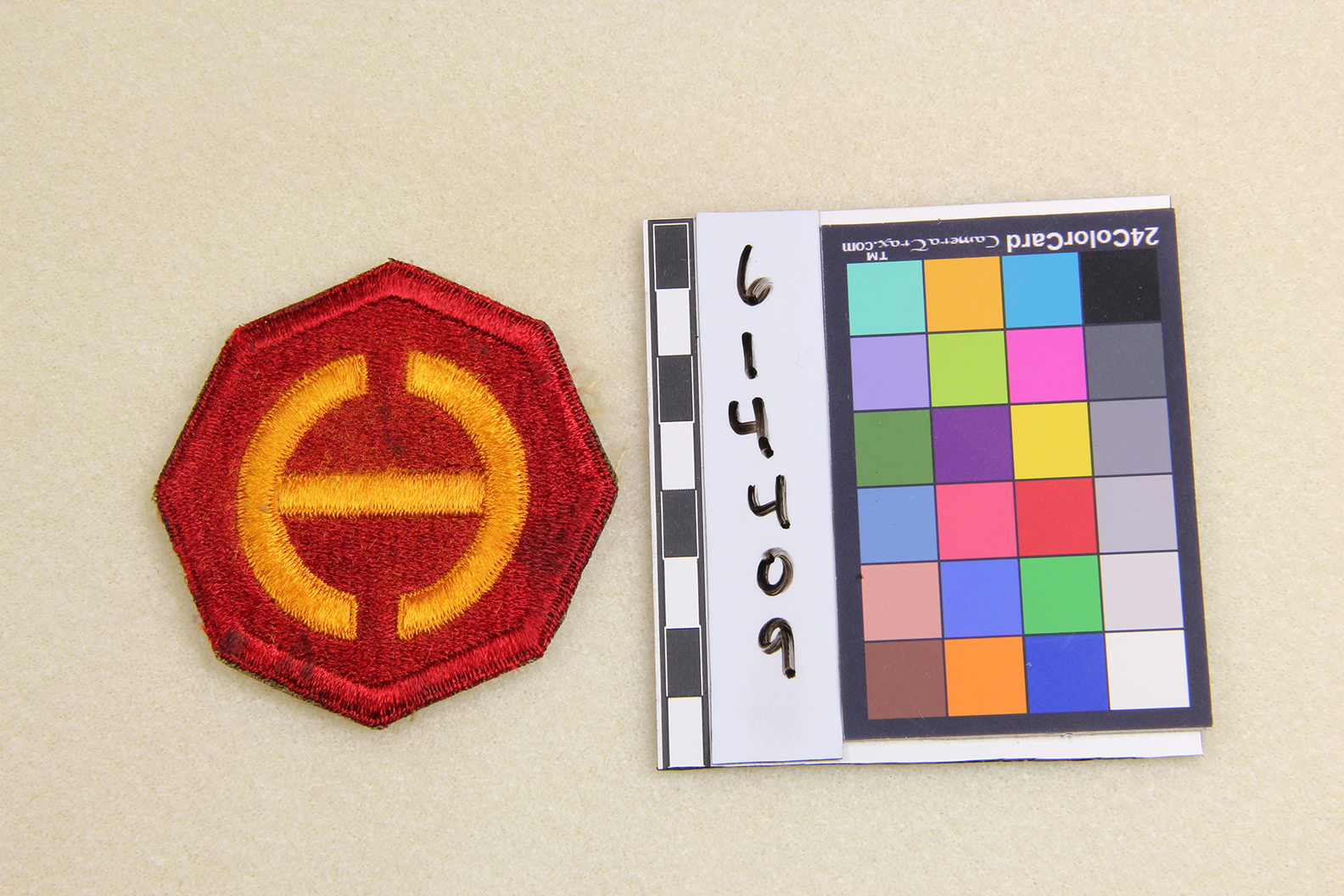 |
| 614410 |
Insignia, Shoulder Sleeve, Iceland Base Command, US Army, Cloth, Blue/White/Red/Green, US, Circa 1943, World War II |
Insignia |
2.4" diameter |
3 g |
 |
| 614480 |
Insignia, Shoulder Sleeve, Italy, US Army, Cloth, Green/Silver, US, Circa 1943, World War II |
Insignia |
5" oval |
9 g |
 |
| 614412 |
Insignia, Shoulder Sleeve, Kagnew Station, US Army, Cloth, White/Red/Blue, US, Circa 1960, Vietnam Era |
Insignia |
2.9" x 2.15" |
3 g |
 |
| 614413 |
Insignia, Shoulder Sleeve, Labrador, N.e. Canada Base Command, US Army, Cloth, White/Red/Blue, US, Circa 1943, World War II |
Insignia |
2.5" diameter |
5 g |
 |
| 614414 |
Insignia, Shoulder Sleeve, Military District Of Washington, US Army, Cloth, Blue/Red/White/Gold, US, Circa 1943, World War II |
Insignia |
2.15" x 2.9" |
4 g |
 |
| 614451 |
Insignia, Shoulder Sleeve, Military Intelligence Center & School, US Army, Cloth, Blue/Yellow/Silver, US, Circa 2005, Early-21st Century |
Insignia |
2.2" x 3" |
4 g |
 |
| 614450 |
Insignia, Shoulder Sleeve, Military Intelligence Center & School, US Army, Cloth, Green/Black, US, Circa 2005, Early-21st Century |
Insignia |
2.2" x 3" |
3 g |
 |
| 614415 |
Insignia, Shoulder Sleeve, Mission To Moscow, US Army, Cloth, Red/White/Blue, US, Circa 1943, World War II |
Insignia |
3.5" x 4.25" |
10 g |
 |
| 614417 |
Insignia, Shoulder Sleeve, Northwest Service Command, US Army, Cloth, Red/Blue/White/Green, US, Circa 1943, World War II |
Insignia |
2.1" x 2.8" |
4 g |
 |
| 614420 |
Insignia, Shoulder Sleeve, Panama Canal Department, US Army, Cloth, Orange/Red/Green, US, Circa 1943, World War II |
Insignia |
2.2" x 2.5" |
4 g |
 |
| 614421 |
Insignia, Shoulder Sleeve, Persian Gulf Command, US Army, Cloth, Green/Red/White, US, Circa 1943, World War II |
Insignia |
2.4" x 3.25" |
6 g |
 |
| 614423 |
Insignia, Shoulder Sleeve, Philippine Department, US Army, Cloth, Blue/White, US, Circa 1943, World War II |
Insignia |
2.95" x 2.6" |
4 g |
 |
| 614425 |
Insignia, Shoulder Sleeve, Ports Of Embarkation, US Army, Cloth, Brown/Gold, US, Circa 1943, World War II |
Insignia |
3" x 3.25" |
8 g |
 |
| 614389 |
Insignia, Shoulder Sleeve, Recruiting Service, US Army, Cloth, Orange/White/Gray, US, Circa 1943, World War II |
Insignia |
2.9" x 3.3" |
6 g |
 |
| 614427 |
Insignia, Shoulder Sleeve, Replacement & School Command, US Army, Cloth, Blue/Gold/Red/Greeen, US, Circa 1943, World War II |
Insignia |
2.5" diameter |
5 g |
 |
| 614428 |
Insignia, Shoulder Sleeve, Shaef, US Army, Cloth, Black/Red/Blue/Gold/White, US, Circa 1943, World War II |
Insignia |
2.45" x 3.35" |
4 g |
 |
| 614441 |
Insignia, Shoulder Sleeve, Tank Destroyer Forces, US Army, Cloth, Orange/Black/Red, US, Circa 1943, World War II |
Insignia |
2.8" diameter |
5 g |
 |
| 614449 |
Insignia, Shoulder Sleeve, U.s. Army Forces Western Pacific, US Army, Cloth, Red/White/Blue, US, Circa 1943, World War II |
Insignia |
2.55" diameter |
5 g |
 |
| 614495 |
Insignia, Shoulder Sleeve, U.s. Army Pacific, US Army, Cloth, Blue/Silver/Red, US, Circa 1943, World War II |
Insignia |
2.6" diameter |
4 g. |
 |
| 614499 |
Insignia, Shoulder Sleeve, U.s. Military Academy, US Army, Cloth, White/Blue/Red, US, Circa 1943, World War II |
Insignia |
2.35" x 2.85" |
5 g |
 |
| 614497 |
Insignia, Shoulder Sleeve, U.s.a. - R.o.k. Combined Field Army, US Army, Cloth, Blue/White/Black/Red, US, Circa 1990, Late-20th Century |
Insignia |
3.25" x 2.4" |
4 g |
 |
| 421681 |
Insignia, Shoulder Sleeve, V Corps, US Army, RAYON, White/Blue, US, Circa 1974, Late-20th Century |
Patch, V Corp. Royal blue and white pentagon shaped rayon embroidered patch, white merrowed (overedge stitching) edge, and five (5) spokes from center to corners forming five (5) blue isocoles triangles. |
1.25" |
.12 oz |
 |
| 614502 |
Insignia, Shoulder Sleeve, Women's Air Ferrying Command, Woman's, US Army, Cloth, Blue/Red/Gold/Silver/Black, US, Circa 1943, World War II |
Insignia |
2.9" diameter |
7 g |
 |
| 428190 |
Instructions, Aircraft Recognition, Iraqi Army, Iraqi, Circa 1990, Persian Gulf War (Desert Storm) |
A wood framed 2 sided air-craft recognition chart/poster consisting of 2 paper posters on opposite sides of a .125in thick piece of plywood with nailed frames of dissimilar materials. On one side are pictured 12 different allied jet aircraft, on the other side are pictured 15 allied helicopters. Identification on all aircraft in Arabic. |
40.38" x 1" x 28.13" |
7 lbs 6 oz |
 |
| 842742 |
Instructions, Assembly, US Army, Paper, White/Black/Red, US, Global War on Terrorism |
Instructions printed on a single sheet of white paper, folded several times. The instructions are printed in various languages. |
4.5" x 6" |
|
 |
| 421098 |
Instrument, Crucible, Silver Assay, Clay Ceramic, Brown/Black, US, Circa 1890, Late-19th Century |
Clay ceramic silver assay crucible, base 5 cm diameter, top formed into triangle shape with 7 cm sides x 10 cm high; has dark residue of melted elements in bottom and along one spout. |
7 cm X 10 cm |
10 OZ |
 |
| 427987 |
Instrument, Transit, W/case, Iraqi Army, Metal/Rubber/Leather/Plastic, Olive Green/Black, T2, Iraqi, Circa 1990, Persian Gulf War (Desert Storm), SN: 277518 |
A "Wild T-2" swiss mfg transit with sealed metal case with leather carrying strap. Ser# 277518. Screwdriver clipped to bottom of case. Operators handbook is Arabic. Also included is a bag of silica gel with instructions. The whole encased in a rubberlined olive green fiberglass container. |
12" x 12" x 20.5" |
29 lbs 2oz |
 |
| 427989 |
Instrument, Tripod, Aiming Circle, Iraqi Army, Metal, Olive Green/Black, PAB2M, Iraqi, Circa 1981, Persian Gulf War (Desert Storm), SN: 0106-81 |
Tripod for PAB-2M Aiming Circle. Has adjustable legs(max adj 66 in)(see 1IDHH1325) and a .75 in wide carrying strap. Bottom has attachment for plumb bob. |
5" x 5" x 38.75" |
11 lbs 8oz |
 |
| 84342 |
Iron, Fribig, Civilian, Man's, NONE, Wood/Steel, Brown/Gray, 20" X 1 1/4" X 12", US, Circa 1895, Late-19th Century |
An all wooden factory made plane of early to mid 19th century style. Ohio Tool Company can a steel warranted and two arrows on face of steel chisel. |
20" x 1 .25 x 12" |
|
 |
| 421411 |
Jacket (Set), Field, US Army, Cotton Poplin, Olive Drab, US, 1945, World War II |
A short olive drab cotton poplin jacket with a wool flannel lining, two side slash pockets, a button and zipper front closure, and a roll collar with notched lapels. |
|
|
 |
| 425956 |
Jacket, Fatigue, Man's, US Army, Cotton HBT, Olive Drab, Medium, US, Circa 1938, Mid-20th Century |
A jacket with two pleated breast pockets, metal 13 star buttons with waist band and adjusting straps. 5th button from the bottom is bent and partly missing. Faded, rust stains on left pocket and left arm. Neck has been repaired |
28" x 22" x 1.5" |
1 lb 9 oz |
 |
| 426382 |
Jacket, Fatigue, Man's, US Army, Cotton HBT, Olive Drab, US, Circa 1943, World War II |
A long sleeve, olive drab, herringbone twill cotton jacket with button front, two patch breast pockets with button flaps, and pointed fall collar. |
|
|
 |
| 426548 |
Jacket, Fatigue, Man's, US Army, Cotton HBT, Olive Drab, US, Circa 1943, World War II |
A long sleeve, olive drab, herringbone twill cotton jacket with button front, two patch breast pockets with button flaps, and pointed fall collar. |
|
|
 |
| 468120 |
Jacket, Field, 1st Infantry Division, Enlisted, Man's, US Army, Wool, Olive Drab, M1944, 40R, US, Circa 1945, World War II |
A short, waist length jacket with two flapped chest pockets, a notched lapel collar, shoulder straps, buttoned cuffs, and metal buckles at each side of the waist. 1st Inf Div patch sewn to left shoulder sleeve. |
|
1 lb |
 |
| 426804 |
Jacket, Field, 1st Infantry Division, Enlisted, Man's, US Army, Wool, Olive Drab, M1944, US, Circa 1944, World War II |
A waist-length, single breasted, wool olive drab jacket, with a concealed button front, two patch pockets, button down shoulder loops, and a roll collar with notched lapels. With 1st Div SSI. |
24 X 32 |
|
 |
| 468160 |
Jacket, Field, 1st Infantry Division, Enlisted, Man's, US Army, Wool, Olive Drab, M1950, 36R, US, 1951, Mid-20th Century |
Short, waist length jacket with two flapped chest pockets, covered button front, notched lapel collar, shoulder straps, and snapped waistband. Has 1ID patch on left shoulder, also has marks on the right shoulder from a previous patch. Light scattered moth damage is apparent. |
|
1 lb 12 oz |
 |
| 650219 |
Jacket, Field, 40th Infantry Brigade, Enlisted, Man's, US Army, Wool, Olive Drab, 38L, US, Mid-20th Century |
Olive drab jacket commonly known as an "Ike" jacket. It is a shortened jacket ending at the waist. Two tabbed breast pockets, tabbed at the shoulder, knotched lapel and button cuffed sleeves. Shoulder insignia designates rank as staff sergent on each sleeve and 40th Inf. Bdg insignia on right shoulder. Interior is lined with coarse tannish cotton. |
|
3 lbs. |
 |
| 425928 |
Jacket, Field, 69th Infantry Division, US Army, Cotton Poplin/Wool, Olive Drab, P1941, Medium, US, Circa 1942, World War II |
A cotton poplin field jacket as issued early during WW2 to U.S. troops under stock numbers 55-J-200 through 55-J-304. This specimen has a 69th Division SSI on the left shoulder. Cuffs and hem are beginning to show signs of fraying. Back side of right sleeve has light rust and white paint stains. One 1/2" hole below right pocket has been repaired by some previous owner by applying an iron on patch from the inside. Sleeve: 31", Back: 18", Lenght: 25". |
20" x 30" x 3" |
2 lbs |
 |
| 421620 |
Jacket, Field, 92d Infantry Division, US Army, Cotton Poplin/Wool, Olive Drab, P1941, Small, US, Circa 1942, World War II |
Jacket, M1941 Parsons. 92nd Div patch. short olive drab cotton poplin jacket with a wool flannel lining, two side slash pockets, a button and zipper front closure, and a roll collar with notched lapels. |
|
2 LBS |
 |
| 421421 |
Jacket, Field, 93rd Inf Div, US Army, Cotton Poplin/Wool, Olive Drab, M1941, 42, US, Circa 1942, World War II |
Jacket, parsons M1941. Cotton poplin jacket with a wool flannel lining, two side slash pockets, a button and zipper front closure, and a roll collar with notched lapels. 93d Div patch. |
|
2 LBS |
 |
| 376303 |
Jacket, Field, Camouflage, Czech Army, Cotton/Nylon, Yellow/Green/Black, 40R, Czechoslovakian, Circa 1960, Mid-20th Century |
Zipper and button front two pockets mainly yellow. |
|
0.903 kg |
 |
| 377048 |
Jacket, Field, Camouflage, East Germany Army, Cotton/Polyester, Brown/Olive Green, East German, Circa 1980, Late-20th Century |
Field jacket with gray pebble finish buttons and a "running raindrop" camoflage design. |
|
|
 |
| 377062 |
Jacket, Field, Camouflage, Estonian Army, Cotton, Dark Green/Green/Black, 182-100, Estonian, Circa 1997, Late-20th Century |
Four pocket field jacket with an additional pocket on the left sleeve. An inner turquoise water proof pocket is sewn into the left breast. Insignia includes; two slip-on rank markings for the shoulder straps, being camoflage with four medium green snow flakes on each piece. A name tape embroided "TIRU" is sewn over the right breast pocket, "EESTI KAITSEVAGI" is embroidered directly into the coat above the left breast pocket. A national crest, triangular embroidered SSI, with the national colors and "ESTONIA" is sewn to the left sleeve pocket. The right sleeve has a peacekeeper SSI buttoned on bearing the Estonian blue lions on a gold shield. |
21" x 33" |
1 lb 12 oz |
 |
| 377077 |
Jacket, Field, Camouflage, Finnish Army, Cotton/Polyester, Green/Brown, 752, Finnish, Circa 1997, Late-20th Century |
Field jacket four front pockets, a right sleeve pocket, and drawstring waistband. Front pockets and front of jacket close with zippers. Insignia includes blue and white SFOR SSI on the right sleeve, a printed Finnish battleflag SSI on the left sleeve and a velcro rank insignia below the flag SSI. The flag has a lion in the middle of the blue cross and the word "FINLAND" printed below the flag. The green rank insignia has three black painted metal flowers or snowflakes that denote the wearer's rank. |
21.5"w x 35"l |
2 lb 3 oz |
 |
| 376906 |
Jacket, Field, Camouflage, German Army, Cotton, Green/Brown/Tan, MEDIUM, German, Circa 1943, World War II |
A hooded insulated jacket with patern camouflage and a silver colored liner. Right arm is badly fadded torn. Under arms have been inlarged. Many alternations and repairs. 10 plastic buttons, two missing. |
|
2 oz |
 |
| 377082 |
Jacket, Field, Camouflage, Parachutist's, Polish Army, Cotton, OliveGreen/Brown/Black, 86-163, Polish, Circa 1997, Late-20th Century |
Jacket with four pockets on the front, one pocket on the right sleeve, two on the left, and two zippered pockets in the rear of the skirt. Each shoulder has an embroidered Polish flag sewn to it. The right sleeve pocket has a blue and white SFOR SSI, the top left sleeve pocket has a paratrooper badge (white rubber on maroon woolen) bearing a parachute and eagle. The shoulder straps have slip-on camoflage rank insignia (each with four gray rubber stars on cloth). The inside carries the size and manufacturers label. Over the right breast pocket is a velcro name tag "RYSZKIEWICZ" (white letters on green rubber). |
19" x 31" |
2 lb 3 oz |
 |
| 377051 |
Jacket, Field, Camouflage, Polish Army, Cotton, Gray-Green/Dark Green, Polish, Circa 1980, Late-20th Century |
Field jacket in Polish camoflage pattern, which has a squiggly effect. |
|
|
 |
| 377125 |
Jacket, Field, Camouflage, Russian Army, Cotton/Polyester, Green/Brown, 48-3, Russian, Circa 1996, Late-20th Century |
Field jacket with two breast, two sleeve pockets, shoulder straps and reinforced elbows. Left sleeve pocket has a Russian national SSI (black woolen background, yellow cyrillic script and Russian flag in the center). Lining is olive green and there is one inside pocket. The collar has an airborne badge on each side of antiqued white metal with a parachute, airplanes on either side with a wreath around it. The related metal badges are attached to the right pocket flap. Many of the exposed buttons were melted by the cleaners who had to launder and press the artifact. |
21.25"w x 31.5"l |
1 lb 9 oz |
 |
| 377113 |
Jacket, Field, Camouflage, Russian Army, Cotton/Polyester, Green/Brown, 52-3, Russian, Circa 1995, Late-20th Century |
Field jacket with two breast pockets, two sleeve pockets and shoulder straps. The jacket is devoid of insignia. The inside is lined with olive green cotton cloth. There is an inside pocket on right side and a pistol pocket on the left. The pistol pocket has blue cloth on the outside, brown plastic on the inside and a lanyard attached. |
22"w x 31"l |
1 lb 10 oz |
 |
| 377067 |
Jacket, Field, Camouflage, Swedish Army, Cotton/Polyester, Green/Black, 180-85, Swedish, Circa 1995, Late-20th Century |
Heavy four pocket jacket with with drawstring at the waist and reinforced elbows. Pockets close with heavy zippers. Front is secured with a zipper and snaps. Includes the follwing badges; On left sleeve, a bevo weave Swedish flag and Swedish coat of arms with the word "SWEDEN" over them. Right sleeve has a blue and white SFOR SSI. The collar has sewn on rank tabs, right side has a crown over crossed swords, left side has three yellow stars. Manufacturing label inside. |
22" x 35" |
2 lb 8 oz |
 |
| 376308 |
Jacket, Field, Captain's, Dutch Army, Cotton, Olive Green, 96 (metric size), Dutch, Circa 1984, Late-20th Century |
Olive green fatigue jacket with two rectangular breast pockets. All fastenings are snap closures. There is a Dutch National emblem on the left shoulder (red, white and blue), and slip on captain's insignia (three stars) on each epaulette. |
|
0.665 kg |
 |
| 377045 |
Jacket, Field, Desert Camouflage, French Army, Cotton, Tan/Brown/Gray, French, Circa 1990, Persian Gulf War (Desert Storm) |
Short waist-length jacket with an elastic band around the bottom. |
|
|
 |
| 427913 |
Jacket, Field, Enlisted, Man's, US Army, Wool, Olive Drab, M1944, 38 Regular, US, Circa 1944, World War II |
A waist-length, single breasted, wool olive drab jacket, with a concealed button front, two patch pockets, button down shoulder loops, and a roll collar with notched lapels. Shadow on lower right sleeve from a meritiorious unit citation. |
|
2 lbs 8 oz |
 |
| 426403 |
Jacket, Field, Enlisted, Man's, US Army, Wool, Olive Drab, M1944, 38R, US, Circa 1944, World War II |
A waist-length, single breasted, wool olive drab jacket, with a concealed button front, two patch pockets, button down shoulder loops, and a roll collar with notched lapels. On the right sleeve: 15th Army patch and Technician 3rd Grade chevron. On the left sleeve: HQ European Theater of Operations patch and Technician 3rd Grade chevron. On the front above right breast pocket is "Honorable Service/Discharge Emblem" |
|
|
 |
| 426803 |
Jacket, Field, Enlisted, Man's, US Army, Wool, Olive Drab, M1944, 38R, US, Circa 1944, World War II |
A waist-length, single breasted, wool olive drab jacket, with a concealed button front, two patch pockets, button down shoulder loops, and a roll collar with notched lapels. Medical Corps insignia on collar. Sewn ribbons: Silver Star, Bronze Star, European-African-Middle Eastern Campaign w/4 bronze stars |
24 X 38 |
|
 |
| 421630 |
Jacket, Field, Enlisted, Man's, US Army, Wool, Olive Drab, M1944, 42, US, Circa 1945, World War II |
Ike jacket, M1944. ,Appears to be rather dirty/stained. With pants. |
|
2 lbs 12oz |
 |
| 446179 |
Jacket, Field, Enlisted, Man's, US Army, Wool, Olive Drab, M1944, US, Circa 1944, World War II |
A waist-length, single breasted, wool olive drab jacket, with a concealed button front, two patch pockets, button down shoulder loops, and a roll collar with notched lapels. |
|
|
 |
| 427057 |
Jacket, Field, Enlisted, Man's, US Army, Wool, Olive Drab, M1950, 38 Long, US, 1952, Mid-20th Century |
A M1950 jacket with olive green satin lining. Patches have been removed, 4th from top button hole is torn 3/8". |
|
2 lbs |
 |
| 427276 |
Jacket, Field, First Sergeant's, 1st Us Army, Enlisted, Man's, US Army, Wool, Olive Drab, 36 Regular, US, Circa 1950, Mid-20th Century |
A field jacket with a 1st Army SSI on the left shoulder, miniature blue on gold 1SGT chevrons on both sleeves & 7 service stripes. 1st Div SSI on right shoulder. Service stripes are beginning to unravel. Insignia puncture marks on both collars. Button missing from right sleeve. |
|
2 lbs 8 oz |
 |
| 377119 |
Jacket, Field, Lightweight, Camouflage, Parachutist's, Russian Army, Cotton, Dark Green/Light Green/Brown, 182-188, 96-100, Russian, Circa 1997, Late-20th Century |
Field jacket with two breast, two lower and one left sleeve pockets. The back, sleeves and chest have loops attached for securing camoflage material. There are buttons around the collar for securing the hood. The left sleeve pocket has the Russian national SSI sewn to it, this being a black badge with yellow cyrillic lettering and a white, blue and red Russian flag in the center. The collar has a paratrooper badge on each side. The paratrooper bades are antiqued white metal depicting a parachute with airplanes on either side and surrounded with a wreath. The elbows are reinforced. |
20"w x 30.75"l |
10 oz |
 |
| 427142 |
Jacket, Field, Man's, US Army, Cotton, Olive Drab, M1943, 34 Long, US, Circa 1943, World War II |
Both sleeves frayed at the cuffs. Jacket is dirty with black smudges on both sleeves and back. Grey paint on back bottom of coat. Collar wind flap is missing and collar button is missing. Tag is washed out. Several rust spots on both sleeves. |
34 LONG |
2 lbs 10oz |
|
| 425921 |
Jacket, Field, Man's, US Army, Cotton, Olive Drab, M1943, 34 Regular, US, Circa 1944, World War II |
Collar sweat stained, left lower pocket button missing, small reddish stains at right waist and inside rear hem. 2 1/4 " tear on hem of liner and small (1/8") puncture on rear bottom. Slightly soiled. |
17" x 20" x 3" |
2 lbs 10oz |
 |
| 426613 |
Jacket, Field, Man's, US Army, Cotton, Olive Drab, M1943, US, Circa 1944, World War II |
A thigh-length jacket with internal waist and hem adjustment cords, shoulder loops, two patch breast pockets with flaps, and two slash skirt pockets with flaps. |
. |
|
 |
| 434069 |
Jacket, Field, Man's, US Army, Cotton, Olive Drab, M1950, Extra-Small Regular, US, Circa 1950, Mid-20th Century |
An olive drab shade 7 field jacket, M-1950. 7 button front closure with an elastic cord adjusted at the waist. Button cuffs and four pockets. |
31.5" x 20" |
34 oz |
 |
| 434068 |
Jacket, Field, Man's, US Army, Cotton, Olive Drab, M1950, Small, US, Circa 1950, Mid-20th Century |
An olive drab shade 7 field jacket, M-1950. 7 button front closure with an elastic cord adjusted at the waist. Button cuffs and four pockets. |
31.5" x 20" |
34 oz |
 |
| 426001 |
Jacket, Field, Man's, US Army, Cotton, Olive Green, M1951, Large Regular, US, Circa 1955, Mid-20th Century |
A M1951 field jacket with both sleeve cuffs frayed through, hem frayed through in spots, 1 3/4" rip on left front pocket, and several scattered punctureson front. Scattered black & white paint smears over front and both sleeves. |
24" x 32" x 2" |
3 lbs 8 oz |
 |
| 421961 |
Jacket, Field, Master Sergeant's, 93rd Infantry Division, Enlisted, Man's, US Army, Wool, Olive Drab, M1944, 40R, US, Circa 1945, World War II |
Ike jacket. 93d Inf. Division patch on left shoulder, MSG chevrons, service stripes, overseas service bars, MUC wreath, and WWI service chevrons on both sleeves. |
|
2 LBS |
 |
| 428275 |
Jacket, Field, Master Sergeant's, Us Forces Austria, Enlisted, Man's, US Army, Wool, Olive Drab, M1944, 38 Long, US, Circa 1947, Mid-20th Century |
Jacket with metal buckle type waist band adjusting straps. Master Sergeant chevrons on each sleeve with 1st DIv SSI on right shoulder and U.S. Forces Austria SSI on the left. MSG chevron on right arm slightly stained. |
25" x 30" |
2 lbs 6 oz |
 |
| 427056 |
Jacket, Field, Technician Fifth Class', Enlisted, Man's, US Army, Wool, Olive Drab, M1944, 36S, US, 1944, World War II |
A jacket with OD cotton lining. ETO patch on the left shoulder. Combat patch 2nd AD and T-5 rank insignia on each sleeve. T-5 stripes loosely sewn and about to fall off. Also a "ruptured duck" (Honorable discharge patch) above right pocket. Three ribbons (ACM, ADS, EAME Campaign) with two bronze stars. On lower left sleeve are five yellow metal bars (o/s service 6 months ea) and one slanted stripe (3yrs service). |
|
2 lbs 10oz |
 |
| 377109 |
Jacket, Flight, Helicopter Pilot's, Camouflage, Russian Army, Cotton/Polyester, Light Green/Dark Green/Brown, 52-5, Russian, Circa 1992, Late-20th Century |
Flight jacket with two front pockets. Pockets have zipper closures. The right pocket is rectangular, the left pocket is made to carry a pistol. The right pocket has an inside pocket attached as well. The front of the jacket closes with a zipper and the waist band has adjustable pull tabs. |
22.25"w x 28.5"l |
1 lb 7 oz |
 |
| 422658 |
Jacket, Mess Dress, Master Sergeant's, Enlisted, Man's, US Army, Wool/Satin, Black, 38, US, Circa 1980, Late-20th Century |
Jacket, Mess Dress NCO blk. satin lapels, brass buttons, NCO chevrons, six (6) hash marks, full rayon lining. |
|
2 lbs 1 oz |
 |
| 377815 |
Jug, of Sand, Normandy Beachhead/Omaha, Sand, Brown, French, 1994, Late-20th Century |
Plastic jug, six sides, screw on cap containing six pounds of sand, |
6" dia x 7.5" High |
5 LBS 4 OZ |
 |
| 822604 |
Jump Boots, US Army, Leather, Brown, 7, US, 1942, World War II |
Boots, Para 1942 russet |
|
|
 |
| 421941 |
Key, Telegraph, US Army, Brass/Metal, Bright/Black, US, 1940, World War II |
Key, telegraph. Brass and metal telegraph key, with it's attachment chord. The key itself is made of brass, while the base of the item is made of pot metal. |
6.25" x 3.5" |
3 lbs 12oz |
 |
| 421198 |
Key, Telegraph, US Army, Brass/Steel, Bright/Black, US, Circa 1930, Mid-20th Century |
Telegraph Key. Steel base with black pebbled finish, nickled steel bar, screws and fittings, flat composition msterial finger button. |
5.5" x 2.1" x 1.7" |
7 OZ |
 |
| 422110 |
Key, Telegraph, US Army, Metal, Black, US, Circa 1930, Mid-20th Century |
Telegraph, knee. Incomplete, no key. Black metal horseshoe shaped transmitter, with two transmitter keys. The item shows some wear. |
5.5" x 3.5" x 1 7/ |
11.5 oz |
 |
| 422113 |
Key, Telegraph, US Army, Metal/Brass, Black/Bright, US, Circa 1910, Early-20th Century |
Key, Telegraph. Blk metal with a brass "punching" handle and a wooden knob. The key has several prongs for wire attachment. |
5.5" x 2.5" |
10 OZ |
 |
| 422083 |
Key, Telegraph, US Army, Steel/Brass, Black/Bright, US, Circa 1942, World War II, SN: 88943 |
Key, Telegraph |
6.5" X 3.5" X 3.5" |
3 lbs 10oz |
 |
| 422868 |
Key, Telegraph, US Army, Steel/Brass, Olive Drab, T-G-5-B, US, Circa 1943, World War II |
Telegraph key. Steel box, top opens and front side folds down with telegraph key on fold down part. |
7" x 4" x 4.9" |
5 lbs 4 oz |
 |
| 614164 |
Kit (Set), Decontamination, Chemical Agent, Iraqi Army, Metal/Paper/Plastic, Green/Yellow, LPD, Iraqi, 1980, Persian Gulf War (Desert Storm) |
Kit |
3.6" w x 5.3" l x 1.5" h |
6.5 oz |
 |
| 423147 |
Kit (Set), Medical, Field, US Army, Cotton Canvas, Olive Drab, US, Circa 1912, Early-20th Century |
Medical Kit. A khaki cotton medical kit carrying case (9" x 5.5"); containing a metal case (5" x 1" x .25"), with two scapels; a piece of metal (4.5" long), with a hook at one end; tweezers (4" x .375" x 1"); a metal case (3.5" x 1.75" x .75" ), with metal hypodermic needle case, two screw-on needles, six glass vials with medicine tablets, and serveral pieces of thin wire. NOTE: Other items enclosed, include two paper envelopes with Aseptic Catgut Ligatures and one envelope with Surgeon's Needles. All envelopes have been opened. |
9" x 5.5" |
8 oz |
 |
| 423008 |
Kit (Set), Mess, Corrosion Resistant, (with Knife And Fork), US Army, Steel, Bright, P1942, US, 1942, World War II |
Mess Kit with table knife, fork 7.5" x 1", tablespoon |
|
1 lb 3.5oz |
 |
| 421376 |
Kit (Set), Signal Flags, Signal Corps, US Army, Canvas, Olive Drab, US, Circa 1916, Early-20th Century |
An olive drab cotton canvas case for the signal corps flag kit (64.8 x 12cm), flap on top secured by a strap and brass three-bar frame buckle. Shoulder strap attached to one side and, two pieces of leather thong threaded through gromets on one side. Two hickory staffs for semaphore flags; two semaphore signal flags diagonally red and white; two signal flags (red with white center and white with red center). (The three-section pole found in case No. 3077 B 2.4C goes to these flags). |
|
1 lb 9 oz |
 |
| 421372 |
Kit (Set), Signal Flags, Signal Corps, US Army, Canvas, Olive Drab, US, Circa 1917, World War I |
Flags, SigC. OD cotton canvas case for the signal corps flag kit (64.8 x 12cm), flap on top secured by a strap and brass three-bar frame buckle. Shoulder strap attached to one side and, two pieces of leather thong threaded through gromets on one side. Two two semaphore signal flags diagonally red and white are wrapped around hickory staffs. |
17" x 17" |
1 LB 1 OZ |
 |
| 422038 |
Kit (Set), Signal Flags, Signal Corps, US Army, canvas, Olive Drab, US, Circa 1918, World War I |
Case, SigC Flag. OD cotton canvas case for the signal corps flag kit (64.8 x 12cm), with a flap on top secured by a strap and brass three-bar frame buckle. Shoulder strap attached to one side and, two pieces of leather thong threaded through gromets on one side. Case contains a three section wood and brass rod for the 2 foot signal flags. No Flags. |
25" x 4.5" |
1 lb 14 oz |
 |
| 421319 |
Kit (Set), Surgical, Pocket, US Army, Leather/Steel, Black/Bright, US, Circa 1860, Civil War |
Surgical kit, c1900. Small black kid leather kit with red velvet and leather lining with 13 instruments: a) case; b) steel spring; c) scalpel folds into steelcase, .375" curved blade with shell; d) carved hook with shell; e) 2.75" curved blade with shell, 2.5" curved blade with shell; g) small hook with broken shell; h) .875" shaft with all cutting edge a shell; i) tongue lifter; j) scissor type clamp; k) hollow snake; l) 4.75" tweezers; m) snake; n) pick. |
6" x 2.5" x 1.25" |
5.5 oz |
 |
| 421271 |
Kit (Set), Surgical, Pocket, US Army, Leather/Steel, Black/Bright, US, Circa 1900, Early-20th Century |
Surgeons Tool Kit. Blk leather case which unfolds flat, with loops sewn to fit the instruments which include: Four scalpels in case section with pieces of cork to protect the blades, One tongue lifter, q curved sharp-pointed pbobe, one scissors-clamp, and two needles in section behind clamp. The leather somewhat worn and torn around snap. |
5.5" x 2." x 1" |
5 OZ |
 |
| 426425 |
Kit, Decontamination, Chemical Agent, Iraqi Army, Metal, Green, Iraqi, Persian Gulf War (Desert Storm) |
|
|
|
 |
| 428182 |
Kit, Detection, Chemical, Iraqi Army, Canvas/Glass/Chemicals, Tan/Olive Drab, Iraqi, Circa 1985, Persian Gulf War (Desert Storm) |
A rubber lined tan light weight canvas box with a 2in wide adjustable carrying strap. Box is re-inforced with masonite inserts bottom and back. Interior divided into three separate pockets of differing sizes. Inside is a small green cloth bag with 9 each pointed wooden stakes with various markings in Arabic. Inside are 2 paper packages, #1 marked with 3 green bars and containing ten each 4.5inch long glass ampules with a yellow liquid inside. Marked on package "0634" and "Valid to November 1989" (Phosgene and Di-Phosgene test ampules). # 2 is marked with a red bar and dot and contains 8 test ampules for Sarin, Soman, and V gases.Case is faded and soiled. Rubberized lining coming loose on the cover. |
7" x 4" x 9" |
1 lb 8 oz |
 |
| 567569 |
Kit, Medical, Dental Tools, Stainless Steel, Bright, US, Mid-20th Century |
All stainless steel instruments. MED 6091 Kit, Dental .01 Burr, Dental .02 Mandrell .03 Mandrell .04 Burr .05 Mandrell .06 Mandrell .07 Mandrell .08 Straight Burr .09 Mandrell .10 Mandrell .11 Burr, Surgical .12 Straight Burr .13 Straight Burr .14 Mandrell .15 Mandrell .16 Mandrell .17 Mandrell .18 Finishing Point .19 Mandrell .20 Burr, Round .21 Burr, Round .22 Burr .23 Burr, Dental .24 Burr, Round MED 6091. Dental Kit .25 Polishing Stone .26 Polishing Wheel .27 Polishing Disc .28 Finishing Disc .29 Finishing Disc .30 Polishing Wheel .31 Polishing Disc .32 Polishing Disc .33 Finishing Disc .34 Grinding Wheel with Diamonds .35 Finishing Disc .36 Finishing Point .37 Mandrell .38 Mandrell .39 Polishing Disc .40 Finishing Disc .41-.69 Polishing Brushes .70-.84 Brush, Buffing .85-.88 Scalers .89-108 Mirror, Mouth .109 Hemostat .110 Plugger .111 Spatula .112 Margin Trimmer MED 6091. Dental Kit .113 I. D. Not Known .114 Excavator .115 Plastic Instrument .116 Carver, Amalgam .117 Scaler .118 Scaler, Broken Tip .119 Excavator .120 Chisel .121 Spoon Excavator .122 Carrier for Amalgam .123 Hemostat .124 Dycal Instrument .125 Wax Instrument .126 Chisel .127 File, Bone .128 I D Not Known .129 Chisel .130 Chisel .131 Scaler .132 Carver .133 Carver, Amalgam .134 File, Bone .135 Excavator .136 I. D. Not Known MED 6091. Dental Kit .137 Instrument Handle, tip missing .138 Burnisher .139 Broken Tip I. D. not known .140 Chisel, Dental .141 Carver .142 Mirror, Mouth .143 Mirror, Mouth .144 Mirror, Mouth .145 Barb Parker/Blade Handle .146 I. D. Not Known .147 Margin Trimmer .148 Hatchet .149 Root Elevator .150 Chisel .151 Cotton Forcept .152 Mirror, Mouth .153 Carver .154 Plastic Instrument .155 Scaler .156 Dycal Instrument .157 I D Not Known .158 Remover, Crown .159 Remover, Crown .160 Forcept MED 6091. Dental Kit .161 Tool Handle .162 Root Elevator .163 Margin Trimmer .164 Chisel .165 Barb Parker, Blade Handle .166 Carver .167 Margin Trimmer .168 Scaler .169 Margin Trimmer .170 Broken Tip, I D Not Known .171 Chisel .172 Chisel .173 Chisel .174 Plugger .175 Hatchet .176 Elevator .177 Chisel .178 Chisel .179 Chisel .180 Finishing & Polishing Discs .181 Brushes, Thin, w/ bag .182 Hatchet .183 Wooden Mallet .184 Pliers MED 6091. Dental Kit .185 Wire Cutters .186 Sissors .187 Surgical Sissors .188 Dental Dam Punch .189 Wire Bender .190 Drill Bit Holder .191 Surgical Sissors .192 Surgical Sissors .193 Surgical Sissors .194 Crown & Collar Sissors .195 Sissors, Surgical .196 Forcept/Pliers .197 Screw Driver .198 Aspirator .199 Knife, Putty .200 Knife, Putty .201 Screwdriver .202 screwdriver .203 SCREWDRIVER .204 DENTAL LAB INSTRUMENT .205 TOOL HANDLE .206 NOT KNOWN .207 TOOL HANDLE .208 FILE MED 6091. Dental Kit .209 CROWN REMOVER PART A .210 CROWN REMOVER PART B .211 NOT KNOWN .212 NOT KNOWN, GREEN LENS .213 GAUGE, MEASURING .214 WRENCH .215 HOOK, GERMAN TUNIC .216 WIRE .217 small electric buzzer in round metal container .218 DRAWING INSTRUMENT IN BOX .219 GLASS MORTAR? .220 SPLINT .221 BUNDLE WOODEN STICKS .222 HEX WRENCH .223 BOX, ARTICULATING PAPER .224 BOX-RAZOR BLADES .225 BUNDLE WOODEN STICKS .226 A-B 2 PACKAGES ARTICULATING PAPER .227 TUBE-LUBRICANT .228 WIRE ON SPOOL .229 WIRE ON SPOOL .230 PACKAGE-GOLD CYLINDERS .231 TIN CONTAINER WITH DENTAL FILM .232 SHARPENING STONE IN LEATHER SHEATH |
7" |
10lbs |
 |
| 421048 |
Kit, Sewing, (with Contents), US Army, Cotton, Tan/Blue, US, Circa 1918, World War I |
Housewife, WW2. Tan cotton sewing kit with blue bias binding around the edges; includes scissors, needles and buttons. |
11.5" x 4.5" |
5 oz |
 |
| 426929 |
Kit, Sewing, US Army, Cotton, OD/Khaki, US, World War I |
Small sewing kit consisting of 9 brown buttons and 6 white/bone colored buttons. Wrap around strap with metal snap closure. |
|
1. 2 oz |
 |
| 434050 |
Kit, Sewing, US Army, Metal/Fabric/Wood, Brown/Gray/Copper, US, Circa 1941, World War II |
A. sewing kit contained in a 3" long 1 1/4" diameter metal can and consisting of 2 wooden spools(1 white thread and 1 empty), a thimble(which protrudes from the lid when stored), and a 2"long x 1/4" Dia. empty copper capsule for needle storage. Interior of can is grey, exterior is rusting over its entire surface excepting the lid. |
1.25 in dia x 3.75 in |
1 oz |
 |
| 427954 |
Kit, Sewing, US Army, Plastic/Metal/Fabric, Multicolor, US, Circa 1950, Mid-20th Century |
A brown plastic folder with snap closure. Front opens to reveal pocket containing a piece of cardboard with 6 kinds of thread wound on it, a slot in the pocket for the included scissors. Above the pocket is sewn a 2.25 in W x 4.25 in L piece of dark brown felt to hold the needles. Included is a wax paper bag with 6 buttons and a safety pin. |
4.25 in x 2.63 in x .63 in |
2 oz |
 |
| 421473 |
Kit, Signal Panel, Air-ground, US Army, Cotton/Plastic/Wood/Nylon, Olive Drab/Orange/White, US, Circa 1943, World War II |
Signal Panels, Grnd. one-piece Signal-Panel kit consisting of an orange panel, 31" x 74," bound with nylon canvas 1.375" wide, backed with white plastic; straps 67" x .75" fastened through gromets with pine dowels about 1" diameter threaded onto straps with screw eyes; straps across back at mid-length of panel; attached canvas case wraps around and snaps for closure. |
|
3 lbs 2 oz |
 |
| 421307 |
Kit, Snake Bite, US Army, Cardboard/Plastic, Tan/Black, US, Circa 1943, World War II |
SnakeBite kit. Blk plastic case and khaki cardboard box. |
4" x 2.5" x 1" |
3.75 oz |
 |
| 932147 |
Kit, Stamp, Document Embossing, US Army, Metal, Black/Gold, Desktop, US, Circa 1900, Mid-20th Century |
Black enameled cast metal with painted design ("Falling star" with action lines and 5-pointed star with red painted dot in center, on both sides of upright) and gold painted trim. May be early 20th century due to style and weight, and bottom shows signs of new lead as if the stamp had been replaced/updated for use after Ft Huachuca reopened in 1954. |
9-3/4" H x 2-1/4" W x 6" D |
4 lbs 11 oz |
 |
| 421270 |
Kit, Surgical, Pocket, US Army, Leather/Steel, Black/Bright, US, Circa 1880, Late-19th Century |
Surgeons Tool kit. Blk leather kit with pockets to hold surgical tools. Pieces include: two pair of scissors, one small saw, one small scoop, four small scalpels, one blunt end needle, one tongue lifter, one sealed glass vial of catgut, one piece of gauze with seven needles, and other instruments. The kit has pieces of cork glued on to protect the tips of the scalpels. The leather badly torn in places. |
6" x 3" x 1.5" |
9.5 oz |
 |
| 421432 |
Kit, Toiletry, (with Contents), US Army, Leather, Brown, US, Circa 1945, World War II |
Toiletry Kit, WAC (?) A rectangular leather case with flaps at both ends, loops and pockets on the inside to hold the contents, and a metal catch fastener. Includes a black plastic comb, a metal nail file, a brush, and other items. |
27 cm x 19cm x 5 cm |
13.5 oz |
 |
| 832414 |
Knife, Bowie, Homemade, Steel/Wood, Dark Brown, US, Early-20th Century |
Homemade Bowie style knife. Wood handle with finger grooves. Bent guard. |
11 1/4" |
9.3 oz |
 |
| 428234 |
Knife, Presentation, Rocky Mountain Elk Foundation, Civilian, US Army, Steel/Wood, Bright/Brown, US, Circa 1995, Late-20th Century |
A 12 ounce 12 inch hunting knife with a wood laminate handle and a seven inch by 1.3125in wide engraved blade. Engraving consists of a horseman leading 2 pack horses, mountain scenery, a ribbon with words "1995 Commemorative" and the words "Rocky Mountain Elk Foundation" above the whole.The case is of stained oak 13.75in Long x 4.125in W x 2.1875in H with the same picture on top as the knife. Included is the "Certificate of Authenticity" and the warranty form. |
12" x 2.63" x 1" |
1 lb 12 oz |
 |
| 842786 |
Labels (Set), Anesthesia, EPHEDRINE, US Army, Paper, Purple, US, Global War on Terrorism |
(14) label sheets, each sheet containing sixteen adhesive labels. NOTE: One label sheet contains only thirteen adhesive labels. |
4" x 4.5" |
|
 |
| 842784 |
Labels (Set), Anesthesia, FENTANYL, US Army, Paper, Blue, US, Global War on Terrorism |
(20) label sheets, each sheet containing sixteen adhesive labels. NOTE: One label sheet contains only seven adhesive labels. |
4" x 4.5" |
|
 |
| 842785 |
Labels (Set), Anesthesia, KETAMINE, US Army, Paper, Yellow, US, Global War on Terrorism |
(9) label sheets, each sheet containing sixteen adhesive labels. |
4" x 4.5" |
|
 |
| 842788 |
Labels (Set), Anesthesia, LIDOCAINE, US Army, Paper, Gray, US, Global War on Terrorism |
(13) label sheets, each sheet containing sixteen adhesive labels. |
4" x 4.5" |
|
 |
| 842787 |
Labels (Set), Anesthesia, MIDAZOLAM, US Army, Paper, Orange, US, Global War on Terrorism |
(18) label sheets, each sheet containing sixteen adhesive labels. |
4" x 4.5" |
|
 |
| 842790 |
Labels (Set), Anesthesia, MORPHINE, US Army, Paper, Blue, US, Global War on Terrorism |
(10) label sheets, each sheet containing sixteen adhesive labels. |
4" x 4.5" |
|
 |
| 842791 |
Labels (Set), Anesthesia, ROCURONIUM, US Army, Paper, Red, US, Global War on Terrorism |
(12) label sheets, each sheet containing sixteen adhesive labels. |
4" x 4.5" |
|
 |
| 842789 |
Labels (Set), Anesthesia, SUCCINYLCHOLINE, US Army, Paper, Red/Black, US, Global War on Terrorism |
(13) label sheets, each sheet containing sixteen adhesive labels. |
4" x 4.5" |
|
 |
| 422798 |
Lantern, Folding Trench, Stonebridge, US Army, Tin, GRAY, US, Circa 1917, World War I |
Lantern WW1 tin trench candle lantern, opens to a triangle to shelter a candle, two (2) sides have mica sides with a diamond shaped cutout in the center, on one side the mica is half gone. |
7.5" X 4.5" X 1" |
6 oz |
 |
| 422799 |
Lantern, Folding Trench, Stonebridge, US Army, Tin, GRAY, US, Circa 1917, World War I |
Lantern, WW1 tin trench candle lantern, opens to triangle to shelter a candle, two (2) sides have mica sides with diamond shaped cutout in center, one window is mostly broken out. |
7.5" X 4.5" X 1" |
6 oz |
 |
| 428057 |
Lantern, Kerosene, Iraqi Army, Metal/Glass, Silver/Rust, 276, Baby Special, Iraqi, Circa 1980, Persian Gulf War (Desert Storm) |
A West German manufactured Kerosene lantern with telescoping chimney. Model "Feuerhand # 276 Baby Special". Glass is cracked and taped together, lid is missing from fuel tank. Chimney is rusty. |
5.75" x 10.75" |
1 lb 2 oz |
 |
| 427506 |
Lanyard, Organizational, Officer's, Iraqi Army, Fabric, Red/Blue, Iraqi, Circa 1985, To Be Determined |
A red & blue lanyard made 4 each .09375 in cords, 2 blue and 2 red. Shoulder loop ends in a 1 in long by .75 dia knot, the whole ending in a 1 in long loop. Worn around the right shoulder. |
30" x .25" dia |
< 1oz |
 |
| 614362 |
Leaflet, Capture, "MAY CAU NOI VOI TU BIHN MY", Viet Cong, Vietnamese, Circa 1969, Vietnam Era |
Leaflet |
3.9" x 4.67" |
1 g |
 |
| 614363 |
Leaflet, Capture, "MAY CAU NOI VOI TU BIHN MY", Viet Cong, Vietnamese, Circa 1969, Vietnam Era |
Leaflet |
4.08" x 4.62" |
1 g |
 |
| 614308 |
Leaflet, Propaganda, "Bill for Special Fair Treatment", Viet Cong, Vietnamese, Circa 1969, Vietnam Era |
Leaflet |
5.73" x 4.15" |
1 g |
 |
| 614309 |
Leaflet, Propaganda, "Bill for Special Fair Treatment", Viet Cong, Vietnamese, Circa 1969, Vietnam Era |
Leaflet |
5.7" x 4.14" |
1 g |
 |
| 614329 |
Leaflet, Propaganda, "Early End to the Vietnam War", Viet Cong, Vietnamese, Circa 1969, Vietnam Era |
Leaflet |
5.96" x 4.05" |
1 g |
 |
| 614330 |
Leaflet, Propaganda, "Early End to the Vietnam War", Viet Cong, Vietnamese, Circa 1969, Vietnam Era |
Leaflet |
6" x 4.02" |
1 g |
 |
| 614331 |
Leaflet, Propaganda, "Early End to the Vietnam War", Viet Cong, Vietnamese, Circa 1969, Vietnam Era |
Leaflet |
5.94" x 4.02" |
1 g |
 |
| 614332 |
Leaflet, Propaganda, "Early End to the Vietnam War", Viet Cong, Vietnamese, Circa 1969, Vietnam Era |
Leaflet |
6.06" x 3.93" |
1 g |
 |
| 614333 |
Leaflet, Propaganda, "Early End to the Vietnam War", Viet Cong, Vietnamese, Circa 1969, Vietnam Era |
Leaflet |
6.08" x 3.93" |
1 g |
 |
| 614334 |
Leaflet, Propaganda, "Early End to the Vietnam War", Viet Cong, Vietnamese, Circa 1969, Vietnam Era |
Leaflet |
6.06" x 3.93" |
1 g |
 |
| 614345 |
Leaflet, Propaganda, "Early End to the Vietnam War", Viet Cong, Vietnamese, Circa 1969, Vietnam Era |
Leaflet |
3.72" x 5.33" |
1 g |
 |
| 614346 |
Leaflet, Propaganda, "Early End to the Vietnam War", Viet Cong, Vietnamese, Circa 1969, Vietnam Era |
Leaflet |
3.73" x 5.33" |
1 g |
 |
| 614347 |
Leaflet, Propaganda, "Early End to the Vietnam War", Viet Cong, Vietnamese, Circa 1969, Vietnam Era |
Leaflet |
3.72" x 5.33" |
1 g |
 |
| 614353 |
Leaflet, Propaganda, "Officers and Men in the 1st Air Cav Div!", Viet Cong, Vietnamese, Circa 1969, Vietnam Era |
Leaflet |
3.93" x 4.27" |
1 g |
 |
| 614354 |
Leaflet, Propaganda, "Officers and Men in the 1st Air Cav Div!", Viet Cong, Vietnamese, Circa 1969, Vietnam Era |
Leaflet |
3.93" x 4.27" |
1 g |
 |
| 614355 |
Leaflet, Propaganda, "Officers and Men in the 1st Air Cav Div!", Viet Cong, Vietnamese, Circa 1969, Vietnam Era |
Leaflet |
3.95" x 4.29" |
1 g |
 |
| 614356 |
Leaflet, Propaganda, "Officers and Men in the 1st Air Cav Div!", Viet Cong, Vietnamese, Circa 1969, Vietnam Era |
Leaflet |
3.95" x 4.27" |
1 g |
 |
| 614357 |
Leaflet, Propaganda, "Officers and Men in the 1st Air Cav Div!", Viet Cong, Vietnamese, Circa 1969, Vietnam Era |
Leaflet |
3.95" x 4.27" |
1 g |
 |
| 614358 |
Leaflet, Propaganda, "Officers and Men in the 1st Air Cav Div!", Viet Cong, Vietnamese, Circa 1969, Vietnam Era |
Leaflet |
3.9" x 4.3" |
1 g |
 |
| 614349 |
Leaflet, Propaganda, "Peace in Vietnam, Bring American Troops Home!", Viet Cong, Vietnamese, Circa 1969, Vietnam Era |
Leaflet |
6.7" x 1.97" |
1 g |
 |
| 614340 |
Leaflet, Propaganda, "To: American and satellite servicemen wounded in battlefield!", Viet Cong, Vietnamese, Circa 1969, Korean War |
Leaflet |
5.65" x 4.12" |
1 g |
 |
| 614338 |
Leaflet, Propaganda, "To: American and satellite servicemen wounded in battlefield!", Viet Cong, Vietnamese, Circa 1969, Vietnam Era |
Leaflet |
5.67" x 4.1" |
1 g |
 |
| 614339 |
Leaflet, Propaganda, "To: American and satellite servicemen wounded in battlefield!", Viet Cong, Vietnamese, Circa 1969, Vietnam Era |
Leaflet |
5.68" x 4.1" |
1 g |
 |
| 614301 |
Leaflet, Propaganda, "What must you do To Restore Peace Early?", Viet Cong, Vietnamese, Circa 1969, Vietnam Era |
Leaflet |
3.42" x 2.67" |
1 g |
 |
| 614302 |
Leaflet, Propaganda, "What must you do To Restore Peace Early?", Viet Cong, Vietnamese, Circa 1969, Vietnam Era |
Leaflet |
3.52" x 3.69" |
1 g |
 |
| 614303 |
Leaflet, Propaganda, "What must you do To Restore Peace Early?", Viet Cong, Vietnamese, Circa 1969, Vietnam Era |
Leaflet |
3.52" x 2.7" |
1 g |
 |
| 614321 |
Leaflet, Propaganda, "What's In Washington's War for You?", Viet Cong, Vietnamese, Circa 1969, Vietnam Era |
Leaflet |
4.25" x 6.11" |
2 g |
 |
| 614366 |
Leaflet, Surrender, "Rallied Man Nolan to 1st and 25th Infantrymen", Viet Cong, Vietnamese, Circa 1969, Vietnam Era |
Leaflet |
5.3" x 8.17" |
3 g |
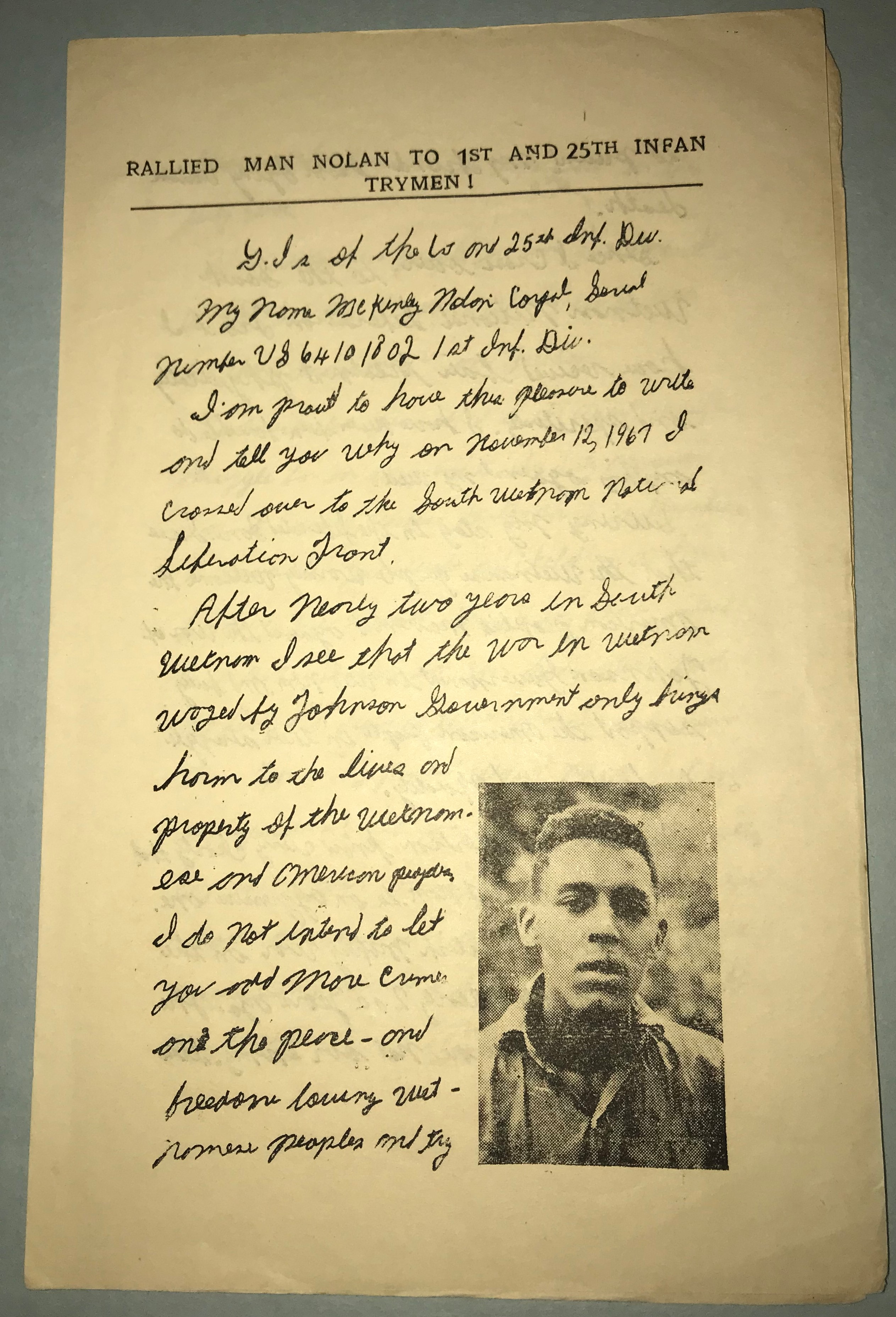 |
| 614367 |
Leaflet, Surrender, "Rallied Man Nolan to 1st and 25th Infantrymen", Viet Cong, Vietnamese, Circa 1969, Vietnam Era |
Leaflet |
5.37" x 8.22" |
3 g |
 |
| 428427 |
Legging, Dismounted, Left, US Army, Cotton Canvas, Olive Drab, 2, US, Circa 1934, Early-20th Century |
Badly stained. |
15 in x 6 in |
4 oz |
 |
| 428426 |
Legging, Dismounted, Right, US Army, Cotton Canvas, Olive Drab, 2, US, Circa 1934, Early-20th Century |
Badly stained . Remnants of laces in two holes. Apparent rodent damage consisting of 3/4" x 1/2" hole 2 1/2" down from upper edge. |
15 in x 6 in |
4 oz |
 |
| 422034 |
Leggings (Pair), Dismounted, US Army, Cotton Canvas, Olive Drab, M1938, US, 1941, World War II |
Leggins, WW2. canvas leggings with a nine-inch web strap at the bottom that fastens under the boot to a metal buckle. The leggings are side opening and are fastened with a cord that laces around hooks and through eyelets. |
12.5" x 6" |
13 oz |
 |
| 468263 |
Leggings (Pair), Dismounted, US Army, Cotton Canvas, Olive Drab, M1938, US, Circa 1943, World War II |
One pair of cotton leggings that have 17 laces. |
|
|
 |
| 421949 |
Leggings (Pair), Mounted, Enlisted, Man's, US Army, Leather, Brown, US, Circa 1916, Early-20th Century |
Leggings c1914. Brown leather leggings with leather wrap straps and brass buckles, which are somewhat corroded. |
15" x 12.5" |
26 oz |
 |
| 421486 |
Leggings (Pair), Mounted, Officer's, US Army, Leather, Brown, US, Circa 1920, Early-20th Century |
Leggings, leather. Dk brown, strap on top to go through brass eyelet and fasten with steel buckle; brass hook and eye at ankle. |
16.5" x 11.75" |
12.75 oz |
 |
| 421907 |
Leggings (Pair), Mounted, US Army, Cotton Canvas/Leather, Olive Drab/Brown, US, 1935, Early-20th Century |
Leggins, canvas Mtd w/leather panels on the inseam side, and buckled straps at the bottom. |
3" dia x 14" x 6" |
14 oz |
 |
| 427328 |
Lens, Goggles, Sun, Wind, And Dust, US Army, Plastic, Gray, P1974, US, 1990, Late-20th Century |
A standard pattern replacement lens for goggles, SWD M1974 FSN 8465-01-004-2893. Consisting of a flat piece of tinted(Natural Grey) plastic shaped to fit the above named goggles. |
7 in x 3 .31 in x 1.32 in |
1 oz |
 |
| 422820 |
Level, Carpenter’s, Spirit, Wood/Steel, Brown/Bright, US, Circa 1900, Early-20th Century |
An antique level (48" x 2.5" x 1"), made of oak with three level tube windows, steel thong hole in one end and .25" thick steel edges; Level comes with an oak slip case (48" x 3.75" x 1.5"). |
|
5 lbs 9 oz |
 |
| 814009 |
Lighter, Cigarette, 50th Anniversary of 1ID, Aluminum, Silver, US, Late-20th Century |
Vulcan commemorative cigarette lighter inscribed: "50th Anniversary 8 June 1917 to 8 June 1987" with bronze medallion of 1ID patch in front of crossed rifles with "No Mission Too Difficult, No Sacrifice Too Great, Duty First" |
1.5" x 2.25" x .50" |
2 oz. |
 |
| 657172 |
Liner, Collar, Insulated, East German Army, Fiber, Gray, 48, East German, Circa 1985, Late-20th Century |
A semi crecent shaped collar liner.One side is gray artificial wool. The other, green , rain drop pattern camouflage. There are three buttton holes along bottom. |
TBD |
3 oz |
 |
| 426002 |
Liner, Field Jacket, Cold Weather, Man's, US Army, Cotton/Nylon, White/Olive Drab, M1950, Medium, US, Circa 1950, Mid-20th Century |
A M1950 Field Jacket Liner in poor condition. The liner is made of a loop woven (to create air space) fabric, lined with a taffeta like cloth. The left arm pit is torn and worn through, the taffeta covering is worn through in many places and the covering on the left arm is missing . |
22" x 28" x 3" |
1 lb 14 oz |
 |
| 467538 |
Liner, Field Jacket, Cold Weather, US Army, Polyester, Olive Drab, 56 Large-Long, US, Circa 1996, Late-20th Century |
Olive colored field jacket liner made of padded nylon/polyester. Has buttonholes to secure it to inside of jacket. |
28 x 31.5" |
15 oz |
 |
| 422906 |
Liner, Field Trousers, Cold Weather, Woman's, US Army, WOOL, OLIVE DRAB, 12 R, US, Circa 1945, World War II |
Wool trouser liner with knitted cuffs; no pockets. |
|
1 LB 4 OZ |
 |
| 822603 |
Liner, Helmet, Ground Troops, US Army, fiberglass, grn, M1, US, Circa 1944, World War II |
Helmet, Liner. M1 (WW2). Webbing damaged and missing. No chinstrap. |
|
|
 |
| 426958 |
Liner, Helmet, Ground Troops, US Army, Plastic Impregnated Cloth, Olive Drab, M1, US, Circa 1960, Mid-20th Century |
A dome shaped plastic liner for the M-1 Steel Helmet. The interior is webbed with 1 1/8" cotton webbing which is affixed to the side of the liner with nine triangular metal clamps which are riveted to the side of the liner w/9 brass rivets. Affixed to the webbing by means of six metal clips is an adjustable leather and fabric headband.the chin strap is missing. |
10.56" x 8.44" x 6.38" |
12 oz |
 |
| 427748 |
Liner, Helmet, Ground Troops, US Army, Plastic Impregnated Cloth, Olive Drab, M1, US, Circa 1960, Mid-20th Century |
Helmet liner w/lining band and leather strap. Smooth, flat OD finish. |
8.63" x 10.63" |
12 oz |
 |
| 427791 |
Liner, Helmet, Ground Troops, US Army, Plastic Impregnated Cloth, Olive Green, M1, US, Circa 1950, Mid-20th Century |
Standard pattern fiber liner for M-1 helmet. 1" in long "U" shaped puncture on top rear. Edge cracked and frayed on both sides. Chin strap missing. |
|
12 oz |
 |
| 656020 |
Liner, Helmet, Ground Troops, US Army, Resin/Cotton, Olive Drab, M1, US, Circa 1943, World War II |
Helmet liner, 3 Star Gen. OD green helmet liner, three stars were purchased and affixed to the helmet for purposes of display. |
10.75" x 8.25" x 6.5" |
10.5 oz |
 |
| 862639 |
Link Strap, US Army, leather, black, M1959, US, Circa 1862, Civil War |
Link Strap, Cavalry M1859 variant buckle. |
21" x 0.75" |
|
 |
| 842696 |
Litter, Folding, Rigid Pole, US Army, Aluminum/Nylon, Olive Drab/Black, US, Global War on Terrorism |
A folding litter having two straight rigid aluminum poles, a nylon mesh cover (bed), retractable handles, four stirrups (bolted near the end of each pole) that support the litter when placed on the ground, two hinged spreader bars (one near each end of the litter) that are extended crosswise at the stirrups to hold the cover taut when the litter is open, and two litter securing straps (one attached to each pole at the stirrup bolts) that secure the litter when closed. |
23" x 90" x 6" |
|
 |
| 842697 |
Litter, Folding, Rigid Pole, US Army, Aluminum/Nylon, Olive Drab/Black, US, Global War on Terrorism |
A folding litter having two straight rigid aluminum poles, a nylon mesh cover (bed), retractable handles, four stirrups (bolted near the end of each pole) that support the litter when placed on the ground, two hinged spreader bars (one near each end of the litter) that are extended crosswise at the stirrups to hold the cover taut when the litter is open, and two litter securing straps (one attached to each pole at the stirrup bolts) that secure the litter when closed. The litter is labeled "ATLS F6". |
23" x 90" x 6" |
|
 |
| 194200 |
Locket, Photograph, Civilian, Knights of Columbus, Metal, Multicolored, US, Circa 1920, Early-20th Century |
A rectangular locket with a two sided Roman Catholic Medal inside on a hinge with the two sides of the locket. there is a picture of a female on the front half and a picture of T.J.McCabe on the other side.Locket is made of brass and has decorative metal work on the top angles with the knights of columbus insignia on the front.The connecting hook is broken. |
.81 in x .81 in x .19 in |
2 oz |
 |
| 427504 |
Loop, Shoulder, Officer's, Iraqi Army, Fabric, Green/Yellow, Iraqi, Circa 1985, Persian Gulf War (Desert Storm) |
A dark green gabardine cloth rank loop tapered to fit over the epaulet on a uniform shirt. On the loop are two 1.09375 in wide yellow stars axial to the length of the loop. The 2 stars signify the rank of a 1st Lt or "Mulazim Awwal". |
3.25" x 2.5" |
<1 oz |
 |
| 427505 |
Loop, Shoulder, Officer's, Iraqi Army, Fabric, Green/Yellow, Iraqi, Circa 1985, Persian Gulf War (Desert Storm) |
A dark green gabardine cloth rank loop tapered to fit over the epaulet on a uniform shirt. On the loop are two 1.09375 in wide yellow stars axial to the length of the loop. The 2 stars signify the rank of a 1st Lt or "Mulazim Awwal" |
3.25" x 2.5" |
<1 oz |
 |
| 427507 |
Loop, Shoulder, Officer's, Iraqi Army, Fabric, Green/Yellow, Iraqi, Circa 1985, Persian Gulf War (Desert Storm) |
A dark green gabardine cloth rank loop tapered to fit over the epaulet on a uniform shirt. On the loop is a 1.125 in wide yellow star .875 from the large end. The star signifies the rank of 2nd Lt or "Mulazim". |
3.5" x 2.5" |
<1 oz |
 |
| 427508 |
Loop, Shoulder, Officer's, Iraqi Army, Fabric, Green/Yellow, Iraqi, Circa 1985, Persian Gulf War (Desert Storm) |
A dark green gabardine cloth rank loop tapered to fit over the epaulet on a uniform shirt. On the loop is a 1.125 in yellow star .875 from the large end. The star signifies the rank of 2nd Lt or "Mulazim". |
3.5" x 2.5" |
<1 oz |
 |
| 822616 |
M1884 Prariebelt, Whittemore, Single Loop, US Army, cotton, Dark Blue, P1894, .30 Caliber, US, Circa 1890, Late-19th Century |
Prariebelt, dk blue M1884 Whittemore. 30 cal loops. "US" H buckle, brass |
|
|
 |
| 421476 |
Magazine, "HARPER'S BAZAAR", US, 1883, Late-19th Century |
Harper's Bazar magazine, eight (8) pages; cover drawing of two women in fashion of the day, one front and one back view of different outfits, full length dresses with bustles. Left edges of publication somewhat tattered; pages 193-193 and 205-208; inside eight (8) pages missing. |
40.3 cm x 28.8 cm |
1.75 oz |
 |
| 423056 |
Magazine, "Harper's Weekly", US, 11 JUN 1898, War with Spain |
A paper magazine (16.5" x 11.5") entitled Harper's Weekly (pages 557-580). Cover page has print of a ship with men on deck and rigging. Many of the men are waving with their hats. Picture is entitled: GOING TO HELP DEWEY. The cover page is quite tattered and torn, and has two pieces of mending tape. Publication encapsulated in Mylar. |
16.5" x 11.5" |
5.5 oz |
 |
| 423063 |
Magazine, "Harper's Weekly", US, 18 NOV 1893, Late-19th Century |
A paper magazine (16.5" x 11.5") entitled Harper's Weekly(pages 1095-1116) no cover page, issue is somewhat tattered. This packet also contains pp 971/972 of another issue --- there is NO date on this page. These numbers do not fit with the numbers on any of the other issues. Therefore, I included it in this packet, rather than package it separately. Publication encapsulated in Mylar. |
16.5" x 11.5" |
5 oz |
 |
| 423053 |
Magazine, "Harper's Weekly", US, 21 OCT 1893, Late-19th Century |
A paper magazine (16.5" x 11.5") entitled Harper's Weekly (pages 997-1020). Cover page topic is the Columbian Exposition with Frederick Remington's print of an Arabian man, mounted on galloping horse with his right arm raised with lance in hand. Cover page tattered on right edge. Publication encapsulated in Mylar. |
16.5" x 11.5" |
5 oz |
 |
| 423051 |
Magazine, "Harper's Weekly", US, 23 SEP 1893, Late-19th Century |
A paper magazine (16.5" x 11.5") entitled Harper's Weekly (pages 901-924). Page 901 has PART I of a serialized story THE MOONSHINERS AT HOHO-HEBEE FALLS and a picture of boy, a woman and a man. Publication encapsulated in Mylar. |
16.5" x 11.5" |
5 oz |
 |
| 423059 |
Magazine, "Harper's Weekly", US, 26 NOV 1898, Late-19th Century |
A paper magazine (16.5" x 11.5") entitled Harper's Weekly (pages 1145-1168), Cover Page entitled: A Triumphal Parade of Insurgent Troops In Manila. Pages Not Much Tattered. Publication encapsulated in Mylar. |
16.5" x 11.5" |
6 oz |
 |
| 423058 |
Magazine, "Harper's Weekly", US, 26 NOV 1898, War with Spain |
A paper magazine (16.5" x 11.5") entitled Harper's Weekly (pages 1145-1168), Cover Page entitled: A Triumphal Parade of Insurgent Troops In Manila. Pages Not Much Tattered. Publication encapsulated in Mylar. |
16.5" x 11.5" |
10.5 oz |
 |
| 423054 |
Magazine, "Harper's Weekly", US, 28 OCT 1893, Late-19th Century |
A paper magazine (16.5" x 11.5") entitled Harper's Weekly. |
16.5" x 11.5" |
5 oz |
 |
| 423055 |
Magazine, "Harper's Weekly", US, 4 NOV 1893, Late-19th Century |
A paper magazine (16.5" x 11.5") entitled Harper's Weekly (pages 1045-1068). Cover page about the Columbian Exposition with print: MANHATTAN'S GREAT DAY showing crowd in front of festooned, lighted building. Pages are tattered at bottom. Publication encapsulated in Mylar. |
16.5" x 11.5" |
5 oz |
 |
| 423057 |
Magazine, "Harper's Weekly", US, 5 NOV 1898, War with Spain |
A paper magazine (16.5" x 11.5") entitled Harper's Weekly (pages 1073-1094). Cover page has print of Industrial Magnate lounging on a bench, titled: SUPREME COUNT OF NEW YORK, and his feet crowding a robed justice almost off the bench. Publication encapsulated in Mylar. |
16.5" x 11.5" |
5 oz |
 |
| 423060 |
Magazine, "Harper's Weekly", US, 7 JAN 1899, Late-19th Century |
A paper magazine (16.5" x 11.5") entitled HARPER'S WEEKLY (pages 1-24) Cover page has a print "Ice Yachting - Hard-A-Left. Cover and other pages not very tattered. Publication encapsulated in Mylar. |
16.5" x 11.5" |
5.5 oz |
 |
| 423061 |
Magazine, "Harper's Weekly", US, 7 JAN 1899, Late-19th Century |
A paper magazine (16.5" x 11.5") entitled HARPER'S WEEKLY (pages 1-24) Cover page has a print "Ice Yachting - Hard-A-Left. Cover and other pages not very tattered. Publication encapsulated in Mylar. |
16.5" x 11.5" |
5.5 oz |
 |
| 423052 |
Magazine, "Harper's Weekly", US, 7 OCT 1893, Late-19th Century |
A paper magazine (16.5" x 11.5") entitled Harper's Weekly (pages 949-970). Cover page has a picture entitled: DRILLING THE CREW OF THE VIGILANT, showing with seven men on the deck of a ship with sails. Cover page slightly tattered. Publication encapsulated in Mylar. |
16.5" x 11.5" |
4.5 oz |
 |
| 423050 |
Magazine, "Harper's Weekly", US, 8 AUG 1885, Late-19th Century |
A paper magazine (16.5" x 11.5") entitled Harper's Weekly (pages 509-528). Cover page has picture of a dead man with wife and two daughters by his bed, and a black wreath on the man's chest. Edges of publication somewhat tattered.. Publication encapsulated in Mylar. |
16.5" x 11.5" |
3 oz |
 |
| 423062 |
Magazine, "Leslie's Weekly", US, 25 APR 1898, Late-19th Century |
A paper magazine (16.5" x 11.5") entitled Leslie's Weekly (pages 255-292). Cover is a print of the American Flag with 45 Stars and a circular picture of General Fitzhugh Lee, The Hero from Dixie Land. Publication encapsulated in Mylar. |
16.5" x 11.5" |
3.5 oz |
 |
| 858150 |
Magazine, Automatic Pistol, Mounted, 7-Round, US Army, Steel, Black, M1911, .45 Caliber, US, Late-20th Century |
Standard .45 cal. magazine clip. |
|
|
 |
| 858151 |
Magazine, Automatic Pistol, Mounted, 7-Round, US Army, Steel, Black, M1911, .45 Caliber, US, Late-20th Century |
Standard .45 cal magazine clip. |
|
|
 |
| 426715 |
Magazine, Drum, Light Machine Gun, US Army, Steel, Tan, AGS17, 30 cal, US, To Be Determined |
Tan colored drum. It has inprinted loading instructions reading: "WHEN LOADING/ THE FIRST LINK/ MUST BE REMAINED EMPTY". Paint seems to be intact. Powder inside. |
13 in x 6 in depth x 10 in |
3 lbs |
 |
| 421329 |
Magazine, Magazine, Saturday Evening Post, "Soldiers in Worship", by Rockwell, Norman, US, 25 JUL 1942, World War II |
Norman Rockwell illustration on cover of July 25, 1942 Saturday Evening Post of a young soldier, Private, sitting in a church pew, a Sergeant with five (5) hashmarks in the pew behind him and a Colonel in white dress uniform in pew in front of Private. |
34.7 cm x 27.2 cm |
.25 oz |
 |
| 421444 |
Magazine, Vol Iii No. 138, Aug 20, 1859, "HARPER'S WEEKLY", United States, US, 20 AUG 1859 |
A paper magazine (11" x 16") entitled Harper's Weekly. |
11" x 16" |
.12 oz |
 |
| 421445 |
Magazine, Vol Iii No. 152, Nov 26, 1859, "HARPER'S WEEKLY", United States, US, 26 NOV 1859 |
A paper magazine (11" x 16") entitled Harper's Weekly. |
11" x 16" |
.12 oz |
 |
| 421446 |
Magazine, Vol Iii No. 153, Dec 3, 1859, "HARPER'S WEEKLY", United States, US, 3 DEC 1859 |
A paper magazine (11" x 16") entitled Harper's Weekly. |
11" x 16" |
.12 oz |
 |
| 421447 |
Magazine, Vol Iii No. 154, Dec 10, 1859, "HARPER'S WEEKLY", United States, US, 10 DEC 1859 |
A paper magazine (11" x 16") entitled Harper's Weekly. |
11" x 16" |
.12 oz |
 |
| 421448 |
Magazine, Vol Iii No. 155, Dec 17, 1859, "HARPER'S WEEKLY", United States, US, 17 DEC 1859 |
A paper magazine (11" x 16") entitled Harper's Weekly. |
11" x 16" |
.12 oz |
 |
| 421449 |
Magazine, Vol Iii No. 156, Dec 24, 1859, "HARPER'S WEEKLY", United States, US, 24 DEC 1859 |
A paper magazine (11" x 16") entitled Harper's Weekly. |
11" x 16" |
.12 oz |
 |
| 421450 |
Magazine, Vol Iii No. 156, Dec 24, 1859, "HARPER'S WEEKLY", United States, US, 24 DEC 1859, Mid-19th Century |
A paper magazine (11" x 16") entitled Harper's Weekly. |
11" x 16" |
.12 oz |
 |
| 421451 |
Magazine, Vol Iv No 209, Dec 29, 1860, "HARPER'S WEEKLY", United States, US, 29 DEC 1860 |
A paper magazine (11" x 16") entitled Harper's Weekly. |
11" x 16" |
.12 oz |
 |
| 421463 |
Magazine, Vol Ix No. 439, May 27, 1865, "HARPER'S WEEKLY", United States, US, 27 MAY 1865, Mid-19th Century |
A paper magazine (11" x 16") entitled Harper's Weekly. |
11" x 16" |
.12 oz |
 |
| 421452 |
Magazine, Vol V No. 212, Jan 19, 1861, "HARPER'S WEEKLY", United States, US, 19 JAN 1861, Civil War |
A paper magazine (11" x 16") entitled Harper's Weekly. |
11" x 16" |
.12 oz |
 |
| 421453 |
Magazine, Vol V No. 217, Feb 23, 1861, "HARPER'S WEEKLY", United States, US, 23 FEB 1861, Civil War |
A paper magazine (11" x 16") entitled Harper's Weekly. |
11" x 16" |
.12 oz |
 |
| 421454 |
Magazine, Vol V No. 232, June 8, 1861, "HARPER'S WEEKLY", United States, US, 8 JUN 1861, Civil War |
A paper magazine (11" x 16") entitled Harper's Weekly. |
11" x 16" |
.12 oz |
 |
| 421455 |
Magazine, Vol V No. 241, Aug 10, 1861, "HARPER'S WEEKLY", United States, US, 10 AUG 1861, Civil War |
A paper magazine (11" x 16") entitled Harper's Weekly. |
11" x 16" |
.12 oz |
 |
| 421456 |
Magazine, Vol V No. 242, Aug 17, 1861, "HARPER'S WEEKLY", United States, US, 17 AUG 1861, Civil War |
A paper magazine (11" x 16") entitled Harper's Weekly. |
11" x 16" |
.12 oz |
 |
| 421457 |
Magazine, Vol V No. 248, Sep 28, 1861, "HARPER'S WEEKLY", United States, US, 28 SEP 1861, Civil War |
A paper magazine (11" x 16") entitled Harper's Weekly. |
11" x 16" |
.12 oz |
 |
| 421458 |
Magazine, Vol V No. 250, Oct 12, 1861, "HARPER'S WEEKLY", United States, US, 12 OCT 1861, Mid-19th Century |
A paper magazine (11" x 16") entitled Harper's Weekly. |
11" x 16" |
.12 oz |
 |
| 421459 |
Magazine, Vol V No. 254, Nov 9, 1861, "HARPER'S WEEKLY", United States, US, 9 NOV 1861, Mid-19th Century |
A paper magazine (11" x 16") entitled Harper's Weekly. |
11" x 16" |
.12 oz |
 |
| 421460 |
Magazine, Vol V No. 261, Dec 28, 1861, "HARPER'S WEEKLY", United States, US, 28 DEC 1861, Mid-19th Century |
A paper magazine (11" x 16") entitled Harper's Weekly. |
11" x 16" |
.12 oz |
 |
| 421461 |
Magazine, Vol Vii No. 349, Sep 5, 1863, "HARPER'S WEEKLY", United Nations, US, 5 SEP 1863, Mid-19th Century |
A paper magazine (11" x 16") entitled Harper's Weekly. |
11" x 16" |
.12 oz |
 |
| 421462 |
Magazine, Vol Vii No. 351, Sep 19, 1863, "HARPER'S WEEKLY", United States, US, 19 SEP 1863, Mid-19th Century |
A paper magazine (11" x 16") entitled Harper's Weekly. |
11" x 16" |
.12 oz |
 |
| 421464 |
Magazine, Vol Xvi No. 823, Oct 5, 1872, "HARPER'S WEEKLY", United States, US, 5 OCT 1872, Late-19th Century |
A paper magazine (11" x 16") entitled Harper's Weekly. |
11" x 16" |
.12 oz |
 |
| 421465 |
Magazine, Vol Xvi No. 825, Oct 19, 1872, "HARPER'S WEEKLY", United States, US, 19 OCT 1872, Late-19th Century |
A paper magazine (11" x 16") entitled Harper's Weekly. |
11" x 16" |
.12 oz |
 |
| 421466 |
Magazine, Volume Xxxiii No. 1679, Feb 23, 1889, "HARPER'S WEEKLY", United States, US, 23 FEB 1889, Late-19th Century |
A paper magazine (11" x 16") entitled Harper's Weekly. |
11" x 16" |
.12 oz |
 |
| 427863 |
Map, Field Expedient, "Unit Situation Map", Iraqi Army, Iraqi, Circa 1990, Persian Gulf War (Desert Storm) |
A piece of sheet rock with one side furnished in a white pattern. Grey side has the situation of an Iraqi mechanized Infantry battalion showing supply and medical locations along with location of reserve company. Details are draw in red, blue and yellow. Sheetrock is cracked and punctured. |
.38" x 23.75" x23.75" |
6 lbs 2 oz |
 |
| 428191 |
Map, Ordnance Material, (with Overlays), "Umm Qasr", US Army, US, MAR 1991, Persian Gulf War (Desert Storm) |
A hand drawn map and overlay of the UMM QASR area on the Kuwait border (QU 13/54 to QU 80/40) showing ASP's, motor pools, supply points and other ammo/vehicle locations. Map is drawn in pencil on white graph paper with acetate cover, both taped to a cardboard backing with green tape. Over this is an additioonal sheet of acetate fastened only at the top. |
.5" x 29.5" x 34.88" |
2 lbs 8 oz |
 |
| 428432 |
Marker, Equipment, Artillery, Metal, Bronze, US, Circa 1930, Early-20th Century |
A 1" Diameter stamped metal disc(A) with three 3/8" long tapered prongs (bent down to facilitate fastening) equally spaced around its circumfrence. On the face is stamped "U.S." over a 3/16"space (for stamping numbers). Below the space is an artillery insignia(a pair of crossed cannon). Also included is a metal backing disc(B)(15/16" dia x 1/64")with a 1/2" hole in the middle. |
1" dia x .03" x .38" |
<1 oz |
 |
| 426109 |
Marker, Equipment, Artillery, US Army, Metal, Bronze, US, Circa 1930, Early-20th Century |
A 1" Diameter stamped metal disc with three 3/8" long tapered prongs (bent down to facilitate fastening) equally spaced around its circumfrence. On the face is stamped "U.S." over a 3/16"space (for stamping numbers). Below the space is an artillery insignia(a pair of crossed cannon). Also included is a metal backing disc(15/16" dia x 1/64")with a 1/2" hole in the middle. |
1" dia x .03" x .38" |
<1 oz |
 |
| 428433 |
Marker, Equipment, Artillery, US Army, Metal, Bronze, US, Circa 1930, Early-20th Century |
A 1" Diameter stamped metal disc (A)with three 3/8" long tapered prongs (bent down to facilitate fastening) equally spaced around its circumfrence. On the face is stamped "U.S." over a 3/16"space (for stamping numbers). Below the space is an artillery insignia(a pair of crossed cannon). Also included is a metal backing disc(B)(15/16" dia x 1/64")with a 1/2" hole in the middle. |
1" dia x .03" x .38" |
<1 oz |
 |
| 428434 |
Marker, Equipment, Infantry, US Army, Metal, Bronze, US, Circa 1930, Early-20th Century |
A 1" Diameter stamped metal disc(A) with three 3/8" long tapered prongs (bent down to facilitate fastening) equally spaced around its circumfrence. On the face is stamped "U.S." over a 3/16"space (for stamping numbers). Below the space is an infantry insignia(a pair of crossed rifles). Also included is a metal backing disc(B)(15/16" dia x 1/64")with a 1/2" hole in the middle. |
1" dia x .03" x .38" |
<1 oz |
 |
| 428435 |
Marker, Equipment, Infantry, US Army, Metal, Bronze, US, Circa 1930, Early-20th Century |
A 1" Diameter stamped metal disc(A) with three 3/8" long tapered prongs (bent down to facilitate fastening) equally spaced around its circumfrence. On the face is stamped "U.S." over a 3/16"space (for stamping numbers). Below the space is an infantry insignia(a pair of crossed rifles). Also included is a metal backing disc(B)(15/16" dia x 1/64")with a 1/2" hole in the middle. |
1" dia x .03" x .38" |
<1 oz |
 |
| 428436 |
Marker, Equipment, Infantry, US Army, Metal, Bronze, US, Circa 1930, Early-20th Century |
A 1" Diameter stamped metal disc(A) with three 3/8" long tapered prongs (bent down to facilitate fastening) equally spaced around its circumfrence. On the face is stamped "U.S." over a 3/16"space (for stamping numbers). Below the space is an infantry insignia(a pair of crossed rifles). Also included is a metal backing disc(B)(15/16" dia x 1/64")with a 1/2" hole in the middle. |
1" dia x .03" x .38" |
<1 oz |
 |
| 844290 |
Marker, Grave, World War I, Metal, Multicolored, US, Late-20th Century |
Round metal grave marker with 1ID in the center with white shield in the background. "Veteran World War I 1917-1918" |
5" x 3.5" |
|
 |
| 650193 |
Marker, Parade Field, 1st Infantry Division, US Army, Metal, Red/White/Blue, US, Circa 1965, Mid-20th Century |
On a white colored metal post with a four legged stand is a pennant shaped metal marker with red, white and blue colors. Centered on a dark green background is the "Big Red One" decal. |
23" oal |
6.10 lbs |
 |
| 842762 |
Mask (Set), Oxygen, US Army, Plastic, Clear, US, Global War on Terrorism |
(4) oxygen masks, clear, with green elastic strap and clear tubing, individually packaged in clear plastic bags. |
5.5" x 7" x 2.5" |
|
 |
| 422753 |
Mask, Protective, Field, US Army, Cotton/Rubber/Metal, Green/Black, M25A1, US, Circa 1985, Late-20th Century |
Mask, Protective w/carrier. Grn cotton canvas case with straps and metal fasteners containing a protective mask of rubber and plastic with a large face shield of clear plastic and black head straps of elastic material. There is a flexible hose leading to filter canister carried in the carrier. |
12" x 12" x 4.5" |
4 lbs 8 oz |
 |
| 513657 |
Medal, "international War", Russian Army, Metal/Fabric, Red/Gold, Russian, Circa 1980, Late-20th Century |
A Russian Communist medal consisting of a red 1" ribbon from which is suspended a stamped medal consisting of a gold and white bordered red star super-imposed over a smaller gold wreath. Centered on the star is a black belt around a blue globe behind two clasped hands. Below the hands is a small shield with the cyrillic letters "CCCP". There is Cyrillic writing on the black belt. Screw post and disc fastener on back of ribbon. |
|
1 oz |
 |
| 422424 |
Medal, Bronze Star, (with Case), US Army, Metal/Leather, Gold/Blue, US, Circa 1945, World War II |
Medal, Bronze Star, with box. |
2.75" x 1.4" |
.5 oz |
 |
| 428270 |
Medal, French, Legion Of Honor, French Army, Metal/Fabric, Multicolored, French, Circa 1945, Mid-20th Century |
The French Legion D'Honneur medal consisting of a 1.34" wide red ribbon from which is suspended a .94" wide oak leaf and olive leaf wreath from which in turn is suspended a five membered maltese cross. The cross is superimposed over an oak and olive leaf wreath. The members are of white metal filled with a white enamel. Center is a gold liberty head surrounded with a blue field with words "Republique Francaise 1870". Obverse is the same except the words are "Honneur et Patrie" and a crossed tri-color instead of a liberty head. Red ribbon is frayed across the top and about 25% of the green enamel is missing from the wreaths. |
3.63 in 1.56 in |
1 oz |
 |
| 428290 |
Medal, Religious, Catholic, US Army, Metal, Aluminum, French, Circa 1917, World War I |
An aluminum disc with the figure of the virgin Mary surrounded by the words "Pries Pour Nous" on the observers right and "N.D.Lourd" on the left. On reverse is a representation of the temple of Lourdes. |
.88" dia x .06" |
.1 oz |
 |
| 656095 |
Medal, Service, American Defense, Enlisted, Man's, US Army, Bronze/Rayon, Bronze/Yellow/Red/White/Blue, US, Circa 1943, Mid-20th Century |
1.25" diameter bronze medal, obverse has female with shield and sword; ribbon, 1.375" x 1.25", is yellow with narrow red, white, and blue stripes near each edge. |
1.25" diameter x 2.75" |
|
 |
| 421792 |
Medal, Service, Mexican, US Army, Metal/Cloth, Bronze/Green/Blue/Yellow, US, 1917, Early-20th Century |
Mexican Service yucca. The medal is bronze with oxidized, relieved finish. On the obverse: A Yucca plant in full bloom with mountains in the background. Above the plant appear the words MEXICAN SERVICE around the border and below the plant are the dates 1911-1917. On the reverse: A spread eagle on a trophy consisting of a cannon, six rifles and four standards, an Indian shield, quiver of arrows and three spears, a Cuban machete and a Sulu Kris, all above the words FOR SERVICE. Around the border at the top are the words UNITED STATES ARMY and thirteen stars around the bottom. The ribbon is 1.45" in width and consists of the following vertical stripes: 1/8 inch Emerald Green, 3/8 inch Golden Yellow, 3/8 inch Ultramarine Blue, 3/8 inch Golden Yellow, and 1/8 inch Emerald Green. |
1.25" |
1 OZ |
 |
| 427929 |
Medal, Service, Ww1 Victory, US Army, Metal/Fabric, Multicolored, US, Circa 1919, World War I |
Standard pattern WW1 victory medal with "France" clasp. Ribbon is deteriorating but still in one piece. |
1.5 in x 3 in |
2 oz |
 |
| 422534 |
Medal, Soldier's, US Army, Metal/Cloth, Bronze/Red/White/Blue, US, Circa 1944, World War II |
On a 1.45"wide Bronze octagon an eagle displayed, standing on a fasces, between two groups of stars of six and seven, above the group of six a spray of leaves. On the reverse is a shield paly of 13 pieces, on the chief the letters US, supported by sprays of laurel and oak, around the upper edge the inscription SOLDIER’S MEDAL and across the face the words FOR VALOR. In the base is a panel for the name of the recipient to be engraved. The medal is suspended from the ribbon by a rectangular-shaped metal loop with corners rounded. The ribbon is 1.45" wide and consists of the following stripes: 3/8 inch Ultramarine Blue 67118 on each side and the center containing 13 White and Red stripes of equal width (7 White 67101 and 6 Old Glory Red 67156). |
.62"x .62"" x 3" |
1 oz |
 |
| 421356 |
Medal, Victory, World War I, US Army, Metal/Cloth, Bronze/Multicolored, US, Circa 1920, Early-20th Century |
Victory Medal, WW1 With Bars. |
3.5" x 1.5" |
.75 oz |
 |
| 656096 |
Medal, Victory, World War Ii, Enlisted, Man's, US Army, Bronze/Rayon, Bronze/Red/Blue/et a;, US, Circa 1945, Mid-20th Century |
Obverse shows Liberation, her right fist on War God's helmet, holds broken sword in right hand and broken blade in left, "WORLD WAR II"; ribbon has wide center stripe of dark red, edged by two (2) narrow bands of white. At each end is a rainbow pattern. |
1.5" diameter x 3" |
1 ounce |
 |
| 427175 |
Medallion, Commemorative, Organizational Day, 1st Infantry Division, US Army, Copper-Plated Aluminum, Bright, US, 1945, World War II |
A copper plated aluminum souvenir coin with a hanging loop at the top. On front side written in 1/8' letters around the rim is"FIRST DIVISION ORGANIZATIONAL DAY OCTOBER 21, 1945" and in the center "26th INF". The figure "1"in the center is 1/2"high and enameled red. Reverse is panorama of a medieval city and a torn scroll with the word "Nurnberg". |
1.56" dia x .06 |
< 1 oz |
 |
| 468141 |
Medallion, Presentation, Boxed, Civilian, US Army, Brass/Wood, Bright/Brown, Soviet, 1993, Late-20th Century |
A 6 3/4" square varnished wooden case w/ hinged top of equal size w/ a sickle shaped brass latch. Inside is lined w/ a red cloth (both sides) and centered in the bottoms is a brass medalion 4 3/4" diam. On the medallion is a 5-point 2" star surrounded by an oak and an olive branch wreath. Hammer and Sickle in center of star. Below are the letters "CYXOTTYTHbIE BONCKA". |
6 3.4 x 6 3/4 x 1 1/2" |
2 lb 3 oz |
 |
| 854931 |
MI School, US Army, nylon, blue yellow, US, Circa 2001, Early-21st Century |
Patch, MI School |
2.5" |
|
 |
| 421913 |
Microphone, Chest, US Army, Plastic/Rubber/Metal, Black, US, Circa 1942, World War II |
Microphone, chest. Mounted on a pad with two arm straps. The microphone's stand is adjustable. |
11" |
3 OZ |
 |
| 421272 |
Microscope, Medical, Cased, Civilian, Wood/Brass, Brown/Bright, US, Circa 1885, Late-19th Century |
Microscope (4.5" x 6.5" x 11.5"), with a 10x lens and two lens 1/6 and 2/3 on bottom. Microscope is contained in a Maple case (7.25" x 9" x 14"), with a dark finish, door hinged on right side, nickled steel handle on top (the door catch is broken; In the case is a reversible morror, 2" diameter x .375". |
|
13lbs 10oz |
 |
| 426599 |
Mine (inert) (Lot), Land, Anti-tank, US Army, Steel, Olive Drab, M1A1, US, World War II |
Very corroded and rusty M1A1 anti-tank mines. |
8" DIAM. |
|
 |
| 426582 |
Mine (inert), Anti-Tank, Practice, US Army, Steel, Light Blue, M12, US, Mid-20th Century |
Turquoise land mine. Circular, tiered with obverse having a iron tag reading: "CENTER CAP - PLUG - ARMING AT MINE M4, ARMED, DANGER, SAFE". Reverse has stencil reading: MINE, AT/ HEAVY/ PRACTICE/ M12A1" and '3LQ-10-8/55" |
13 in Dia x 3 .5 in H |
3 lbs |
 |
| 427156 |
Mine (inert), Land, Anti-personnel, German Army, Wood, Brown/Black, S-42, German, Circa 1944, World War II |
A standard pattern German Schu-mine 42 with Z.Z.42 igniter. This specimen has not been painted, and the explosive charge has been replaced by two blocks of wood nailed together w/4 nails. The igniter has been dis-armed and inserted into the side of the wooden block. Lid on box is starting to warp. |
5.13" x 4.13" x 3.06" |
12 oz |
 |
| 428416 |
Mirror, Field, US Army, Metal/Glass, Silver/Bare, US, Circa 1945, World War II |
A round metal edged 2-sided mirror with folding handle. Mirror has magnification properties on one side and is about 50% blind on the normal side. The 1/8" wire handle folds flat over the magnification side. Bright plating is 10% gone. |
2.5 in dia x .25 in |
2 oz |
 |
| 421925 |
Mirror, Signaling, Heliograph, Canadian Army, Brass/Wood/, Bright/Brown, British, Circa 1925, Early-20th Century |
Heliograph, wood and brass with items showing wear and use. |
5' high |
10 LBS |
 |
| 421752 |
Mirror, Signaling, Heliograph, Canadian Army, Steel/Brass, Black/Bright, Mark 5, Canadian, Circa 1915, Early-20th Century, SN: B28017 |
Heliograph reflecting unit: 5" mirror, steel structure with pebbled black paint finish and 1.75" diameter brass threaded base to fasten to tripod; threaded shaft vertical arc adjustment normal to mirror range 62 degrees, including 12 degrees below to 50 degrees above horizontal; size of arc includes spring loaded vernier 5 degree range; horizontal knurled knob rotates worm gear to turn ring gear to move it on tripod. |
6.5" x 3.4" x 8" |
2lbs 5.5oz |
 |
| 428174 |
Mitten, Asbestos, Iraqi Army, Asbestos Cloth, Beige, Iraqi, Circa 1990, Persian Gulf War (Desert Storm) |
A "Hot-Shell" mitten made of a rough asbestos type material, the inside is a softer cloth like material. There are 3 appendages, 1 for three fingers and the other two for one finger each. |
10.88" x 7.5" |
4 oz |
 |
| 428175 |
Mitten, Asbestos, Iraqi Army, Asbestos Cloth, Beige, Iraqi, Circa 1990, Persian Gulf War (Desert Storm) |
A "Hot -Shell" mitten made of a rough asbestos type of material, the inside is a softer cloth like material. There are three appendages, 1 for three fingers and the other two for one finger each. |
10.88" x 7.5" |
4 oz |
 |
| 428178 |
Mitten, Asbestos, Iraqi Army, Asbestos Cloth, Beige, Iraqi, Circa 1990, Persian Gulf War (Desert Storm) |
A "Hot-Shell" mitten made of a rough asbestos type of material, the inside is a softer clothlike material. There are three appendages, 1 for three fingers and the other two for one finger each.There is a 24in long strap hanging from the inside edge of the mitten. Strap is frayed in places. |
10.88" x 7.5" |
4 oz |
 |
| 428179 |
Mitten, Asbestos, Iraqi Army, Asbestos Cloth, Beige, Iraqi, Circa 1990, Persian Gulf War (Desert Storm) |
A "Hot Shell" mitten made of a rough asbestos type of material, the inside is made of a softer clothlike material. There are three appendages, 1 for three fingers and the other two for one finger each. There is a 24in long strap hanging from the inside edge of the mitten. Strap is frayed in places. There is a small hole in the three finger appendage. |
10.88" x 7.5" |
4 oz |
 |
| 446173 |
Model, Armored Vehicle, Bmp, Russian Army, Brass/Wood, Bright/Black, US, Circa 1993, Late-20th Century |
A brass model of a BMP-1 Infantry Fighting Vehicle 5 3/4"W x 12 1/2"L x 4 1/4H with rubber tracks. Mounted on a black board 8 1/2" x 16 1/2"L and secured by one bolt. Board has brass legs 3/4" long at front and rear. 11/16" 2 7/8" red leather tag with synthetic stitching on it in gold cemented to the front of the mount. Workmanship poor. |
16.5" x 8.38" x 5.38" |
7 lbs 10oz |
 |
| 650194 |
Model, Presentation, T-72 Tank, US Army, Metal, Bronze, Soviet, Circa 1970, Late-20th Century |
A bronze color, metal model of a Soviet T-72 tank attached to a black brick pattern plastic base. On the front of the base is a multi colored, Soviet decal, trimmed in gold color, the letters MC on a light blue back ground, centered is a bird crest and below is a number 27. |
9.5" x 4.75" |
8.75 lbs |
 |
| 425991 |
Model, Watchtower, Presentation, Argentinean Army, Wood/Metal, Dull/Brass, Argentinean, Circa 1997, Late-20th Century |
Argentine watch tower made of steel rods on a wood base. |
6.88" x 4.25" x 11.75" |
2 lbs 2 oz |
 |
| 567578 |
Mold, Dental-Casting, US Army, white, US, Mid-20th Century |
White waxlike forms of upper and lower set of teeth. Has some chips in the molds. Flat top and bottoms. Marked on the forms is makers name and N20U and N20L |
2.25" x 3" x 2.25" H |
7oz |
 |
| 567579 |
Mold, Dental-Casting, US Army, white, US, Mid-20th Century |
Wax like forms of upper and lower teeth. Flat top and bottoms. Marked on forms along with makers name is 260U and 260L. |
1.5" x 2.25" x 1.875 I |
3oz |
 |
| 842653 |
Monitor, Vital Signs, US Army, Plastic/Metal, Multicolor, US, 2006, Global War on Terrorism, SN: DA101964 |
Vital Signs Monitor (A), Universal Power Adapter (B), Blood Pressure Cuff (C), and Medical Supply Case (D). VITAL SIGNS MONITOR, white, push buttons and LCD screen at front. The monitor is labeled "2ND FST" at top. UNIVERSAL POWER ADAPTER, black, removable black power cord attached. BLOOD PRESSURE CUFF, black, velcro closure, various cords attached (some of which are enclosed in a blue plastic tube). MEDICAL SUPPLY CASE, olive drab, plastic, stackable design, hinged lid, stainless steel hardware, pressure relief valve at front. The case is labeled "3" at front. |
18.5" x 24.5" x 15.5" |
|
 |
| 842654 |
Monitor, Vital Signs, US Army, Plastic/Metal, Multicolor, US, 2006, Global War on Terrorism, SN: DA101986 |
Vital Signs Monitor (A), Universal Power Adapter (B), Blood Pressure Cuff (C), Medical Supply Case Diagram (D), and Medical Supply Case (E). VITAL SIGNS MONITOR, white, push buttons and LCD screen at front. The monitor is labeled "A", "DA101986" and "2ND FST" at top. UNIVERSAL POWER ADAPTER, black, removable gray power cord attached. BLOOD PRESSURE CUFF, black, velcro closure, various cords attached (some of which are enclosed in a clear plastic tube). MEDICAL SUPPLY CASE DIAGRAM, white, plastic, packing instructions printed in black on the obverse, adhesive on the reverse. MEDICAL SUPPLY CASE, olive drab, plastic, stackable design, hinged lid, stainless steel hardware, pale blue foam padding, pressure relief valve at front. The case is labeled "ICU" at front, and "OR INSTRUMENTS" at side. |
18.5" x 24.5" x 15.5" |
|
 |
| 426615 |
Mug, Coffee, Commemorative, Officers Of The 1st Infantry Division, US Army, Ceramic, Black/Gold, US, Circa 1994, Late-20th Century |
A typical coffee mug made of ceramic. A black back ground with a gold colored rim, a gold colored first division symbol surrounded by a wreth. A red number 1 is in the center of the shield. |
3.75" x 3" |
12 oz |
 |
| 858242 |
Necktie, Four-in-Hand, Enlisted, Man's, Cotton/Wool, Khaki, US, World War II |
Khaki tie with worn spot on backside where it was knotted. Also back flap of tie is is sewn together in two spots. |
|
|
 |
| 858243 |
Necktie, Four-in-Hand, Enlisted, Man's, Cotton/Wool, Khaki, US, World War II |
Khaki tie with worn spot on backside of tie where it was knotted. |
|
|
 |
| 428424 |
Necktie, Service, Clip-on, Man's, US Army, Cloth, Khaki, US, Circa 1945, World War II |
A short khaki necktie of unknown manufacture. Consists of a 17 1/2" piece of fabric folded & sewn to taper from 7/8" to 2 1/2" wide. There is a flat hook at the small end. |
18.25" x 2.25" |
<1 oz |
 |
| 650218 |
Necktie, Service, Four Fold, Enlisted, Man's, wool, olive drab, US, World War II |
An oilve drab tie. |
47 in x 4 in |
.02 oz |
 |
| 426503 |
Necktie, Service, Four Fold, Man's, US Army, Cotton, Khaki, US, Circa 1941, World War II |
A khaki colored, cotton necktie. |
40.5" x 2.75" |
1 oz |
 |
| 427111 |
Necktie, Service, Four Fold, Man's, US Army, Wool/Cotton, Khaki, US, Circa 1942, World War II |
A plain WW2 era officers dress necktie. Scattered Moth Damage. |
46.63" x 3.25" |
1 oz |
 |
| 434055 |
Necktie, Service, Four Fold, Man's, US Army, Worsted Wool, Black, US, 1958, Mid-20th Century |
Man's necktie. Slight moth damage, 2 minute holes. |
53" x 3" |
2 oz |
 |
| 427112 |
Necktie, Service, Four Fold, Man's, US Army, Worsted Wool, Khaki, US, Circa 1942, World War II |
A standard issue tan wool necktie. Devoid of tags. 1 small blue-black stain and 1 rust stain. |
44.63" x 2.88" |
1 oz |
 |
| 194173 |
Necktie, Souvenir, 1st Infantry Division, Civilian, Polyester, Blue, US, Circa 1955, Mid-20th Century |
Blue facing, white lining. Hand embroidered designs on wider part. Lining is discolored at ends. |
52.5" x 2.25" |
2 oz |
 |
| 842752 |
Needle (Set), Monoject, US Army, Plastic, Clear/Blue, 22 Gauge, US, Global War on Terrorism |
(56) hypodermic needles, packaged in individual cartridges, color coded caps (blue). |
0.38" x 0.38" x 2.5" |
|
 |
| 842712 |
Needle (Set), Safety, US Army, Plastic/Paper, White/Green/Blue, 21 Gauge, US, Global War on Terrorism |
(5) hypodermic needles, integral safety shield, color coded (green), individually packaged. |
4.25" x 6.75" x 1.25" |
|
 |
| 842749 |
Needle (Set), SafetyGlide, US Army, Plastic, White/Purple/Black, 22 Gauge, US, Global War on Terrorism |
(48) hypodermic needles, color coded (black/gray), individually packaged. |
1.25" x 4.75" x 0.75" |
|
 |
| 842745 |
Needle (Set), SafetyGlide, US Army, Plastic, White/Purple/Orange, 25 Gauge, US, Global War on Terrorism |
(95) hypodermic needles, color coded (orange), individually packaged. |
1.25" x 4.75" x 0.75" |
|
 |
| 842750 |
Needle (Set), SafetyGlide, US Army, Plastic, White/Purple/Pink, 18 Gauge, US, Global War on Terrorism |
(49) hypodermic needles, color coded (pink), individually packaged. |
1.25" x 4.75" x 0.75" |
|
 |
| 842720 |
Needle (Set), Spinal, Quincke Type Point, US Army, Plastic/Paper, White/Black, 22 Gauge, US, Global War on Terrorism |
(11) spinal needles, individually packaged. |
1" x 6.25" x 0.5" |
|
 |
| 835566 |
Net, Helmet, Camouflage, Iraqi Army, Plastic/Nylon, Green, Iraqi, Global War on Terrorism |
Iraqi helmet netting with elastic band to fit around helmet. |
|
|
 |
| 835567 |
Net, Helmet, Camouflage, Iraqi Army, Plastic/Nylon, Green, Iraqi, Global War on Terrorism |
Iraqi helmet netting with elastic band to wrap around helmet. |
|
|
 |
| 835568 |
Net, Helmet, Camouflage, Iraqi Army, Plastic/Nylon, Green, Iraqi, Global War on Terrorism |
Iraqi helmet netting with elastic band to fit around helmet. |
|
|
 |
| 427141 |
Net, Helmet, Camouflage, US Army, Cotton, Olive Green, US, Circa 1950, Mid-20th Century |
A piece of 2" mesh net of a size large enough to fit over the standard M-1 steel helmet. Consists of 1/16" olive green cord tied in 2" square mesh. |
26" x 26" |
1 oz |
 |
| 427653 |
Net, Helmet, Camouflage, US Army, Fabric, Olive Green, US, Circa 1945, World War II |
A rectangularly shaped camouflage net for the US M-1 helmet. Made of unknown thread(Possibly cotton) woven into .75 in squares. Torn in about 11 places. Slight variation of color. |
19" x 15" |
1 oz |
 |
| 427654 |
Net, Helmet, Camouflage, US Army, Fabric, Olive Green, US, Circa 1945, World War II |
A irregularly shaped camouflage net for the US M-1 helmet. Made of unknown thread (possibly cotton) and woven in .75 in squares. Torn in about 6 places. Slight variation in color. |
22" x 17" |
1 oz |
 |
| 468053 |
Net, Mosquito, US Army, Nylon, Olive Green, US, 1988, Persian Gulf War (Desert Storm) |
Large rectangular nylon mesh net with attached sides and ends, and tie taps for hanging over a cot. |
200" x 68" |
1 lb 4 oz |
 |
| 422605 |
Newspaper, Us Army, Algiers Edition, "The Stars And Stripes", US Army, US, 9 DEC 1942, World War II |
The first issue of the Algiers Edition of THE STARS AND STRIPES in World War II, Vol 1 - No 1 - Wednesday, 9 December 1942. |
11.75" x 16.75" |
.5 oz |
 |
| 854928 |
Nurse, Officer's, US Army, Brass, gold, 1", US, Circa 1999, Late-20th Century |
Nurse collar insignia. clutchback. Two |
|
|
 |
| 832412 |
Opener, Letter, Bayonet, Brass, Shiny, US, World War II |
Brass letter opener in the shape of a bayonet. On the handle is 1ID emblem and "18 above crossed rifles and B underneath crossed rifles." Etched on the blade is "Algeria, Tunsisia, Sicily" and on the opposite side "France, Belgium, Germany, Czecho-Slovakia." |
9" |
7.2 oz |
 |
| 602424 |
Ornament, Cap, Officer's, US Army, Metal, Gold, US, Circa 1970, Vietnam Era |
A gold colored, officers, Eagle cap insignia.Two straight pins on each side with a screw post in the center of the back. |
2.250 In W x 2.375 In H |
1 Oz |
 |
| 468074 |
Overboot, Protective, Chemical/biological, Iraqi Army, Rubberized Canvas, Tan/Black, Iraqi, Circa 1980, Persian Gulf War (Desert Storm) |
A tan overboot of rubberized fabric with a black sole. Top is 20" high. Top, back seam, and seam across the top of the front all sewn, all others cemented/valcanized. Inside top is a 1 diam stamp w/ cyrillic lettering. Boot has 2 white tape and elastic toggle type leg ties. |
13 1/4 x 5 1/4" |
14 oz |
 |
| 468169 |
Overboot, Protective, Chemical/biological, Iraqi Army, Rubberized Canvas, Tan/Black, Iraqi, Circa 1980, Persian Gulf War (Desert Storm) |
A tan overboot of rubberized fabric with a black sole. Top is 20" high. Top, back seam, and seam across the top of the front all sewn, all others cemented/valcanized. Inside top is a 1 diam stamp w/ cyrillic lettering. Boot has 2 white tape and elastic toggle type leg ties. |
13 1/4 x 5 1/4" |
14 oz |
 |
| 427452 |
Overboot, Protective, Chemical/biological, Left, Iraqi Army, Rubber/Rubberized Cloth, Black/Tan, Iraqi, Circa 1990, Persian Gulf War (Desert Storm) |
A tan overboot of rubberized fabric with a black sole. Top is 20" high. Top, back seam and seam across the foot are sewn, all others are cemented/vulcanized. Boot has 2 white tape and elastic toggle type leg ties. |
13" x 5.13" |
14 oz |
 |
| 427453 |
Overboot, Protective, Chemical/biological, Right, Iraqi Army, Rubber/Rubberized Cloth, Black/Tan, Iraqi, Circa 1990, Persian Gulf War (Desert Storm) |
A tan overboot of rubberized fabric with a black sole. Top is 20" high. Top, back seam, and seam across the foot are sewn, all others are cemented/vulcanized. Boot has 2 white tape and elastic toggle type leg ties. |
13" x 5.13" |
14 oz |
 |
| 426451 |
Overboots (Pair), Protective, Chemical/biological, US Army, Rubber, Black, Universal, US, Circa 1985, Late-20th Century |
Pair of NBC overboots, black, still in plastic wrapper. |
|
2.85 lbs |
 |
| 422755 |
Overboots (Pair), Protective, Chemical/biological, US Army, RUBBER, BLACK, US, Circa 1985, Persian Gulf War (Desert Storm) |
Overboots, Chem. Blk rubber pull on and then tie down, soles have projections on the front, back and sides with holes for black cotton laces. When worn the projections fold up over the sides. |
18" X 9.25" X 15" |
2 lbs 8 oz |
 |
| 424217 |
Overcoat, Cold Weather, Man's, US Army, Wool, Army Green, 36 Extra Long, US, Circa 1960, Mid-20th Century |
Double breasted with two rows of three plastic buttons, belt around waist, cuff belts with two plastic buttons on each cuff, shoulder straps with plastic buttons, two interior and two exterior pockets. |
tbd |
2 lbs |
 |
| 428266 |
Overcoat, Field, Long (with Liner), Master Sgt's, 1st Infantry Div., Enlisted, Man's, US Army, Cotton, Olive Drab Shade 7, M1951, 37 Short, US, Circa 1955, Mid-20th Century |
A Overcoat, Field, Long (stock # 55-0-2404-10) with removable liner (stock # 55-0-2446-460). 1st Inf Div SSI on left shoulder and Master Sgt stripes on each sleeve. Size of liner is "Long-Large." Small hole on right epaulet. Small repair on right sleeve. |
46" x 26" |
5 lbs 8 oz |
 |
| 426995 |
Overcoat, Officer's, US Army, Wool, Olive Drab, M1917, US, 1917, World War I |
Workmanship and material seems a bit below officer standard on this specimen. All but the three rear slit buttons are missing. There was once a company grade officer's Trefoil sewn to the sleeves and a 2" diameter circular patch on the left sleeve. There is slight moth damage on the surface. There is a 2 1/2" x 1 1/4" QM tag inside the bottom center edge of the liner. There are black spots inside on the right plastron and a large (4" dia) discoloration on the right rear bottom edge. There is also a brown stain/smudge on the right rear bottom 18" up from the edge. Collar loop is torn loose at one end. Measurements: length: 46 1/2", waist: 17", back width: 8", sleeve length: 32 1/2". |
|
6 lbs 2 oz |
 |
| 425923 |
Overcoat, Short, 1st Infantry Division, Officer's, Man's, US Army, Wool, Olive Drab, US, 1926, Mid-20th Century |
A short overcoat with a handsewn 1st Division SSI on the left shoulder. Top left button is missing,light scattered moth damage(skimming) with a 3/8" hole on lower right front. Lining worn out at arm-pits. Several small holes in lining, some have been repaired. Neck seam at collar is beginning to unravel. |
20" x 38" x 3" |
6 lbs |
 |
| 428397 |
Overcoat, Short, Lieutenant Colonel's, US Forces Far East, Officer's, US Army, Wool, Olive Drab, Medium, US, Circa 1943, World War II |
A short overcoat with embroidered LTC insignia and a US Forces Far East patch. The coat shows signs of normal wear. The lining is worn through at the back and some seams are beginning to unravel at the pocket flaps. There is scattered slight moth damage. |
35" x 9" x 33.33" |
4 lbs 12oz |
 |
| 421423 |
Overcoat, US Army, Wool, Olive Drab, 36 R, US, Circa 1940, World War II |
Overcoat, wool EM c1942 with 93rd patch |
|
6 LBS 3 OZ |
 |
| 422749 |
Pack, Field, Combat, US Army, Nylon, Olive Drab, LC-1, Medium, US, Circa 1985, Late-20th Century |
Rucksack, Dk OD soft pack with three (3) large pockets, miscellaneous nylon webbing straps, brass snaps and steel hooks; item to be fastened to pack frame. |
. |
2 lbs 8 oz |
 |
| 422725 |
Pack, Field, Combat, US Army, Nylon, Olive Green, LC-1, Medium, US, Circa 1985, Late-20th Century |
RuckSack. Grn nylon soft pack with three (3) large pockets, miscellaneous nylon webbing straps, brass snaps and steel hooks; to be fitted to packframe. |
. |
2lbs 8.5oz |
 |
| 422735 |
Pack, Field, Combat, US Army, Nylon, Olive Green, LC-1, Medium, US, Circa 1985, Late-20th Century |
Rucksack. Grn nylon soft pack with three (3) large pockets, miscellaneous nylon webbing straps, brass snaps with steel hooks, to be fastened to packframe. |
. |
2 lbs 9 oz |
 |
| 422713 |
Pack, Field, Combat, US Army, Nylon, Olive Green, LC-1, Medium, US, Circa 1985, Persian Gulf War (Desert Storm) |
Rucksack, grn nylon soft pack with three (3) large pockets, miscellaneous nylon webbing straps, brass snaps and steel hooks; to be fastened to packframe. |
. |
2 lbs 9 oz |
 |
| 423009 |
Package, Gillette, US Army, Paper, Black/Tan, US, Circa 1942, World War II |
RazorBlade box, WW2. Unopened box rectangular cardboard box of safety razor blades. |
2" x 1" x .25" |
.5 oz |
 |
| 603143 |
Package, Insect/arthropod Repellent, Treatment For Military Battle Dress Uniforms, US Army, Plastic, Olive Green, 18-Mililiter, US, Circa 2004, Early-21st Century |
Package containing “Insect/Arthropod Repellent Treatment for Military Battle Dress Uniforms.” Package is over all OD Green with black lettering on the front with description of contents and ingredients. Warning at the bottom of the package warns “For Military Use Only, Caution Keep Out of Reach of Children.” |
4.25" x 9" |
4 oz |
 |
| 422752 |
Package, Overgarment, Chemical-biological Protective (coat And Trousers), US Army, Plastic, Olive Green, US, Circa 1985, Late-20th Century |
Chem-Suit Bag. OD plastic bag-like package sealed at both ends containing a chemical-biological protective overgarment (coat and trousers). |
24" x 16.5" x 7" |
6 lbs 4 oz |
 |
| 421782 |
Packet, 1st Aid, Field Dressing, US Army, Painted Brass, Brown, US, Circa 1918, World War I |
Aid Dressing Tin, WW1. A brown painted brass box, with a horizontal seam around the center of each side secured by a strip of metal with a pull ring on one end to facilitate opening. The box is embossed on the top with the makers name and contract information. Russet leather 2 snap case. |
|
7.5 oz |
 |
| 427127 |
Packet, 1st Aid, Field Dressing, Us Government, US Army, Metal, Red, Carlisle Model, US, Circa 1942, World War II |
Red metal 1st Aid packet consisting of 2 rectangular boxes joined by a U shaped strip of metal with a 3/4" pull tab. |
4.06" x 2.31" x.94" |
2 oz |
 |
| 858189 |
Packet, Long Range Packet, Menu No. 2, Plastic/Food Stuffs, Brown, US, Late-20th Century |
Long Range Meal sealed in original brown package. |
|
|
 |
| 858190 |
Packet, Long Range Patrol, Menu No. 1, Plastic/Food Stuffs, Brown, US, Late-20th Century |
Long Range Patrol meal in original sealed brown package |
|
|
 |
| 858188 |
Packet, Long Range Patrol, Menu No. 2, Plastic/Food Stuffs, Brown, US, Late-20th Century |
Long Range Patrol menu still in sealed brown package. |
|
|
 |
| 427128 |
Packet, Sulfadiazine, US Army, Paper/Foil/Sulfa, Brown/Black/Red, US, Circa 1942, World War II |
A rectangular paper and foil package containing eight sulfadiazene tablets. There is a 1/2" Dia impression on one side of the from the fastener on the first aid packet. |
3.63" x 2.19" x.38" |
1 oz |
 |
| 842792 |
Pad (Set), Prep, Alcohol, US Army, Foil, White/Blue, US, Global War on Terrorism |
(144) alcohol prep pads, individually packaged in pairs, the pairs perforated at center. |
2" x 2" x 0.25" |
|
 |
| 842793 |
Pad (Set), Prep, Povidone-Iodine, US Army, Foil, White/Red, US, Global War on Terrorism |
(32) povidone-iodine prep pads, individually packaged. |
2" x 2" x 0.25" |
|
 |
| 428420 |
Pad, Stamp, Black Ink, US Army, Metal/Felt, White/Black, US, Circa 1945, World War II |
A stamp pad consisting of a tin box with rounded corners and lid. Inside is a 3"W x 3"L felt pad. |
3.06 in x 2.06 in x.31 in |
<1 oz |
 |
| 421306 |
Padlock, Ordnance Department, US Army, Brass/Steel, Dk Brass, US, Circa 1930, Early-20th Century |
Padlock, Steel in brass jacket. |
2.5" x 1.5" |
5.5 oz |
 |
| 487081 |
Painting, Acrylic, On Board, "Two M113 APC's in the Woods", US Army, United States, Late-20th Century |
This is an acrylic painting depicting two M113 armored personnel carriers in what looks like the woods. Main colors are greens and browns. This painting is matted in white and framed in brown wood. Frame knicked and scratched. Framing is not professional. |
89.5 x 74.5 cm |
8 lbs |
 |
| 845906 |
Painting, Casein, on Canvasboard, "We Shall Triumph", by Soulen, Henry J., US Army, United States, 1944, Revolutionary War |
Casein on canvasboard mural mounted to hardwood board, depicting a winter scene of George Washington in prayer with Valley Forge in background. Painted in pointillist style primarily in a pastel palette of blue, purple, pink, and yellow. In right foreground upon a small hill, Washington is shown in left profile view kneeling on his left knee. He is dressed in military uniform with yellow breeches, tall black boots, a purple coat with long tails and yellow trim at cuffs and collar, and a pink and purple cape. He holds his sword before him with the point on the ground and his hands folded on the hilt. He gazes proudly to the viewer's left. A brown tricorner hat sits on the snowy ground in the foreground. In the left middleground a cannon points away from the viewer. In the left background, at the bottom of the hill are snow-covered houses with smoke rising from their chimneys. Snow-covered fields and forests in the background with clouds above. In the sky on the left, sun rays break through the clouds and shine in the direction of Washington. |
83-3/4“ x 180-5/8” |
|
 |
| 487069 |
Painting, Pastel, On Silk, "Before the Storm", by Kasumovic, Fuao?, US Army, Bosnia, Circa 1997, Late-20th Century |
A pastel painting on silk. Not quite sure what the subject matter is. I can see a couple of faces in the image, but that's all. The stand out color is red, w/ blue-green background. Signature at bottom of painting, but can't make it out. Painting is poorly framed in a purple mat, w/ wood frame. Glass has been broken and taken out. At bottom right corner there's a plate engraved "With respect of GM Meigs/ Tuzla, 25. 6. '97/ brig. Gen. Sead Delic". |
52 x 62 cm |
600 grams |
 |
| 427683 |
Paperweight, Commemorative, Swedish Army, Stone/Metal, Gray/White/Silver, Swedish, Circa 1977, Late-20th Century |
A stone and metal paper weight consisting of a 1.6875 high piece of grey and white stone with a metal soldier figure 1.25 high and holding a spear. Mounted to the stone is a white metal monogram "C.G'" with a crown on top and the roman numeral "XVI" below. |
3.31 in x 2.5 in x 2.44 in |
13 oz |
 |
| 468061 |
Parka, Desert Camouflage, Night, US Army, Cotton/Nylon, Green/Gray, X-Small, US, Circa 1990, Persian Gulf War (Desert Storm) |
Standard pattern (DLA 100-83-C-0680) parka, night camoflage, desert. Fed. Stock #8415-01-102-6278. Same basic pattern as winter parka but for a camoflage pattern which consists of dark green background with a series of lighter green squares and dark green leaves. |
|
1 lb 13 oz |
 |
| 426249 |
Parka, Iraqi Army, Polyester/Cotton, Olive Green, Small (160-170), West German, Circa 1985, Persian Gulf War (Desert Storm) |
Parka made of 65% polyester 35% cotton and having a liner of 100% polyacryl. Parka has built on hood with draw string, 5 button and zipper front, button strap sleeves, 4 bag type pockets, 2 Buttons missing. Much repaired, sleeves and elbows worn, original button-in liner partially hand-sewn in. |
44" x 22" x 3" |
3 lbs 2 oz |
 |
| 614396 |
Patch, Bomb Disposal Personnel, US Army, Cloth, Brown/Red/Gold, US, Circa 1942, World War II |
Patch |
1.5" x 2.75" |
3 g |
 |
| 422917 |
Patch, Pocket, 258th MP Bde, Arizona National Guard, COTTON, Blue/White/Red/Black, US, Circa 1970, Vietnam Era |
Patch, snake 258th MP not 158th Inf. Blue shield shaped patch with white edging, snake in center coiled around knife blade. Knife handle in upper right and blade points to lower left corner. |
3.25" X 3.25" |
.12 oz |
 |
| 422919 |
Patch, Pocket, 258th MP Bde, Arizona National Guard, COTTON, Blue/White/Red/Black, US, Circa 1970, Vietnam Era |
Patch, 258th MP. Blue shield shaped patch with white edging and snake in center coiled around knife blade. Knife handle in upper right and blade pointed in lower left corner. |
3.25" X 3.25" |
.12 oz |
 |
| 421683 |
Patch, Pocket, 258th MP Bde, Arizona National Guard, RAYON, Blue/White, US, Circa 1968, Vietnam Era |
258th MP Bde patch, Snake. Modified shield shaped blue patch with white edging and a coiled white snake in center. old 158th Inf Patch. |
3" X 3" |
.12 oz |
 |
| 614496 |
Patch, Pocket, Official U.s. Army Photographer, US Army, Cloth, Black/Gold, US, Circa 1943, World War II |
Patch |
3.9" x 1.5" |
6 g |
 |
| 428105 |
Patch, Sleeve, 1st Armored Division (uk), British Army, Fabric, Khaki/Black, British, Circa 1990, Persian Gulf War (Desert Storm) |
A rectangular khaki patch with a 1.375 H black Kangaroo rat sitting on its haunches. Backside white. |
2.63 in x 2.25 in |
.5 oz |
 |
| 434085 |
Patch, Sleeve, 9th Infantry Division, US Army, Cloth, Multi, US, Circa 1945, Mid-20th Century |
A round 2-1/2 inch dia. cloth shoulder sleeve insignia patch of the 9th Infantry Division. The patch is made up of an equal size red and blue five point leaf with a round white center, all on a dark green background. |
2.5 in dia |
.3 oz |
 |
| 614377 |
Patch, Sleeve, Aviation Cadet, U.S. Army Air Force, Cloth, Blue/Gold, US, Circa 1943, World War II |
Patch |
3" diameter |
5 g |
 |
| 656180 |
Patch, Sleeve, Private First Class', Signal Corps, Enlisted, US Army, Wool/Cotton, Olive Drab/Gold, US, Circa 1918, World War I |
PFC SigC WW1. Circular olive drab wool PFC rank with Signal Corps Emblem embroidered in gold cotton in center. |
2.5" diameter |
.0625 oz |
 |
| 421402 |
Peg (Set), Tent, US Army, Wood, Tan, P1884, US, Circa 1942, World War II |
Tent-Pegs, wooden. WW2. Five each lathe-formed tapered wood shelter tent peg. |
2.5 cm x 23.5 cm |
8 oz |
 |
| 428422 |
Pen, Fountain, Haro, Civilian, US Army, Plastic/Metal, Black, US, Circa 1945, World War II |
A black plastic fountain pen consisting of the barrel and the cap. The pen point is missing from the barrel.There is a heavy brass pocket clip on the cap. |
4.88 in x .5 in dia |
<1 oz |
 |
| 842757 |
Pencil, Electrosurgical, US Army, Plastic, White/Blue, US, Global War on Terrorism |
An electrosurgical pencil (white), button switch control, stainless steel blade electrode, attached cord (blue) with 3-prong connector. |
0.5" x 7.5" x 0.5" |
|
 |
| 842756 |
Pencil, Electrosurgical, US Army, Plastic/Paper, Clear/White/Blue, US, Global War on Terrorism |
An electrosurgical pencil (yellow), rocker switch control, attached cord (blue) with 3-prong connector, sealed in a peel-to-open package. |
3" x 10.5" x 1.75" |
|
 |
| 426672 |
Pennant, Souvenir, Russian, Felt, Red/Gold/Multicolored, Russian, Late-20th Century |
Red pennant with gold trim. Pins are as follows: Top Row: Guards, Personal Achievement. Second Row: ?. Third Row: St. George. Fourth Row: Army Cap Badge |
8.5" x 11" |
3.2 oz |
 |
| 608657 |
Percolator, Tea, Civilian, US Army, Porcelain, Silver, Iraqi, Circa 2004, Early-21st Century |
Chromed stamped steel tea maker. Maker is set on a liquid fuel burner and dispenses the tea via a nozzle at the bottom and is filled from the top. Handles are located on each side and are made of wood. Two knobs are located on top of the tea pot which sits on the burner which allows the user to remove the finished tea from the burner. A wood knob is also on the valve which dispenses the tea. |
|
|
 |
| 858224 |
Periscope, Tank Commander, Metal, Green, TKH-1C, Russian, Late-20th Century |
|
|
|
 |
| 422040 |
Periscope, Trench, US Army, Wood/Glass, Olive Drab, US, 1918, World War I |
Periscope, wood. |
24" x 2.25" x 14.5" |
16 OZ |
 |
| 650196 |
Pillow, Souvenir, Civilian, US Army, Cloth, Orange/Gold, Japanese, Circa 1988, Late-20th Century |
A square shaped pillow with gold color flowers on a burnt orange back ground. |
10.5" x 13" |
10 Oz |
 |
| 421518 |
Pillow, Souvenir, Homemade, US Army, Cloth, Green, US, Circa 1944, World War II |
Pillow, Sham w/unit patches. Grn cloth pillow with the US Army insignia stitched to the front (clockwise from the top): 1st Service Command, 103rd Infantry Division, 2nd Infantry Division, 8th Service Command, 45th Infantry division, 6th Service Command, Amphibious Command, 33rd Infantry Division, and 2nd Amphibious Engineer Brigade (in the center). |
22" x 16" x 3" |
1 lb 11 oz |
 |
| 811617 |
Pin, 1ID Vietnam Veteran, Metal, Green/Yellow/Gold, US, Early-21st Century |
|
1.125" |
|
 |
| 650209 |
Pin, Commemorative, North & South Carolina Maneuvers, metal, dark bronze & gold, US, 1940, World War II |
A bronze medal commemorating the 1940 Maneuvers. Motif: A 5-ray 'star' suspended from a banner pin. Medal: Five rectangular rays each with a bas-relief crossed cannon motif at the center encircles a gilt disc with a Great Seal bas-relief. Encircling ring inscribed: "NATIONAL DEFENDERS OF USA". Reverse has "Lord's Prayer". Hanging devise: Outstretched eagle with "1940/ MANEUVERS" below. Straight pin devise. |
2.5 in x 1.5 in |
.01 |
 |
| 656016 |
Pin, Commemorative, President Abraham Lincoln's Funeral, Civilian, Brass/Silk, Bright/Purple/White/Blue, US, Circa 1865, Civil War |
Brass American Eagle pin in good condition, with a tattered remnant of a purple (faded red), white and blue ribbon + or - .75". |
1.75" x .75" |
.25 ounce |
 |
| 650211 |
Pin, Commemorative, textile, white & red & blue, US, 1941, World War II |
A pin which commemorates the 1941 North & South Carolina Maneuvers. General motif: a round white pin with blue text from which red, white and blue ribbons are suspeneded. Pin motif: White domed circular pin with blue text. Graphis of the Great Seal is at the center. Perimeter text reads: "SOUVENIR OF NORTH & SOUTH CAROLINA MANEUVERS". Center: "1941/ ARMY". Attached ribbon is red( left), white and blue. Each ribbon is angle cut. |
4.75 in x 3 in |
.01 |
 |
| 426925 |
Pin, Commemorative, World War I, Metal, Multicolored, US, World War I |
WWI Blue Star Pin with flags from Belgium, Great Britain, France, and Itay |
2" |
less than an ounce |
 |
| 513658 |
Pin, Commemorative, Zagorsk, Civilian, Pewter, Blue/White/Green, Russian, Circa 1990, Late-20th Century |
A commemorative pin consisting of a pewter shield with a castellated top. In the center of this a rectangular picture of a white castle wall rising from the green the wall haviing a rectangular tower with a green pointed roof. Below this on the pewter the word "ZAGORSK" (Zagorsk:a city in Russia). Pinback fastener. |
|
less than an ounce |
 |
| 814439 |
Pin, Hat, Vietnam Veteran 1ID, Steel, Green, US, Late-20th Century |
Hat Pin with 1ID Patch and inscription of "1st Infantry 1965-1970 Vietnam." |
1" x .25" |
less than an ounce |
 |
| 603147 |
Pin, Label, Hooah, US Army, Metal/Rhinestones, Gold/Clear, US, 2004, Early-21st Century |
HOOAH pin spelled out in rhinestones on a gold backing. Pin attaches to shirt or lapel with a folding pin on the back. |
1.75" oal |
|
 |
| 603155 |
Pin, Label, Task Force Victory, US Army, Enameled Metal, Yellow/Red/Blue/Gold, US, 2004, Early-21st Century |
Task Force Victory pin, a yellow ribbon with a copy of the 1st Infantry Division’s Headquarters and Headquarters Company, Distinguished Unit Insignia in the center. Pin attaches with a straight push pin on the back. |
1" oal |
|
 |
| 603156 |
Pin, Label, Task Force Victory, US Army, Enameled Metal, Yellow/Red/Blue/Gold, US, 2004, Early-21st Century |
Task Force Victory pin, a yellow ribbon with a copy of the 1st Infantry Division’s Headquarters and Headquarters Company, Distinguished Unit Insignia in the center. Pin attaches with a long pin that angles downward on the back. |
2 3/8" oal |
|
 |
| 243918 |
Pitcher, Cream, Civilian, Ceramic, White/Silver/Lavender, Ukrainian, 1997, Late-20th Century |
Ceramic creamer with gold edging and a green bird pictured on the bottom. |
3 5/8" x 4 5/8" x 3" |
5 oz |
 |
| 243922 |
Pitcher, Cream, US Army, Ceramic, White/Silver/Lavender, Ukrainian, 1997, Late-20th Century |
Ceramic creamer with gold edging and a green bird pictured on the bottom. |
3 5/8" x 4 5/8" x 3" |
5 oz |
 |
| 426673 |
Placard, Russian Armed Forces, Russian Army, Polyester, Multicolored, Russian, Late-20th Century |
|
9.25" x 5" |
1 oz. |
 |
| 426663 |
Placard, Russian Armed Forces, Russian Army, Polyester/Cotton, Multicolored, Russian, Late-20th Century |
|
8.25" x 5.75" |
1 oz. |
 |
| 422046 |
Plane, Groove, Carpenter's, Civilian, Wood/Iron, Brown/Black, US, Circa 1890, Late-19th Century |
A wooden plane, small and designed to be used with one hand and to cut grooves into wood. The blade is worn, as is much of the wood. |
13.9" x 3 x 1.9" |
2 LBS 7 OZ |
 |
| 422045 |
Plane, Molding, Civilian, Wood/Iron, Brown/Black, US, Circa 1900, Early-20th Century |
Plane, woodworking |
9.5" x 6" x 1.5" |
17 OZ |
 |
| 422043 |
Plane, Wood, Adjustable, Carpenter's, Civilian, Wood/Iron/Brass, Brown/Black/Bright, US, Circa 1900, Early-20th Century |
Plane, wood |
11" x 6.75" x 10.75" |
3 LBS 5 OZ |
 |
| 422044 |
Plane, Wood, Carpenter's, Civilian, Wood/Iron, Brown, US, Circa 1890, Late-19th Century |
A wooden plane, with an iron handle and blade. The blade is worn, as is much of the wood. |
9.4" x 2.25" x 11" |
14.5 oz |
 |
| 422041 |
Plane, Wood, Carpenter's, Civilian, Wood/Iron, Brown/Black, US, Circa 1900, Early-20th Century |
A wooden plane, with an iron handle and blade. The blade is worn, as much of the wood. |
23" x 2.6" x 2.75" |
4 lbs 13oz |
 |
| 426267 |
Plaque, Appreciation, 1st Infantry Division (mechanized), Civilian, Germania Club of Kansas City, Brass/Wood, Bright/Brown, US, 1982, Late-20th Century |
A block of wood in the shape of the 1st Inf Div SSI, with a brass plate 8.375in by 8.5in mounted with 4 screws. Below the brass plate .5625in W x .875in H club insignia surrounded by a gilded wreath. The wooden part has a .25 in chamfer around the entire edge. There is a 7 notched metal hangar on the back side. |
9.38" x 12.6" x .75" |
2 lbs 9 oz |
 |
| 426268 |
Plaque, Appreciation, 2-128th Infantry, Wisconsin Army National Guard, Wood, Multicolor, US, Circa 1980, Late-20th Century |
A stained and varnished wooden plaque cut in the shape of the state of Wisconsin with a routed decorative edge and having thereon a 3.5in Dia white tile with the DUI of the 128th Infantry on it. There is also a 3in x 1.25in brass plate below the tile and fastened by gluing. |
7.38" x 8" x 1" |
11 oz |
 |
| 426870 |
Plaque, Commemorative, 1st Armored Division, US Army, Wood, Blue/Red/Yellow, US, Late-20th Century |
1st Armored Division Plaque |
|
|
 |
| 446169 |
Plaque, Commemorative, 1st Infantry Division Nco & Em Club, US Army, metal, Bright, US, Circa 1967, Vietnam Era |
A metal plaque, silver finish on one side with black lettering reading "1st Infantry Division NCO & EM club, Open Mess, Honory lifetime pioneer, Thomas D. Campbell, Vietnam." On the reverse side of the plaque, the back ground color is olive green with a red number 1 in the center. The plaque is square on top and is pointed at the bottom. The finish on both the fron and back is scratched and stained. |
2.5 in x 3.75 in |
1 oz |
 |
| 468128 |
Plaque, Commemorative, 1st Infantry Division, Fall Of The Iron Curtin, US Army, Mahogany, Brown, US, Circa 1990, Late-20th Century |
Two pieces of mahogany: outer piece 24 3/4 x 18", attached is a piece 12 x 18". Inner piece has attached a piece of the Berlin Wall and barbed wire from Czechoslovakian boarder. In upper left corner is 1st Inf Div crest, opposite corner a Victory Crest. There are 6 seperate information/label plaques. |
Outer piece: 24 3/4" x 18". |
9 3/4 lb |
 |
| 426580 |
Plaque, Commemorative, 285th Armored Artillery Battalion, German Army, Wood, Brown/Red/Black/Silver, German, 1990, Late-20th Century |
A wood plaque cut as a three point shield. In the top center is a small shield composed of the following: On top the raised inscription in black "PzArtBtl285, below two squares with unknown symbols, below that a larger red and silver color background with crossed cannons and a small black color cannon ball. On the lower center is a silver colored label, in black lettering is the following "Zur Erinnerung an Grafenwohr, 18-22.06.1990, 2./Pz.Art.Btl.285" |
9.25" x 7.5" |
1.10 lb |
 |
| 428143 |
Plaque, Commemorative, 50th Anniversary Commemorative Coin, Civilian, United Service Organization, Metal/Wood, Dull/Brown, US, 1991, Persian Gulf War (Desert Storm) |
A 9in x 6.9375inch x .75inch walnut plaque with a fluted edge. Top center is a recessed 3inch circle of back velvet with a clear plastic encased 50th anniversary USO coin with the words "In God We Trust" and 1991 on the outer edge. Below is a 2inch x 6inch black aluminum rectangle with the words "USO 50th Anniversary Commemorative Coin Presented to 1st Infantry Division Operation Desert Storm-National Victory Celebration June 8, 1991 - Washington DC." |
9" x 6.94" x .75" |
1 lb 2 oz |
 |
| 425811 |
Plaque, Commemorative, Al-shaheed Brigade To 1st Infantry Div. (w/case), US Army, Brass/Velvet, Bright/Crimson, Kuwaiti, 1994, Late-20th Century |
Crimson, velvet case containing a brass plaque. Plaque shows a tank in a green wreath surmounted by an eagle crest. English inscription: "AL-SHAHEED Brigade, Kuwait Army, Presented to the 1st Infantry Division, 'The Big Red One'. 7th Tank BN 1994." Persian inscription/translation: "In the name of God the most merciful. Presented by the 7th Tank Bn." |
9 1/2" x 11 5/8" |
880g |
 |
| 468152 |
Plaque, Commemorative, Assistant Commanding Generals, 1st Infantry Div., US Army, Wood/Brass, Brown/Bright, US, 1961, Mid-20th Century |
A shield plaque with three points at the top. The division insignia is depicted in a wreath at the top. Under wreath the inscription "Assistant Commanding Generals 1st Infantry Division". Each ACG from Nov 1940 to July 1961 is listed on a brass plaque mounted on the wooden shield. ACG's names are inscribed on small brass plates. |
20 x 13 3/8" |
3,275 gram |
 |
| 426334 |
Plaque, Commemorative, Canadian Light Infantry, US Army, Wood, Brown, US, Circa 1993, Late-20th Century |
A wood plaque of the Canadian Light Infantry; attached is the following on a gold color metal tag "Presented to 4th Bn/16th Inf from all ranks, 2PPCLI." In the center of the plaque is a Canadian crest with the following inscribed "Princess Patricias, Canadian Light Infantry." |
7 in W x 8.50 in H |
1 lb-13 oz |
 |
| 426078 |
Plaque, Commemorative, Cgsc, US Army, Wood, Black, US, 1998, Late-20th Century |
A rectangular piece of black walnut with grooved edges upon which is mounted a 5" x 7" sheet of aluminum with the coat of arms of the C. & G.S.C. (left side), a 3' x 5" name plate(lower right corner) and two round medallions ( one US Army and the other C & GSC) joined together on a metal backing.(upper right corner) |
12" x 10" x .75" |
2 lbs 2 oz |
 |
| 468153 |
Plaque, Commemorative, Chiefs Of Staff, 1st Infantry Division, US Army, Wood/Metal, Brown/Natural, US, Circa 1960, Mid-20th Century |
A natural wood shield with 3 points on top. On the face a metal plate with a black wreath around the BRO SSL. Below this is a plate with "Chiefs of Staff 1st Division". Around these are 37 plates with names, rank, and inclusive dates of office. Plates are somewhat coroded. Lists all Chiefs of Staff from 8 June 1917 to 18 July 1960. |
19 3.4 x 13 3/4 x 1 1/8" |
6 lb 4 oz |
 |
| 468151 |
Plaque, Commemorative, Commanding Generals, 1st Infantry Division, US Army, Wood/Brass, Brown/Bright, US, 1955, Mid-20th Century |
A shield plaque with three points at the top. The division insignia is depicted in a wreath at top. Under wreath the inscription "Commanding General 1st Division". Each commander from June 1917 to Dec 1955 is listed on a small brass plate in chronological order. All the brass plates are mounted on the wooden shield. |
19 7/8 x 13 3/8" |
3,390 gram |
 |
| 427254 |
Plaque, Commemorative, Department Of Intelligence, Ecuadorian Army, Aluminum, Blue, Ecuadorian, 1989, Late-20th Century |
An aluminum frame enclosing a dark blue velvet background with a 4 11/16" diameter departmental insignia of the Ecuadorian Department of Intelligence. Below this is a 2"W x 4" L Aluminum plaque with the words "EL JEFE DE INTELLIGENCIA DEL EJERCITO ECUATORIANO, AL SENOR MAYOR GENERAL GORDON R. SULLIVAN COMMANDANTE DE LA PRIMERA DIVISION DE INFANTERIA, CON MOTIVO DE SU VISITA, FEBRERO 1989" |
10.38" x 8.44" x.75" |
1 lb 3 oz |
 |
| 468148 |
Plaque, Commemorative, Horsemastership, 1st Infantry Division, US Army, Brass/Wood, Bright/Brown, US, 1929, Early-20th Century |
A rectangular brass plaque mounted to a wooden frame w/ bolts. On front the words "First Division" then the DUI of the American Remont Assn. Then "Horsemastership Trophy" under this 12 plates in 2 rows of 6 showing the unit receiving this award. Four have been used. |
30 5/8 x 36 3/4 x 1 1/2" |
120 lbs |
 |
| 426637 |
Plaque, Commemorative, Indian Army, Wood/Metal, Red/Brown, Indian, Circa 1994, Late-20th Century |
A combination wall and desk plaque, on a red background crossed swords in the center with an "Indian" icon on top. Below enscribed on a brass label, in red letters is the following. "Presented By General B C Joshi PVSM AVSM ADC, Chief of the Army Staff, Indian Army." This plaque is contained in a felt lined box, 8 inches wide by 6-1/4 inches high, black felt on the exterior and red felt in the interior. |
5" x 6.75" |
1 lb 13 oz |
 |
| 426840 |
Plaque, Commemorative, Neu Ulm, Hammered Copper, Bright, West German, Late-20th Century |
Large and heavy Hammered Copper Relief that is attached to wood board. |
22" x 27" |
|
 |
| 426558 |
Plaque, Commemorative, The Life Guards, British Army, Wood, Red/Gold/Natural, British, Late-20th Century |
All wood plaque with raised burgandy center. Painted on is crowned lion on top of crown on top of celtic scroll artwork. Below: THE LIFE GUARDS. |
7" x 5.75" |
4.8 oz. |
 |
| 468146 |
Plaque, Commemorative, US Army, Metal, Bronze, US, Circa 1968, Vietnam Era |
A rectangular bronze plaque w/ 1/2" border around it. There are 4 mounting holes at each corner. In each upper corner is a BRO SSL. In between the SSL the words "Joseph C. Venable Service Club Named in Honor of CSM Joseph C. Venable CSM Big Red One Kia Loc Ninh 13 September 1968" |
30 1/8 x 17 7/8 x 1/4" |
50 lb 8 oz |
 |
| 426841 |
Plaque, Commemorative, US Army, Wood, Multicolored, US, Vietnam Era |
Large wood cutout of 1ID Patch with BIG RED ONE painted in the center. Attached to the board are dog tags of the fallen soldiers from 2-33 F.A. during the Vietnam War. |
48" x 32" |
|
 |
| 468154 |
Plaque, Commemorative, US Army, Wood/Brass, Brown/Bright/Red, US, Circa 1968, Vietnam Era |
Brass plaque mounted on a wooden backing, shield shaped. Has the inscription "THE FIGHTING FIRST Commanding General's Mess 51st Anniversary 8 June 1968 MG Keith L. Ware Lai Khe Vietnam". Has a large red "1" superimposed over an outline of Vietnam. |
9 5/8 x 7 1/4" |
750 grams |
 |
| 468163 |
Plaque, Egyptian Army, Wood/Metal, Multicolor, Egyptian, 1994, Late-20th Century |
A thick varnished brown wooden plaque with Egyptian national eagle badge over a disc with anchors, wings and missles grouped around and pointed toward a vertical sword in the center. Arabic writing on edge above and below insignia. Below this a crudely lettered brass plate with words in English "Egyptian Army". Plaque has a folding stand on the backside and is packed in a red velvet covered case with brass hooks. |
11 1/2 x 9 x 2 1/4" |
2 lb |
 |
| 426795 |
Plaque, Instructor Of The Cycle, Nco Academy, US Army, Wood/Metal, Brown/Bronze, US, Late-20th Century |
1st Infantry Division USA NCO Cademy Instructor of the Cycle Plaque with 30 name plates and date awarded. In the center of plaque is a 5 1/4" NCO figure. The plaque is stained dark brown. The Name plates and Header plate is bronze colored with lasered inscriptions. The dates on the plaque range from January 1992 to March 1995. |
11.6" x 15" |
3.54 lbs. |
 |
| 468147 |
Plaque, Memorial, US Army, Brass, Bright, US, Circa 1945, Mid-20th Century |
A rectangular brass plaque with a 3/8" wide boarder around it. There are 4 holes at each corner. Top line of wording is "Henry Kaserne". Remaining letters "Named in Honor of Private Robert T. Henry Co B 16th Inf. Regt. Postumously Awarded the Medal of Honor for Conspicious Gallentry near Luchem Germany on 3 December 1944 His spirit lives on". Letters "E" from Henry and "I" from Inf are missing. |
19 1/4 x 3/8 x 23 1/8" |
11lb 10 oz |
 |
| 426269 |
Plaque, Presentation, Canadian Army, Wood, Brown/Red/Blue, Canadian, Circa 1980, Late-20th Century |
A rectangular dark wood plaque with a 6.25 x 4.5in dark blue pennant having on it a red maple leaf in the center and a yellow number 4 in the upper left corner. Reverse side has sunken black plastic hanger. |
8" x 6.5" x .88" |
14 oz |
 |
| 468009 |
Plaque, Presentation, Military Governor, Metz, French Army, Brass/Velvet, Multicolor, US, Circa 1960, Mid-20th Century |
A brass plate iscribed with "Offert par le General d'Armee SERVIN Gouverneur de Metz Commandant la R.M.D. N.E./ C.M.D. de Metz". Plate is decorated with crossed swords and a starburst in blue, white, red and black on a light blue background. The plate has been inlayed in a velvet case colored blue with white lining. The plate can be set upright by using a leg in the back. The dark blue case closes with a brass snap clasp. |
5 3/8 x 4 1/8 x 1 3/16" |
460 grams |
 |
| 428235 |
Plaque, Presentation, Saudi Arabian Army, Wood, Green/Gold, Saudi Arabian, Circa 1995, Late-20th Century |
A five sided varnished wood plaque with hinged stand. Bolted to the plaque is a 4.875in diameter Saudi Army insignia. Under the insignia is a gold edged green ribbon with Arabic writing. Below this is a 1.375in x 4in brass plaque with words "Saudi Arabian Army presented to Major General Dodson, Fort Riley Commander". Included is a green faux leather covered case, 13in W x 13.125in L x 2.75in H. The interior is lined with a velvet liner. |
10.13" x 10.38" x 2" |
1 lb 10 oz |
 |
| 425807 |
Plaque, Presentation, Saudi Royal 7th Air Defense Artillery Regiment, Moroccan Army, Brass, Bright, Moroccan, Circa 1991, Late-20th Century |
Brass plate inscribed with Moroccan incription. Translation reads: Kingdom of Morocco, Saudi Royal 7th Artillery Regiment, Air Defense. |
11 7/8" dia |
435 gram |
 |
| 468099 |
Plaque, US Army, Wood/Plastic/Metal, Brown/Gold/Black, US, 1985, Late-20th Century |
A satin finished dark wood rectangular plaque with a concave bevel. Consists of a 9 x 12 document covered over with a plastic and fastened with 4 brass upholstery nails. Words on document "American Society for Industrial Security presents this distinguished achievement award to US Army Headquarters 1st Infantry Division Ft. Riley KS in recognition of first place 1985 slide presentation competition Government Category Community Crime Prevention". |
|
3 lb 12 oz |
 |
| 499529 |
Plaque, Vietnam Kia, Wood/Metal, Brown, US, Circa 1970, Vietnam Era |
Wood plaque in shape of 1st ID patch; has a brass plaque with "In tribute to those who gave the last full measure in Vietnam 1965-1970" on bottom point. There are 26 dog tags w/names of KIA's affixed to the plaque. The names are from left to right. |
30" x 12" x .5" |
5 lbs |
|
| 426233 |
Plaque, Wall, 16th Infantry Regiment, US Army, Wood, Blue/White, US, Circa 1970, Vietnam Era |
A 16th Infantry plaque made of a heavy dark brown wood. Consists of a large 5 sided (like the BRO SSI) piece of wood with a smaller(5.875 in x 7.625 in) blue/white/gold metal 16th Infantry Regiment crest mounted on a like shaped piece of beveled wood mounted on it. |
13.5" x 10.13" |
3 lbs 6 oz |
 |
| 468096 |
Plaque, Wall, 1st Infantry Division, Civilian, US Army, Wood/Metal, Multicolor, US, 1977, Late-20th Century |
A blonde wood shield with concave top and side with a convex botttom centered and 1 5/16" down is a yellow flat top shield with a 3/32" gold boarder, and having a black lion rampart. He is facing left, has a long red tongue and red claws. Below tis is a brass plate with the date "10 September 1977". Wood has been finished with a satin finish varnish or shellac. No mfg marks. Small scratches and gouges. |
7 7/8 x 6/1/16 x 9/16" |
11 oz |
 |
| 468008 |
Plaque, Wall, 1st Infantry Division, Commanding General, US Army, Wood, Brown/Red, US, Circa 1980, Late-20th Century |
Wooden plaque with two screw holes on either end. The words "COMMANDING GENERAL" are inscribed between two 1ID badges. The "1" are painted red. |
11 7/8 x 3 15/16 x 13/16" |
350 grams |
 |
| 426232 |
Plaque, Wall, 1st Infantry Division, US Army, Wood, Brown, US, Circa 1970, Vietnam Era |
A 1st Inf Div SSI plaque made of a heavy dense dark brown wood. Consists of a large 5 sided(like BRO SSI) piece of wood with a smaller SSI with beveled edges having a wooden figure one in the center. Reverse side has a hand made brass hanger. |
13.5" x 10.25" |
3 lbs 4 oz |
 |
| 426616 |
Plaque, Wall, 1st Infantry Division, US Army, Wood/Paper, Black/White/Red, US, Circa 1919, World War I |
A pressed wood and paper plaque of the First Infantry Division (Big Red One.) The plaque constist of a 1/2 inch wide black trim, a large yellowish color filler with a big red number one on a green background. The plaque is stained and has scractches on the outer edge. The lower left corner has been chipped. |
12" x 11.75" x .13" |
13.6 oz |
 |
| 608684 |
Plaque, Wall, Bible Verse, Civilian, Wood, Brown, Iraqi, 2004, Early-21st Century |
Wall plaque made from a cut of a tree, with bark around the edges. Dimensions are 10” x 4.5” x .5” Etched into the wood at the top of the plaque is a tree. Below the tree is the inscription “The Righteous Shall Flourish Like The Palm Tree; And Grow Like A Cedar In Lebanon” “PS.92:12” The back of the plaque is inscribed, “Raymond Azar June 2004”. |
10" x 4.5" x .5" |
6 oz |
 |
| 844287 |
Plaque, Wall, MP Assoc. Australia, Wood, Brown/Shiny, US, Early-21st Century |
Plaque presented to 1st MP battalion from John B. Watson, MP Association Australia "Together Then - Together Again" 27 August 2010 |
5.5" x 8.5" |
|
 |
| 426557 |
Plaque, Wall, Nato Defense College, US Army, Wood/Metal, Brown/Pewter, US, 1989, Late-20th Century |
A wood and metal wall plaque. Attached to the wood plaque, on top, is a round aluminum colored wreth with the words "DEFENSE COLLEGE NATO" on a dark blue background. In the center is the yellow and blue colored NATO star or symbol. The bottom of the plaque in a wreth pattern in blue letters are the words, "UNITATEM ALENTES". A metal tag, in blue letters with silver background is the following "Presented By COURSE 74, 19 April 1989. |
9" x 6.75" |
1 lb 4 oz |
 |
| 427984 |
Plaque, Wall, Scud Bowl, US Army, Wood, White, US, 1991, Persian Gulf War (Desert Storm) |
A rectangular wooden plaque consisting of a 20 in x 18 in x .5 in rectangle over another larger, both with beveled edges. Glued to the surface are 5 white metal plaques, 1 fragment of a scud missile, 1 fragment of a patriot misslie and a BRO SSI. Sealed to the reverse is a a letter of origin by BG William E Mullin. |
26.75" x 24.06" x 4.44" |
12lbs 14oz |
 |
| 468097 |
Plaque, Wall, Wichita River Festival, Civilian, Wool/Metal, Brown/Gold, US, 1983, Late-20th Century |
A rectangular wooden (oak) plaque with a 1/4" concave bevel and centered a 3 7/16" diam laser engraving of a covered wagon. Below this is an iscription "In appreciation for your role in Wichita River Festival '83". Below this a brass plate with words "Ft. Riley Ist Infantry Division". |
7 x 5 x 3/4" |
10 oz |
 |
| 426634 |
Plaque, Wall, Y.a.r.c.g.s.c., US Army, Metal, Black, US, Circa 1989, Persian Gulf War (Desert Storm) |
A black trimmed metal commerative plaque of the Command and Staff College. The front face of the plaque is chrome in color with black and red letters and Arabic markings. The plaque reads in black "Command & Staff College, and with black Arabic markings" on the top half of the plaque. On the left side of the plaque is a round turquoise colored Arabic disk 2-1/2 inch in diameter. The disk consists of four wreths of green, red, and white on each side of a center silver colored crossed sword and feather. Above is a black winged bird with two small black, white, and red, half round markings. ion the bottom in a brown and white scrolled is arabic markings. The disk has become loose and is not attached to the plaque. The back of the plaque is made of a light green felt with gold leaf patterns, attached is a flexable stand. |
5.25" x 7.75" |
10.8 oz |
 |
| 422851 |
Plate, Automobile License, Fort Huachuca, US Army, Brass, Bright, US, 1926, Early-20th Century |
Plate, License. On plaque. Brass plate (5.75" x 4.4"), with stamped letters and numbers mounted on finished wooden plaque with a brass hanger. |
7.25" X 5.5" X 1" |
13 oz |
 |
| 468085 |
Plate, Automobile License, Military, Iraqi Air Force, Aluminum, White/Blue, Iraqi, Circa 1990, Persian Gulf War (Desert Storm) |
A rectangular stamped license plate with blue arabic numbers. (in american 2873). The background is reflectorized white. There is a 3 /16" blue boarder around the edge. There are 4 holes of about 1/4" diam. Plates are scratched and dented. |
12 9/16" x 6 1/8" |
5 oz |
 |
| 421172 |
Plate, Cartridge Box, CS Army, BRASS, Bright, US, Circa 1865, Civil War |
Crudely stamped oval Cartridge Box Plate, .875" letters "CSA" stamped in center. |
3" x 2.9" |
.5 oz |
 |
| 427149 |
Plate, Commemorative, 1-4th Cavalry, Non-commissioned Officer's, US Army, Brass, Bright, US, 1967, Vietnam Era |
A round brass plate with a 3/4" crack on the right edge. |
10.25" dia x.06" |
1 lb 4 oz |
 |
| 427679 |
Plate, Commemorative, 12th Armored Division, German Army, Ceramic, Multicolored, German, 1987, Late-20th Century |
A white ceramic plate with .3125 in black, red, and yellow stripe around the inside outer edge. Displayed on the plate are 6 unit crests, the larger one in the center being that of the 12th Panzer Division.Below the crests written in black is "12th Panzer Division" |
8" dia x .88" |
12 oz |
 |
| 426721 |
Plate, Commemorative, Operation Reforger, Stadt Erbendorf, US Army, Ceramic, White, US, Circa 1990, Late-20th Century |
A white background plate with a narrow gold trim, a .50 inch wide black and yellow trim with scroll around the rim. In the center of the plate is a German shield with a black bird wearing a orange crown. Enscribed above the shield is the word "STADT" in black lettering, and below the word "ERBENDORF" in black lettering. There is a green crown above the lettering. In the upper center on the back is a wall hanging device. |
10.5" dia |
22 oz |
 |
| 426725 |
Plate, Commemorative, Operation Reforger, Turkish Army, Ceramic, White/Gold, US, Circa 1986, Late-20th Century |
A ceramic plate, white background with multi colored floral designs, with gold colored trim around the rim of the plate. |
8" dia |
12.2 oz |
 |
| 426724 |
Plate, Commemorative, Operation Reforger, West German National Police, Ceramic, White, US, 1986, Late-20th Century |
A white colored plate with gold colored trim around the edge with two German Polizei emblems in the center of the plate. In black letters is the following "Polizeiprasidium Oberfranken". On the back, in the center of the plate is engraved the number 7098. Found with the plate on a separate card is the following information "Presented to LTC H. Vandrey by the polizeiprasidium Oberfranken in appreciation of outstanding cooperation and close working relations between German police and the 1st Infantry Division during Reforger 86" I have placed this card in the back up folder. |
10.75" x 8.5" |
26 oz |
 |
| 426723 |
Plate, Commemorative, Pegnitz Village, Civilian, Ceramic, White/Brown, West German, Circa 1986, Late-20th Century |
A ceramic plate, white background with a black colored painted sketch of a German village. The plate has a narrow gold colored trim around the edge. In the center of the plate is a German shield which includes a fish, one half of an eagle and on the upper right black and white checkers.There is wall mounting device on the upper back of the plate. |
9.25" dia |
15.8 oz |
 |
| 427702 |
Plate, Commemorative, US Army, Plaster, Multicolored, US, Circa 1919, World War I |
A bronzed cast plaster plate with a 1 in wide wreath of gilded oak leaves around the edge. In the center is a crossed rifles insignia with wreathed BRO patch left, 3rd army SSI right, American Eagle with shield above and 3 chevrons below. Surrounded by words "American Expeditionary Forces, July 1918, France, Germany, 1 Dec 1918" and the name "James W Sheehan" and "I/18". Plate has been broken and repaired. |
10" dia x .88 |
2 lbs 3 oz |
 |
| 427680 |
Plate, Commemorative, Veitschochheim, Ceramic, Black/White/Red/Gold, German, Circa 1981, Late-20th Century |
A white china dinner plate with a .0625 gold rim on the inside edge. Centered is a 7.75 in dia black line with the words "BAYERN GEMEINDE VEITSHOCHHEIM" inside in .5625 letters. Inside this is a picture of a naked man kneeling in a cooking pot with his hands clasped as in prayer. This on a red shield background . |
9.69" dia x 1" |
1 lb 1 oz |
 |
| 428269 |
Plate, Commemorative, Verdun, Civilian, Ceramic, White, French, Circa 1991, Late-20th Century |
A white china dinner plate with a .625in wide blue band surrounding the plate .375in from the edge. There are 12 gold stars on the blue band. Inside are the pictures of WW1 monuments and the words "Verdun Capitale de La Paix" (Verdun capitol of peace). |
9.5" x 1.13" |
1 lb 2 oz |
 |
| 608696 |
Plate, Decorative, Iraq Babylon, Civilian, Brass, Multicolor, Iraqi, Circa 2004, Early-21st Century |
Brass Iraqi wall plate, 11 inch diameter. Outer edge is black with brass etchings of Iraqi historical and religious scenes. Each scene is contained within its own circle and is labeled. They include scenes of Kahrmana, Mosell, Basra, Ishtar, Babylon, Samara, Namarood, and golden-harp. Etched lines emanate from the center of the plate and fill space around the individual circles. The central picture is etched on a blue and orange background. An etched lion stands on a platform above a person. The front of the platform reads IRAQ BABYLON. |
11 dia |
12 oz |
 |
| 608695 |
Plate, Decorative, Iraq Kharmana, Civilian, Brass, Multicolor, Iraqi, Circa 2004, Early-21st Century |
Brass Iraqi wall plate. Outside edge is black with brass etchings. The etchings, circumscribing the central drawing, are within their own circles. Each etching is of an historical Iraqi site or religious scene, including Samara, Ishoor, Kharman, golden-harp, Ishtar, Hamorabe, Namarood, Basra, two scenes of Babylon, Hatar, and Mosell. Each is labeled. Emanating from the center and framing the circles is a leaf pattern. The central scene is etched against a blue and orange background. An etched woman stands on a platform and pours a jug of water into a larger bowl by her feet. To the left of her is a small painting of an Iraqi flag. To the right is a painted star framing a central circle with Arabic writing. Above the stare is a small caldron of fire. A banner with Arabic writing sits below the star, leaves frame the side of the star. Beneath the star is the title Iraq Kharmana. |
21" dia |
|
 |
| 608691 |
Plate, Decorative, Iraq-babylon, Civilian, Enameled Brass, Multicolor, Iraqi, Circa 2005, Early-21st Century |
Brass decorative plate, plate is stamped with 12 circular images surround a center image of a lion on top of the tower of Babylon. Above the center image is written in black “Iraq-Babylon,” surrounding the central image is 12 circular images enameled in red images from Iraq’s ancient history. Between the smaller red enameled images is a blue enameling of foliage. Engraved below the central image is wording in Arabic. |
15.75" dia |
|
 |
| 608690 |
Plate, Decorative, Iraq-hamurarie, Civilian, Enameled Brass, Multicolor, Iraqi, Circa 2005, Early-21st Century |
Brass decorative plate, plate is stamped with 12 circular images surround a center image of a pregnant woman standing before Hamurari. Below the center image is written in green “Iraq-Hamurarie,” surrounding the central image is 12 circular images enameled in red images from Iraq’s ancient history. Between the smaller red enameled images is a green enameling of foliage. Engraved below the central image is wording in Arabic. |
12" dia |
|
 |
| 426969 |
Plate, Equipment, Identification, Enlisted, US Army, Metal, Gray, US, Circa 1920, Early-20th Century |
Thin stamped metal disc with 5/16" high "US" embossed at top and crossed rifles on a stippled background. 3/16" wide unstippled strip across upper center . |
1 in dia |
.5 oz |
 |
| 421129 |
Plate, Helmet, Dress, Cavalry, Enlisted, US Army, BRASS, Bright, P1881, US, Circa 1890, Late-19th Century |
A bright brass die stamped US Coat of Arms (eagle) plate for the enlisted dress helmet. Four loops on back for securing the plate to the front of the helmet. |
4.5" x 4" x 1" |
1 oz |
 |
| 467429 |
Plate, License, Major General's, US Army, Metal, Red/White, US, Circa 1980, Late-20th Century |
Red metal plate with two white stars. No holes for attaching to a vehicle. License plate is stored in a manila envelope. |
9" x 6" |
235 grams |
 |
| 421261 |
Plume, Chapeau de Bras, Officer's, CLOTH, Black/Gold, US, Circa 1875, Indian Wars |
embroirdered eagle insig for side of chapeau bra. With staff button and black edging |
3.25" x 5 |
1 OZ |
 |
| 421216 |
Plume, Dress Helmet, Artillery, US Army, Horsehair/Brass, Red/Bright, US, Circa 1880, Late-19th Century |
Plume, Horsehair Red/Artillery helmet plume with brass top section to hold plume to helmet. |
1.4" x 20" |
4.5 oz |
 |
| 421217 |
Plume, Dress Helmet, Cavalry, US Army, HORSEHAIR, Gold, US, Circa 1880, Late-19th Century |
Plume, horsehair Cav c1885 |
1.75" x 13.5" |
3 OZ |
 |
| 421645 |
Pocket, Magazine, Double, Automatic Pistol, US Army, Leather, Brown, .45 Caliber, US, Circa 1924, Early-20th Century |
Pouch, Dbl 45 lea. Brown leather magazine pocket, with a single closure tab. The tab is made of brass. |
5.25" x 4 x 1.75" |
3.75 oz |
 |
| 421646 |
Pocket, Magazine, Double, Automatic Pistol, US Army, Leather, Brown, .45 Caliber, US, Circa 1924, Early-20th Century |
Pouch, Dbl 45 lea. Brown leather magazine pocket, with a single closure tab. The tab is made of brass. |
5.4" x 4.5" x 1.5" |
4 OZ |
 |
| 421647 |
Pocket, Magazine, Double, Automatic Pistol, US Army, Leather, Brown, .45 Caliber, US, Circa 1924, Early-20th Century |
Pouch, 45 lea. Brn leather magazine pocket, with a single closure tab. The pocket comes with two .45 Cal ACP magazines. |
|
8.5 oz |
 |
| 426373 |
Pointer, Wooden, Iraqi Army, Wood, Light Brown, Iraqi, Persian Gulf War (Desert Storm) |
|
|
|
 |
| 650191 |
Pole, Flag, Two Piece, US Army, Wood, Brown, US, Circa 1990, Late-20th Century |
One half of a two piece pole used with the US Army Confinement Activity Standard (1IDHH2619). There is a chrome colored female threaded union on one end and a pointed chrome connection on the bottom end. |
56.5" oal |
5.40 Lbs |
 |
| 428428 |
Pole, Tent, Folding, Shelter Half, US Army, Wood, Brown, US, Circa 1940, World War II |
Consists of 3 each 14 3/8" long wooden poles connected with two each 1 3/4" flat brass hinges held straight by two brass sleeves which slide down to hold the hinge in position. Wood scratched & stained. |
43 in x .94 in dia |
15 oz |
 |
| 422410 |
Pole, Tent, Folding, Shelter Half, US Army, Wood, Brown, US, Circa 1942, World War II |
Tent-Pole, pup. 3 section folding wooden tent pole with three (3) 37cm sections, 1.12M extended length, slight taper from 1.7 cm diameter at top to 2.5 cm diameter at bottom end; has tip to fit through grommet; bottom and center sections have galvanized sleeves to cover the section joints to maintain the pole in a rigid position, bottom section marked with ballpoint pen "B5373". |
|
11 OZ |
 |
| 427778 |
Pole, Tent, Single Section, Shelter Half, US Army, Wood, Olive Drab, US, 1975, Late-20th Century |
Issue tent pole of wood with a 2" metal end cup and 2.25 metal tip which tapers almost to a point. Minor corrosion on metal ends. Pole has been painted a lighter shade of OD. Scuffed and scratched. |
16" x .88" dia |
4 oz |
 |
| 427779 |
Pole, Tent, Single Section, Shelter Half, US Army, Wood, Olive Green, US, 1975, Late-20th Century |
Issue tent pole of wood with a 2 in metal end cup and 2.25 in metal tip which tapers almost to a point. Minor corrosion on metal ends. |
16" x .88" dia |
4 oz |
 |
| 427780 |
Pole, Tent, Single Section, Shelter Half, US Army, Wood, Olive Green, US, 1975, Late-20th Century |
Issue tent pole of wood with 2 in metal end cup and 2.25 in metal tip which tapers almost to a point. Minor corrosion on metal ends. |
16" x .88" dia |
4 oz |
 |
| 6573 |
Postcard (Set), Photographic, Color, "Dome Lake, Sheridan, WY/Red Rock, Yellowstone NP/Mirror Lake, Big Horn Mountains", US Army, United States, Circa 1912, Early-20th Century |
Clear plastic sleeve with three color photo postcards. The images show scenes of Dome Lake, Sheridan, WY, Red Rock, Yellowstone National Park, Mirror Lake, Big Horn Mnts. The cards are addressed to Mrs. P. Brenneman, 50 Tremont Ave., Orange, NJ and postmarked 1912. |
5" x 7" |
14.5 GRAMS |
|
| 6576 |
Postcard (Set), Photographic, Color, "Veramendi Palace/The Alamo", United States, Circa 1910, Early-20th Century |
Clear plastic sleeve containing three color postcards. The images show scenes of Veramendi Palace, and the exterior and interior of the Alamo. The cards are address to Mr. P. Brenneman, 50 Tremont Ave., Orange, NJ and postmarked 1911 over an attached postage stamp. |
5" x 7" |
14.5 GRAMS |
|
| 642823 |
Postcard, Photographic, "The Berlin Wall", West Germany, Circa 1990, Late-20th Century |
1000 Berlin, Grenzoffnung - Berliner Mauer |
4" x 5 7/8" |
0.1 oz |
 |
| 642822 |
Postcard, Photographic, "The Wall", by Schmidt Schikkus, West Germany, Circa 1990, Late-20th Century |
Color postcard of an East German guard tower behind the Berlin Wall. The wall is covered in graffiti. |
4" x 5 7/8" |
0.1 oz |
 |
| 6581 |
Postcard, Photographic, Black And White, "Big Goose, Sheridan, WY/Natural Bridge, Yellowstone NP/A Steam Plow", US Army, United States, Circa 1911, Early-20th Century |
Clear plastic sleeve containing three photo postcards. The images show scenes of Big Goose near Sheridan, WY, Natural Bridge, Yellowstone National Park, and a steam plow. The cards are addressed to Mr. and Mrs. P. Brenneman, 50 Tremont Ave., Orange, NJ and postmarked 1910 and 1912. |
5" x 7" |
14.5 GRAMS |
|
| 6577 |
Postcard, Photographic, Black And White, "Camp Diamond/Camp Orin Junction", US Army, United States, Circa 1910, Early-20th Century |
Clear plastic sleeve with three black and white photo postcards. The images show scenes of a camp "Diamond", and a camp marked "Orin Junction". The cards are stamped with an Orange, NJ postmark dated 1910 over the remains of postage stamps. The cards are addressed to Mr. and Mrs. P. Brenneman, 50 Tremont Ave., Orange, NJ. |
5" x 7" |
14.5 GRAMS |
|
| 6582 |
Postcard, Photographic, Black And White, "Camp Gardner/A View of 70 Miles/XX Sand Hills", US Army, United States, Circa 1911, Early-20th Century |
Clear plastic sleeve containing three black and white photo postcards. The images show scenes of Camp Gardner and "XX Sand Hills 75 ft High". The cards are addressed to Mr. P. Brenneman, 50 Tremont Ave., Orange, NJ and postmarked 1911. |
5" x 7" |
14.5 GRAMS |
|
| 6580 |
Postcard, Photographic, Black And White, "Wagon Train/Rock Outcropping/Soldier on Rock at Summit of Pole Mountain", US Army, United States, Circa 1911, Early-20th Century |
Clear plastic sleeve containing three photo postcards. The images show scenes of a wagon train, a rock outcropping titled "FRED'S CARD WITH X ...", and a soldier on a rock at the summit of Pole Mtn. The cards are addressed to Mr. and Mrs. P. Brenneman, 50 Tremont Ave., Orange, NJ and postmarked 1911. |
5" x 7" |
14.5 GRAMS |
|
| 6579 |
Postcard, Photographic, Color, "Buffalos in Brackenridge Park/Fort Slocum, NY Band/Cloud Peak, Big Horn Mtns.", US Army, United States, Circa 1911, Early-20th Century |
Clear plastic sleeve with three color photo postcards. The images show scenes of buffalos in Brackenridge Park, the Fort Slocum, NY Band, Cloud Peak in the Big Horn Mtns. The cards are addressed to Mrs. P. Brenneman, 50 Tremont Ave., Orange, NJ and postmarked 1911. |
5" x 7" |
14.5 GRAMS |
|
| 6575 |
Postcard, Photographic, Color, "Camp of Soldiers at Rest/Custer Battlefield Monument/View of Custer Battlefield", US Army, United States, Circa 1912, Early-20th Century |
Clear plastic sleeve with three b/w photo postcards. The images show scenes of a "camp of soldiers at rest", the Custer Battlefield Monument, and a general view of the Custer Battlefield. The cards are addressed to Mr. and Mrs. P. Brenneman, 50 Tremont Ave., Orange, NJ and postmarked 1911. |
5" x 7" |
14.5 GRAMS |
|
| 6589 |
Postcard, Photographic, Color, "Giant Geyser/Norris Geyser Basin/Firehole Cascades (Yellowstone National Park)", US Army, United States, Circa 1912, Early-20th Century |
Clear plastic containing three photo postcards. The images show scenes of Giant Geyser, Norris Geyser Basin, and Firehole Cascades, all in Yellowstone National Park. The cards are address to Mr. and Mrs. P. Brenneman, 50 Tremont Ave., Orange, NJ and postmarked 1912. |
5" x 7" |
14.5 GRAMS |
|
| 6574 |
Postcard, Photographic, Color, "Gibson Canyon, Yellowstone/Sunset Behind Pike's Peak/Balanced Rock, CO", US Army, United States, Circa 1911 |
Clear plastic sleeve with three color photo postcards. The images show scenes of Gibson Canyon, Yellowstone National Park, sunset behind Pike's Peak, Balanced Rock, Garden of the Gods, CO. The cards are addressed to Mrs. P. Brenneman, 50 Tremont Ave., Orange, NJ and Miss R. Specht, 10 Lawrence Ave., West Orange, NJ and postmarked 1911 and 1912. |
5" x 7" |
14.5 GRAMS |
|
| 6578 |
Postcard, Photographic, Color, "Minerva Terrace/Mammoth Springs/Fountain Hotel, Yellowstone National Park", US Army, United States, Circa 1912, Early-20th Century |
Clear plastic sleeve with three color photo postcards. The images show scenes of a waterfall, Minerva Terrace, Mammoth Springs and Fountain Hotel at Yellowstone National Park. The cards are addressed to Mrs. P. Brenneman, 50 Tremont Ave., Orange, NJ and postmarked 1912. |
5" x 7" |
14.5 GRAMS |
|
| 6588 |
Postcard, Photographic, Color, "Water Carriers/Confederate Monument/St. Mark's Protestant Episcopal Church", US Army, United States, Circa 1911, Early-20th Century |
Clear plastic containing three photo postcards. The images show scenes in San Antonio, TX of water carriers, the Confederate Monument, and St. Mark's Protestant Episcopal Church. The cards are address to Mr. and Mrs. P. Brenneman, 50 Tremont Ave., Orange, NJ and postmarked 1911. |
5" x 7" |
14.5 GRAMS |
|
| 426842 |
Poster, Campaign, (framed), "Big Red One", US Army, United States, Late-20th Century |
Wood framed poster of 1ID's campaigns, and CGs from 1917-1992. Signed by some of the CGs. |
38.5" x 26 " |
|
 |
| 243917 |
Pot, Tea, Civilian, Ceramic, White/Silver/Lavendar, Ukrainian, 1997, Late-20th Century |
Ceramic teapot with stopper over spout. Kettle is shperical and spout rises vertically from the kettle. Ceramic stopper covers the opening in the spout. The spout is decorated with a picture of a rural building. |
14.5"h x 5.25" dia |
1 lb 7 oz |
 |
| 842780 |
Pouch (Set), Drainable, US Army, Plastic, Transparent, US, Global War on Terrorism |
(5) HOLLISTER PREMIER DRAINABLE POUCH 3606 with Karaya 5 Seal Ring and Belt Tabs, Microporous Adhesive and Transparent Odor-Barrier Quiet Film 3" Opening. |
7.5" x 11" x 0.5" |
|
 |
| 421653 |
Pouch, 1st Aid Packet, US Army, Cotton Canvas, Olive Drab, M1942, US, Circa 1943, World War II |
Pouch, Aid ltd |
5.5" x 3.5" |
2 OZ |
 |
| 422446 |
Pouch, 1st Aid Packet, US Army, Cotton Web, Drab, M1910, US, Circa 1918, World War I |
Pouch. Single snap cotton envelope. A drab cotton canvas pouch made from a single peice of material folded and stitched with a flap on top (with square corners), secured by two brass snap fasteners. On the rear is a peice of web strap looped and stitched with a double belt hook. |
5.75" x 4.75" |
1.12 oz |
 |
| 423010 |
Pouch, 1st Aid Packet, US Army, Cotton Web, Olive Drab, M1924, US, 1942, World War II |
Bandage & Aid Pouch, WW2. Carlisle OD painted brass Model Field Dressing. |
|
5 oz |
 |
| 427126 |
Pouch, 1st Aid Packet, US Army, Cotton Web, Olive Drab, M1942, US, 1944, World War II |
A standard pattern M1942 1st Aid pouch. Belt hook slightly rusted. |
6" x 3.63" |
2 oz |
 |
| 470789 |
Pouch, 1st Aid Packet, US Army, Cotton Web, Olive Drab, M1942, US, 1944, World War II |
Pouch, aid. Dk OD with Carlisle cardboard |
|
4 oz |
 |
| 470771 |
Pouch, 1st Aid Packet, US Army, Cotton Web, olive drab, M1942, US, Circa 1944, World War II |
Pouch, aid WW2. Dk OD strange shiny brass "parade" pouch with Carlisle tin |
|
5.5 oz |
 |
| 854894 |
Pouch, Ammunition, 2 pocket, Austrian Army, leather, brown, Austrian, Circa 1917, World War I |
Pouches, two slanted. Austrian WW1 brn leather. |
4" x 7" |
|
 |
| 858149 |
Pouch, Magazine, .45, Web, OD, M1924, 2 x .45 Clips, US, Late-20th Century |
Standard 2 pocket .45 cal. magazine pouch with snap enclosure. On back of pouch 2 slide attachments. |
|
|
 |
| 426424 |
Pouch, Magazine, Rifle, Kalashnikov, Canvas, OD, 7.62 X 39mm, Iraqi, Persian Gulf War (Desert Storm) |
7 pocket magazine pouch with shoulder straps. Worn and dirty. |
|
|
 |
| 421655 |
Pouch, Meat Can, Haversack, US Army, Cotton Canvas, Olive Drab, M1910, US, Circa 1918, World War I |
Pouch, messkt. Drab cotton canvas with a flap on the top secured by a bronze metal tack button. Inside there are pockets for the knife and fork (one on each side). The rear has four metal loops for attaching the pouch to the M1910 haversack. #9741 stencilled on left side & written on inside of top flap, "K-136" also written on inside of flap. |
8" x 7.75" x 2" |
5.5 oz. |
 |
| 421808 |
Press, Wafer, Communion, Civilian, STEEL, Black/Bright, Mexican, Circa 1840, Mid-19th Century |
A sissor type wafer press (similar to a waffel mold) with long handles with two flat ends with engraved inner surface. |
24" x 5" x 10" |
10 LBS |
 |
| 487068 |
Print, On Paper, (framed), "Operation Desert Storm/ The New World Order", by Steffey, Linda K., United States, Circa 1991, Persian Gulf War (Desert Storm) |
A print made for Operation Desert Storm, with flags bordering the print, from United States, United Nations and all the Allied Nations (28 total). In middle, flags of all United States Armed Services (5 total). Map of Persian gulf Area in lower right portion. There is also a dedication on lower left corner, and orginal signature of donor in pencil below that. Print if matted w/ blue and beige board, then framed in gold. I believe this was professionaly framed. |
78 cm x 64.5 cm |
8 lbs |
 |
| 596864 |
Print, Photographic, "The Legacy Continutes...10 April 1996", US Army, United States, APR 1996, Late-20th Century |
Large color photo of reflagging from 3id to 1st ID in 1995 at the Wurzburg Residenz. There is a double matt of red and olive green with coins of each Division set in and a brass engraved name plate on which is inscribed, "The LEGACY CONTINUTES... 10 April 1996. Wooden frame with gold and green accents. |
57cm x 65cm |
|
 |
| 468162 |
Print, Photographic, (framed), "Saddam Hussein", Iraq, Circa 1985, Persian Gulf War (Desert Storm) |
An aluminum framed color print of Saddam Hussein, the "leader" of IRAQ, wearing a pinstripped dark blue suit and a blue paisley necktie, and seated on a black chair with white upholstry. There are 2 lines of Arabic script on the bottom of the print. The glass is chipped in one place. |
2" x 23" x 30 3/8" |
16 lb 2 oz |
 |
| 608699 |
Print, Photographic, (framed), "Tribute in Light", US Army, United States, FEB 2005, Early-21st Century |
Framed print of the New York city skyline post 9-11 with the “Tribute in Light.” Below the photo is printed ‘On March 11th 2002, the six-month anniversary of the World Trade Center attacks, two great beams of light rose to honor those lost on September 11th. “Tribute In Light” shined each night through April 13th, from dusk until 11pm.’ Below the print on the matt is a brass plate with “42nd Inf. Div., “Never Forget” engraved on the plate. The back of the frame is covered in a computer generated describing the donation of the print from MG Taulto 42d Infantry Division Commander 08 Feb 2005, to MG Batiste Commander of the 1st Infantry Division. |
33" x 14" |
|
 |
| 428188 |
Print, Photographic, Color (framed), "Saddam Hussein", Iraqi Army, Iraq, Circa 1985, Late-20th Century |
A wood framed color print of Saddam Hussein from the waist up. He is wearing a brown Iraqi army uniform with the rank of General of the Army with 10 medals on his chest, a badge on his left breast pocket and a red and black sash over his right shoulder. Surface of the portrait is badly scratched (from broken glass). White paint on frame checked,scratched and chipped. Common wire hanger. Size of print is 27.375in H x 19.5in W. |
.88" x 22.38" x 30.25" |
3 lbs 6 oz |
 |
| 426644 |
Print, Photographic, Color (matted And Framed), "Women's Vietnam Memorial", by Gravenstein, Jim, The American Legion, United States, Circa 1994, Late-20th Century |
An 18 x 11.75 in color photo of the Women's Vietnam Memorial matted in grey and green with a varnished brown wood frame. Photo was taken in winter. |
25.5 in x 19.81 in x .75 in |
5 lbs 6 oz |
 |
| 425809 |
Print, Photolithograph, (framed), "New World Order", by Steffey, Linda K., United States, 1990, Persian Gulf War (Desert Storm) |
Framed resolutions against Iraq, titled "New World Order". Resolutions behind glass. |
19 5/8" x 14 1/4" |
1570 gram |
 |
| 842725 |
Probe Covers, Thermometer, Disposable, US Army, Cardboard, Gray/Blue, US, Global War on Terrorism |
A cardboard box containing (500) disposable probe covers. There is a removable tab on the front of the box. |
1.38" x 7.89" x 1.38" |
|
 |
| 842726 |
Probe Covers, Thermometer, Disposable, US Army, Cardboard, Gray/Blue, US, Global War on Terrorism |
A cardboard box containing (500) disposable probe covers. There is a removable tab on the front of the box. |
1.38" x 7.89" x 1.38" |
|
 |
| 842727 |
Probe Covers, Thermometer, Disposable, US Army, Cardboard, Gray/Blue, US, Global War on Terrorism |
A cardboard box containing (500) disposable probe covers. There is a removable tab on the front of the box. |
1.38" x 7.89" x 1.38" |
|
 |
| 842728 |
Probe Covers, Thermometer, Disposable, US Army, Cardboard, Gray/Blue, US, Global War on Terrorism |
A cardboard box containing (500) disposable probe covers. There is a removable tab on the front of the box. |
1.38" x 7.89" x 1.38" |
|
 |
| 842729 |
Probe Covers, Thermometer, Disposable, US Army, Cardboard, Gray/Blue, US, Global War on Terrorism |
A cardboard box containing (500) disposable probe covers. There is a removable tab on the front of the box. The box is slightly damaged. |
1.38" x 7.89" x 1.38" |
|
 |
| 603171 |
Projectile (inert), Artillery, Training, Cut-away, Iraqi Army, Steel/Concrete, Green/Red/Yellow, 152mm, Iraqi, Circa 2000, Early-21st Century |
152mm howitzer classroom cut-away training model discovered in the SJA building on FOB Danger in March 2004. Projectile is a cut-away shell filled with concrete with a dummy fuze and projectile. Inside the cut-away the separate components are color coated. Included with the projectile is a cut-away brass shell. The shell is cut to match the projectile but is not color coated inside. |
28 3/4" x 6 3/4" |
41 lbs |
 |
| 839026 |
Projectile (Inert), Iron, Rust, 75mm, US, Early-20th Century |
75 mm iron projectile. Top part missing and all that remains is middle and bottom half with jagged edges. |
|
|
 |
| 427284 |
Puttee, Mounted, Left, US Army, Leather/Cotton Canvas, Brown/Olive Drab, US, Circa 1917, World War I |
A metal reinforced canvas covered leather puttee with one buckle at the top. Made so the bottom is held together by an extension of the metal reinforcement which sticks out and fits in a metal pocket on the other side. Bottom edges are frayed and worn. Fabric very dingy, stained and blackened. |
12.13 in |
8 oz |
 |
| 427285 |
Puttee, Mounted, Right, US Army, Leather/Cotton Canvas, Brown/Olive Drab, US, Circa 1917, World War I |
A metal re-inforced canvas covered leather puttee with 1 buckle at the top. Made so the bottom is held together by an extension of the metal re-inforcement which sticks out and fits into a metal pocket on the other side. Bottom edges frayed and worn. Canvas very dirty, stained and blackened, and has a wrinkle at the top. |
12.13 in |
8 oz |
 |
| 427923 |
Puttee, Spiral, US Army, Wool, Dark Khaki, British, Circa 1918, World War I |
A strip of brown wool cloth 115 in long x 4.25 in wide with a .8125 in wide x 60 in long tie strap making the whole length 175 inches. Insect damage: Some skimming and 14 small holes up to .25 in dia. |
115 in x 4.25 in |
6 oz |
 |
| 426936 |
Puttee, Spiral, US Army, Wool, Olive Drab, US, Circa 1917, World War I |
A long, narrow stip of OD wool with a cotton tie tape on one end. |
|
|
 |
| 427273 |
Puttee, Spiral, US Army, Wool, Olive Drab, US, Circa 1917, World War I |
A standard issue puttee consisting of a wool strip of 110 1/2"L with a 54"L x 7/8"W strap sewn to the end making the whole 164 1/2"long. There is a 3/4" cut about half way down the wool strip. |
164.5 in x 3.75 in |
3 oz |
 |
| 427737 |
Puttee, Spiral, US Army, Wool, Olive Drab, US, Circa 1917, World War I |
A standard issue leg wrap consisting of a strip of wool cloth about 3.25 in wide by about 113 in long with a tie strap of about 28 in long. |
113" x 3.25" |
3 oz |
|
| 427738 |
Puttee, Spiral, US Army, Wool, Olive Drab, US, Circa 1917, World War I |
A standard issue leg wrap consisting of a strip of wool about 3 1/4 in wide and having a tie strap of about 28 inches in length. |
113" x 3.25" |
3 oz |
 |
| 427798 |
Puttee, Spiral, US Army, Wool, Olive Drab, US, Circa 1918, World War I |
A 3.25 in wide long strip of OD wool blanket cloth used to wrap the leg from the shoe to just below the knee. Tied off by two .5 in wide x about 24 in long tie straps. Ex DTY-41. |
3.25" wide |
7 oz |
 |
| 427799 |
Puttee, Spiral, US Army, Wool, Olive Drab, US, Circa 1918, World War I |
A 3.25 in wide long strip of OD wool blanket cloth used to wrap the leg from the shoe to just below the knee. Tied off by two .5 in wide by about 24 in long tie straps. Ex DTY-41. |
3.25" wide |
7 oz |
 |
| 426534 |
Puttees (Pair), Spiral, US Army, Wool, Olive Drab, US, Circa 1917, World War I |
Puttee |
|
|
 |
| 467537 |
Puttees (Pair), Spiral, US Army, Wool, Olive Drab, US, Circa 1917, World War I |
Light OD brown leggings. has a black silk label. No moth holes. |
10' x 5 " |
5 grams ea |
 |
| 422050 |
Puttees (Pair), Spiral, US Army, Wool, Olive Drab, US, Circa 1918, World War I |
Puttees, woolen drab. Long wool strips with cotton tie taps attached at one end. |
3.75" x 109.5" |
8 oz |
 |
| 836054 |
Puttees (Pair), Spiral, Wool, Olive Drab, US, World War I |
Wool spiral puttees (pair). |
|
|
 |
| 836055 |
Puttees (Pair), Spiral, Wool, Olive Drab, US, World War I |
Wool spiral puttees (pair). |
|
|
 |
| 650197 |
Quilt, 1st Division, US Army, cotton, Multicolors, US, 1986, Late-20th Century |
A machine quilted pieced quilt that is composed of 45 various squares that are either embroidered, pieced or cross-stitched. Forty-four of the squares are of the various coat of arms of the mechanized units of the 1st Division. At the center is a larger, pieced rectangle with the 1st Division Coat of Arms. The borders (horizontal and vertical) are either red or green. The reverse is bright white. At the lower left is an embroidered inscription reading: Presented to Mrs. Ronald L. Watts 8 April 1986 from the Ladies of the 1st Infantry Division (Mech) and Fort Riley. The machine quilting stitch is a twisted rope pattern. |
96 in x 75 in |
5.0 lbs. |
|
| 434114 |
Radio (Set), Combination, Iraqi Army, Metal/Rubber/Synthetic, Olive Drab/Black/Red, See Description, Iraqi, Circa 1990, Persian Gulf War (Desert Storm) |
A combination vehicular or stationary military reciever/transmitter set consisting of : (top) RACAL MA4224, (center)RACAL SYNCAL 30, (Bottom) RACAL MA937, the 2 lower units mounted in MA989/8 frames of 1 in x 1 in square tube. Includes power cable with battery clamps, telephone, long audio cable, short audio cable and ground wire. No antenna. # CD781282 in white letters on top. Set is marked with, and individual parts are marked with a 3 in red dot. There are 3 screws missing from face of SYNCAL 30 and a side clamp missing from bottom unit. Ser # on MA 4224 is 010209. |
11.88" x 15.56" x 15.25" |
46lbs 13oz |
 |
| 427996 |
Radio (Set), Man-packed, (with Accessories), Iraqi Army, Wood/Metal/Cloth/Rubber, Black/Brown/Olive, R105, Iraqi, Circa 1979, Persian Gulf War (Desert Storm), SN: 452296 |
R-105 field radio set ser # 452296. Consists of radio, wooden carrying case(24in L x 14in W x 15.375in H), antenna roll (consisting of canvas roll, 4 stakes w/guy wires and 6 poles), 2 ea 2.25 in x 4.75 in x 3.125 metal batteries(See B/U file-drained 92217 by post maint facility), plastic reel with antenna & ground wire, 1ea headset, 2 handsets(1 broken), 1 black pouch, 1 nut driver, 1 plug wrench, 1 operations manual, 1 log book, 1 battery manual, 4 battery logs and an 8 piece metal antenna(in pouch).Box is chipped scratched and peeling. Total weight of box w/o radio:46 lbs 2 oz. Radio weight:19 lbs 4 oz. |
24" x 14" x 15.38" |
65 lbs 6oz |
 |
| 427995 |
Radio (Set), Man-packed, (with Accessories), Iraqi Army, Wood/Metal/Cloth/Rubber, Black/Brown/Olive, R105, Iraqi, Circa 1985, Persian Gulf War (Desert Storm), SN: 1356421182 |
R-105 field radio ser# 1356421182. Complete with back-pack, carrying case, extra pair of shoulder straps, antenna roll (consisting of antenna with grounding cables, canvas roll, 4 stakes w/guy wires & 6 poles), remote power cord (broken), and a black pouch (with headset, telephone and 8 sections of metal antenna). Box is chipped scratched & peeling. Radio has a screw missing from one side and shoulder strap has been wired on. Radio weight: 20 lb 10 oz stripped. Total weight of box w/o radio: 40 lb 6oz. |
13.5" x 24" x 16" |
61 lbs |
 |
| 428020 |
Radio, Handi-talkie, Iraqi Army, Metal/Leather, Black/Olive Drab, Mil7854, US, Circa 1985, Persian Gulf War (Desert Storm) |
Standard pattern US made Mil-7854 hand held radio transciever with 8.375 long rubber coated black antenna and black heavy leather carrying case with belt loop and white metal snap buttons. Hand cord missing from right side. Paint slightly worn on the edges. |
2.38 in x 3.88 in x 15.63 in |
2 lbs 1 oz |
 |
| 427807 |
Radio, Man-packed, Iraqi Army, Metal/plastic, Sand, PRC439, Iraqi, Circa 1985, Persian Gulf War (Desert Storm), SN: 65755 |
A rectangular radio box, black plastic dials, 5 in all. There is an antennna coupling. Battery compartment secured by snap hooks. |
8.25" x 6" x 2.5" |
3.5 lbs |
 |
| 427634 |
Radio, Transciever, 7-1 B-1, North Vietnamese Army, Metal/Rubber/Ceramic, Dark Green/Black/White, 7-1 B-1 251A, Chicom, Circa 1960, Vietnam Era, SN: 58-017-07 |
A standard pattern Chinese model 7-1 B-1 military radio transciever Ser# 58-01707. Antenna is missing. Entire surface scratched chipped and scraped. 3 Screws missing from face. Rusty in spots. Appendage slightly bent on one corner. |
11.38" x 7.56 x 16" |
20lbs 12oz |
 |
| 421619 |
Raincoat, Dismounted, Enlisted, Man's, US Army, RUBBERIZED COTTON, Olive Drab, M1938, Small, US, Circa 1945, World War II |
A single breasted raincoat with a pointed collar, plastic button front, buttoned cuff straps, and two slash waist pockets. |
|
2 lbs 6 oz |
 |
| 421401 |
Raincoat, US Army, Rubberized Cotton, Olive Drab, Small, US, Circa 1938, Mid-20th Century |
RainCoat with plastic buttons. |
|
2 LBS 6 OZ |
 |
| 422910 |
Raincoat, Women's Army Corps, Officer's, Woman's, US Army, Cotton, Sage Green, 14 Short, US, Circa 1943, World War II |
Sage green women's raincoat with belt, slash pockets and plastic buttons. |
|
2 lbs |
 |
| 423014 |
Razor (Set), Safety, Boxed, US Army, Metal, Black, US, Circa 1942, World War II |
Razor, WW2 w/blades & cream. A black case with 2-piece razor and package of five (5) Gem razor blades (items in case not marked separately), with a cream and brown paper box, 4" x 2.375" x 1.125", for razor. |
4" x 2.25" x 1" |
4.5 oz |
 |
| 842694 |
Refrigerator, Solid-State, Biologicals, US Army, Metal, Green, US, 2004, Global War on Terrorism, SN: 011A04 |
(A) REFRIGERATOR, green, metal, hinged door at top with (2) latches, chart recorder at front, (2) carrying handles, black power cord, ID plate and small blue label at front. (B) BASKET, white, metal, wire. (C) DC POWER CORD, black, (2) individually insulated conductors (red/black). (D) CHART (Recording Instrument) (50), red/white, paper disc, 7-day temperature chart. |
18" x 26" x 20" |
|
 |
| 427880 |
Relic, Ludendorf Bridge, Remagen, Germany, US Army, Concrete, Gray, German, Circa 1945, World War II |
A jagged piece of grey concrete roughly in the shape of a triangle. |
8.5" x 7" x 4.13" |
8 lbs 11oz |
 |
| 421494 |
Report, "Secretary of War", by Beale, US War Department, US, 1858, Mid-19th Century |
A US War Department report, printed on leaf paper. Beale |
22.5 cm x 14 cm |
1.25 oz |
 |
| 421509 |
Restraint (Pair), Physical, Leg Shackles, Civilian, iron, black, US, Circa 1861, Civil War |
Shackles, leg. Heavy iron shackle (9.5cm diameter), with a 5-link chain connected at the end to a large O-ring (27cm long x 3.5cm wide), and oval loops attached to each side of cuff. The shackle cuff with hollow iron tube at bottom, connects through the O-ring at the end of the chain of left shackel. A removeable iron slide bar (1.7 x 1.5cm), with a loop at one end and a right angle bend with key hole. ( To lock: Place padlock through removeable slide, which goes on right cuff). |
|
|
 |
| 421514 |
Restraint (Set), Physical, Ball And Chain, Civilian, Iron/Brass, Black, US, Circa 1870, Late-19th Century |
Ball & Chain. A two-section, two-piece leg iron shackle with a 1.24meter iron link chain with ball (11cm diameter) attached to the end of the chain; A (8.5 x 6.5 x 1.5cm) padlock made in halves and fastened together by brass rivets, (brass key hole goes through the lock). A key (4.2 x 2.3cm). |
|
|
 |
| 421849 |
Restraint (Set), Physical, Leg Shackles, Civilian, IRON, Black, US, Circa 1870, Late-19th Century |
Leg irons, with two leg loops conected by an iron bar. The leg loops fasten via locks. |
3.5" x 16" |
1 LB 9 OZ |
 |
| 421511 |
Restraint, Physical, Leg Shackle, Civilian, Nickled Iron, Bright/Brown, US, Circa 1880, Late-19th Century |
Shackles, leg. One pair nickle plated metal leg irons with a 12-link chain (31cm long), between them; locking bars hinged on chain side locked with slotted key, (no key). Very rusted, probably are rusted closed and could not be opoened even if the key was available; nickle plating intact in few places. |
50 cm x 14 cm |
3 lbs |
 |
| 421525 |
Ribbon, Campaign, Asiatic-pacific, US Army, Cloth, Yellow/Red/White/Blue, US, Circa 1945, World War II |
The ribbon is 1.45" wide and is mounted on a metal support bar with two clutch fasteners on the rear. The ribbon consists of the following stripes: 3/16 inch Yellow 67108; 1/16 inch White 67101; 1/16 inch Scarlet 67111; 1/16 inch White; ¼ inch Yellow; center 1/8 triparted Old Glory Blue 67178, White and Scarlet; ¼ inch Yellow; 1/16 inch White; 1/16 inch Scarlet; 1/16 inch White; and 3/16 inch Yellow. |
1.4" x .5" |
.12 oz |
 |
| 814010 |
Ring, 1st Infantry Division, Aluminum, Silver, 11, US, Vietnam Era |
Men's ring, size 11, 1st Infantry Division, on the sides of ring celtic-like designs. |
.65" x 1" |
.2 oz |
 |
| 811618 |
Ring, 1st Infantry Divison, US Army, Gold/Alloy, Gold, 10, US, Late-20th Century |
Men's ring, size 10, 10k yellow gold with the following inscription: "FIRST INFANTRY DIVISION" on top with "Tunisia, Sicily, Germany, The Bulge" around 1ID Emblem Patch. On both sides of the ring is bas relief of eagle clutching quiver and arrows with star at the very bottom of bas relief. |
.94" x .87" |
8.39 grams |
 |
| 428055 |
Rocket (inert), Anti-Tank, Iraqi Army, Aluminum, Black, Iraqi, Circa 1985, Persian Gulf War (Desert Storm) |
A black painted cast metal practise round for an RPG. Consists of a 3.25 in diameter x 14.75 in long main body with a 1.5 in diameter 2 piece tail assembly. Coarsley machined. 70% of paint chipped or scratched off. |
33.88" x 3.5" dia |
6 lbs 2 oz |
 |
| 421404 |
Rope, Guy, Tent, US Army, HEMP, Olive Drab, US, Circa 1943, World War II |
Rope, pup tent. |
29 X 2 cm |
1 OZ |
 |
| 427682 |
Rose, Silver, Presentation, Peruvian Army, Silver, Bright, Peruvian, Circa 1983, Late-20th Century |
A silver rose branch consisting of a 6.75 in L stem with a 1.75 diameter rose on one end, 1.375 from which is a leaf, then 1.625 in back a .875 dia rose then 2.25 in back a stem with 2 leaves. |
8" x 2.38" x 1.63" |
3 oz |
 |
| 428237 |
Round (inert), Artillery, High Explosive (he), US Army, Bright, Brass, M1916, 37mm, US, Circa 1918, World War I |
Standard pattern M1916 37mm Cartridge. Projectile has been fired(See grooves on the copper ring). Projectile is empty. Lip of casing has been expanded so the projectile slides further into the casing than it originally did by about .25in. |
6" x 1.44" dia |
1 lb 5 oz |
 |
| 427939 |
Round (inert), Training, Howitzer, US Army, Steel/Brass, Black/Bright, M14, 105mm, US, Circa 1950, Mid-20th Century |
A 105mm howitzer practice round consisting of a black metal shell, a brass projectile and a cast iron fuse. The shell is 120 MM in Dia across the base and 105MM at the mouth. It is 14.625 Long. Projectile is hollow of machined brass, 15.75 Long x 105mm Dia. and Fuse is a black M59 cast iron dummy. |
120 mm dia x 31" |
40 lbs 6oz |
 |
| 427940 |
Round (inert), Training, Howitzer, US Army, Steel/Brass, Black/Bright, M14, 105mm, US, Circa 1950, Mid-20th Century |
A 105mm howitzer practice round consisting of a black metal shell, a brass projectile and a cast iron fuse. The shell is 120mm across the base and 105mm at the mouth. It is stamped "Drill Cartridge M14 Howitzer" on the base and is 14.625 in long. Projectile is hollow of machined brass, is 15.75 in l x 105 mm dia and is stamped "AMM Lot No. 37-23144-7". Fuse is a black cast iron dummy and is broken. |
120 mm dia x 31" |
40 lbs 6oz |
 |
| 608703 |
Rug, Persian, Civilian, US Army, Wool, Blue/Cream, Iraqi, Early-21st Century |
Persian rug with a repeating design around the edges and a second repeating design on the top and bottom, the main area of the rug is cream in color. In the center is a rectangle with a figure sitting holding a staff, another figure is standing before the first. Above the two is a scale. The rug measure 40” X 70”. Fringe is on two sides. |
40" x 70" |
|
 |
| 608663 |
Rug, Persian, Civilian, US Army, Wool, Multicolor, Iraqi, Early-21st Century |
Persian rug with 3/4" blue border surrounding the rug and 2” white fringe on two sides. Rug measures 39” X 60” with the fringe. |
39" x 60" |
|
 |
| 608664 |
Rug, Persian, Civilian, US Army, Wool, Multicolor, Iraqi, Early-21st Century |
Persian rug with a solid blue border and a set of three repeating borders. Rug is a combination of blue, red and white showing stylized flowers. Rug measure 28” X 60” Fringe is on one side, the other side appears as if the fringe has yet to be exposed. |
28" x 60" |
|
 |
| 608665 |
Rug, Persian, Civilian, US Army, Wool, Multicolor, Iraqi, Early-21st Century |
Persian rug with a solid maroon border inside of a smaller border is a 4” border with a repeating floral design. Rug is a combination of blue, red and off white showing stylized flowers. Rug measure 40” X 64.” Fringe is on two sides. |
40" x 64" |
|
 |
| 608666 |
Rug, Persian, Civilian, US Army, Wool, Multicolor, Iraqi, Early-21st Century |
Persian rug with a solid maroon border with a series of borders inside forming a rectangle. Inside the rectangle on a blue background is a repeating floral design with a primarily red circular design in the center. Rug measure 38” X 63.” Fringe is only on one side with the opposite side being a solid material. |
38" x 63" |
|
|
| 608667 |
Rug, Persian, Civilian, US Army, Wool, Multicolor, Iraqi, Early-21st Century |
Persian rug with a solid maroon border with a series of borders inside forming a rectangle. Inside the rectangle on a maroon background is a repeating floral design with a circular design in the center. Rug measure 40” X 66.” Fringe is one two sides but is not equal. One side measures 1” while the other side measures 5” |
40" x 66" |
|
|
| 608668 |
Rug, Persian, Civilian, US Army, Wool, Multicolor, Iraqi, Early-21st Century |
Persian rug with a solid maroon border with a series of borders inside forming a rectangle. Inside the rectangle on a blue background is a repeating floral design with a repeating geometric design in the center. Rug measure 40” X 65.” Fringe is one two sides. |
40" x 65" |
|
|
| 608671 |
Rug, Persian, Civilian, US Army, Wool, Multicolor, Iraqi, Early-21st Century |
Persian rug with an image of Jesus completing the sign of the cross and holding his robe open expose his heart. His head is surrounded by a halo. Rug measure 27” X 44.” With fringe. Fringe is one two sides. |
27" x 44" |
|
|
| 608639 |
Rug, Persian, Civilian, US Army, Wool, Multicolor, Iraqi, Early-21st Century |
Persian rug with a scene showing five deer in the center a tree with three birds on and around the tree. A separate scene is below with three birds in the center of the design. A border surrounds the two scenes. White fringe is on the upper and lower ends of the rug. |
38" x 61" |
|
|
| 427401 |
Sack, Feed, Civilian, US Army, Synthetic Fabric, Green/Black, Saudi Arabian, Circa 1989, Persian Gulf War (Desert Storm) |
A large(possibly 100 lb) empty feed sack made of synthetic fibers. Machine stitched across the top. |
24.75" x 39.63" |
5 oz |
 |
| 87803 |
Saddle Tree, Mcclellan, Wood/Rawhide, Tan, M1885, 12" seat, US, Circa 1885, Late-19th Century |
A M-1885 saddle tree; uncovered. Four girth straps are present but ends are no longer sewn. Stitching on underside of cantle has come undone. Brass plates are present at cantle but missing from pommel. See Ordnance Memoranda #29, pages 26, 27. |
12" seat |
5 7/8 lbs. |
|
| 421874 |
Saddle, Cavalry, Japanese, Officer's, Japanese Army, Leather, brown, Japanese, Circa 1936, Mid-20th Century |
Saddle, Japanese |
20" x 14" x 17" |
15 LBS |
 |
| 83775 |
Saddle, Childrens, Western, Civilian, Leather/Wood/Steel, Russet, 13" long x 9", US, Circa 1900, Early-20th Century |
A western type saddle with mexican type horn, rawhide with some russet trim and rigging. Hooded stirrups. Seat entirely spring supported. |
13" long x 9" |
4 1/2 lbs |
|
| 415022 |
Saddle, Mcclellan, Enlisted, Man's, Leather/Brass/Wood, Russet, M1904, McClellan, 11 1/2" SEAT, US, 1940, Mid-20th Century |
A STANDARD EXAMPLE OF A M-1904 PATTERN MCCLELLAN SADDLE. CONSISTS OF SADDLE TREE; STIRRUPS; GIRTH STRAP; SAFES; ONE CARRYING STRAP. THE TREE'S UNDERSIDE HAS NOT PADDING AND IS BEAR LEATHER. THE STIRRUPS APPEAR TO BE REPLACEMENTS; NO US MARKINGS AND HAVE A HIGHLIGHT DESIGN AROUND THEIR OUTER BORDER. THE SADDLE SHOWS NORMAL USAGE AND WEAR. THERE IS ONE SADDLE STRAP ATTACHED. NOTICEABLY SCUFF MARK ON THE LEFT SIDE OF THE SEAT. BOTH SAFES HAVE SOME RESIDUAL WOOL COVERING AND ARE ENGRAVED "DUNCAN/E.H.P." STAMPED ON THE BACKSIDE OF THE POMMEL AND FRONT CANTLE STRAP ARE THE INITIALS "E.H.R." ENGRAGED ONTO THE CARRYING STRAP PLATES IS "524-23-8335" WHICH MAY BE THE SOCIAL SECURITY NUMBER OF A PREVIOUS OWNER. TO THE RIGHT OF THE CANTLE RING IS STAMPED INTO THE LEATHER ARE THE INITIALS "H.R.". |
|
15 3/4 lbs |
|
| 86099 |
Saddle, Mcclellan, Leather/Wood, Black, M1885, 12" seat, US, Circa 1885, Late-19th Century |
Twelve inch seat. All brass plates are in place. Leather is extremely dry and needs to be cleaned. Leather is splitting from the tree; most noticeably on the right side. It is also splitting along the seam of the saddle, front and back. Stamped into the leather, left rear is 200. In this position (both sides) the leather has curled and is split away from the base of the saddle. A piece of leather is missing just to the right of the brass 12 inch seat plate. |
12" seat |
8 1/2 lbs. |
|
| 85880 |
Saddle, Mexican Cavalry, MEXICAN US Army, Leather, Russet, 11" seat, Mexican, Circa 1975, Late-20th Century |
A russet leather copy of the M-1928 McClellan saddle with quarter straps, quarter rings, cinchs, leather skirts, and brass stirrups. |
11" seat |
19 lbs. |
|
| 84222 |
Saddle, Side, Civilian, Woman's, Leather/Wood, Russett, US, Circa 1900, Philippine Insurrection |
NONE |
|
|
|
| 84525 |
Saddle, Side, Woman's, Leather/Wood, Black, 24 x 14", US, Circa 1900, Philippine Insurrection |
Single cinch black one horn women's side saddle, not a quality saddle. |
24 x 14" |
7 lbs |
|
| 422417 |
Saddle, Training, US Army, Leather, Brown, MODEL 1917, British, Circa 1917, World War I |
Saddle, Offcr, British made. |
25" X 13" X 22.5" |
12lbs 13oz |
 |
| 422077 |
Saddle, Training, US Army, Leather, dark brown, US, Circa 1912, Early-20th Century |
Saddle with steel frame and brass fittings; stitching on top left of saddle is broken. |
22" x 16" x 22" |
15 lbs |
 |
| 421618 |
Safe, Sword Sling, Sam Browne, Officer's, US Army, Leather, Russet, M1921, US, Circa 1935, Early-20th Century |
A russet leather belt safe with a slot in the front through which a metal loop fits. Attached to the loop is a nickel chain (figure 8 style) with hook at the end to attached to the scabbard ring. |
|
5 OZ |
 |
| 423148 |
Sam Browne, Officer's, US Army, Leather, Dk Brown, Admiralty Islands, Circa 1918, World War I |
Sam Browne. European pattern. |
|
1 lb |
 |
| 838061 |
Sand, Omaha Beach, Normandy, Sand, Sand, French, Early-21st Century |
Sand from Omaha Beach, Normandy, France |
|
|
 |
| 826241 |
Sand, Omaha Beach, Sand/Rock, Sand, French, Late-20th Century |
Small bag of sand and rocks from Omaha Beach, France |
|
13.4 oz |
 |
| 428201 |
Scabbard, Bayonet, Knife, Iraqi Army, Metal/Rubber, Black/Gray, (AKM), Iraqi, Circa 1985, Persian Gulf War (Desert Storm), SN: 8884 |
Standard pattern Soviet made scabbard for the AKM bayonet. Consists of a steel sheath with wire cutter riveted to the end. Sheath is covered with a grey rubber insulator. Strap missing. |
8" x 2" x 1.13" |
6 oz |
 |
| 818067 |
Scabbard, Bayonet, Knife, US Army, Fiberglass/Metal/Web, Olive Drab, M8A1, US, Late-20th Century |
Standard pattern M8A1 scabbard. Some wear on scabbard. |
13.06" |
5 oz. |
 |
| 427201 |
Scabbard, Bayonet, Knife, US Army, Fiberglass/Metal/Web, Olive green/Black, M8A1, US, Circa 1945, World War II |
Standard M8A1 Bayonet scabbard. Metal slightly rusty, paint worn off buckle ends. |
13.06" |
4 oz |
 |
| 421405 |
Scabbard, Bayonet, Knife, US Army, Resin Impregnated Cotton, Olive Drab, M8A1, US, Circa 1945, World War II |
Scabbard, Bayonet M8A1. |
32.5 cm x 2.8 cm |
5 OZ |
 |
| 470813 |
Scabbard, Carbine, Krag-jorgenson, US Army, Leather, Black, P1896, .30 Caliber, US, Circa 1898, Late-19th Century |
Piece of brown leather folded over and fastened with 13 copper rivets at edges; has two (2) leather loops on one side and one (1) on the other. |
29.5" x 5.25" |
2lbs 5.5oz |
 |
| 421431 |
Scabbard, Carbine, US Army, Leather, Brown, M1942, US, Circa 1942, World War II |
Scabbard, Carbine WW2 brn leather for M1 Carbine (?) saddle carbine holder; top belt holder fastened with brass rivets; bottom belt holder has copper rivets. Probably a cutdown Garand scabbard. |
|
3 lbs 2 oz |
 |
| 854878 |
Scabbard, Carbine, US Army, leather/brass, black, M1885, US, Circa 1888, Late-19th Century |
Scabbard, carbine 1880s. Missing some strapping. |
13" |
|
 |
| 421935 |
Scabbard, Rifle, Homemade, Civilian, Leather, Brown, .30 Caliber, US, Circa 1905, Early-20th Century |
Leather rifle scabbard which is home made, leather is faded and somewhat dry. Folded leather which has been sewn on edges, but the stitching has come apart and thread is gone, has brass rivets holding pocket, strap and loops. |
29" x 5.5" |
2 lbs 8 oz |
 |
| 842751 |
Scalpel (Set), Disposable, US Army, Paper, White/Blue, No. 10, US, Global War on Terrorism |
(36) disposable scalpels, individually packaged. |
2.5" x 10" |
|
 |
| 842731 |
Scalpels, Disposable, US Army, Cardboard, White/Blue, No. 15, US, Global War on Terrorism |
A cardboard box containing (10) disposable scalpels. |
2" x 9" x 1.5" |
|
 |
| 842732 |
Scalpels, Disposable, US Army, Cardboard, White/Gray/Red, No. 11, US, Global War on Terrorism |
A cardboard box containing (10) disposable scalpels. |
2" x 8.5" x 1.5" |
|
 |
| 842733 |
Scalpels, Disposable, US Army, Cardboard, White/Gray/Red, No. 11, US, Global War on Terrorism |
A cardboard box containing (10) disposable scalpels. |
2" x 8.5" x 1.5" |
|
 |
| 842734 |
Scalpels, Disposable, US Army, Cardboard, White/Gray/Red, No. 11, US, Global War on Terrorism |
A cardboard box containing (10) disposable scalpels. |
2" x 8.5" x 1.5" |
|
 |
| 446165 |
Scissors, Ribbon-cutting Ceremony, 1st Infantry Division Museum, Civilian, US Army, Steel, Black/Chrome, US, Circa 1993, Late-20th Century |
A typical pair of scissors, black handle with chrome color blades, 9 inches long. |
9" oal |
5.6 oz |
 |
| 656504 |
Selecto-switch, US Army, Metal, Gray, US, Circa 1990, Late-20th Century, SN: 077 |
Selecto-Switch |
19"W x 9"D x 3.5"H |
3.25 lbs. |
 |
| 842730 |
Sensor, Oxygen Monitor, US Army, Plastic/Paper, Multicolor, US, Global War on Terrorism |
An oxygen monitor sensor (with instruction sheet) sealed in a clear plastic package. |
2" x 2.63" x 1.25" |
|
 |
| 608697 |
Set, Tea, (with Case), Civilian, US Army, Porcelain, White, Iraqi, Circa 2004, Early-21st Century |
Tea set in red silk case with oriental design. The dimensions of the case are 17.5”x11”x3”. The set contains twelve saucers, twelve teacups, and two bowls. The saucers have a gold colored border containing an etched golden floral pattern. The centers of the saucers are a brown color with a pattern of gold and yellow flowers. The teacups have the same border. Under the border is a strip of the same brown colored background with yellow and gold floral pattern. The bottom halves of the cups are solid white. The handles are butterfly shaped with gold edging. The two bowls have the same border and brown strip. Golden handles are on each side of the saucers. The cover is damaged, it arrived in this condition. |
17.5" x 11" x 3" |
7 lbs 6oz |
 |
| 608685 |
Set, Tea, (with Case), Civilian, US Army, Porcelain, White/Yellow, Iraqi, Circa 2004, Early-21st Century |
Tea set in a red silk case with oriental design. The dimensions of the case are 15”x11”x3.5”. Attached to the underside of the cover is the serving platter. The platter is white and gold with gold plated handles. The outer edge is gold colored with a curved pattern. A larger, lighter gold colored border, with a white geometric meander, frames the center of the platter. One golden flower shoots off from the top right corner of the plate into the white center. A second, smaller, flower reaches to the center from the bottom left corner. The set includes twelve teacups, each with the same gold borders with two flowers. The handles are gold plated. There are also twelve saucers, each with the same borders and flowers as the serving platter. The inside of the case is lined with yellow cloth. The inside cover is in bad condition, with the cardboard that holds the platter almost completely detached. It was donated in this condition. |
15" X 11" X 3.5" |
9lb 4oz |
 |
| 421414 |
Shirt (Set), Service, Man's, Enlisted, Man's, US Army, Wool, Olive Drab, US, Circa 1945, World War II |
|
|
3 LBS |
 |
| 422652 |
Shirt, Army Green Uniform, Half Sleeve, Man's, US Army, POLYESTER/COTTON, LIGHT GREEN, 17 1/2 x 36, US, Circa 1980, Late-20th Century |
Shirt, Lgt Grn. Short-sleeved cotton shirt with epaulettes and pearl buttons. |
|
7.5 oz |
 |
| 835555 |
Shirt, Army Green Uniform, Half Sleeve, US Army, Poly/Wool, Light Green, 16, US, Late-20th Century |
A man's single breasted coat style shirt, with breast pockets with button-down flaps, and pointed fall collar. |
|
|
 |
| 423029 |
Shirt, Army Green Uniform, Half Sleeve, Woman's, US Army, Polyester/Cotton, light green, 12 R, US, Circa 1985, Late-20th Century |
Shirt, Lt Grn. female short sleeve shirt with epaulettes and green pearl buttons. |
|
5 oz |
 |
| 422651 |
Shirt, Army Green Uniform, Long Sleeve, Man's, US Army, POLYESTER/WOOL, LIGHT GREEN, 17 1/2 x 36, US, Circa 1985, Late-20th Century |
Long-sleeved, light green shirt with epaulettes and pearl buttons. |
|
11 oz |
 |
| 835557 |
Shirt, Army Green Uniform, Long Sleeve, US Army, Poly/Cotton, Light Green, 17 x 32/33, US, Late-20th Century |
A man's single breasted coat style shirt, with breast pockets with button-down flaps, and pointed fall collar. |
|
|
 |
| 656007 |
Shirt, Collarless, Civilian, Man's, Silk, Cream/Brown, 14, US, Circa 1890, Late-19th Century |
Shirt without collar, button down front, brown striped. |
|
4 oz. |
 |
| 656008 |
Shirt, Collarless, Long Sleeve, Civilian, Man's, Silk, Gray, 14, US, Circa 1890, Late-19th Century |
Button down front shirt without collar, long sleeve. |
|
4 oz. |
 |
| 657229 |
Shirt, Combat, Lightweight, Desert Camoflage, Man's, British Army, Cotton, Dark Khaki/Brown, Large, British, Early-21st Century |
A two pocket desert camouflage blouse. Each brest/cargo pocket has a button down pointed flap. Each shoulder has a button down epaulet. The blouse has 15 large mud brown buttons, two on each sleeve and six down the front which also has a nylon zipper. The camouflage is a two shade light tan/wet sand color. Collar can be buttoned closed. |
|
1 Lb |
 |
| 377042 |
Shirt, Combat, Lightweight, Desert Dpm, British Army, Cotton, Tan/Brown, British, Circa 1990, Persian Gulf War (Desert Storm) |
Shirt with two breast pockets, shoulder straps and a pen pocket on the left sleeve. Printed in desert DPM camoflage. |
|
|
 |
| 426385 |
Shirt, Fatigue, Denim, Enlisted, Man's, US Army, Cotton Canvas, Blue, US, Circa 1940, Mid-20th Century |
A denim pull over fatigue shirt. |
|
|
 |
| 376920 |
Shirt, Field, Camouflage, Iraqi Army, Fabric, Green/Brown/Black/Tan, MED., Iraqi, Circa 1985, Persian Gulf War (Desert Storm) |
A heavy duty two pocket, camouflage green, brown, black, tan shirt with shoulder tabs. Light o.d. on the inside. Seven small holes in fabric around middle. |
|
2 Ib 3 oz |
 |
| 376924 |
Shirt, Field, Camouflage, Iraqi Army, Fabric, Tan/Brown, 50/18, Kuwaiti, Circa 1985, Persian Gulf War (Desert Storm) |
A camouflage (Three shades of sand) shirt with two pockets and shoulder tabs. There is a pencil pocket on the left shoulder and rust staned on the right corner. |
|
|
 |
| 513626 |
Shirt, Field, Camouflage, Man's, Russian Army, Cotton, Green/Brown, Russian, Circa 1995, Late-20th Century |
A 6 button front heavy cotton camouflage shirt with epaulets and 2 5.75 in square, two button expanding breast pockets with rectangular flaps. There is a 6 in x 7 in inner pocket with one button on the right side, and a hidden pistol holster with an attached lanyard on the left side. Both sleeves have a 4 in x 5 in expanding pocket 3.5 in down from the shoulder seam. |
|
|
 |
| 377039 |
Shirt, Field, Desert Camoflage, Egyptian Army, Cotton, Tan/Olive/Brown, Egyptian, Circa 1990, Persian Gulf War (Desert Storm) |
Shirt with two breast pockets, printed with desert camoflage pattern. |
|
|
 |
| 377103 |
Shirt, Field, Long Sleeve, Camouflage, Slovenian Army, Cotton/Polyester, Tan/Olive/Brown/Black, 41, Slovenian, 1995, Late-20th Century |
Button down field shirt with breast pockets and shoulder straps. Front has seven buttons. Sleeves have loops and buttons to hold sleeves when they're rolled up. Left sleeve has the Slovenian national SSI sewn to it. There is a flap sewn just above the it that buttons to the poket flap button. |
23.5"w x 35"l |
15 oz |
 |
| 377080 |
Shirt, Field, Long Sleeve, Finnish Army, Cotton/Polyester, Sage green, C 42, Finnish, Circa 1997, Late-20th Century |
Sage green, button down, long sleeve shirt with two breast pockets. Front has 7 buttons. Shoulder straps have dark blue green slip on rank insignia, each with three black plastic flower symbols. The right sleeve has a printed SFOR SSI (blue and white). and the left sleeve has a printed SSI with a Finnish flag and the word "FINLAND" below it. The flag has a lion at the center of the blue cross. |
23"w x 32"l |
15 oz |
 |
| 376307 |
Shirt, Field, Long Sleeve, West German Army, Cotton, Gray-Green, West German, Circa 1975, Late-20th Century |
Standard issue uniform shirt of the West German Army two buttons missing at front. |
39/40 |
0.415 kg |
 |
| 426384 |
Shirt, Field, Man's, US Army, Cotton, Olive Drab, M1943, US, Circa 1944, World War II |
A thigh-length jacket with internal waist and hem adjustment cords, shoulder loops, two patch breast pockets with flaps, and two slash skirt pockets with flaps. |
|
|
 |
| 470762 |
Shirt, HBT, Long Sleeve, Officer's, US Army, HBT, olive drab, 38 R, US, Circa 1945, World War II |
Shirt, HBT. Olive drab cotton fatigue shirt, "U.S. ARMY" patch over left pocket and "KULL" patch over right pocket., |
|
1 lb 4.5oz |
 |
| 421266 |
Shirt, Pullover, Long Sleeve, Enlisted, Man's, US Army, Wool, Blue, 15 1/2 x 33, US, Circa 1890, Late-19th Century |
Shirt, Campaign Blue wool. shirt with two (2) breast pockets, four (4) pearl buttons on front, button down collar, and one (1) button on each cuff. |
|
17 oz |
 |
| 469490 |
Shirt, Service, (with Plastic Wrapper), Iraqi Army, Cotton/Polyester, Olive Green, Iraqi, Circa 1982, Persian Gulf War (Desert Storm) |
A folded green OD pocketed shirt in an unopened plastic wrapper. |
|
|
 |
| 434105 |
Shirt, Service, Coat Style, Half Sleeve, Man's, US Army, Cotton, Khaki, Small, US, Circa 1960, Mid-20th Century |
S/Sleve Khaki shirt with SFC chevrons. |
|
|
 |
| 470742 |
Shirt, Service, Coat Style, Long Sleeve (tw), Officer's, US Army, Worsted Wool, khaki, 14 x 32, US, Circa 1980, Late-20th Century |
Shirt, khaki. wool with a pointed collar, epaulets, two button flapped chest pockets, and a 40th Artillery(?) patch on left sleeve. |
|
15 oz |
 |
| 421099 |
Shirt, Service, Coat Style, Long Sleeve, 5th Air Force, Officer's, US Army, Wool, Olive Drab, Small, US, Circa 1943, World War II |
Shirt, wool drab officer's, 5th AF. w/epauleetes. Button front, pointed collar, button cuffs, two button flap chest pockets, epaulets, and a 5th Air Force patch on the left shoudler. |
|
16 oz |
 |
| 421422 |
Shirt, Service, Coat Style, Long Sleeve, Enlisted, Man's, US Army, Wool, Olive Drab, 15 x 32, US, Circa 1942, World War II |
Shirt, drab wool WW2. A single breasted flannel shirt with tan plastic buttons, a pointed collar, and two buttoned chest pockets. |
|
15 oz |
 |
| 427730 |
Shirt, Service, Coat Style, Long Sleeve, Enlisted, Man's, US Army, Wool, Olive Drab, 33 x 15, US, Circa 1945, World War II |
A 6 button OD wool shirt. Slight tear on rear of collar. Two breast pockets. |
|
3 oz |
 |
| 421624 |
Shirt, Service, Coat Style, Long Sleeve, Enlisted, Woman's, US Army, Wool, Olive Drab, 34, US, Circa 1945, World War II |
Shirt. Woolen drab buttoned shirt with two flapped chest pockets, a pointed collar, buttoned cuffs, and plastic buttons. |
|
12 OZ |
 |
| 426624 |
Shirt, Service, Coat Style, Long Sleeve, Man's, US Army, Cotton Poplin, Tan Shade 46, US, Circa 1970, Late-20th Century |
|
|
|
 |
| 421955 |
Shirt, Service, Coat Style, Long Sleeve, Man's, US Army, COTTON, Khaki, 16 1/2 x 32, US, Circa 1950, Mid-20th Century |
Shirt, Khaki |
|
10 OZ |
 |
| 573224 |
Shirt, Service, Coat Style, Long Sleeve, North Vietnamese Army, Cotton, Gray, North Vietnamese, Circa 1968, Vietnam Era |
A male field shirt with 4 plastic green buttons on the front, two pockets with buttoned flaps, and long sleeves with buttoned cuffs. There is a general discoloration to the shirt with white spotting where the dye has bled, especially on the back and along the sleeve. |
23" x 21" |
.56 lbs |
 |
| 375374 |
Shirt, Service, Coat Style, Long Sleeve, North Vietnamese Army, Cotton, Gray-Green, Small, North Vietnamese, Circa 1968, Vietnam Era |
Shirt w/4-button front; straight them convertible collar; 2 pleated pockets w/buttoned flaps; pleats below yoke in back; sleeves w/buttoned cuffs. |
TBD |
8 oz |
 |
| 573283 |
Shirt, Service, Coat Style, Long Sleeve, North Vietnamese Army, Cotton, Olive Green, North Vietnamese, Circa 1967, Vietnam Era |
Shirt men's, cotton, NVA, button closure coat style, two patch pockets with cotton flap closure, full length sleeve, one button cuff closure. |
|
|
 |
| 468117 |
Shirt, Service, Coat Style, Long Sleeve, Officer's, Man's, US Army, Cotton, Khaki, Small, US, Circa 1943, World War II |
A cotton khaki shirt w/ 2 square breast pockets w/ button down flaps and a 6 button front. Top button is brown where the rest are tan. Minor stain on collar. Starched, and long sleeve. |
|
1 lb |
 |
| 470757 |
Shirt, Service, Coat Style, Long Sleeve, Officer's, US Army, cotton, khaki, 13 x 32, US, Circa 1945, World War II |
Shirt, khaki LS |
|
15 oz |
 |
| 470754 |
Shirt, Service, Coat Style, Long Sleeve, Officer's, US Army, cotton, khaki, 14 x 32, US, Circa 1945, World War II |
Shirt, Khaki LS |
|
1 lb 3 oz |
 |
| 470753 |
Shirt, Service, Coat Style, Long Sleeve, Officer's, US Army, wool, olive drab, 14 x 32, US, Circa 1945, World War II |
Shirt, offcr drab wool w/eppaulets. |
|
15 oz |
 |
| 421625 |
Shirt, Service, Coat Style, Long Sleeve, Officer's, US Army, Wool, Olive Drab, 15 1/2 x 35, US, 1945, World War II |
Shirt, Offcr drab wool. Full button front, button cuffs, epaulets, and two buttoned flap chest pockets. |
|
1 LB |
 |
| 421626 |
Shirt, Service, Coat Style, Long Sleeve, Sergeant's, 92d Infantry Division, Enlisted, Man's, US Army, Wool, Olive Drab, 15 1/2 x 35, US, Circa 1945, World War II |
Shirt, wool WW2. SGT chevrons and a 92d Inf. Division patch on the left shoulder. |
|
1 lb 2.5oz |
 |
| 421970 |
Shirt, Service, Coat Style, Long Sleeve, US Army, COTTON, Khaki, 14 1/2 x 31, US, 1960, Mid-20th Century |
Shirt, Khaki LS |
|
8 OZ |
 |
| 421831 |
Shirt, Service, Coat Style, Long Sleeve, US Army, WOOL, Olive Drab, 15 x 33, US, Circa 1912, Early-20th Century |
Shirt, drab woolen pullover |
|
6 oz |
 |
| 421623 |
Shirt, Service, Coat Style, Long Sleeve, Women's Army Corps, Enlisted, Woman's, US Army, Wool, OLIVE DRAB, 32, US, Circa 1943, World War II |
Shirt, wool drab WAC. Yoke with front and back slightly gathered, front pockets, front and back darts. |
|
12 oz |
 |
| 657314 |
Shirt, Service, Iraqi Army, Wool, Olive Green, 15 1/2, Iraqi, Circa 2000, Early-21st Century |
Brand new, in bag, Iraqi Army, olive drab wool shirt. still buttoned and folded with transparant plastic form at inner neck and a white card-bourd form at outer neck. |
|
|
 |
| 427503 |
Shirt, Service, Long Sleeve, Officer's, Man's, Iraqi Army, Synthetic Fabric, Dark Green, Iraqi, Circa 1985, Persian Gulf War (Desert Storm) |
An officer's 5-button, long sleeve, uniform shirt with two pleated 5 x 6 in pockets with pointed button-down flaps. There are tapered epaulets on each shoulder and the shirt is made to be worn with the collar open. 1.5 in down from the epaulet on the back of the right shoulder is a loop sewn into the shoulder seam. About 3.25 in down from the shoulder on left arm is a 2.25 in x 5.25 pencil pocket. The breast pockets have had snap fasteners sewn to them. |
20" x 29" |
1 lb 3 oz |
 |
| 425920 |
Shirt, Service, Private Purchase, Enlisted, Man's, US Army, Wool, Olive drab, Large, US, Circa 1918, World War I |
A privately manufactured wool shirt of the same material as used on the EM M1917 service coat. 5 Button front, 2 ea 5" x 6" breast pockets w/ v-shaped bottom and fake flap. 7/8" wide cotton lining around the neck. Reddish-brown stain 3" long down front (barely perceptible). Left sleeve has been repaired. Right arm slightly soiled at cuff. Collar has button hole extension. Slightly worn. 9" back & 34" sleeve. |
29" x 16" x 3" |
1 lb 12 oz |
 |
| 427908 |
Shirt, Service, Pullover, Long Sleeve, Corporal's, Enlisted, Man's, US Army, Wool, Olive Drab, P1916, Large, US, Circa 1918, World War I |
A wool pullover shirt with corporal stripes on left sleeve. Negligible moth damage on bottom front (skimming). |
25 in x 28 in |
1 lb |
 |
| 427209 |
Shirt, Service, Pullover, Long Sleeve, Enlisted, Man's, US Army, Wool, Olive Drab, P1916, US, Circa 1917, World War I |
A wool pullover shirt. Three holes on left front hem from 1/2" to 7/8" long. Two button neck enclosure. Four non-standard buttons. All 4 button holes enlarged, one repaired with black thread. Extensive moth damage on upper right sleeve shoulder front. |
25" x 31" x 1" |
1 lb |
 |
| 427210 |
Shirt, Service, Pullover, Long Sleeve, Enlisted, Man's, US Army, Wool, Olive Drab, P1916, US, Circa 1917, World War I |
A wool pullover shirt with elbow reinforcements. One small hole on left elbow patch, one 1/4" hole center of back 1 3/8" down from back seam. One small double hole 1/2" long on right sleeve 2 1/4" back from cuff. Scattered surface moth damage. Black left sleeve button not original. |
30" x 7" x 27.5" |
15 oz |
 |
| 376922 |
Shirt, Service, Replublican Guard, Iraqi Army, Cotton/Polyester, Tan, Medium, Iraqi, Circa 1985, Persian Gulf War (Desert Storm) |
A two pocket shirt with shoulder tabs. there is a vertical band of fabric under each pocket, the left band has a button. There is a small red trianlge stitched to each shoulder. |
|
1 Ib 11 oz |
 |
| 424173 |
Shirt, Service, Woman's, US Army, Worsted wool, KHAKI, 34 Regular, US, Circa 1945, World War II |
Two breats pockets provided with pencil opening left side. Double yoke cease in back. |
tbd |
.6 lbs |
 |
| 428209 |
Shirt, Short Sleeve, Durable Press, Sergeant First Class', Enlisted, Man's, US Army, Cotton/Polyester, Tan Shade 445, Medium, US, 1977, Late-20th Century |
A short sleeve shirt with SFC stripes on the sleeves. |
30" x 30" |
13 oz |
 |
| 650128 |
Shirt, Tropical Service, Long Sleeve, Enlisted, Man's, US Army, cotton, tan, 38R, US, World War II |
Cotton, light tan (Tropical) long sleeved shirt. It has two flapped breast pockets, Staff Sergant sholder insignia and 40th Inf. Bdg shoulder patch on lright sleeve. |
|
|
 |
| 421650 |
Shoes (Pair), Combat, Reversed Uppers, Composition Sole, Enlisted, US Marine Corps, Leather, Brown, 5 1/2 E, US, 1943, World War II |
Boots, ankle USMC Roughout WW2, 7 eyelet, lace-up, flesh side out russet leather ankle length shoes with rubber toes and heels attached to leather soles. |
|
2 lbs 14oz |
 |
| 421998 |
Shoes (Pair), Dress, Lowquarter, Man's, US Army, Leather/Rubber, Black, Oxford, 8W, US, Circa 1960, Mid-20th Century |
Shoes, blk c1965 lowquarter. A pair of Oxford style black leather lace-up low-quarter shoes with leather soles and rubber heels. |
|
3 LBS |
 |
| 421797 |
Shoes (Pair), Service, ankle, Enlisted, US Army, Leather, Brown, 13 C, US, Circa 1942, World War II |
Boots, ankle russet WW2 smooth, toecap. |
|
3 LBS 7 OZ |
 |
| 421377 |
Shoes (Pair), Service, Civilian, Woman's, US Army, Leather/Cotton, Brown/Drab, 5, US, Circa 1898, Late-19th Century |
Shoes, ankle. Female brown leather ankle length front-laced shoes, tan cotton duck lining, rubber heels, 17 pair of eyelets on each side, toes scratched and worn. |
|
2 lbs 11oz |
 |
| 421409 |
Shoes (Pair), Service, Composition Sole, US Army, Leather, Russet, 13 C, US, 1945, World War II |
Boots, ankle WW2 russet. toecap |
|
3 lbs 13oz |
 |
| 421412 |
Shoes (Pair), Service, Composition Sole, US Army, Leather, Russet, 13 C, US, 1945, World War II |
A pair of russet leather ankle length lace-up,service shoes with composition rubber soles and rubber heels. The shoes have nine pair of eyelets in front. |
|
3 lbs 13oz |
 |
| 421415 |
Shoes (Pair), Service, Composition Sole, US Army, Leather, Russet, 13 C, US, 1945, World War II |
A pair of russet leather ankle length lace-up,service shoes with composition rubber soles and rubber heels. The shoes have nine pair of eyelets in front. |
|
3 lbs 13oz |
 |
| 421209 |
Shoes (Pair), Service, Lowquarter, Army Nurse Corps, Woman's, US Army, Leather, Black, 7 1/2 A, US, Circa 1943, World War II |
Shoes, Nurse Blk. WW2. A pair of Army Nurse Corps women's low quarter black leather service shoes with black leather soles and rubber heels. |
|
14 oz |
 |
| 422054 |
Shoes (Pair), Service, Lowquarter, Man's, US Army, LEATHER, BLACK, Oxford, 6 1/2 W, US, 1960, Mid-20th Century |
Shoes, men's low quarter black leather, oxford-style, lace-up service shoes. |
|
2 LBS |
 |
| 421467 |
Shoes (Pair), Service, Lowquarter, Man's, US Army, Leather, Black, Oxford, 8 EE, US, 1970, Late-20th Century |
A pair of men's low quarter black leather, oxford-style, lace-up service shoes with composition soles. |
|
2 LBS 6 OZ |
 |
| 421997 |
Shoes (Pair), Service, Lowquarter, Man's, US Army, LEATHER, Russet, Oxford, 9 N, US, 1945, World War II |
A pair of men's low quarter BLACK leather, oxford-style, lace-up service shoes. |
|
3 LBS |
 |
| 421425 |
Shoes (Pair), Service, Lowquarter, Man's, US Army, Leather, Russet, Oxford, US, Circa 1944, World War II |
Boots, russet ankle. No toe cap. A pair of russet leather Oxford-style lace-up low-quarter dress shoes with leather soles and rubber heels. |
|
2 lbs 10oz |
 |
| 421210 |
Shoes (Pair), Service, Lowquarter, Woman's, US Army, Leather, black, 7 1/2 AA, US, Circa 1945, Mid-20th Century |
Shoes, Women's blk leather c1945, leather sole with rubber heels and nylon laces. |
|
1 lb 8 oz |
 |
| 421420 |
Shoes (Pair), Service, Man's, US Army, Leather, Russet, 9 1/2 AA, US, Circa 1941, World War II |
Boots, ankle russet c1940. nine eyelets in front and brown cotton laces. |
|
2 LBS 7 OZ |
 |
| 421395 |
Shoes (Pair), Service, Reversed Uppers, Composition Sole, Man's, US Marine Corps, Leather, Russet, 5 1/2 E, US, 1943, World War II |
Boots, ankle. Roughout leather, with nine eyelet lace-up front, composition sole and rubber heels |
|
2 lbs 14oz |
 |
| 421396 |
Shoes (Pair), Service, Reversed Uppers, Composition Sole, Man's, US Marine Corps, Leather, Russet, 5 1/2 E, US, Circa 1943, World War II |
Boots,ankle USMC roughout. Nine eyelet, lace-up, flesh side out russet leather ankle length shoes with rubber toes and heels attached to leather soles. |
|
2 lbs 14oz |
 |
| 421424 |
Shoes (Pair), Service, US Army, Leather, Russet, US, 1945, World War II |
Boots, ankle russet w/toecap. A pair of russet leather ankle length service shoes with nine eyelets in front and brown cotton laces. |
|
2 LBS 9 OZ |
 |
| 421102 |
Shoes (Pair), Service, Woman's, US Army, LEATHER, BROWN, 37 1/2, US, Circa 1918, World War I |
Shoes, women higtop brn c1918. A pair od high top ankle boots of russet leather with pointed-toes. Shoes lace up the front with 17 pair of eyelet, Shoes have leather soles and heels. |
|
1 LB 5 OZ |
 |
| 854884 |
Shoes, Service, Lowquarter, Man's, US Army, leather, brown, Oxford, 12, US, Circa 1942, Mid-20th Century |
Shoes, russet Oxford style lace-up low-quarter dress shoes. |
-- |
|
 |
| 513643 |
Shovel, Commemorative, 937th Engineer Group, US Army, Wood/Metal, Red/White, US, Circa 1990, Late-20th Century |
A common "D" handled shovel 38in L with a 8.75in spade. This particular shovel appears to have some historical significance since it has been painted red and the handle has been painted white. |
38" x 8.75" |
3.25 lbs |
 |
| 858219 |
Shrapnel, US Army, Steel, Gray, Iraqi, Global War on Terrorism |
7" long piece of shrapnel with jagged edges. |
7" |
|
 |
| 428189 |
Sight (Set), Telescopic, Anti-aircraft, (with Storage Box), Iraqi Army, Steel, Olive Green, MG54-T1U/D, 14.5mm, Iraqi, Circa 1990, Persian Gulf War (Desert Storm) |
Sighting kit for Soviet manufactured ZPU-1 14.5mm machine-gun. Complete with exception of screwdriver (see attached packing list for inventory of component parts). Basic components are a wooden storage box, a MG5-4 gun sight and a complete BS-14.5 boresight in a black metal box. All related paper work is included. |
20.19" x 11.38" x 7.56 |
24 lbs 6oz |
 |
| 428048 |
Sight, Commanders, Iraqi Army, Metal/Glass, White/Tan/Black, NV-46, Iraqi, Circa 1990, Persian Gulf War (Desert Storm) |
An electric powered night sight device believed to be of UK manufacture(re:other NV items mentioned in Jane's Weapons Systems 1988/89 page 381). No serial number.Bears a strong resemblance to and possibly a replacement for the Soviet made TKH-1C.(See 1IDHH1375). Part Number NVC 60701 on side. Unused. |
11.63" x 10.75" x 13.75 |
13 lbs 4oz |
 |
| 428039 |
Sight, Infra-red, (with Case), Iraqi Army, Metal/Rubber, Black, TKH-1C, Iraqi, Circa 1985, Persian Gulf War (Desert Storm), SN: N0907 |
A Soviet made TKH-1C electric powered sighting device (possibly infa-red). Single eye piece, 2 switches and 1 power hook-up. Set includes a 14.75 in W x 12.6875 in W x 9.4375 Olive Drab plywood case with metal corners and list stating contents. Other items in box: extra eye piece rubber, 2 ea rubber gaskets, wire handle, 2 lens wipes, small external periscope cover, 4 in paper gasket, extra upper lens for periscope and a Russian instruction manual. |
7.5" x 9.75" x 13.88" |
26lbs 12oz |
 |
| 428033 |
Sight, Infra-red, (with Case), Iraqi Army, Metal/Rubber, Black, TKH-1C, Iraqi, Circa 1985, Persian Gulf War (Desert Storm), SN: NKAL-1678 |
A Soviet manufactured TKH-1C electric powered sighting device (possibly Infa-red) monocular eye-piece, 2 switches and one power hook up. Set includes a 14.5625 in W x 12.625 in L x 10.25 in H. OD plywood case (with metal corners & black marks stating the contents), extra eye piece rubber, spare head, spare head cover and wire handle. |
7.5" x 9.75" x 13.88" |
25 lbs 3oz |
 |
| 428069 |
Sight, Launcher, Grenade, Iraqi Army, Steel, Black, PGO-7, Iraqi, 1983, Late-20th Century, SN: 0240 |
Standard pattern PGO-7 series sight for RPG-7 series portable rocket launcher. This model uses the long cylindrical battery. Engraved on the side of the switch housing is "1983 No 0240" in white. |
5.88 in x 2.25 in x 7 in |
1 lb 6 oz |
 |
| 427389 |
Sight, Optical, Launcher, Grenade, Iraqi Army, Steel, Black, Iraqi, Circa 1985, Late-20th Century, SN: 260119 |
Black metal sight for RPG-7 anti-tank weapon. Has battery powered night reticle. |
5.69 in x 7 in x 2.25 in |
1 lb 4 oz |
 |
| 426678 |
Sight, Optical, Launcher, Grenade, North Vietnamese Army, Steel, Black, PGOV7, North Vietnamese, Circa 1967, Vietnam Era, SN: 251496 |
A standard pattern Russian made PGO-7V series sight for the RPG 7V anti-tank weapon. Set consists of sight, a 4 pocket leather edged canvas carrying case, a remote battery case w/cable (unit uses 2.5V battery) ,2 spare batteries, 4 spare reticle bulbs, a yellow lens filter, a grey lens filter and a small screw driver. |
|
|
 |
| 426714 |
Sign, 16th Surg. Hosp., Plywood, Multicolored, US, Late-20th Century |
Plywood sign with four red crosses and "SURGERY SAVES SOLDIERS" along bottom of sign. |
|
|
 |
| 426810 |
Sign, 1st Inf. Div Ssi, Wood, Green/Red, US, Late-20th Century |
Wood 1ID sign with red "1" in the center. |
|
|
 |
| 446185 |
Sign, Aluminum, E-german Border, Aluminum, White/Black, US, Late-20th Century |
Black border and lettering with white background: "US FORCES PERSONNEL HALT German Democratic Republic (East Germany) DO NOT PROCEED WITHOUT AUTHORITY" |
35" x 42.5" |
|
 |
| 470452 |
Sign, Border Check Point, US Army, Aluminum, Bright, US, Circa 1980, Late-20th Century |
A large metal sign stating "US FORCES/ PERSONNEL/ HALT/ 1 Kilometer to /German Democratic/Republic (east germany)/ Do not proceed/ without authority". Background is silver, with black lettering and black boarder. Four holes for the purpose of screws. Scuffs over parts of sign. |
35" x 42.5" x .25" |
16 lbs |
 |
| 603169 |
Sign, Door, Al Fuquaar, Civilian, US Army, Wood, Brown, Iraqi, Circa 2000, Early-21st Century |
On the panel is the palace in which the 1ID has its headquarters (FOB Danger). The name Al Fuquaar is spelled out in wooden block letters, as noted by interpreters. |
19.5" x 19.5" |
9lbs 2oz |
 |
| 426707 |
Sign, Plywood, Med. Dept. Corps, Plywood, Multicolored, US, Late-20th Century |
Painted Medical Unit Sign. Silver colored background. American flag on left side of sign. Medical Symbol painted green on right side. Below images: To Conserve Fighting Strength |
|
1.35 lbs |
 |
| 842663 |
Sink Unit, Surgical Scrub, US Army, Plastic/Metal, Multicolor, US, Global War on Terrorism, SN: 05303R |
Frame Assembly (A), Upper Support Rod (B), Lower Support Rod (C), Faucet (D), Control Box (E), Power Cord (F), Basin (G), Tray (H), Accessory Tray (I), Accessory Tray (J), Drain Hose (K), Outlet Hose (L), Outlet Hose (M), Impeller Assembly (N), Primer Bulb (O), Tubing (P), Coupling (Q), Coupling (R), Micro Switch (S), Fuse Holder (T), Heater Element (U), Power Cord (V), Shipping Case (W). FRAME ASSEMBLY, olive drab, aluminum, tubular design, hinged. UPPER SUPPORT ROD, olive drab, aluminum, tubular design, threaded stud, male quick-disconnect. LOWER SUPPORT ROD, olive drab, aluminum, tubular design, hook, female quick-disconnect. FAUCET, olive drab, aluminum, tubular design, OPEN/CLOSED valve, barbed fitting. CONTROL BOX, olive drab, metal, foot pedal, ground strap with alligator clip, GFCI switch. POWER CORD, gray. BASIN, olive drab, plastic, threaded drain hole at bottom center. TRAY, olive drab, plastic, rectangular, flat, mounting bracket with thumbscrew. ACCESSORY TRAY, olive drab, plastic, rectangular basin. ACCESSORY TRAY, olive drab, plastic, rectangular basin. DRAIN HOSE (1" DIA), clear vinyl tubing. OUTLET HOSE (0.56" DIA), clear vinyl tubing, black rubber primer bulb. OUTLET HOSE (0.56" DIA), braided vinyl tubing. IMPELLER ASSEMBLY (for water pump), white, plastic, magnet, black rubber O-ring. PRIMER BULB, black, rubber, with barbed fittings. TUBING (0.44" DIA), braided vinyl tubing. COUPLING, white, plastic, barbed fitting, black rubber O-ring. COUPLING, white, plastic, threaded. MICRO SWITCH, black, plastic, (3) brass screws. FUSE HOLDER, black, plastic, (2) silver metal contacts. HEATER ELEMENT, silver, metal, cylindrical, threaded brass fitting. POWER CORD, black. SHIPPING CASE, olive drab, plastic, two-piece construction, stackable design, stainless steel hardware, interior tray with buckle straps, pressure relief valve at front. Labeled "SINK" and "OR A F-2". |
27.5" x 29.5" x 15" |
|
 |
| 423088 |
Skirt, Enlisted, Woman's, US Army, cotton, sage green, 14 R, US, 1972, Late-20th Century |
Skirt, PT. Sage green cotton poplin wrap around skirt. |
|
9 oz |
 |
| 423084 |
Skirt, Service, Summer Cord, Enlisted, Woman's, US Army, Polyester/Cotton, green/white, 16S, US, 1978, Late-20th Century |
Skirt, Green/white striped skirt with side zipper placket. |
|
5.5 oz |
 |
| 423035 |
Skirt, Service, Summer, Enlisted, Woman's, US Army, polyester, Light Green, 12 R, US, Circa 1985, Late-20th Century |
Skirt, lime green summer polyester. |
|
8 oz |
 |
| 423024 |
Skirt, Sevice, Enlisted, Woman's, US Army, Wool, Army Green, 12 R, US, Circa 1985, Late-20th Century |
Skirt, Grn poly/wool gabardine skirt with rayon lining, side zipper placket and button on band. |
|
8 oz |
 |
| 423022 |
Skirt, Sevice, Enlisted, Woman's, US Army, wool, Army Green, 12 S Plus, US, Circa 1985, Late-20th Century |
Skirt, grn poly/wool gabardine skirt with a side zipper placket with button on band. |
|
9.5 oz |
 |
| 567555 |
Slab, Mixing, Dental, Glass, Clear, US, Mid-20th Century |
Retangular shaped piece of polished glass. Middle of glass is very scratched where it was used as a mixing slab. All four corners are chipped. |
3" x 6" x .75" H |
1lb 3oz |
 |
| 421264 |
Sling, Carbine, US Army, Leather, Black, P1885, US, Circa 1888, Late-19th Century |
Sling, carbine M1885 (thin). Blk leather carbine sling with a brass frame, single prong buckle stitched and rivited to one end and a brass tip rivited to the other end with a series of evenly spaced holes in the leather. The sling is looped through a steel swivel with a large spring clip that attached to the carbine ring. The metal for the swival and clip is somewhat rusted and corroded. |
1.5" x 60.5" |
1 lb |
 |
| 421223 |
Sling, Saber, Stuart Patent, US Army, Leathe, Black, P1885, US, Circa 1887, Late-19th Century |
Attachment, Saber Slings. Brass (Stuart Attachment) hook with the base slotted for two leather straps (.75" x 12" and .75 x 26.5") attached with brass rivets. The ends of the straps are folded back and held by leather keepers and a brass stud. |
2.5" x 4" |
4 OZ |
 |
| 376305 |
Smock, Wet-weather, Camouflage, British Army, Nylon, Brown/Green/Tan, 40R, British, Circa 1975, Late-20th Century |
Two pocket, hooded, zipper and velcro front closure printed in standard British "disruptive pattern camoflage. |
|
0.895 kg |
 |
| 428095 |
Soap, Bar, Iraqi Army, Soap, Light Green, Iraqi, Circa 1990, Persian Gulf War (Desert Storm) |
A rectangular pale green bar of soap w/4 parallel lines length wise on top and 2 sets of 2 parallel lines on the bottom. |
2.88 in x 1.88 in x .94 in |
2 oz |
 |
| 428094 |
Soap, Bar, Iraqi Army, Soap, Pale green, Iraqi, Circa 1990, Persian Gulf War (Desert Storm) |
A rectangular, pale green bar of soap with 4 parallel lines lengthwise on top and 2 sets of 2 parallel lines on the bottom. No other markings. |
2.88 in x 1.88 in x 94 in |
2 oz |
 |
| 427193 |
Sock, US Army, Wool Knit, Gray/Blue, US, Circa 1917, World War I |
A heavy knit gray wool sock with a three strand blue stripe around the top of the sock 1 3/8"down. This sock has a smalll hole in the center of the foot and a small rip at the ankle. Bottom slightly stained. |
18.5" x 5.5" |
2 oz |
 |
| 427194 |
Sock, US Army, Wool Knit, Gray/Blue, US, Circa 1917, World War I |
A heavy knit gray wool sock with a 2 strand blue strip around the top 1 1/4" down. This sock has 3 large holes (possibly moth damage) around the top in the blue stripe. Bottoms slightly stained. |
18.25" x 5.63" |
2 oz |
 |
| 821844 |
Socks (Pair), Boot, Cotton, White, US, Global War on Terrorism |
Pair of white boot socks wiht gray at heels and toes. |
|
|
 |
| 842744 |
Sponge (Set), Gauze, US Army, Paper, White/Blue, US, Global War on Terrorism |
(13) gauze sponges, individually packaged. |
3.38" x 4.25" x 0.13" |
|
 |
| 446182 |
Spur(l) (Pair), Officers, Officer's, US Army, Metal/Leather, White/Brown, US, Circa 1940, Mid-20th Century |
A privately purchased white metal spur with short (1/2") tang and leather top and sole straps. |
4.5" x 4.5" x 2" |
4.5 oz |
 |
| 426124 |
Spur(r) (Pair), Officers, Officer's, US Army, Metal/Leather, White/Brown, US, Circa 1940, Mid-20th Century |
A privately purchased white metal spur with short (1/2") tang and leather top and sole straps. |
4.5" x 4.5" x 2" |
4.5 oz |
 |
| 427669 |
Spur, Officers, Officer's, US Army, Steel/Leather, Brown/Silver, US, Circa 1935, Mid-20th Century |
A privatly purchased military style steel spur with 1.5 in shank. Spur is complete but straps are not. Top strap is complete, understrap is wrong one (Too short and not punched). |
5.38" x 4" |
5 oz |
 |
| 422817 |
Spurs (Pair), (with Leather Cover), Officer's, US Army, Nickeled Steel, Bright, British, Circa 1930, Early-20th Century |
Spurs, M1911 style with chains & russet butterflys. British made. ELEC 4678. |
|
11 oz |
 |
| 421155 |
Spurs (Pair), Officer's, US Army, Brass/Leather, Silver/Brown, US, Circa 1930, Early-20th Century |
Spurs, steel |
3.5" x 5.25" |
6 oz |
 |
| 421140 |
Spurs (Pair), Officer's, US Army, Nickled Steel/Leather, Bright/Brown, US, Circa 1905, Early-20th Century |
One pair spurs, 5.5" x 3.75", with well worn leather straps, 8.75" and 7.375", and rusted steel buckles. |
5.5" x 3.75" |
9 OZ |
 |
| 421269 |
Spurs (Pair), US Army, Nickeled Steel, Bright, M1911, US, Circa 1912, Early-20th Century |
Spurs, steel |
3.4" x 5.5" x 1" |
9 oz |
 |
| 421437 |
Spurs, Civilian, Mexican Insurgent, Steel, Bright, Mexican, Circa 1900, Early-20th Century |
Steel spurs, non military. The spurs have cast lion heads where the rowel is attached. |
15 X 10 X 3 cm |
15 OZ |
 |
| 421617 |
Spurs, Officer's, US Army, Nickeled Steel/Leather, Bright/Brown, US, Circa 1935, Mid-20th Century |
Spurs, nickle. Brit |
|
10 OZ |
 |
| 421391 |
Spurs, US Army, NICKLED STEEL, Bright, P1911, US, 1913, Early-20th Century |
Spurs, steel |
12.5 X 10.5 cm |
3 oz |
 |
| 421833 |
Spurs, US Army, Steel, Dull, US, Circa 1905, Early-20th Century |
Spurs, steel |
|
|
 |
| 427625 |
Staff, Flag, US Army, Wood/Metal, Natural Wood/Silver, US, Circa 1980, Late-20th Century |
Standard pattern (Stock No. 5-F-6575) flag staff. Spear head ferrule is slightly bent. Staff shows signs of use. Good solid overall condition. This flag staff is in 2 sections. |
1.5" dia x 114.44" |
4 lbs 13oz |
 |
| 428058 |
Stake, Aiming, Artillery, Iraqi Army, Metal, Red/White/Metallic, Iraqi, Circa 1985, Persian Gulf War (Desert Storm) |
An artillery aiming stake consisting if a piece of water pipe painted red and white at varying intervals and having welded to it a hook 6" down from the top. Protruding from the bottom is a 4 in long x .25 in rod. Nine in. from the bottom are the remains of an unknown object protruding from the stake. Surface chipped, scratched and about 70% of the paint is missing. Stake is bent bottom and center and the top end is mushroomed. |
62.75" x .81" |
4 lbs 13oz |
 |
| 426241 |
Stamp, Ink, 40th Anniversary Normandy Invasion, US Army, Wood/Rubber, Maroon/Black/Blue, US, 1984, Late-20th Century |
A rubber stamp commemorating the 40th Anniversary of the "D"day landings on Normandy beach in France. Consists of a 3 1/2" by 2 1/8 in block of red stained wood with a black wood handle. |
3.5" x 2.13" x 3.38 |
2 oz |
 |
| 423141 |
Stamps (Set), War Ration, Book One, Civilian, Paper, White, US, 1944, World War II |
Four World War II Ration Books of Bertha M. Archer, Age 29: a) War Ration Book One; b) War Ration Book Two; c) War Ration Book No. 3; d) War Ration Book Four. |
5.75" x 4.25" |
1 oz |
 |
| 423142 |
Stamps (Set), War Ration, Book One, Civilian, Paper, White, US, 1944, World War II |
Four World War II Ration Books of Phillip Lee Archer, Age 5: a) War Ration Book One; b) War Ration Book Two; c) War Ration Book No. 3; d) War Ration Book Four. |
5.75" x 4.25" |
1 oz |
 |
| 423143 |
Stamps (Set), War Ration, Book One, Civilian, Paper, White, US, 1944, World War II |
Four World War II Ration Books of Thomas Maynard Archer, Age 21 Months: a) War Ration Book One; b) War Ration Book Two; c) War Ration Book No. 3; d) War Ration Book Four. |
5.75" x 4.25" |
1 oz |
 |
| 423140 |
Stamps (Set), War Ration, Fuel Oil, Civilian, Paper, White, US, 1944, World War II |
Six World War II Ration Books of Maynard T. Archer, Age 31: a-b) V-Fuel Oil Ration Books; c) War Ration Book One; d) War Ration Book Two; e) War Ration Book No. 3; f) War Ration Book Four. |
5.75" x 4.25" |
1 oz |
 |
| 842804 |
Stapler, Linear, Reloadable, US Army, Cardboard, White/Blue/Gray/Black, 60 mm, US, Global War on Terrorism |
A reloadable linear stapler, packaged in a cardboard box. There is an adhesive bar code label affixed to the box. |
8.5" x 15" x 1.13" |
|
 |
| 842801 |
Stapler, Vascular Linear, Reloadable, US Army, Cardboard, White/Blue/Red/Black, 30 mm, US, Global War on Terrorism |
A reloadable vascular linear stapler, packaged in a cardboard box. There is an adhesive bar code label affixed to the box. |
8.5" x 15" x 1.13" |
|
 |
| 842802 |
Stapler, Vascular Linear, Reloadable, US Army, Cardboard, White/Blue/Red/Black, 30 mm, US, Global War on Terrorism |
A reloadable vascular linear stapler, packaged in a cardboard box. There is an adhesive bar code label affixed to the box. |
8.5" x 15" x 1.13" |
|
 |
| 427792 |
Stein, Beer, Commemorative, 7th Artillery Battalion, US Army, Ceramic, Beige, .8 liter, US, Circa 1920, Early-20th Century |
A large beige ceramic mug of about .8 liter capacity, having a listing of 7th Artillery campaigns and a 2.5"dia 3rd Army patch over a multi-colored military mural 1.375 in wide on lower edge. There is a .375 wide green band around the top with the words"Seventh Field Artillery" in Red. |
4.25" dia x 7.75" |
1 lb 12 oz |
 |
| 426630 |
Stencil, Identification, Paper, Brown/Green, US, Circa 1943, World War II |
A brown/green piece of cardboard, folded in half that shows signs of usage and wear. Cut into the card, in two lines is LT. CHARLES C. HAYNES JR./0-1032590. |
5" x 22" |
6 oz |
 |
| 428249 |
Stick, Carrying, Civilian, Wood, Tan, South Vietnamese, Circa 1965, Vietnam Era |
A 47.75in long piece of bamboo tapered from center to the ends with a knob on each end to keep the buckets from slipping off. Stick is placed above ones shoulders with the load suspended from the ends. |
47.75" x 2" x 1" |
14 oz |
 |
| 427406 |
Stick, Swagger, Officer's, US Army, Wood, Brown, US, 1917, World War I |
A wooden swagger-stick with a 7" leather handle and a 3 1/4" leather tip with a 3"leather loop on the end. At the top is a 7/8" diameter brass disc, on the stick are 2 brass bands, 1 on the handle and the other at the end. The leather strap is almost torn through. |
23.5 in x 1.13 in dia |
3 oz |
 |
| 468123 |
Stick, Swagger, Regimental, 26th Infantry, US Army, Wood/Metal, Brown/Silver, US, Circa 1938, Mid-20th Century |
Common wood swaggerstick with a silver top 3/4" and a silver cap 1", with a 26th Infantry insignia. Silver cap is dented. |
24 1/2 x 1/2" diam |
2 oz |
 |
| 495959 |
Stick, Walking, Handmade, Civilian, US Army, Wood, Brown/Tan/Silver, US, Circa 1908, Early-20th Century |
A 35 in long hardwood walking stick with a silver cap topped off with a Spanish coin.Stick tapers from .375 inches dia to .875 inches at the head. The diameter of the coin is 1.125 inches. Wood is dark brown with tan streaks. Silver letters inlet into the side 2.785 in. down from silver cap spell "Manila,PI". Tip appears to have had a cap at sometime in the past. |
35 in x 1.19 in dia |
10 oz |
 |
| 495958 |
Stick, Walking, Mexican, US Army, Wood, Brown/Red/Yellow/Green, US, Circa 1916, Mexican Expedition (Mexican Border) |
A 33.25 in long wooden walking stick with carving and blackening covering the entire length.From top to bottom the carving goes from cross-hatching to a Mexican eagle insignia to 3 separate but similiar bullfighting scenes. Uncarved portions are darkened by flame spotting. Surface split in several places. |
33.25 in x 1.75 in dia |
7 oz |
 |
| 421877 |
Stirrups (Pair), US Army, Wood/Leather, Brown, US, Circa 1925, Early-20th Century |
Stirrups, McClellan covered Wood, 6" wide x 7.5" in height, brown leather covering is 9.5" at base x 9" in height. Right has Guidon staff holder. |
9.5" x 9" |
4 LBS |
 |
| 447246 |
Stirrups (Pair), US Army, Wood/Leather, Brown/Tan, M1904, US, Circa 1905, Early-20th Century |
Stirrups M1904 Brn leather |
9.5" x 8" x 6.5" |
3.5 oz |
 |
| 421387 |
Stirrups (Pair), US Army, Wood/Leather/Steel, Brown, US, Circa 1890, Late-19th Century |
Stirrups, Oak c1900 |
13 X 5 X 16 cm |
1 lb 15 oz |
 |
| 567576 |
Stone, Sharpening, Dental, Aluminum Oxide, Buff/black, US, Mid-20th Century |
Retangular shape of black stone. Comes in a package with one short side open to remove the stone. Outside of package has name instructions for use and a drawing of a big bear. |
1.75" x 3.5" x .5" H |
2oz |
 |
| 567577 |
Stone, Sharpening, Dental, Aluminum Oxide, Dark brown, US, Mid-20th Century |
Small stone with no marks. Has two long grooves, one wide, one narrow, and two round grooves one large other small. Back side is flat. |
1" x 3.5" x .5" H |
2oz |
 |
| 567580 |
Stone, Sharpening, Dental, Aluminum Oxide, Dark Brown/black, US, Mid-20th Century |
Black sharpening stone in a dark brown box. |
2.375" x 4" x .75" H |
11oz |
 |
| 422119 |
Stones (Set), Ornamental, Polished, Civilian, STONE, Multicolored, US, Circa 1950, Mid-20th Century |
Polished rocks. |
3" x .5" |
4 OZ |
 |
| 842753 |
Stopcock (Set), Three-Way, US Army, Plastic/Paper, White/Blue, US, Global War on Terrorism |
(4) NOVEX Three-Way Stopcocks, individually packaged. |
3.75" x 7" x 0.75" |
|
 |
| 421835 |
Stove (Set), Field, US Army, STEEL, Black, P1856, Sibley, US, Circa 1862, Civil War |
Stove, Black iron conical in shape, with a door on the upper section. The stove is tapered in shape. It is made of cast iron. |
28.5" x 18" |
22 LBS |
 |
| 858136 |
Stove, Field, Gasoline, Aluminium/Metal, OD/Silver, M1950, US, Late-20th Century |
Squad Field Stove. Aluminium cannister that contains single burner gasoline stove with wrench. |
|
|
 |
| 85895 |
Stove, Sibley, Tent, US Army, Iron, Black, 72 cm high, US, Circa 1864, Mid-19th Century |
Iron conical shape, both ends open. Door near middle, hinged. Arched groove cut out at base, about 1 1/2". Rusted and welded down one side. 3" tube extension top. Held in place by a screw. |
72 cm high |
16 lbs. |
 |
| 470768 |
Strap, Equipment, Cotton Web, Olive Drab, US, Circa 1945, World War II |
Strap, web dk OD equipt. (93" x 1.4") |
93" x 1.4" |
8.5 oz |
 |
| 470769 |
Strap, Equipment, Cotton Web, Olive Drab, US, Circa 1945, World War II |
Strap, web dk OD equipt. (93" x 1.4") |
93" x 1.4" |
8.5 oz |
 |
| 426510 |
Strap, Shoulder, 2 Nd Lt, Officer's, US Air Force, Cloth, Gold, US, War with Spain |
Pair of 2dLt Shoulder boards. Coloring dulled. |
|
1.4 oz |
 |
| 422620 |
Straps (Pair), Shoulder, Captain's, Cavalry, Officer's, Cavalry, Bullion/Nylon, Gold/Black/Silver, US, Circa 1950, Mid-20th Century |
Shoulder straps, Capt Cav. Bullion. black wool lining upon which has been embroidered a .5" gold bullion border. In the center is a yellow gorsgrain ribbon upon which has been embroidered with bullion thread two silver bar (Captain's) insignia (at each end). Snap fasteners on the rear. |
4" x 1.75" x .4" |
1.75 oz |
 |
| 421362 |
Straps (Pair), Shoulder, Colonel's, Staff, Officer's, US Army, Bullion/Wool, Silver/Gold/Black, US, Circa 1930, Early-20th Century |
Shoulder straps, Col bullion. Woven on bl cloth...but incomplete/not mounted. black wool velvetine lining upon which has been embroidered a .5" gold bullion border. In the center is black wool upon which has been embroidered with silver bullion thread an eagle with head turned and wings outstretched (Colonel insignia). |
4" x 4.5" |
1.5 oz |
 |
| 421218 |
Straps (Pair), Shoulder, Colonel's, Staff, Officer's, US Army, Rayon/Wool, Silver/Gold/Black, US, Circa 1960, Late-20th Century |
Shoulder straps, Col. Woven rayon c1978 of black wool velvetine lining upon which has been embroidered a .5" gold border. In the center is black wool upon which has been embroidered with silver thread an eagle with head turned and wings outstretched (Colonel insignia). |
4.25" x 1.75" |
2 oz |
 |
| 427624 |
Streamer (Set), Campaign, 5/16 Infantry, US Army, Fabric/Metal, Multicolored, US, Circa 1980, Late-20th Century |
A group of 43 streamers and 4 fourragere's hooked to a central 2.5 in dia disc with a .375 in hole in the center and 15 each .1875 in holes on the edge. The streamers are: Kasserine, Luzon 1899, Luzon 1900, Normandy, Wilderness, Lorraine 1917, Lorraine 1918, Algeria-French Morroco, Mateur(PUC), Sicily(PUC), Mexico 1916-1917, Peninsula, Rhineland, Hamich(PUC), Hurtgen Forest(PUC), Central Europe, Gettysburg, Utes, Chancellorsville, Virginia 1862, Cold Harbor, Manassas, Normandy(PUC), Northern France, Virginia 1863, Meuse Argonne,Petersburg,Aisne-Marne, Sicily, Montdidier--Noyon,Picardy,Fredricksburg,Meuse-ArgonneTunisia, St Mihiel, Pine Ridge, Santiago, Cheyennes, Ardennes-Alsace, Spotsylvania, Antietam, and Normandy. The Fourragere's are:1 ea French Medal Militaire, 1 ea Belgian Croix-de-guerre, 2 ea French Croix-de-guerre. The streamers are 2.75 in wide and 36 in long, and are hooked to the disc with clips and key rings. |
38" x 10" x 3" |
2 lbs 2 oz |
 |
| 426013 |
Streamer (Set), Regimental, US Army, Fabric/Metal, Multicolored, US, Circa 1970, Late-20th Century |
A grouping of campaign streamers showing the past accomplishments of an unknown infantry regiment of the 1st Division.Consists of a 2 5/8"dia metal ring with 15 holes around the edge to which fifty -nine streamers and a green & yellow fouraguerre have been attached. |
39" x 9" x 2" |
2 lbs |
 |
| 434072 |
Streamer, (set Of 39), US Army, Cloth, Multicolored, US, Late-20th Century |
Multicolored streamers for 5th F.A. |
|
|
|
| 426581 |
Streamer, (set), 2/5 Artillery Bn, Cloth, Multicolored, US, Late-20th Century |
Eighteen multicolored streamers for 2/5 |
|
|
 |
| 426671 |
Streamer, Expert Inf. Bn, Nylon, White/Black, US, Late-20th Century |
|
36" x 2.75" |
0.4 oz |
 |
| 468180 |
Streamer, Reunification, Civilian, Silk, Multicolor, German, 1991, Late-20th Century |
A streamer mulitcolored with gold fringe at one end. Embroidered in gold is "Bundesrepublik Deutschland 1991". There is a snap hook on opposite end. On opposite side is embroidered "Einsatz For Freiden und Freiheit". |
43 x 2 1/2" |
2 oz |
 |
| 426706 |
Streamer, S/w Asia, 593rd Trans. Detachment, US Army, Cloth, Red/White, US, Circa 1993, Late-20th Century |
A red colored streamer with the large words "Southwest Asia" in white letters. The top end is looped with a white label attached inside consisting of "DPSC, Dir. of MFG, 11-8-93, P.B., Inspected." The reverse end is frayed. |
25" x 1.38" |
.2 oz |
 |
| 426668 |
Streamer, Zero Awol, 1989, Polyester, Blue/White, US, Late-20th Century |
|
19" x 2.125" |
0.5 oz |
 |
| 426669 |
Streamer, Zero Awol, 1990, Polyester, Blue/White, US, Late-20th Century |
|
19" x 2.125" |
0.5 oz |
 |
| 426670 |
Streamer, Zero Awol, 1991, Polyester, Blue/White, US, Late-20th Century |
|
19" x 2.125" |
0.5 oz. |
 |
| 446174 |
Streamers, Eto, Cloth, Multicolored, US, Late-20th Century |
Eight streamers with colors representing ETO. Only one streamer has name of campaign on it: NORMANDY |
|
|
 |
| 427742 |
Striker, Gong, Civilian, Wood/Hemp, Brown/Tan, South Vietnamese, Circa 1965, Vietnam Era |
A striker for an oriental gong(See 1IDHH1023). Consists of a cylinderically shaped striker with a 5.5 inch long brown wooden handle. Attached to handle is a hemp fiber loop. The head of the striker is rounded on the edges, expanded in the center and covered with woven hemp fiber. |
9.5" |
1 lb 2 oz |
 |
| 421135 |
Stripe, Service, Dress, Artillery, Enlisted, US Army, Wool/Ribbon, Scarlet/Gold, US, Circa 1884, Late-19th Century |
A 9 inch long gold matalic lace stitched to red wool backing. |
9.25" x .75" |
.5 oz |
 |
| 421134 |
Stripe, Service, Dress, Infantry, Enlisted, US Army, Wool/Bullion Lace, Blue/Gold, US, Circa 1884, Late-19th Century |
A 9 inch long gold bullion lace stripe on a blue wool backing. |
9" x .75" |
.5 oz |
 |
| 421701 |
Stripe, Service, Enlisted, US Army, Wool, Blue/Olive Drab, US, Circa 1930, Early-20th Century |
Stripe, Service. A dark blue wool diagonal stripe stitched to an OD wool backing. |
2.25" x .5" |
.12 oz |
 |
| 614419 |
Stripe, Service, Overseas, US Army, Cloth, Khaki/Gold, US, Circa 1945, World War II |
Stripe |
1.6" x 4" |
3 g |
 |
| 426412 |
Stripes (Set), Service, Cloth, Dark Blue/Khaki, US, Mid-20th Century |
One set of service stripes representing 16 years service. |
|
|
 |
| 426407 |
Stripes, Service, Overseas, US Army, Cloth/Wool, OD/Khaki, US, 1917, World War I |
Quantity of 5 sets of overseas chevrons |
|
|
 |
| 842759 |
Stylet (Set), Intubating, US Army, Plastic/Paper, White/Blue, 14 French, US, Global War on Terrorism |
(3) intubating stylets, individually packaged. |
1.75" x 17" x 0.5" |
|
 |
| 842664 |
Suction Apparatus, Surgical, US Army, Plastic/Metal, Multicolor, US, 2004, Global War on Terrorism, SN: 0608106 |
Aspirator (A), Power Supply (B), Auto Power Cable (C), Collection Canister (D), Collection Canister (E), Collection Canister Bracket (F), Collection Canister Bracket (G), Instruction Manual (H), Instruction Manual (I), Carry Case (J). ASPIRATOR, gray/white, clear hinged door, carrying handle. Labeled "2 QT" at front. POWER SUPPLY, white, metal, (2) black cords attached. Labeled "B" at front. AUTO POWER CABLE, black, with (2) plugs. COLLECTION CANISTER (1000ML), clear, plastic, molded black cap, (2) stainless steel elbow tubes. COLLECTION CANISTER (1000ML), clear, plastic, molded black cap, (2) stainless steel elbow tubes. COLLECTION CANISTER BRACKET, chrome plated wire basket. COLLECTION CANISTER BRACKET, chrome plated wire basket. INSTRUCTION MANUAL, bound in clear-front report cover (black) having three metal fasteners. INSTRUCTION MANUAL, bound in clear-front report cover (black) having three metal fasteners. CARRY CASE, black, plastic, hinged lid, gray foam padding, carry handle, (2) latches. |
18" x 23" x 7" |
|
 |
| 842659 |
Suction Apparatus, Surgical, US Army, Plastic/Metal/Nylon, Multicolor, US, 2004, Global War on Terrorism, SN: 0608035 |
Aspirator (A), Padded Case (B), Power Supply (C), Collection Canister (D), Collection Canister (E), Collection Canister Bracket (F), Collection Canister Bracket (G), Carry Case (H). ASPIRATOR, gray/white, clear hinged door, carrying handle. PADDED CASE, black, nylon, zipper front, velcro closure, clear plastic window at front, "IMPACT" embroidered in red/white at left front. POWER SUPPLY, white, metal, (2) black cords attached. COLLECTION CANISTER (1000ML), clear, plastic, molded black cap, (2) stainless steel elbow tubes. COLLECTION CANISTER (1000ML), clear, plastic, molded black cap, (2) stainless steel elbow tubes. COLLECTION CANISTER BRACKET, chrome plated wire basket. COLLECTION CANISTER BRACKET, chrome plated wire basket. CARRY CASE, black, plastic, hinged lid, gray foam padding, carry handle, (2) latches. |
18" x 23" x 7" |
|
 |
| 842661 |
Suction Apparatus, Surgical, US Army, Plastic/Metal/Nylon, Multicolor, US, 2004, Global War on Terrorism, SN: 0608051 |
Aspirator (A), Padded Case (B), Power Supply (C), Collection Canister (D), Collection Canister (E), Collection Canister Bracket (F), Collection Canister Bracket (G), Carry Case (H). ASPIRATOR, gray/white, clear hinged door, carrying handle. Labeled "2FST", "2 QT", "B", and "0608051". PADDED CASE, black, nylon, zipper front, velcro closure, clear plastic window at front, "IMPACT" embroidered in red/white at left front. POWER SUPPLY, white, metal, (2) black cords attached. COLLECTION CANISTER (1000ML), clear, plastic, molded black cap, (2) stainless steel elbow tubes. COLLECTION CANISTER (1000ML), clear, plastic, molded black cap, (2) stainless steel elbow tubes. COLLECTION CANISTER BRACKET, chrome plated wire basket. COLLECTION CANISTER BRACKET, chrome plated wire basket. CARRY CASE, black, plastic, hinged lid, gray foam padding, carry handle, (2) latches. |
18" x 23" x 7" |
|
 |
| 426383 |
Suit, Working, One-piece, US Army, Cotton HBT, Olive Drab, Small, US, Circa 1943, World War II |
An olive drab, cotton herringbone twill, one-piece, long sleeve coverall with an integral belt with a metal frame buckle, buttoned front closure, buttoned cuff and ankle adjustment, and breast and front and rear hip pockets. |
|
|
 |
| 842747 |
Supply, Power, US Army, Plastic, Black, US, Global War on Terrorism, SN: 549043795 |
OPERATINGTECH OTE-4812 POWER SUPPLY, AC socket, output cord, "Power On" LED indicator. |
2.25" x 4.63" x 1.38" |
|
 |
| 842706 |
Support, Litter, Folding, US Army, Aluminum, Olive Drab, US, Global War on Terrorism |
A pair of litter support stands, each stand consisting of two leg assemblies with crosspiece. There is a base plate on each foot. Each litter support stand is provided with a velcro securing strap. (A) labeled "ICU A F-3", (B) labeled "ICU B F-6". |
5" x 38" x 5.5" |
|
 |
| 428099 |
Suspenders, Combat, Pack, Iraqi Army, Cotton Web, Olive Green/Black, 1944, Iraqi, Circa 1990, Persian Gulf War (Desert Storm) |
A set of LBE suspenders of the 1944 British pattern. New & unused. Of Iraqi manufacture. |
42" x 3.13" |
8 oz |
 |
| 421413 |
Suspenders, Combat, US Army, Cotton Canvas, Olive Drab, M1936, US, Circa 1943, World War II |
combat suspenders. Drab webbing WW2 made of olive drab cotton web straps that cross in the back and have two secondary straps stitched in front. The ends of the straps are adjustable with a buckle arrangement and spring clips for attaching the suspenders to the belt. At the wide part of the shoulder strap ther is a D-ring. Includes aid pouch and a pistol pouch. |
|
1 LB 1 OZ |
 |
| 422687 |
Suspenders, Individual Equipment, US Army, Nylon, Olive Green, LC-1, US, Circa 1982, Late-20th Century |
Suspenders, Combat c1985. 2 dk olive grn nylon covered padded straps, coming to "V" at one end and 14" apart at other, fitted with miscellaneous straps, hooks and rings. |
15.5" x 2.75" |
10.5 OZ |
 |
| 422715 |
Suspenders, Individual Equipment, US Army, Nylon, Olive Green, LC-1, US, Circa 1985, Late-20th Century |
Suspenders, Combat. c1985. 2 Dk olive grn nylon covered padded straps, coming to "V" at one end and 14" apart at other, fitted with miscellaneous straps, hooks and rings. |
15" x 3" |
10 oz |
 |
| 422727 |
Suspenders, Individual Equipment, US Army, Nylon, Olive Green, LC-2, US, Circa 1985, Late-20th Century |
Suspenders, combat c1980. Two dark olive green nylon covered padded straps, coming to "V" at one end and 14" apart at other, fitted with miscellaneous straps, hooks and rings. |
14.5" x 2.6" |
10.5 oz |
 |
| 422738 |
Suspenders, Individual Equipment, US Army, Nylon, Olive Green, LC-2, US, Circa 1985, Late-20th Century |
Suspenders, Combat. c1985. 2 dk olive green nylon covered padded straps, coming to "V" at one end and 14" apart at other, fitted with miscellaneous straps, hooks and rings. |
11.5" x 2.5" |
11 oz |
 |
| 858202 |
Suspenders, Individual Equipment, US Army, Nylon, Olive Green, M1967, US, Late-20th Century |
Typical nylon load bearing suspenders. |
|
|
 |
| 656021 |
Suspenders, Trouser, Civilian, Elastic/Brass, Green/Blue/Bright, US, 1960, Mid-20th Century |
Suspenders, light green w/blue stripes, have brass ends & length adjustments. Modern |
1.375" oal |
3 oz. |
 |
| 842718 |
Suture (Set), Surgical, Nonabsorbable, Nylon, Black Monofilament, US Army, Foil, White/Green/Gray, 3-0, US, Global War on Terrorism |
(7) surgical sutures, color coded (green), individually packaged. |
2.25" x 5.25" x 0.25" |
|
 |
| 842717 |
Suture (Set), Surgical, Nonabsorbable, Silk, Black Braided, US Army, Plastic/Paper, White/Blue/Black, 0, US, Global War on Terrorism |
(7) surgical sutures, color coded (blue), individually packaged. |
2.25" x 5.25" x 0.25" |
|
 |
| 842778 |
Sutures (Box), Surgical, Absorbable, Coated Vicryl, Braided, Undyed, US Army, Cardboard, White/Purple/Black, 0, US, Global War on Terrorism |
An unopened cardboard box containing (36) individually packaged sutures. The box is wrapped in clear cellophane. There is an adhesive bar code label affixed to the cellophane. |
5.5" x 5.5" x 2.25" |
|
 |
| 842779 |
Sutures (Box), Surgical, Absorbable, Coated Vicryl, Violet Braided, US Army, Cardboard, White/Purple/Black, 3-0, US, Global War on Terrorism |
A cardboard box (opened) containing an undetermined number of individually packaged sutures. The box is wrapped in clear cellophane. "2nd FST" is handwritten in black ink on the cellophane. "AO52G" is handwritten in blue ink on the cellophane. |
5.5" x 5.5" x 2.25" |
|
 |
| 842800 |
Swabstick (Set), Benzoin Tincture, US Army, Foil, White/Green/Black, US, Global War on Terrorism |
(52) benzoin tincture swabsticks, individually packaged. |
1.63" x 5.25" x 0.5" |
|
 |
| 425927 |
Sweater, Highneck, Man's, US Army, Wool, Olive Drab, Small, US, Circa 1945, World War II |
A five button highneck sweater stock numbers 55-S-6423 through 55-S-64252. Scattered moth damage (44 holes from 1/8" up to 1") over entire surface. Worst damage on left sleeve and cuff. Due to location of damage artifact could be used for limited display purposes with minimal repairs. Back 9", sleeve 27", length 22". |
18" x 12" x 2" |
15 oz |
 |
| 421919 |
Switchboard, Field, US Army, Steel/Wood, Olive Drab, US, Circa 1943, World War II |
Switchboard. Wooden OD case w/carrying strap. The board has numerous plug in jacks. |
25.5" x 14" x 9.5" |
70 LBS |
 |
| 428017 |
Switchboard, Telephone, Iraqi Army, Metal/Rubber/Plastic, Olive Drab, R193M, 10 Line, Iraqi, Circa 1985, Persian Gulf War (Desert Storm) |
A standard pattern soviet manufactured R193M 10 line telephone switch board with Iraqi battery. Battery stuffed in with paper and a piece of foil from a capsule package. Cables are frayed. Telephone/Headset is missing. Paint scratched and chipped. 1 rubber foot missing. 1 closing hasp bent. |
12.5" x 6.75" x 9" |
21lbs 2 oz |
 |
| 842722 |
Syringe (Set), Luer-Lok Tip, US Army, Plastic/Paper, White/Purple, 10 mL, US, Global War on Terrorism |
(11) syringes, individually packaged. |
1.89" x 6" x 0.75" |
|
 |
| 842721 |
Syringe (Set), Luer-Lok Tip, US Army, Plastic/Paper, White/Purple, 3 mL, US, Global War on Terrorism |
(16) syringes, individually packaged. |
1.63" x 5.13" x 0.5" |
|
 |
| 567581 |
Syringe, Dental, Filling, Stainless Steel, Bright, US, Mid-20th Century |
All metal has a plunger with a stop, top bent at a 45% angle with screw on tip. No markings. |
4.5" x .5" dia |
3oz |
 |
| 377106 |
T-Shirt, Camouflage, Slovenian Army, Cotton/Polyester, Gray/Olive/Brown/Black, 46-48, Slovenian, 1994, Late-20th Century |
Camoflage t-shirt with a white nylon manufacturer's tag. The original paper manufacturer's tag is connected to the label with a plastic fastener. |
17.25"w x 31.30"l |
6 oz |
 |
| 513649 |
T-Shirt, Peacekeeper 95, 1st Infantry Division (mechanized), Man's, US Army, Cotton/Polyester, White/Blue/Red, Extra-Large, US, 1995, Late-20th Century |
An T-shirt with a 9.75 in wide circle with the American and Russian flags in the center. Written on the blue circle in white is "Peacekeeper 95" in Russian and on the lower half in English. Below the peacekeeper insignia are the insignias of the 27th Motor Infantry Regiment, City of Junction City, and the 1st Infantry Division. |
|
|
 |
| 422702 |
T-Shirt, Physical Training, US Army, Cotton/Polyester, Gray, Large, US, Circa 1990, Late-20th Century |
T-Shirt, Gray short-sleeve with "ARMY" in black pressed-on letters. |
|
7.5 oz |
 |
| 614422 |
Tab, Shoulder, Philippine Army, US Army, Cloth, Blue/Khaki, US, Circa 1943, World War II |
Tab |
3.9" x 1" |
2 g |
 |
| 842698 |
Table Leg Set, US Army, Aluminum/Stainless Steel, Silver, US, Global War on Terrorism |
(A-D) LEG ASSEMBLY (4), a stainless steel leg with upper and lower slots, an aluminum bracket mounted at bottom (4" x 21.5" x 1.75"). (E-F) BRACE (2), an aluminum cross brace, slotted at both ends (3.5" x 22" x 0.25"). (G) CARRY BAG (1), a black nylon bag, drawstring closure, assembly instructions printed in white on the outside of the bag (9.75" x 26"). |
9" x 26" x 3" |
|
 |
| 842699 |
Table Leg Set, US Army, Aluminum/Stainless Steel, Silver, US, Global War on Terrorism |
(A-D) LEG ASSEMBLY (4), a stainless steel leg with upper and lower slots, an aluminum bracket mounted at bottom (4" x 21.5" x 1.75"). (E-F) BRACE (2), an aluminum cross brace, slotted at both ends (3.5" x 22" x 0.25"). (G) CARRY BAG (1), a black nylon bag, drawstring closure, assembly instructions printed in white on the outside of the bag (9.75" x 26"). |
9" x 26" x 3" |
|
 |
| 842700 |
Table Leg Set, US Army, Aluminum/Stainless Steel, Silver, US, Global War on Terrorism |
(A-D) LEG ASSEMBLY (4), a stainless steel leg with upper and lower slots, an aluminum bracket mounted at bottom (4" x 21.5" x 1.75"). (E-F) BRACE (2), an aluminum cross brace, slotted at both ends (3.5" x 22" x 0.25"). (G) CARRY BAG (1), a black nylon bag, drawstring closure, assembly instructions printed in white on the outside of the bag (9.75" x 26"). |
9" x 26" x 3" |
|
 |
| 842701 |
Table Leg Set, US Army, Aluminum/Stainless Steel, Silver, US, Global War on Terrorism |
(A-D) LEG ASSEMBLY (4), a stainless steel leg with upper and lower slots, an aluminum bracket mounted at bottom (4" x 21.5" x 1.75"). (E-F) BRACE (2), an aluminum cross brace, slotted at both ends (3.5" x 22" x 0.25"). (G) CARRY BAG (1), a black nylon bag, drawstring closure, assembly instructions printed in white on the outside of the bag (9.75" x 26"). The number "2A" is stenciled in orange on the outside of the bag. |
9" x 26" x 3" |
|
 |
| 842702 |
Table Leg Set, US Army, Aluminum/Stainless Steel, Silver, US, Global War on Terrorism |
(A-D) LEG ASSEMBLY (4), a stainless steel leg with upper and lower slots, an aluminum bracket mounted at bottom (4" x 21.5" x 1.75"). (E-F) BRACE (2), an aluminum cross brace, slotted at both ends (3.5" x 22" x 0.25"). (G) CARRY BAG (1), a black nylon bag, drawstring closure, assembly instructions printed in white on the outside of the bag (9.75" x 26"). The number "2B" is stenciled in orange on the outside of the bag. |
9" x 26" x 3" |
|
 |
| 842703 |
Table Leg Set, US Army, Aluminum/Stainless Steel, Silver, US, Global War on Terrorism |
(A-D) LEG ASSEMBLY (4), a stainless steel leg with upper and lower slots, an aluminum bracket mounted at bottom (4" x 21.5" x 1.75"). (E-F) BRACE (2), an aluminum cross brace, slotted at both ends (3.5" x 22" x 0.25"). (G) CARRY BAG (1), a black nylon bag, drawstring closure, assembly instructions printed in white on the outside of the bag (9.75" x 26"). The number "3B" is stenciled in orange on the outside of the bag. |
9" x 26" x 3" |
|
 |
| 842704 |
Table Leg Set, US Army, Aluminum/Stainless Steel, Silver, US, Global War on Terrorism |
(A-D) LEG ASSEMBLY (4), a stainless steel leg with upper and lower slots, an aluminum bracket mounted at bottom (4" x 21.5" x 1.75"). (E-F) BRACE (2), an aluminum cross brace, slotted at both ends (3.5" x 22" x 0.25"). (G) CARRY BAG (1), a black nylon bag, drawstring closure, assembly instructions printed in white on the outside of the bag (9.75" x 26"). The number "4B" is stenciled in orange on the outside of the bag. |
9" x 26" x 3" |
|
 |
| 842705 |
Table Leg Set, US Army, Aluminum/Stainless Steel, Silver, US, Global War on Terrorism |
(A-D) LEG ASSEMBLY (4), a stainless steel leg with upper and lower slots, an aluminum bracket mounted at bottom (4" x 21.5" x 1.75"). (E-F) BRACE (2), an aluminum cross brace, slotted at both ends (3.5" x 22" x 0.25"). (G) CARRY BAG (1), a black nylon bag, drawstring closure, assembly instructions printed in white on the outside of the bag (9.75" x 26"). The number "5B" is stenciled in orange on the outside of the bag. |
9" x 26" x 3" |
|
 |
| 85472 |
Table, End, Card, Civilian, NONE, Mahogany/Wood/And, Mahogany, 37 x 19 x 30' folded, US, Circa 1920, Early-20th Century |
Mahogany pedestal card table with rotating top, it is suported by 4 splayed legs (concave) terminated in brass paws. 36' wide when unfolded curved corners when open top is squared rotated 90 degrees with both leaves supported by table bed. There is some warping on top. |
37 x 19 x 30' folded |
20 - 25 lb |
 |
| 430131 |
Table, End, Civilian, Oak, Brown, US, To Be Determined |
OAK SIDE TABLE WITH SPINDLE LEGS AND ONE CURVE CUT SHELF BELOW TABLE TOP. |
24" x 16' x 29" |
|
 |
| 85471 |
Table, Pedestal, Card, Civilian, Mahogany/Wood/And, Mahogany, 37 x 18 x 30' (folded), US, Circa 1930, Early-20th Century |
Mahogany pedestal card table with rotating top, it is suported by 4 splayed legs (concave) terminated in brass paws. 36' wide when unfolded curved corners when open top is squared rotated 90 degrees with both leaves supported by table bed. There are some scratches on the top. |
37 x 18 x 30' (folded) |
20 - 25 lb |
 |
| 842798 |
Tape (Roll), Surgical, US Army, Paper, White, 3", US, Global War on Terrorism |
A roll of paper surgical tape (3"), white, adhesive. The roll of tape has a white/blue cardboard tube at center. |
3" x 2" DIA |
|
 |
| 842796 |
Tape (Roll), Surgical, US Army, Silk, White, 1", US, Global War on Terrorism |
A roll of silk-like surgical tape (1"), white, adhesive. The roll of tape has a white/green cardboard tube at center. |
1" x 2" DIA |
|
 |
| 842797 |
Tape (Roll), Surgical, US Army, Silk, White, 1", US, Global War on Terrorism |
A roll of silk-like surgical tape (1"), white, adhesive. The roll of tape has a white/green cardboard tube at center. |
1" x 2" DIA |
|
 |
| 421704 |
Tape, "u.s. Army", US Army, RAYON, Black/Gold, US, Circa 1980, Late-20th Century |
"US ARMY" name tape c1980. Black rayon woven tape with the words US Army in gold lettering. |
4.2" x 1" |
.12 oz |
 |
| 421705 |
Tape, "u.s. Army", US Army, RAYON, Black/Gold, US, Circa 1980, Late-20th Century |
"US ARMY" name tape c1980. Black rayon woven tape with the words US Army in gold lettering. |
4.2" x 1" |
.12 oz |
 |
| 421706 |
Tape, "u.s. Army", US Army, RAYON, Black/Gold, US, Circa 1980, Late-20th Century |
"US ARMY" nametape c1980. Black rayon woven tape with the words US Army in gold lettering. |
4.2" x 1" |
.12 oz |
 |
| 426719 |
Tapestry, Commemorative, Romanian Army, Cloth, Multicolor, Romanian, Circa 1995, Late-20th Century |
A hanging cloth of Romania. On a white background with yellow stitched boarder, blue, yellow, and red squares across the center with the word "ROMANIA" in blue at the bottom. On the reverse is blue, yellow, and red verticle stripes with a yellow eagle on a white back ground. The words "Ministerul Aparacii Nationale" on a white scroll all trimmed in black. |
4.75" x 6.25" |
.4 oz |
 |
| 422017 |
Teeth (Set), Horse, US Army, Calcium, Gray, US, Circa 1880, Late-19th Century |
Fossilized teeth, about three (3), which have stayed connected. |
3.25" x 3" x 2.75" |
13 OZ |
 |
| 446177 |
Telephone, Cy-1181/tt, W/canvas Case, South Vietnamese Army, textile, olive drab, CY-1181/TT, South Vietnamese, Vietnam Era |
Field telephone set. Motif: Waterproof olive drab reinforced case with various buckles and snaps. Black stencil on front: "CASE TELEPHONE SET/ CY-1181/TT". Inside has another protective plastic barrier. Case contains a standard black phone receiver and rectangular generator. Foreign white spotting on front and sides. |
10 in H x 7.75 in W x 4 in D |
10 lbs |
 |
| 446175 |
Telephone, Field, (with Leather Case), US Army, Metal Leather, Olive Drab, EE-8-B, South Vietnamese, Circa 1965, Vietnam Era |
At the top of the phone, exposed when the cover is opened, there is a terminal block. All control switches and binding posts for wire are contained on the terminal block. The lever switch is curved and spring loaded so that it is depressed when the weight of the handset is rested on it (EE-8 is off line, switch open). The EE-8 comes on the line when the handset is lifted (switch closed). |
10 in H x 8 in W x 4 in D |
10 lbs |
 |
| 446176 |
Telephone, Field, (with Leather Case), US Army, Metal Leather, Olive Drab, EE-8-B, South Vietnamese, Circa 1965, Vietnam Era |
At the top of the phone, exposed when the cover is opened, there is a terminal block. All control switches and binding posts for wire are contained on the terminal block. The lever switch is curved and spring loaded so that it is depressed when the weight of the handset is rested on it (EE-8 is off line, switch open). The EE-8 comes on the line when the handset is lifted (switch closed). |
10 in H x 8 in W x 4 in D |
10 lbs |
 |
| 428002 |
Telephone, Field, Iraqi Army, Metal/Plastic, Olive Drab/Black, TA312/PT, Iraqi, Circa 1960, Persian Gulf War (Desert Storm), SN: 621439 |
A standard pattern US made TA-312P/T battery powered field phone with an H-60/PT handset. Battery spring broken and battery well corroded. Line connectors broken off and a piece of commo wire twisted to remains of the line connectors. Serial # 621439. |
10.5" x 4" x 6.5" |
7 lbs 5 oz |
 |
| 428001 |
Telephone, Field, Iraqi Army, Metal/Plastic, Olive Drab/Black, TA312/PT, Iraqi, Circa 1965, Persian Gulf War (Desert Storm), SN: 1447 |
A standard pattern US made TA 312/PT battery powered field telephone with a H-60/PT rotating switch type handset.. The cable to the hand set has been home-made using five strands of commo wire. |
10.5" x 4" x 6.5" |
7 lbs 6 oz |
 |
| 421179 |
Telephone, Field, Signal Corps, US Army, Steel/Plastic/Rubber, Black, TP-6-A, US, Circa 1940, World War II |
Telephone, desk. WW2, Black plastic |
9" x 5.25" x 5.5" |
5 LBS 2 OZ |
 |
| 426950 |
Telephone, Field, US Army, Leather/Plastic/Metal, Russet/Black/Red, EE-8-B, US, 1943, World War II |
A 9 1/16" x 3 1/4" x 4 1/4" black metal & Plastic telephone with a T59 handset on a 67" cable which is hooked to the top of the telephone. This is a battery powered hand-crank type telephone using 2 D-cell batteries. This entire assembly fits into a leather pouch with a carrying strap. |
8.38 in x 4.13 in x 10.25 in |
10 lbs 6oz |
 |
| 428038 |
Telescope, Artillery, Iraqi Army, Metal/Wood/Glass/Canvas, Olive Drab/Black/Dark Green, Iraqi, Circa 1970, Persian Gulf War (Desert Storm), SN: N0528 |
A Soviet manufactured Artillery spotting scope. Consists of a pair of articulated scopes, the right one having an articulated ranging reticle. Entire assembly is designed to be mounted on a tripod (missing). Also included is a pair of 2X external lens with covers and a pair of 5.125 in long lens shading extensions. 1 leather lens cap is missing. There is also a black steel screw of unknown origin in the canvas box which is in poor condition, the bottom is loose as is one side. Level bubble on upper motion is inoperable and the rubber eye pieces are in advanced stages of deterioration. Pack strap ring is broken off. |
6.75" x 7.25" x 21.25" |
26 lbs 2oz |
 |
| 428037 |
Telescope, Artillery, Iraqi Army, Metal/Wood/Glass/Canvas, Olive green/Black, Iraqi, Circa 1985, Persian Gulf War (Desert Storm), SN: NO211 |
A Soviet made Artillery spotting telescope. Consists of a pair of articulated scopes, the right one haviing a ranging reticle. Built to be mounted on a tripod. Included is a pair of 5.125 in long shading extensions for the upper lens. Also included is a pair of leather lens caps which are attached to the panel of each scope with a leather strap. Carrying case is of tan canvas covered wood and has canvas pack straps. Case scratched, scuffed and worn. Strap is broken on lid and left shoulder strap is broken. |
6.75" x 7.13" x 21.5" |
21lbs14 oz |
 |
| 421403 |
Tent, Shelter Half, US Army, CANVAS, Olive Drab, US, Circa 1943, World War II |
Shelter 1/2. Khaki/drab cotton canvas shelter tent with flap on one end, metal buttons and button holes along one side; |
1.69 m x 1.46 m |
2 lbs 6 oz |
 |
| 427043 |
Tent, Shelter Half, US Army, Cotton Canvas, Olive Drab, US, Circa 1940, World War II |
A light weight cotton duck shelter half of the type used since early 1940's This speciman has seen some use. There are nine holes (two have been repaired). There is a large dark spot (about one foot across) just to one side of the center. All buttons are missing on one end. |
153" x 56.5" |
3 lbs |
 |
| 427042 |
Tent, Shelter Half, US Army, Cotton Canvas, Olive Green, US, 1943, World War II |
A light weight cotton duck shelter half of the type used since 1943 when this one was made. This speciman has seen some use. There are six repaired holes and one not repaired. It is spotted with black ink in 1-4 locations. One button is missing from the end.One rope loop is missing and another has a non-standard repair. There are 19 buttons and 19 button holes, 5 rope tent peg loops and 2 guy loops. |
153" x 56" |
3 lbs 4 oz |
 |
| 427577 |
Thread, Spool, Iraqi Army, Plastic/Cloth, Cream/Black, Iraqi, Circa 1985, Persian Gulf War (Desert Storm) |
A plastic type cream colored spool with about .1875 in of black thread. |
1.25 in x .88 in dia. |
<1 oz |
 |
| 567582 |
Timer, Dental, Plastic/metal, Black/Bright, US, Mid-20th Century |
Black box. On front is a timer with black knob divided into seconds. Can be set to up to one minute. Has three thin incised white lines across bottom front and makers name also incised in white. Back is a metal piece with vents. Has four small screws on each corner for removal. |
2.25" x 3.25" x 4.5" |
13oz |
 |
| 422757 |
Tool, Entrenching, Collapsible, Lightweight, US Army, STEEL, BLACK, LC-1, US, Circa 1985, Late-20th Century |
Shovel, folding c1985. Blk lightweight shovel that folds into three parts with a blade, short handle and a triangular grip. The paint has been rubbed off on back and it is somewhat rusted. |
23.25" X 6" X 2" |
2 lbs 4 oz |
 |
| 470812 |
Tool, Entrenching, Shovel, US Army, Steel/Wood, Olive Drab, M1910, US, Circa 1942, Mid-20th Century |
Shovel, T handle entrenching tool. Handle has been painted olive drab, most of which has rubbed off; shovel originally black, but now mostly rusted. |
22" x 6.5" |
1lb 12.5oz |
 |
| 84395 |
Tool, Wheelright, Hand, Civilian, Man's, NONE, Iron, Black, 12" X 9 1/2", US, Circa 1895, Late-19th Century |
A hand crank with two gears for turning nuts onto bolt thru Felloes on carriage wheels; one hand clamps tool in place while other rotates crank. Predecessor of the air driven lug wrench. |
12" x 9 .5" |
3 lbs |
 |
| 427770 |
Toque, US Army, Wool Knit, Olive Drab, M1941, US, Circa 1942, World War II |
A brown hood with opening for face. Extends over throat area, tapered on the sides. There are several moth holes in the back of the hood. |
16" x 8" |
2 oz |
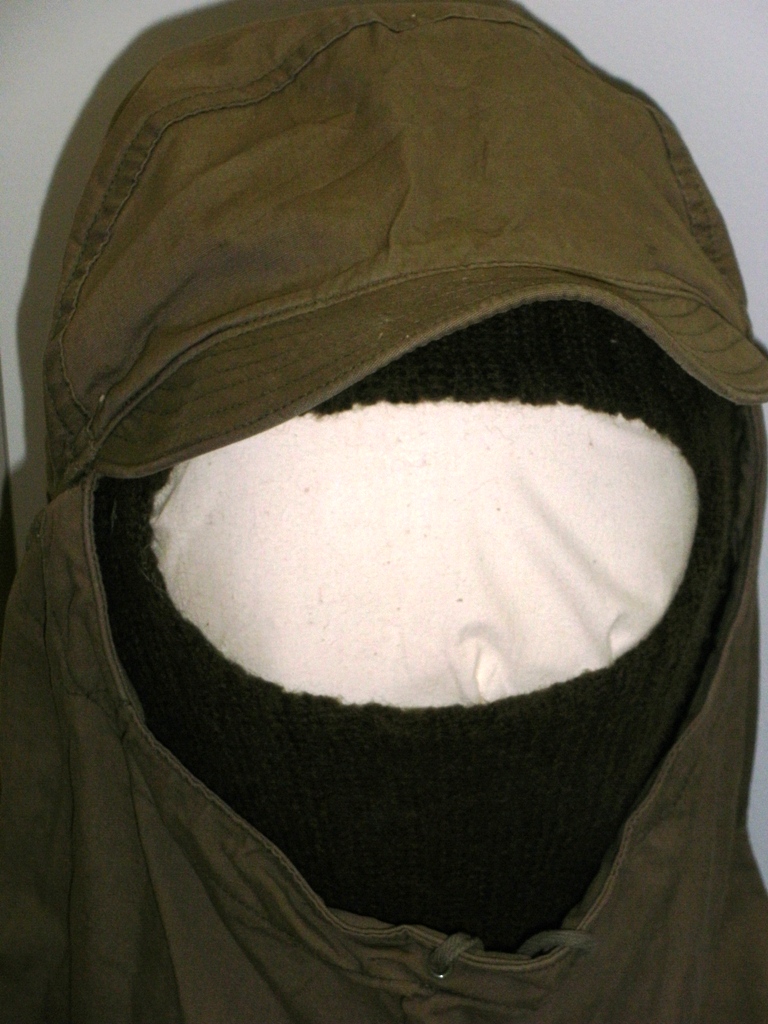 |
| 426713 |
Towel, Medical, Cotton, Blue Gray, US, Late-20th Century |
Blue Gray cotton towel. |
31" x 17" |
3.8 oz |
 |
| 428163 |
Training Aid, Round, Artillery, Cut-away, Iraqi Army, Metal, Gray, 57mm, Iraqi, Circa 1985, Persian Gulf War (Desert Storm) |
Cut-away 57mm anti-aircraft gun cartridge training aid. Plaster and metal fillers painted to represent charges and functions of the parts. Grey projectile. Paint on interior surfaces chipped and 10% missing.Lot & mfg numbers on the side of the projectile in blue "A-1X-2" and "OP-281Y". In black on the side of the casing "OP-218Y, 57-C60 NHEPT" and "1-81-1". |
5.4 cm x 9.5 cm dia |
10lbs 6oz |
 |
| 567126 |
Tray, Impression, Dental, Metal, Brass, US, Mid-20th Century |
Tray is shaped like the outline of a mouth with holes all through it. Has a handle on the curved end. Handle has a hole in it, with maker's name, "USA" and "XL9". |
3.75" x 3.25" |
2oz |
 |
| 426867 |
Trophy, Athletic, Army 10 Mile Run, US Army, Glass, Clear, US, Late-20th Century |
Glass Vase Trophy |
8" X 5" |
|
 |
| 426398 |
Trophy, Athletic, Basketball, Fort Wadsworth, US Army, Metal, Silver, US, 1928, Early-20th Century |
|
|
|
 |
| 426402 |
Trophy, Athletic, Bowling, K Company, US Army, Metal, Silver, US, Circa 1930, Early-20th Century |
|
|
|
 |
| 426392 |
Trophy, Athletic, Bowling, Metal, Silver, US, 1930, Early-20th Century |
|
|
|
 |
| 426390 |
Trophy, Athletic, Volkswanderung, 3rd International, Metal/Wood, Shiny, US, Late-20th Century |
|
|
|
 |
| 468149 |
Trophy, Athletic, Wrestling, US Army, Brass/Wood, Green, US, 1947, Mid-20th Century |
A hollow brass casting depicting 2 men wrestling, one has the other over his right shoulder. The figure is standing against a wall type background, his feet on a ledge protruding from the well. On the top fron of the wall "CHAMPIONS" on the front of ledge. "EUROPEAN THEATRE" on right side and "1947". Casting has a wood backing attached by 4 screws. There is a green coating over the entire casting. |
14 x 19 1/2" |
40 lb 2 oz |
 |
| 426394 |
Trophy, Cup, Guardsman's, Metal, Silver, US, Mid-20th Century |
|
|
|
 |
| 426393 |
Trophy, Cup, War Correspondent's, Metal, Silver, US, Mid-20th Century |
|
|
|
 |
| 426866 |
Trophy, Ducks Unlimited, Civilian, Wood/Composite, Multicolor, US, Late-20th Century |
|
|
|
 |
| 426401 |
Trophy, Marksmanship, 1st Place, US Army, Metal, Shiny, US, Late-20th Century |
|
|
|
 |
| 468098 |
Trophy, Marksmanship, Light Machine Gun, Regimental Tournament, US Army, Wood/Brass, Brown/Dull, US, 1948, Mid-20th Century |
A 3-pointed varnished wooden shield with a like shaped 2mm thick brass plate fastened with four small brass buttons. Words engraved are "Light Machine Gun trophy presented to Company E winners of Regimental Tournament held in Grafenwohr Germany July 1948". Finger marks on brass. |
9.25" x 7.5" x .5" |
1 lb 2 oz |
 |
| 426391 |
Trophy, Marksmanship, Small-bore, 8th Infantry Division, US Army, Metal, Shiny, US, Mid-20th Century |
|
|
|
 |
| 468104 |
Trophy, Presentation, 5th Field Artillery, 1st Division Artillery, US Army, Metal, Multicolor, US, Circa 1958, Mid-20th Century |
A trophy consisting of the shipping cap of a 762mm rocket with a 3/16" handle welded around the top and a 3 3/32" x 4 1/2" copper plate sinched to the bottom with sword information. Affixed to the sides are 2 each DUI's from the 1st Div Artillery, 5th Field Artillery and the 1st Inf Div SSI. |
8 11/16" x 5 3/16" |
7 lb 12 oz |
 |
| 426395 |
Trophy, Rifle-practise, US Army, Metal, Silver, US, 1930, Early-20th Century |
|
|
|
 |
| 434099 |
Trousers, Battle Dress Uniform, Woodland Camouflage, US Army, Cotton Ripstop, Green/Brown/Black, US, Circa 1995, Late-20th Century |
Woodland camouflage pattern trousers with two slash hip pockets, two cargo pockets with button down flaps, and two rear pockets with button down flaps. Trousers have a button fly, a waistband with size adjustment tabs on each side, and belt loops all around. Size: Large - Long |
|
1.9 lbs |
 |
| 426457 |
Trousers, Battle Dress, British Army, Wool, Dark Khaki, 38/40 Regular, British, Circa 1943, World War II |
Coarse wool, dark khaki British Battle Dress trousers. 6-button fly. Waist slide buckle adjustments. 2 slash side pockets and 2 button back pockets. |
38" |
2.5 lbs |
 |
| 426751 |
Trousers, Camouflage, Man's, Russian Army, Cloth, Multicolor, Russian, Circa 1995, Late-20th Century |
|
|
1lb, 1 oz. |
 |
| 422717 |
Trousers, Combat, Desert Camouflage, US Army, Cotton/Nylon, Brown/Tan/Black, 35 x 30, US, Circa 1985, Late-20th Century |
Trousers, Desert Chip camouflage pattern trousers with two slash hip pockets, two cargo pockets with button down flaps, and two rear pockets with button down flaps. Trousers have a button fly, a waistband with size adjustment tabs on each side, and belt loops all around. |
|
1 LB 10 OZ |
 |
| 422704 |
Trousers, Combat, Desert Camouflage, US Army, Cotton/Nylon, Brown/Tan/Black, Medium/Short, US, Circa 1985, Late-20th Century |
Trousers, Chip Desert camouflage pattern trousers with two slash hip pockets, two cargo pockets with button down flaps, and two rear pockets with button down flaps. Trousers have a button fly, a waistband with size adjustment tabs on each side, and belt loops all around. |
|
1 LB 10 OZ |
 |
| 468064 |
Trousers, Combat, Desert Camouflage, US Army, Cotton/Nylon, Brown/Tan/Black, Small Regular, US, Circa 1990, Persian Gulf War (Desert Storm) |
A pair of trousers w/ 5-button fly, 6 pockets , 2 front, 2 rear (with 2 button flaps) and 2 cargo pockets w/ 2 button flap. There are draw strings on the legs and adjusting straps on the waist band. |
|
1 lb 8 oz |
 |
| 422729 |
Trousers, Combat, Desert Camouflage, US Army, Cotton/Nylon, Brown/Tan/Black, Small, US, Circa 1990, Late-20th Century |
Trousers, desert chips. Desert camo with two slash hip pockets, two cargo pockets with button down flaps, and two rear pockets with button down flaps. Trousers have a button fly, a waistband with size adjustment tabs on each side, and belt loops all around. |
|
1 lb 8.5oz |
 |
| 446146 |
Trousers, Combat, Tropical, Wind Resistant, Man's, US Army, Cotton Poplin, Olive Green, Medium/Regular, US, Circa 1968, Vietnam Era |
Tropical cotton poplin, olive green (shade 107) trousers with two slash hip pockets, two cargo pockets with button down flaps, and two rear pockets with button down flaps. Trousers have a button fly, and a waistband with size adjustment tabs on each side and belt loops all around. There is a draw string at the bottom of each leg. |
|
1.85 lbs |
 |
| 468093 |
Trousers, Combat, Tropical, Wind Resistant, Man's, US Army, Cotton Ripstop, Olive Green, Regular/Medium, US, Circa 1970, Vietnam Era |
A pair of standard pattern FSN 8405-935-3308 vietnamese era jungle fatigue trousers. Trousers are faded with scattered pin holes and black spots. There is a blue paint stain/imprint on the right hip. |
|
1 lb 10 oz |
 |
| 467971 |
Trousers, Combat, Tropical, Wind Resistant, Man's, US Army, Cotton Ripstop, Olive Green, Type 3, Medium Short, US, Circa 1967, Vietnam Era |
Standard 3rd pattern style jungle pants, all button complete. A cargo pocket on each leg. Stains on outside left leg. |
|
630 grams |
 |
| 426601 |
Trousers, Combat, Winter, US Army, Cotton/Wool, Olive Drab, US, Circa 1943, World War II |
Heavy olive drab cotton bib-overall style trousers with a blanket wool lining and a zipper fly. |
|
|
 |
| 468065 |
Trousers, Desert Camouflage, Night, US Army, Cotton/Nylon, Green/Gray, X-Small/Long, US, 1986, Persian Gulf War (Desert Storm) |
Standard pattern trousers, night camoflage desert, DLA 100-86-C-0527, FSN 8415-01-102-6287. Consisting of a pair of trousers with 2 hip pockets, velcro fly fastner and pocket flaps. Slits for front and cargo pockets, draw strings at legs and waist. Cross hatch dark and light olive green camouflage pattern. |
|
1 lb 5 oz |
 |
| 650146 |
Trousers, Dress, Acu, Enlisted, Man's, cotton, green-woodland/grey/sand brown, M-R, US, 2007, Early-21st Century |
ACU trousers |
|
2.0 lbs. |
 |
| 421644 |
Trousers, Dress, Cavalry, Enlisted, Man's, US Army, Wool, Blue, P1902, 38 x 29.5, US, Circa 1902, Early-20th Century |
Trousers, medium blue with 1.375" wide faded yellow stripe on each leg. |
|
2 LBS 2 OZ |
 |
| 421076 |
Trousers, Dress, Chaplain Corps, Enlisted, Man's, US Army, WOOL, Blue, P1902, 31 x 32, US, Circa 1920, Early-20th Century |
Trousers, EM's dark blue wool with a 1.25 black felt stripe on each leg, cotton waistband and pockets. |
|
2 lbs 2 oz |
 |
| 650132 |
Trousers, Dress, Dsu, Enlisted, Man's, cotton, tan/green/brown, M-L, Afghan, 2007, Early-21st Century |
DCU trousers |
|
2.0 lbs. |
 |
| 422659 |
Trousers, Dress, Enlisted, Man's, US Army, Wool, Blue, 41 x 33, US, Circa 1980, Late-20th Century |
Trousers, dress blu, 1.5" wide golden stripe on each leg, black cotton pockets and waistband. |
. |
15.5 oz |
 |
| 427180 |
Trousers, Dress, Officer's, Man's, US Army, Cotton, White, P1907, W32 x L30, US, Circa 1909, Early-20th Century |
A pair of officers dress white uniform trousers. They are slightly discolored. No rips/tears. All fasteners intact. |
|
1 lb |
 |
| 602440 |
Trousers, Dress, White, Enlisted, Man's, US Army, Cotton/Nylon, White, US, Circa 1970, Vietnam Era |
A pair of white colored dress trousers. No markings noted. |
41.50 In L |
1 Lb-5 Oz |
 |
| 421621 |
Trousers, Fatigue, Man's, US Army, Cotton HBT, Olive Drab, 28 x 32, US, Circa 1945, World War II |
Trousers, HBT. Button fly, belt loops at waistband, and two large button-down flapped thigh pockets. |
|
1 LB 6 OZ |
 |
| 421622 |
Trousers, Fatigue, Man's, US Army, Cotton HBT, Olive Drab, 30 x 32, US, Circa 1945, World War II |
Olive drab herringbone twill cotton trousers with button fly, belt loops at waistband, and two large button-down flapped thigh pockets. |
|
1 LB 2 OZ |
 |
| 470764 |
Trousers, Fatigue, Man's, US Army, Cotton HBT, olive drab, 32 x 31, US, Circa 1945, World War II |
Trousers, HBT |
|
1 lb 5 oz |
 |
| 425954 |
Trousers, Fatigue, Man's, US Army, Cotton HBT, Olive Drab, W32 x L32, US, Circa 1943, World War II |
A pair of HBT fatigue trousers with cargo pockets. Several white paint spatters, some rust on several buttons and black stains on lower left leg. |
14.5" x 42" |
1 lb 6 oz |
 |
| 426386 |
Trousers, Fatigue, US Army, Cotton HBT, Olive Drab, W32/L33, US, Circa 1943, World War II |
Olive drab herringbone twill cotton trousers with button fly, belt loops at waistband, and two large button-down flapped thigh pockets. |
|
|
 |
| 376113 |
Trousers, Field, Belgian Army, Wool, Olive Drab, WAIST 32/LENGTH 32, Belgian, Circa 1950, Mid-20th Century |
Zipper. |
|
.738 kg |
 |
| 376304 |
Trousers, Field, Camouflage, Czechoslovakian Army, Cotton/Nylon, Yellow/Green/Black, 36R, Czechoslovakian, Circa 1961, Mid-20th Century |
Two pockets 5-button fly belt loops. |
|
0.781 kg |
 |
| 377049 |
Trousers, Field, Camouflage, East German Army, Cotton/Polyester, Brown/Olive Green, East German, Circa 1980, Late-20th Century |
Field trousers with gray, pebble finish buttons and a "running raindrop" camoflage design. |
|
|
 |
| 377063 |
Trousers, Field, Camouflage, Estonian Army, Cotton, Green/Black, 182-100, Estonian, Circa 1997, Late-20th Century |
Field pants with two side and two cargo pockets. Has belt loops and adjustable pull tabs at the waist. Seat and knees are reinforced and cuffs have elastic straps for securing under the heels to hold pants legs in the boots. |
21.5" x 46" |
1 lb 10 oz |
 |
| 377078 |
Trousers, Field, Camouflage, Finnish Army, Cotton/Polyester, Green/Brown, 752, Finnish, Circa 1997, Late-20th Century |
Field trousers with two side and two cargo pockets, belt loops, elastic cuffs and zipper fly. |
23.25"w x 46"l |
1 lb 8 oz |
 |
| 376921 |
Trousers, Field, Camouflage, Iraqi Army, Cotton/Polyester, Green/Tan/Brown/Black, Iraqi, 1983, Persian Gulf War (Desert Storm) |
a green, tan, brown, and black camouflage trouser with lining, zipperd fly with 5 buttons. Five large belt loops with button holes. There is an elastic cord at each pant leg end. Six pockets, one button missing. |
|
1 Ib 11 oz |
 |
| 376925 |
Trousers, Field, Camouflage, Iraqi Army, Cotton/Polyester, Tan/Brown, 44S, Kuwaiti, Circa 1985, Persian Gulf War (Desert Storm) |
A camouflage (Three shades of sand) pair of field pants with a zippered fly and 5 pockets. Elastic draw string at each leg end. |
|
|
 |
| 377083 |
Trousers, Field, Camouflage, Parachutist's, Polish Army, Cotton, Green/Brown/Black, 78-163, Polish, Circa 1997, Late-20th Century |
Trousers with belt loops, removable suspenders, reiforced seat, two side pockets and two cargo pockets attached to the front of the thighs. Right leg has a pocket for a knife with a tab to hold the knife in place. Cuffs are fitted with elastic bands to keep pant legs tucked in boots. |
21.5" x 40.75" |
1 lb 12 oz |
 |
| 377053 |
Trousers, Field, Camouflage, Polish Army, Cotton, Gray-Green/Green, Polish, Circa 1980, Late-20th Century |
Field trousers in Polish camoflage pattern which has a squiggly effect. |
|
|
 |
| 513628 |
Trousers, Field, Camouflage, Russian Army, Cotton, Green/Light Green/Brown, Russian, Circa 1990, Late-20th Century |
A pair of woodland pattern camouflage trousers having two 18cm x 22cm expanding cargo pockets (one on each leg, left one divided in two), watch pocket on right, no hip pockets, draw strings and foot straps on legs, and a five button fly. Sewn in pleat on legs and knees, backside and crotch re-inforced. |
|
|
 |
| 377114 |
Trousers, Field, Camouflage, Russian Army, Cotton/Polyester, Green/Brown, 52-3, Russian, Circa 1995, Late-20th Century |
Field trousers with belt loops, waist adjustment tabs, button fly, watch pocket, two side pockets, two cargo pockets, and reinforced seat and knees. Cuffs have blousing ties sewn in. |
22"w x 43.25"l |
1 lb 5 oz |
 |
| 377126 |
Trousers, Field, Camouflage, Russian Army, Cotton/Polyester, Green/Brown, 56-6, Russian, Circa 1995, Late-20th Century |
Field trousers with two side and two cargo pockets, belt loops and adjusting waist tabs, reinforced knees and seat, and blousing tapes in the cuffs. A four button fly closes at the waist with a hook and eyelet. The trousers were recieved with holes in the rear panels, but many of the buttons were melted when taken to the American cleaners for laundering. |
22.5" w x 46 'l |
1 lb 9 oz |
 |
| 377104 |
Trousers, Field, Camouflage, Slovenian Army, Cotton/Polyester, Tan/Olive/Brown/Black, 48, Slovenian, 1996, Late-20th Century |
Field trousers with belt loops,waist adjustment tabs, two side and cargo pockets, and one right hip pocket. Reinforced seat and knees and blousing strings at the cuffs. Fly has a button closure. Original paper manufacturer's label is attached to the nylon label with a plastic fastener. |
26"w x 43.25"l |
1 lb 12 oz |
 |
| 377068 |
Trousers, Field, Camouflage, Swedish Army, Cotton/Polyester, Green/Black, 180-85, Swedish, Circa 1995, Late-20th Century |
Field trousers with belt loops two side pockets and two cargo pockets. Cargo pockets close with zippers. Reinforced knees. Cuffs are protected with water resistant nylon and close on sides with zippers. |
24" x 44" |
2 lb 2 oz |
 |
| 377040 |
Trousers, Field, Desert Camouflage, Egyptian Army, Cotton, Tan/Olive/Brown, Egyptian, Circa 1990, Persian Gulf War (Desert Storm) |
Trousers patterned after the fatigue pants of the US Army of the 1960's and 70's printed in desert camoflage pattern. |
|
|
 |
| 377046 |
Trousers, Field, Desert Camouflage, France, Cotton, Tan/Brown/Gray, French, Circa 1990, Persian Gulf War (Desert Storm) |
Cotton field trousers in desert camoflage pattern. |
|
|
 |
| 858245 |
Trousers, Field, Enlisted, Man's, Wool Serge, OD, 38" x 31", US, World War II |
OD wood serge field trousers with 4-button fly. Small "L" shaped tear/mend below left back pocket. |
|
|
 |
| 426439 |
Trousers, Field, Iraqi Army, Cloth, Olive Green, Iraqi, Circa 1985, Persian Gulf War (Desert Storm) |
Dark green field pants with cargo pockets along the sides of each leg. 4-button fly. |
|
|
 |
| 376795 |
Trousers, Field, Iraqi Army, Cotton/Polyester, Olive Green, Iraqi, Circa 1985, Persian Gulf War (Desert Storm) |
Olive green trousers with two pockets and three buttoned straps around belt loop area. Has green zipper and metal clasp for closing trousers. Small pocket flap on inside of trousers near zipper. |
|
1/2 lb |
 |
| 376923 |
Trousers, Field, Iraqi Army, Cotton/Polyester, Tan, Medium, Iraqi, Circa 1985, Persian Gulf War (Desert Storm) |
Tan field pants with 3 button fly , 3 pockets, deep loops green fabric ribbon draw strings at bottoms. |
|
1 Ib 6 oz |
 |
| 377120 |
Trousers, Field, Lightweight, Camouflage, Russian Army, Cotton, Green/Brown, 182-188, 96-100, Russian, Circa 1997, Late-20th Century |
Field pants with belt loops, cargo pockets and reinforced knees. The cuffs have white elastic bands to hold the legs in the boots. There is a four button fly and a white nylon maker's label at the rear seam with the size stamped on it. |
21.25"w x 45.25"l |
8 oz |
 |
| 377043 |
Trousers, Field, Lightweight, Desert Dpm, British Army, Cotton, Tan/Brown, British, Circa 1990, Persian Gulf War (Desert Storm) |
Trousers with two large cargo pockets on each leg. Printed inn desert DPM camoflage. |
|
|
 |
| 427150 |
Trousers, Field, Man's, US Army, Cotton HBT, Olive Drab, P1943, W36 x L32, US, 1944, World War II |
A pair of herringbone field pants w/ith black metal buttons. |
|
1 lb 10 oz |
 |
| 423820 |
Trousers, Field, Man's, US Army, Wool, OLIVE DRAB, 32 x 29, US, Circa 1945, World War II |
EM trousers button fly, belt loops, inside buttons. |
tbd |
2.4 lbs |
 |
| 375375 |
Trousers, Field, North Vietnamese Army, Cotton, Olive Green, Small, North Vietnamese, Circa 1965, Vietnam Era |
Cuffless trousers w/loop and button gathers at ankles; 5 belt loops button fly; pleats below waistband in front, 2 side pockets; one back pocket w/loop and button. |
|
8 oz |
 |
| 844282 |
Trousers, Field, Wool, OD Green, RegularX-Small, US, Mid-20th Century |
Wool serge trousers with 4-button fly, small watch pocket in front, 2-side pockets, and 2-button down rear pockets. Along the waist is slide adjustment. |
|
|
 |
| 434079 |
Trousers, Food-handler's, Man's, US Army, Cotton, White, US, Circa 1995, Late-20th Century |
Men's white trousers. |
|
|
 |
| 434080 |
Trousers, Food-handler's, Man's, US Army, Cotton, White, US, Circa 1995, Late-20th Century |
Men's White Trousers, stained. |
|
|
 |
| 377110 |
Trousers, Helicopter Pilot's, Camouflage, Russian Army, Cotton/Polyester, Green/Brown, 52-5, Russian, Circa 1992, Late-20th Century |
Flight trousers with a button fly, two side and two cargo pockets. The trousers have supenders and belt loops, and the cargo pockets a sewn on the front and close with zippers. The right leg has a knife pocket. Manufacturer's stampings on the right inside pocket are almost entirely worn off now. |
41.5" x 25"w |
1 lb 6 oz |
 |
| 427708 |
Trousers, Man's, US Army, Cotton, Khaki, W30 x L36, US, Circa 1965, Vietnam Era |
A pair of civilian "Big Mac" khaki trousers used in lieu of the Army khaki. Almost identical to 1IDHH987 except for the slanted front pockets on this pair. Slit rear pockets with button on left pocket. Scratch on right leg, two small reddish spots on left leg. Zipper fly. |
|
1 lb 3 oz |
 |
| 427707 |
Trousers, Man's, US Army, Cotton, Khaki, W34 x L33, US, Circa 1965, Vietnam Era |
Standard pattern khaki uniform FSN 8405-183-8706. Slit type back pockets, left pocket has button. Zipper has been replaced. Starch stains on front. Minute rust spots on front. |
|
1 lb 6 oz |
 |
| 468138 |
Trousers, Pajama Style, Civilian, Viet Cong, Cotton, Black, South Vietnamese, Circa 1960, Vietnam Era |
A pair of plain black cotton trousers with white canvas pockets, five button fly. Button and loop on opposing sides on pant legs 3" up from the cuff. All buttons are blue in color. There are 5 1/2" wide belt loops. Unused condition. |
27" x 28" |
10 oz |
 |
| 422650 |
Trousers, Service, Durable Press, Enlisted, Man's, US Army, Wool/Polyester, ARMY GREEN, 38 L, US, Circa 1980, Late-20th Century |
Trousers, Grn EM. front and rear pockets, and belt loops. The trousers are somewhat worn. |
|
1 LB 4 OZ |
 |
| 434106 |
Trousers, Service, Enlisted, Man's, US Army, Cotton, Khaki, 30x29, US, Mid-20th Century |
Khaki service trousers. |
|
|
 |
| 434081 |
Trousers, Service, Enlisted, Man's, US Army, Cotton, Khaki, US, Mid-20th Century |
|
|
|
 |
| 434104 |
Trousers, Service, Enlisted, Man's, US Army, Cotton, Khaki, US, Mid-20th Century |
Service trousers - Khaki |
|
|
 |
| 194223 |
Trousers, Service, Enlisted, Man's, US Army, Wool Serge, Olive Drab, M1937, Medium, US, 1938, Mid-20th Century |
Olive Drab wool trousers with 5 button fly, white cotton lining and 4 slit pockets and a watch pocket. A 1/4 " moth hole on right hip. Some Skimming. |
34" x 28" |
1 lb 14 oz |
 |
| 489394 |
Trousers, Service, Enlisted, Man's, US Army, Wool Serge, Olive Drab, Medium, US, Circa 1938, Mid-20th Century |
Olive Drab wool trousers with a button fly. |
21" |
12 oz |
 |
| 427055 |
Trousers, Service, Enlisted, Man's, US Army, Wool Serge, Olive Drab, US, Circa 1943, World War II |
There are two hip pockets, two backside pockets and a watch pocket at the front of the right hip. There is a button fly, all pockets and lining are of white cotton duck. Underneath the right side pocket is a white label. Left rear pocket has a button down flap, right does not. |
32" x 37" |
2 lbs 4 oz |
 |
| 427059 |
Trousers, Service, Enlisted, Man's, US Army, Wool Serge, Olive Drab, W30 x L29, US, Circa 1941, World War II |
A pair of trousers having two hip pockets and a watch pocket around the front of the right hip. There is a five button fly. All pockets and linings are white cotton duck. Legs have been hemmed by hand with a lighter colored thread. Lower right leg has been scorched (by ironing with hot iron) about 5" above hem behind inside seam. There are four holes (repaired) at the seat. Hem coming out of trouser cuff. |
|
|
 |
| 427058 |
Trousers, Service, Enlisted, Man's, US Army, Wool Serge, Olive Drab, W32 x L31, US, 1941, World War II |
There are two hip pockets, two slash side pockets and a watch pocket at the front of the right hip. There is a button fly. All pockets and lining are of white duck. Right pocket is worn through. Trousers are well worn, pocket edges are starting to fray. |
|
1 lb 14 oz |
 |
| 468244 |
Trousers, Service, Enlisted, Man's, US Army, Wool, OD Light Shade, M1937, 33 x 31, US, Circa 1942, World War II |
Light Shade, wool service trousers. 5 button fly, brown plastic buttons. Top button 5/8" diam, the rest 1/2" diam. Four pockets. There are a couple of small moth holes. |
|
730 grams |
 |
| 468143 |
Trousers, Service, Enlisted, Man's, US Army, Wool, Olive Drab, US, Circa 1950, Mid-20th Century |
A pair of standard pattern stock number 55-T-35427 31 OD 33 dress trousers. A button fly, covered back pockets. Medium moth damage primarily in front. Lining and pockets of white cotton duck. |
27" x 31" |
1 lb 10 oz |
 |
| 470763 |
Trousers, Service, General Officer's, Man's, US Army, Wool, Army Green, 36 x 31, US, Circa 1980, Late-20th Century |
Trousers, grn with Gen Offcr two black stripes on each leg and tan cotton pockets. |
|
1 lb 11 oz |
 |
| 422977 |
Trousers, Service, Infantry, Enlisted, Man's, US Army, Wool, Blue, 30 x 27, US, Circa 1895, Late-19th Century |
Blue trousers with 1.5" white felt stripe on each outside leg, white cotton back pockets and waistband, button fly. |
|
1 LB 5.5OZ |
 |
| 422884 |
Trousers, Service, Officer's, US Army, Wool, Army Green, 32 x 28, US, Circa 1957, Mid-20th Century |
Trousers, Officer's green wool trousers with 1 5/8" black stripe on each side, cotton front pockets, rayon back pockets. |
|
1 LB 13 OZ |
 |
| 422810 |
Trousers, Service, Officer's, US Army, Wool, Dark Blue, P1894, 31 x 28, US, Circa 1894, Late-19th Century |
Trousers, Navy blue wool with four button fly, somewhat breeches style with seven (7) button closure on outside bottom of each leg; white pockets and bottom part of waistband. |
|
1 LB 12 OZ |
 |
| 470752 |
Trousers, Service, Officer's, US Army, Wool, dark olive drab, 34 x 31, US, Circa 1945, World War II |
Trousers, Officer's dark olive drab wool trousers with beige cotton twill pockets. |
|
1 lb 14 oz |
 |
| 470751 |
Trousers, Service, Officer's, US Army, Wool, Olive Drab, 34 x 31, US, Circa 1945, World War II |
Trousers, Officer's dark olive drab wool trousers with tan cotton twill pockets. |
|
1 lb 14 oz |
 |
| 650127 |
Trousers, Service, Olive Drab, Enlisted, Man's, Wool, Olive drab, 32R, US, World War II |
Olive drab wool trousers. Side slash pockets. Button waist, zippered , cuffless. |
44 in x 32 in |
2.0 lbs |
 |
| 421627 |
Trousers, Service, Special, Enlisted, Man's, US Army, Wool, Olive Drab, M1937 Spec, 31 x 34, US, Circa 1943, World War II |
A pair of wool OD service tousers with white linen interior lining, pockets, belt loops, and plastic buttons. |
|
2 lbs .5oz |
 |
| 421628 |
Trousers, Service, Special, Enlisted, Man's, US Army, Wool, Olive Drab, M1937 Spec, 32 x 26 1/2, US, Circa 1943, World War II |
Trousers, EM wool WW2. A pair of wool OD service tousers with white linen interior lining, pockets, belt loops, and plastic buttons. |
|
1lb 12.5oz |
 |
| 421629 |
Trousers, Service, Special, Enlisted, Man's, US Army, Wool, Olive Drab, M1937 Spec, 35 x 32, US, Circa 1944, World War II |
Trousers, WW2 Wool OD service with white linen interior lining, pockets, belt loops, and plastic buttons. |
|
2 LBS |
 |
| 470745 |
Trousers, Service, Tropical Weight, Officer's, US Army, Worsted Wool, Khaki, 30 x 30, US, Circa 1980, Late-20th Century |
Trousers, khaki. Officer's khaki wool gabardine trousers with beige cotton pockets. |
|
1 lb |
 |
| 426304 |
Trousers, Service, Tropical, Enlisted, Man's, US Army, Polyester/Wool, Army Green Shade 344, W35 x L34, US, Circa 1966, Late-20th Century |
Two stright pockets in front and two hip pockets. Slide fastener fly closure. Tan colored inner liner. |
|
1.5 lb |
 |
| 434102 |
Trousers, Utility, Man's, US Army, Cotton, Olive Green (Shade 107), US, Circa 1965, Mid-20th Century |
Olive green shade 107 cotton trousers with button fly, belt loops at waistband, and two front and two back hip patch pockets with button flaps. |
|
|
 |
| 376306 |
Trousers, Wet Weather, Camouflage, British Army, Nylon, Brown/Green/Tan, 86/110, British, Circa 1979, Late-20th Century |
Oversized pants with a drawsring at the waist and at both pants legs. |
|
0.560 kg |
 |
| 421832 |
Trousers, Winter, US Army, WOOL, Olive Drab, 36, US, Circa 1912, Early-20th Century |
Breeches, drab woolen |
|
8 OZ |
 |
| 425801 |
Trumpet, US Army, Brass, Bright, US, Circa 1950, Mid-20th Century |
Ludwig brand single valve brass trumpet. Completely intact with two spit valve openings, only movable spring valve, and mouthpiece. There are several small dents, most likely from usage through the years, that would not interfere with sound quality. |
24.5 in |
1300 gram |
 |
| 818040 |
Trunk, Army, US Army, Wood/Metal, Green, US, 1902, Early-20th Century |
A military trunk with a cut edge hinged lid. There are two hinges on the lid to use with padlocks. There are two metal strips running around the length of the lid and one around the length of the bottom of the trunk. The trunk has chipped green paint and two soiled cloths tacked to the inside front and back of the trunk. Paint is blistering on some areas. There are two leather handles attached to each side. Stencil lettering on the inside, right hand side which reads, Pening April 26 - TH. 1902, J.M.M. Sellers Inspector, Geo-Deark, Pack. |
42"L x 22"w x 18.13d |
|
 |
| 842740 |
Tube (Set), Sump, US Army, Plastic/Paper, White/Blue, 18 French, US, Global War on Terrorism |
(4) sump tubes, individually packaged. |
6.25" x 12.75" x 0.75" |
|
 |
| 421940 |
Tube, Cathode Ray, US Army, Glass/Plastic/Metal, Multicolored, US, Circa 1965, Mid-20th Century |
A large cathode ray tube, with a large tapered end. The rear--or attachment section--of the tube has seveal wire prongs. There are numerous wires visible inside the tube. |
9.25" x 1.5" x 3" |
10.5 oz |
 |
| 854872 |
Type EE-3-B, US Army, wood/steel, brn, EE-3-B, US, Circa 1918, World War I |
Telephone, Field EE-3-B WW1. Wood box. |
10" x 5" x 9" |
|
 |
| 854873 |
Type EE-3-B, US Army, wood/steel, brn, EE-3-B, US, Circa 1918, World War I |
Telephone, Field EE-3-B WW1. Wood box. Missing handset. |
10" x 5" x 9" |
|
 |
| 656000 |
Umbrella, Parasol, Ladies, Civilian, Woman's, Wood/Brass/Silk, Purple, US, Circa 1900, Early-20th Century |
Lavender parasol with blue tassel and L-shaped bamboo handle. |
3' Long |
1 lb. |
 |
| 421656 |
Underdrawers, Long, Man's, US Army, Wool/Cotton, Olive Drab, 28/30, US, Circa 1943, World War II |
A pair of wool knit long underdrawers with button front and elastic waist and leg cuffs. |
|
9 oz |
 |
| 421397 |
Underdrawers, Long, Man's, US Army, Wool/Cotton, Olive Drab, 32, US, 1945, World War II |
Underdrawers, grn. Button fly. back drawstring back. |
|
12.5 oz |
 |
| 858170 |
Undershirt (Set), Crew Neck, Quarter-Sleeve, Cotton, Brown, Large, US, Late-20th Century |
Sealed in original clear package 2 brown shirts. |
|
|
 |
| 858171 |
Undershirt (Set), Crew Neck, Quarter-Sleeve, Cotton, Brown, Medium, US, Late-20th Century |
Sealed in original clear package 2 brown T-shirts. |
|
|
 |
| 426748 |
Undershirt, Camouflage, Russian Army, Cloth, Multicolor, Russian, Circa 1995, Late-20th Century |
|
|
5.8 oz |
 |
| 421398 |
Undershirt, Cold Weather, Man's, US Army, Wool/Cotton, White, Small, US, Circa 1945, World War II |
Undershirt, winter. Long sleeve knit with elastic at the waist and cuffs, and a button neck. |
|
12 OZ |
 |
| 421400 |
Undershirt, Sleeveless, Man's, US Army, COTTON, Olive Drab, 34, US, Circa 1945, World War II |
Undershirt |
|
3 OZ |
 |
| 421657 |
Undershirt, Sleeveless, Man's, US Army, COTTON, Olive Drab, Small/Medium, US, Circa 1943, World War II |
Underwear, WW2 |
|
|
 |
| 421399 |
Undershirt, V-neck, Quarter-sleeve, Man's, US Army, Cotton/Wool, Olive Drab, Medium, US, Circa 1945, World War II |
Undershirt, Long Sleeve - drab. cotton/wool |
|
5.5 oz |
 |
| 426633 |
Vase, Polished, Swiss, Pewter, Polished Silver, Swiss, Late-20th Century |
Polished pewter vase. |
8.5" x 4/75" |
1lb 5 oz |
 |
| 842656 |
Ventilator, Portable, US Army, Plastic/Metal/Nylon, Multicolor, 754/754M, US, 1998, Global War on Terrorism, SN: 0007040 |
Portable Ventilator (A), Universal AC Power Supply (B), DC Power Cable (C), Velcro Straps (D), Padded Case (E), Instruction Manual (F), Work Order (G), Instructional Video (VHS) (H), Training Video (CD) (I), Calibration Software (CD) (J), and Medical Supply Case (K). PORTABLE VENTILATOR, gray, hinged plastic cover (covered with sheet of white adhesive paper), carry handle, LCD screen at front. UNIVERSAL AC POWER SUPPLY, gray, several cords/cables attached. DC POWER CABLE, black, silver metal cable plug at one end, black auto connector at other end. VELCRO STRAPS (2), black, sealed in clear plastic package. PADDED CASE (for ventilator), black, nylon, zipper front, velcro closure, clear plastic window at front, reflective tape sewn at sides, "IMPACT" embroidered in red/white at left front. INSTRUCTION MANUAL, bound in clear-front report cover (black) having three metal fasteners. WORK ORDER, black/white, nine sheets of paper stapled together at upper left corner (last sheet detached). INSTRUCTIONAL VIDEO (VHS), black, a video cassette in a black cardboard box with window at front, white adhesive labels affixed to cassette. TRAINING VIDEO (CD), a compact disc in a white paper sleeve with clear plastic window at front. On the face of the compact disc, a photograph of the front panel of the ventilator. CALIBRATION SOFTWARE (CD), white, a compact disc in a white paper sleeve with clear plastic window at front. MEDICAL SUPPLY CASE, olive drab, plastic, stackable design, hinged lid, stainless steel hardware, gray foam padding, pressure relief valve at front. The case is labeled "ICU" at front. |
18.5" x 24.5" x 15.5" |
|
 |
| 842655 |
Ventilator, Portable, US Army, Plastic/Metal/Nylon, Multicolor, US, 2002, Global War on Terrorism, SN: 0403248 |
Portable Ventilator (A), Universal AC Power Supply (B), DC Power Cable (C), Velcro Straps (D), Padded Case (E), Instruction Manual (F), Work Order (G), Instructional Video (VHS) (H), Training Video (CD) (I), Calibration Software (CD) (J), and Medical Supply Case (K). PORTABLE VENTILATOR, gray, hinged plastic cover, carry handle, LCD screen at front. UNIVERSAL AC POWER SUPPLY, gray, several cords/cables attached. DC POWER CABLE, black, silver metal cable plug at one end, black auto connector at other end. VELCRO STRAPS (2), black, sealed in clear plastic package. PADDED CASE (for ventilator), black, nylon, zipper front, velcro closure, clear plastic window at front, "IMPACT" embroidered in red/white at left front. INSTRUCTION MANUAL, bound in clear-front report cover (black) having three metal fasteners. WORK ORDER, black/white, eight sheets of paper stapled together at upper left corner. INSTRUCTIONAL VIDEO (VHS), black, a video cassette in a black cardboard box with window at front, white adhesive labels affixed to cassette. TRAINING VIDEO (CD), silver, a compact disc in a white paper sleeve with clear plastic window at front. CALIBRATION SOFTWARE (CD), green, a compact disc in a white paper sleeve with clear plastic window at front. MEDICAL SUPPLY CASE, olive drab, plastic, stackable design, hinged lid, stainless steel hardware, gray foam padding, pressure relief valve at front. The case is labeled "ICU" at front. |
18.5" x 24.5" x 15.5" |
|
 |
| 421516 |
Vest, Civilian, Man's, Chamois, Cream, US, Circa 1860, Mid-19th Century |
Somewhat soiled chamois vest, top cream colored and underside is natural tan, each side 37 x 22cm, with five (5) pockets, have pocket flaps with six white glass buttons on each side, edges of vest and flaps bound with green twill tape, 2.5cm wide twill tape, 72cm long sewn to underarm section to cross across back and fasten to hooks at shoulders, 52cm long twill tape on left side of vest to go around waist and fasten at right side. |
|
4 oz |
 |
| 427179 |
Vest, Dress, Man's, US Army, Cotton, White, US, Circa 1925, Early-20th Century |
A white cotton vest, lightweight duck front, strap at small of back with 2 prong buckle. 3 Slanted pockets on front, 1 right, 2 left side, 4 sewn button holes. Yellow magic marker stain on right upper breast. |
19" x 5.75" |
8 oz |
 |
| 422711 |
Vest, Fragmentation Protective, Woodland Camouflage, US Army, Kevlar, Green/Brown/Black, Large, US, Circa 1985, Late-20th Century |
Flak Vest. Woodland camouflage kevlar protective vest with a velcro front closure, a collar, two front pockets, and seperate shoulders with snapped elastic straps. |
|
10 lbs |
 |
| 422723 |
Vest, Fragmentation Protective, Woodland Camouflage, US Army, Kevlar, Green/Brown/Black, Medium, US, Circa 1985, Late-20th Century |
Flak Vest. Woodland camouflage kevlar protective vest with a velcro front closure, a collar, two front pockets, and seperate shoulders with snapped elastic straps. |
|
8 lbs 4 oz |
 |
| 573329 |
Vest, Magazine, Seven-Pocket, North Vietnamese Army, Cotton Canvas, Olive Green, 7.62mm, North Vietnamese, Circa 1965, Vietnam Era |
A canvas vest with seven pockets for ammunition and or hand grenades. The pockets have flaps with tape and wood toggle closures. There are adjustable web shoulder straps and tie tapes to secure the vest around the waist. |
|
|
 |
| 573332 |
Vest, Magazine, Seven-Pocket, North Vietnamese Army, Cotton Canvas, Olive Green, 7.62mm, North Vietnamese, Circa 1965, Vietnam Era |
A canvas vest with seven pockets for ammunition and or hand grenades. The pockets have flaps with tape and wood toggle closures. There are adjustable web shoulder straps and tie tapes to secure the vest around the waist. |
|
|
 |
| 421959 |
Vest, Mess Dress, Officer's, US Army, COTTON, WHITE, Medium, US, Circa 1940, Mid-20th Century |
Vest, white c1940 |
|
8 oz |
 |
| 567574 |
Viewer, Dental Films, w/ 9 Reels, Plastic, Buff, US, Mid-20th Century |
View master set. Has the viewer and nine reels. The subject of the reels are dental; Prevention and restoration of cavitys. Made in conjusvctin with the Colgate tooth paste co. |
3.25" x 2.25" |
6oz |
 |
| 428124 |
Viewer, Stereographic, Civilian, US Army, Metal/Glass, Black, US, Circa 1917, Early-20th Century |
A black painted metal stereograph. Looks like a pair of binoculars with an adjustable slidiing photo fram in front. All but sliding apparatus and lens are black. Printed on front is "Keystone View Co, Meadville PA USA Patent Applied for 9153" |
6.63 in x 7.13 in x 3.5 in |
12 oz |
 |
| 567575 |
Viewer, X-Ray, Dental Film, United States, Metal/glass, Green/Bright, US, Mid-20th Century |
Half round in shape with stand on bottom, on/off switch on side. Front part is frosted glass, possibly used to view dental x-rays. has cloth covered wire. |
3.5" x 6.125" x 2" dia |
1lb |
 |
| 422042 |
Vise, Civilian, Wood/Iron, Brown, US, 1890, Late-19th Century |
Vice, brown iron vice with a stationary base with one half of the vice jaw, with the other half of the jaw able to move by a gear device with a bar-like lever. |
18.4" x 3.75" x 5.1 |
4 LBS |
 |
| 428035 |
Vision-device, Iraqi Army, Metal, Olive Drab/Black/Brown, TVNO-2B, Iraqi, Circa 1985, Persian Gulf War (Desert Storm), SN: 8208X5338 |
A standard pattern Russian Made TVNO-2B infa-red periscope with binocular eyepiece. This example has attached to it the linkage which is used to attach it to the vehicle when in use. Included in the kit is the vision device, a 10.125 in x 16 in x 7.635 olive drab wooden box, 2 each 7.75 in x 7.25 lens cloths, 2 each yellow lens, a small bag of silica gel and a black plastic container. |
6.25" x 8.19" x 11.5" |
18 lbs |
 |
| 428036 |
Vision-device, Iraqi Army, Rubber/Wood/Metal, Olive Drab/Black/Brown, TVNO-2B, Iraqi, Circa 1985, Persian Gulf War (Desert Storm), SN: 8408X8370 |
Standard pattern Russian made TVNO-2B infra-red periscope with binocular eye piece. This example has attached to it the linkage which attaches it to the vehicle when in use.Included in the kit is: the vision deveice, a 10.125 in x 16 in 7.875 in OD wooden storage box, 4 black rubber eye-piece protectors, a black plastic storage cylinder, 2 soft lens cloths, a package of 5 each 1 amp fuses and a black rubber washer. Box in poor condition (4 corner re-inforcements missing, 3 of 4 rubber bumpers missing.) |
6.5" x 8.75" x 11.88" |
18 Lbs |
 |
| 642821 |
Wall, Piece of, East German, Concrete, Neutral - Grey, East German, Circa 1962, Late-20th Century |
Concrete stone 6.5" circumference chiseled from the Berlin Wall. |
6.5" dia |
1.0 oz |
 |
| 426939 |
Watch, Wrist, Iraqi Air Force, Metal, Silver, Iraqi, Persian Gulf War (Desert Storm) |
Breitling Pilot's wrist watch. |
|
|
 |
| 426938 |
Watch, Wrist, US Army, Metal, Black/OD, US, Late-20th Century |
OD flat finish wrist watch with black nylon strap. |
|
|
 |
| 567558 |
Wax, Dental, Box, Wax/cardboard, Multicolored, US, Mid-20th Century |
Cardboard box with blue label "Dr. Peck's Improved Inlay Wax" Inside are wax rods of various sizes and colors. |
3.5" x 4.5" x .625" |
2oz |
 |
| 655994 |
Whip, Twitch, Wood/Rope, Tan/Biege, US, Circa 1900, Early-20th Century |
Twitch c1920 |
10.5" x 2.75" x 1.5" |
7.5 oz. |
 |
| 608706 |
Wreath, Commemorative, Civilian, US Army, Wicker, Multicolor, US, Circa 2005, Early-21st Century |
Wicker wreath made for PFC Nathan Brown, C Company 2-108 Infantry. The wreath is heart shaped and attached to it is a toy HMMWV, Tank and motorcycle. Also attached is plastic ivy and ribbon tied into a bow with a flag print. |
17" width |
|
 |
| 421875 |
Yoke, Oxen, Handmade, Native American, Civilian, Wood/iron, Dark Brown, US, Circa 1880, Late-19th Century |
Yoke. Hand made yoke with wooden "U"s for oxen necks, rough hewn wood with an iron ring on the bottom. |
52" x 22" x 7", 9" cir |
10 lbs |
 |